
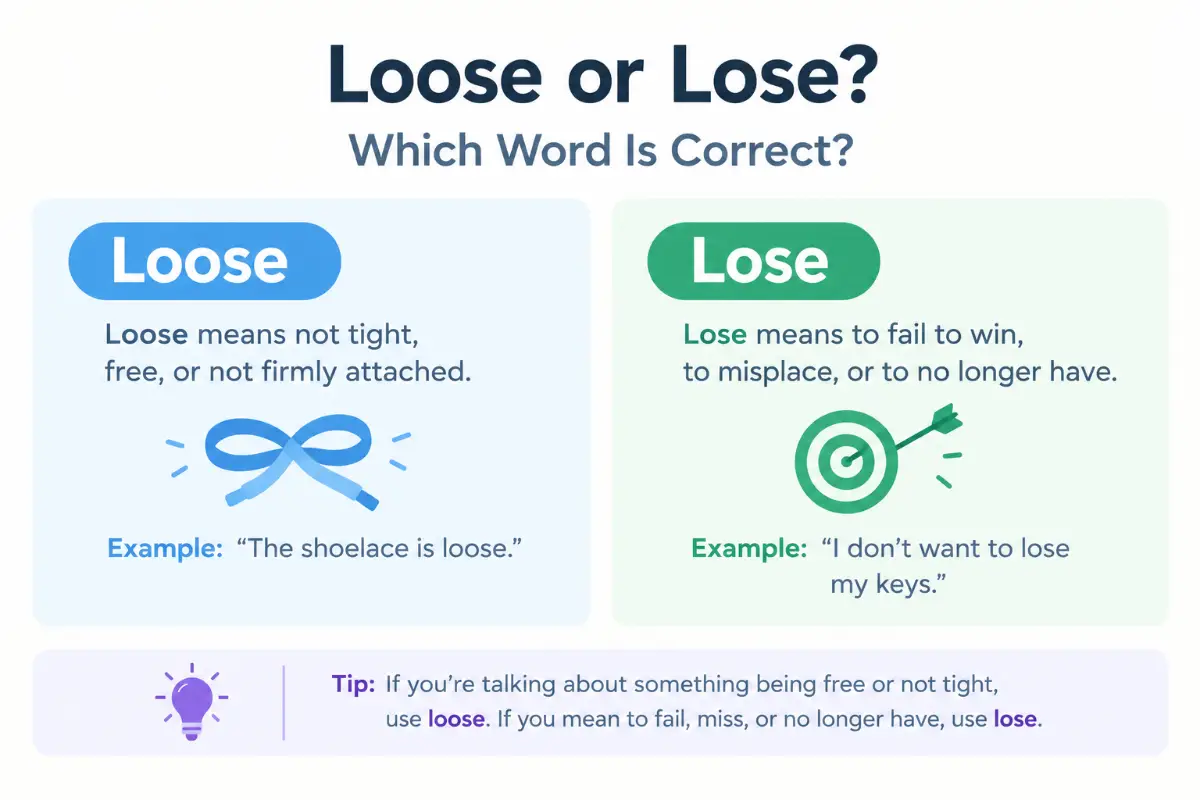
Loose or lose can confuse even people who speak English every day. The words share most of their letters and sound similar, but they serve different purposes in a sentence. Choosing the right one helps you communicate clearly in emails, school assignments, social media posts, business documents, and everyday conversations.
The simplest way to remember the difference is to connect loose with something that is not tight and lose with something that goes missing or slips away. A loose button might fall off your shirt. If you cannot find that button afterward, you lose it. This small distinction makes the correct spelling much easier to remember.
Both words are common in American English and British English. Their meanings stay consistent across these varieties of English, although pronunciation can vary slightly by accent. Once you understand their definitions, grammatical roles, and common sentence patterns, you can choose the right word without second guessing yourself.
Short Answer
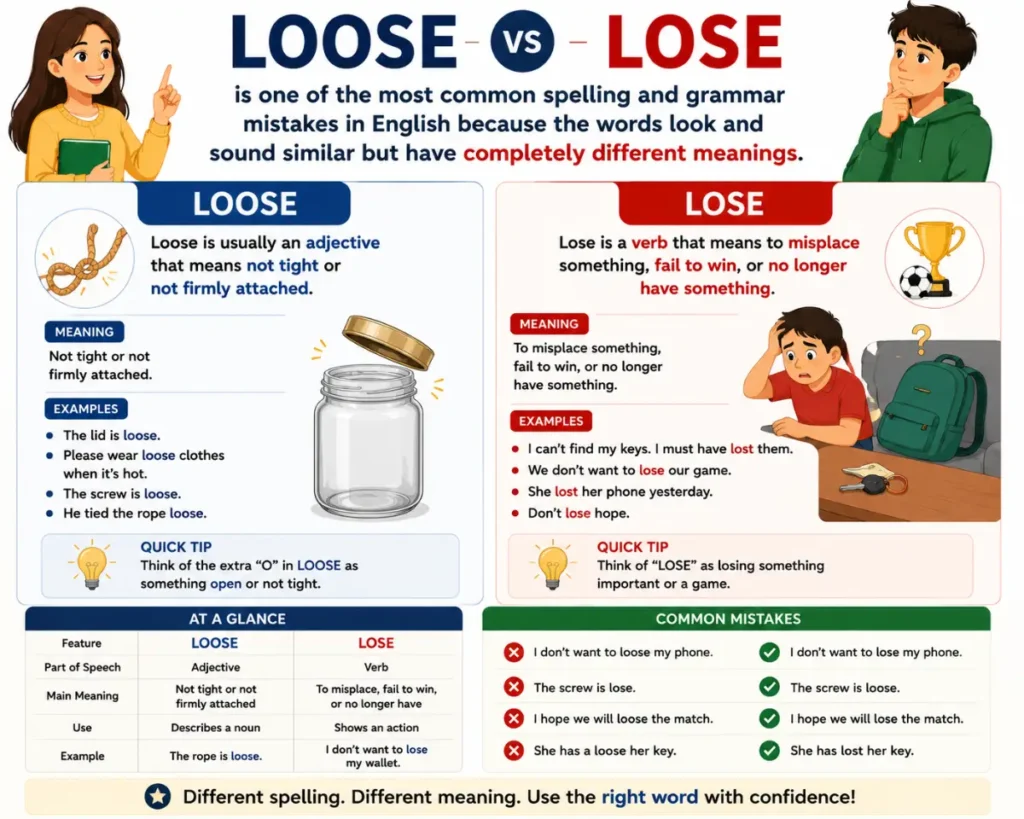
Loose or lose is a common word choice problem in English because the two words look similar but have different meanings. Loose means not tight, firmly attached, or securely held. Lose means to misplace something, fail to win, or no longer have something. For example, a loose shoelace can cause you to lose a race. Remember that loose describes a condition while lose describes an action or result.
Table of Contents
- The Difference Between Loose and Lose.
- What Loose Means.
- What Lose Means.
- Loose or Lose Comparison Table.
- How to Pronounce Loose and Lose.
- Grammar Rules and Sentence Patterns.
- Real Life Examples.
- Common Mistakes to Avoid.
- Easy Memory Tricks.
- Related Words and Expressions.
- American and British English Usage.
- Frequently Asked Questions.
- Key Takeaways.
- Conclusion.
The Difference Between Loose and Lose
The main difference comes down to meaning and grammar. Loose is usually an adjective that describes something that is not tight, firmly fixed, or closely controlled. Lose is a verb that describes misplacing something, failing to win, or experiencing a reduction or loss.
Consider these two sentences.
- My shoes feel loose after I changed the insoles. The word loose describes how the shoes fit.
- I might lose my shoes if I leave them outside the gym. The word lose describes the possibility of misplacing them.
The first sentence describes a condition. The second describes an action or outcome. That grammatical difference provides a reliable way to choose the correct spelling.
You can also use loose to describe rules that are not strict, a group that is not tightly organized, or clothing that fits comfortably without being tight. Lose appears in sentences about losing keys, losing money, losing weight, losing a competition, or losing confidence.
A useful rule is to check what the word does in your sentence. If it describes a noun, loose may be the right choice. If it expresses an action involving something you no longer have or a result you fail to achieve, lose is usually correct.
What Loose Means
Loose is an adjective that describes something that is free from tightness, secure attachment, close fitting, or strict control. It can refer to physical objects, clothing, relationships, rules, and even the way someone organizes information.
Loose Means Not Tight
The most familiar meaning of loose is not tight or firmly secured.
Examples include the following.
- The screw is loose. This means the screw is not firmly secured in place.
- My jacket has a loose fit. This means the jacket does not fit tightly against my body.
- A loose tooth moved when the child touched it. This means the tooth was not firmly fixed in place.
In each sentence, loose describes a condition rather than an action. The word tells you how something fits, feels, or stays attached.
Loose Can Mean Free or Unrestrained
Loose can also describe something that is not tied down, contained, or held in place.
Examples include the following.
- The dog got loose in the backyard. This means the dog escaped its restraint or was no longer confined.
- Keep your hair loose for the photo. This means you should leave your hair down rather than tie it up.
- The papers were loose inside the folder. This means the papers were not fastened together.
The exact meaning depends on context, but the central idea remains the same. Something is not tightly held or restricted.
Loose Can Describe Rules or Control
The word also applies to situations that lack strict limits or close supervision.
Examples include the following.
- The teacher has a loose policy on classroom seating. This means students have considerable freedom to choose their seats.
- The team follows a loose schedule on Fridays. This means the schedule allows flexibility.
- The report provides a loose estimate of the total cost. This means the estimate is approximate rather than exact.
These uses are common in professional writing and everyday speech. They show that loose can describe abstract ideas as well as physical objects.
Loose Can Describe Connections or Relationships
Loose sometimes describes a weak, informal, or indirect connection.
Examples include the following.
- The two stories have a loose connection. This means they are related in a general way but do not share a strong connection.
- The group formed a loose network of local volunteers. This means the volunteers work together without a strict organizational structure.
- The article offers a loose summary of the original report. This means the summary captures the general idea without following every detail closely.
In these sentences, loose suggests flexibility or a lack of strict structure.
Common Phrases With Loose
Several everyday expressions use loose.
| Expression | Meaning | Example |
|---|---|---|
| Loose change | Coins carried as money | I found some loose change in my pocket. |
| Loose ends | Unfinished details | We need to tie up a few loose ends before Friday. |
| Loose clothing | Clothing that does not fit tightly | She wore loose clothing on the hot day. |
| Let loose | Allow someone or something to act freely | The children let loose on the playground. |
| Play fast and loose | Act carelessly or without following accepted rules | The company played fast and loose with the facts. |
| Loose lips | Careless talking that reveals information | Loose lips can expose a private plan. |
These phrases have established meanings. Learning them helps you understand loose in natural conversations and recognize the adjective in context.
What Lose Means
Lose is a verb that describes the failure to keep, find, win, maintain, or achieve something. It often refers to a change from having something to no longer having it, but it also appears in expressions about competition, emotions, opportunities, and control.
Lose Means to Misplace Something
One of the most common meanings of lose is to misplace an object or become unable to find it.
Examples include the following.
- I always lose my keys. This means I often put my keys somewhere and cannot find them.
- Do not lose your receipt. This means you should keep the receipt somewhere safe.
- She lost her phone at the airport. This means she could no longer locate her phone and might not know where it went.
Notice that lose changes form to lost when you talk about the past. The base form is lose, the simple past is lost, and the past participle is also lost.
Lose Means to Fail to Win
Lose also describes an unsuccessful result in a game, contest, election, or competition.
Examples include the following.
- Our team could lose the final game. This means the team might not win.
- He lost the chess match. This means his opponent won the match.
- The candidate may lose the election. This means the candidate may receive an unsuccessful result.
In these examples, lose does not mean that someone misplaced an object. It describes the outcome of a contest.
Lose Means to Experience a Reduction
The verb can describe a decrease in quantity, value, weight, time, or money.
Examples include the following.
- The company could lose money this quarter. This means the company might experience a financial loss.
- I want to lose a few pounds. This means I want my body weight to decrease.
- We may lose an hour because of the delay. This means we may have less available time.
This use is especially common in business, fitness, travel, and everyday planning.
Lose Can Describe Emotions or Control
Lose also appears in phrases about mental states, behavior, and personal relationships.
Examples include the following.
- Try not to lose your temper. This means you should avoid becoming angry.
- She began to lose confidence after the setback. This means she started feeling less confident.
- He lost control of the car on the wet road. This means he could no longer steer the car effectively.
These phrases describe a change in someone’s ability to manage emotions, maintain confidence, or control a situation.
Lose Can Mean to Miss an Opportunity
Lose can also describe failing to keep or take advantage of something valuable.
Examples include the following.
- Do not lose this opportunity. This means you should not let the chance slip away.
- The business lost an important client. This means the client stopped working with the business.
- She lost interest in the project. This means she no longer felt interested in it.
In each example, something valuable or meaningful is no longer available or present.
Common Phrases With Lose
| Expression | Meaning | Example |
|---|---|---|
| Lose weight | Experience a reduction in body weight | He wants to lose weight gradually. |
| Lose track of time | Stop noticing how much time has passed | I lost track of time while reading. |
| Lose your temper | Become angry | She rarely loses her temper. |
| Lose your way | Become unable to find the correct route | We lost our way in the woods. |
| Lose touch | Stop communicating regularly | They lost touch after college. |
| Lose interest | Stop feeling interested | He lost interest in the class. |
| Lose sleep | Sleep less or worry enough to affect sleep | Do not lose sleep over a minor mistake. |
| Lose face | Suffer embarrassment or a loss of respect | He apologized to avoid losing face. |
These expressions are useful because they show how lose works with different nouns. The verb often describes a decline, failure, absence, or change in state.
Loose or Lose Comparison Table
The quickest way to choose the correct word is to compare its meaning, grammatical role, and use in a sentence.
| Feature | Loose | Lose |
|---|---|---|
| Part of speech | Usually an adjective | Verb |
| Main meaning | Not tight or firmly secured | Misplace something or fail to keep or win something |
| Pronunciation | Sounds like goose | Sounds like choose |
| Final sound | Unvoiced S sound | Voiced Z sound |
| Past tense | Does not apply to the adjective | Lost |
| Present participle | Not normally used as a verb | Losing |
| Common examples | Loose shirt, loose screw, loose rules | Lose keys, lose money, lose a game |
| Memory clue | Two Os suggest extra room | One O in lose reminds you of losing something |
The table highlights the main distinction. Loose describes a state or quality, while lose expresses an action or outcome.
One useful detail is that lose has an irregular past tense. You say I lose my keys today but I lost my keys yesterday. You do not say I loosed my keys when you mean you misplaced them.
How to Pronounce Both Words
The spelling difference becomes easier to remember when you pay attention to the final sound.
Loose rhymes with goose, moose, and noose. Its final sound is an unvoiced S sound, as in the word sun.
Lose rhymes with choose, shoes, and views. Its final sound is a voiced Z sound, as in the word zoo.
The two words also share the same long OO vowel sound in standard American English. The main difference is the final consonant sound.
| Word | Pronunciation guide | Rhymes with |
|---|---|---|
| Loose | Looss | Goose |
| Lose | Looz | Choose |
A Simple Pronunciation Exercise
Say these sentences aloud.
- My loose shoes make me lose my balance.
- The loose lid fell off, and I almost lost the contents.
- I do not want to lose my keys, so I keep them in a secure pocket.
Pay attention to the final sound of each word. Loose ends with a crisp S sound, while lose ends with a buzzing Z sound.
This distinction can help you remember the spelling when speaking and writing. However, pronunciation alone does not tell you which word belongs in every sentence. You still need to understand the meaning.
Grammar Rules and Sentence Patterns
Understanding the grammatical role of each word makes spelling decisions much easier. Loose usually describes a noun, while lose acts as a verb and changes form to match the tense and structure of a sentence.
Use Loose Before a Noun
When loose describes a person, place, thing, or idea, it usually functions as an adjective.
Examples.
- The loose cable hangs behind the desk. Loose describes the cable and tells you it is not secured.
- She prefers loose jeans. Loose describes the fit of the jeans.
- The manager gave the staff loose guidelines. Loose describes the flexible nature of the guidelines.
Loose can also follow a linking verb such as is, looks, feels, or seems.
Examples.
- The handle is loose. The adjective follows is and describes the handle.
- This shirt feels loose. The adjective follows feels and describes how the shirt fits.
- The connection seems loose. The adjective follows seems and describes the connection.
These patterns are useful because you can often spot loose by looking at the words around it.
Use Lose as an Action Verb
Lose usually takes an object when someone misplaces or fails to keep something.
Examples.
- I lose my wallet too often. Lose describes the action, and my wallet identifies what goes missing.
- They could lose the contract. Lose describes the possible outcome, and the contract is the object.
- You might lose your place in the book. Lose describes the action, and your place identifies what you may no longer be able to find.
Lose can also appear without a direct object when the context makes the meaning clear.
For example, the sentence Our team cannot afford to lose uses lose to mean fail to win. The object does not need to appear because the game or competition is already understood.
Learn the Verb Forms of Lose
The verb lose has several forms that appear in different sentence structures.
| Verb form | Correct spelling | Example |
|---|---|---|
| Base form | Lose | I do not want to lose. |
| Third person singular | Loses | She loses her patience sometimes. |
| Simple past | Lost | We lost the game yesterday. |
| Past participle | Lost | They have lost their tickets. |
| Present participle | Losing | He is losing interest. |
The past forms deserve special attention. Lost is the correct past tense and past participle of lose.
Examples.
- I lost my keys this morning. The simple past describes an event that happened earlier.
- She has lost her phone. The past participle appears with has to form the present perfect tense.
- We are losing time. The present participle appears with are to describe an ongoing situation.
Can Loose Be a Verb
Loose can function as a verb in some contexts, although this use is less common than the adjective. As a verb, it means to release, free, or let something go.
For example, the archer loosed an arrow. Here, loosed means released. Another example is the command Loose the dogs, which means release them.
This verb use does not replace lose. If you misplace your phone, you lose it. If you deliberately release an animal, you might loose it.
The past tense of this less common verb is loosed, while the past tense of lose is lost. Their meanings remain different.
Why Losing Is Correct but Loosing Has a Different Meaning
Losing is the present participle of lose. Loosing is the present participle of the less common verb loose.
Examples.
- I am losing my patience. This means my patience is decreasing.
- The hunter is loosing the dogs. This means the hunter is releasing the dogs.
Most everyday writing calls for losing when you mean something is slipping away or decreasing. Use loosing only when you genuinely mean releasing or setting something free.
How to Choose the Right Word in a Sentence
Use this three step check before you write.
- Identify the meaning. Decide if you are describing something that is not tight or talking about losing, misplacing, or failing to keep something.
- Check the grammar. If the word describes a noun or follows a linking verb, loose may fit. If the word expresses an action, lose may fit.
- Read the sentence aloud. Check the meaning and the final consonant sound to confirm your choice.
For example, in the sentence I do not want to lose my job, lose describes the possibility of no longer having the job. In the sentence My job has a loose schedule, loose describes a flexible schedule.
The context determines the correct spelling.
Real Life Examples
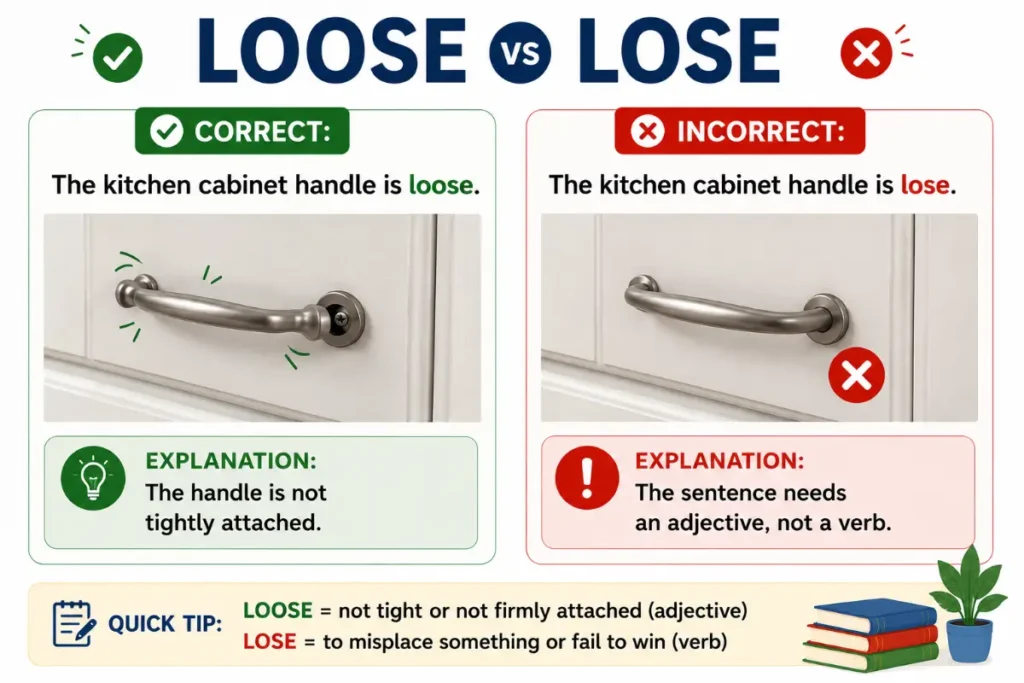
Examples from everyday life help you recognize the difference quickly. Each sentence below shows how the word works in a natural situation.
Everyday Conversations
- My shoelaces are loose. The word loose describes shoelaces that are not tied tightly.
- I always lose one glove during winter. Lose describes the repeated experience of misplacing a glove.
- Your backpack strap looks loose. Loose describes a strap that may need tightening.
- Do not lose the note I gave you. Lose means misplace the note or fail to keep it.
- These pants are too loose around the waist. Loose describes how the pants fit.
School and Education
- Students should not lose points for a minor formatting error. Lose describes the possibility of receiving a lower score.
- The teacher gave us loose instructions for the creative writing task. Loose means the instructions allow flexibility.
- I do not want to lose my place while reading. Lose means become unable to find the correct point in the text.
- The screw on my desk chair is loose. Loose describes a part that is not securely fastened.
- He lost his notebook before the exam. Lost is the past tense of lose.
Work and Business
- The company could lose several clients. Lose describes the possibility of losing customers.
- We need to fix the loose connection before the presentation. Loose describes a connection that is not secure.
- The team may lose valuable time if the meeting starts late. Lose describes the loss of available time.
- Our manager follows a loose schedule on Fridays. Loose means the schedule is flexible.
- She does not want to lose her professional reputation. Lose describes the risk of damaging or forfeiting something valuable.
Money and Shopping
- I do not want to lose my debit card. Lose means misplace the card.
- The lid on this bottle is loose. Loose describes a lid that is not firmly attached.
- You could lose money if you ignore the fees. Lose describes a financial loss.
- The bag has a loose handle. Loose describes a handle that is not securely attached.
- The store could lose sales because of its limited hours. Lose means fail to make sales that might otherwise happen.
Sports and Fitness
- Our team does not want to lose the championship. Lose means fail to win the competition.
- My running shoes feel loose. Loose describes an uncomfortable or insufficiently snug fit.
- He wants to lose weight before the race. Lose means reduce body weight.
- A loose shoelace can cause a runner to trip. Loose describes a lace that is not tied securely.
- We lost the match by two points. Lost is the past tense of lose.
Relationships and Emotions
- I do not want to lose touch with my old friends. Lose means stop maintaining regular contact.
- She felt loose and relaxed after the dance class. Here, loose describes a relaxed physical state, although relaxed would often sound more natural.
- He may lose confidence after repeated criticism. Lose describes a decline in confidence.
- Try not to lose your temper during the discussion. Lose means stop controlling your anger.
- Their friendship became a loose connection over time. Loose describes a relationship that is no longer close.
These examples show why context matters. The same word can appear in physical, emotional, financial, and professional situations, but its basic meaning stays consistent.
Common Mistakes to Avoid
Even experienced writers sometimes mix up these spellings. Most errors happen because the words look alike or because the writer focuses on sound instead of meaning.
Using Loose When You Mean Lose
Incorrect: I do not want to loose my job.
Correct: I do not want to lose my job.
Explanation: The sentence refers to the possibility of no longer having a job. Lose is the correct verb because the person wants to keep something valuable.
Using Lose When You Mean Loose
Incorrect: My shoelaces are lose.
Correct: My shoelaces are loose.
Explanation: The sentence describes the condition of the shoelaces. Loose is the correct adjective because the laces are not tied securely.
Writing Loosing Instead of Losing
Incorrect: I am loosing interest in the show.
Correct: I am losing interest in the show.
Explanation: Losing is the present participle of lose. It describes a gradual decrease in interest. Loosing means releasing something and does not fit this sentence.
Writing Lost When You Mean Loose
Incorrect: The handle is lost.
Correct: The handle is loose.
Explanation: If the handle is still attached but moves around, it is loose. If the handle has disappeared and you cannot find it, it is lost.
Confusing Loss With Lose
Loss and lose are related words, but they have different grammatical roles.
- I might lose my wallet. Lose is a verb that describes an action or possible outcome.
- The loss of my wallet caused a problem. Loss is a noun that names the event or result.
Remember that lose describes what happens, while loss names the event or result. The word lost describes a past event or a condition, depending on the sentence.
Using Looser and Loser Incorrectly
Looser is the comparative form of loose. It means less tight or less restrictive than something else.
Example: This shirt is looser than my old one. Looser compares the fit of two shirts.
Loser is a noun that can describe someone who loses a game or competition. It can also be an insult, so use it carefully.
Example: The loser of the final match received a silver medal. Loser identifies the person who did not win.
The extra letters change the meaning, so always check the entire word rather than just its first few letters.
Easy Memory Tricks
A good memory trick should help you recall the meaning quickly without making you memorize a complicated grammar rule.
Remember the Two Os in Loose
Loose has two Os. Think of the extra O as extra room around an object.
This trick connects the spelling with the idea of something that is not tight.
Connect Lose With Losing Something
Lose has one O. Connect the word with losing a game, losing your keys, or losing an opportunity.
For example, if you lose your keys, you can no longer find them. If your shoes are loose, they may not fit securely.
The two examples create a clear contrast that you can remember easily.
Use the Replace Test
Replace loose with not tight. If the sentence still makes sense, loose is probably correct.
Example: My belt is not tight. The sentence makes sense, so My belt is loose is correct.
Now replace lose with misplace or fail to keep. If that meaning fits, lose is likely correct.
Example: I might misplace my wallet. The sentence makes sense, so I might lose my wallet is correct.
This test works for many common sentences, although context still matters for figurative expressions.
Learn One Sentence That Uses Both Words
Memorize this sentence.
My loose shoelace caused me to lose the race.
Loose describes the shoelace because it was not tied securely. Lose describes the unsuccessful result of the race.
One sentence gives you both spellings and their meanings at the same time.
Use the Final Sound
Loose ends with an S sound, like goose. Lose ends with a Z sound, like choose.
Say the rhyming words aloud and notice the difference. The spelling and pronunciation together provide another clue.
Related Words and Expressions
Learning related words helps you avoid similar mistakes and improve your overall vocabulary.
Loose and Loosen
Loose is usually an adjective that describes something not tight. Loosen is a verb that means to make something less tight.
Examples.
- The knot is loose. Loose describes the knot.
- Please loosen the knot. Loosen describes the action of making the knot less tight.
The verb loosen commonly takes an object. You loosen a belt, a screw, a grip, or a restriction.
Lose and Loss
Lose is a verb, while loss is a noun.
Examples.
- The team may lose the game. Lose describes the possible result.
- The team suffered a loss. Loss names the result.
You can remember the distinction by looking at the sentence structure. After a subject such as I, she, or they, lose often expresses an action. After an article such as a or the, loss often functions as a noun.
Lose and Lost
Lost is the simple past and past participle of lose.
Examples.
- I lose my keys often. Lose describes a recurring situation.
- I lost my keys yesterday. Lost describes a completed past event.
- I have lost my keys. Lost works with have to form the present perfect tense.
Do not write losed. English uses lost as the correct past form.
Loose and Loosely
Loosely is an adverb that describes how someone performs an action or how something is arranged.
Examples.
- The rope was loosely tied. Loosely describes how the rope was tied.
- The report is loosely based on real events. Loosely means the report uses the events as a general basis rather than following every detail.
Loose describes a condition, while loosely modifies a verb, adjective, or another adverb.
Lose and Misplace
Misplace means to put something somewhere and then forget where it is. Lose has a wider range of meanings.
For example, I misplaced my glasses means I cannot remember where I put them. I lost the competition means I failed to win. You cannot replace lose with misplace in every sentence.
Loose and Free
Loose can mean free from restraint, but the two words are not always interchangeable.
For example, the dog got loose means the dog escaped its restraint. The dog is free can describe the same situation, but it may also mean the dog has no restrictions more generally.
The best choice depends on the specific meaning you want to express.
American and British English Usage
American and British English use loose and lose with the same core meanings and spellings. You do not need to change either word when writing for readers in the United States or the United Kingdom.
Both varieties use loose for something that is not tight and lose for the act of misplacing something or failing to win.
The pronunciation also follows the same basic distinction. Loose ends with an unvoiced S sound, while lose ends with a voiced Z sound. Individual accents can affect vowel quality and rhythm, but the final consonant distinction remains a useful guide.
The words also appear in the same common expressions. American and British writers both use phrases such as loose change, loose ends, lose weight, lose touch, and lose your temper.
For US readers, the best approach is simple. Choose the spelling based on meaning rather than regional preference.
Expert Editor Insight
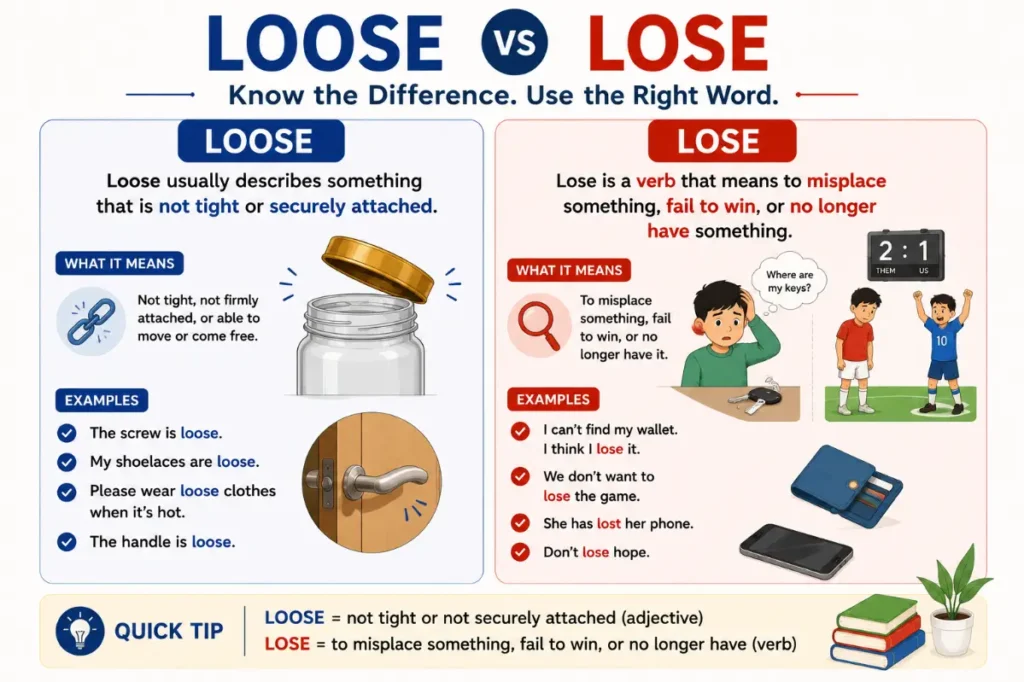
As an editor I’d treat this as a meaning problem rather than a spelling problem. If you only memorize that one form has two o’s you may still hesitate later. Instead connect the spelling to the idea. Loose describes freedom from tightness or firm attachment. Lose describes the disappearance or failure to keep something. Native speakers make the distinction automatically because context guides the choice. Grammar checkers can catch some mistakes but they may miss a correctly spelled word used in the wrong sentence. A human proofreader still has the advantage when meaning matters.
Key Takeaways
- Loose is usually an adjective that means not tight, not firmly attached, or not strictly controlled.
- Lose is a verb that means misplace something, fail to win, or no longer have something.
- Loose rhymes with goose, while lose rhymes with choose.
- The past tense of lose is lost, not losed.
- Losing is the correct form when you describe an ongoing loss or decrease.
- Loosening means making something less tight, while loosing means releasing something.
- Loose and lose have the same core meanings in American and British English.
- The easiest memory trick is to associate the two Os in loose with extra room.
- Use the meaning and grammar of the sentence to choose the correct spelling.
- Read your sentence again before submitting important writing, especially when a spelling mistake could change the meaning.
Conclusion
Loose or lose becomes much easier to remember when you focus on meaning instead of spelling alone. Loose describes something that is not tight, firmly attached, or strictly controlled. Lose describes the act of misplacing something, failing to win, or no longer having something valuable.
Keep one simple example in mind. A loose shoelace can cause you to lose a race. The first word describes the shoelace, while the second explains the possible result. This sentence gives you a practical way to remember both spellings whenever you write.
With a little practice, you can use these words confidently in everyday conversations, school assignments, professional emails, and online content. Check the meaning, identify the grammatical role, and choose the spelling that fits. That simple habit will help you write more clearly and avoid a common English mistake.
Frequently Asked Questions
What Is the Difference Between Loose and Lose?
Loose describes something that is not tight or securely attached. Lose means to misplace something, fail to win, or no longer have something. For example, a loose shoe may cause you to lose your balance.
How Do I Remember the Correct Spelling?
Remember that loose has two Os, which can represent extra room around an object. Lose has one O and often describes something that slips away, such as a game, a wallet, or an opportunity.
Is It Lose Weight or Loose Weight?
The correct phrase is lose weight. Lose is a verb that means to reduce body weight. Loose weight is incorrect in this context because loose describes something that is not tight.
Is It Loose Change or Lose Change?
The correct phrase is loose change. It refers to coins that you carry or keep separately rather than secure in a fixed place. Loose describes the coins, so lose would not fit.
Is It Loosing or Losing?
Losing is correct when you mean misplacing something, failing to win, or experiencing a decrease. Loosing is a valid but uncommon verb form that means releasing something, such as loosing an arrow.
What Is the Past Tense of Lose?
The past tense of lose is lost. For example, I lost my phone yesterday is correct. The form losed is not standard English.
Can Loose Be Used as a Verb?
Yes. Loose can be a verb meaning to release or set free. For example, the archer loosed an arrow means the archer released it. This meaning differs from lose, which describes misplacing something or failing to keep or win it.
Why Do Loose and Lose Sound Different?
Both words share a similar vowel sound in standard American English, but their final consonants differ. Loose ends with an unvoiced S sound, while lose ends with a voiced Z sound.
Is Loose or Lose the Correct Word for Clothing?
Loose is correct when describing clothing that does not fit tightly. For example, these pants are loose means they have a relaxed fit. Lose would be incorrect because the sentence describes the clothing rather than an action.
Is It Lose a Game or Loose a Game?
The correct phrase is lose a game. Lose means to fail to win. For example, our team might lose the game describes a possible unsuccessful result.
What Is the Difference Between Lose and Loss?
Lose is a verb that describes an action or outcome, while loss is a noun that names the event or result. You might lose money, and the amount you no longer have represents a financial loss.
Which Word Should I Use in Professional Writing?
Use loose to describe something that is not tight, fixed, or strictly controlled. Use lose to describe a failure to keep something, a decrease, or an unsuccessful result. Check the sentence meaning before choosing the spelling.
