
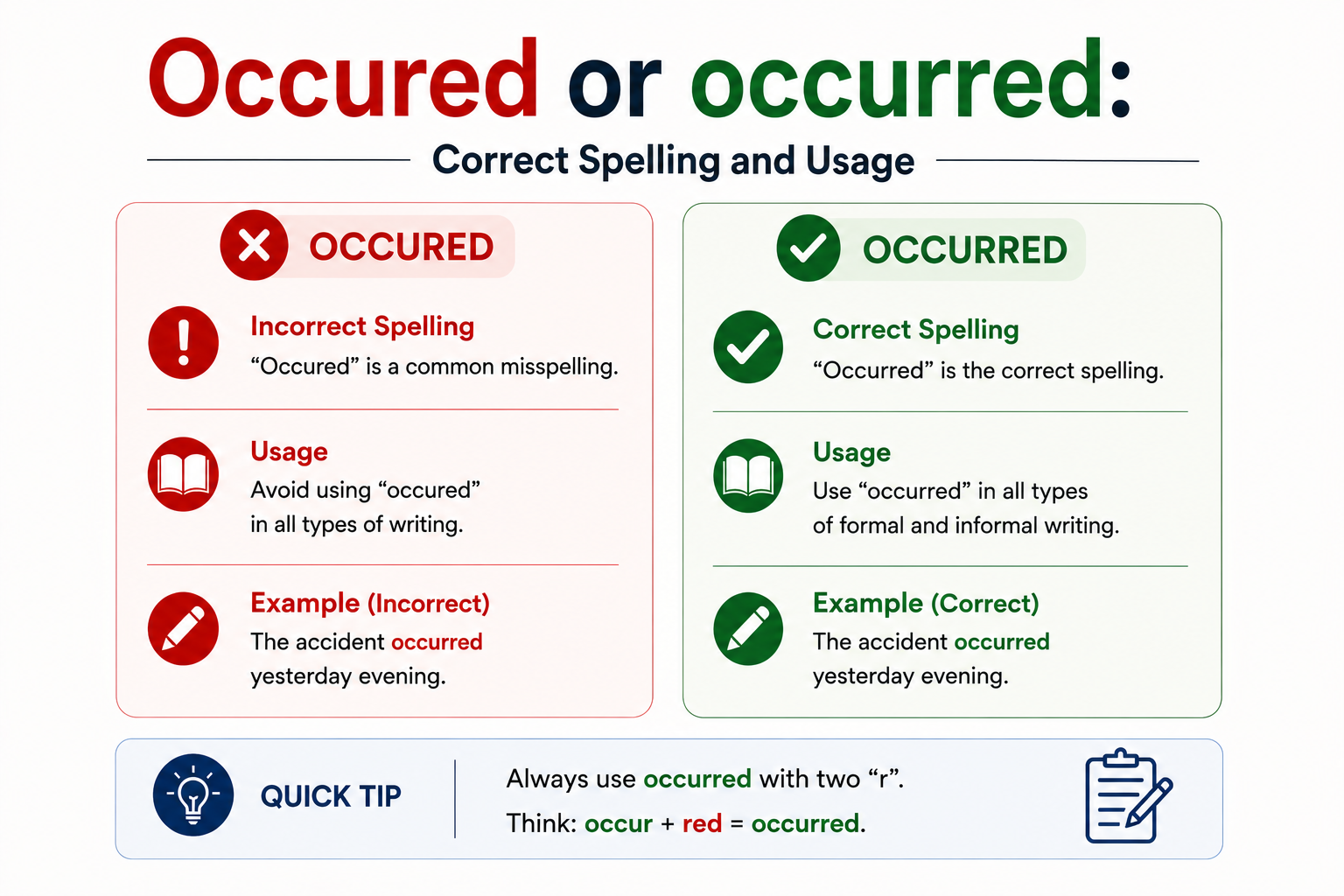
The spelling choice between occured or occurred can trip up even confident writers. Both forms look reasonable at first glance, but only one follows standard English spelling rules. The correct form is occurred, with two r’s before the ending ed.
This mistake often happens because English spelling rules can feel inconsistent. Some verbs simply add ed to form the past tense, while others double their final consonant. Since occur ends in r, writers sometimes forget to double that letter when describing something that happened in the past.
Once you understand how occur changes in different verb forms, the spelling becomes easier to remember. You can apply the same rule to words such as refer, prefer, and transfer when their endings require a doubled consonant.
Quick Answer
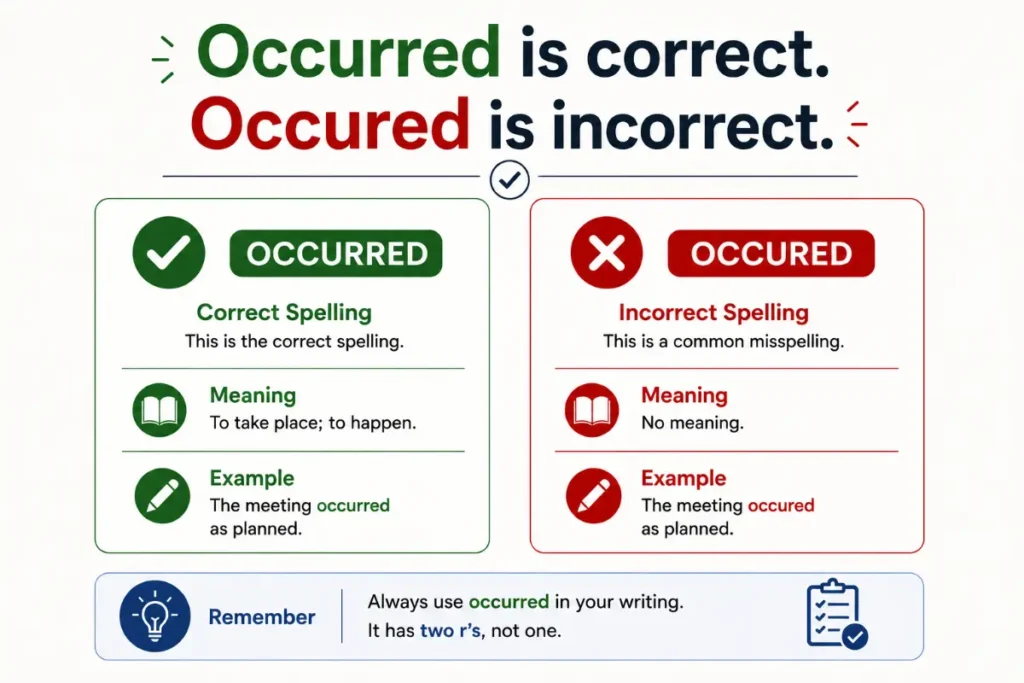
Occurred is the correct spelling in American English and British English. Occured is a misspelling. The verb occur doubles its final r before adding ed because it follows a common English spelling rule for stressed final syllables. For example, write “The accident occurred yesterday” with two r’s in the past tense.
Table of Contents
- The Correct Spelling.
- Why Occurred Has Two Rs.
- The Meaning of Occur and Occurred.
- Occur vs Occurred vs Occurring.
- How to Use Occurred in a Sentence.
- Common Spelling Mistakes.
- Memory Tips for Remembering Occurred.
- Similar Words That Double the Final Consonant.
- American English vs British English.
- Grammar and Usage Tips.
- Frequently Asked Questions.
- Key Takeaways.
- Conclusion.
The Correct Spelling
The correct spelling is occurred. The incorrect form is occured.
| Spelling | Correct or Incorrect | Explanation |
|---|---|---|
| Occurred | Correct | The past tense and past participle of occur. |
| Occured | Incorrect | It leaves out one required r. |
| Occur | Correct | The base form of the verb. |
| Occurring | Correct | The present participle with a doubled r. |
| Occurrence | Correct | The noun form with a doubled r. |
The difference is only one letter, but that letter matters in school assignments, professional emails, reports, articles, and other forms of writing.
For example, “The problem occured during testing” contains a spelling error. The correct sentence is “The problem occurred during testing.” The verb describes an event that happened in the past, so it needs the ed ending and the doubled r.
Why Occurred Has Two Rs
The spelling of occurred follows a familiar English rule. When a verb ends in a consonant followed by a stressed vowel sound and a final consonant, writers often double the final consonant before adding a vowel beginning suffix such as ed or ing.
The base verb occur has two syllables: oc and cur. The stress falls on the second syllable, which makes the final consonant doubling rule relevant when you form words such as occurred and occurring.
Here is how the word changes.
- Start with the base verb occur.
- Keep the original spelling of the word.
- Double the final r before adding ed.
- Write the result as occurred.
The same pattern appears in refer becoming referred and prefer becoming preferred. In each case, the final consonant doubles before the suffix because the final syllable receives the stress.
English has exceptions and variations in consonant doubling, so you cannot apply this rule blindly to every verb. Still, the pattern gives you a reliable way to remember occurred.
The Meaning of Occur and Occurred
The verb occur means to happen, take place, or exist in a particular situation. Its past tense, occurred, describes something that happened earlier. The word can refer to everyday events, unexpected problems, scheduled activities, or ideas that come to mind.
For example, “A power outage occurred last night” means the power outage happened last night. The sentence uses the past tense because the event is complete.
The verb also appears in formal and academic writing. A researcher might write that a change occurred during an experiment. A business report might explain that an error occurred during data entry. In both cases, the word describes an event or change.
What Occur Means
Use occur when you talk about something that happens in general, something that happens regularly, or an event that may happen in the future.
- Natural disasters occur in many parts of the world. This sentence describes events that happen in general.
- Errors sometimes occur during software updates. This sentence describes a recurring possibility.
- The meeting may occur next week. This sentence refers to a possible future event.
- These symptoms can occur after strenuous exercise. This sentence describes something that can happen under certain conditions.
The base form occur also follows helping verbs such as will, can, may, and does. For example, write “The event will occur tomorrow” rather than “The event will occurred tomorrow.”
What Occurred Means
Use occurred when an event happened in the past. The word often appears with time expressions such as yesterday, last week, in 2024, and a few minutes ago.
- The delay occurred because of heavy traffic. The sentence explains a past event and gives its cause.
- The mistake occurred during the final review. The sentence identifies when the mistake happened.
- Several changes occurred after the new policy took effect. The sentence describes completed changes.
- The thought occurred to me while I was walking home. The sentence means the idea came into my mind at that time.
The word can describe physical events and mental experiences. A problem can occur, but an idea can also occur to someone. The context tells readers which meaning applies.
Occur as a Formal Alternative to Happen
Occur often sounds more formal than happen. Both verbs can describe an event, but writers may choose occur in reports, academic papers, technical documents, and professional communication.
For example, “The error occurred during installation” sounds suitable for a technical report. “The error happened during installation” is also correct and feels more conversational.
Neither form is automatically better. Choose the word that fits your audience and the tone of your sentence.
Occur vs Occurred vs Occurring
The three forms belong to the same verb, but each serves a different grammatical purpose. Learning the difference helps you spell the word correctly and build accurate sentences.
| Word | Grammatical Form | Main Use | Example |
|---|---|---|---|
| Occur | Base form | General facts and actions after helping verbs | Problems can occur. |
| Occurs | Present tense | An event involving a singular third person subject | The error occurs frequently. |
| Occurred | Past tense | A completed past event | The error occurred yesterday. |
| Occurred | Past participle | Used with helping verbs | The error has occurred before. |
| Occurring | Present participle | Ongoing actions or events | The error is occurring again. |
| Occurrence | Noun | An event or instance | This is a rare occurrence. |
When to Use Occur
Use occur after modal verbs such as can, could, may, might, must, shall, should, will, and would. It also appears after to when the infinitive form is needed.
- Such problems can occur without warning.
- The ceremony will occur at noon.
- Similar events may occur in the future.
- We expect the change to occur soon.
Each sentence uses the base form because the surrounding grammar requires it.
When to Use Occurs
Use occurs with a singular third person subject in the simple present tense. Common subjects include it, the event, the problem, and the change.
- The error occurs whenever the file is missing.
- This condition occurs more often in winter.
- The meeting occurs on the first Monday of each month.
The final s marks subject and verb agreement. It does not mean the event happened in the past.
When to Use Occurred
Use occurred for completed past events and with helping verbs that require a past participle.
- The incident occurred during the night.
- The same problem occurred last month.
- A similar error has occurred before.
- Several delays have occurred this year.
In the first two examples, occurred is the simple past tense. In the last two, it is the past participle used with has or have.
When to Use Occurring
Use occurring when the verb needs an ing ending. It commonly appears with forms of be to describe an ongoing event.
- The problem is occurring again.
- Several changes are occurring at the same time.
- The issue was occurring before the update.
The spelling keeps the doubled r. Dropping one r creates the incorrect form occuring.
When to Use Occurrence
Occurrence is a noun rather than a verb. It refers to an event, incident, or instance of something happening.
- Power outages are a rare occurrence in this area.
- The report describes the occurrence of several errors.
- This occurrence prompted a safety review.
Notice the spelling carefully. Occurrence contains a double r and a double c. That combination makes it easy to misspell, especially when you switch between the verb and noun forms.
How to Use Occurred in a Sentence
The best way to learn a spelling is to see it in real situations. The following examples show how occurred works in everyday conversations, workplace communication, school assignments, and formal writing.
Everyday Examples
- The accident occurred near the grocery store. The sentence identifies where a past event happened.
- A strange noise occurred while we were watching television. The sentence describes an event that happened during another activity.
- The power outage occurred just before dinner. The sentence connects the event to a specific time.
- The misunderstanding occurred because we shared different information. The sentence explains the cause of a past problem.
- A sudden change in the weather occurred overnight. The sentence describes a change that took place during the night.
These examples use the simple past tense because the events have already happened.
Workplace Examples
- The error occurred during data entry. This sentence identifies the stage at which a mistake happened.
- The delay occurred because the supplier missed the deadline. This sentence connects the delay to its cause.
- The incident occurred before the manager arrived. This sentence places one past event before another.
- A technical issue occurred during the presentation. This sentence reports a problem in a professional setting.
- The change occurred after the team reviewed the results. This sentence explains the sequence of events.
In workplace writing, occurred helps describe events without adding unnecessary emotion. That makes it useful for reports, incident summaries, and factual explanations.
Academic Examples
- The reaction occurred at a higher temperature. This sentence describes a scientific event.
- A significant change occurred during the study. This sentence reports a change observed by researchers.
- The pattern occurred in three separate trials. This sentence describes repeated observations.
- The event occurred under controlled conditions. This sentence explains the circumstances of an experiment.
- The difference occurred because the groups received different treatments. This sentence gives a possible explanation for a research result.
Academic writers should make sure the evidence supports any explanation they provide. The word occurred reports the event, but it does not establish its cause by itself.
Examples Involving Thoughts and Ideas
The verb occur can also describe a thought that comes to someone’s mind. In this use, it often appears in the phrase occurred to me.
- It occurred to me that we had forgotten the keys. This means the thought came into my mind.
- The solution occurred to her during the meeting. This means she suddenly thought of the solution.
- It never occurred to him that the schedule might change. This means he had not considered that possibility.
- The idea occurred to us after we reviewed the feedback. This means the idea came to mind after the review.
The phrase it occurred to me is natural in both casual and formal English. It can describe a sudden realization or a thought that develops during reflection.
Examples With Different Verb Tenses
The spelling changes depending on the tense and the structure of the sentence.
- Present tense. “The problem occurs every winter.” The sentence describes a recurring event.
- Simple past. “The problem occurred last winter.” The sentence describes an event in the past.
- Present perfect. “The problem has occurred several times.” The sentence connects past events to the present.
- Past perfect. “The problem had occurred before the inspection began.” The sentence places one past event before another.
- Future tense. “The problem may occur again.” The sentence describes a possibility.
- Present continuous. “The problem is occurring right now.” The sentence describes an ongoing event.
Understanding the tense helps you choose the right form. The doubled r remains in occurred and occurring, but the ending changes to fit the sentence.
Common Spelling Mistakes
Many spelling errors happen because writers apply a familiar rule to the wrong word. The verb occur is especially easy to misspell because its final r needs to double before certain endings.
Writing Occured Instead of Occurred
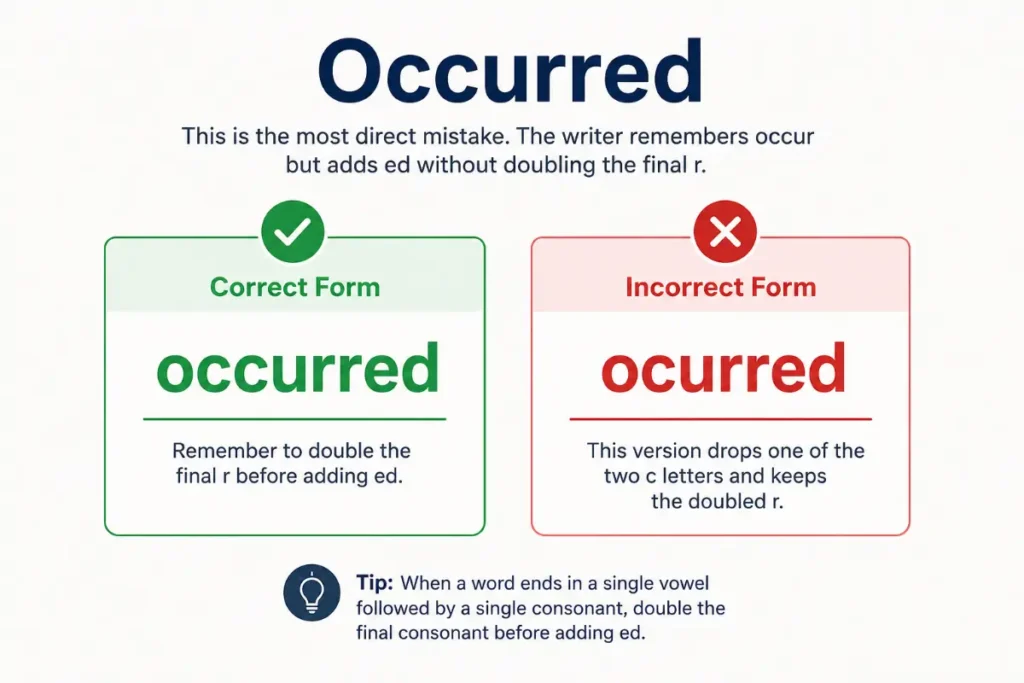
The most common mistake is leaving out the second r.
Incorrect. The power failure occured during the storm.
Correct. The power failure occurred during the storm.
The corrected sentence uses the proper past tense of occur. Remember that adding ed does not remove the need to double the final consonant.
Writing Occured Instead of Occurrence
Some writers also confuse the verb with its noun form.
Incorrect. The occured was unexpected.
Correct. The occurrence was unexpected.
The noun occurrence refers to an event or instance. The verb occurred describes something that happened. They share the same word family, but they serve different grammatical purposes.
Writing Occured Instead of Occurring
The same spelling problem appears when writers add ing.
Incorrect. The issue is occuring again.
Correct. The issue is occurring again.
The verb occur doubles its final r before both ed and ing. Keep the doubled consonant in mind when switching between past and ongoing actions.
Using Occurred With the Wrong Helping Verb
A sentence can have the correct spelling and still contain a grammar error.
Incorrect. The problem will occurred tomorrow.
Correct. The problem will occur tomorrow.
After will, use the base form of the verb. The same rule applies to can, may, might, and should.
Another example is “The problem has occurred before.” This sentence is correct because has takes the past participle occurred.
Forgetting the Difference Between Occurred and Had Occurred
Both forms are correct, but they describe different relationships between events.
- The error occurred before lunch. This sentence places the error in the past.
- The error had occurred before the technician arrived. This sentence makes clear that the error happened before another past event.
Use the past perfect when the order of past events matters to your explanation. Otherwise, the simple past often works well.
Memory Tips for Remembering Occurred
You do not need to memorize a long list of spelling rules to get this word right. A few simple habits can help you remember it.
Remember the Double R
Think of occurred as the base word occur plus the ending ed, with the final r doubled.
Occur becomes occurred.
Refer becomes referred.
Prefer becomes preferred.
These words share a useful spelling pattern. The comparison can help you recall the correct form when you write quickly.
Connect the Verb to Its Noun.
Remember the related noun occurrence. Both occurred and occurrence contain two r letters.
This trick works because related word forms often preserve important parts of their spelling. However, occurrence also contains a double c, so check the complete word when you write the noun.
Read the Sentence Aloud.
Reading a sentence aloud can help you notice its meaning and tense. However, pronunciation alone cannot reliably tell you how many letters a word needs.
For example, occurred and occured may sound the same in ordinary speech. You must remember the spelling rule or check the written form.
Use a Quick Proofreading Check.
When editing an email, report, essay, or article, search for common mistakes involving occur.
- Check every past tense form for the spelling occurred.
- Check every ing form for the spelling occurring.
- Check every noun form for the spelling occurrence.
- Review the surrounding sentence to confirm that the verb tense fits.
- Use your word processor’s spell checker as a final check.
Spell checkers can catch many errors, but they do not always identify the wrong verb form in a grammatically incorrect sentence. Read the complete sentence before making a correction.
Similar Words That Double the Final Consonant.
The spelling pattern in occurred appears in other English verbs. Learning a few examples makes it easier to recognize the pattern and avoid similar mistakes.
| Base Verb | Past Tense | Present Participle | Noun Form |
|---|---|---|---|
| Occur | Occurred | Occurring | Occurrence |
| Refer | Referred | Referring | Reference |
| Prefer | Preferred | Preferring | Preference |
| Transfer | Transferred | Transferring | Transfer |
| Admit | Admitted | Admitting | Admission |
| Commit | Committed | Committing | Commitment |
| Begin | Began | Beginning | Beginning |
| Forget | Forgot | Forgetting | Forgetfulness |
These examples show that English often doubles a final consonant when a verb takes an ending that begins with a vowel. The exact spelling can depend on the word’s stress pattern and established spelling conventions.
Why Some Words Double Their Final Consonant.
The doubling rule helps preserve the pronunciation of a short vowel in many words. For instance, doubling the final consonant in running helps maintain the short vowel sound in run.
Stress also matters. In occur, the second syllable carries the stress. That pattern supports the doubled r in occurred and occurring.
Not every word follows the same pattern. Words ending in w, x, or y generally do not double those letters before ed or ing. For example, play becomes played and playing, not playyed or playying.
The safest approach is to learn the pattern alongside common examples instead of assuming that every verb behaves identically.
American English vs British English.
The spelling occurred is standard in both American and British English. The form occured is incorrect in both varieties.
Some English words have different spellings across the United States and the United Kingdom. For example, American English commonly uses color, while British English commonly uses colour. However, the past tense of occur does not change between these varieties.
| Usage | American English | British English |
|---|---|---|
| Base verb | Occur | Occur |
| Past tense | Occurred | Occurred |
| Present participle | Occurring | Occurring |
| Noun | Occurrence | Occurrence |
You can use occurred confidently in American school assignments, workplace emails, business reports, and academic writing. The same spelling works in British publications and professional documents.
Grammar and Usage Tips.
Correct spelling is only one part of effective writing. You also need to choose the right tense, make the subject and verb agree, and use the word in a natural sentence.
Match the Verb to the Time.
Use occurred for a completed event in the past.
Example. The outage occurred on Tuesday.
Use occurs for a present fact or repeated event.
Example. The outage occurs every summer.
Use will occur for a future event.
Example. The maintenance will occur next Tuesday.
These forms help readers understand when an event takes place. A clear time expression can make the meaning even easier to follow.
Choose the Right Word for the Context.
Although occur is correct, it can sound formal in casual conversation. In many everyday sentences, happen feels more natural.
Formal. The incident occurred at approximately 8 p.m.
Conversational. The incident happened around 8 p.m.
Both sentences communicate the same basic information. The first sounds more suitable for a formal report, while the second feels more relaxed.
Avoid Unnecessary Wordiness.
Writers sometimes add extra words that do not improve the meaning.
Wordy. An unexpected delay occurred at the time when the team was preparing to leave.
Clearer. An unexpected delay occurred as the team prepared to leave.
The shorter version communicates the event without unnecessary wording. Strong writing depends on precise language rather than complicated sentences.
Use Occurred Carefully in Reports.
In professional and academic writing, occurred describes an event but does not explain its cause on its own.
For example, “The failure occurred after the update” establishes a sequence. It does not prove that the update caused the failure.
To make a causal claim, writers need supporting evidence. A more careful sentence might say, “The failure occurred after the update, and further testing identified a software conflict.”
This distinction improves accuracy and helps readers separate observed facts from conclusions.
Final Proofreading Check
Before you submit an essay send an important email or publish an article check these points.
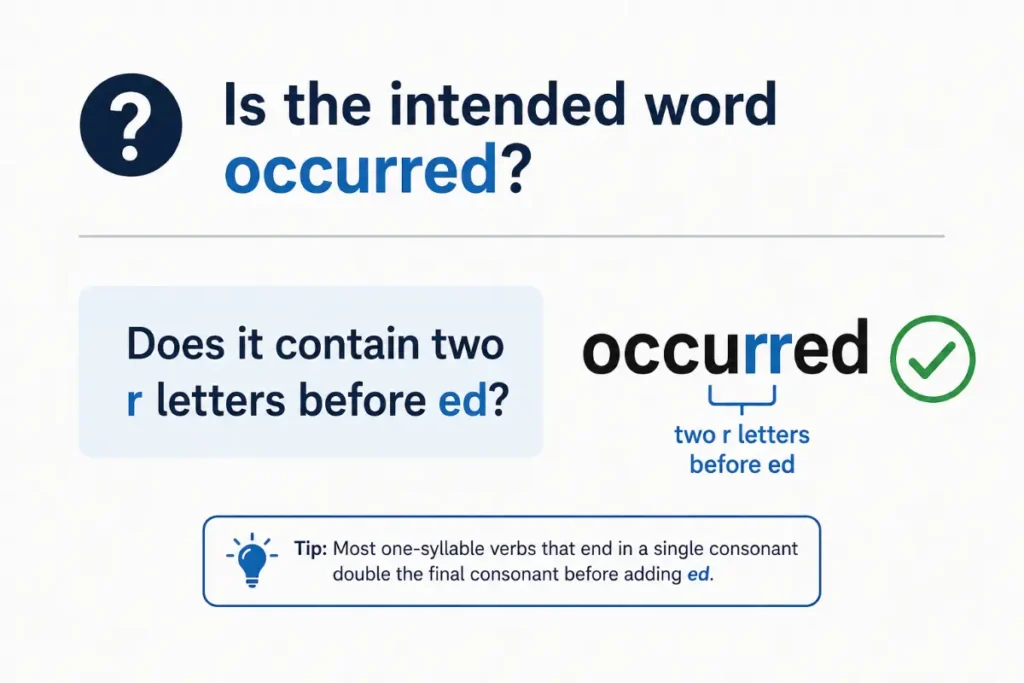
- Is the intended word occurred?
- Does it contain two r letters before ed?
- Are you using it as the past tense or past participle of occur?
- Does the sentence actually mean happened or took place?
- If you mean that an idea entered someone’s mind have you used occurred to?
- Does another verb sound more natural in your context?
Key Takeaways
- Occurred is the only correct spelling for the past tense of occur.
- Occured is a misspelling in American and British English.
- The verb doubles its final r before adding ed or ing.
- Use occur for the base form and occurs for the simple present with a singular third person subject.
- Use occurred for completed past events and as a past participle with helping verbs.
- Use occurring for ongoing events and occurrence for the noun.
- After helping verbs such as will and can, use occur rather than occurred.
- Read the whole sentence to check both spelling and grammar.
Conclusion
The spelling choice between occured or occurred has a clear answer. Occurred is correct, and occured is a misspelling. The doubled r follows a common English spelling pattern that appears in words such as referred, preferred, and transferred.
Once you learn how occur changes into occurred, occurring, and occurrence, you can avoid one of the most common spelling mistakes in everyday and professional writing. Remember the doubled r, check the tense, and proofread the complete sentence before publishing or sending your work.
Accurate spelling makes your writing easier to read and helps you communicate with confidence. Keep the correct forms in mind, and you’ll be ready to use this word correctly in emails, reports, essays, and everyday conversations.
Frequently Asked Questions
1. Is Occured or Occurred Correct?
Occurred is correct. The word occured is a misspelling because it leaves out one r. Use occurred when describing an event that happened in the past.
2. Why Does Occurred Have Two Rs?
The final r doubles before the ed ending. The verb occur has stress on its final syllable, which follows a common English consonant doubling pattern.
3. Is Occured Ever Correct in English?
No. Standard American and British English use occurred. Spell checkers may flag occured as an error, and writers should correct it in formal and informal content.
4. What Is the Past Tense of Occur?
The past tense is occurred. For example, “The meeting occurred yesterday.” The past participle has the same spelling, as in “The meeting has occurred before.”
5. Is Occurring Spelled With One R or Two?
The correct spelling is occurring, with two r letters. Add ing to occur after doubling the final consonant.
6. What Is the Difference Between Occur and Occurred?
Occur is the base form of the verb, while occurred is its past tense and past participle. Write “Problems occur frequently” for a general statement and “A problem occurred yesterday” for a past event.
7. Is Occurred the Correct American Spelling?
Yes. Occurred is the standard spelling in American English. British English uses the same form.
8. How Do You Spell the Noun Form of Occur?
The noun is occurrence. It contains a double c and a double r. For example, “The occurrence of errors decreased after testing.”
9. Is It Has Occurred or Has Occur?
The correct form is has occurred. The helping verb has requires a past participle in this construction. For example, “A similar problem has occurred before.”
10. Is It Will Occur or Will Occurred?
The correct form is will occur. After will, use the base form of the verb. For example, “The event will occur next month.”
11. How Can I Remember the Correct Spelling?
Remember that occur becomes occurred with a doubled final r. You can also connect it to occurrence and check both forms during proofreading.
12. Can Occurred Describe a Thought?
Yes. The phrase occurred to me means that an idea came into your mind. For example, “It occurred to me that I had left my phone at home.”
