
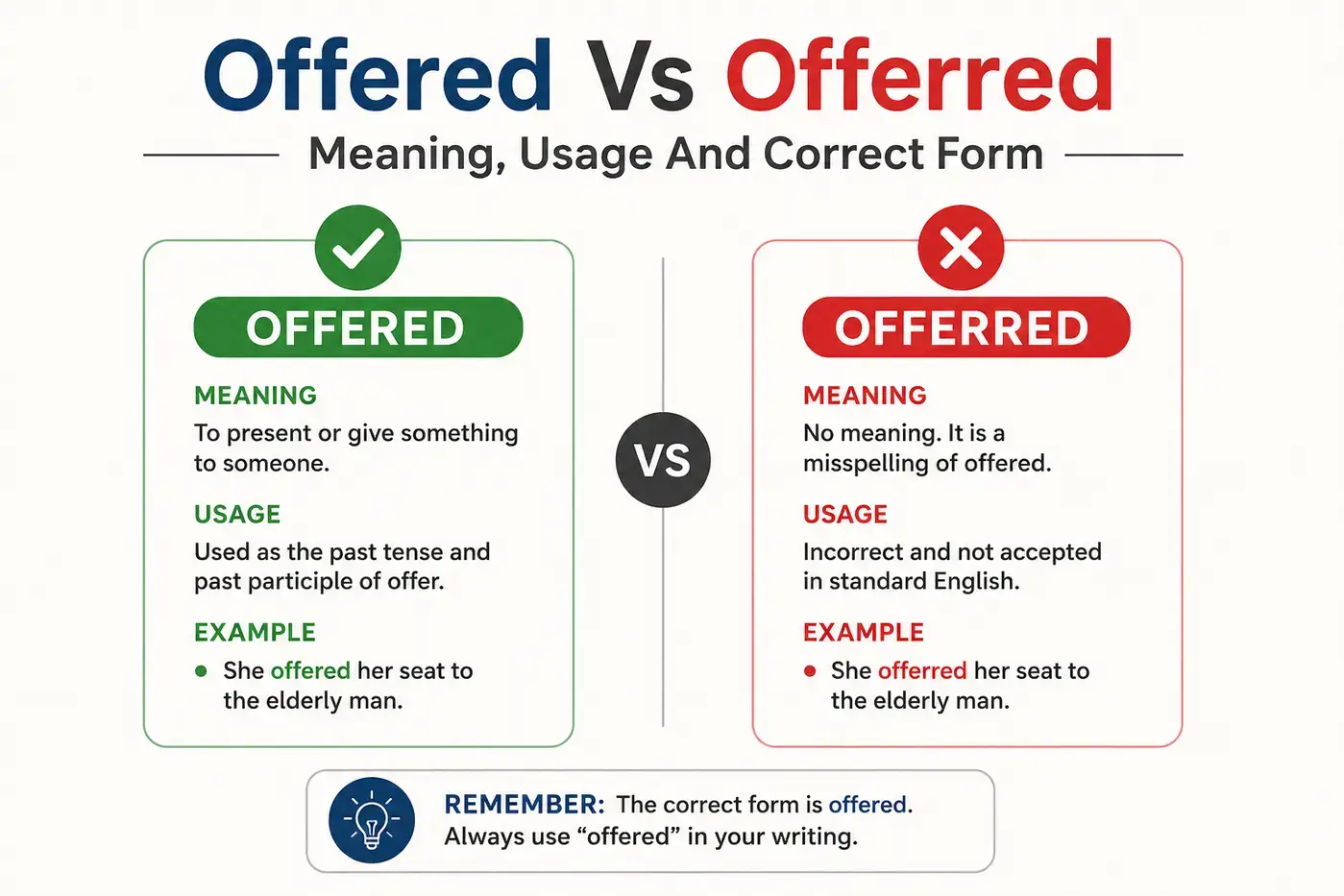
If you’ve ever paused while typing the past tense of offer, you’re not alone. The choice between offered and offerred can be confusing because English sometimes doubles a final consonant before adding ed. However, that rule doesn’t apply to every verb, and adding an extra r to this word creates a spelling error.
The correct form is offered, with one r after the letter e in the ending. The base verb is offer, and its past tense is formed by adding ed. You don’t need to change the original spelling or double the final consonant. The same form also works as the past participle, as in has offered and was offered.
Understanding this pattern will help you spell the word correctly and recognize similar mistakes in other verbs. You’ll learn how the word works in a sentence, why the extra letter appears tempting, how to pronounce it, and how to avoid related spelling errors. The goal is simple: make the correct form feel natural every time you write it.

Offered Vs Offerred Quick Definition
Offered is the correct past tense and past participle form of the verb offer. Offerred is an incorrect spelling. The confusion happens because some English verbs double the final consonant before adding ed, but offer does not follow that pattern because the stress falls on the first syllable.
Quick Answer
Offered is the correct spelling in standard English. It is the past tense and past participle of the verb offer, which means to present something for someone to accept or refuse. Offerred is a misspelling because the verb keeps its original final consonant pattern when you add ed. Write offered in emails, schoolwork, business documents, and everyday communication.
Comparison Table
| Feature | Offered | Offerred |
|---|---|---|
| Spelling status | Correct | Incorrect |
| Base verb | Offer | Offer |
| Part of speech | Verb form | Misspelling |
| Past tense | Yes | No |
| Past participle | Yes | No |
| Meaning | Presented something for consideration or acceptance | No separate standard meaning |
| Formal writing | Correct | Avoid |
| American English | Standard | Nonstandard |
| British English | Standard | Nonstandard |
| Example | She offered to help. | She offerred to help. |
The difference is spelling, not meaning. The standard verb offer forms its past tense and past participle by adding ed, giving offered. The extra r in the incorrect version has no grammatical purpose.
Meaning and Definition
What Does Offered Mean
Offered is the past tense and past participle of offer. The verb means to present something for another person to consider, accept, or refuse. It can refer to help, money, advice, a job, an opportunity, a product, or a suggestion.
For example, consider this sentence.
Maya offered her friend a ride home.
Maya presented the option of giving her friend a ride. Her friend could accept or decline the offer.
The word can also describe an action that happened in the past.
- The company offered me a full time position.
- He offered to help with the project.
- The restaurant offered a discount to new customers.
- She offered an apology after the argument.
- They offered several solutions to the problem.
In each sentence, the action involves presenting something to another person or group.
The word can also appear in passive sentences. For example, I was offered a job means someone presented a job opportunity to me. The person making the offer is not named in the sentence, but the meaning remains clear.
What Does Offerred Mean
Offerred is not the standard spelling of the past tense or past participle of offer. In ordinary English writing, it is a misspelling of offered.
People may type the extra r because they remember that English sometimes doubles a final consonant before adding an ending. That pattern is real, but it applies only under certain spelling conditions. The verb offer does not need another r.
For example.
Incorrect: The manager offerred me a promotion.
Correct: The manager offered me a promotion.
The second sentence follows the standard spelling rule. The verb remains offer, and the ending ed creates the past tense.
If you see the incorrect version in a draft, an email, a website, or a school assignment, replace it with the standard form. There is no separate meaning that you need to preserve.
Why The Extra R Is Incorrect
English spelling rules can seem inconsistent because different verbs follow different patterns. Some verbs double their final consonant before adding an ending, while others keep their original spelling.
The key is to look at the structure of the base verb.
The verb offer already ends in two consonant letters, f and r, following a short vowel sound. When you add ed, you do not double the final r. The result is offered.
Compare these forms.
- Offer becomes offered.
- Refer becomes referred.
- Prefer becomes preferred.
- Admit becomes admitted.
- Visit becomes visited.
Notice that refer and prefer double their final r, while offer does not. The difference comes from the spelling patterns and stress of the base verbs.
In refer and prefer, the final syllable receives the main stress. In offer, the main stress falls on the first syllable. This distinction helps explain why the words follow different patterns.
The rule is not simply that every verb ending in r doubles the letter. English spelling depends on several factors, including the final letter pattern, vowel sounds, and stress.
Which Spelling Is Correct
Offered is the correct spelling in standard American English and standard British English.
The verb offer forms its past tense and past participle by adding ed. This is the regular past tense pattern used by many English verbs.
For example.
- Present tense: I offer my help.
- Past tense: I offered my help.
- Present perfect: I have offered my help.
- Past perfect: I had offered my help.
- Passive voice: My help was offered.
All five examples use the standard form.
The incorrect spelling does not represent a separate tense, regional variant, or accepted alternative in ordinary modern English. If your writing tool marks it as an error, the correction should be offered.
Grammar Rules And Part Of Speech
Offered As The Past Tense
Use offered when an action happened in the past.
For example.
She offered me a seat on the bus.
The sentence describes a completed action. The offer happened in the past, so the simple past tense is appropriate.
Other examples include the following.
- He offered to pay for lunch.
- The teacher offered extra help after class.
- We offered our guests something to drink.
In each sentence, the action is presented as a past event.
Offered As The Past Participle
The same word also functions as the past participle. A past participle appears in perfect tenses and passive constructions.
For example.
She has offered to help us.
The auxiliary verb has combines with the past participle to form the present perfect tense.
The team had offered several options before the meeting ended.
Here had offered forms the past perfect tense.
The position was offered to an experienced applicant.
Here was offered creates a passive construction. The sentence focuses on the position rather than the person who made the offer.
Common Sentence Patterns
The verb offer appears in several common patterns. Learning these patterns will help you use the past tense naturally.
| Pattern | Example | Meaning |
|---|---|---|
| Offer someone something | She offered me coffee. | She presented coffee to me. |
| Offer something to someone | She offered coffee to me. | The same action with a different word order. |
| Offer to do something | He offered to drive. | He volunteered to drive. |
| Offer something for sale | They offered the house for sale. | They made the house available to buyers. |
| Be offered something | She was offered a job. | Someone presented a job opportunity to her. |
| Have offered something | We have offered assistance. | The offer has been made. |
These patterns work with offered because the word is a standard past tense and past participle form.
Is Offered An Adjective
Offered is primarily a verb form, but past participles can sometimes work like adjectives.
For example.
The offered price was too high.
In this sentence, offered describes the price that someone proposed. It still comes from the verb offer, but it functions as a modifier.
This does not change the spelling. The correct form remains offered.
Ten Natural Example Sentences
These examples show how the word appears in everyday life, school, work, and formal communication.
1. My neighbor offered to water the plants while I was away.
The neighbor volunteered to help. The past tense shows that the offer happened earlier.
2. The store offered a discount on all winter coats.
The store made a lower price available to customers.
3. She offered me a cup of tea when I arrived.
She presented tea to her guest. The sentence uses the pattern offer someone something.
4. The teacher offered extra time to students who needed support.
The teacher made additional time available to help students complete their work.
5. The company offered him a position in the marketing department.
The company presented him with a job opportunity.
6. I offered to pick up dinner on my way home.
The speaker volunteered to collect dinner.
7. The report offered a clear explanation of the problem.
Here the verb means that the report provided an explanation.
8. The school offered several courses in computer science.
The school made different courses available to students.
9. After the disagreement, he offered a sincere apology.
He expressed an apology in an attempt to address the conflict.
10. The applicant was offered a scholarship for the next academic year.
This passive sentence means someone awarded or presented the applicant with a scholarship opportunity.
Each sentence uses the same spelling because the base verb does not double its final r.

Offered Vs Offerred Meaning Comparison
One reason this topic is easier than many spelling comparisons is that only one form is actually correct.
Offered Meaning
A legitimate English word.
The past tense and past participle form of offer.
Offerred Meaning
Not recognized as a standard English word.
Generally treated as a spelling mistake.
Common Spelling Mistakes
The extra letter is not the only spelling problem writers may face. Several related errors come from applying familiar spelling rules too broadly.
Mistake One
Incorrect: Offerred.
Correct: Offered.
The incorrect version doubles the final r. The base verb offer does not follow the same doubling pattern as refer or prefer.
Mistake Two
Incorrect: Offerred to help.
Correct: Offered to help.
The phrase offered to help follows a common verb pattern. The infinitive to help does not change the spelling of the main verb.
Mistake Three
Incorrect: Has offerred.
Correct: Has offered.
The present perfect tense requires the past participle of offer. That participle is offered, not the doubled form.
Mistake Four
Incorrect: Was offerred a position.
Correct: Was offered a position.
The passive voice uses a form of be followed by the past participle. The correct participle is offered.
Mistake Five
Incorrect: The offerred price was accepted.
Correct: The offered price was accepted.
A past participle can modify a noun, but its spelling remains the same. The extra r is still unnecessary.
Pronunciation Guide
The correct spelling is easier to remember when you understand how the word sounds.
In standard American English, offered is pronounced /ˈɔː.fɚd/ or /ˈɑː.fɚd/, depending on the speaker’s accent. The first vowel differs across American regional speech patterns.
The word has two syllables.
- OF receives the main stress.
- fered forms the second syllable.
A simple pronunciation guide is AW ferd or AH ferd, depending on your accent.
The ending sounds like a single syllable rather than a separate ed syllable. That’s because the base verb ends in the voiced sound /r/, and the past tense ending is pronounced /d/ after that sound.
The incorrect spelling does not have a separate standard pronunciation. Adding an extra r in writing does not create another syllable or change the intended verb form.
A useful tip is to say the base verb first, then add the past tense ending. The sound remains natural, and the spelling becomes easier to recall.
Etymology And Word Origin
The verb offer entered English through French and can be traced further back to Latin offerre, meaning to bring or present something. Its history connects with the modern sense of presenting something for another person to consider or accept.
The English verb developed into a regular verb, which means its past tense and past participle follow the usual ed pattern. That gives us offered.
The word’s history does not support the extra r in the nonstandard spelling. Modern English spelling conventions determine the accepted form, and dictionaries record offered as the past tense and past participle of offer.
For everyday writing, you do not need to remember the Latin origin. The practical rule is enough: start with offer and add ed.
Regional Usage
American English
Offered is the standard spelling in the United States. It appears in everyday conversation, business writing, education, journalism, and formal documents.
For example.
The company offered health insurance to its employees.
The sentence follows standard American spelling and grammar.
British English
British English also uses offered. There is no standard regional spelling difference for this past tense form.
A British writer would use the same spelling in a sentence such as:
The school offered additional support to pupils.
Australian English
Australian English follows the same spelling rule. Offered is the standard form, and the extra r is not an accepted regional alternative.
Canadian English
Canadian English also uses offered. There is no meaningful difference between standard Canadian and American spelling for this word.
Across these English varieties, the correct form remains the same.
Real Life Usage Examples
Daily Conversation
Example one: He offered to carry my bags.
This means he volunteered to help with the bags.
Example two: My friend offered me the last slice of pizza.
The friend gave the speaker the choice to take the remaining slice.
Workplace Communication
Example one: The manager offered flexible working hours to the team.
The manager made a work arrangement available to employees.
Example two: We offered the client three possible solutions.
The team presented three options for the client to consider.
Academic Writing
Example one: The study offered evidence to support the claim.
The study provided evidence that helped support the argument.
Example two: The professor offered a different interpretation of the results.
The professor presented another way to understand the findings.
News And Journalism
Example one: The mayor offered reassurance after the storm.
The mayor tried to comfort the public by giving a reassuring message.
Example two: Officials offered assistance to residents affected by the flooding.
The officials made help available to people who needed it.
Literature And Storytelling
Example one: The old traveler offered the young boy a place by the fire.
The traveler presented a place to rest and get warm.
Example two: She offered no explanation for her sudden departure.
The sentence means she did not provide an explanation.
These examples show that the verb can refer to a physical item, an action, an idea, support, or information. The meaning changes with context, but the spelling does not.
Related Words And Commonly Confused Forms
Understanding nearby spelling patterns can help you avoid errors beyond this one word.
Offer
Offer is the base form of the verb.
Example: I offer my assistance whenever I can.
Offers
Offers is the third person singular present tense.
Example: The company offers free delivery.
Offering
Offering is the present participle or gerund.
Example: They are offering a new service.
Offered
Offered is the standard past tense and past participle.
Example: She offered a solution.
Refer And Referred
Refer becomes referred. The final consonant is doubled because the verb follows a different stress pattern.
Example: The doctor referred the patient to a specialist.
Prefer And Preferred
Prefer becomes preferred. The final r is doubled when the past tense ending is added.
Example: I preferred the earlier version.
Admit And Admitted
Admit becomes admitted. The final consonant is doubled because the stress falls on the final syllable in the base verb.
Example: He admitted his mistake.
Visit And Visited
Visit becomes visited. The final consonant is not doubled because the stress falls on the first syllable.
Example: We visited our grandparents last weekend.
These examples show why spelling rules need to be applied carefully. Similar looking words can follow different patterns depending on their structure and stress.
How To Remember The Correct Spelling
A few simple memory techniques can help you avoid the extra letter.
Remember The Base Verb
Start with offer. Add ed without changing the original spelling.
Offer + ed = offered.
This is the most reliable method because it focuses on the actual spelling of the verb.
Compare Similar Words
Think of offer and visit. Both keep their final consonant pattern when forming the past tense.
Offer becomes offered.
Visit becomes visited.
Then compare them with refer and admit, which double their final consonants.
Refer becomes referred.
Admit becomes admitted.
This comparison reminds you that consonant doubling follows a pattern rather than a universal rule.
Use A Sentence
Repeat a sentence that feels natural.
She offered to help.
The company offered a discount.
I offered my opinion.
Seeing the correct form in familiar phrases can help make the spelling automatic.
Use Spell Check Carefully
Most modern spelling tools can flag a nonstandard form and suggest the correct spelling. Still, do not accept every suggestion without thinking about the sentence.
For this verb, the correction is straightforward. Replace the extra r with the standard spelling.

Offered Vs Offerred In Modern English
Modern English style guides, dictionaries, grammar books, and educational resources all agree on one point. Offered is the accepted spelling.
You’ll find it in:
- Newspapers.
- Academic journals.
- Government publications.
- Corporate websites.
- Educational materials.
- Legal documents.
- Books.
- Professional correspondence.
Expert Editor Insight
Experienced editors look at the base verb before deciding how to form the past tense. They do not double a final consonant simply because another verb follows that pattern. For this word, the standard form is offered. Spell checkers will often catch the error, but understanding the rule helps you spot it in titles, headings, copied text, and documents that may not receive a full grammar review.
Key Takeaways
- Offered is the correct standard spelling.
- Offerred is a misspelling in ordinary English usage.
- The base verb is offer.
- The past tense and past participle are both offered.
- The word is used in active and passive sentences.
- Standard American, British, Australian, and Canadian English all use the same spelling.
- The extra r comes from overapplying a consonant doubling rule.
- A simple memory trick is to write the base verb first and then add ed.
Conclusion
The correct spelling is offered, not offerred. The verb offer forms its past tense and past participle by adding ed without doubling the final r. This form works in everyday conversation, professional writing, academic work, and formal documents across major English varieties.
To remember the rule, start with the base verb before adding an ending. Some verbs double their final consonants, but others do not. Learning each spelling pattern will help you avoid similar mistakes with words such as referred, preferred, and visited. When in doubt, check the base verb and confirm the standard form before you publish or send your writing.
Frequently Asked Questions
Is offerred a real English word?
Offerred is not a standard spelling of the past tense or past participle of offer. In ordinary English writing, it should be corrected to offered. If you encounter the doubled form in a document, treat it as a spelling error unless a specific proper name or unusual context clearly requires otherwise.
What does offered mean?
Offered means presented something for another person to accept, reject, or consider. It is the past tense and past participle of offer. For example, She offered to help means she volunteered to provide assistance. The word can also describe a job, discount, apology, suggestion, or opportunity that someone presented.
Which spelling is correct in American English?
Offered is the standard spelling in American English. It is also the accepted spelling in British, Australian, and Canadian English. The doubled form is not a recognized regional variant. In formal documents, emails, schoolwork, and published content, use offered.
Why do people add an extra r?
People may add an extra r because English doubles the final consonant in some verbs before adding ed. For example, refer becomes referred. However, the rule does not apply to every verb. Offer keeps its original spelling and becomes offered.
How do you pronounce offered?
In American English, offered has two syllables, with stress on the first. Its IPA pronunciation is commonly represented as /ˈɔː.fɚd/ or /ˈɑː.fɚd/, depending on the speaker’s accent. The past tense ending is pronounced as a /d/ sound, so the word does not gain an extra syllable.
Is offered the past tense or past participle?
It is both. Use offered for the simple past, as in She offered advice. Use the same form with auxiliary verbs, as in She has offered advice or Advice was offered. English regular verbs often use the same form for the past tense and past participle.
Does British English use offerred?
No. Standard British English uses offered, just like American English. There is no established British spelling rule that adds another r to this verb. The same standard form is used in Australian and Canadian English.
How can I avoid this spelling mistake?
Remember the base verb and add ed: offer becomes offered. If you are unsure about doubling a consonant, check the verb’s spelling pattern instead of applying a rule from a different word. Reading the sentence aloud and using a spelling checker can also help you catch errors before publishing.
