
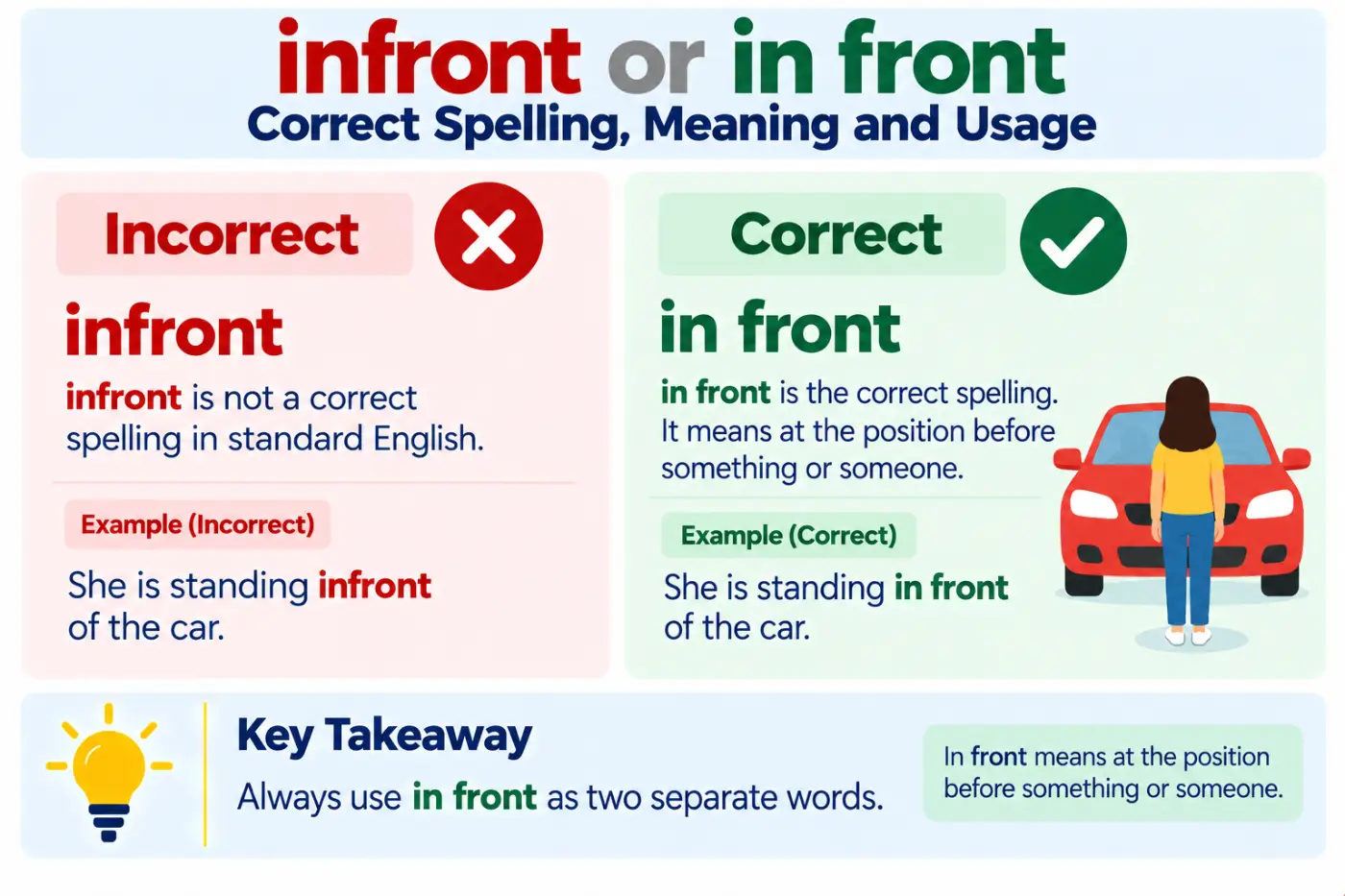
In front or infront is a common spelling question because the phrase sounds like a single unit when people say it aloud. However, standard American English uses two words. The correct form is in front. It describes a position ahead of someone or something or a location on the forward side of an object.
The confusion often comes from familiar compound words such as inside, into, and indoors. Since these words appear as one word, writers may assume that infront follows the same pattern. It does not. In standard English, in and front remain separate when they express position or relative location.
Once you understand how the phrase works, the spelling becomes easy to remember. You can use it to describe a person standing ahead of a line, a vehicle parked before a building, or someone speaking before an audience. The same spelling rule applies in casual conversation and formal writing.
Quick Answer
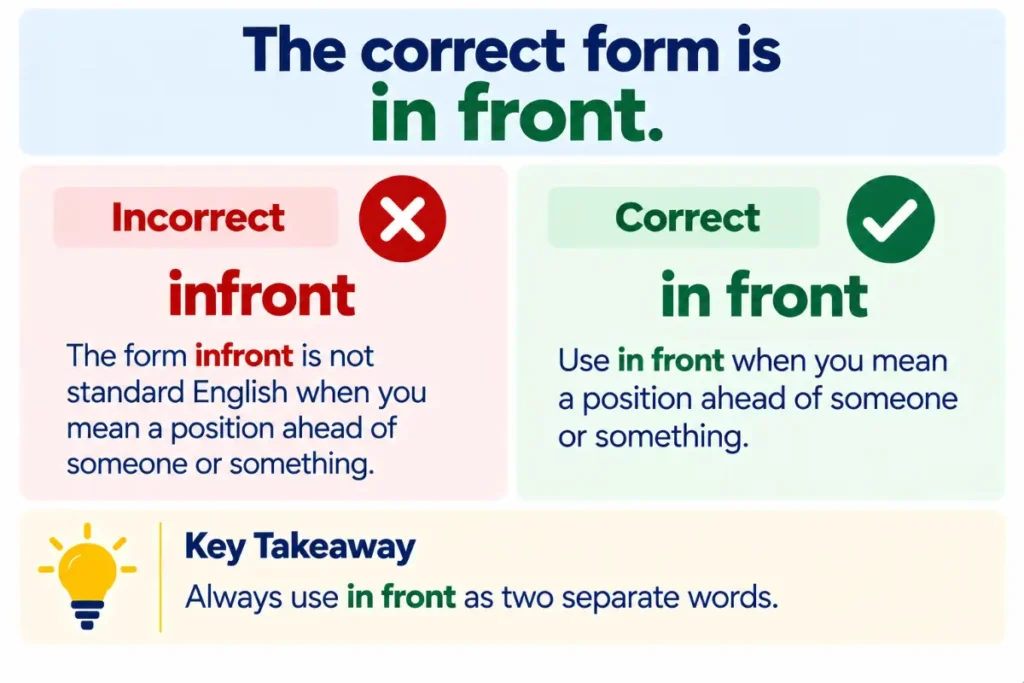
In front is the correct spelling when you mean ahead of someone or something or positioned before it. It is written as two separate words. Infront is not the standard spelling in American English. For example, write The car is parked in front of the house. Remember this simple rule whenever you write the phrase in emails, schoolwork, professional documents, or everyday messages.
Table of Contents
- The Correct Spelling of In Front or Infront.
- What In Front Means.
- How to Use In Front in a Sentence.
- Grammar Rules for In Front.
- In Front vs Infront Comparison.
- In Front vs In the Front.
- In Front vs Ahead Of.
- Common Spelling and Grammar Mistakes.
- Easy Ways to Remember the Correct Spelling.
- Real Life Examples.
- Related Grammar and Usage Notes.
- Frequently Asked Questions.
- Key Takeaways.
- Conclusion.
The Correct Spelling of In Front or Infront.
The standard spelling is in front. The phrase contains two words and usually works as a prepositional phrase that describes location or position.
For example.
- Sarah stood in front of the classroom.
- The delivery truck stopped in front of our building.
- Please wait in front of the main entrance.
Each sentence describes a person or object positioned ahead of another person or place. The words remain separate in every example.
The single word infront is a nonstandard spelling in this context. You should avoid it in essays, business emails, academic assignments, website content, and other writing that follows standard English conventions.
Why In Front Has Two Words.
English includes open compounds, closed compounds, and hyphenated compounds. An open compound contains separate words that work together to express a related meaning. The phrase in front follows this pattern.
Other common open compounds include ice cream, high school, and post office. Although each phrase expresses a connected idea, its words remain separate.
The fact that a phrase has one meaning does not automatically make it one word. English spelling depends on established usage rather than sound alone. Therefore, you should write in front instead of combining the words into infront.
Is Infront Ever Correct.
In ordinary American English writing, infront is not the accepted spelling of the location phrase. A person might use it accidentally in a text message or online post, but that does not make it standard.
You may also encounter the form as part of a username, a business name, a product name, or a website address. Those uses involve naming choices rather than the normal spelling rule. When writing a regular English sentence, use in front.
What In Front Means.
The phrase in front describes a position ahead of someone or something. Its exact meaning depends on the surrounding sentence and the point of reference.
Meaning One: At the Forward Side of Something.
Use in front to identify a person or object located on the side that faces forward or toward an observer.
Example.
The bicycle is in front of the garage.
This sentence means the bicycle is positioned on the garage’s front side. The exact location depends on the layout of the property and the direction from which the garage faces.
Another example.
A small garden sits in front of the house.
The garden occupies the area before the house rather than behind it. The phrase helps the reader picture the property’s layout.
Meaning Two: Ahead of Someone in a Line.
The phrase can also describe a person’s position relative to others waiting or moving in a line.
Example.
James stood in front of me at the checkout counter.
James was ahead of the speaker in the line. The sentence describes their relative positions rather than a permanent location.
Another example.
The runner in front of Maya crossed the finish line first.
The runner was ahead of Maya during the race. Here the phrase communicates position in a sequence or competition.
Meaning Three: Before an Audience.
You can use in front of when someone appears, speaks, performs, or acts before other people who are watching.
Example.
He felt nervous speaking in front of the audience.
The sentence means he felt nervous while speaking before people who were listening or watching him.
Another example.
The student presented her project in front of the class.
The student gave her presentation before her classmates. The phrase describes the social setting rather than a physical position alone.
Meaning Four: Within Someone’s View.
The phrase can describe something located where another person can see it.
Example.
The teacher placed the answer sheet in front of the students.
The students could see the sheet because it was placed on the side facing them. The exact arrangement depends on where they were sitting.
Another example.
Please keep the documents in front of you.
The documents should remain in a position where you can easily see or access them. This usage is common in meetings, instructions, and customer service conversations.
How to Use In Front in a Sentence.
The phrase in front usually appears with the preposition of when you identify the person or object that something is ahead of. However, you can also use in front without of when the reference point is already clear.
Using In Front Of.
This is the most common construction when describing the position of one person or object relative to another.
Examples.
1. The dog is sleeping in front of the fireplace.
The dog is resting on the side of the fireplace that faces the room.
2. We parked in front of the restaurant.
The car is parked near the restaurant’s front entrance or front side.
3. A tall man stood in front of the television.
The man blocked the speaker’s view of the television.
4. The children gathered in front of the stage.
The children stood in the area facing the stage.
5. My office is in front of the elevator.
The office is positioned ahead of the elevator from the speaker’s point of reference.
Notice that of connects the phrase to the person or thing that serves as the reference point. In everyday English this construction sounds natural and clear.
Using In Front Without Of.
You can omit of when the sentence already makes the reference point clear or when the phrase describes a position in a sequence.
Examples.
1. The person in front moved forward.
The person who was ahead of the speaker or group moved forward.
2. Please step in front.
The instruction asks someone to move to a forward position. The listener can usually work out the location from the situation.
3. The runner in front won the race.
The runner who was leading won the competition.
4. I could not see the screen because the person in front was too tall.
The person directly ahead blocked the speaker’s view.
The main rule is simple. Use in front of when you name the reference point. Use in front alone when the context makes that point clear.
Grammar Rules for In Front.
Understanding the grammar behind the phrase helps you use it confidently. The words may look simple, but they perform different jobs depending on the sentence.
In Front as a Prepositional Phrase.
A prepositional phrase begins with a preposition and adds information about a person or thing. In the phrase in front of the house, the words identify a location relative to the house.
Example.
The mail carrier left the package in front of the door.
The phrase in front of the door tells the reader where the mail carrier left the package. It functions as an adverbial phrase because it explains where the action occurred.
In Front After a Verb.
The phrase often follows verbs that describe movement or position.
Common examples include stand, sit, wait, park, stop, move, walk, and gather.
Examples.
1. Please stand in front of the window.
The phrase identifies the requested position.
2. The taxi stopped in front of the hotel.
The phrase explains where the taxi stopped.
3. She walked in front of her brother.
The phrase describes her position as she walked.
The phrase does not change its spelling based on the verb. You should always keep in front as two words in these sentences.
In Front Before a Noun.
When you want to identify a person or object by its position ahead of another, you can place the phrase before a noun with a relative clause or other modifier.
Example.
The child in front of me dropped a toy.
The phrase in front of me identifies which child the speaker means.
Another example.
The car parked in front of our house belongs to my neighbor.
The phrase helps identify the particular car. It tells the reader which car the sentence describes.
In Front in Questions.
You can use the phrase in direct questions and everyday requests.
Examples.
1. Who is standing in front of the building.
This asks for the identity of the person at the building’s front.
2. Is there a parking space in front of the store.
This asks about available parking near the store’s front side.
3. What is that object in front of the camera.
This asks the listener to identify an object that appears ahead of the camera.
In formal writing these questions should end with question marks. Correct punctuation helps readers recognize the intended meaning.
Infront or In Front Comparison.
The spelling difference is straightforward. The two forms do not have equal standing in standard American English.
| Feature | In front | Infront |
|---|---|---|
| Standard spelling | Correct | Nonstandard |
| Number of words | Two | One |
| Meaning | Ahead of or at the forward side | Intended meaning is usually the same but the spelling is incorrect |
| Formal writing | Appropriate | Avoid |
| Academic writing | Appropriate | Incorrect in ordinary usage |
| Everyday messages | Correct | Common typing error |
| Example | The car is in front of the house. | The car is infront of the house. |
The first sentence follows standard spelling conventions. The second sentence contains a spelling error because infront should be written as two separate words.
If you are searching for infront or in front because you have seen both forms online you can use this comparison to make the right choice. The accepted phrase is in front.
In Front vs In the Front.
Although the phrases look similar they do not always mean the same thing. The difference depends on the setting and the location being described.
In front usually means ahead of something or positioned before it.
In the front usually means inside the forward section of a larger space or object.
Consider these examples.
1. The car is in front of the house.
The car is outside the house and positioned on its front side.
2. The driver is sitting in the front of the car.
The driver is inside the vehicle and sitting in the forward seating area.
3. The students stood in front of the classroom.
The students stood outside or at the forward side of the classroom area.
4. The students sat in the front of the classroom.
The students sat in the rows closest to the teaching area.
5. She placed a flower in front of the mirror.
The flower is positioned before the mirror.
6. She placed a flower in the front of the display case.
The flower occupies the forward section inside the display case.
The distinction matters because one phrase describes a relative position while the other often identifies a section within a space.
How Context Changes the Meaning.
Imagine that you are at a movie theater. If you say that someone is in front of the screen you usually mean the person is positioned between you and the screen or standing on the screen’s forward side. If you say that someone is in the front of the theater you usually mean the person is seated or standing in the forward section of the theater.
The same principle applies to a classroom, bus, office, and meeting room. Look at the complete sentence rather than choosing a phrase based on sound alone.
In Front vs Ahead Of.
The phrases in front of and ahead of often describe a similar position. However, they can emphasize different ideas.
In front of commonly describes physical location. Ahead of can describe physical position as well as progress, order, or advantage.
Compare these sentences.
1. The bicycle is in front of the garage.
This describes the bicycle’s location relative to the garage.
2. The cyclist is ahead of the other riders.
This means the cyclist is farther along the route than the others.
3. A tree stands in front of the house.
This describes a physical arrangement.
4. Our team is ahead of the competition.
This means the team has a better position or higher score than its competitors.
5. Please stand in front of the group.
This asks someone to move to a position at the group’s front.
6. Please stay ahead of the group.
This tells someone to remain farther forward than the group.
Infront or in front questions usually concern spelling rather than meaning. Still, understanding related phrases helps you choose the right wording for each situation.
Common Mistakes and Misspellings
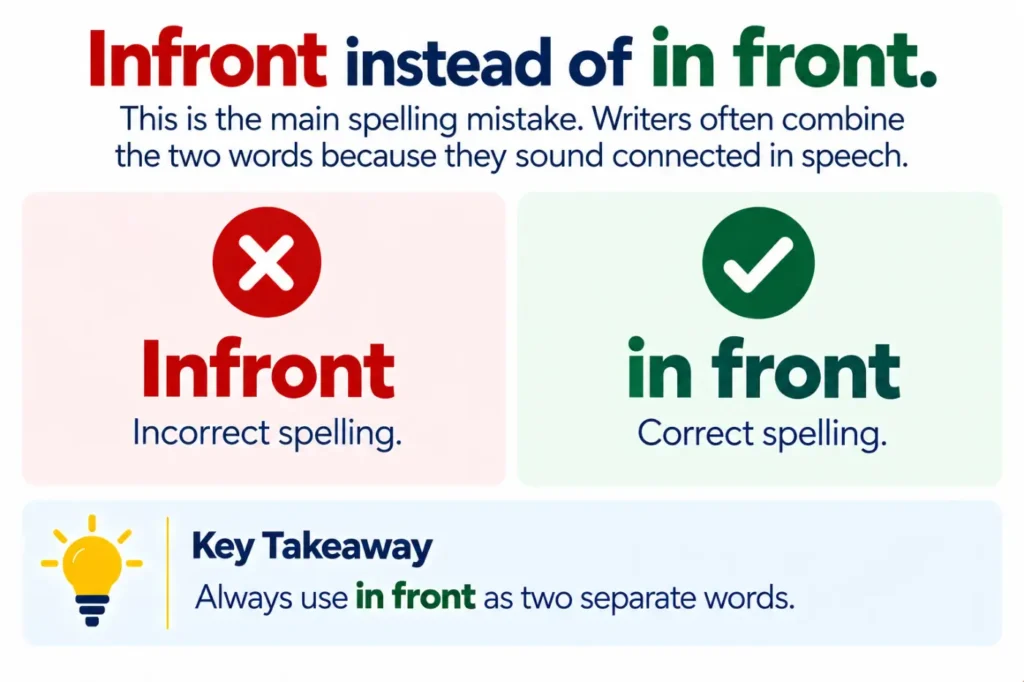
Writers often make small errors with this phrase because they treat familiar expressions as single words or mix up similar constructions. These mistakes are easy to fix once you recognize the pattern.
Mistake One: Writing Infront as One Word.
Incorrect.
The teacher stood infront of the students.
Correct.
The teacher stood in front of the students.
The phrase contains two words. Keep them separate even when the sentence is short or informal.
Mistake Two: Leaving Out Of When You Need a Reference Point.
Incorrect in the intended standard construction.
The keys are in front the computer.
Correct.
The keys are in front of the computer.
When you name the object that establishes the position you normally need of. Without it the sentence sounds incomplete.
Mistake Three: Confusing In Front With In the Front.
Incorrect for the intended meaning.
The car is in the front of the house.
This sentence is not always grammatically wrong but it may suggest that something is located in a front section within the house. If you mean that the car is parked outside on the house’s front side write this instead.
The car is in front of the house.
The second sentence expresses the intended location more clearly.
Mistake Four: Using In Front When Ahead Of Fits Better.
Consider this sentence.
Our company is in front of its competitors in annual sales.
Readers can understand the meaning but ahead of its competitors often sounds more natural when describing a lead or advantage.
Better.
Our company is ahead of its competitors in annual sales.
Use in front of for physical position and consider ahead of for progress or competitive standing.
Mistake Five: Forgetting the Space in Fast Typing.
A quick message might read The meeting room is infront of the lobby. This is a simple typing error but it can make professional writing look less polished.
Correct it to The meeting room is in front of the lobby.
A spelling checker may catch this error depending on its dictionary and settings. Still a quick proofread is useful because not every typing mistake gets flagged.
Easy Ways to Remember the Correct Spelling.
The best memory trick is to picture the two words doing two different jobs.
Think of In and Front Separately.
The word in points to a relationship involving position. The word front identifies the forward side. Together they create a phrase that describes location.
Say the phrase slowly and picture a person standing in front of a door. Then write the words separately.
Use the Of Test.
Try placing of after the phrase.
The bag is in front of the chair.
The sentence sounds natural because of connects the position to the chair.
The bag is infront of the chair.
The meaning is understandable but the spelling remains incorrect. Adding of does not make the single word standard.
Compare It With Other Two Word Phrases.
Remember expressions such as in back of, in place of, and in spite of. These phrases contain separate words that work together.
This method helps you recognize that a meaningful phrase does not always need to become one word.
Read the Sentence Aloud.
Reading aloud can help you catch missing words and awkward sentence structures. However pronunciation alone cannot tell you the correct spelling because in front and infront are usually intended to sound alike.
Use sound to check the flow of the sentence and rely on standard spelling to decide how to write it.
Real Life Examples.
The following examples show how the phrase works in common situations. Each sentence includes a short explanation so you can apply the same pattern in your own writing.
At Home.
1. The shoes are in front of the closet.
The shoes are positioned on the closet’s front side.
2. Please leave the package in front of the door.
The instruction tells someone where to place the package.
3. The cat is sitting in front of the fireplace.
The phrase describes the cat’s physical location.
4. A large tree grows in front of our house.
The tree stands on the front side of the property.
5. The children are playing in front of the television.
The children are positioned between the viewer and the television.
At School.
1. The teacher wrote the answer in front of the class.
The teacher presented the answer where the class could see it.
2. Please wait in front of the library.
The speaker asks someone to wait near the library’s front side.
3. The student standing in front of me dropped his pencil.
The phrase identifies the student by his position.
4. Our group performed in front of the judges.
The group performed before the judges who watched them.
5. She placed her backpack in front of her desk.
The backpack is located ahead of the desk from the relevant point of view.
At Work.
1. The manager spoke in front of the entire team.
The manager addressed the team directly.
2. Please meet me in front of the conference room.
The speaker gives a meeting location outside or near the room’s front entrance.
3. The delivery driver parked in front of the office.
The driver stopped the vehicle on the office’s front side.
4. He presented the report in front of the board.
He delivered the report before the board members.
5. The new employee is standing in front of reception.
The employee is positioned near the reception area.
While Traveling.
1. The taxi stopped in front of the airport terminal.
The taxi stopped near the terminal’s front entrance.
2. A bus was parked in front of our hotel.
The bus occupied a position on the hotel’s front side.
3. The tourist stood in front of the monument.
The tourist stood ahead of the monument from the observer’s viewpoint.
4. The cyclist riding in front slowed down.
The cyclist who was ahead reduced speed.
5. We waited in front of the train station.
The group waited outside or near the station’s front entrance.
In Everyday Conversation.
1. Do not stand in front of the camera.
The instruction asks someone to move out of the camera’s view.
2. I get nervous speaking in front of strangers.
The speaker feels anxious when talking before unfamiliar people.
3. She always sits in front during meetings.
She prefers a forward seat in the meeting room.
4. The child ran in front of his father.
The child moved to a position ahead of his father.
5. The person in front knows the answer.
The person ahead of the speaker or group knows the answer.
These examples show why the phrase appears in so many everyday situations. It describes location and position in a way that most readers understand immediately.
Related Grammar and Usage Notes.
Is In Front a Compound Word.
The phrase in front functions as a unit of meaning but remains an open compound or multiword expression in standard writing. It is not written as a closed compound.
A compound expression can contain two or more words without losing its shared meaning. For example living room names one part of a home but still uses two words. The same principle applies to in front.
Is In Front a Preposition.
In traditional grammar the complete phrase in front of is often described as a complex preposition. It introduces a relationship between a person or thing and a reference point.
For example The dog slept in front of the fireplace.
The phrase tells the reader where the dog slept. The words work together to establish the location.
Is In Front Formal or Informal.
The phrase is suitable for both formal and informal writing. You can use it in academic assignments, work emails, reports, instructions, and casual messages.
There is no need to replace it with a complicated expression just to sound professional. Clear and accurate wording usually works best.
Does American English Differ From British English.
The standard spelling is in front in both American and British English. The single word infront is not the standard form of this phrase in either variety.
Regional differences may affect vocabulary, punctuation, or other conventions but they do not change this spelling rule.
How Is In Front Pronounced.
In American English the phrase is commonly pronounced with a short vowel sound in in and the consonant cluster at the start of front. In connected speech the two words flow together naturally.
Because the phrase often sounds like one unit when spoken quickly some writers assume that it must be one word. That assumption is unreliable. Spelling and pronunciation do not always match word boundaries.
What Is the Opposite of In Front.
The most common opposite is behind. For example The car is in front of the house describes a position on the house’s front side. The car is behind the house describes a position on the other side.
The best opposite depends on context. At the back of can also describe location while behind in a race can describe a lack of progress.
Can In Front Start a Sentence.
Yes. A prepositional phrase can appear at the beginning of a sentence when it provides useful context.
Example.
In front of the building stood a large statue.
This sentence places the location first and the subject later. It is grammatically correct and may sound more descriptive than the usual word order.
Another example.
In front of the class the student explained her answer.
The opening phrase establishes the setting. A comma after the introductory phrase may improve readability when the phrase is long or when the sentence would otherwise feel unclear.
Expert Editor Insight
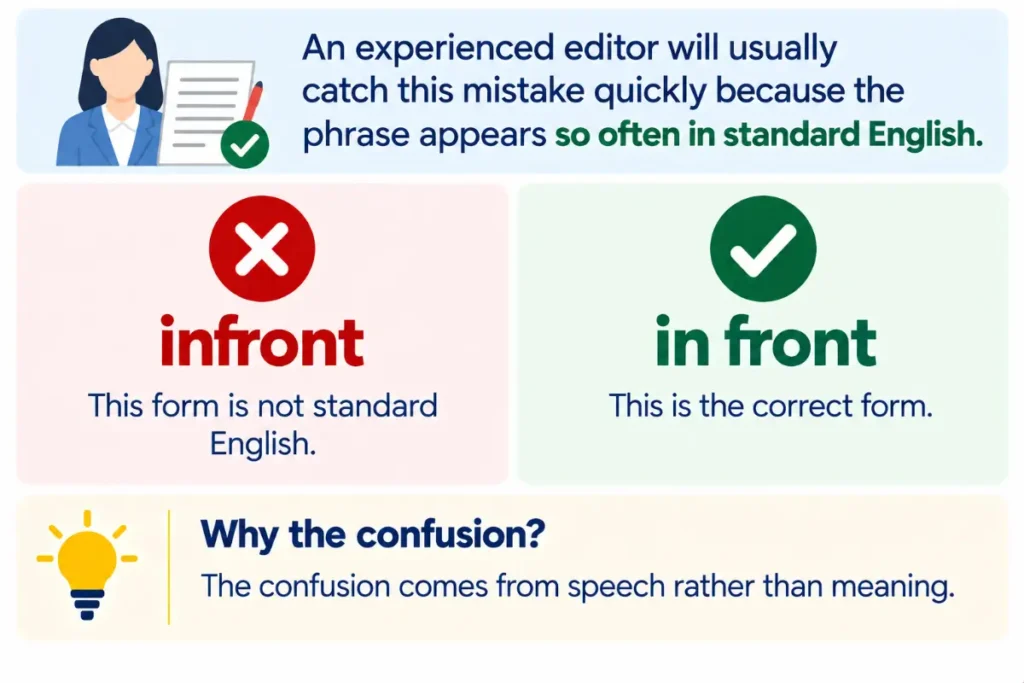
An experienced editor will usually catch this mistake quickly because the phrase appears so often in standard English. The confusion comes from speech rather than meaning. Native speakers naturally connect the sounds of in and front so the phrase can feel like one unit when spoken. During proofreading an editor checks word boundaries as carefully as spelling. A useful editing habit is to read the sentence slowly and ask if each part has a separate grammatical job. In this case in and front do, so keeping the space is the right choice.
Key Takeaways.
- The correct spelling is in front.
- Write the phrase as two separate words in standard American English.
- Use in front of when naming the person or object that establishes the position.
- Use in front alone when the reference point is clear from context.
- Use in the front when you mean the forward section inside a place or object.
- Consider ahead of when discussing progress or competitive advantage.
- The spelling rule is the same in American and British English.
- Proofread your work to catch the common mistake of combining the words.
Conclusion.
The correct spelling of infront or in front is in front. Standard English uses two separate words to describe a position ahead of someone or something. You can use the phrase in everyday conversation and formal writing without changing its spelling.
Remember to use in front of when you identify a reference point and in front when the context already makes the location clear. Keep the phrase separate even when you pronounce the words quickly. If you mean the forward section inside a vehicle or room use in the front instead.
Once you understand these small differences you can write the phrase with confidence. The rule is simple and consistent. Whenever you describe something positioned ahead of another object or person write in front.
Frequently Asked Questions
Is Infront or In Front Correct?
In front is correct in standard English. Write it as two separate words when describing a location or position ahead of someone or something. The form infront is a common spelling error.
Is Infront One Word or Two Words?
The standard phrase contains two words. Write in front rather than combining the words. This rule applies in American English and British English.
Should I Write In Front Of or Infront Of?
Write in front of. The phrase uses three separate words. For example The store is in front of the bank. The form infront of is not standard.
Why Do People Spell In Front as Infront?
People often combine the words because they sound connected during normal speech. They may also assume the phrase follows the pattern of words such as inside or into. However standard English keeps in front separate.
Can I Use In Front in Formal Writing?
Yes. The phrase is appropriate for formal and informal writing. It works well in reports emails academic assignments instructions and professional documents.
What Is the Difference Between In Front and In the Front?
In front of generally describes a position ahead of something. In the front usually refers to the forward section inside a place or object. For example a car can be in front of a house while a passenger can sit in the front of the car.
Is In Front Correct in American and British English?
Yes. Both American and British English use in front as the standard spelling. The single word infront is not the accepted spelling of the ordinary phrase.
Can I Say In Front Without Of?
Yes. You can omit of when the reference point is already clear. For example The runner in front won the race. When you name the reference point you normally use of as in The runner in front of me won the race.
What Is Another Word for In Front?
Depending on context you can use ahead of, before, or at the front of. These expressions do not always mean exactly the same thing. Use ahead of for position or progress and at the front of when identifying the forward part of a space or group.
What Is the Opposite of In Front?
Behind is the most common opposite. For example The dog is in front of the chair describes one position while The dog is behind the chair describes the opposite position.
Is In Front a Prepositional Phrase?
Yes. In the construction in front of the house the phrase functions as a prepositional expression that identifies a location. It can modify a verb by explaining where an action takes place.
How Can I Remember the Correct Spelling?
Remember that in and front are separate words that work together. Picture a person standing in front of a door and write the phrase as you imagine the scene. A quick spelling check can also help you avoid the common error.
