
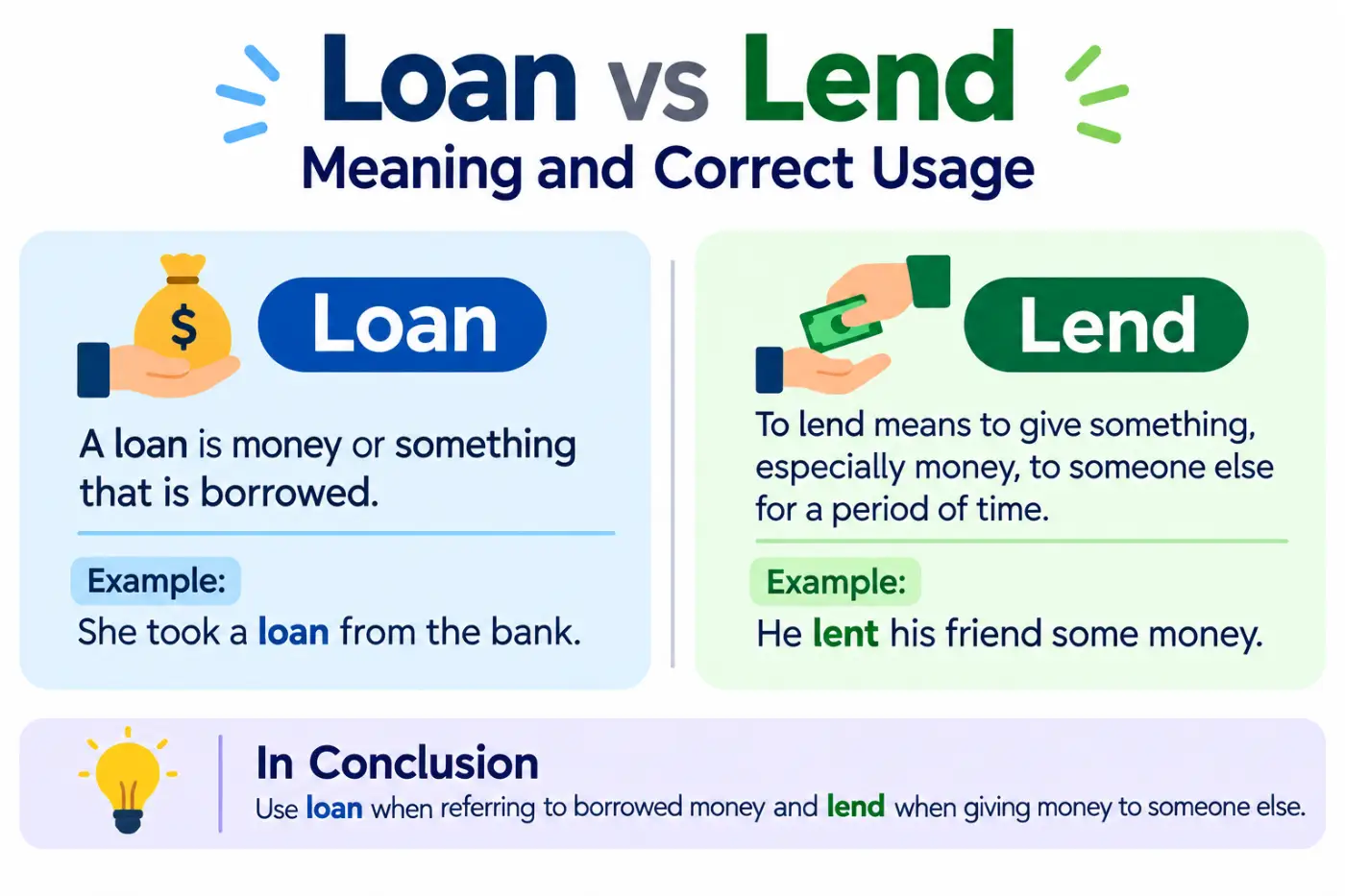
Loan vs lend is a common source of confusion because both words describe a similar action. If you give your friend $20 and expect the money back, you can say you lent your friend $20 or loaned your friend $20. Both sentences are standard American English. However, you would call the money you borrowed a loan, not a lend.
The difference becomes clearer when you look at grammar. Loan often names the money or arrangement itself, as in a car loan or a student loan. Lend describes the action of giving money or an item temporarily. Both words also appear in everyday conversations, workplace emails, banking documents, and school assignments, so choosing the right form helps your writing sound natural.
You don’t need to memorize a long list of complicated rules. Start by asking what your sentence needs. Are you naming money that someone borrows, or are you describing the act of giving something temporarily? Once you understand that distinction, you can use both words with confidence. You’ll also learn how their verb forms work, how they differ from borrow, and how to avoid mistakes that often appear in casual messages and formal writing.
Quick Answer
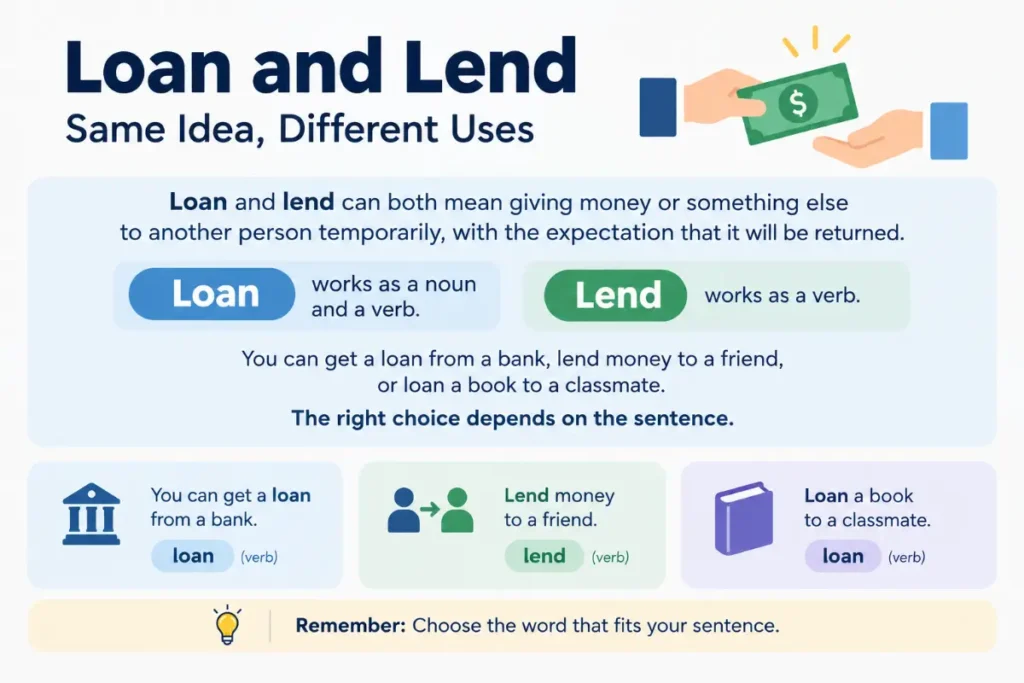
Loan and lend can both mean giving money or something else to another person temporarily, with the expectation that it will be returned. Loan works as a noun and a verb, while lend works as a verb. You can get a loan from a bank, lend money to a friend, or loan a book to a classmate. The right choice depends on the sentence.
Meaning and Definition
What Does Loan Mean
Loan has two main uses in modern English. It works as a noun and as a verb.
As a noun, a loan is money or another item that someone gives to another person temporarily, with an agreement or expectation that it will be returned. In financial settings, a loan often involves a lender, a borrower, repayment terms, and sometimes interest.
Examples include a mortgage loan, a car loan, a student loan, and a personal loan. In each phrase, loan names the financial arrangement or the money provided.
As a verb, loan means to give money or something else to another person temporarily. American English commonly uses this verb in everyday speech and writing.
Examples:
- The bank approved my loan.
- My aunt loaned me her car for the weekend.
- The credit union loaned him $5,000.
- Can you loan me a pen until class ends?
In the first sentence, loan is a noun because it names a financial arrangement. In the other sentences, it is a verb because it describes the act of giving something temporarily.
What Does Lend Mean
Lend is a verb that means to give money or an item to someone temporarily, expecting it to be returned. It can also describe providing help, support, or a quality that makes something more effective.
For example, you can lend someone money, lend a friend a book, lend support to a cause, or lend credibility to an argument.
Examples:
- I can lend you $20 until Friday.
- She lent me her notes before the exam.
- The bank lends money to qualified borrowers.
- His experience lends credibility to his advice.
The first three examples describe giving money or an item temporarily. The fourth uses lend in a broader sense. His experience adds credibility to his advice without being physically transferred to another person.
Unlike loan, lend does not normally function as a noun in standard modern English. You wouldn’t usually say that someone received a lend from a bank. You would say that the person received a loan.
Comparison Table for Loan and Lend
| Feature | Loan | Lend |
|---|---|---|
| Part of speech | Noun and verb | Verb |
| Main meaning | Money or an item provided temporarily; also the act of providing it | The act of giving money or an item temporarily |
| Present form | Loan or loans | Lend or lends |
| Past tense | Loaned | Lent |
| Past participle | Loaned | Lent |
| Present participle | Loaning | Lending |
| Common financial phrase | Apply for a loan | Lend money |
| Common object pattern | Loan someone something | Lend someone something |
| American English | Standard as a noun and verb | Standard as a verb |
| British English | Standard as a noun and verb | Standard as a verb |
| Example | She loaned me her laptop. | She lent me her laptop. |
The biggest difference is the role each word plays in a sentence. Loan can name a financial arrangement or describe an action. Lend describes an action and has different past tense forms.
Key Differences Explained
Difference in Meaning
Both verbs can describe giving something temporarily, but loan is also the name of the money or arrangement.
Consider these sentences.
- I need a loan to buy a car.
- My brother will lend me money for the down payment.
- The bank loaned the business enough money to expand.
The first sentence uses loan as a noun. The second uses lend as a verb. The third uses loan as a verb.
The words overlap in meaning when they describe an action. The noun use of loan makes it especially common in banking and personal finance.
Difference in Grammar
Loan can appear in two grammatical roles.
As a noun, it can be the subject or object of a sentence.
The loan was approved.
She repaid the loan.
As a verb, it describes an action.
The bank loaned us the money.
Lend is a verb.
The bank lent us the money.
You can use both verbs with a person and an item or amount of money.
The manager loaned Maria a laptop.
The manager lent Maria a laptop.
Both sentences are grammatical. The main difference lies in the verb form and the style of the sentence.
Difference in Verb Forms
The past tense is a frequent source of mistakes. Loan follows the regular pattern by adding ed. Lend is an irregular verb, so its past tense changes to lent.
| Verb form | Loan | Lend |
|---|---|---|
| Base form | Loan | Lend |
| Third person singular | Loans | Lends |
| Simple past | Loaned | Lent |
| Past participle | Loaned | Lent |
| Present participle | Loaning | Lending |
Here are examples of each form.
- I loan my brother tools when he needs them.
- She loans equipment to local schools.
- He loaned me his calculator yesterday.
- They have loaned the museum several paintings.
- I am loaning my bike to a neighbor this week.
Now compare the forms of lend.
- I lend books to my classmates.
- She lends money to family members.
- He lent me his jacket.
- They have lent their support to the project.
- We are lending equipment to the school.
Notice that you should write lent, not lended, when using the past tense of lend. This is a basic irregular verb pattern, much like send and sent.
Difference in Formality
Both verbs are standard English, but they may feel more natural in different settings.
Loan is especially common as a noun in financial and legal contexts. Banks advertise loans, borrowers repay loans, and lenders set loan terms. As a verb, loan is common in American English, including casual speech.
Lend is common in both conversation and formal writing. People lend money to friends, libraries lend books, and organizations lend support to projects.
Neither verb is automatically more formal or more correct. The best choice depends on the sentence, the intended meaning, and the style of the document.
Difference in Context
The context can make one form much more natural than the other.
Use the noun loan when discussing a financial product or a temporary arrangement.
The bank offered a low interest loan.
Use lend when focusing on the act of giving.
Could you lend me your notes?
Use loan as a verb when describing the same action, especially in American English.
Could you loan me your notes?
Both questions are acceptable. However, if you are naming the money itself, loan is the standard noun.
She received a loan from her credit union.
You wouldn’t normally replace loan with lend in that sentence.
Which Form Is Correct
Both words are correct English. Neither is a misspelling of the other.
Loan is the right choice when you need a noun for money or an item provided temporarily. It is also a standard verb in American English.
Lend is the right choice when you want to describe giving money or an item temporarily. Its past tense is lent, not lended.
The important point is that the words overlap as verbs but don’t share every grammatical use. If you write about a financial product, use loan as a noun. If you describe the act of giving something to another person, either verb may work, depending on your sentence.
For example, these sentences are all correct.
- I took out a loan to pay for my car.
- My parents lent me money for the car.
- My parents loaned me money for the car.
- The bank has lent money to the business.
- The bank has loaned money to the business.
The choice between the two verbs often comes down to style and regional preference rather than a difference in the basic action.
Sentence Examples
The following examples show how these words work in everyday and professional English.
Everyday Conversation
1. Can you lend me your phone for a minute?
Lend describes giving the phone to someone temporarily.
2. I loaned my neighbor a ladder last weekend.
Loaned is the regular past tense of the verb loan.
3. She lent me her umbrella because it was raining.
Lent describes an action that happened in the past.
Text Messages
4. Can you loan me $15 until payday?
Loan works as a verb in this casual American English question.
5. I lent him my charger, so ask him if he still has it.
Lent is the past tense of lend and refers to the charger given temporarily.
Work and School
6. The library lends laptops to students who need them.
Lends describes the library’s regular action of providing equipment temporarily.
7. Our office loaned the conference room projector to another department.
Loaned describes the temporary transfer of equipment between departments.
Academic and Formal Writing
8. The study examines how local banks lend money to small businesses.
Lend describes the action banks perform when they provide funds to borrowers.
9. The university received a loan to improve its research facilities.
Loan is a noun because it names the funding arrangement.
10. The museum has lent several paintings to a national exhibition.
Lent is the past participle used with has to describe a completed action with present relevance.
These examples show that context matters more than choosing one verb every time. Both forms can be natural when used with the correct grammar.
Common Mistakes and How to Fix Them
Using Lend as a Noun
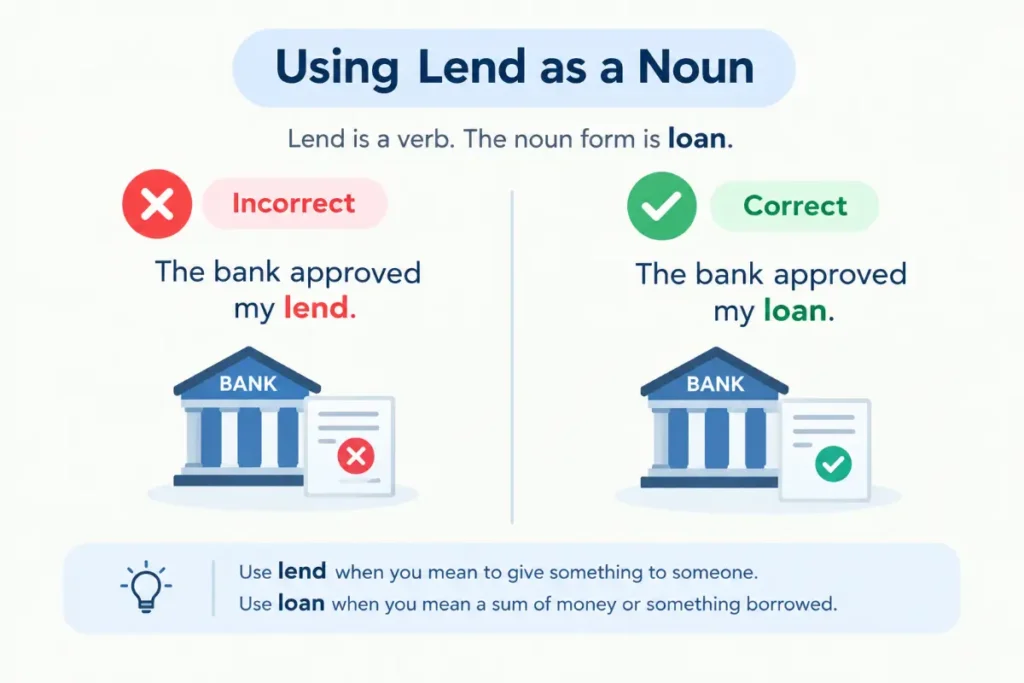
Incorrect: The bank approved my lend.
Correct: The bank approved my loan.
The noun loan names the money or financial arrangement. Lend is a verb, so it does not fit in this sentence.
Writing Lended Instead of Lent
Incorrect: She lended me her notes.
Correct: She lent me her notes.
Lend is an irregular verb. Its simple past and past participle are lent.
Assuming Loan Is Only a Noun
Incorrect: You can’t loan someone a book because loan is only a noun.
Correct: You can loan someone a book or lend someone a book.
Loan is commonly used as a verb in American English. Both versions are standard.
Confusing the Giver and the Receiver
Incorrect: Can I borrow you some money?
Correct: Can I lend you some money?
The person who gives the money lends it. The person who receives the money borrows it.
Using the Wrong Verb Form After Have
Incorrect: I have lended him my car.
Correct: I have lent him my car.
The present perfect tense uses have or has followed by the past participle. For lend, that form is lent.
Using Loaned in Place of Lent in Every Context
Loaned is correct as the past tense of loan. Lent is correct as the past tense of lend.
Both can work in sentences about giving something temporarily, but you should keep each verb’s forms consistent.
Correct: I loaned her my camera.
Correct: I lent her my camera.
Incorrect: I lended her my camera.
The last sentence uses the wrong past tense form.
Pronunciation Guide
Loan and lend are easy to distinguish when you know their vowel sounds.
How to Pronounce Loan
The American English pronunciation of loan is /loʊn/.
It rhymes with words such as phone, stone, and grown.
The word has one syllable. Start with the consonant sound represented by l, move into the long o sound, and finish with n.
An easy pronunciation guide is lohn.
How to Pronounce Lend
The American English pronunciation of lend is /lɛnd/.
It has one syllable and rhymes with send, bend, and friend in many common American pronunciations.
An easy pronunciation guide is lend, with the vowel sound found in bed.
Common Pronunciation Mistakes
Some learners confuse the words because they focus on their meanings rather than their sounds. Loan has a long o sound, while lend has a short e sound.
Another mistake is treating the past tense lent as if it rhymes with loaned. It doesn’t. Lent rhymes with sent, while loaned rhymes with toned.
Say the words aloud in short sentences to practice.
- I need a loan.
- Can you lend me a hand?
- She loaned me a book.
- He lent me a book.
Practicing the words in context can help you remember both the meaning and the pronunciation.
Etymology and Word Origin
The histories of these words help explain their different forms.
Loan entered English through Old Norse and related Germanic forms. It developed as a noun for something lent and later became common in financial expressions. The verb use also became established in English.
Lend comes from Old English lǣnan, meaning to lend or grant temporarily. It belongs to an older group of English verbs whose forms developed over time. The past tense lent reflects this older irregular pattern.
The two words share a related idea, but they followed different paths in English. Loan developed a strong role as a noun, especially in finance, while lend remained a common verb for giving something temporarily.
This history also explains why their past tense forms differ. Loan follows a regular pattern with loaned. Lend keeps the irregular form lent.
Regional Usage
American English
Both loan and lend are standard in the United States. Americans commonly use loan as a noun in financial settings and as a verb in everyday conversation.
For example, an American might say, Can you loan me your car? Another speaker might ask, Can you lend me your car? Both are natural.
The noun loan is especially common in expressions such as car loan, home loan, business loan, and student loan. Lend also appears frequently in phrases such as lend a hand, lend support, and lend money.
British English
British English uses both words, too. Loan is a noun, and it can also function as a verb. Lend is a standard verb for giving something temporarily.
For example, a British speaker might say, Could you lend me a pen? The speaker could also say, Could you loan me a pen? The second version is grammatically possible, although lend may sound more natural to many British speakers in everyday conversation.
The basic grammar remains the same in both varieties.
Australian English
Australian English also recognizes loan as a noun and a verb, along with lend as a verb. The words follow the same basic grammatical patterns used in American and British English.
In casual conversation, the preferred choice can depend on the speaker and context. There is no separate Australian spelling rule that makes one word incorrect.
Canadian English
Canadian English follows the same general distinction. Loan commonly appears in financial terms, while both verbs can describe giving something temporarily.
For example, a Canadian bank may offer a personal loan, and a person may lend a friend some money. The core meanings do not change across these varieties of English.
Grammar Rules and Sentence Patterns
Understanding the sentence structure makes it easier to choose the right form.
Loan as a Noun
A noun can act as the subject or object of a sentence. Loan commonly appears in both positions.
As a subject: The loan helped us pay for the repairs.
The noun loan is the subject because it performs the grammatical role of the main topic.
As an object: She repaid the loan last month.
The noun loan receives the action of the verb repaid.
You can also use loan after an article or adjective.
- A loan can help cover an unexpected expense.
- The bank approved a small loan.
- His new loan has a fixed interest rate.
These patterns are common in financial writing.
Loan as a Verb
As a verb, loan describes the act of giving something temporarily.
The basic patterns include:
- Loan someone something.
- Loan something to someone.
- Loan something for a period of time.
Examples:
The school loaned students tablets.
The school loaned tablets to students.
The library loaned me the book for two weeks.
All three patterns are grammatical. The first two focus on the recipient or the item. The third also tells you how long the arrangement lasts.
Lend as a Verb
Lend follows similar sentence patterns.
- Lend someone something.
- Lend something to someone.
- Lend someone money for a purpose.
Examples:
My sister lent me her bicycle.
My sister lent her bicycle to me.
The credit union lent us money for home repairs.
The patterns are similar, but remember that lend changes to lent in the past tense.
Using Prepositions Correctly
The preposition to often introduces the person receiving the item or money.
The bank lent money to the business.
The bank loaned money to the business.
You can also put the recipient directly after the verb.
The bank lent the business money.
The bank loaned the business money.
Both structures are correct. However, you should avoid adding an unnecessary preposition when the sentence already has a direct recipient.
Incorrect: She lent to me her book.
More natural: She lent me her book.
Also correct: She lent her book to me.
Negative Sentences and Questions
The same rules apply in questions and negative sentences.
Can you lend me your calculator?
Did the bank loan you the money?
I can’t lend you any cash right now.
The bank didn’t loan us enough money to complete the project.
Notice that questions with did use the base form of the verb. Write Did she lend you the money? rather than Did she lent you the money?
The same rule applies to loan. Write Did the bank loan you the money? rather than Did the bank loaned you the money?
Real Life Usage Examples
Daily Conversation
People often use these verbs when sharing things with friends or family.
- Can you lend me a few dollars for lunch?
- I loaned my cousin my old bicycle.
The first sentence asks for temporary help. The second describes an action that happened in the past.
Workplace Communication
These words can describe shared equipment or financial arrangements in an office.
- The finance team approved a loan for the new equipment.
- Our department lent the projector to the training team.
In the first sentence, loan names a funding arrangement. In the second, lent describes the temporary transfer of an item.
Academic Writing
Academic writing may use these verbs in discussions of banking, economics, or shared resources.
- Commercial banks lend money to individuals and businesses.
- The university received a loan to renovate its science laboratories.
The first sentence describes a general banking activity. The second identifies a financial arrangement.
News and Journalism
News reports often use loan as a noun when discussing financial matters.
- The company secured a loan to expand its operations.
- Local banks lent money to small businesses affected by the storm.
The first sentence reports that the company obtained financing. The second describes what the banks did.
Literature and Storytelling
Both verbs can help writers describe generosity, trust, and relationships.
- The old man lent the traveler his coat for the cold night.
- Her friend loaned her a bicycle so she could reach the village before sunset.
Each sentence describes a temporary act of giving. The items are expected to be returned, even though the story may not describe the return itself.
Eight Related Terms You Should Know
These related words can help you express the same ideas more precisely.
1. Borrow
Borrow means to receive money or an item temporarily, with the expectation of returning it. It describes the action from the receiver’s point of view.
Example: I borrowed $50 from my brother.
The brother gave the money. The speaker received it.
2. Lender
A lender is a person or organization that provides money to a borrower.
Example: The lender approved her application.
The lender is the party providing the funds.
3. Borrower
A borrower is a person or organization that receives money or something else temporarily.
Example: The borrower must make the scheduled payments.
The borrower receives the funds and follows the repayment terms.
4. Loan Agreement
A loan agreement is an arrangement that sets out the terms of a loan. It may identify the amount, repayment schedule, interest rate, and responsibilities of each party.
Example: Both parties signed the loan agreement.
The phrase names the arrangement that governs the borrowing.
5. Repay
Repay means to return borrowed money or settle a debt.
Example: She plans to repay the loan within three years.
Repay describes the action of returning the money.
6. Reimburse
Reimburse means to pay someone back for money they spent on your behalf or for an approved expense.
Example: The company reimbursed me for my travel costs.
Reimburse often involves paying back expenses rather than lending money.
7. Advance
Advance can mean money paid or provided before it is normally due. In some situations, an advance must be repaid or deducted from later payments.
Example: The employer gave him a salary advance.
An advance may resemble a loan, but the terms and purpose can differ.
8. Grant
A grant is money or assistance provided for a particular purpose, often without the standard repayment obligation associated with a loan.
Example: The school received a grant for its science program.
A grant usually does not need to be repaid if the recipient follows the grant’s conditions. Specific terms can vary.
Expert Editor Insight
Experienced editors look at the word’s grammatical role before changing it. They don’t automatically replace loan with lend because both can function as verbs in standard English. Instead, they check the intended meaning, the sentence structure, and the verb tense. Spelling tools may flag unusual forms such as lended, but a tool may not identify every context problem. Reading the entire sentence is still the best way to catch a word choice error.
Key Takeaways
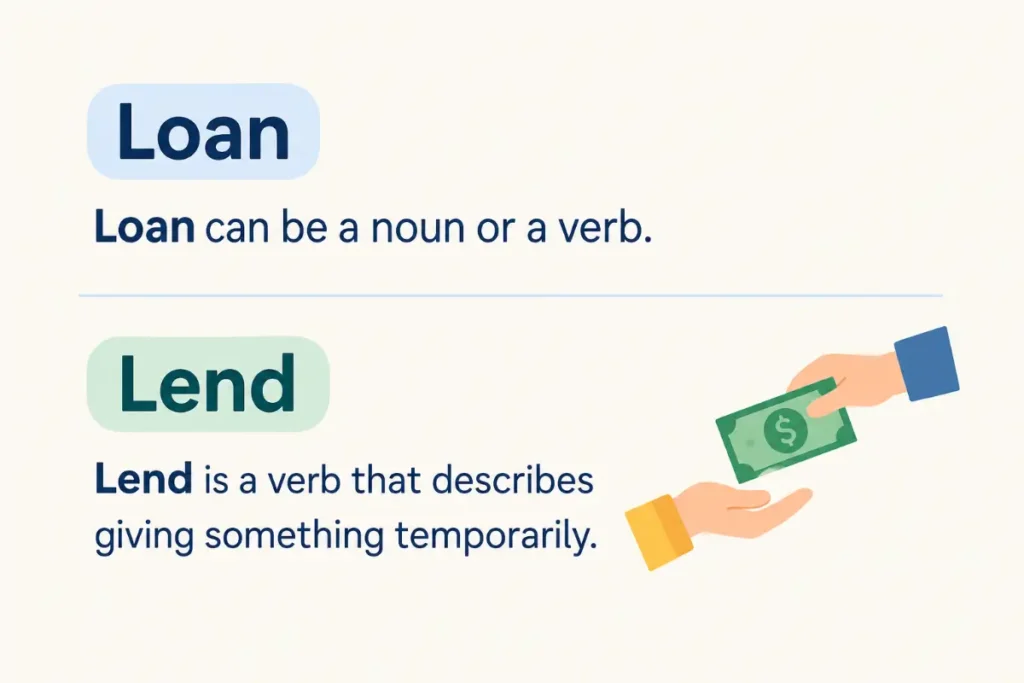
- Loan can be a noun or a verb.
- Lend is a verb that describes giving something temporarily.
- Both verbs can describe giving money or items with the expectation of return.
- The past tense of loan is loaned.
- The past tense of lend is lent.
- Loan is common in financial terms such as car loan and personal loan.
- Lend is common in expressions such as lend money, lend a hand, and lend support.
- Borrow describes receiving something, while loan and lend describe giving it.
- Both words are standard in American, British, Canadian, and Australian English.
- Choose the word based on its role in the sentence rather than assuming one verb is always correct.
Conclusion
Loan and lend share a meaning when they describe giving money or an item temporarily, but they don’t serve exactly the same grammatical purpose. Loan works as both a noun and a verb, while lend is a verb with the past tense lent. Both verbs are acceptable in American English when used correctly.
Use loan when naming money or a financial arrangement, and use lend when describing the act of giving something temporarily. Remember that the person who gives money lends or loans it, while the person who receives it borrows it. This simple distinction will help you choose the right word in conversation, schoolwork, emails, and professional writing.
FAQs
Is loan or lend correct in American English?
Both are correct in American English. Loan can be a noun or a verb, while lend is a verb. You can say that a bank approved a loan, that a friend lent you money, or that a friend loaned you money. The correct choice depends on the sentence and the meaning you want to express.
Is loan a real verb?
Yes. Loan is a standard verb meaning to give money or something else temporarily, with the expectation that it will be returned. For example, She loaned me her car for the weekend is correct American English. The word also works as a noun, as in She applied for a car loan.
What is the past tense of lend?
The past tense of lend is lent. For example, I lent my friend some money yesterday. Lent is also the past participle, so you can write, I have lent my friend some money. Lended is not the standard past tense of lend and should be avoided in ordinary English writing.
Can you use loan instead of lend?
Yes. In American English, loan can replace lend in many sentences about temporarily giving money or an item. For example, I loaned her my laptop and I lent her my laptop are both correct. However, loan also works as a noun, while lend does not normally have that function in modern standard English.
What is the difference between borrow and lend?
Lend describes giving something to another person temporarily. Borrow describes receiving something temporarily. If you give your friend $20, you lend the money. If your friend receives the $20 and agrees to return it, your friend borrows the money. The same distinction applies to books, tools, and other items.
How do you pronounce loan and lend?
Loan is pronounced /loʊn/ in American English and rhymes with phone. Lend is pronounced /lɛnd/ and rhymes with send. Both words have one syllable, but their vowel sounds differ. Loan has a long o sound, while lend has the short e sound heard in bed.
Is loan more formal than lend?
Neither word is always more formal than the other. Loan is especially common as a noun in financial and legal writing, such as a loan agreement or mortgage loan. Lend is common in both formal and informal English. In American conversation, loan is also widely used as a verb.
What is the difference between a loan and a grant?
A loan is money that the borrower generally must repay according to agreed terms. A grant is funding provided for a specific purpose and generally does not require repayment if the recipient follows its conditions. The exact requirements depend on the agreement. A loan creates a repayment obligation, while a grant usually provides financial support without one.
