
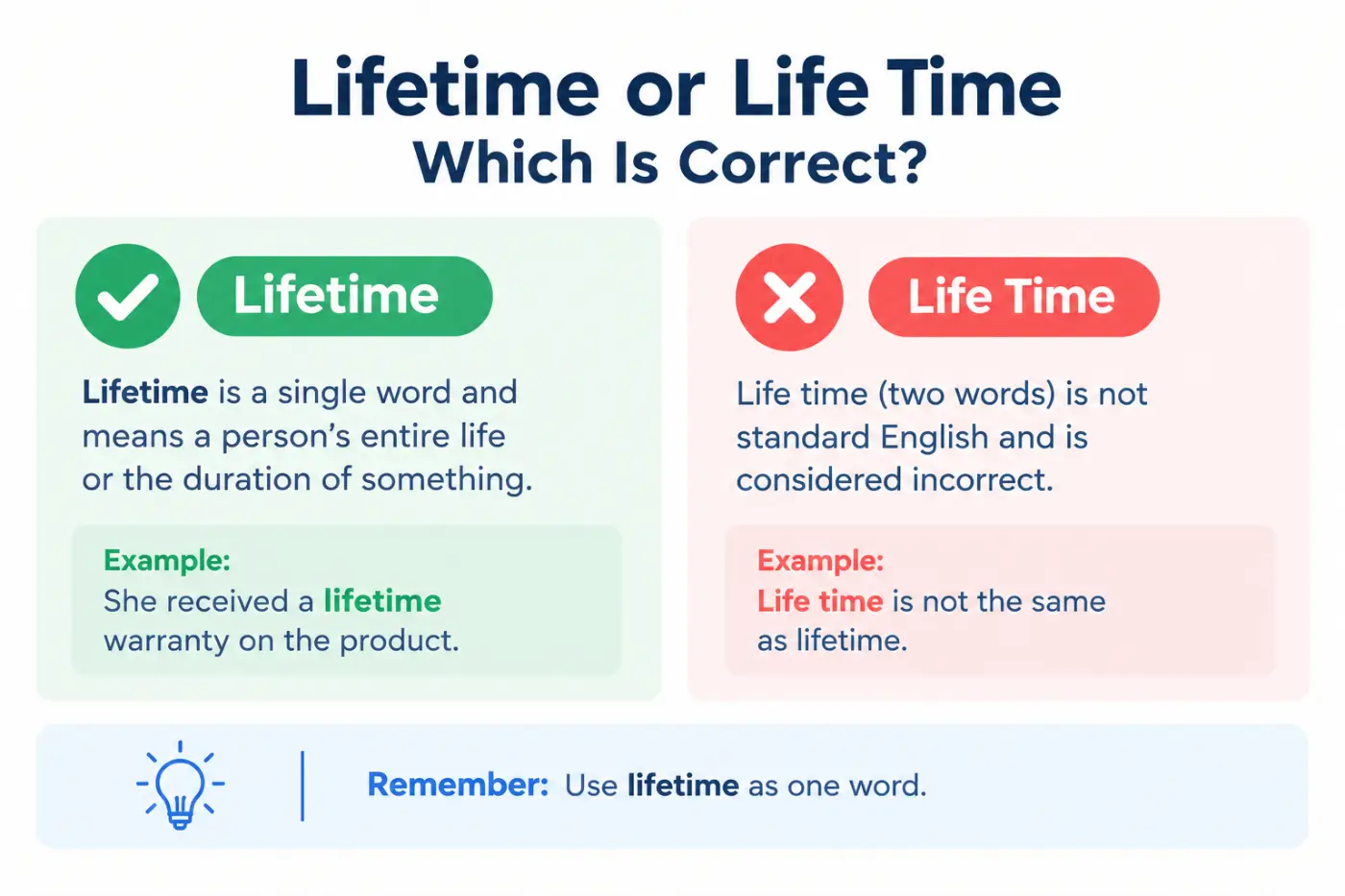
If you’ve ever paused while writing lifetime or life time, you’re not alone. English has many compound words that begin as separate words and later become one word. This pair can be confusing because both forms look reasonable, but they don’t always work the same way. In most everyday writing, lifetime is the correct and natural spelling.
The word refers to the period during which a person lives or something exists, operates, or remains relevant. You might talk about a lifetime of experience, a lifetime membership, a lifetime warranty, or a lifetime supply of a product. In these expressions, the one word spelling is standard in American English.
The two word form can still make sense in a sentence where life and time function as separate words. However, writers often use it by mistake when they mean the established compound noun. Understanding the difference will help you write more clearly in emails, school assignments, articles, product descriptions, and professional documents.
Quick Answer
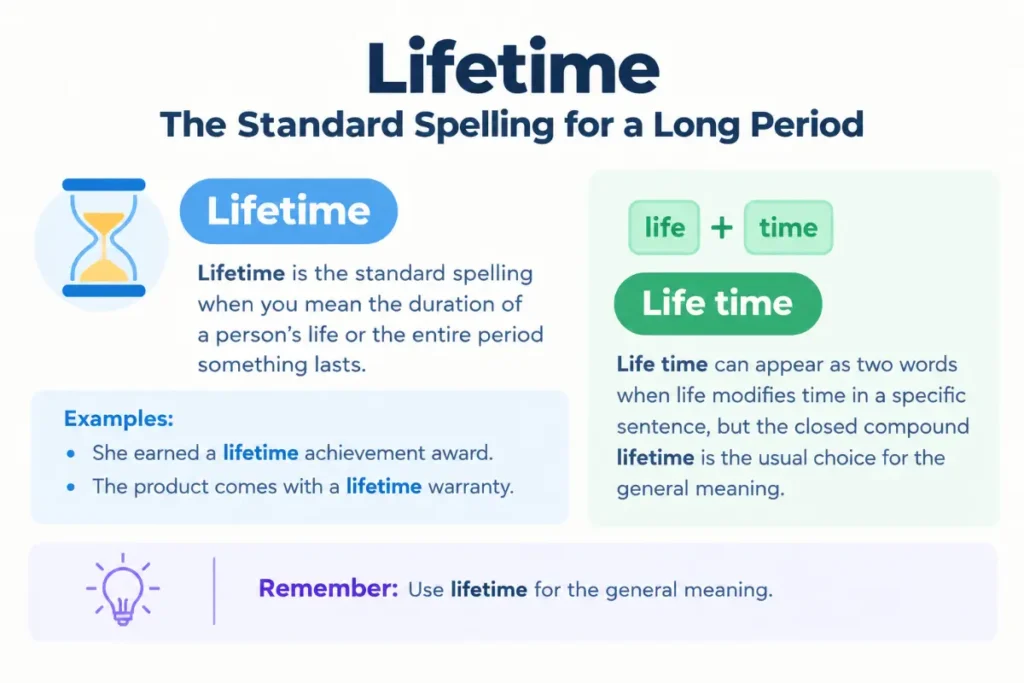
Lifetime is the standard spelling when you mean the duration of a person’s life or the entire period something lasts. For example, you might earn a lifetime achievement award or receive a lifetime warranty. Life time can appear as two words when life modifies time in a specific sentence, but the closed compound lifetime is the usual choice for the general meaning.
What Does Lifetime Mean
Lifetime is a noun that means the period during which a person lives or the full period during which something exists or remains active. It can also work as an adjective before another noun to describe something lasting for a person’s life or covering that entire period.
For example, a lifetime friend is someone who remains a friend throughout life. A lifetime warranty is a warranty that lasts for a defined lifetime, although the exact coverage depends on its terms. A lifetime achievement award recognizes a person’s work over a long period or across a career.
The meaning depends on context, but the central idea is duration. The word points to a complete span of time connected to a life, an object, a service, or an activity.
Meaning and Definition
The noun lifetime has several closely related uses.
- The duration of a person’s life. A person might accomplish many things during a lifetime. Here, the word refers to the period from birth to death.
- The period during which something exists. The lifetime of a building, machine, or product refers to how long it exists or remains useful.
- The full period of a particular experience or relationship. A lifetime of learning means learning that continues across many years or throughout a person’s life.
- A long or seemingly extraordinary period. In casual speech, someone might say, It took a lifetime to finish that line. The speaker usually means that the wait felt extremely long, not that an actual life had passed.
As an adjective, lifetime describes something associated with the full period of a life or a specified long term.
Examples include lifetime membership, lifetime access, lifetime earnings, and lifetime achievement.
The word doesn’t always promise that something will last forever. A lifetime warranty, for example, may cover only the product’s expected useful life or the original owner’s period of ownership. The written terms determine what the warranty actually covers.
Comparison Table for Lifetime or Life Time
| Feature | Lifetime | Life time |
|---|---|---|
| Standard spelling | Yes | Not usually used for the established compound meaning |
| Main meaning | The duration of a life or the full duration of something | Life and time used as separate words in a particular sentence |
| Part of speech | Noun or adjective | A noun phrase formed from two words |
| American English | Standard and preferred for the general meaning | Uncommon for the general meaning |
| British English | Standard | Usually unnecessary for the general meaning |
| Common contexts | Lifetime warranty, lifetime achievement, lifetime membership | Special sentence structures where life and time retain separate meanings |
| Example | She received a lifetime achievement award. | The life time available for the experiment was limited. This wording is unusual and should normally be rewritten for clarity. |
The practical rule is straightforward. Use lifetime when you mean the duration of a life or the complete period something lasts. Use the two word form only when the sentence genuinely requires life and time to remain separate.
Which Spelling Is Correct
For ordinary writing, lifetime is the correct choice. It is the established compound spelling used for the duration of a life and for related expressions such as lifetime warranty and lifetime achievement.
English compounds often develop over time. A combination may begin as two words, become hyphenated in some uses, and eventually settle into a closed compound. Lifetime is an established closed compound in modern English.
You should write:
- She has a lifetime of experience in teaching.
- The product comes with a lifetime warranty.
- He received a lifetime achievement award.
- They formed a friendship that lasted a lifetime.
- The machine has a long expected lifetime.
In these examples, the one word form communicates the intended meaning directly.
Writing life time in the same contexts is generally unnecessary and may look like a spelling error. A reader will usually understand what you mean, but standard spelling makes the sentence look polished and professional.
How to Use Lifetime Correctly
The word fits several common grammatical patterns. Learning these patterns is often more useful than memorizing a spelling rule alone.
Lifetime as a Noun
As a noun, the word names a period of time.
Examples:
- She spent a lifetime studying music.
- A lifetime is not always long enough to learn everything.
- He has collected books for a lifetime.
- The device has a limited lifetime.
- They shared a lifetime of memories.
In each sentence, the word names a period. It can appear after a verb, after an article, or in a phrase that describes experience or duration.
Lifetime as an Adjective
The word can also describe a noun that follows it.
Examples:
- He received a lifetime membership.
- The company offers lifetime access to selected materials.
- She earned a lifetime achievement award.
- The product includes a lifetime warranty.
- They became lifetime supporters of the organization.
In these expressions, lifetime modifies the noun that follows. It tells the reader that the membership, access, award, warranty, or support relates to a long or life spanning period.
Lifetime in Everyday Expressions
Several expressions use the closed compound so often that it’s best to learn them as complete phrases.
- A lifetime of experience.
- A lifetime achievement award.
- A lifetime warranty.
- A lifetime supply.
- A lifetime membership.
- A lifetime opportunity.
- A lifetime of memories.
- A lifetime goal.
These expressions appear in everyday conversation, marketing, news reports, and professional writing. The spelling remains one word in each.
Ten Natural Example Sentences
The following examples show how the word works in different settings.
- Everyday conversation: I’ve known her for a lifetime. The speaker means that the friendship has lasted a very long time, perhaps since childhood.
- Family life: My grandparents shared a lifetime of memories. The phrase describes experiences collected over many years together.
- Workplace writing: She received a lifetime achievement award for her work in public education. The award recognizes accomplishments built over a long career.
- Product description: This tool comes with a lifetime warranty. The sentence describes a warranty, but its actual length and coverage depend on the seller’s terms.
- School assignment: The novel follows the character’s development over a lifetime. The word describes the full span of the character’s life.
- Academic writing: The study examined the lifetime of the material under different conditions. Here, the word refers to how long the material remains useful or functional.
- Email communication: Please keep your account details safe for the lifetime of your subscription. The sentence connects the period to the subscription rather than to a human life.
- Social media: Meeting my favorite author was a once in a lifetime experience. In this common expression, the event is presented as rare or unlikely to happen again. In formal editing, the phrase is often written as once in a lifetime experience without hyphens when it functions as a noun phrase.
- News reporting: The scientist received recognition for a lifetime of research. The phrase summarizes work performed over many years.
- Personal reflection: It took a lifetime to understand what mattered most to me. This is figurative language that emphasizes how long the process seemed to take.
These examples show that the same spelling works for literal duration, professional recognition, product terms, and figurative expressions.
Common Mistakes and Misspellings
Writers often make mistakes with compound words because English spelling doesn’t follow one universal rule. The following errors are easy to prevent.
Writing Life Time for the General Meaning
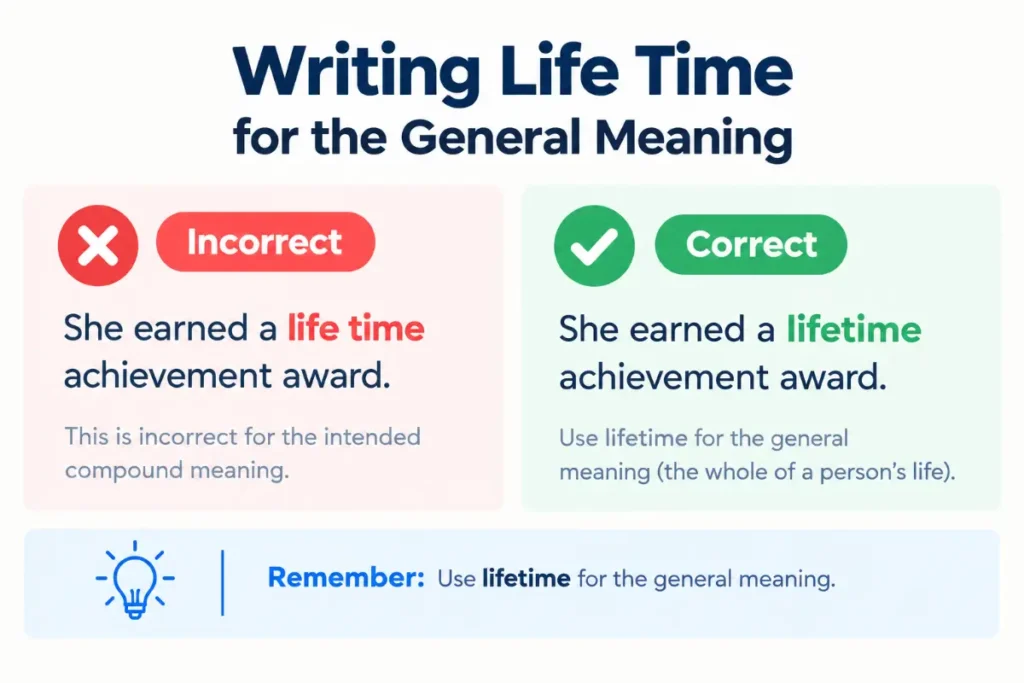
Incorrect for the intended compound meaning: She earned a life time achievement award.
Correct: She earned a lifetime achievement award.
The expression is an established compound, so the one word spelling is preferred.
Adding an Unnecessary Hyphen
Incorrect in standard general usage: He received a life-time membership.
Correct: He received a lifetime membership.
The closed compound is the usual modern spelling. Avoid inserting a hyphen unless a specific publication or established name requires it.
Confusing Lifetime With Lifelong
These words are related but not identical in grammar.
Less natural: She is a lifetime learner.
More natural: She is a lifelong learner.
Lifelong is the usual adjective for something continuing throughout a person’s life. Lifetime is more commonly used in phrases such as lifetime membership or a lifetime of learning.
Using Lifetime When You Mean a Short Period
Unclear: The battery has a lifetime of two hours.
Clearer: The battery life is two hours.
Lifetime can describe how long a device or component lasts, but battery life is the more natural expression when reporting the time a charge lasts.
Misunderstanding Warranty Coverage
Potentially misleading: The warranty covers everything for a lifetime.
Clearer: The product includes a lifetime warranty subject to the stated terms.
The word lifetime doesn’t define every legal or practical detail. Warranty coverage can depend on the product, the owner, exclusions, and the manufacturer’s policy.
Pronunciation Guide
Lifetime is pronounced with two syllables in standard American English.
IPA: /ˈlaɪf.taɪm/
Easy pronunciation: LIFE time.
The first syllable receives the main stress. The word combines the familiar sounds of life and time, so most English speakers find it easy to say once they recognize the spelling.
The spelling does not change the pronunciation in any meaningful way when someone mistakenly writes the expression as two words. That similarity is one reason the error can go unnoticed during proofreading.
To remember the correct written form, focus on how the word functions rather than how it sounds. When it names the duration of a life or the full duration of something, write it as one word.
Etymology and Word Origin
Lifetime is formed from the words life and time. Life comes from Old English līf, which referred to life or living existence. Time comes from Old English tīma, a word connected with a period or interval.
English has a long history of forming compounds by combining familiar words. In this case, life identifies the kind of period being discussed, while time contributes the idea of duration. Together, they form a word for the span of a life or a comparable period.
The modern closed compound reflects established English spelling. You don’t need to know the historical details to use it correctly, but the structure helps explain its meaning. A lifetime is a time span associated with life.
Regional Usage
American English
In American English, lifetime is the standard spelling for the general meaning. It’s used in personal writing, professional documents, product descriptions, education, journalism, and everyday conversation.
Common examples include lifetime warranty, lifetime achievement, lifetime membership, and lifetime supply. The two word form is not the normal choice for these expressions.
British English
British English also uses lifetime as the standard closed compound. There is no major spelling difference between American and British English for this word.
Writers in both varieties use it for the duration of a person’s life and for the useful or active period of an object or service.
Canadian English
Canadian English follows the same general pattern. Lifetime is the standard spelling in ordinary writing, including professional and educational contexts.
Australian English
Australian English also generally uses the one word form. The meaning and spelling remain consistent across these major English varieties.
The important point is that this is not a regional spelling dispute. The closed compound is the normal choice in all four varieties.
Grammar Rules and Part of Speech
Understanding the word’s grammatical role helps you place it correctly in a sentence.
Lifetime as a Countable Noun
Lifetime can be countable when referring to one person’s life span or a defined period of existence.
Examples:
- She achieved more in her lifetime than she expected.
- The product has an estimated lifetime of ten years.
- He has made several close friends over two lifetimes of family generations.
The third example is awkward because lifetimes would need a clear referent. A better sentence would be: The family has preserved the tradition across several generations. This shows why grammar and meaning should be checked together.
Lifetime as a Modifier
Lifetime can come before another noun.
Examples:
- Lifetime access.
- Lifetime membership.
- Lifetime earnings.
- Lifetime achievement.
- Lifetime coverage.
This pattern is common in product descriptions and formal expressions. The word functions as a modifier, telling the reader what kind of access, membership, earnings, achievement, or coverage is involved.
The Difference Between Lifetime and Lifelong
Lifetime is commonly a noun and can also work as a modifier. Lifelong is an adjective.
Compare these sentences.
- She has a lifetime of experience.
- She is a lifelong learner.
The first sentence uses lifetime as a noun in the phrase a lifetime of experience. The second uses lifelong to describe the person as someone who continues learning throughout life.
Both expressions relate to long duration, but their grammatical patterns differ.
The Difference Between Lifetime and Life Span
Lifespan is another closed compound. It refers to the length of time a person, animal, organism, or object is expected to live or exist.
Lifetime and lifespan overlap, but lifespan is often used in scientific or biological contexts. Lifetime is more flexible in everyday expressions and can also refer to experiences, achievements, memberships, and services.
For example, researchers may study the lifespan of a species, while a person may describe a lifetime of work.
Real Life Usage Examples
Daily Conversation
People often use lifetime to describe a long period or a rare experience.
- It feels like a lifetime since we last met. This means the speaker feels that a long time has passed.
- I’ve learned a lifetime’s worth of lessons from my mistakes. The expression emphasizes the amount of experience gained.
Workplace Communication
In professional settings, the word often appears in awards, service terms, and product information.
- The organization presented him with a lifetime achievement award. The award recognizes long term contributions.
- Please review the lifetime access terms before purchasing the course. The sentence refers to the duration and conditions of access.
Academic Writing
Academic writing may use lifetime to describe a period of research or an object’s useful life.
- The researchers measured the lifetime of the particles under controlled conditions. The term describes how long the particles persisted.
- The paper examines the effects of stress over a lifetime. The word refers to a long period across an individual’s life.
News and Journalism
News reports often use the word for career achievements or unusually rare events.
- The athlete received a lifetime honor for outstanding service to the sport. The phrase highlights recognition for sustained contributions.
- The discovery offered scientists a once in a lifetime opportunity to study the rare event. The expression emphasizes how unusual the opportunity was.
Literature and Storytelling
Writers use lifetime both literally and figuratively.
- She spent a lifetime searching for the home she remembered from childhood. The word describes a long personal journey.
- In a single afternoon, he seemed to learn lessons that would guide him for a lifetime. Here, the word points to the lasting value of the experience.
Related and Confused Terms
These eight terms can help you choose the most precise word for duration.
Lifelong
Lifelong is an adjective meaning continuing throughout a person’s life.
Example: They formed a lifelong friendship.
Use it to describe a person, habit, interest, commitment, or relationship that continues for life.
Lifespan
Lifespan means the length of time a person, organism, or object lives or exists.
Example: The species has a short lifespan.
This word is common in biology, health research, and discussions of product durability.
Life Expectancy
Life expectancy refers to the average number of years a person or group is expected to live under particular conditions.
Example: Life expectancy can vary across populations.
Unlike lifetime, the phrase often appears in statistics and public health discussions.
Duration
Duration means the length of time something lasts.
Example: The duration of the film is two hours.
This is a general term and doesn’t specifically connect the period to a person’s life.
Life Span
Life span is also used as two words in some dictionaries and style conventions, although lifespan is a common closed spelling. If you need a consistent style, check your chosen dictionary and apply its preferred form throughout the document.
Example: The life span of the device depends on how it is used.
Lifelong Learning
Lifelong learning means continuing to gain knowledge and skills throughout life.
Example: Lifelong learning helps workers adapt to new responsibilities.
This expression is especially common in education and career development.
Long Term
Long term describes a period extending over a relatively long time. As a compound modifier before a noun, it is often written long term or long term with a hyphen depending on the style guide and grammatical construction. In accordance with a no hyphen style, writers can often rephrase the sentence.
Example: The project requires a long term plan.
Everlasting
Everlasting means lasting forever or for a very long time.
Example: Their story became an everlasting symbol of hope.
It is more emphatic than lifetime and may suggest permanence rather than a defined life span.
Expert Editor Insight
An experienced editor treats lifetime as the default spelling when the word means the span of a life or the full period something lasts. The confusion happens because English compounds aren’t always written consistently, and spelling tools may focus on whether a sequence is possible rather than whether it fits the sentence. During proofreading, check the meaning first, then confirm the established spelling in a reliable dictionary. For product claims such as lifetime warranty, also verify the actual terms instead of assuming the word promises permanent coverage.
Conclusion
Use lifetime as one word when you mean the duration of a person’s life or the full period something lasts. It is the standard spelling in American English and in other major varieties of English. Expressions such as lifetime warranty, lifetime achievement, and lifetime membership all use the closed compound. The two word form is rarely needed for this general meaning.
To avoid mistakes, check how the word functions in your sentence and learn common expressions as complete phrases. A simple memory tip works well: when life and time combine to name one span of duration, write lifetime as one word.
FAQs
Is lifetime one word or two words?
Lifetime is normally one word when you mean the duration of a person’s life or the full period something lasts. It is the standard spelling in expressions such as lifetime warranty, lifetime membership, and lifetime achievement. The two word form is unusual for this established meaning, so use the closed compound in ordinary American English.
Is life time a real word?
Life and time are both real English words, but life time is not the usual spelling of the established compound noun. In most sentences about a person’s life span or the duration of an object, lifetime is the standard form. Separate wording may be possible in a special sentence, but writers should avoid splitting the compound without a clear grammatical reason.
What does lifetime mean?
Lifetime means the period during which a person lives or the full period during which something exists or remains active. It can also describe a product term, membership, achievement, or experience associated with a long or life spanning period. The exact duration of a warranty or service depends on its written terms.
Is lifetime correct in American English?
Yes. Lifetime is the standard spelling in American English. It is also widely accepted in British, Canadian, and Australian English. There is no major regional spelling difference for the general meaning. Writers should use the one word form in standard expressions such as lifetime achievement, lifetime warranty, and lifetime supply.
How do you pronounce lifetime?
Lifetime has two syllables and is pronounced LIFE time. Its IPA transcription in standard American English is /ˈlaɪf.taɪm/. The main stress falls on the first syllable. The pronunciation is straightforward because the word combines the familiar sounds of life and time.
What is the difference between lifetime and lifelong?
Lifetime is usually a noun that refers to the duration of a life or another full period. Lifelong is an adjective describing something that continues throughout life. You can say a lifetime of experience or a lifelong interest. The words are related, but their grammatical roles and common sentence patterns differ.
Is lifetime warranty always valid for life?
No. A lifetime warranty does not automatically cover every repair or last forever under every circumstance. The seller or manufacturer defines the warranty’s coverage, limits, exclusions, and duration. Some warranties are tied to the original owner or the expected useful life of the product. Read the actual warranty terms before relying on the claim.
Can lifetime be used as an adjective?
Yes. Lifetime can modify a noun in expressions such as lifetime membership, lifetime access, lifetime achievement, and lifetime earnings. In these phrases, it describes the type or duration of the thing that follows. Lifelong is often more natural when describing a person or activity that continues throughout life, as in lifelong learner.
