
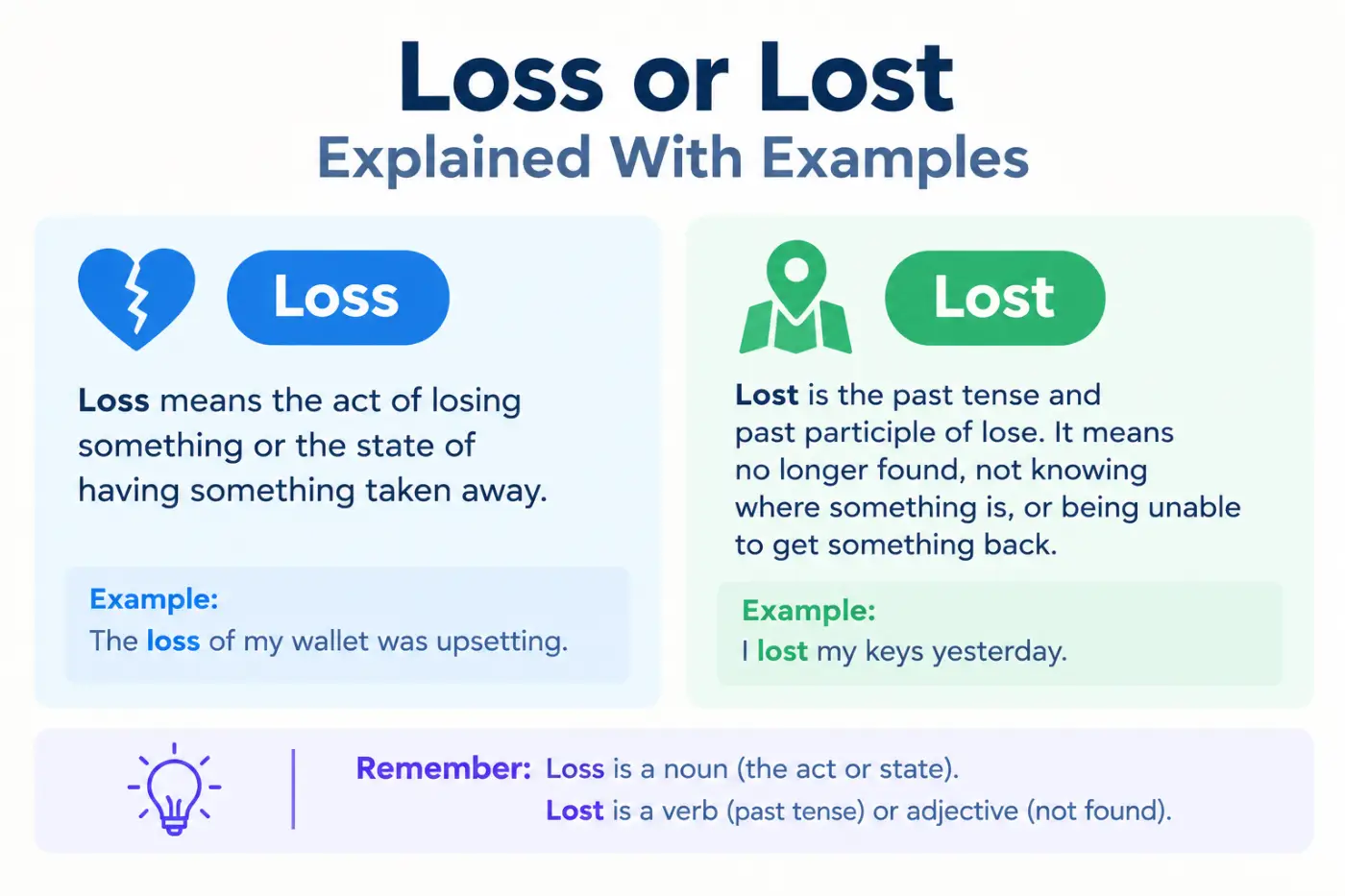
Loss or lost can be confusing because both words relate to losing something. They share similar spelling and meaning, but they perform different jobs in a sentence. The correct choice depends on what you want to say. Use loss when you need a noun and lost when you need the past form of the verb lose or an adjective describing something missing.
For example, you might say, “The team suffered a loss” after a game. You would say, “The team lost the game” to describe what happened. Both sentences express a similar idea, but their grammar differs. Using the wrong form can make a sentence sound awkward or incorrect, especially in school assignments, emails, reports, and professional writing.
The good news is that you don’t need to memorize a long list of complicated rules. Once you understand the difference between a noun, a verb, and an adjective, choosing the right spelling becomes much easier. You’ll also learn how to use these words in everyday conversation, recognize common mistakes, pronounce them correctly, and remember the difference when writing quickly.
Quick Answer
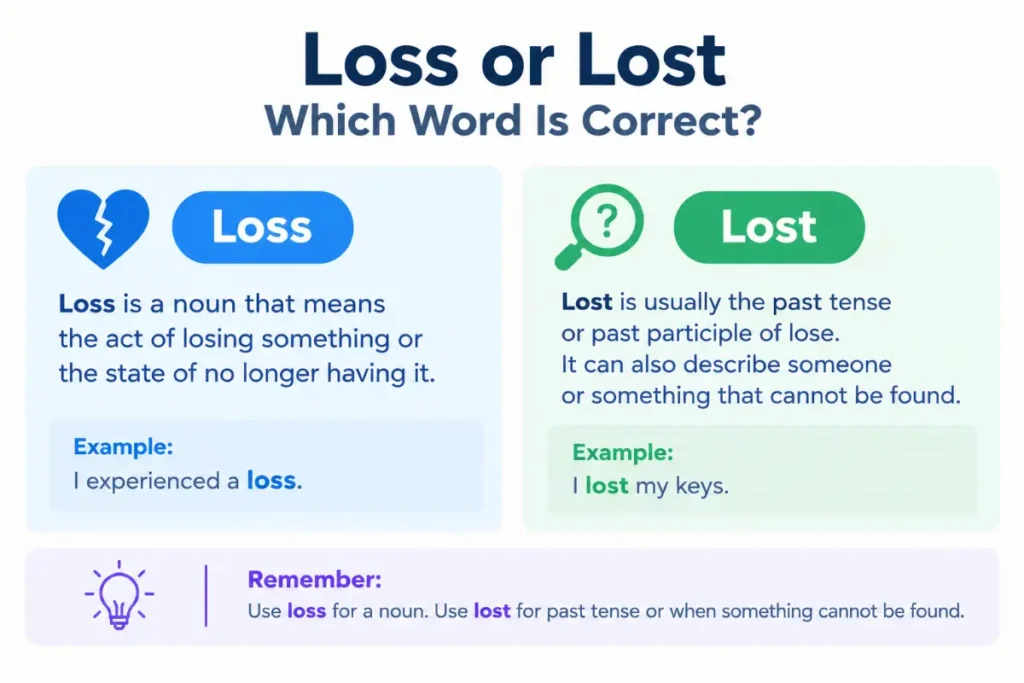
Loss is a noun that means the act of losing something or the state of no longer having it. Lost is usually the past tense or past participle of lose. It can also describe someone or something that cannot be found. Write “I experienced a loss” but “I lost my keys.”
Understanding the Meaning of Loss
Loss is a noun that refers to the act of losing something, the state of no longer having something, or the amount by which something has decreased. It can describe losing money, property, a competition, an opportunity, a relationship, or a person.
The word can also describe an emotional experience. For example, the loss of a loved one can cause deep sadness. In business, a company may report a financial loss when its expenses exceed its income. In sports, a loss means a defeat.
Consider these examples.
- The company reported a loss of $5,000 last month.
- She felt a deep sense of loss after her friend moved away.
- The team suffered its first loss of the season.
- The storm caused a significant loss of property.
In each sentence, loss names an event, condition, result, or amount. It doesn’t describe the action through a verb form.
Loss as a Noun
A noun names a person, place, thing, event, condition, or idea. Loss belongs to this category because it names the result or experience of losing something.
You can often place words such as a, the, this, that, or significant before it.
For example:
- The loss was unexpected.
- We experienced a serious loss.
- Her financial loss affected the family.
- The company worked to prevent further loss.
These patterns help you recognize the noun. The word loss often appears after an article or adjective because it names the thing being discussed.
Loss can be countable or uncountable depending on its meaning and context. You can talk about a loss in a game, several losses during a season, or the loss of a particular opportunity. You can also use it more generally in phrases such as loss of confidence or loss of control.
Common Expressions With Loss
English uses loss in many familiar expressions. Learning these combinations makes it easier to recognize the word in natural sentences.
- Financial loss. This means money has been lost or a financial situation has become worse. For example, the store suffered a financial loss after the flood.
- Loss of appetite. This means someone no longer feels as interested in eating as usual. For example, the patient reported a loss of appetite.
- Loss of control. This means someone can no longer manage a situation or direct an action. For example, the driver lost control of the car, resulting in a loss of control over the vehicle.
- Loss of confidence. This means someone no longer feels as sure of their ability. For example, repeated criticism led to a loss of confidence.
- At a loss. This expression means confused or unsure about what to do or say. For example, I was at a loss for words after hearing the news.
- Net loss. This refers to the amount by which expenses exceed income over a particular period. For example, the business recorded a net loss for the quarter.
- Weight loss. This means a reduction in body weight. For example, the doctor discussed the patient’s unexpected weight loss.
- Loss of life. This is a formal expression for deaths resulting from an event. For example, the rescue team worked to prevent further loss of life.
These expressions show that loss has several related meanings. However, it remains a noun in each example.
Understanding the Meaning of Lost
Lost is the past tense and past participle of the verb lose. It describes an action that happened in the past or forms part of a verb phrase. Lost can also function as an adjective meaning missing, unable to find one’s way, or unable to understand a situation.
For example, “I lost my wallet yesterday” describes a past action. “My wallet is lost” describes its current state. The spelling stays the same, but the grammatical function changes with the sentence.
Lost as a Verb
When lost functions as a verb, it tells you what someone or something lost in the past.
Consider these examples.
- I lost my phone on the bus.
- She lost the final match.
- They lost their tickets before the concert.
- Our team lost three games last month.
In each sentence, lost describes an action that occurred in the past. The base verb is lose, and its simple past form is lost.
The past participle is also lost. You use it with helping verbs such as have, has, had, and be.
For example:
- I have lost my keys.
- She has lost interest in the project.
- They had lost their way before sunset.
- The documents were lost during the move.
These examples show different grammatical patterns. The form lost stays the same, but the helping verb and sentence structure determine how it functions.
Lost as an Adjective
Lost can also describe a condition rather than an action. As an adjective, it commonly means missing, confused, unable to find the right direction, or unsure how to proceed.
For example:
- The lost child waited beside the information desk.
- I felt lost during the first week of college.
- We found the lost package behind the counter.
- He looked lost during the complicated discussion.
In the first and third examples, lost describes something or someone that cannot be found. In the second and fourth, it describes confusion or uncertainty.
The adjective can appear before a noun or after a linking verb.
Before a noun: The lost dog returned home.
After a linking verb: The dog was lost.
The word can also appear after verbs such as seem and look.
For example, she seemed lost during the lesson. This means she appeared confused or unable to follow what was happening.
The Main Differences Explained
The most useful distinction is grammatical rather than visual. Loss names the result or experience of losing something. Lost usually describes a past action, a completed action, or a state of being missing.
| Feature | Loss | Lost |
|---|---|---|
| Main part of speech | Noun | Verb form or adjective |
| Basic meaning | The act or result of losing | Lost something in the past or is missing |
| Base verb | Lose | Lose |
| Common pattern | A loss or the loss of something | Lost something or something is lost |
| Example | The loss was painful. | I lost my bag. |
| Adjective use | Not normally used as an adjective | The lost bag was found. |
| Pronunciation | One syllable | One syllable |
| Common context | Defeat, damage, grief, financial decline | Past actions, missing items, confusion |
A Simple Grammar Comparison
Compare these pairs to see the difference clearly.
Pair One
Correct: The loss was unexpected.
Correct: We lost the game.
The first sentence names a result. The second tells you what happened.
Pair Two
Correct: She experienced a loss of confidence.
Correct: She lost confidence in herself.
Both sentences communicate a similar idea. The first uses the noun loss, while the second uses the verb lost.
Pair Three
Correct: The loss of the document caused a delay.
Correct: The document was lost during the move.
The first sentence treats the event as a noun phrase. The second uses lost as part of a passive verb construction.
Pair Four
Correct: The company reported a financial loss.
Correct: The company lost money.
The meaning is closely related, but the grammar changes. The noun loss names the financial result, while lost describes the company’s past action or experience.
Which Form Is Correct
Both forms are correct English words. Neither is a misspelling of the other. The right choice depends on the meaning and grammatical structure of your sentence.
Use loss when you need a noun.
For example, “The loss of the contract affected the company.” Here, loss names the event of no longer having the contract.
Use lost when you need the past tense or past participle of lose.
For example, “The company lost the contract.” Here, lost describes what happened.
You can also use lost as an adjective.
For example, “The lost contract was difficult to replace” could describe a contract that is no longer available or has been misplaced, depending on context.
A helpful editing test is to replace the word with a simple alternative. If you can replace it with defeat, damage, or the act of losing, the noun loss may fit. If you can replace it with misplaced, failed to keep, or no longer had, lost may be appropriate.
This test is useful, but sentence structure should guide your final choice.
Ten Natural Sentence Examples
The following examples show how these words work in everyday and professional situations.
- Everyday conversation: I lost my sunglasses at the beach. The word lost describes a past action involving an item that the speaker can no longer find.
- Text message: Sorry, I lost track of time and forgot to call. The phrase lost track of time means the speaker stopped noticing how much time had passed.
- Workplace communication: The company reported a loss after sales declined. Loss names the negative financial result.
- School assignment: The team lost the final match by two points. Lost is the past tense of lose and describes a defeat.
- Formal writing: The loss of public trust can affect an organization’s reputation. Loss refers to the state of no longer having public trust.
- Social situation: She felt lost when she arrived at the unfamiliar event. Lost functions as an adjective describing confusion or discomfort.
- Online communication: I have lost access to my account and need help recovering it. The present perfect construction uses have with the past participle lost.
- Family life: The family experienced a painful loss last year. Loss names an emotionally difficult experience.
- Sports reporting: The team’s latest loss ended its winning streak. Loss is a noun referring to a defeat.
- Travel: We got lost while driving through the countryside. Lost describes the state of being unable to find the correct route.
Notice that the noun often appears after a determiner or adjective, while the verb form often appears after a subject. This pattern can help you choose the correct word when editing your own sentences.
Common Mistakes and Misspellings
Writers sometimes confuse these forms because they share a meaning and contain similar letters. Here are five mistakes to watch for.
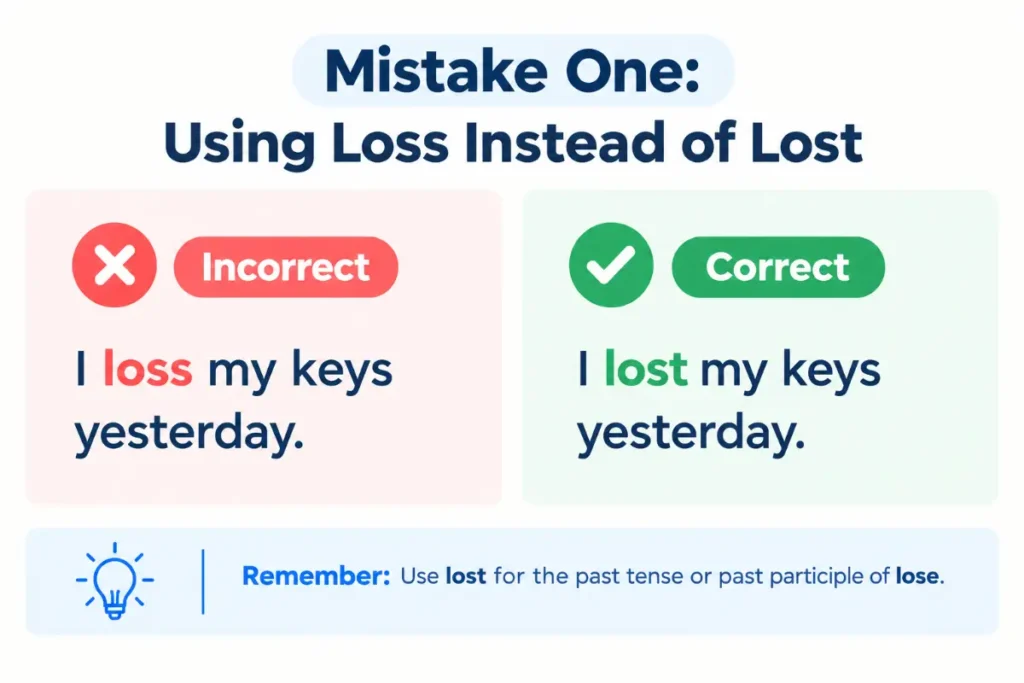
Mistake One Using Loss Instead of Lost
Incorrect: I loss my keys yesterday.
Correct: I lost my keys yesterday.
The sentence describes an action that happened in the past, so it needs the past tense of lose. Loss is a noun and cannot replace the verb in this structure.
Mistake Two Using Lost Instead of Loss
Incorrect: The company suffered a lost.
Correct: The company suffered a loss.
The verb suffered needs a noun as its object in this sentence. Loss names the negative result, while lost is a verb form or adjective.
Mistake Three Writing I Have Loss My Phone
Incorrect: I have loss my phone.
Correct: I have lost my phone.
The helping verb have requires the past participle in this construction. The correct past participle is lost, not loss.
Mistake Four Writing The Lost Was Unexpected
Incorrect: The lost was unexpected.
Correct: The loss was unexpected.
The sentence needs a noun to act as the subject. Loss names the event or result. Lost cannot normally fill this role by itself unless it has a separate noun function in a specialized context.
Mistake Five Confusing Losses With Lost
Incorrect: The team has three lost this season.
Correct: The team has three losses this season.
When counting defeats, use the plural noun losses. Lost is not the plural form of loss. It is a form of the verb lose and can also be an adjective.
Pronunciation Guide
Loss and lost are both one syllable, and their pronunciation is different.
Loss
- IPA: /lɔːs/ in many American dictionary transcriptions, with regional variation in the vowel.
- Easy guide: LAWS, with a final unvoiced s sound.
- Syllables: One.
- Stress: The entire word carries the stress.
Lost
- IPA: /lɔːst/ in many American dictionary transcriptions, with regional variation in the vowel.
- Easy guide: LAWST, ending with a clear st sound.
- Syllables: One.
- Stress: The entire word carries the stress.
The most noticeable difference is the final sound. Loss ends with /s/, while lost ends with /st/. The t in lost should be audible, though it may be less released in connected speech.
Avoid adding an extra syllable to either word. Both are short words with one vowel sound.
Pronunciation can help you identify the intended word in speech, but grammar remains the best guide when writing.
Etymology and Word Origin
Both words come from the same verb family.
Lose developed from Old English losian, meaning to perish, be lost, or become lost. The noun loss is related to this family and developed as a term for the act or result of losing something. Lost is the past tense and past participle form of lose.
The spelling difference reflects the way English forms and preserves different grammatical words. Loss is a noun, while lost belongs to the verb lose and also works as an adjective.
You don’t need to memorize the historical details to use the words correctly. Still, knowing that they belong to the same word family explains why their meanings overlap even though their grammatical roles differ.
Regional Usage
There is no major difference in the basic meanings of these words across standard English varieties. American, British, Canadian, and Australian English all use loss as a noun and lost as a form of lose or as an adjective.
American English
In the United States, loss is common in phrases such as financial loss, loss of life, and loss of confidence. Lost appears in everyday sentences such as “I lost my wallet” and “We got lost.”
British English
British English uses the same distinction. A writer might discuss a loss in a match or say that a person lost their way. The spelling and basic grammar remain the same.
Canadian English
Canadian English follows the same standard patterns. Loss names an event or result, while lost describes a past action or missing state.
Australian English
Australian English also uses both words in the same way. Sports reports may refer to a loss, while everyday conversation commonly uses lost to describe a past event.
The main difference is not regional. It is grammatical.
Grammar Rules and Sentence Structure
Understanding the grammatical role of each word is the easiest way to avoid mistakes.
How to Use the Noun Loss
Loss can serve as the subject or object of a sentence. It can also appear after a preposition or form part of a longer noun phrase.
As the subject: The loss affected the whole team.
As the object: The business reported a loss.
After a preposition: They spoke about the loss of their home.
In a noun phrase: Her loss of confidence worried her teacher.
Loss can be singular or plural. The plural form is losses.
For example, the team suffered two losses in a row. The business recorded several financial losses during the year.
How to Use Lost as a Verb
Lost is the simple past form of lose.
For example:
- I lost my wallet yesterday.
- She lost the competition.
- They lost their reservation.
In these sentences, lost describes completed actions.
Lost is also the past participle of lose. It appears with helping verbs.
- I have lost my wallet.
- She had lost her reservation.
- The files were lost during the transfer.
The helping verb determines the larger tense or construction. Lost itself remains the past participle.
How to Use Lost as an Adjective
Lost can describe a person or thing that is missing or confused.
For example:
- The lost keys were found under the couch.
- The child looked lost in the crowd.
- I felt lost during the lecture.
- They were lost in the forest.
In these examples, lost describes a state or condition. It doesn’t name the act of losing.
Using the Words in Questions
Questions follow the same grammar rules.
Correct: Did you lose your phone?
Correct: Did you suffer a loss?
Correct: Have you lost your wallet?
The first question uses the base verb lose after did. The second uses the noun loss. The third uses the past participle lost after have.
One common error is writing “Did you lost your phone?” The auxiliary did already marks the past tense, so the main verb should return to its base form: lose.
Real Life Usage in Different Settings
Daily Conversation
People often use lost when talking about misplaced belongings or a past experience.
“I lost my keys on the way home.”
“We got lost while looking for the restaurant.”
In contrast, loss often appears when people describe a result or emotional experience.
“The loss was hard to accept.”
Email and Workplace Communication
Professional writing often uses loss for financial results and business changes.
“The department reported a loss for the previous quarter.”
“The loss of the client affected our sales forecast.”
Lost is appropriate when describing an action or event.
“We lost access to the shared files.”
“The shipment was lost during transit.”
Academic Writing
Academic writing may use loss to describe a reduction or negative result.
“For example, the loss of biodiversity can affect the stability of an ecosystem.”
Lost may describe an event or condition.
“The researchers lost several data points during the experiment.”
Choose the word that matches the intended grammar instead of choosing the more formal sounding option.
News and Journalism
News reports frequently use loss in coverage of disasters, business results, sports, and public events.
“The storm caused a major loss of property.”
“The team’s loss surprised its supporters.”
Lost commonly describes people, objects, opportunities, or resources that are no longer available.
“Several hikers became lost during the storm.”
Literature and Storytelling
Writers often use loss to express grief, change, or the end of something meaningful.
“Her loss changed the family forever.”
Lost can describe a character’s emotional state or a past action.
“He felt lost after leaving the town where he grew up.”
These examples show how the same word family can express related ideas through different grammatical forms.
Related Words and Expressions
Learning related terms can help you express the same idea more precisely.
- Lose. This is the base verb. Use it for an action or event. For example, “Try not to lose your ticket.”
- Loses. This is the third person singular present tense of lose. For example, “She loses her patience when she is tired.”
- Losing. This is the present participle or gerund form. For example, “He is losing confidence.”
- Losses. This is the plural form of the noun loss. For example, “The company reported several losses.”
- Misplace. This means to put something somewhere and then be unable to find it. For example, “I misplaced my glasses.”
- Defeat. This can mean a loss in a competition or struggle. For example, “The team accepted its defeat.”
- Missing. This describes something that cannot be found or someone whose location is unknown. For example, “The missing document was found.”
- Grief. This refers to deep sadness, especially after someone’s death. For example, “She needed time to work through her grief.”
These words are related but not interchangeable in every sentence. Misplace usually refers to an item put in the wrong place, defeat often relates to competition, and grief describes an emotional response. Choosing a precise word helps readers understand the situation.
Expert Editor Insight
An experienced editor looks at the whole sentence before correcting a confusing word. A spelling checker may accept both loss and lost because both are standard English words, so it may not detect a grammar error when the wrong form appears in a sentence. Editors check the word’s role, the verb tense, and the intended meaning. A quick replacement test also helps: if the sentence needs a noun, loss may fit; if it describes something that happened in the past, lost may be correct.
Conclusion
The difference between loss and lost comes down to grammar. Loss is a noun that names the act or result of losing something, while lost is usually the past tense or past participle of lose. It can also describe something missing or someone who feels confused. Both words are correct, so the key is to choose the form that matches your sentence.
Remember this simple tip: a loss is something you experience, while lost describes what happened or the state you’re in. Check the word’s role before submitting an email, assignment, or report, and you’ll avoid one of the most common mistakes in English writing.
FAQs
Is loss or lost the correct spelling?
Both are correct spellings, but they serve different grammatical purposes. Loss is a noun that refers to the act or result of losing something. Lost is the past tense and past participle of lose, and it can also work as an adjective. Choose the form that fits your sentence rather than treating one as universally correct.
Is lost a real word?
Yes. Lost is a standard English word. It is the past tense and past participle of lose, as in “I lost my phone” and “I have lost my phone.” It can also be an adjective, as in “The lost child was found.” Its meaning depends on the sentence and its grammatical function.
What is the difference between lose and loss?
Lose is a verb that describes an action or state, while loss is a noun that names the act or result of losing something. For example, “Don’t lose your keys” uses the verb. “The loss of the keys caused a delay” uses the noun to name the event.
What is the difference between loss and lost in a sentence?
Loss names an event, result, or condition. Lost usually describes a past action or a state of being missing. For example, “The loss was unexpected” uses a noun. “I lost my wallet” uses a past tense verb. The sentence structure tells you which form belongs.
Is it correct to say I have loss my phone?
No. The standard sentence is “I have lost my phone.” The verb have requires the past participle in this construction, and the correct past participle of lose is lost. Loss is a noun, so it cannot replace lost in this verb phrase.
What is the plural of loss?
The plural of loss is losses. For example, “The team suffered three losses this season.” Lost is not the plural form of loss. It belongs to the verb lose and can also work as an adjective. Remember that losses counts events or results, while lost describes actions or states.
How do you pronounce loss and lost?
Both words have one syllable. Loss ends with an s sound, while lost ends with an st sound. In American English, the vowel may vary by region. Pay attention to the final consonants when speaking, and use the meaning and grammar of the sentence to select the correct spelling.
Can lost be used as an adjective?
Yes. Lost can describe a person or thing that is missing, confused, or unable to find the right direction. For example, “The lost dog returned home” describes a missing animal, while “I felt lost during the lesson” describes confusion. In these sentences, lost describes a condition rather than naming an action.
