
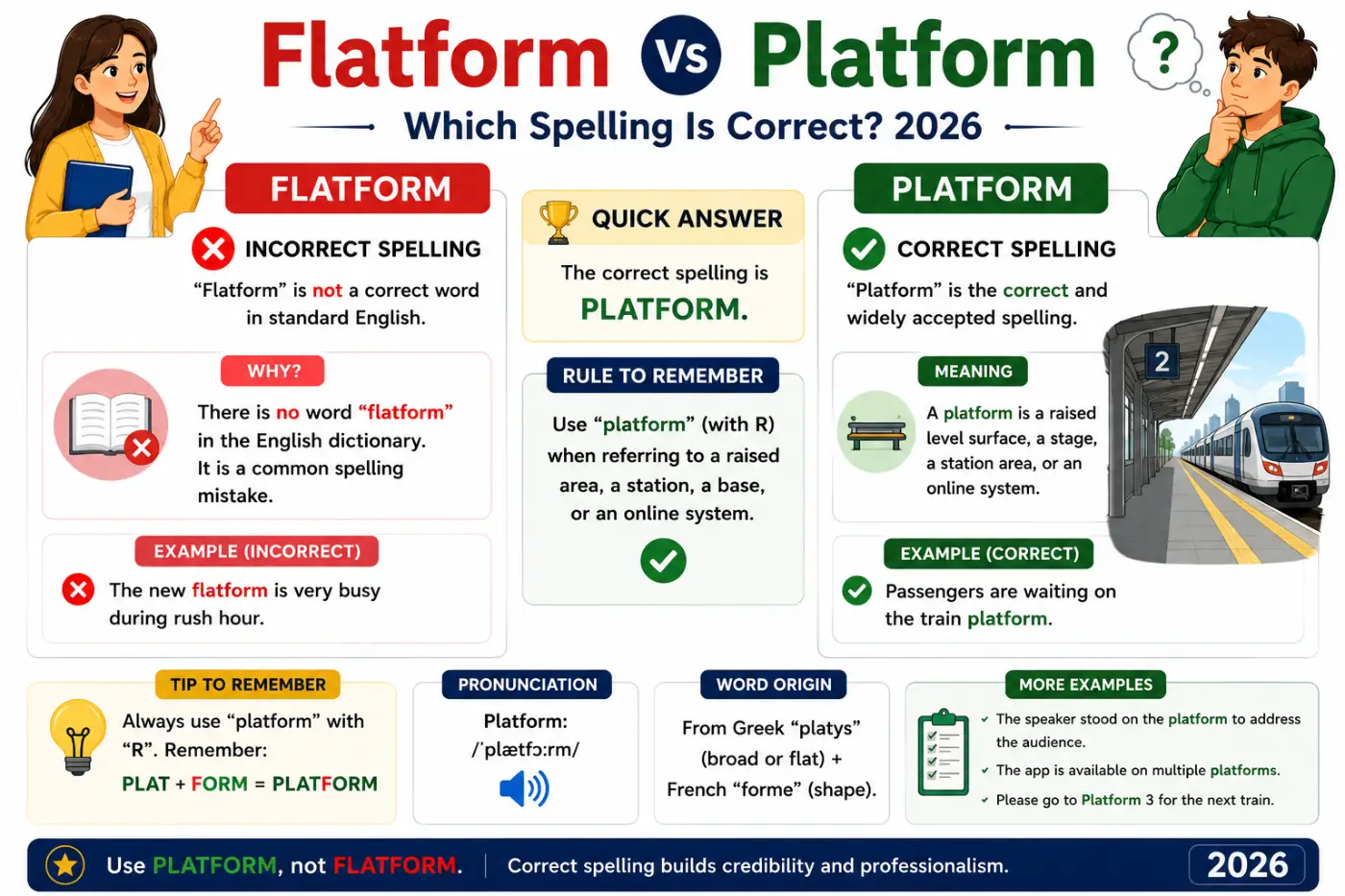
flatform vs platform can be confusing because both forms look like they could be English words. The standard word is platform. It can refer to a raised surface, a physical structure, a set of ideas, a digital service, or a place where people stand or speak. Flatform is not the standard spelling of platform in general English.
The confusion often comes from the way platform sounds when people say it quickly. The middle part can be easy to hear incorrectly, especially for learners who are writing the word from memory. There is also a real word called flatform in fashion terminology, which makes the issue more interesting. A flatform is a type of shoe with a thick sole that stays relatively level from the front to the back. So the two forms cannot simply be treated as identical.
This distinction matters because the intended meaning changes the correct choice. In this guide, you’ll learn the standard meaning of platform, the specialized meaning of flatform, how to pronounce both forms, where each word comes from, and how native English speakers use them in real situations.
Quick Definition
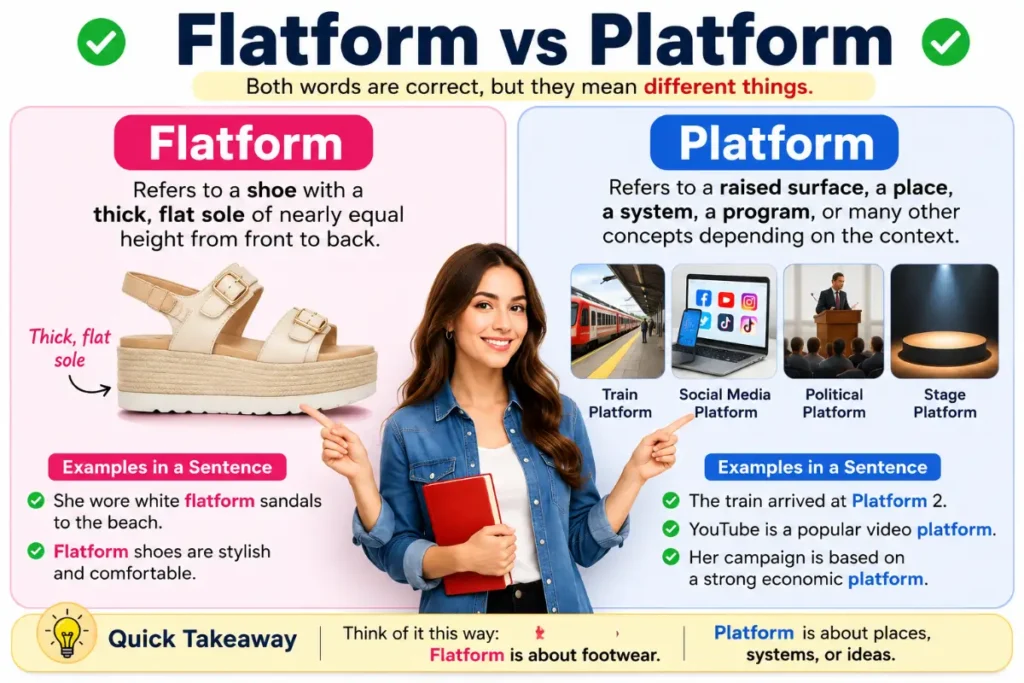
Platform is the standard English word for a raised surface or structure and can also mean a set of ideas, a digital service, or a place for public activity. Flatform is a specialized fashion term for a shoe with a thick, relatively level sole. The two words have different meanings and should not be treated as interchangeable.
Quick Answer
Platform is the standard word for most situations involving a raised surface, system, service, political position, or digital space. Flatform is also a legitimate word, but it has a much narrower meaning in fashion.
If you mean a train station surface, software service, political program, public position, or raised structure, use platform. If you mean a type of shoe with a thick sole that stays mostly level, flatform can be correct.
Comparison Table
| Form | Meaning | Part of Speech | Origin | Usage Frequency | Formality | Common Contexts | Example |
|---|---|---|---|---|---|---|---|
| Platform | A raised surface, system, service, or organized set of ideas | Noun | From French and Italian through earlier European usage | Very common | Neutral to formal | Technology, transportation, politics, architecture, business, education | The train is waiting at the platform. |
| Flatform | A shoe with a thick sole that has little difference in height between the front and back | Noun | Modern fashion formation based on flat and platform | Specialized and less common | Neutral in fashion writing | Shoes, fashion, retail, style | She bought black flatform sandals. |
Meaning and Definition
Meaning of Flatform
Flatform is a legitimate but specialized English word. It is mainly used in fashion to describe footwear with a thick sole that is generally flat or has little change in height from the heel to the front.
The word combines the ideas represented by flat and platform. A typical flatform shoe gives the wearer extra height through a thick sole while keeping the sole relatively level.
You may see the term in fashion articles, shoe descriptions, product listings, style discussions, and retail catalogs. It can describe sandals, sneakers, loafers, boots, and other types of footwear.
For example, you could write:
She wore white flatform sandals during the summer.
The word does not mean the same thing as platform in every context. It belongs to a specific area of vocabulary.
This is where many spelling questions become tricky. A person who types flatform while discussing a shoe may actually be using a valid fashion term. A person who types flatform while talking about a train station or technology service is probably using the wrong word.
Context decides the answer.
Meaning of Platform
Platform is a much broader and more common noun.
In transportation, a platform is the raised area beside railway tracks where passengers wait for trains.
We waited on the platform for ten minutes.
In technology, a platform can mean a digital system or service that allows users to perform activities or access content.
The company launched a new learning platform.
In politics, platform can refer to the policies and ideas supported by a political party or candidate. The term can also describe a public position or set of principles.
The party published its platform before the election.
In construction and engineering, a platform can mean a raised level or working surface.
Workers stood on a platform several feet above the ground.
The word can also describe an opportunity to speak, perform, or gain public attention.
The conference gave young researchers a platform to share their work.
Because platform has so many meanings, it appears across everyday conversation, business, education, technology, transportation, journalism, and public life.
Key Differences Explained
- Spelling. Platform is the standard spelling for the general word. Flatform is a separate word used mainly in fashion.
- Meaning. Platform has several meanings connected with raised structures, systems, services, and public positions. Flatform specifically refers to certain footwear.
- Grammar. Both words are normally nouns. They can function as singular countable nouns and can take plural forms.
- Pronunciation. Platform and flatform sound different at the beginning. Platform begins with a pl sound while flatform begins with an fl sound.
- Formality. Platform works naturally in casual, professional, academic, and formal contexts. Flatform is also standard in its field but is much more specialized.
- Context. Platform can describe transportation, technology, architecture, business, education, and public affairs. Flatform is strongly associated with shoes and fashion.
- Regional usage. Neither word represents a major American versus British spelling difference. The distinction is mainly about meaning and context.
- Standard usage. A writer should not replace platform with flatform simply because the words look similar. The intended meaning determines the appropriate word.
Which Form Is Correct?
Both forms can be correct, but they are not interchangeable.
Platform is the correct word for the broad range of meanings associated with raised surfaces, digital services, transportation areas, public positions, and organized systems.
Flatform is correct when you are describing a particular style of footwear. The word is especially common in fashion and retail language.
This distinction is useful because many spelling questions assume that one form must always be wrong. That is not the case here. Flatform has its own specialized meaning.
A good dictionary based approach is to check the meaning before changing the spelling. If your sentence refers to a shoe with a thick level sole, flatform may be exactly what you need. If your sentence refers to a railway area or an online service, platform is the appropriate word.
The safest editing habit is simple. Read the whole sentence and identify the object or idea you are describing before deciding on the spelling.
Sentence Examples
Here are natural examples using platform.
- The passengers were waiting on the train platform.
- Our teacher uses an online platform for class assignments.
- The speaker stepped onto the platform and greeted the audience.
- The company created a new platform for small businesses.
- The party released its policy platform before the election.
- The workers built a temporary platform beside the building.
- The video platform added new privacy settings.
- She used the platform to share her research with a wider audience.
- Please check the station board to find the correct platform.
- The new education platform makes it easier for students to access lessons.
Here are examples using flatform.
- She wore black flatform sandals with a summer dress.
- The store sells several styles of flatform shoes.
- These flatform sneakers add height without a sharply raised heel.
- I like flatform sandals because they feel more stable than high heels.
- The fashion collection includes leather flatform boots.
These examples show why context matters. Platform and flatform may look related, but they refer to different things.
Common Mistakes and Misspellings
Using Flatform for a Train Station
Incorrect:
We waited at the train flatform.
Correct:
We waited at the train platform.
The word refers to the raised area where passengers wait for trains. There is no fashion meaning in this sentence.
Using Flatform for Technology
Incorrect:
The company created a new social flatform.
Correct:
The company created a new social platform.
Technology uses platform to describe a digital service, system, or environment.
Using Platform for Certain Shoes
Incorrect:
She bought a pair of black platform sandals.
This sentence can actually be correct because platform is also a normal footwear term. However, if the writer specifically means a shoe with a thick sole that stays mostly level, flatform may communicate that particular style more precisely.
Treating Flatform as a Universal Misspelling
This is another common mistake. Some people see flatform and assume it is always wrong. That approach misses its established fashion meaning.
The correct choice depends on context.
Changing the Word Without Checking the Sentence
Automatic correction can sometimes create problems when a specialized term is involved. If you see flatform in a fashion article or product description, check the context before changing it.
This is a useful lesson for natural language processing too. A language system can identify spelling patterns, but meaning often depends on the surrounding words. Context gives the word its intended sense.
Pronunciation Guide
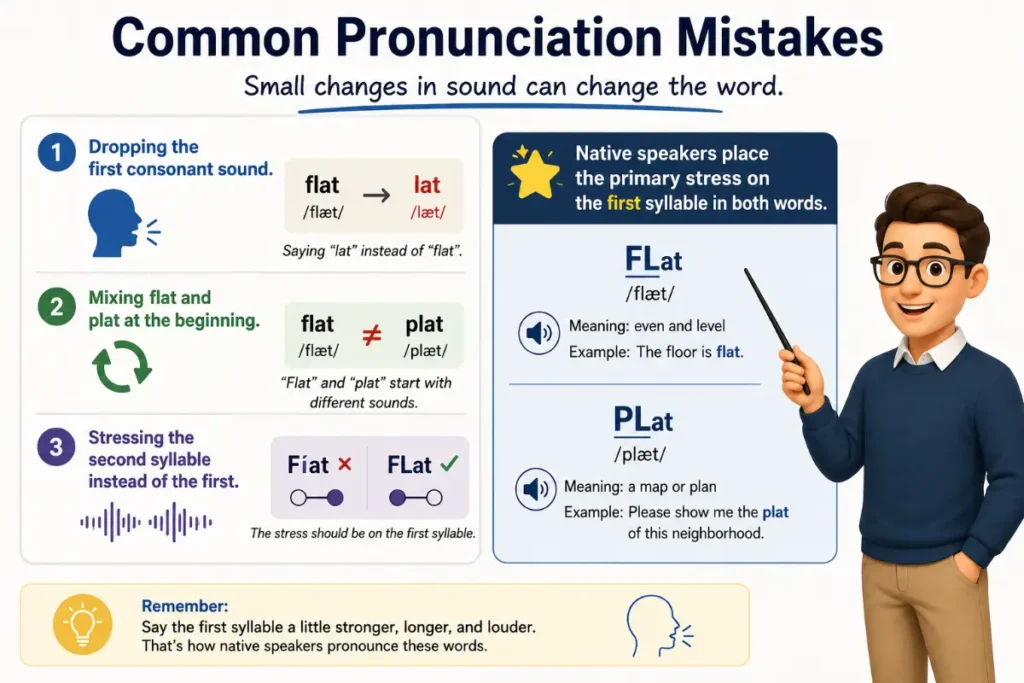
Platform is commonly pronounced /ˈplæt.fɔːrm/ in American English. You can think of it as:
PLAT form
The main stress falls on the first syllable.
Flatform is commonly pronounced /ˈflæt.fɔːrm/. You can think of it as:
FLAT form
Again, the main stress falls on the first part.
The difference is easy to miss when someone speaks quickly. Platform begins with the consonant cluster pl while flatform begins with fl.
Compare these sounds:
Platform: PLAT form.
Flatform: FLAT form.
The first sound changes the word. That small difference carries a completely different meaning.
For English learners, saying the first syllable clearly can help prevent confusion. Try saying platform with a clear p sound and flatform with a clear f sound.
Etymology and Word Origin
Platform has a long history. The English word came through French and is related to older Italian and French forms associated with a raised or level structure.
Over time, English expanded the meaning beyond physical structures. A platform could describe a raised place for people to stand. From there, the word developed broader uses for systems, opportunities, public positions, and organized sets of ideas.
The technology meaning developed naturally from the broader idea of a base or structure that supports an activity. A digital platform can be understood as a system that supports users, services, communication, or other functions.
The political meaning also follows the idea of a foundation or stated position. A political platform is a set of policies or principles that provides a basis for a party or candidate’s public program.
Flatform has a much more recent history. It is a modern fashion term formed from flat and platform. The word describes footwear that combines the height of a platform sole with a relatively level shape.
The two words therefore look related for a reason. Flatform was formed partly from platform, but it developed its own specialized meaning.
Regional Usage
American English
American English uses platform as the standard spelling for the broad meanings of the word. You will see it in transportation, technology, education, business, architecture, and public affairs.
Flatform also appears in American fashion language. It is most likely to occur in descriptions of shoes and clothing styles.
There is no general American rule that changes platform into flatform.
British English
British English also uses platform for the standard meanings. Train platforms, online platforms, public platforms, and political platforms all use the same spelling.
Flatform can appear in British fashion writing when describing a particular type of footwear. It does not replace platform in general English.
Australian English
Australian English follows the same broad distinction. Platform is the normal term for railway areas, digital systems, raised structures, and public positions.
Flatform may appear in fashion and retail contexts. The specialized meaning remains separate from the general uses of platform.
Canadian English
Canadian English also uses platform for the standard general meanings. Flatform can occur in fashion terminology but does not function as a general replacement for platform.
The key distinction across these English varieties is meaning rather than regional spelling.
Grammar Rules and Part of Speech
Both platform and flatform are nouns.
A noun names a person, place, thing, or idea. In these cases, both words identify things or concepts.
Platform can be singular.
The platform is crowded.
It can also be plural.
The platforms are crowded.
Flatform works the same way.
She bought a flatform.
She bought two flatforms.
The plural form simply adds s.
Platform can appear after articles such as a and the.
We found a platform near the entrance.
The platform was crowded.
It can also follow possessive forms.
The company’s platform has millions of users.
The school’s online platform is easy to use.
Flatform can appear in similar structures.
She bought a flatform for the summer.
The store sells several flatforms.
Adjectives can modify both nouns.
The train platform was crowded.
The digital platform is popular.
The leather flatforms were comfortable.
One useful grammar point is that platform has many meanings but remains the same part of speech. Context changes the meaning without changing its basic grammatical role.
Real Life Usage Examples
Daily Conversation
Platform appears naturally in ordinary conversations about travel.
I think our train leaves from platform four.
Check the screen to see which platform we need.
Flatform can appear in conversations about clothing.
Those flatform sandals look comfortable.
I prefer flatform shoes because they give me extra height.
Email and Workplace Communication
Platform is extremely common in professional communication.
Please upload the report to our shared platform.
The new platform will be available to employees next week.
Flatform is much less common in workplace writing unless the subject involves fashion or retail.
The product team added three new flatform designs to the summer collection.
The retailer expects strong interest in its new flatform range.
Academic Writing
Platform can have several academic meanings.
The researchers developed a digital platform for collecting responses.
The study examines how online platforms affect communication.
Flatform is unlikely to appear in general academic writing unless the subject is fashion, design, footwear, or consumer studies.
The paper examines changing consumer preferences for flatform footwear.
The researchers compared several flatform designs.
News and Journalism
Journalists frequently use platform when discussing transportation, technology, public affairs, and business.
The train arrived at the platform shortly after noon.
The company announced changes to its online platform.
Flatform may appear in fashion news.
The designer introduced a new collection of flatform sandals.
The summer trend includes several styles of flatform footwear.
Literature and Storytelling
Platform can describe a physical location or a figurative opportunity.
He stood alone on the platform as the train disappeared.
Her first speech gave her a platform to speak about the issue.
Flatform is more likely to appear in modern stories involving clothing or fashion.
She stepped outside in her favorite flatform sandals.
Related and Confused Terms
Stage
A stage is a raised area used for performances, speeches, or presentations. It can overlap with one meaning of platform but usually has a stronger connection with performance.
Stand
A stand can refer to a structure where someone sells goods, watches an event, or displays something. Its meaning depends heavily on context.
Base
A base is something that supports another object or structure. This idea connects closely with one of the broad concepts behind platform.
Digital Platform
A digital platform is an online system or service that supports communication, transactions, content, software, or other activities.
Online Service
An online service provides a function through the internet. It can operate through a platform but the two terms are not always identical.
Political Platform
A political platform is a collection of policies or principles associated with a political party or candidate.
Platform Shoe
A platform shoe has a thick sole that adds height. Unlike a flatform, a platform shoe can have a more noticeable difference between the front and back of the sole.
Flatform Shoe
A flatform shoe has a thick sole that remains relatively level. The term is mainly used in fashion and footwear.
These related terms show how broad the word platform has become. Its meaning changes according to the setting, while flatform remains much more closely tied to footwear.
Why the Confusion Happens
The confusion between these forms has a few simple causes.
First, the words look similar. Both contain the letters f, l, a, t, and form in a similar overall pattern. That visual similarity can make the difference easy to overlook.
Second, flatform is actually a real word in fashion. Someone who encounters the term may later assume it has the same broad meaning as platform.
Third, fast typing can make people rely on approximate spelling. If a writer remembers the general shape of a word but not its exact form, a similar looking version may appear.
Fourth, context matters. A language model, search engine, or spell checker may need surrounding words to determine the intended meaning. For example, shoes, sandals, and boots strongly suggest flatform. Train, station, software, and users strongly suggest platform.
This is a useful NLP concept called context disambiguation. A word cannot always be understood correctly by looking at its letters alone. The surrounding words often provide the strongest clue about meaning.
Platform in Technology
Platform has become especially common in technology.
A technology platform is a system that provides tools or an environment for users, developers, businesses, or other groups. The exact meaning depends on the product and industry.
For example, an education platform may provide lessons, assignments, tests, and communication tools. A payment platform may help businesses process transactions. A software platform may provide an environment where applications can run or be developed.
The word does not necessarily mean a website. A platform can include software, hardware, services, tools, infrastructure, or a combination of these.
That broader meaning comes from the basic idea of a platform as something that supports activity. A physical platform supports people or objects. A digital platform can support services or interactions.
Platform in Public Life
Platform also has a well established public meaning.
In political communication, a platform describes the policies and principles a political party or candidate presents to voters. The word can also refer more generally to a person’s public position or an opportunity to communicate ideas.
For example:
The organization published its policy platform.
The speaker used the event as a platform for discussing education.
These meanings are related but not identical. The first describes a set of stated policies. The second describes an opportunity or means for public expression.
Because the word has several established senses, writers should use context to make the intended meaning clear.
Platform in Transportation
The transportation meaning is one of the oldest and most familiar uses.
At a train station, the platform is the raised area where passengers wait and board trains. In American English, platform is the normal word for this area.
For example:
The train will arrive at platform three.
Please wait behind the safety line on the platform.
The word can also appear in other transportation settings, although the exact meaning may change based on the type of facility.
This context provides one of the easiest ways to recognize the correct form. If people are waiting for a train, bus, or similar service at a designated raised area, platform is the natural word.
Flatform in Fashion
Flatform belongs to a different semantic field.
Fashion writers use the word to describe shoes with thick soles that remain fairly level. These shoes can add height without creating the sharply raised heel associated with many traditional platform or heeled shoes.
Flatforms can appear in many styles. They may be sandals, sneakers, boots, loafers, or other footwear.
For example:
The new collection includes woven flatform sandals.
She chose flatform sneakers for a casual outfit.
The word is especially useful because it gives readers a quick idea of the shoe’s structure. Instead of simply saying the shoe has a thick sole, a fashion writer can use flatform to identify a particular style.
Expert Editor Insight
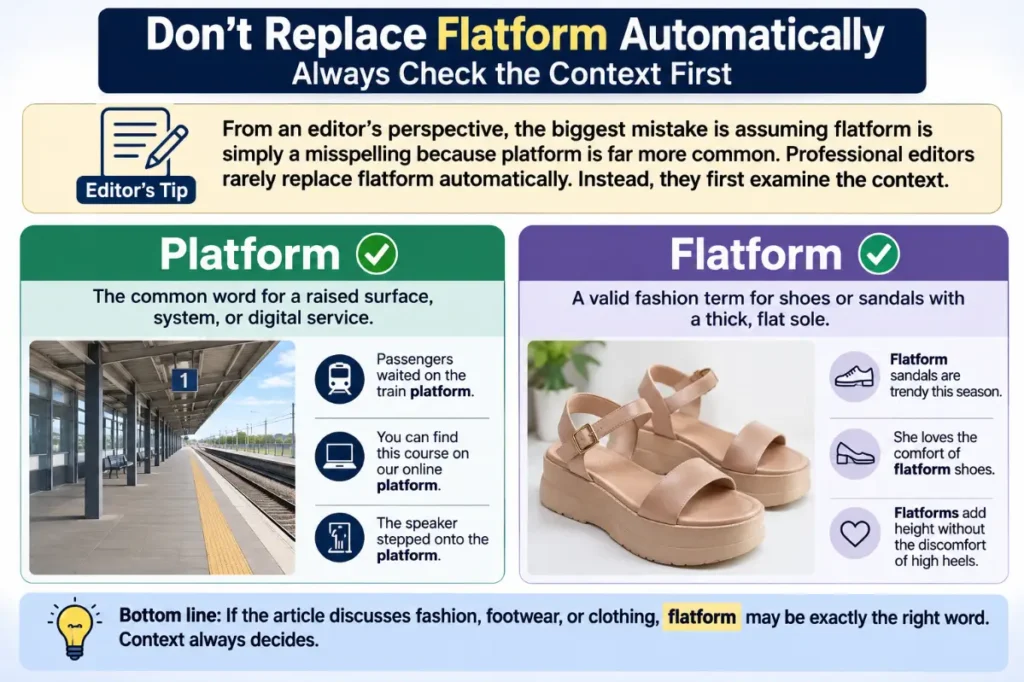
An experienced editor would not automatically change flatform to platform. The first step is always to read the surrounding sentence. If the text discusses trains, technology, public speaking, education, business, or policy, platform is probably intended. If it discusses sandals, sneakers, boots, soles, or fashion, flatform may be the correct specialized term. Editing tools can catch obvious spelling errors, but context still deserves human attention because a legitimate specialized word can look like a typo.
Conclusion
flatform vs platform becomes much easier once you focus on meaning instead of appearance. Platform is the standard word for a raised surface, train station area, digital system, public opportunity, or organized set of policies. Flatform is a specialized fashion term for footwear with a thick sole that stays relatively level.
The two words can look confusing because they share several letters and a similar sound. Still, they belong to different contexts. A train has a platform, while a fashion store may sell flatform sandals. That simple context difference usually gives you the answer.
For an easy editing trick, read the sentence before correcting the word. If the subject involves technology, transportation, business, education, or public affairs, platform is probably right. If the subject involves footwear and fashion, flatform may be the intended term.
FAQs
Is flatform a real word?
Yes. Flatform is a legitimate English word used mainly in fashion and footwear. It describes a shoe with a thick sole that stays relatively level from front to back. It is not a general replacement for platform. If you are discussing a train station, digital service, raised structure, or public position, platform is the appropriate word.
What does platform mean?
Platform has several meanings. It can mean a raised area where people stand, such as a train platform. It can also describe a digital service, a system that supports activity, a public opportunity, or a set of political policies. The surrounding context determines the intended sense. It is a common and widely used English noun.
Which form should I use for a train station?
Use platform. A train station has platforms where passengers wait for and board trains. For example, you can say The train leaves from platform five. Flatform does not have this transportation meaning. Its main standard use relates to footwear with a thick and relatively level sole.
What is the difference between platform shoes and flatform shoes?
Platform shoes have thick soles that add height and can have different levels between the front and back. Flatform shoes generally have a thick sole that stays more level from front to back. The terms can overlap in casual fashion writing, but flatform is more specific when the sole has a relatively uniform height.
How do you pronounce platform?
Platform is commonly pronounced /ˈplæt.fɔːrm/ in American English. You can think of it as PLAT form, with the strongest stress on the first part. The opening pl sound is important because it separates platform from flatform. Saying the first consonant clearly can help you distinguish the two words in conversation.
How do you pronounce flatform?
Flatform is commonly pronounced /ˈflæt.fɔːrm/. An easy pronunciation guide is FLAT form, with stress on the first part. The opening fl sound helps distinguish it from platform. Because the words share much of their structure, saying the first sound clearly can make the difference easier to hear.
Is platform appropriate in formal writing?
Yes. Platform is fully appropriate in formal writing. It appears in academic work, business documents, technical writing, journalism, transportation information, and public policy discussions. The correct meaning depends on context. If you are discussing a digital system, physical structure, public position, or transportation area, platform is usually the natural choice.
Why do people confuse these two words?
The forms look and sound similar, and both contain the word form at the end. Fast typing can also make the difference easy to miss. The confusion becomes stronger because flatform is a real fashion term rather than a simple random spelling error. Checking the surrounding context is the easiest way to choose the right word.
