
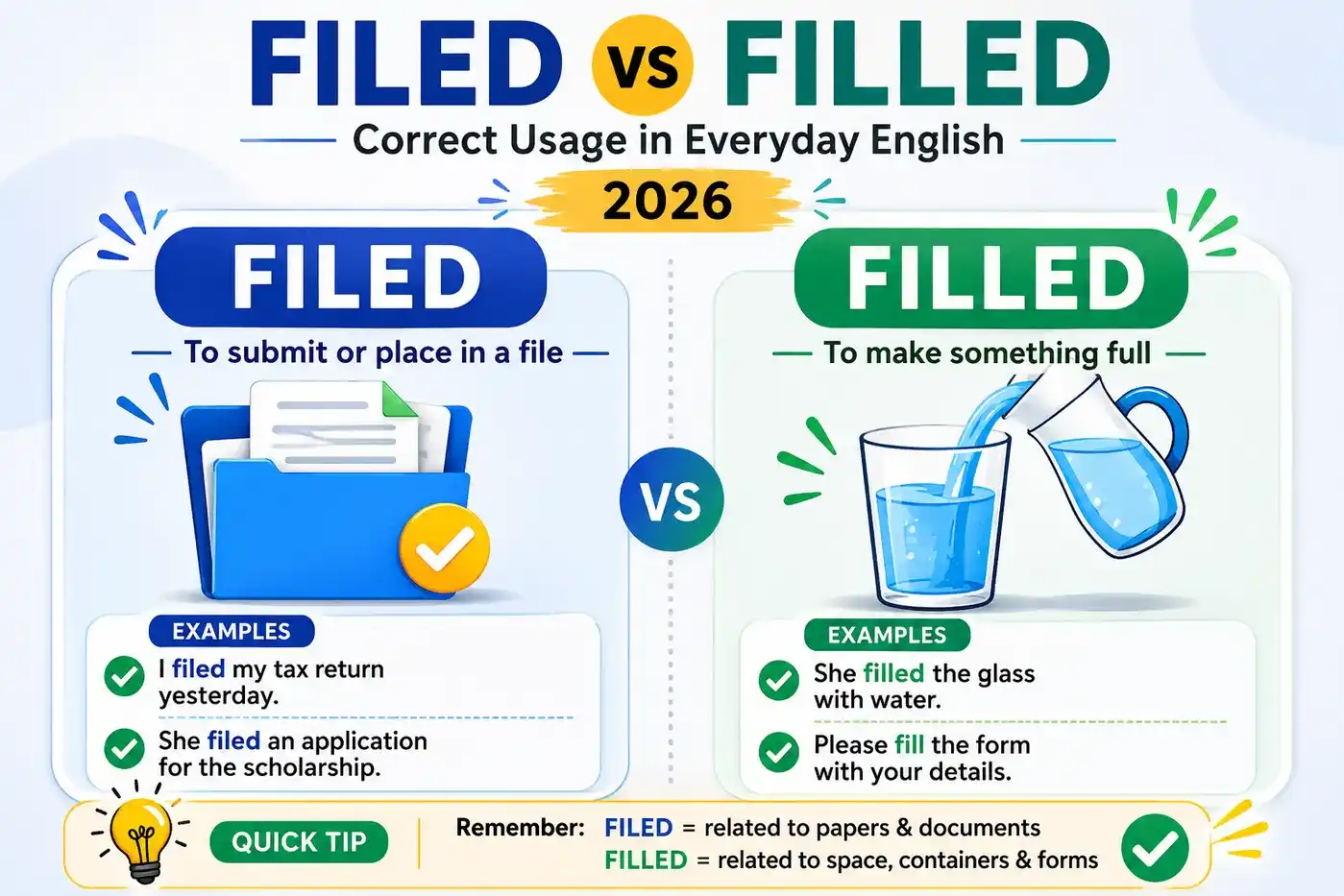
Filed vs filled is a common English confusion because the two words look almost identical and can sound very similar in fast speech. Both forms are correct English words, but they have completely different meanings. Filed usually relates to putting something on record or using a file to smooth or shape something. Filled means made full or supplied with something.
The confusion often starts with pronunciation. The vowel sounds in these words are close in many varieties of American English, especially in quick conversation. Their spellings differ by only one letter, yet that small difference changes the entire meaning of a sentence. A person who writes I filled a complaint instead of I filed a complaint is using the wrong word because a complaint is formally submitted or recorded rather than made full.
This guide explains the meanings, grammar, pronunciation, spelling patterns, word origins, and everyday uses of both forms. You’ll also see practical examples that show exactly when each word belongs in a sentence. By the end, you’ll have an easy way to tell them apart without relying on guesswork.
Quick Definition
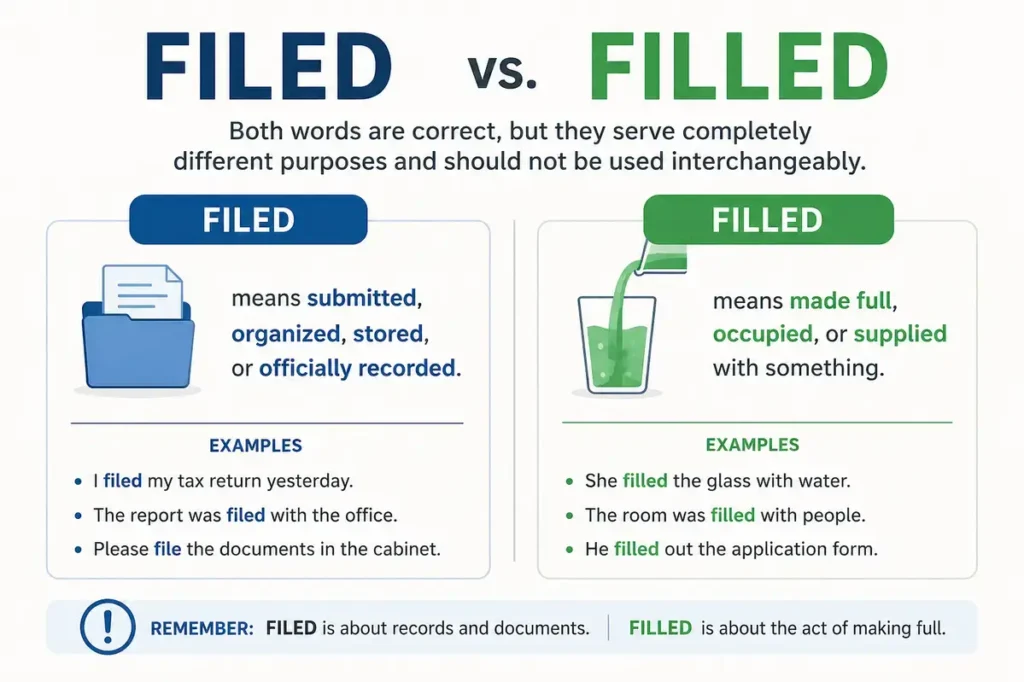
Filed is the past tense and past participle of file. It commonly means submitted something for official record or placed something in an organized record system. Filled is the past tense and past participle of fill. It means made something full or put something into a container, space, form, or role.
Quick Answer
Filed and filled are both correct words. The right choice depends on the meaning of your sentence.
Use filed for submitting, recording, organizing, or working with a file. Use filled when something becomes full or when you put something into an empty space. For example, She filed a complaint is correct, while She filled a complaint is not standard English for that meaning.
Comparison Table
| Form | Meaning | Part of Speech | Origin | Usage Frequency | Formality | Common Contexts | Example |
|---|---|---|---|---|---|---|---|
| Filed | Submitted, recorded, organized, or worked on with a file | Verb | From the noun file and related historical forms | Common | Neutral to formal | Legal documents, records, offices, tools | She filed a complaint with the court. |
| Filled | Made full or put something into a space or container | Verb | From Old English fullian | Very common | Neutral | Food, containers, forms, spaces, positions | He filled the glass with water. |
Meaning and Definition
Meaning of Filed
Filed is the past tense and past participle of the verb file. The word has several related meanings, but the most common one involves placing information into an organized record or officially submitting a document.
You might file a report, file a complaint, file taxes, file an application, or file a legal document. In these examples, the action involves submitting or recording information through an established process.
For example:
She filed a complaint with the manager.
The sentence means that she formally submitted the complaint. Nothing is being made full.
The word can also describe organizing documents.
The assistant filed the invoices in alphabetical order.
Here filed means placed the documents into an organized filing system.
Another meaning relates to the tool called a file. A person can file metal, wood, or another material to smooth, shape, or remove small amounts of it.
The technician filed the rough edge of the piece of metal.
So the word has a practical connection to both records and tools. Context tells you which meaning applies.
Meaning of Filled
Filled is the past tense and past participle of the verb fill. It means made full or put something into a space, container, form, position, or area.
For example:
She filled the bottle with water.
The bottle received enough water to make it full or partly full.
The same word works with forms.
I filled the application out yesterday.
Here filled means entered the required information into the application.
It can also describe a space containing something.
The room was filled with music.
The room contained music throughout the space. The word can also describe a position that someone occupies.
The company filled the vacant position last week.
In this case the position was occupied by a person.
Filled therefore has a broad but consistent central idea. Something receives content, material, information, people, or another thing that occupies an available space.
Key Differences Explained
- Meaning. Filed usually involves submitting, recording, organizing, or shaping something. Filled means making something full or putting something into an available space.
- Spelling. Filed contains one l before ed. Filled contains two l letters before ed.
- Base verb. Filed comes from file. Filled comes from fill.
- Grammar. Both forms can function as the simple past tense and past participle of their respective verbs.
- Pronunciation. The two words can sound very similar in some accents. The surrounding words usually make the intended meaning clear.
- Context. Legal documents, complaints, records, reports, and official submissions commonly use filed. Containers, forms, spaces, positions, and quantities commonly use filled.
- Formality. Both words work in casual and formal English. Filed appears especially often in legal, administrative, business, and professional contexts.
- Standard usage. Both are standard English words. Neither is a misspelling of the other.
The simplest distinction is this: file means organize or submit, while fill means make full or put something inside.
Which Form Is Correct?
Both forms are correct. The important question is what you want to say.
Use filed when the action involves submitting or recording something.
The lawyer filed the documents yesterday.
Use filled when something receives content or becomes full.
She filled the cup with coffee.
This distinction follows directly from the base verbs. Dictionaries treat file and fill as separate verbs with separate meanings. Their past forms naturally remain separate as filed and filled.
A useful editing test is to remove the ending and look at the base word. If you mean submit or organize records, think file. If you mean make full or put something inside, think fill.
This method works especially well when proofreading because it focuses on meaning rather than appearance.
Sentence Examples
The following examples show how the two words work in realistic situations.
- The attorney filed the lawsuit on Monday.
- I filled the glass with cold water.
- She filed the documents before the deadline.
- He filled out the registration form at work.
- The company filed its annual report.
- We filled the boxes with books.
- The customer filed a complaint about the service.
- The teacher filled the board with examples.
- She filed the receipts in a separate folder.
- They filled the empty seats before the show started.
Notice how the meaning changes with the verb. A complaint is filed because it is formally submitted. A glass is filled because something is put into it.
Here are common incorrect uses that help illustrate the difference.
- Incorrect: She filled a complaint with the company.Correct: She filed a complaint with the company.
- Incorrect: He filed the bottle with water.Correct: He filled the bottle with water.
- Incorrect: I filed out the application.Correct: I filled out the application.
- Incorrect: The worker filled the documents in the cabinet.Correct: The worker filed the documents in the cabinet.
- Incorrect: She filed the empty cup with tea.Correct: She filled the empty cup with tea.
The incorrect versions are useful for learning because they show how easily the two words can be swapped when the writer focuses on sound instead of meaning.
Common Mistakes and Misspellings
These errors usually happen because file and fill are short verbs with very similar forms. The extra l in filled can also make the spelling look unusual to learners who are writing quickly.
- Filled a complaint.
The usual expression is filed a complaint. A complaint is formally submitted or recorded.
Example: She filed a complaint with the company.
- Filed a glass with water.
The correct verb is filled because water goes into the glass and occupies space.
Example: He filled the glass with water.
- Filed out a form.
The standard expression is filled out a form. This means completed the requested information.
Example: I filled out the form before the appointment.
- Filled documents in a cabinet.
If you mean organized documents into a record system, use filed.
Example: The clerk filed the documents in the cabinet.
- Filed the room with people.
Use filled because people occupy the available space.
Example: The audience filled the room.
From an NLP perspective, the confusion is a lexical choice problem. The words share similar spelling and pronunciation patterns, but their meanings are different. Human readers use surrounding words to resolve the intended meaning. Phrases such as filed a complaint and filled a bottle provide strong contextual signals.
Pronunciation Guide
Filed is commonly pronounced /faɪld/. It sounds similar to the word smiled without the initial sm sound.
Filled is commonly pronounced /fɪld/. The vowel is shorter and different from the vowel in filed.
The difference is easiest to hear when the words are spoken slowly.
Filed: fyld.
Filled: fild.
The main distinction is the vowel sound.
Filed begins with the long i sound found in words such as fine and file.
Filled begins with the short i sound found in words such as fill and sit.
In quick speech, however, the difference may be less noticeable. This explains why some learners confuse the words when listening.
Try saying these pairs slowly.
Filed a complaint.
Filled a bottle.
The surrounding noun also helps. Complaint strongly connects with filed. Bottle strongly connects with filled.
The final d sound is present in both words. The key pronunciation difference appears in the vowel before the l sound.
Etymology and Word Origin
The two words come from different historical roots even though their modern forms look similar.
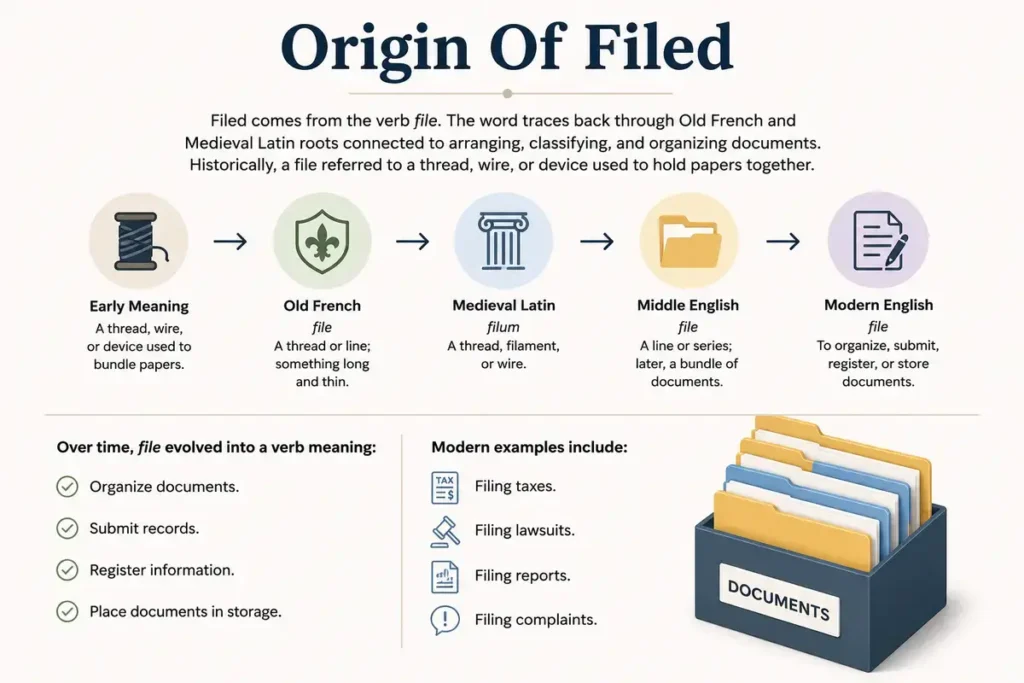
File has a long history connected with records and organized collections. English inherited the word through French from Latin filum meaning thread. The idea of a thread or string developed into the concept of documents arranged together. Over time file became associated with organized records and then with the act of placing documents into a record system.
The word file also developed a separate connection with a tool used to smooth or shape material. That meaning has its own historical development and remains common in technical and practical settings.
Fill has a different origin. It comes from Old English fullian which was related to the idea of making full. This connection remains easy to see in modern English because fill and full belong to the same word family.
That history gives you a useful memory clue. Fill is closely connected with full. If something becomes full, you fill it.
File and fill therefore look similar today but developed from different linguistic histories. Their separate meanings are not accidental.
Regional Usage
American English
American English uses both forms as standard words. Filed appears often in legal, business, administrative, and workplace settings. Filled is extremely common in everyday speech and writing and appears in contexts involving containers, forms, spaces, schedules, positions, and emotions.
British English
British English also uses both words with the same basic distinction. A British speaker can file a complaint and fill out a form just as an American speaker can. The spelling difference between the two forms does not represent a US versus UK variation.
Australian English
Australian English follows the same distinction. Filed relates to filing or submitting something, while filled describes making something full or completing something such as a form. There is no major regional spelling difference between these forms.
Canadian English
Canadian English also uses both forms in their standard meanings. Context determines the correct choice. A person can file an application but fill out an application form. The distinction remains the same in ordinary Canadian usage.
The key point is that this is not a regional spelling issue. The difference comes from meaning and from the two separate base verbs.
Grammar Rules and Part of Speech
Both filed and filled are verbs. More specifically, each is the simple past and past participle form of a different verb.
File becomes filed.
Fill becomes filled.
The difference becomes clear in common sentence patterns.
Filed With Official Documents
Filed often appears with words such as complaint, lawsuit, report, application, paperwork, petition, claim, or taxes.
She filed a tax return.
He filed a formal complaint.
They filed the paperwork yesterday.
In these sentences the object is something submitted or recorded.
Filed In An Organization System
Filed can also describe putting records into a specific place.
The assistant filed the invoices by date.
The records were filed in the cabinet.
Here the action involves organization rather than submission.
Filled With A Substance
Filled commonly appears with with when you describe what occupies a container or space.
She filled the cup with tea.
The box was filled with toys.
The kitchen was filled with the smell of fresh bread.
Filled Out A Form
Filled out is a common phrasal verb in American English. It means completed a form by entering the required information.
Please fill out this form.
I filled out the application yesterday.
Do not replace filled with filed in this expression.
Filled A Position
Filled can also mean occupied an available role.
The company filled the position quickly.
The school filled two teaching positions.
The position was empty before someone took it.
Punctuation
Neither word requires special punctuation. Use normal sentence punctuation based on the structure of the sentence.
For example:
She filed the report yesterday.
He filled the container with water.
The comma rules come from the sentence structure rather than from the verbs themselves.
Real Life Usage Examples
Daily Conversation
In everyday speech, filled is more likely to describe physical objects, food, drinks, spaces, or forms.
I filled the coffee maker this morning.
The parking lot was filled by noon.
Filed appears in ordinary conversation when people talk about complaints, paperwork, or records.
I filed the paperwork yesterday.
She filed a complaint after the issue wasn’t resolved.
Email And Workplace Communication
Professional communication frequently uses filed when discussing documents and formal procedures.
We filed the required documents before the deadline.
The customer has filed a formal complaint.
Filled is common when discussing forms, positions, schedules, or spaces.
Please make sure you’ve filled out every section of the application.
We’ve filled the open position and will close the listing today.
Academic Writing
Academic writing may use filed when discussing records, historical documents, or formal submissions.
The researcher filed the documents according to the archive system.
The organization filed a formal request for access.
Filled can describe data, spaces, or forms.
The participants filled out the questionnaire before the experiment.
The researchers filled the containers with equal amounts of water.
News And Journalism
News reports often use filed when describing legal actions.
The company filed a lawsuit against its former partner.
Officials filed a formal response on Tuesday.
Filled may describe crowds, locations, or positions.
Thousands of visitors filled the stadium.
The newly appointed director filled the vacant position.
Literature And Storytelling
Storytelling uses filled frequently for sensory descriptions.
Warm sunlight filled the room.
Her eyes filled with tears.
Filed can appear when a story involves documents or official actions.
He quietly filed the old letters in a wooden cabinet.
The detective filed the report before leaving the station.
Related And Confused Terms
Several words and expressions connect naturally with these two verbs.
- File. The base verb means to organize records or submit something officially. It can also refer to the tool used to smooth material.
- Fill. The base verb means to make something full or occupy an available space.
- Submit. This is closely related to the official meaning of file. You submit a document or application.
- Record. This relates to preserving information for future reference. Something can be filed as part of a record system.
- Complete. This often overlaps with fill out when someone enters all required information on a form.
- Store. This can describe putting documents or objects into an organized place. It overlaps with one meaning of file but is broader.
- Occupy. This means to take up space. A person or object can occupy an area that has been filled.
- Full. This adjective is closely connected to fill. If you fill a container, the result may be a full container.
These relationships can make the distinction easier to remember. File connects with documents, records, and submission. Fill connects with fullness, space, contents, and completion.
A Simple Memory Trick
You don’t need a complicated rule to remember these words.
Think about file when something goes into an organized record system.
Think about fill when something goes into an empty space.
A complaint gets filed.
A cup gets filled.
An application gets filed.
A form gets filled out.
A report gets filed.
A bottle gets filled.
You can also connect fill with full. Both words share the idea of something becoming full. That connection gives you a quick mental shortcut when you’re writing.
If the sentence involves official paperwork, ask yourself if you mean submit or record. If so, file is probably the word you need.
And If the sentence involves putting something into a space, ask yourself if you mean make full.
Expert Editor Insight
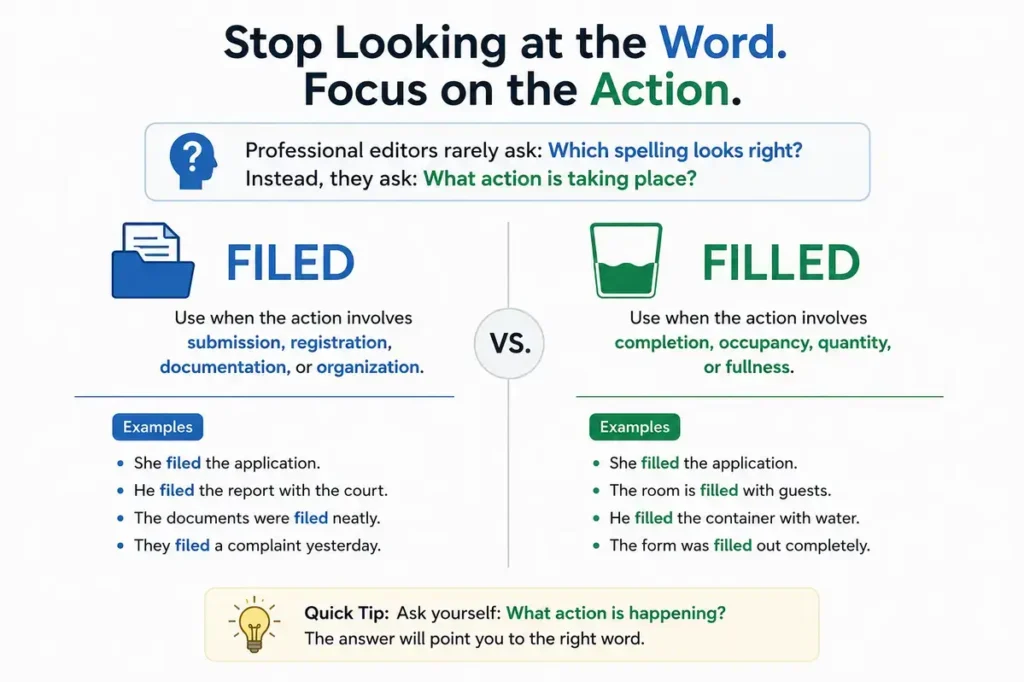
An experienced editor usually doesn’t treat this as a spelling problem because both forms are legitimate words. The real issue is choosing the correct verb for the intended meaning. Native speakers rely heavily on context, so phrases such as file a complaint, file a report, fill a glass, and fill out a form quickly signal the right choice. Grammar and spelling tools can flag some incorrect combinations, but they may not catch every meaning error because both words are valid. The best proofreading method is to check the verb against the noun that follows it.
Conclusion
Filed vs filled presents a meaning problem rather than a simple spelling problem because both words are correct. Filed comes from file and commonly describes submitting or organizing documents. Filled comes from fill and describes making something full, putting something into a space, or completing something such as a form. The surrounding words usually make the intended meaning clear.
A simple memory trick can save you from most mistakes. Think of file with records, reports, complaints, and official documents. Think of fill with containers, spaces, forms, positions, and anything that can become full. When you proofread, check the base verb before focusing on the spelling.
Once you connect each word with its meaning, the difference becomes much easier to recognize. A complaint is filed. A bottle is filled. A form is filled out. That pattern will serve you well in everyday and formal English.
FAQs
Is filed a correct English word?
Yes. Filed is the standard past tense and past participle of file. It can mean submitted something officially, organized documents, or used a file to shape a material. For example, She filed a complaint means she formally submitted the complaint. The word is common in legal, business, administrative, technical, and everyday contexts.
Is filled a correct English word?
Yes. Filled is the standard past tense and past participle of fill. It means made something full or put something into a space, container, form, position, or area. For example, He filled the glass with water. It can also appear in expressions such as filled out a form and filled a vacant position.
What is the difference between filed and filled?
Filed comes from file and usually means submitted, recorded, organized, or shaped with a file. Filled comes from fill and means made full or supplied with something. The words are different in both spelling and meaning. A person files a complaint but fills a bottle. Context tells you which verb belongs in the sentence.
Is it filed or filled a complaint?
The standard expression is filed a complaint. A complaint is formally submitted or recorded, so file is the appropriate verb. You would write She filed a complaint with the company. You would not normally say She filled a complaint when you mean she submitted one. This distinction applies to legal and formal complaints as well.
Is it filed or filled out a form?
The standard American English expression is filled out a form. The verb fill means to complete the available spaces by entering information. For example, Please fill out the application before your appointment. Filed out is not the standard expression for completing a form. File is used for submitting or organizing documents instead.
How do you pronounce filed and filled?
Filed is commonly pronounced /faɪld/ and has the long i sound found in file. Filled is commonly pronounced /fɪld/ and has the short i sound found in fill. The final sound is similar in both words. In fast speech the distinction can become less noticeable, which is one reason learners sometimes confuse them.
Can filed and filled be used in formal writing?
Yes. Both words are standard and fully acceptable in formal writing. Filed is especially common in legal, business, administrative, and professional contexts. Filled is common in formal writing when describing forms, spaces, positions, containers, or quantities. The important point is not formality but meaning. Choose the word that matches the action you want to describe.
How can I remember the difference?
Connect each word with its base meaning. File is associated with records, documents, and official submission. Fill is associated with full spaces and contents. Think of a filed complaint and a filled glass. Another useful clue is the word full, which is closely related to fill. These connections make the difference easier to recall during writing.
