
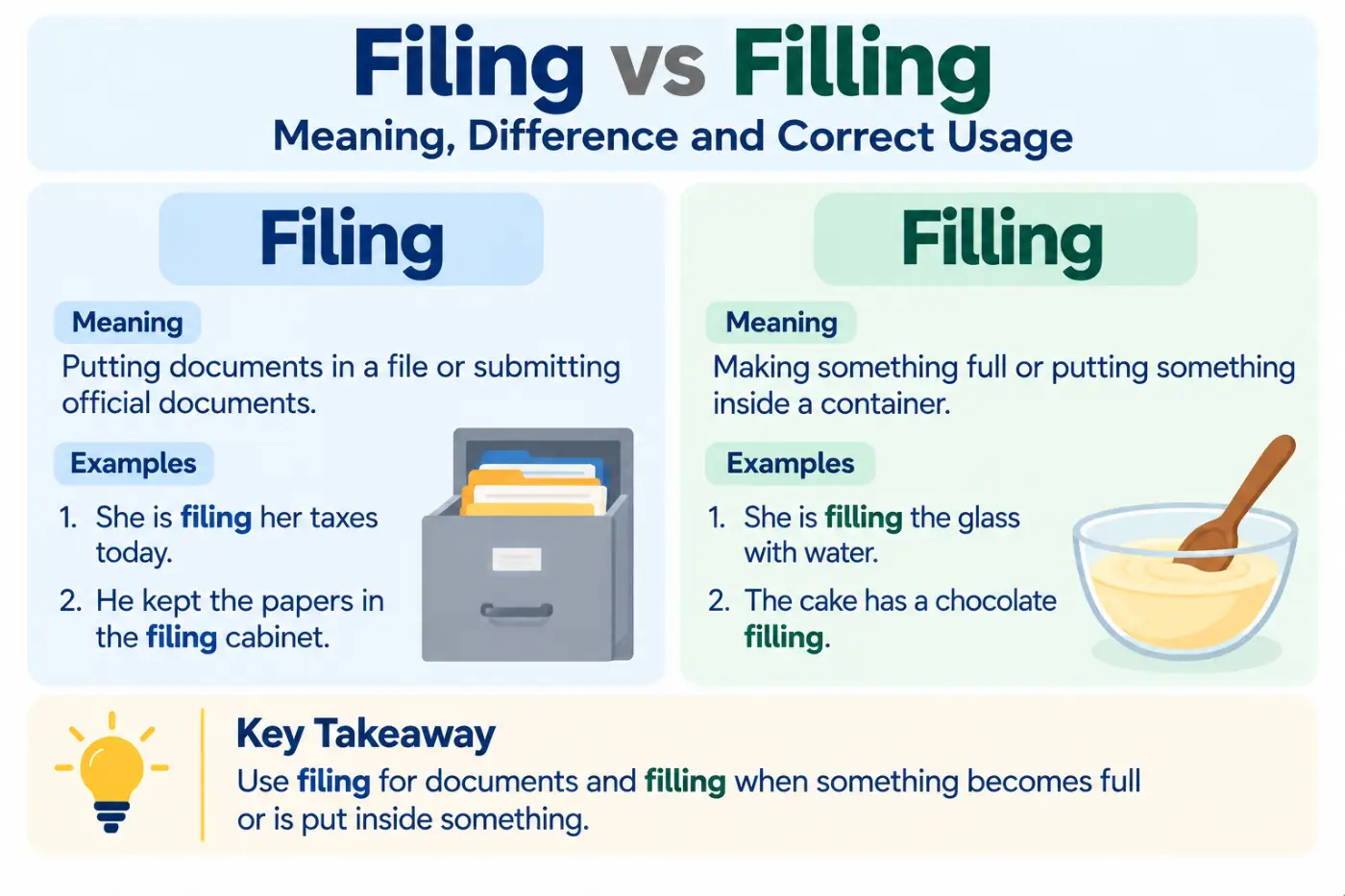
Filing vs filling can be confusing because the two words look and sound very similar. Both are legitimate English words, but they describe completely different actions. Filing usually means organizing documents or using a tool to smooth or shape something. Filling means putting something into a space or making something full.
The confusion often comes from their shared ending and similar pronunciation. The extra l in filling also changes the vowel sound and the meaning. Once you connect each word with its main idea, the distinction becomes much easier to remember. Filing relates to files, documents, and smoothing. Filling relates to making something full or adding something inside a space.
In this guide, you’ll learn the meanings, grammar, pronunciation, word origins, common mistakes, and everyday uses of both terms. You’ll also see practical examples from work, school, cooking, construction, personal communication, and formal writing. By the end, choosing the right form should feel much more natural.
Quick Definition
Filing and filling are both correct words with different meanings. Filing usually means organizing records or using a tool to smooth or shape a material. Filling means putting something into an empty space or adding enough material to make something full. The correct choice depends entirely on the action you want to describe.
Quick Answer
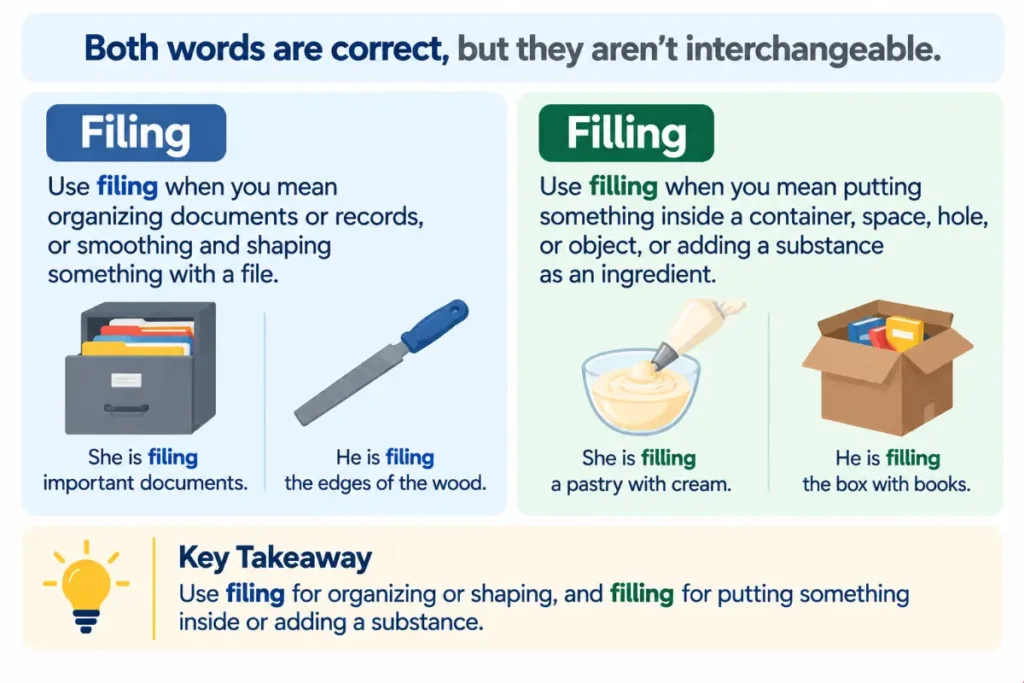
Both words are correct, but they aren’t interchangeable. Use filing when you mean organizing documents or records, or smoothing and shaping something with a file. Use filling when you mean putting something inside a container, space, hole, or object, or adding a substance as an ingredient. For example, a worker may be filing important documents, while a cook may be filling a pastry with cream.
Comparison Table
| Form | Meaning | Part of Speech | Origin | Usage Frequency | Formality | Common Contexts | Example |
|---|---|---|---|---|---|---|---|
| Filing | Organizing records or smoothing and shaping material with a file | Noun or present participle | From file and its historical forms | Common | Neutral to formal | Offices, records, metalwork, woodworking | She is filing the documents. |
| Filling | Putting something into a space or making something full | Noun or present participle | From fill and its historical forms | Very common | Neutral | Cooking, containers, construction, forms, clothing | The filling tastes delicious. |
Meaning and Definition
Meaning of Filing
Filing comes from the verb file. Its meaning depends on the context.
In office work, filing means organizing documents, records, forms, or other information so they can be stored and found later. For example, an employee may spend an afternoon filing invoices by date.
In this sense, the word connects directly to a file. A file can be a physical folder, a collection of documents, or a digital record. The action of filing involves placing information into an organized system.
The word has another important meaning in technical work. Filing can mean using a hand tool called a file to remove small amounts of material from wood, metal, plastic, or another surface. A person may file the edge of a metal part until it becomes smooth.
So filing can describe two very different activities.
- Organizing information or documents.
- Shaping or smoothing a material with a file.
Context tells you which meaning the writer intends.
Meaning of Filling
Filling comes from the verb fill. It means putting something into a space until the space contains the desired amount.
You can fill a glass with water.
You can fill a box with books.
Filling also works as a noun. In cooking, a filling is the food placed inside something else. A pie may have an apple filling. A sandwich may contain a chicken filling. A pastry may have a cream filling.
The word also appears in many technical and everyday expressions. Dentists talk about dental fillings. Builders may fill gaps or cracks. People fill containers, rooms, forms, and spaces.
The central idea stays the same: something goes into a space or makes that space full.
Key Differences Explained
Spelling
The spelling difference comes from the base verbs.
File + ing = filing.
Fill + ing = filling.
The final e in file disappears before the ing ending. The l in fill remains doubled.
That gives you filing with one l and filling with two l letters.
This spelling pattern is worth remembering because the words can sound similar in fast speech.
Meaning
Filing is connected with files and organizing or shaping.
Filling is connected with fill and making something full.
Compare these sentences.
She is filing the reports.
She is filling the box.
The first sentence describes organization. The second describes putting something inside a container.
Grammar
Both forms can function as present participles and gerunds.
As a present participle, the word can appear with a form of be.
She is filing the paperwork.
They are filling the bottles.
As a gerund, the word can act like a noun.
Filing takes time.
Filling the tank was easy.
Both words can also appear in compound nouns and established expressions.
Pronunciation
The words are not pronounced exactly the same.
Filing is commonly pronounced /ˈfaɪlɪŋ/.
Filling is commonly pronounced /ˈfɪlɪŋ/.
The first vowel creates the major difference.
Filing begins with the sound in fine.
Filling begins with the short i sound in fill.
This distinction becomes useful when you hear the words in conversation.
Formality
Both words are standard English and work in formal and informal settings.
Filing is common in workplace communication, administration, legal settings, records management, and technical work.
Filling is even broader. You’ll hear it in daily conversation, cooking, medicine, construction, education, business, and many other areas.
Context
Context usually makes the intended meaning obvious.
If someone says they are filing paperwork, they are organizing records.
If someone says they are filling out paperwork, they are entering information on a form.
That pair is especially useful because it shows how one letter can change the action.
Which Form Should You Use?
Use filing when the action relates to a file, organized records, or the use of a file tool.
Use filling when the action involves making something full, putting something inside a space, or adding information to a form.
A simple test can help.
Ask yourself what is happening.
If you are organizing or shaping, think file.
If you are putting something into a space, think fill.
For example, an office worker might be filing receipts. A customer might be filling out an application. A mechanic might be filing a rough metal edge. A cook might be filling a pastry.
Neither word is a misspelling of the other. They come from different verbs and have different meanings.
Sentence Examples
Here are natural examples that show how the two forms work in real situations.
- I spent the morning filing old customer records.
- She is filing the reports by month and department.
- The lawyer is filing the required documents today.
- He used a small metal tool for filing the rough edge.
- The assistant finished filing the paperwork before lunch.
- We are filling the bottles with clean water.
- She is filling out an application for the new position.
- The baker is filling the pastries with vanilla cream.
- They spent the afternoon filling the boxes with books.
- He is filling the gap with a small piece of wood.
Notice how the surrounding words make the meaning clear. Filing documents relates to organization. Filling boxes relates to putting something inside. Filing an edge involves shaping material. Filling a pastry involves adding food.
Examples of Common Errors
These examples show mistakes that often appear when the intended meaning is misunderstood.
- Incorrect: I am filling the documents in alphabetical order.Correct: I am filing the documents in alphabetical order.
- Incorrect: She is filing the form with her personal information.Correct: She is filling out the form with her personal information.
- Incorrect: He is filling the metal edge with a tool.Correct: He is filing the metal edge with a tool.
- Incorrect: The chef is filing the pastry with chocolate.Correct: The chef is filling the pastry with chocolate.
- Incorrect: I need to fill these records in the cabinet.Correct: I need to file these records in the cabinet.
The key is to focus on the action rather than the visual similarity of the words.
Common Mistakes and Misspellings
Confusing File With Fill
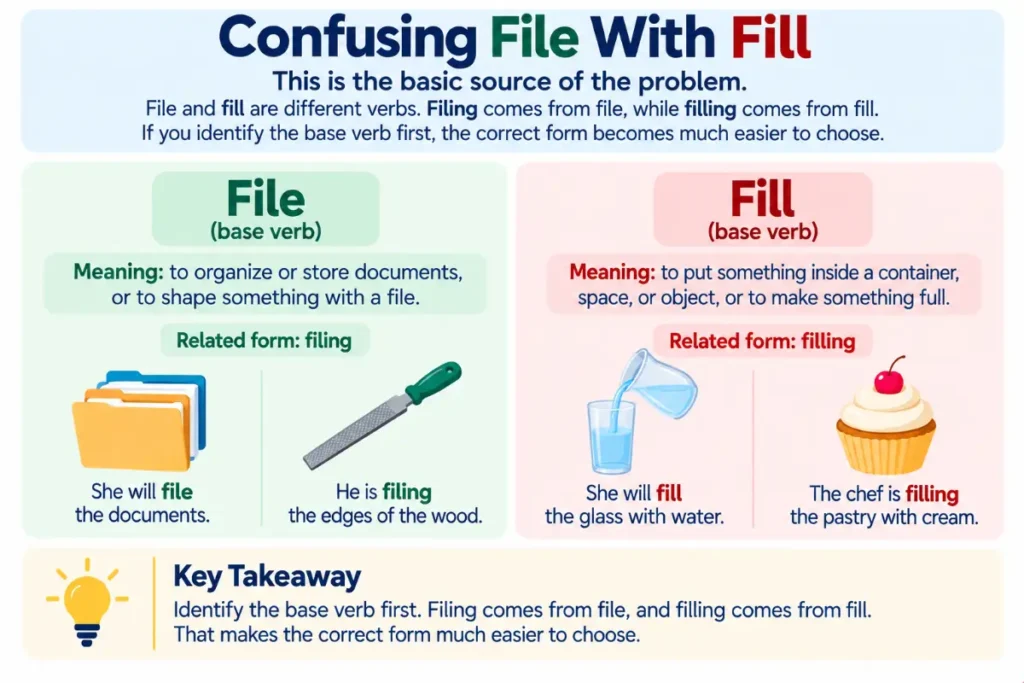
This is the basic source of the problem.
File and fill are different verbs. Filing comes from file, while filling comes from fill. If you identify the base verb first, the correct form becomes much easier to choose.
Confusing Filing With Filling Out
This mistake is especially common in office and school settings.
You file documents, but you fill out a form.
For example:
Please file these invoices.
Please fill out this application.
The two actions may happen in the same workplace, but they are not the same thing.
Using Filling for Document Organization
A person may say that they are filling documents because they are thinking about putting papers into a folder. Standard English normally uses filing for that organized record keeping action.
For example:
I am filing the receipts.
This sentence means the receipts are being organized and stored.
Using Filing for Adding Something
Filing isn’t the normal word when you put something into a container or space.
You fill a bottle.
You fill a box.
Using filing in these situations changes the meaning and usually makes the sentence incorrect.
Ignoring the Vowel Difference
The pronunciation difference can help you avoid the spelling problem.
Filing begins with the long i sound.
Filling begins with the short i sound.
The spelling reflects this difference. Reading the words aloud can help you build a stronger connection between sound and meaning.
Pronunciation Guide
Filing
The standard pronunciation is commonly represented as /ˈfaɪlɪŋ/.
A simple pronunciation guide is:
FYE ling.
The first syllable has the long i sound found in words such as fine, file, and time.
The stress falls on the first syllable.
Filling
The standard pronunciation is commonly represented as /ˈfɪlɪŋ/.
A simple pronunciation guide is:
FIL ling.
The first syllable has the short i sound found in words such as fill, sit, and win.
Again, the first syllable receives the main stress.
Why the Pronunciation Matters
The first vowel gives you a useful listening clue.
If you hear the long i sound from file, you are probably dealing with filing.
If you hear the short i sound from fill, you are probably dealing with filling.
American English speakers may pronounce the unstressed ending quickly, but the first vowel normally remains the strongest clue.
Etymology and Word Origin
The two words have separate histories because they come from different base words.
File has a long history in English. The noun referring to a line or collection of documents developed through French usage and ultimately connects to Latin filum, meaning thread. The idea of documents being arranged in a line or orderly series helped shape the later record keeping sense.
The technical noun file, meaning a tool used to smooth or shape material, has a different historical path. English inherited this sense through French and earlier Germanic language history.
The verb fill has Germanic roots. It is related to older English and Germanic forms expressing the idea of making something full.
These separate histories matter because they confirm that filing and filling aren’t simply two spellings of one word. They come from different word families.
Modern English keeps that distinction.
Regional Usage
American English
Both words are standard in American English.
Filing appears often in workplaces, offices, schools, legal settings, and technical trades. Filling has a much wider everyday range and can refer to containers, forms, food, spaces, and many other situations.
American English also commonly uses fill out for completing a form.
For example:
Please fill out this form.
The expression fill in is also used in American English, especially when referring to missing information.
Please fill in the blank.
British English
British English also uses both forms with the same basic distinction. And British speakers commonly use fill in a form, while American speakers often prefer fill out a form. Both expressions are standard within their respective varieties.
Filing keeps its normal meanings related to documents, records, and shaping materials.
Australian English
Australian English follows the same basic distinction. Filing refers to organizing records or shaping material with a file. Filling refers to making something full or adding something inside a space.
Differences in everyday phrasing may occur, but the spelling distinction remains clear.
Canadian English
Canadian English also uses both words as standard forms And Canadian usage shares features with American and British English, so you may encounter both fill out and fill in for forms depending on context and personal preference.
The meanings of filing and filling remain separate.
Grammar Rules and Part of Speech
Both words come from verbs and can take more than one grammatical role.
Filing as a Present Participle
When filing follows a form of be, it forms part of the progressive verb structure.
She is filing the reports.
They were filing documents all morning.
In these examples, filing describes an action in progress.
Filing as a Gerund
Filing can also act as a noun.
Here the word names an activity rather than directly describing what someone is doing at that moment.
Filling as a Present Participle
Filling works the same way.
He is filling the tank.
They are filling the boxes.
The word describes an action in progress.
Filling as a Gerund
It can also function as a noun.
Filling the container took several minutes.
In this sentence, the activity itself is the subject.
Filling as a Noun
Filling has another common use as an ordinary noun.
The pie has a sweet filling.
The dentist replaced the old filling.
The word can refer to material placed inside something or a dental restoration.
Punctuation
Neither word requires special punctuation simply because of its form. Punctuation depends on the larger sentence.
For example:
She is filing the reports today.
She is filling the bottles today.
The grammar changes according to the verb and context rather than the spelling pattern alone.
Filing Documents and Records
The workplace meaning deserves special attention because it is one of the most common uses of filing.
When you file a document, you place it into an organized record system. That system may be physical or digital.
For example, an office might file invoices by customer name. A school may file student records by identification number. A law firm may file case documents according to a particular system.
The purpose is organization and retrieval.
That gives filing a practical connection with words such as records, folders, documents, archives, storage, and organization.
A useful sentence is:
The receptionist is filing the completed forms.
The receptionist isn’t making the forms full. The person is organizing and storing them.
Filling Forms and Applications
Filling has a completely different workplace meaning when used with forms.
When you fill out a form, you provide the information requested by the form.
For example:
I’m filling out a job application.
She filled out the registration form.
They are filling out the insurance paperwork.
The expression fill in can also mean provide missing information.
Please fill in your address.
In American English, fill out is especially common for completing an entire form. In British English, fill in is widely used for the same general purpose.
This distinction is worth learning because office communication often includes both actions.
You might fill out a form and then file it.
First you enter the information. Then you organize the completed document.
Real Life Usage Examples
Daily Conversation
- I’m filing these papers before I leave the office.
- Can you help me fill this box with the books?
In the first example, the speaker is organizing papers. In the second, the speaker is putting objects into a container.
Email and Workplace Communication
- I’ve finished filing the invoices from last month.
- Please fill out the attached form and return it by Friday.
These sentences are common in professional communication because offices often require both record organization and form completion.
Academic Writing
- The records were filed according to publication date.
- The researchers filled the containers with measured samples.
Academic writing may use both words in technical descriptions. The intended action determines the correct form.
News and Journalism
- The company is filing new documents with the court.
- Heavy rain is filling local reservoirs.
News writing often uses filing in legal and administrative contexts and filling when describing physical spaces or changing conditions.
Literature and Storytelling
- She spent the evening filing old letters in a wooden cabinet.
- He watched the river filling the valley after the storm.
Literary writing gives both words plenty of room because they can describe concrete actions in vivid settings.
Related and Confused Terms
File
File can be a noun or verb. As a verb, it can mean organize records or shape material with a file.
Fill
Fill means to make something full or put something into a space.
File Away
File away means to store something in an organized place for future use.
For example:
She filed away the old receipts.
Fill Out
Fill out usually means complete a form by providing the requested information. This expression is especially common in American English.
Fill In
Fill in can mean provide missing information or complete part of a form.
Filing Cabinet
A filing cabinet is furniture designed to store organized documents and records.
Filling Material
Filling material is a substance used to occupy a space, hole, cavity, or gap. The exact meaning depends on the field.
File a Document
To file a document means to place it into an official or organized record system. In legal contexts, filing can also refer to formally submitting documents to a court or government office.
Filing in Legal and Professional Contexts
The word filing takes on a more specific meaning in legal and administrative language.
A person may file a complaint, file a report, or file a document with a court. In these cases, filing means formally submitting something to an authority or official record system.
For example:
The company filed a response with the court.
This does not mean someone placed paper into a folder. It means an official submission was made.
The distinction matters because professional language often uses familiar words in specialized ways. If you work with legal or government documents, the word filing may refer to an official procedural action.
Filling in Construction and Manufacturing
Filling is also common in construction and manufacturing.
A worker may fill a crack with sealant. A builder may fill a gap with concrete. A manufacturer may fill containers with a product.
For example:
The technician is filling the container to the required level.
The worker filled the gap with insulation.
The basic meaning stays consistent. Something is being added to occupy a space.
Filing can appear in manufacturing too, but the action is different. A worker may file a metal edge to remove rough material and create a smoother surface.
This creates a useful contrast.
A worker can file an edge and fill a gap during the same project.
Expert Editor Insight
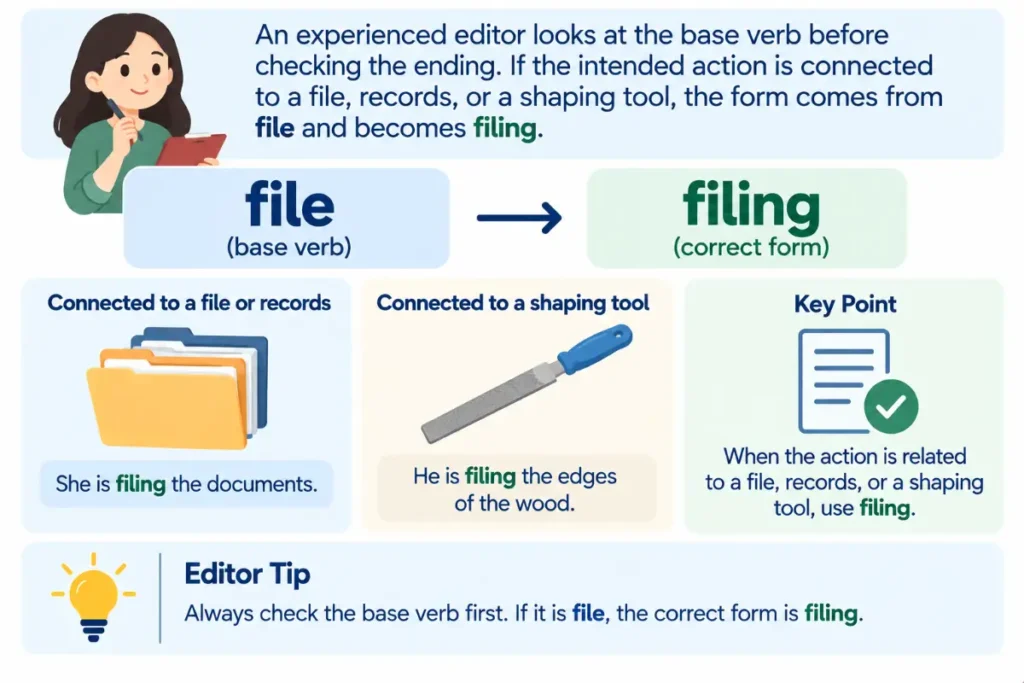
An experienced editor looks at the base verb before checking the ending. If the intended action is connected to a file, records, or a shaping tool, the form comes from file and becomes filing. If the action means making something full or putting something into a space, the base verb is fill and the form becomes filling. Spelling tools can flag accidental substitutions, but context remains the best guide because both words are legitimate English forms.
Conclusion
Filing vs filling becomes much easier once you focus on the base verbs. Filing comes from file and usually refers to organizing records, formally submitting documents, or smoothing material with a file. Filling comes from fill and means putting something into a space or making something full.
The spelling follows the meaning. File becomes filing because the final e drops before ing. Fill becomes filling while keeping the double l. That small spelling difference carries a completely different meaning.
A useful editing trick is to picture the action before choosing the word. Imagine a folder or file cabinet and think filing. Imagine a bottle, box, form, or empty space and think filling. Once that mental picture becomes automatic, the distinction is easy to remember.
FAQs
What is the difference between filing and filling?
Filing and filling come from different verbs and have different meanings. Filing usually refers to organizing records or using a file to smooth or shape material. Filling means putting something into a space or making something full. For example, you file documents but fill a box. The spelling reflects the different base verbs file and fill.
Is filing a correct English word?
Yes. Filing is a standard English word and has several common uses. It can mean organizing documents or records, formally submitting documents, or shaping material with a file. It can also function as a gerund or present participle. For example, She is filing the reports uses it as part of a progressive verb construction.
Is filling a correct English word?
Yes. Filling is a standard English word. It comes from fill and describes the act of putting something into a space or making something full. It can also function as a noun, as in a pie filling or dental filling And It is common in everyday conversation, professional writing, cooking, construction, and many other fields.
Is filing the same as filling out a form?
No. Filing and filling out describe different actions. Filing a document means organizing or formally submitting it. Filling out a form means entering the information requested on that form. In an office, you might fill out an application and then file the completed application in the appropriate record system.
Why do filing and filling sound similar?
The words share several sounds, especially at the beginning and in the final ing ending. Their main pronunciation difference appears in the first vowel. Filing uses the long i sound found in file, while filling uses the short i sound found in fill. Speaking the base verbs aloud can help you hear and remember the difference.
Is filling out or filling in a form correct?
Both expressions are standard, but regional preferences differ. American English commonly uses fill out for completing a form. British English commonly uses fill in. Both expressions mean providing the information requested by a form. The choice usually depends on the variety of English being used and the context of the communication.
Can filing refer to legal documents?
Yes. In legal and administrative contexts, filing can mean formally submitting a document to a court, government agency, or other official body. For example, a lawyer may file a motion with a court. This meaning is related to the idea of placing something into an official record, although it is more specialized than ordinary office filing.
What is the easiest way to remember the difference?
Connect filing with file and filling with fill. If you are organizing documents or smoothing material with a file, use filing. If you are putting something into a space or making something full, use filling. The spelling follows the base verbs. File loses its final e before ing, while fill keeps its double l.
