
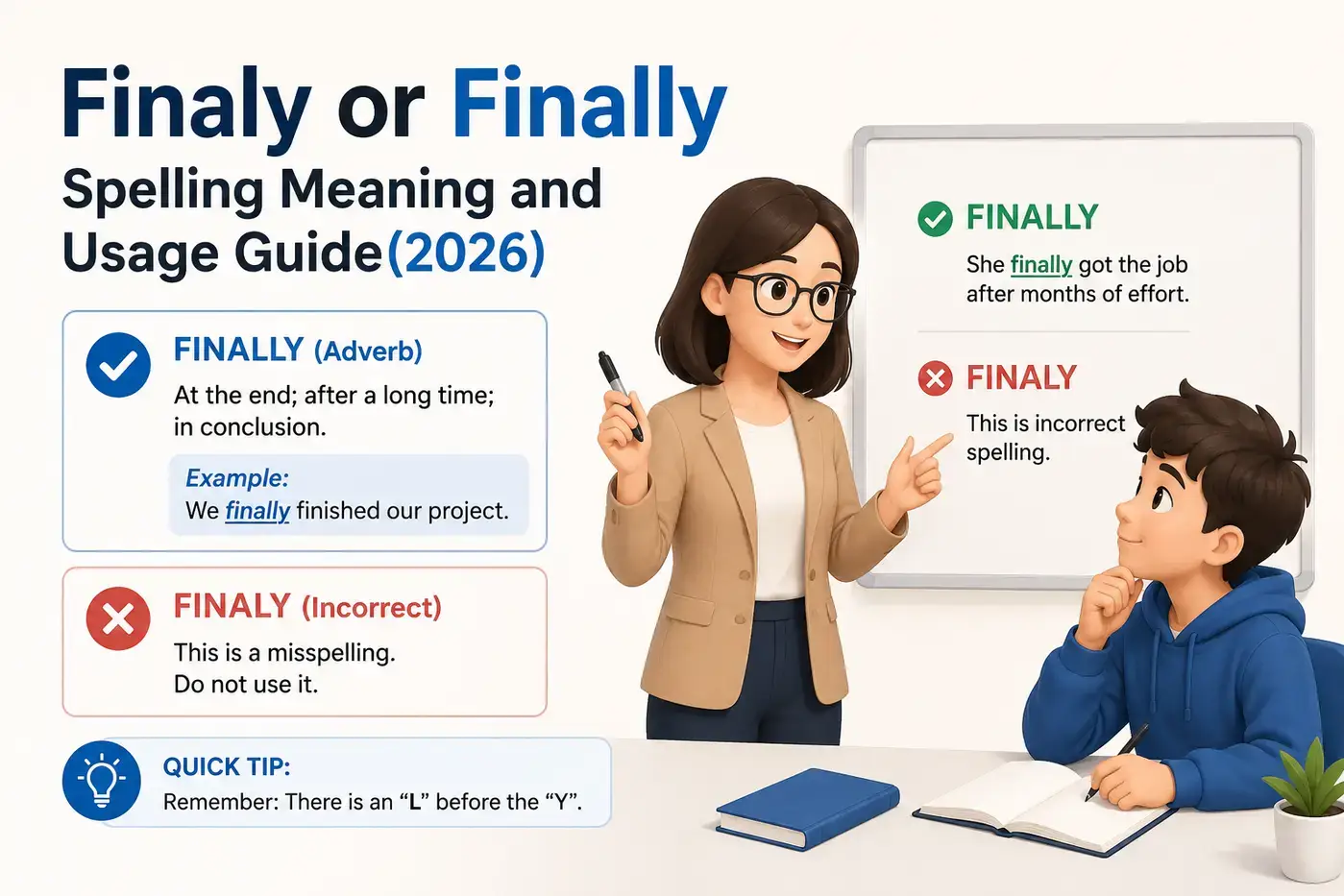
finaly or finally is a common spelling confusion that can make even a simple sentence look wrong. The correct spelling is finally with two l letters. The incorrect form finaly usually appears when someone leaves out one l while typing or spelling the word from memory. Although the difference is only one letter, using the correct form matters in school assignments, professional writing, emails, and published content.
The confusion often comes from pronunciation. When people say finally, the two l letters do not sound like two separate sounds, so the spelling can be easy to forget. English also has many words ending in ly, which can make writers focus on the ending instead of the letters before it. Once you connect the word with final, however, the correct spelling becomes much easier to remember.
In this guide, you’ll learn the meaning of finally, its grammar role, pronunciation, origin, sentence structure, and common uses. You’ll also see practical examples and related words such as eventually, ultimately, at last, and lastly. Most importantly, you’ll get a simple spelling trick that can help you avoid this mistake the next time you write the word.
Quick Answer
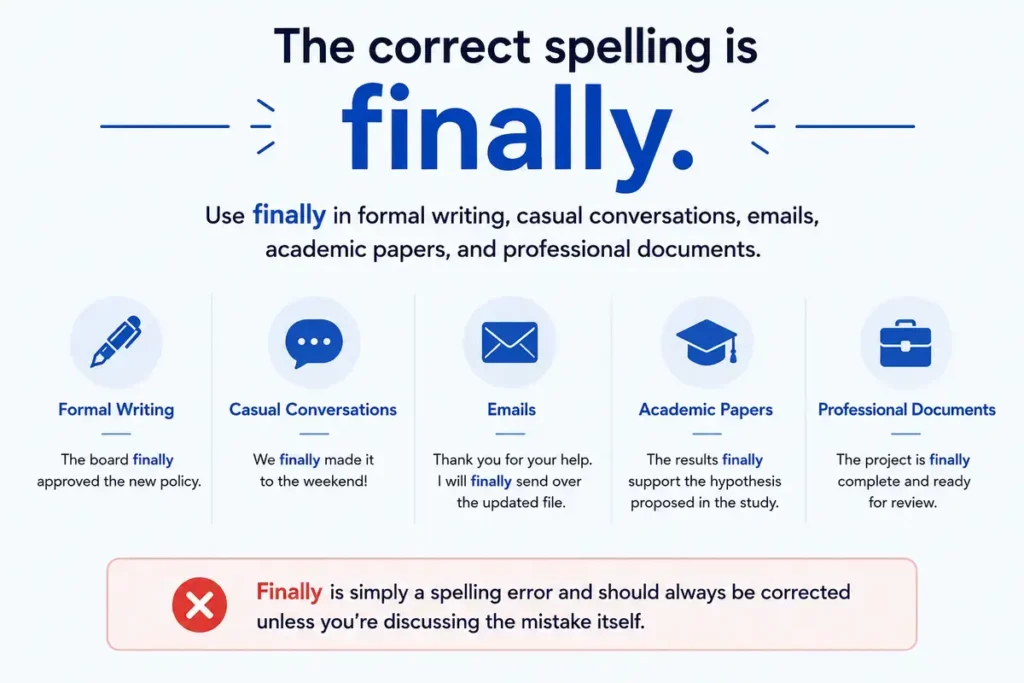
The correct spelling is finally. The form finaly is a common spelling mistake caused by leaving out one of the two l letters. Finally is an adverb that can mean at last after a period of waiting or at the end of a sequence. For example, you can say, I finally finished my homework.
Comparison Table
| Correct Form | Meaning | Part of Speech | Origin | Usage Frequency | Formality | Common Contexts | Example |
|---|---|---|---|---|---|---|---|
| Finally | At last or at the end | Adverb | Latin through French and Middle English | Very common | Neutral and formal | Conversation writing school work business writing news | We finally reached home. |
| Finaly | No standard English meaning | Misspelling | Not an established English form | Uncommon as a correct form | Nonstandard | Typing mistakes casual posts search queries drafts | Finaly is an incorrect spelling. |
Meaning and Definition
Meaning of the Incorrect Form
The incorrect form is usually a simple spelling mistake. It does not have a standard meaning in ordinary English and should not replace the accepted spelling in school work professional writing published material or formal communication.
You may still see it online. People make spelling mistakes while texting writing comments completing forms or typing quickly. Search engines can often understand the intended word from context. That ability doesn’t turn an error into a standard spelling.
There is also an important distinction between a spelling error and a special name. A person could theoretically use Finaly as a username business name character name or other personal label. In that case the spelling belongs to the name itself. It does not change the normal English spelling of the adverb.
For standard English writing the answer is simple. Use the form with two l letters.
Meaning of the Correct Form
Finally is an adverb. Its basic meaning relates to reaching an ending point.
The word commonly means at last. This use often suggests that something took time or happened after waiting.
For example:
I finally found my wallet.
The sentence tells us more than the simple fact that the wallet was found. The word finally suggests that the speaker had been looking for it and had probably become tired or frustrated.
The word can also describe the last stage of a sequence.
First, wash the vegetables. Next, cut them into small pieces. Finally, place them in the pan.
Here the word acts as a sequence marker. It tells the reader that the final step has arrived.
Another use appears when someone presents the last point in an explanation.
Finally, we need to consider the cost.
In this case the word doesn’t necessarily suggest a long wait. It signals that the speaker has reached the last item in a discussion.
That small difference matters. The same word can express completion after delay or the final position in an organized sequence.
Why The Spelling Causes Confusion
The mistake looks minor because the two forms differ by only one letter. When you read them quickly your brain can easily recognize the intended word even when one l is missing.
Pronunciation adds to the problem. The second l isn’t strongly noticeable as a separate sound in normal speech. English spelling often contains letters that don’t stand out clearly when a word is spoken.
Typing speed also plays a role. Repeated letters are easy to skip when someone is writing quickly. The writer may know the word perfectly well but still leave out one character.
There is another useful point. English has many words that end in ly. Once a writer reaches the end of a familiar word pattern the brain can sometimes focus more on the ending than the letters in the middle.
That’s why this mistake usually doesn’t indicate a lack of understanding. It is often a small spelling slip.
Key Differences Explained
- Spelling. The standard form contains two l letters before the final y. The incorrect form contains only one.
- Meaning. The accepted form has clear meanings connected with completion sequence and an ending. The misspelled form has no standard dictionary meaning.
- Grammar. The accepted word functions as an adverb. It can modify an action or introduce a final point.
- Pronunciation. The spoken form does not make the repeated l letters especially obvious. This can contribute to spelling errors.
- Formality. The correct word works in casual conversation and formal writing. The misspelled version should be corrected in polished writing.
- Context. You can use the standard form in emails essays reports conversations news stories and academic work.
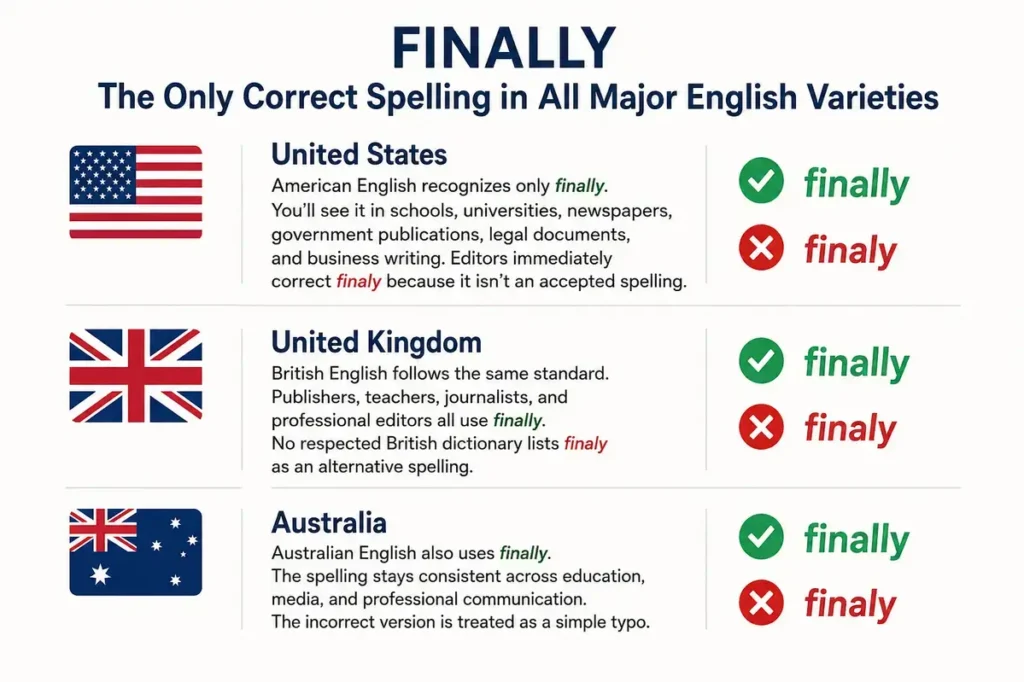
- Regional usage. American British Canadian and Australian English all use the same standard spelling.
- Standard usage. There is no ordinary regional English variety in which the single l version replaces the standard spelling.
Which Spelling Is Correct?
The accepted spelling is finally.
The spelling becomes easier to understand when you connect it to the word final. The adjective final already contains the ending idea. When the adverb form is created with ly the spelling retains the l from final and adds another l at the boundary.
So you can think of it like this:
final + ly = finally
This is a useful spelling pattern to remember. You don’t need to memorize every letter separately.
Standard English dictionaries list finally as an adverb. The single l form is generally treated as an error when the writer intends the common English adverb.
Professional editors use the same basic principle. They check the intended word first and then confirm that the written form matches standard usage. Context matters because spelling alone doesn’t tell the whole story in every language situation.
For ordinary English writing the rule is straightforward. If you mean at last or at the end use the standard double l spelling.
Sentence Examples
The best way to understand a word is to see it working naturally inside a sentence.
- I finally finished my science project.
- She finally called me after several days.
- We finally found a quiet place to sit.
- The students finally understood the difficult lesson.
- He finally decided to accept the offer.
- After two hours we finally reached the airport.
- Finally, the teacher explained the last part of the question.
- I finally remembered where I had put my keys.
- The company finally announced its decision.
- After months of practice she finally felt confident about the presentation.
These examples show two major uses. Some sentences describe something that happens after waiting. Others use the word to introduce the final point in a sequence.
The common misspelling may appear in sentences such as these:
- I finaly finished my homework.
- She finaly called her friend.
- We finaly reached the station.
- He finaly understood the answer.
- They finaly solved the problem.
These examples are useful only for recognizing the error. In standard writing each one should use the accepted spelling with two l letters.
Common Mistakes and Misspellings
Leaving Out One L
The most common error is writing finaly. The writer remembers the general shape of the word but drops one repeated letter.
Correct: I finally finished the report.
Incorrect: I finaly finished the report.
The easiest fix is to connect the word with final.
Adding An Extra E
Some learners may write finalley. This happens when they try to represent the sound rather than follow the standard spelling pattern.
Correct: She finally arrived.
Incorrect: She finalley arrived.
The ending is ly rather than ley.
Confusing Spelling With Pronunciation
English spelling doesn’t always provide a perfect letter by letter representation of pronunciation. A learner may hear the word and write the sounds they think they hear.
That approach can work with some simple words. It becomes less reliable with words whose spelling developed over centuries.
Forgetting The Word Family
The word final is a useful spelling clue. If you remember that related word first then the longer form becomes easier to build.
Final gives you the base. The adverb ending completes the word.
Trusting Fast Typing
Typing quickly can cause repeated letters to disappear. This happens with many English words and isn’t limited to this one.
A quick proofreading pass often catches the mistake. Reading your writing slowly can help you notice letters your brain skipped during fast typing.
Pronunciation Guide
The standard pronunciation is commonly represented in IPA as /ˈfaɪnəli/.
You can think of the word as three sound groups:
fine uh lee
The first syllable carries the main stress.
FI n uh lee
The first sound is similar to the word fine. The middle vowel is light and relaxed. The final part sounds like lee.
American speakers may pronounce the middle part very quickly in normal conversation. That reduced sound can make the written form seem longer than the spoken form.
That difference between speech and spelling is one reason learners sometimes omit a letter. The solution isn’t to pronounce every letter separately. Instead learn the spoken form and written form together.
A useful practice method is to say the word aloud while writing it several times:
Finally.
Finally.
Finally.
Then use it in a complete sentence:
I finally finished my assignment.
This connects pronunciation spelling and meaning at the same time.
Etymology and Word Origin
The word belongs to a long family of English words connected with endings limits and completion.
Its deeper history goes back to Latin. The Latin word finis referred to an end boundary or limit. From this family came Latin finalis meaning relating to an end.
The word family moved through French before developing further in English. The modern English words final and finally are part of this same historical family.
This history explains why the two modern forms look so closely related. Final describes something connected with an ending. Finally turns that idea into an adverb.
Understanding word families can be surprisingly useful for spelling. Instead of remembering a long word as a random group of letters you can connect it with a familiar shorter word.
That gives you a practical memory pattern:
final → finally
The historical development also shows why spelling doesn’t always follow modern pronunciation perfectly. English has borrowed and changed words from several languages over many centuries. Modern spellings often preserve parts of those older forms.
Regional Usage
American English
American English uses the standard spelling finally. It appears naturally in everyday conversation school assignments workplace communication journalism and formal writing.
The meaning also stays familiar across contexts. It can express relief after waiting or introduce the last point in a sequence.
For example:
I finally got home.
Finally, we need to discuss the budget.
Both uses are completely natural in American English.
British English
British English also uses finally as the standard spelling. There is no major spelling difference between American and British English for this word.
British speakers use it in conversation and formal writing in much the same way American speakers do. The pronunciation can vary slightly by speaker and accent but the standard written form remains the same.
Australian English
Australian English follows the same standard spelling. Finally appears in everyday speech professional communication education journalism and published writing.
There is no established Australian spelling variant that replaces the standard form with a single l.
Canadian English
Canadian English also uses the standard spelling. Writers in Canada use it in both casual and formal contexts.
As with American British and Australian English the main distinction is not regional spelling. The issue is simply choosing the accepted English form instead of a common typing error.
Grammar Rules and Part of Speech
Finally is an adverb.
An adverb can provide information about an action or the circumstances surrounding an action. In this case the word can tell us that something happened after a delay or that something represents the final stage of a sequence.
Consider:
She finally passed the exam.
The word finally modifies the idea of passing. It tells us that the result came after some time or effort.
It can also appear at the beginning of a sentence:
Finally, we reached the hotel.
Here it introduces the final stage of the story.
Another common position is after the subject and before the main verb:
She finally understood the problem.
This placement sounds natural in everyday English.
The word can also appear after a form of the verb be:
The project is finally complete.
This sentence emphasizes that the project has reached completion after some process or delay.
Punctuation With Finally
When the word begins a sentence and introduces a final point a comma often helps readability.
Finally, we can begin the meeting.
However, punctuation should serve the sentence rather than become a rigid rule. Short introductory adverbs can sometimes appear without a comma depending on style and rhythm.
The more important point is grammatical. Finally remains an adverb regardless of where it appears.
Finally In A Sequence
The word is especially useful when organizing instructions or arguments.
First, collect the information.
Next, check the details.
Finally, write the conclusion.
Here it functions as a sequence marker. It tells the reader that the last stage has arrived.
Real Life Usage Examples
Daily Conversation
Finally often appears in ordinary speech because people regularly talk about things that took time.
I finally found my phone.
We finally have a day off.
In both sentences the speaker emphasizes completion. The first suggests a search. The second suggests waiting for free time.
Email And Workplace Communication
The word also works naturally in professional communication.
We finally received the documents from the client.
Finally, we can move forward with the next stage.
The first sentence focuses on delayed arrival. The second introduces a final point in a work related process.
Academic Writing
Academic writing often uses the word to describe the last step in an argument or process.
Finally, the study examines the long term effects of the treatment.
The researchers finally identified the main variable affecting the results.
In formal writing the word should add meaning. Avoid using it repeatedly just to make paragraphs sound organized.
News Writing
News stories often describe events that conclude after discussion or delay.
The two sides finally reached an agreement.
Officials finally released the report on Tuesday.
The word can add useful context because it tells readers that the event followed a period of waiting.
Literature And Storytelling
Storytellers use finally to show that a character has reached an important point.
After years of searching he finally returned home.
She finally understood why her father had kept the letter.
In these examples the word can carry emotional weight. It tells the reader that the ending came after a meaningful journey.
Related And Confused Terms
At Last
At last often carries a strong feeling of relief after waiting.
We finally arrived.
We arrived at last.
Both can work in the right context. At last can sound slightly more expressive.
Eventually
Eventually means that something happened after some time. It doesn’t always suggest the same feeling of relief.
He eventually found a solution.
The emphasis is on the passage of time and the final result.
Ultimately
Ultimately focuses on the final result or conclusion of a situation.
Ultimately, the decision belongs to the manager.
This use differs from finally when the speaker is simply describing something that happened after waiting.
In The End
In the end often introduces the final outcome.
In the end, we decided to stay home.
It can describe the result of a decision or situation.
Lastly
Lastly usually introduces the final item in a list or series.
Lastly, check your spelling before submitting the assignment.
It focuses strongly on order.
At The End
At the end points directly to an ending point in time space or a process.
At the end of the movie, everyone went home.
It often works as a phrase rather than as a direct replacement for an adverb.
Eventually And Finally Together
These words can overlap but they aren’t always interchangeable.
Eventually, she agreed.
Finally, she agreed.
The first sentence emphasizes the passage of time. The second can suggest that the agreement came after waiting and may carry a stronger sense of completion or relief.
Conclusively
Conclusively means in a way that settles an issue or establishes something firmly.
The evidence did not conclusively prove the claim.
It shouldn’t replace finally simply because both words can appear near the end of an argument. Their meanings are different.
A Simple Memory Trick
A spelling trick is useful when it works in your head without effort.
Start with the familiar word final.
Then add ly.
Final plus ly gives the standard spelling.
The key is to notice the two l letters sitting together at the joining point.
You can also remember a simple sentence:
The final step is finally complete.
The relationship between final and finally makes the spelling easier to recall.
Another useful method is visual grouping. Instead of seeing a long string of letters try seeing the word as:
final + ly
That gives your brain a structure to remember.
Spelling becomes easier when you understand the structure instead of relying only on memorization.
Why Spellcheck May Miss Some Errors
Modern spelling tools are useful but they aren’t perfect.
A spellchecker may recognize a misspelled form and suggest the standard word. Search engines may also understand the intended meaning based on surrounding words.
Context can make language technology surprisingly good at guessing what a person intended. Natural language processing systems often use nearby words and sentence patterns to identify likely meanings.
Still you shouldn’t depend entirely on automatic correction. A spelling tool can miss errors or fail to understand the writer’s intention.
Human proofreading remains useful because people can evaluate meaning context tone and sentence structure together.
For a short spelling question this may seem like a small point. In professional writing small details add up. A document filled with minor spelling mistakes can feel less polished even when the main ideas are strong.
Formal And Informal Usage
The correct form works across a wide range of situations.
In casual conversation you might say:
I finally got some sleep.
In a school essay you might write:
Finally, the evidence supports the proposed explanation.
In a professional email you could write:
We finally received confirmation from the supplier.
The word itself is not too casual for formal writing. It is a normal English adverb that fits many levels of communication.
The main consideration is frequency. If you use it several times in a short passage you may want to vary your wording. Depending on the context you might use eventually ultimately lastly or in the end.
That doesn’t mean these words are exact substitutes. Choose the one that expresses the intended meaning most accurately.
How Native Speakers Use The Word
Native speakers usually use finally in two major ways.
The first expresses completion after waiting.
I finally got an answer.
The second introduces the last item in a sequence.
Finally, we need to review the results.
The emotional tone can change depending on context.
I finally finished my homework.
This may suggest relief.
Finally, I want to thank everyone who helped.
This simply introduces the final point.
That flexibility makes the word useful. It can carry emotion when context gives it that meaning or simply organize information when the writer needs a clear sequence marker.
Expert Editor Insight
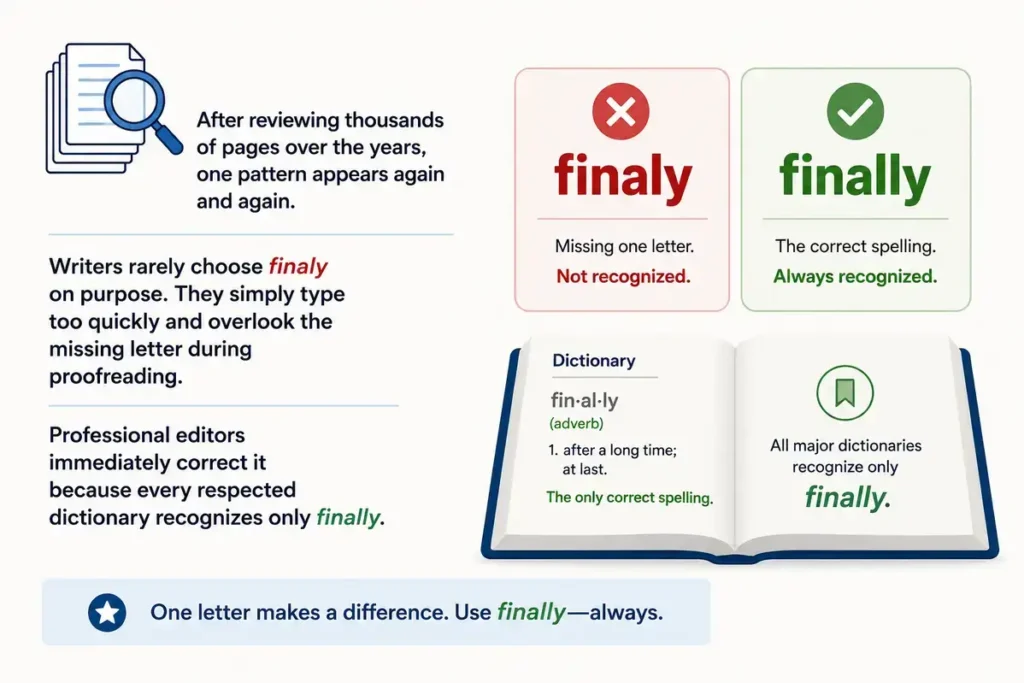
An experienced editor will usually spot this spelling problem quickly because the standard form is visually familiar. The mistake often survives because the reader’s brain automatically corrects it while reading. That same mental correction can make proofreading less reliable. A useful editing habit is to slow down around repeated letters and common endings such as ly. If a word looks familiar but something feels slightly off, compare it with a related base word. In this case the connection with final gives you a quick and dependable spelling check.
Conclusion
finaly or finally has a clear answer. The accepted spelling is finally and the single l form is a common spelling mistake. The correct word is an adverb that can mean at last or indicate the final stage of a sequence. It works naturally in conversation, school writing, professional communication, journalism and formal English.
The spelling becomes much easier when you connect it with the familiar word final. Think of the base word first and then add the adverb ending ly. This helps you remember the two l letters without memorizing the entire word as a separate pattern.
A good proofreading habit is to slow down whenever you see repeated letters or familiar endings. If you remember final plus ly, you’ll have a simple and reliable way to write the word correctly.
FAQs
Is finaly a real English word?
The single l form is not the standard English spelling of the adverb. In ordinary writing it is treated as a misspelling. You may see it in usernames names or other personal labels, but those special uses don’t make it a standard English word. For school work professional communication and published writing use the accepted spelling with two l letters.
What does finally mean?
Finally is an adverb that commonly means at last or after a period of waiting. It can also introduce the final point in a sequence. For example, I finally finished my assignment suggests that the speaker completed it after some time or effort. In Finally, we discussed the results, the word introduces the last part of an organized discussion.
Which form should I use in formal writing?
Use the standard spelling with two l letters. It is appropriate in academic essays reports workplace emails business documents journalism and other formal contexts. The single l version is generally a spelling error. If you are proofreading an important document, search specifically for the incorrect form because spellcheck can sometimes behave differently depending on the software and context.
How do you pronounce finally?
The common IPA pronunciation is /ˈfaɪnəli/. A simple pronunciation guide is fine uh lee. The first syllable receives the main stress. In natural American speech the middle sound can become very light. That reduced sound may make the written form seem shorter than it is. Learning the pronunciation together with the spelling can help prevent the missing l mistake.
Can finally start a sentence?
Yes. Finally can begin a sentence when it introduces the last point in a sequence or describes a final stage. For example, Finally, we reached the station. It can also introduce the final idea in an argument, such as Finally, the evidence supports the proposed explanation. A comma often helps when the word functions as an introductory adverb.
What are useful synonyms for finally?
Useful related expressions include at last, eventually, ultimately, in the end, lastly and at the end. These words overlap but don’t always carry exactly the same meaning. At last often suggests relief after waiting. Eventually focuses on time. Ultimately emphasizes a final result. Lastly usually introduces the final item in an ordered list.
Why do people misspell the word?
The mistake is easy to make because the repeated l letters are not strongly noticeable in normal pronunciation. Fast typing can also cause repeated letters to disappear. Another factor is the common ly ending found in many English adverbs. A useful memory trick is to connect the word with final. Thinking of the base word first makes the spelling much easier to reproduce correctly.
Is finally suitable for academic writing?
Yes. Finally is completely suitable for academic writing when it expresses completion or introduces the last point in an argument. For example, Finally, the researchers examined the long term effects. Academic writers should use the word only when it adds meaning. If several consecutive paragraphs begin with finally, varying the structure may make the writing smoother and more natural.
