
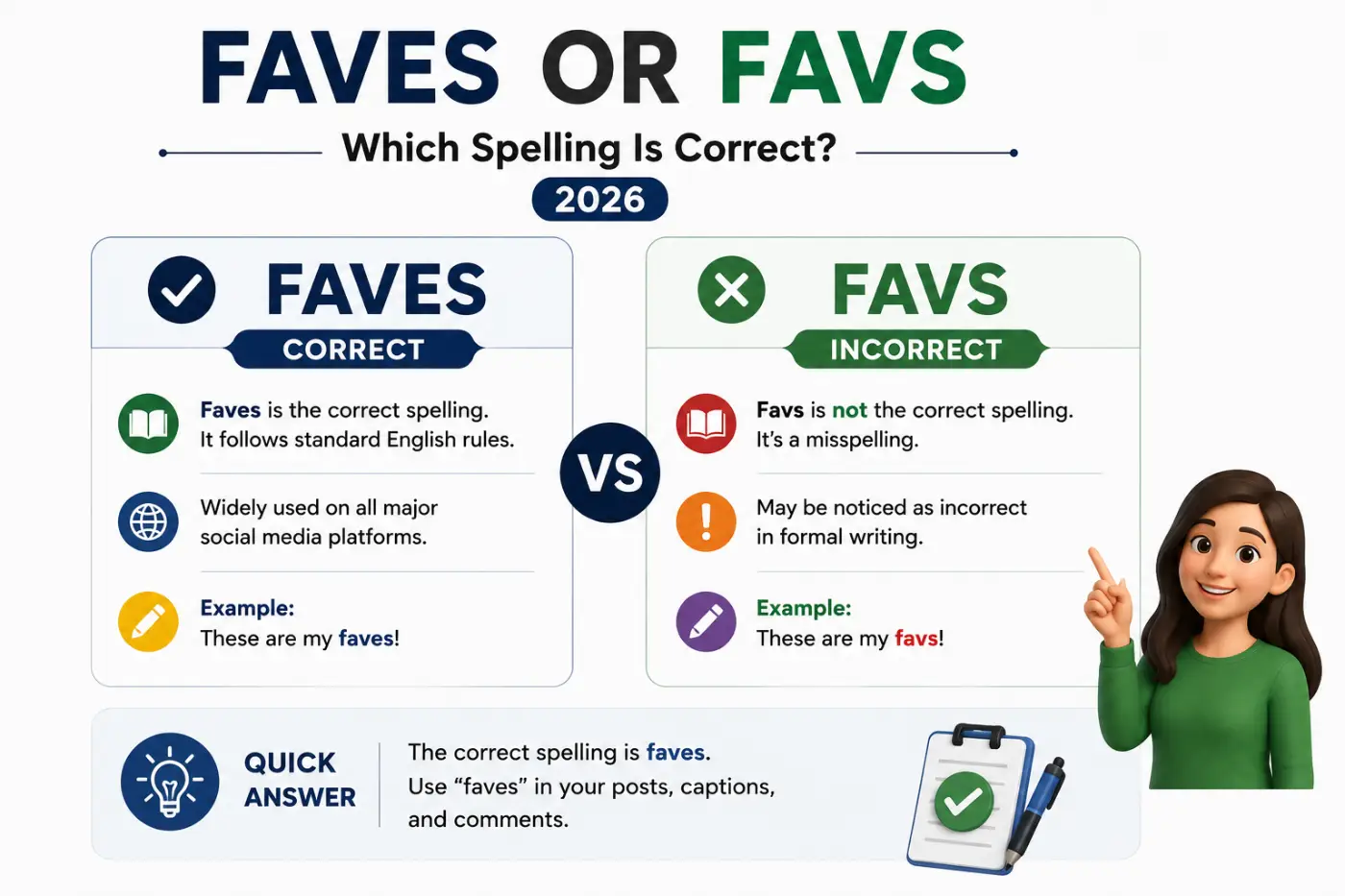
If you’ve seen both faves and favs online, you may wonder which one sounds right. Both forms are used as informal shortenings of favorites, but they have different spelling patterns and levels of familiarity. Neither one works as a formal replacement for favorites in standard professional writing.
The main difference is simple. Faves keeps more of the original word’s sound and spelling pattern, while favs is a shorter abbreviation that removes most of the ending. In American English, both can appear in casual messages, social media posts, comments, and friendly conversation. Your choice depends mainly on context and personal style.
These short forms became common because English speakers often shorten familiar words in relaxed communication. Think of them as linguistic shortcuts. They save space and create a casual tone, much like other shortened forms used in texting and online conversation. The important part is knowing where that relaxed style fits and where the full word is better.
This guide explains the meaning, pronunciation, grammar, spelling, context, regional usage, and practical differences between these two forms. You’ll also see examples that show how native English speakers use them naturally.
Quick Definition
Faves and favs are informal shortened forms of favorites. Faves is a clipped plural form that closely resembles the pronunciation of the full word, while favs is a shorter written abbreviation. Both can work in casual American English, but favorites is the safer choice in formal or professional writing.
Quick Answer
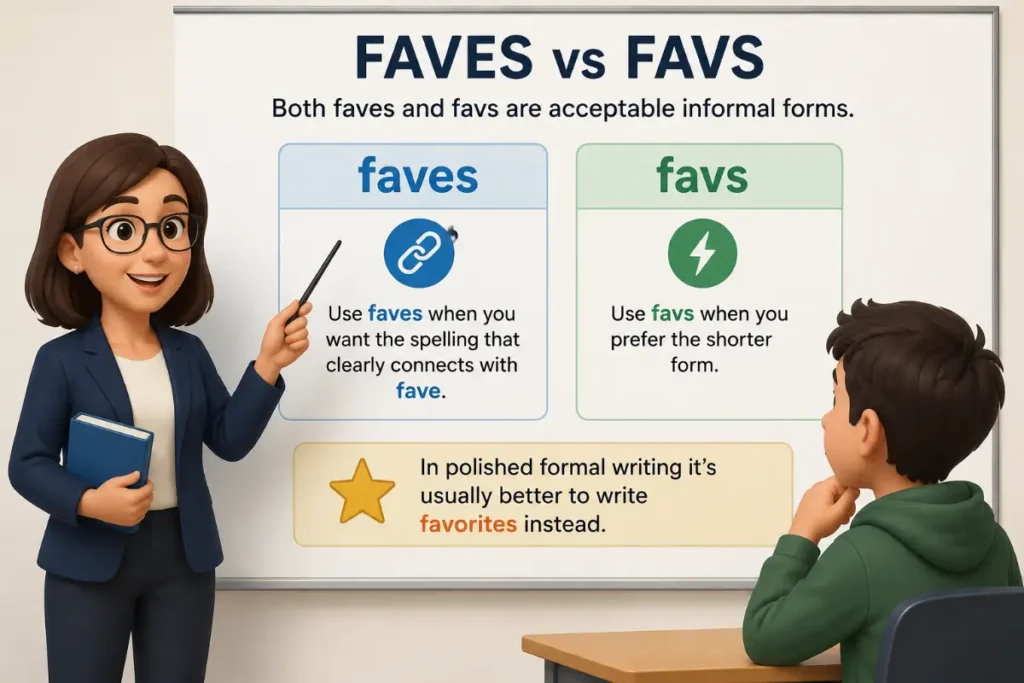
Both faves and favs can be used as informal forms of favorites. Faves is generally easier to recognize as a shortened version of the full word, while favs is especially common in quick digital communication. Neither form should normally replace favorites in formal writing. For a school essay, business report, academic paper, or professional document, write favorites instead.
Comparison Table
| Form | Meaning | Part of Speech | Origin | Usage Frequency | Formality | Common Contexts | Example |
|---|---|---|---|---|---|---|---|
| Faves | Informal plural of favorite | Noun | Shortened from favorite | Common in casual writing | Informal | Social media, texting, conversation | These are my faves. |
| Favs | Informal abbreviation of favorites | Noun | Abbreviated from favorite or favorites | Common in digital communication | Very informal | Texting, apps, comments, online posts | Check my favs. |
| Favorites | Preferred people, things, or choices | Noun | Standard English word | Very common | Neutral to formal | General and professional writing | These are my favorite books. |
Meaning and Definition
Meaning of Faves
Faves is an informal shortening of favorites. It normally refers to two or more people, things, places, foods, songs, movies, or other items that someone likes especially well. For example, someone might write, My summer faves are iced coffee, beach days, and mystery novels.
The meaning is easy to understand because the shortened form preserves the main sound and visual shape of favorite. Most readers can recognize it without much effort. The word usually appears in relaxed settings. Social media captions, text messages, blogs, online discussions, and friendly conversations are natural places to see it.
Faves can also be used as a noun.
These are my faves.
In this sentence, faves means favorite things. The shortened word stands on its own because the surrounding context makes its meaning clear.
The form is informal rather than incorrect. That distinction matters. Informal English contains many shortened words that native speakers use comfortably even though they would avoid them in formal documents.
Meaning of Favs
Favs is another informal shortening related to favorite and favorites. It is particularly natural in digital communication because it is brief and easy to type.
Someone might say, Here are my weekend favs.
The reader understands that favs means favorite things or favorite choices.
The form can feel more compressed than faves. That makes it especially suitable for quick messages, social posts, usernames, app labels, and online comments.
You may also encounter fav as a singular noun.
That song is my fav.
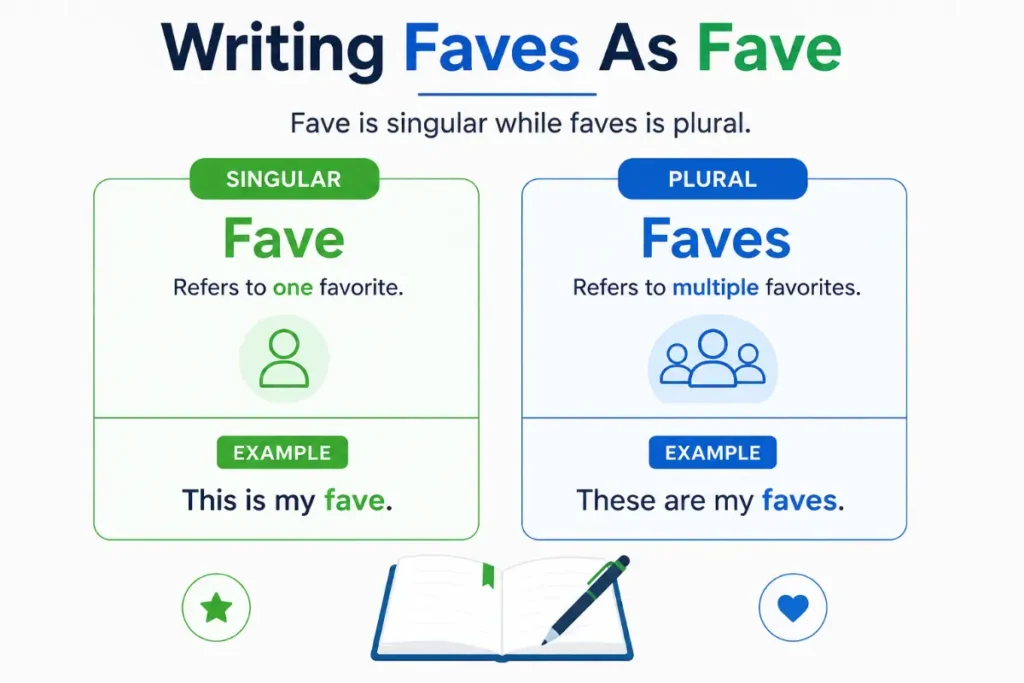
Here fav means favorite. Adding s produces favs when the writer refers to multiple favorites.
The form has a distinctly casual feel. It can be friendly and playful, but it may look too informal in a serious document.
Meaning of Favorites
Favorites is the standard full form. It refers to people or things that someone likes more than others.
My favorite restaurant is nearby.
Those are my favorite shoes.
She listed her favorite movies.
As a noun, favorites can refer to the selected things themselves.
These are my favorites.
This full form works across almost every ordinary English context. It fits conversation, emails, school assignments, articles, reports, and professional writing.
That makes it the safest option when you don’t know how casual your writing should be.
Key Differences Explained
- Length. Faves is closer to the original word, while favs is shorter and more compressed.
- Tone. Both forms sound informal. Favs often feels especially suited to texting and online communication.
- Recognition. Faves closely resembles the sound of favorites, so some readers may find it more immediately recognizable.
- Grammar. Both can function as informal plural nouns. They refer to multiple favorite people or things.
- Pronunciation. Faves is normally pronounced like faves. Favs is usually pronounced like favz.
- Context. Both forms work best in relaxed communication. Favorites works in casual and formal contexts.
- Style. Faves can feel friendly and conversational. Favs can feel shorter and more digital.
- Standard English. Favorites is the standard full form. The shorter versions belong mainly to informal usage.
The key point is that this isn’t a case where one spelling is always correct and the other is always wrong. Both shortened forms have a place in informal English. The real question is which style suits your audience and purpose.
Which Form Should You Use
If you’re writing casually, either shortened form can work. Faves is a natural choice when you want the abbreviation to remain visually close to favorite. Favs is useful when you want something shorter and more compact.
For example, these all communicate the same basic idea.
These are my favorites.
These are my favs.
The first sentence is neutral and works almost anywhere. The second and third sentences are casual.
A professional editor would normally choose the full form in formal writing. A social media writer might choose either shortened version depending on the personality of the post.
There’s no universal grammar rule that requires one informal shortening over the other. The distinction comes mainly from convention, tone, and audience expectations.
Sentence Examples
Here are natural examples using faves.
- These are definitely my faves from the new collection.
- What are your faves from that restaurant?
- I saved a few of my summer faves for later.
- Those three songs are still among my faves.
- My family knows chocolate cake is one of my faves.
- I’m sharing some of my travel faves today.
- That movie has become one of my all time faves.
- These are my faves from the bookstore.
- She asked me to send her my favorite recipes, so I sent my faves first.
- The blue ones are my faves.
Here are natural examples using favs.
- I’ll send you my weekend favs tonight.
- These are some of my current favs.
- What are your coffee shop favs?
- I made a playlist with all my old favs.
- Those are definitely my top favs this month.
Notice that the shorter form fits naturally into casual communication. You might see it in a text message such as Send me your favs. In a formal email, however, Send me your favorites sounds more polished.
Common Mistakes and Confusions
Shortened words often create confusion because writers may treat them like standard dictionary forms in every situation. The problem isn’t usually grammar. It’s context.
Here are five common mistakes to watch for.
- Using a shortened form in formal writing.
Incorrect style for a formal report: These are our top favs.
Better: These are our top favorites.
The shorter form isn’t necessarily grammatically impossible. It simply doesn’t match the expected tone of a formal document.
- Treating fav as the standard plural.
Fav usually works as a casual singular abbreviation.
That song is my fav.
For multiple items, favs is the informal plural.
These songs are my favs.
In formal writing, use favorite and favorites.
- Assuming faves and favs have different meanings.
They usually carry the same basic meaning. The main difference is style and form.
- Adding unnecessary punctuation.
People sometimes write fav’s when they mean multiple favorites. That apostrophe is not needed. The plural is favs.
- Mixing formal and informal tone.
A sentence can become stylistically uneven when highly formal language appears beside a very casual abbreviation.
For example, The committee reviewed the submitted proposals and selected its top favs sounds less consistent than The committee reviewed the submitted proposals and selected its top choices.
Pronunciation Guide
Faves is commonly pronounced like the first part of favors without the second syllable.
A simple pronunciation guide is:
fayvz.
The final sound is voiced. It ends with a sound similar to the z in saves.
Favs is usually pronounced:
favz.
The vowel in fav is the same short a sound found in words such as have and glad in many American accents.
Because these are informal shortenings, pronunciation can vary slightly from speaker to speaker. The written forms are much more important than tiny differences in accent.
The full word favorites has several syllables and a different rhythm. Shortened forms remove that extra material, which is part of their appeal in quick communication.
One useful point for English learners is that abbreviations do not always follow predictable pronunciation rules. Native speakers often learn them from repeated exposure. Context fills in the meaning almost instantly.
Etymology and Word Origin
The history of these shortened forms is tied to the much older word favorite.
Favorite entered English through French from Latin origins connected with the idea of favor or approval. The English word developed into a common noun and adjective referring to someone or something especially preferred.
Over time, English speakers naturally shortened familiar words. Informal speech has always encouraged this kind of clipping. Modern texting and social media have made short forms even more visible.
Faves and favs are examples of this broader linguistic process. Speakers take a familiar word and reduce it while keeping enough information for other people to understand it.
This process is not unusual. English has many shortened forms that began in informal settings and became familiar to large groups of speakers.
The two modern forms differ mainly in how aggressively they shorten the original word. Faves keeps more of the original structure. Favs compresses it further.
Regional Usage
American English
Both shortened forms appear in American informal English. You’re especially likely to see them in text messages, social media posts, casual blogs, comments, and friendly conversations.
Faves can sound slightly more natural in ordinary conversational writing because it remains close to the sound of favorites. Favs is also widely understandable and fits the quick style of digital communication.
For formal American English, favorites remains the preferred choice.
British English
British speakers also use informal shortenings of familiar words, and both forms can be understood. The exact frequency can vary by person, age, platform, and context.
There isn’t a major British spelling rule that changes the meaning of these forms. The larger distinction remains formal versus informal usage.
Australian English
Australian English also makes frequent use of casual shortened forms in everyday communication. Faves and favs can appear in relaxed digital writing, though individual preferences differ.
In formal Australian writing, the full word favorites is the clearer choice.
Canadian English
Canadian English follows the same general pattern. Casual online communication may use shortened forms, while formal writing favors the complete word.
The regional varieties don’t create a major difference in the basic meaning. Audience and context matter more than geography.
Grammar Rules and Part of Speech
Faves and favs usually function as informal plural nouns.
For example:
Those are my faves.
The word refers to several favorite things.
Fav can function as an informal singular noun.
That movie is my fav.
Favs then acts as the plural.
Those movies are my favs.
The full word favorite can work as both an adjective and a noun.
As an adjective:
Blue is my favorite color.
As a noun:
Blue is one of my favorites.
This distinction matters because the shortened forms are generally used as nouns rather than as direct substitutes in every grammatical position.
For example, this sounds natural in casual English:
That’s my fav song.
But in formal writing, this is better:
That’s my favorite song.
The abbreviated form can appear before a noun in casual digital communication, but the full adjective is much more standard.
Punctuation is another area worth watching. Don’t use an apostrophe to create a simple plural.
My favs are coffee and tea.
Not:
My fav’s are coffee and tea.
An apostrophe normally marks possession or contraction rather than an ordinary plural.
Real Life Usage Examples
Daily Conversation
In conversation, shortened words can make speech feel relaxed and friendly.
What are your favorite movies?
My faves are old comedies.
You can also hear people say:
Send me your favs later.
The context makes the meaning clear. Friends rarely need the full word every time.
Email and Workplace Communication
In a casual workplace message between colleagues, a shortened form may fit the tone.
Here are a few of my favs from the presentation.
Still, workplace culture matters. If the message goes to clients, executives, customers, or a formal audience, favorites is usually the safer choice.
For example:
I’ve attached a list of our favorite options for review.
That sentence feels more polished without becoming stiff.
Academic Writing
Academic writing normally favors complete standard forms.
Instead of:
The researchers selected their favs from the sample.
Use:
The researchers selected their preferred items from the sample.
Or:
The researchers selected their favorite items from the sample.
Academic writing values precision and consistency. Informal abbreviations can distract readers from the actual argument.
News and Journalism
News writing generally uses the full form unless an informal expression is part of a direct quote or a deliberately casual feature.
For example:
The survey asked readers to identify their favorite books.
A lifestyle article aimed at a casual audience might use faves in a headline or social post, but the full word remains more broadly appropriate.
Literature and Storytelling
Fiction writers can use shortened forms to make dialogue sound natural.
She looked at the menu and said, Those are my faves.
That kind of wording can reveal a character’s casual speaking style.
In narrative prose, the writer may choose the full form depending on the desired voice.
Related and Confused Terms
Several words and expressions are closely connected to this topic.
- Favorite. This is the standard singular form. It can work as an adjective or noun.
- Favorites. This is the standard plural form and works in formal as well as informal writing.
- Fav. This is a casual abbreviation for favorite.
- Fave. This is a casual shortened form of favorite. It is commonly pronounced as a single syllable.
- Faves. This is the informal plural related to fave.
- Favs. This is another informal plural abbreviation.
- Preferred. This is a more formal alternative that often works well in professional or academic writing.
- Top picks. This is a casual and widely understood expression for selected favorites or preferred choices.
These terms overlap but aren’t identical in tone. Preferred is more formal. Top picks is friendly and conversational. Fav and fave are shorter and more personal.
Why Shortened Forms Become Popular
Language naturally changes when people use it every day. Speakers look for efficient ways to communicate ideas that occur often.
Favorite is a familiar word. Because people use it so frequently, it can easily become shortened in casual communication.
Digital platforms add another layer. Text messages, captions, comments, and app interfaces encourage concise language. A shorter word takes less space and can feel more personal.
There’s also a social element. Informal vocabulary can signal friendliness. Writing My faves sounds more relaxed than writing My favorite choices.
That doesn’t mean one style is better in every situation. Language works best when it matches the audience.
Think of formal and informal vocabulary as different outfits. You wouldn’t wear the same clothes to every event. The words you choose can work the same way.
Faves or Favs in Social Media
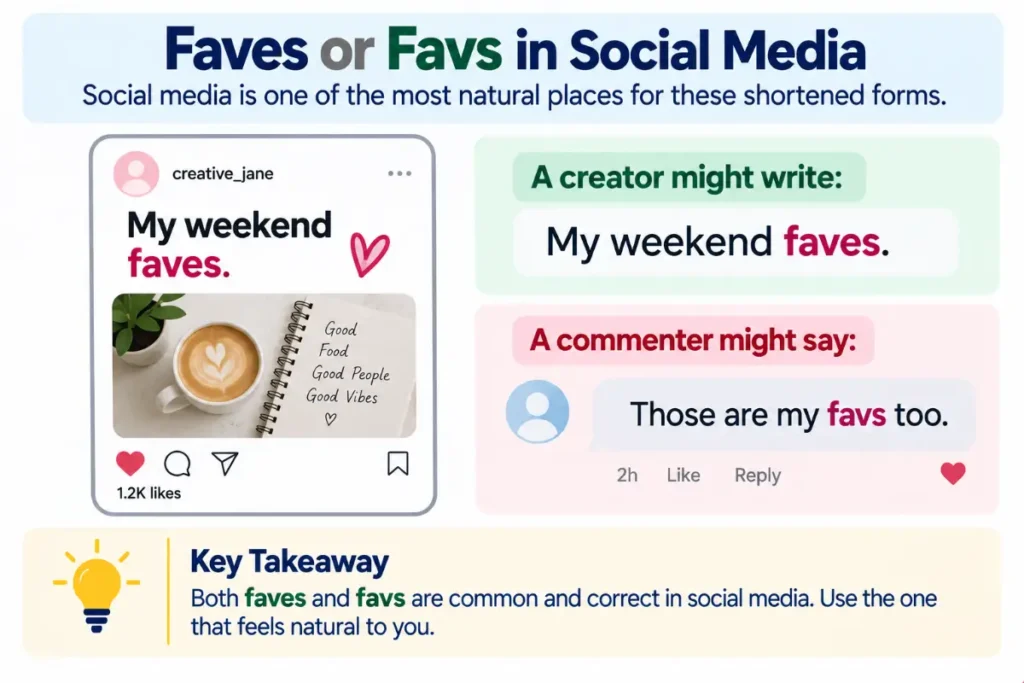
Social media is one of the most natural places for these shortened forms.
A creator might write:
My weekend faves.
A commenter might say:
Those are my favs too.
Both are easy to understand and fit the relaxed tone common on social platforms.
Faves can feel slightly warmer because it retains more of the original word. Favs can feel quicker and more abbreviated.
The choice often comes down to personal writing style. Some people prefer one form simply because it looks better to them.
For captions, hashtags, comments, and casual posts, both can work. For an official company announcement or formal publication, the full word usually communicates more clearly.
Faves or Favs in Text Messages
Texting rewards brevity. People often shorten common words because the conversation moves quickly.
For example:
What are your favs?
Can you send me your faves?
Both sentences sound natural in a casual conversation.
The shortened forms also work well when the relationship between the speakers is informal. Friends and family generally don’t need formal vocabulary to understand one another.
However, context still matters. If you’re texting a professor, client, manager, or professional contact, the complete word may be more appropriate.
The safest approach is to match the other person’s communication style without copying every abbreviation they use.
Formal Writing and Professional Communication
The full form favorites is the strongest choice for formal writing.
Use it in school assignments, academic papers, business reports, official emails, resumes, applications, and professional publications.
For example:
The report identifies the customers’ favorite products.
This sounds clear and polished.
Using favs in that sentence would make the writing feel unnecessarily casual.
That doesn’t make the informal forms bad English. It simply means they belong to a different register.
Register refers to the level of language suited to a particular situation. Native speakers switch registers constantly. The same person might write My favs to a friend and My favorite selections in a business report without thinking twice.
How Editors Handle Informal Abbreviations
Professional editing isn’t only about correcting grammar. It’s also about matching language to purpose.
An editor seeing faves or favs will first consider the audience. If the piece is a social caption, casual blog post, or friendly message, the abbreviation may be perfectly intentional.
If the piece is an academic paper or formal report, the editor will probably replace it with favorites or another suitable standard term.
Spelling and grammar software may also flag informal forms depending on the dictionary and writing mode being used. A flag doesn’t automatically mean a word is meaningless. It can indicate that the software considers the term informal, uncommon, or outside its preferred vocabulary.
That’s why human judgment still matters. A tool can identify a pattern, but the writer has to decide if that pattern fits the situation.
Practical Style Guide
When choosing between the shortened forms and the full word, use this simple guide.
- Texting friends. Faves or favs can work naturally.
- Social media captions. Either shortened form can fit a casual voice.
- Personal blog posts. Either can work if the overall tone is relaxed.
- Friendly emails. Shortened forms may fit if the relationship is informal.
- Workplace messages. Consider the company culture and audience before using them.
- School assignments. Use favorites unless the assignment specifically calls for informal language.
- Academic papers. Use the full standard form.
- Business reports. Use favorites or a more precise formal alternative.
- Official documents. Avoid informal abbreviations.
- Creative dialogue. Either form can work when it matches the character’s voice.
This approach keeps your writing natural without making every sentence sound overly formal.
A Simple Memory Trick
If you’re trying to remember the difference, focus on the level of shortening.
Favorite becomes fave.
Then:
Fave becomes faves.
Another casual shortening is:
Favorite becomes fav.
Then:
Fav becomes favs.
The full form remains your safest option whenever the situation calls for standard formal English.
You don’t need to memorize complicated rules. Just remember that these are casual shortcuts rather than replacements that belong everywhere.
Expert Editor Insight
An experienced editor would usually treat faves and favs as informal vocabulary rather than simple spelling errors. Both can communicate the intended meaning clearly in casual settings, but they carry a relaxed digital tone. The most useful editing tip is to check the audience before changing the word. If the writing is personal or social, the shortened form may add personality. If the writing is academic, professional, or official, use favorites instead.
Final Takeaway
Faves and favs are both informal ways to refer to favorites. Faves keeps more of the original word, while favs is shorter and especially natural in quick digital communication. Neither form should automatically be treated as a spelling mistake when used in an appropriate casual context.
For formal writing, the full word favorites remains the better choice. It works across professional, academic, educational, and official settings without creating a casual tone.
The easiest editing rule is to look at your audience first. If you’re chatting with friends or writing a relaxed social post, either shortened form can work. If you’re writing something official, choose favorites and keep the language clear.
FAQs
Are faves and favs both acceptable?
Yes. Both are established informal shortenings associated with favorite and favorites. They are most natural in casual speech and writing such as texting, social media, comments, and friendly messages. They are not ideal substitutes for the full word in formal documents. The choice between them mainly reflects personal style, context, and how short you want the expression to be.
What does faves mean?
Faves means favorites. It usually refers to several people or things that someone likes especially well. For example, These are my faves means These are my favorite things. The form is informal and conversational. It appears often in casual digital communication and can make a message feel friendly and relaxed.
What does favs mean?
Favs is an informal abbreviation related to favorites. It usually refers to multiple favorite people or things. For example, Send me your favs means Send me the things you like best. It is especially common in short digital messages. In formal writing, favorites is the clearer and more standard choice.
Is faves more correct than favs?
Neither informal form needs to be treated as the universally correct choice. Faves and favs are both casual shortenings with essentially the same basic meaning. Faves stays closer to the original word, while favs is more compressed. For formal writing, neither is the preferred choice. Use favorites when you need a neutral standard form.
How do you pronounce faves?
Faves is usually pronounced like fayvz. It has one syllable and ends with a voiced z sound. The pronunciation is similar to the sound of the word saves with an f sound at the beginning. Because it is an informal shortening, minor differences can occur across accents, but the general pronunciation is straightforward.
Can you use favs in formal writing?
You can physically use it in formal writing, but it usually isn’t the best stylistic choice. Favs has a casual abbreviated feel and can make an academic paper, business report, or official document sound too relaxed. In those settings, use favorites or a more precise formal expression such as preferred options.
Why do people shorten favorite?
People shorten familiar words because shorter forms can make communication quicker and more casual. Digital communication encourages this habit because messages, captions, and comments often favor concise language. Familiar words are especially easy to shorten because readers can recover the original meaning from context. This is a normal feature of informal language.
Which should I use in a text message?
Either form can work in a casual text message. Faves may feel a little closer to the original word, while favs is shorter and more compressed. The best choice depends on your personal style and the person you’re messaging. If the conversation is casual, both are easy to understand. For formal communication, use favorites.
