
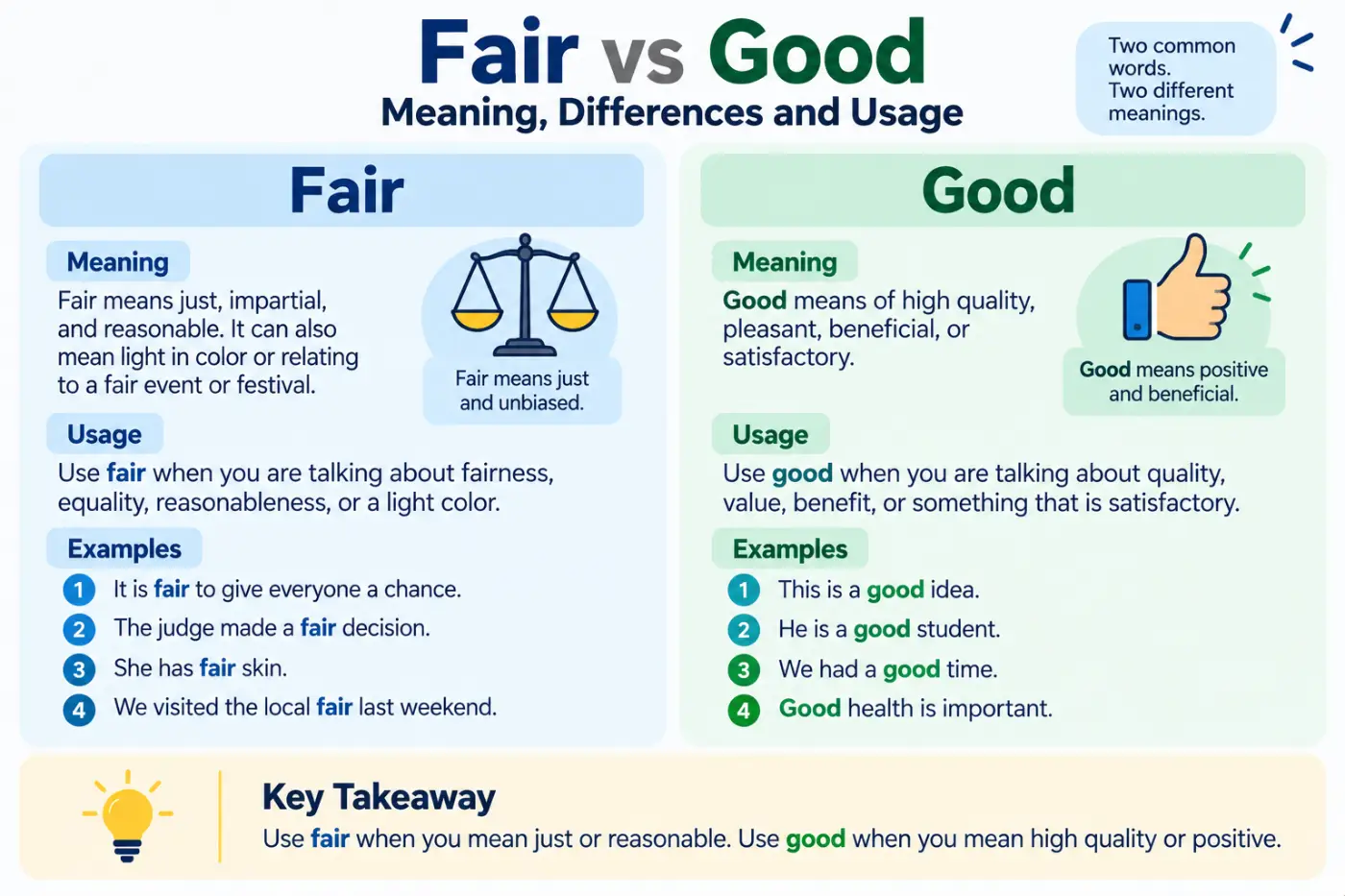
People often search for fair vs good because both words can describe something positive or acceptable. However, they don’t usually communicate the same idea. Fair focuses on reasonableness, balance, or equal treatment, while good usually describes quality, value, usefulness, or a positive result.
The difference becomes clearer when you consider the situation. A fair decision is reasonable and impartial, while a good decision is one that produces a positive or useful result. Sometimes something can be both fair and good, but each word draws attention to a different quality. Choosing the right word depends on what you want to express.
Once you understand this distinction, using these words becomes much easier. You’ll learn how fair and good work in everyday American English, how their meanings change with context, and how to use them naturally in conversations, school writing, emails, and professional communication. Clear examples will also show you why one word can fit a sentence better than the other.
Quick Definition
Fair usually means reasonable impartial or acceptable. Good generally means positive useful enjoyable or of satisfactory quality. The two words can overlap when describing an acceptable situation but fair often focuses on treatment or standards while good focuses more directly on quality value or results.
Quick Answer
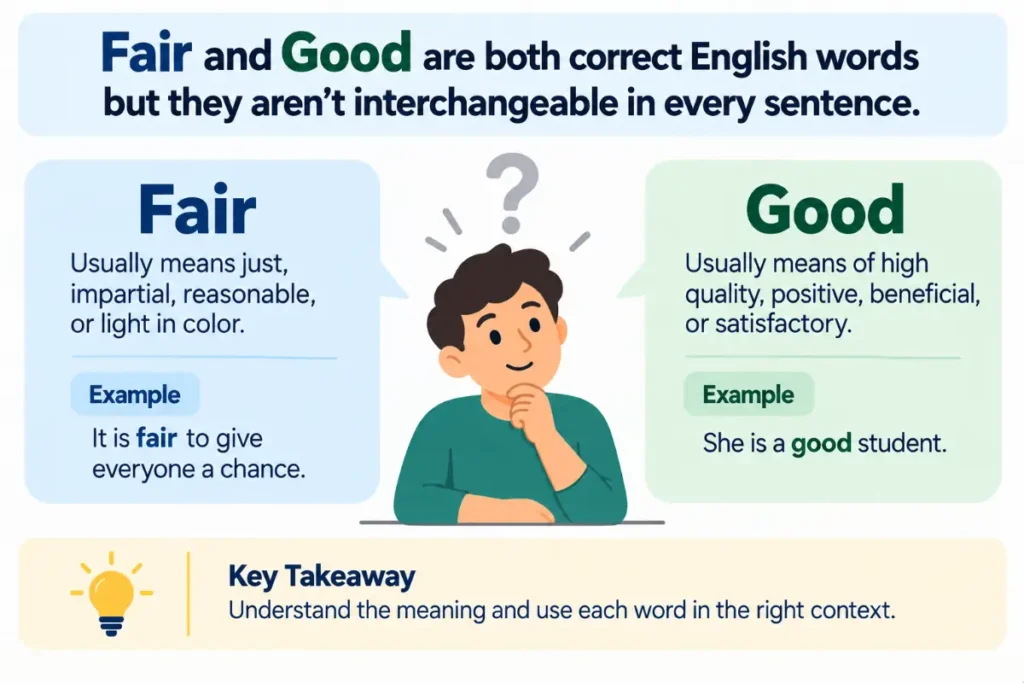
Fair and good are both correct English words but they aren’t interchangeable in every sentence.
Use fair when you mean reasonable impartial acceptable or balanced. Use good when you mean positive high quality useful enjoyable or satisfactory.
For example:
- The teacher gave everyone a fair chance.
- The teacher gave everyone a good lesson.
The first sentence focuses on equal treatment. The second focuses on the quality of the lesson.
Comparison Table fair vs good
| Word | Core Meaning | Part of Speech | Pronunciation | Formality | Common Contexts | Main Focus | Example |
|---|---|---|---|---|---|---|---|
| Fair | Reasonable impartial acceptable or balanced | Adjective and adverb in some uses | /fer/ | Neutral | Rules prices treatment weather performance | Balance and reasonableness | The judge made a fair decision. |
| Good | Positive satisfactory useful enjoyable or high quality | Adjective and noun in some uses | /ɡʊd/ | Neutral | People work food results ideas experiences | Quality and positive value | She did a good job. |
Meaning and Definition
Meaning of Fair
Fair has several meanings. Its most common meaning describes something reasonable and impartial.
If a teacher gives every student the same opportunity to answer a question you might call that fair. The word suggests that nobody received an unfair advantage.
Fair can also mean acceptable but not excellent.
For example:
The movie was fair.
In this sentence the speaker probably means the movie was okay. It wasn’t terrible but it also wasn’t especially impressive.
Fair can describe prices too.
That’s a fair price.
Here fair means reasonable or appropriate for the product or service.
The word can also describe weather.
We had fair weather during the trip.
In this context fair traditionally means reasonably clear or pleasant weather.
Fair has other meanings as well. It can describe someone with light colored hair or skin and can refer to a public event such as a county fair. Context tells you which meaning applies.
Meaning of Good
Good is one of the most common adjectives in English. It generally expresses a positive judgment.
You can use it to describe quality.
That’s a good book.
You can use it to describe performance.
She did a good job.
You can use it to describe behavior.
He’s a good person.
You can also use it to describe health.
I’m feeling good today.
In ordinary conversation good can carry a broad range of positive meanings. It can mean enjoyable useful effective kind satisfactory or high quality depending on the noun or situation.
For example good food is enjoyable or high quality. A good plan is useful or sensible. A good friend is caring and dependable.
The meaning becomes clear from context.
Key Differences Explained
- Meaning. Fair usually relates to reasonableness balance or impartial treatment. Good usually describes positive quality value usefulness or satisfaction.
- Focus. Fair asks if something is reasonable or balanced. Good asks if something has a positive quality or result.
- Grammar. Both words commonly function as adjectives. Good can also function as a noun in expressions such as the common good. Fair can function as an adverb in some expressions such as play fair.
- Tone. Both are neutral everyday words. Fair can sound more evaluative when discussing rules prices or treatment. Good often gives a straightforward positive judgment.
- Context. Fair frequently appears with decisions opportunities prices treatment rules and performance. Good appears with people objects experiences actions results ideas and many other nouns.
- Strength. Fair often suggests an acceptable or reasonable level. Good normally suggests a clearly positive level. The exact strength depends on context and speaker intention.
- Pronunciation. Fair is pronounced /fer/ in most American English. Good is pronounced /ɡʊd/. Their sounds are completely different.
- Regional usage. Both words are standard throughout major varieties of English. Their basic meanings remain stable across American British Canadian and Australian English.
When Fair Is the Better Choice
Use fair when your main concern is equal treatment or reasonable judgment.
Consider this sentence:
The referee made a fair decision.
The speaker isn’t mainly saying the decision was excellent. The speaker is saying the decision was reasonable and impartial based on the situation.
The same idea appears in everyday expressions.
- That doesn’t seem fair.
- Give me a fair chance.
- We agreed on a fair price.
- Everyone deserves fair treatment.
- The teacher was fair to all the students.
Notice the common idea. Each sentence deals with balance or reasonable treatment.
Fair also works when you want to describe an acceptable level.
The restaurant was fair.
This suggests the restaurant was okay but not outstanding. In that context fair can be less positive than good.
When Good Is the Better Choice
Use good when you want to express positive quality or value.
For example:
That was a good movie.
The sentence tells the listener that the speaker liked the movie or considered it high quality.
Good works naturally in countless situations.
- She’s a good teacher.
- That’s a good idea.
- We had a good time.
- He gave a good answer.
- This computer is good for schoolwork.
In each example the word gives a positive evaluation.
Good can also describe moral character.
She’s a good person.
Here the meaning has nothing to do with fairness. The sentence describes the person as kind decent or morally positive.
That distinction is worth remembering. A person can be good without being fair in a particular situation. A decision can be fair without producing a good result.
Can Fair and Good Mean the Same Thing
Sometimes they can overlap but the emphasis changes.
Imagine a restaurant charges $15 for a meal. You might say:
The price is fair.
You’re saying the price is reasonable.
You might also say:
The price is good.
In casual American English this can mean the price is favorable or attractive. The speaker may think the customer is getting good value.
The underlying situation is similar but the perspective changes. Fair focuses on reasonableness. Good focuses on positive value.
Another example involves a student.
She got a fair grade.
This may mean the grade accurately reflected her work.
She got a good grade.
This normally means the grade was positive or higher than satisfactory.
The difference becomes clear when you ask what the speaker is evaluating. If the question concerns balance or justice choose fair. If it concerns quality or positive results choose good.
Grammar Rules and Part of Speech
Fair as an Adjective
Fair commonly appears before a noun.
She received a fair hearing.
He offered a fair price.
The students had a fair opportunity.
It can also appear after linking verbs.
The decision was fair.
The competition seems fair.
The rules are fair.
Fair as an Adverb
Fair can also appear as an adverb in certain expressions.
Play fair.
The phrase means to behave honestly and follow accepted rules.
Fair can also appear in expressions such as fair and square. This phrase emphasizes honesty and direct dealing.
Good as an Adjective
Good usually comes before a noun.
She is a good teacher.
We had a good experience.
That is a good question.
It can also appear after linking verbs.
The food is good.
Your idea sounds good.
He looks good.
Good as a Noun
Good can function as a noun in certain established expressions.
She wants to do some good.
The phrase means she wants to help or create a positive effect.
Another example is:
The common good matters.
Here good refers to the benefit or welfare of people generally.
Good and Well
One common grammar issue deserves attention. Good is normally an adjective while well is commonly an adverb.
She is a good singer.
She sings well.
The first sentence describes the singer. The second describes how she sings.
In casual American English people also say I feel good when talking about their general state or mood. In formal contexts well can be used to describe health.
Sentence Examples
Here are natural examples that show the difference in context.
- The manager gave everyone a fair chance to speak.
- I think that’s a fair price for the service.
- The judge made a fair decision after hearing both sides.
- We had a good meal at the new restaurant.
- She did a good job on her presentation.
- That sounds like a good idea to me.
- The students said the teacher was fair.
- My brother gave me some good advice.
- The test was fair because all students had the same amount of time.
- We had a good time at the family gathering.
Now compare these pairs.
Fair Price and Good Price
A fair price is reasonable based on the product service or circumstances.
A good price often suggests that the price is attractive to the buyer.
Fair Result and Good Result
A fair result is one that seems reasonable or deserved.
A good result is one that is successful or desirable.
Fair Person and Good Person
A fair person treats people reasonably and tries to avoid favoritism.
A good person is generally viewed as kind decent helpful or morally positive.
These differences are subtle but they matter. Choosing the right word tells your reader exactly what kind of judgment you’re making.
Common Mistakes
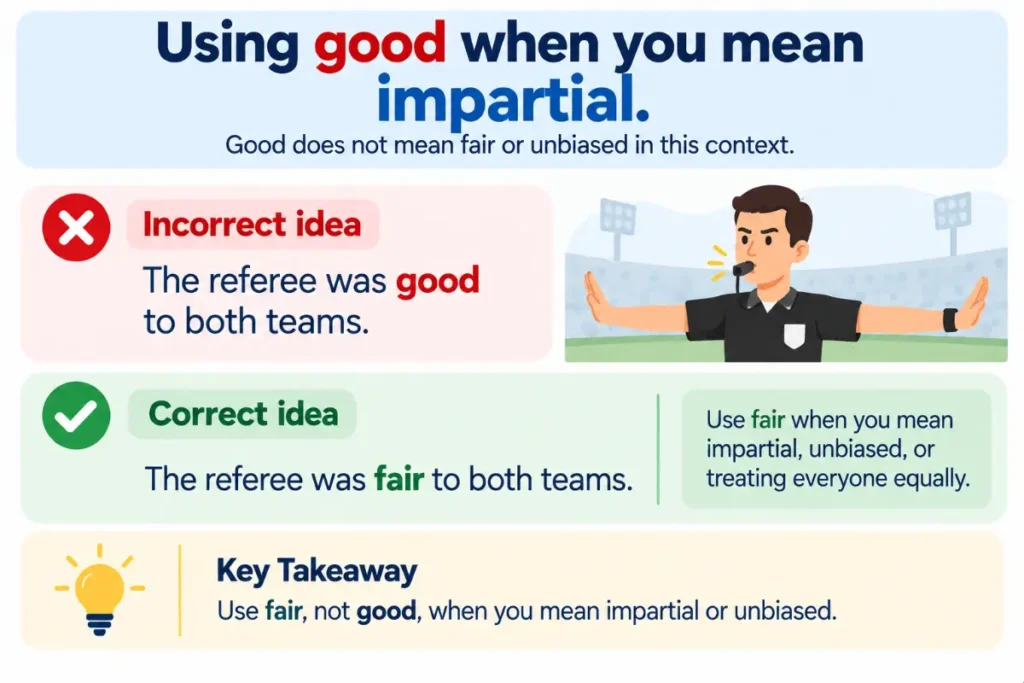
- Using good when you mean impartial.
Incorrect idea: The referee was good to both teams.
Better: The referee was fair to both teams.
The first sentence could mean the referee behaved well. The second clearly describes equal treatment.
- Using fair when you mean high quality.
The sentence The restaurant was fair usually suggests an average or acceptable experience.
If you enjoyed the food and thought the quality was positive say:
The restaurant was good.
- Confusing fair with well.
Good is an adjective and well commonly works as an adverb.
He is a good writer.
He writes well.
- Assuming fair always means positive.
Fair can mean reasonable but it can also mean only acceptable.
The movie was fair.
This often sounds less enthusiastic than:
The movie was good.
- Treating good as a direct synonym for fair.
The words can overlap around ideas such as reasonable decisions or positive outcomes but their central meanings remain different. Look at the specific quality you’re describing before choosing the word.
Pronunciation Guide
Fair
Fair is usually pronounced /fer/ in American English.
It is one syllable.
An easy pronunciation guide is:
FAIR
It rhymes closely with words such as care and share in many American accents.
The vowel sound can vary slightly by accent but the pronunciation remains easy to recognize.
Good
Good is pronounced /ɡʊd/.
It is also one syllable.
An easy pronunciation guide is:
GOOD
The vowel is the short vowel found in words such as book and look.
A common learner mistake is stretching the vowel too much and making good sound closer to food. Those words have different vowel sounds.
Pronunciation alone won’t tell you the difference in meaning because fair and good sound very different. The bigger challenge is choosing the word that matches your intended idea.
Etymology and Word Origin
Fair has a long history in English. It comes from Old English and related Germanic forms associated with ideas such as beautiful pleasant favorable and agreeable. Over time its meanings expanded. The modern word can refer to appearance weather reasonableness justice and acceptable quality.
The sense connected with impartial treatment developed alongside broader ideas of justice and reasonable behavior. That is why phrases such as fair treatment and fair decision feel natural today.
Good also has deep Germanic roots. It traces back to Old English gōd and related forms in other Germanic languages. Its basic positive sense has remained remarkably stable even though its uses have expanded across many contexts.
The word can describe quality character behavior results experiences and value. Its broad meaning is one reason English speakers use it so frequently.
The two words therefore have different histories and different semantic centers. Fair developed around ideas of pleasantness and later reasonableness and justice. Good has remained centered on positive value and quality.
Regional Usage
American English
Both words are completely standard in American English. Fair commonly appears in discussions of prices rules treatment opportunities and judgments. Good is one of the most frequent positive adjectives in everyday speech and writing.
American speakers also use fair in expressions such as fair enough. This phrase often means the speaker accepts an explanation proposal or decision as reasonable.
Good appears in casual phrases such as sounds good and looks good. These expressions are common in everyday conversation.
British English
British English uses both words with the same core meanings. Fair can describe reasonable treatment acceptable quality or favorable conditions. Good remains a general positive adjective covering quality performance behavior and experiences.
Some expressions may have different levels of frequency across regions but there is no major British spelling distinction between these words.
Australian English
Australian English follows the same basic distinction. Fair can express reasonableness or an acceptable standard while good generally expresses positive quality.
The words are familiar in everyday conversation professional communication education journalism and other common settings.
Canadian English
Canadian English also follows the standard distinction. Fair commonly relates to justice balance and reasonable treatment. Good generally expresses positive quality or value.
Speakers may use the words in many of the same expressions found in American English.
Real Life Usage Examples
Daily Conversation
- That seems like a fair deal to me.
- We had a good time at the beach.
In the first sentence fair describes the reasonableness of the deal. In the second good describes the positive experience.
Workplace Communication
- The supervisor gave every employee a fair opportunity to apply.
- She did a good job handling the customer complaint.
The first sentence concerns equal opportunity. The second evaluates performance.
Academic Writing
- A fair assessment should apply the same basic standards to comparable students.
- The study produced good results after several rounds of testing.
Academic writing often needs this distinction because fairness concerns evaluation standards while good can describe desirable outcomes.
News Writing
- Workers asked for fair treatment during the negotiations.
- The company reported good results for the quarter.
News writing frequently uses both words but for different purposes. Fair often appears in discussions about treatment policy or disputes. Good commonly describes favorable outcomes or performance.
Literature and Storytelling
- The old king wanted to be known as a fair ruler.
- Everyone remembered her as a good friend.
The first example describes justice and balanced judgment. The second describes character and personal qualities.
Related and Confused Terms
- Excellent. This expresses a very high level of quality and is usually stronger than good.
- Average. This describes something around the usual or middle level. Fair can sometimes suggest an acceptable level that is close to average.
- Reasonable. This is one of the closest semantic relatives of fair when discussing prices decisions expectations or treatment.
- Just. This often relates to moral fairness law or proper treatment. It can overlap strongly with fair in discussions of justice.
- Impartial. This means not favoring one side over another. It is more precise and formal than fair in many contexts.
- Satisfactory. This means good enough to meet a requirement or expectation. Fair can sometimes carry a similar meaning.
- Positive. This describes something favorable or beneficial. Good often expresses this idea in everyday English.
- Well. This is closely connected to good but serves a different grammatical role in many sentences. Good commonly describes a person thing or result while well often describes an action.
Knowing these related words helps you see the larger meaning network. English vocabulary works like a map rather than a collection of isolated words. Similar words may share territory while still pointing in slightly different directions.
Fair Enough and Good Enough
Two expressions deserve special attention because they sound similar but communicate different ideas.
Fair enough usually means that something seems reasonable or acceptable.
For example:
Fair enough. I understand your point.
The speaker may not completely agree but accepts the reasoning.
Good enough means that something meets the required standard.
For example:
This answer is good enough for the assignment.
The answer may not be perfect but it meets the needed level.
The distinction is simple. Fair enough concerns acceptance or reasonableness. Good enough concerns adequacy or a sufficient level of quality.
Fair Quality and Good Quality
The difference becomes especially clear when describing levels of quality.
Fair can sometimes mean average acceptable or moderate.
The hotel was fair.
This sounds restrained. The speaker probably didn’t find the hotel outstanding.
Good is normally more positive.
The hotel was good.
This tells the listener that the speaker viewed the hotel favorably.
That doesn’t mean fair is always negative. A fair result can be perfectly acceptable. A fair price can be a positive thing because it suggests the customer wasn’t overcharged.
The key is that fair evaluates the situation against an idea of reasonableness while good gives a broader positive evaluation.
Fair Treatment and Good Treatment
Fair treatment and good treatment are related but different.
Good treatment means people are treated kindly or favorably.
Imagine a workplace where every employee follows the same policy. You could describe the policy as fair.
Now imagine a manager who speaks politely to employees and helps them when they need support. You could describe the manager’s treatment as good.
A workplace can have fair policies without offering especially good personal treatment. It can also have friendly treatment while applying rules inconsistently. The two concepts overlap but they are not identical.
Fair Chance and Good Chance
Fair chance and good chance are another useful pair.
A fair chance means an equal or reasonable opportunity.
Everyone deserves a fair chance to succeed.
A good chance means a strong possibility.
You have a good chance of passing the exam.
The first phrase concerns opportunity. The second concerns probability.
This is an excellent example of why context matters more than surface similarity. Changing one word changes the relationship between the subject and the idea being expressed.
Expert Editor Insight
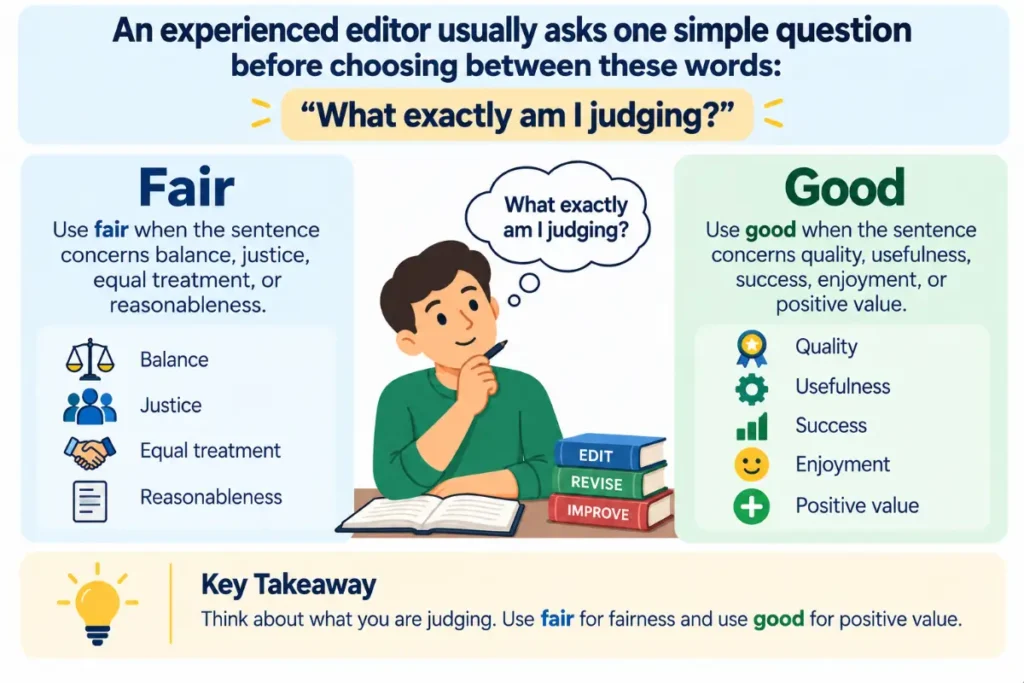
An experienced editor usually asks one simple question before choosing between these words: What exactly am I judging? If the sentence concerns balance justice equal treatment or reasonableness then fair is often the natural choice. If it concerns quality usefulness success enjoyment or positive value then good usually fits better. Grammar tools may not flag a substitution because both are legitimate English words. That makes context more important than spell checking. A useful editing trick is to replace the word mentally with reasonable or positive. If reasonable fits better choose fair. If positive fits better choose good.
Conclusion
Fair vs good becomes much easier once you focus on the quality being judged. Fair usually means reasonable balanced impartial or acceptable. Good generally means positive satisfactory useful enjoyable or high quality. Both words are correct and common but they point toward different ideas.
Use fair for equal treatment fair prices fair decisions and reasonable opportunities. Use good for good work good results good experiences and positive qualities. The difference can be small in casual conversation but it becomes important when you want precise English.
A simple editing trick can help. Ask yourself if you mean reasonable or positive. If reasonable fits choose fair. If positive fits choose good. That quick test can prevent many awkward word choices.
FAQs
What is the main difference between fair and good?
Fair usually describes something reasonable balanced or impartial. Good usually describes something positive useful enjoyable or satisfactory. For example a fair price is a reasonable price while a good price may mean a price that offers attractive value. Both words can describe acceptable situations but they focus on different qualities.
Can fair and good be used interchangeably?
Not in every sentence. The words can overlap when discussing acceptable situations but they usually emphasize different ideas. Fair focuses on reasonableness balance or equal treatment. Good focuses on quality value or positive results. Saying a decision was fair highlights impartiality while saying it was good gives a broader positive evaluation.
Does fair mean bad or average?
No. Fair doesn’t automatically mean bad. It can mean reasonable or impartial and those meanings are often positive. When fair describes quality it can sometimes mean acceptable or average rather than excellent. For example a fair movie may be okay but not outstanding. Context determines the intended meaning.
Is good stronger than fair?
There is no universal scale because the words evaluate different qualities. Good often expresses a more clearly positive judgment about quality or results. Fair often indicates that something meets a reasonable standard or treats people properly. A fair decision can be excellent from a justice perspective while a good decision can still be criticized as unfair.
What does fair mean in a price?
Fair means reasonable or appropriate for the product service and circumstances. If someone says the price is fair they usually mean they don’t feel overcharged and consider the amount reasonable. A good price can also sound positive but may suggest that the buyer thinks the price is especially attractive or offers strong value.
What does good mean in everyday English?
Good is a broad positive adjective used for quality experiences people actions results ideas and many other things. It can mean satisfactory enjoyable useful effective kind or high quality. The exact meaning depends on context. For example good food concerns quality while a good friend describes a positive personal relationship.
Which word should I use for equal treatment?
Use fair when you mean equal or impartial treatment. For example everyone should receive a fair chance means everyone should have a reasonable opportunity without unfair favoritism. Good doesn’t clearly communicate that idea. You could say someone received good treatment but that usually focuses on kindness or favorable behavior rather than equality.
Is fair or good better for formal writing?
Both are appropriate in formal writing when they express the intended meaning. Fair works well for discussions of justice standards prices treatment and impartiality. Good works well for general positive evaluation but formal writers sometimes choose a more precise word such as effective beneficial satisfactory or high quality. The best choice depends on the exact idea you want to communicate.
