
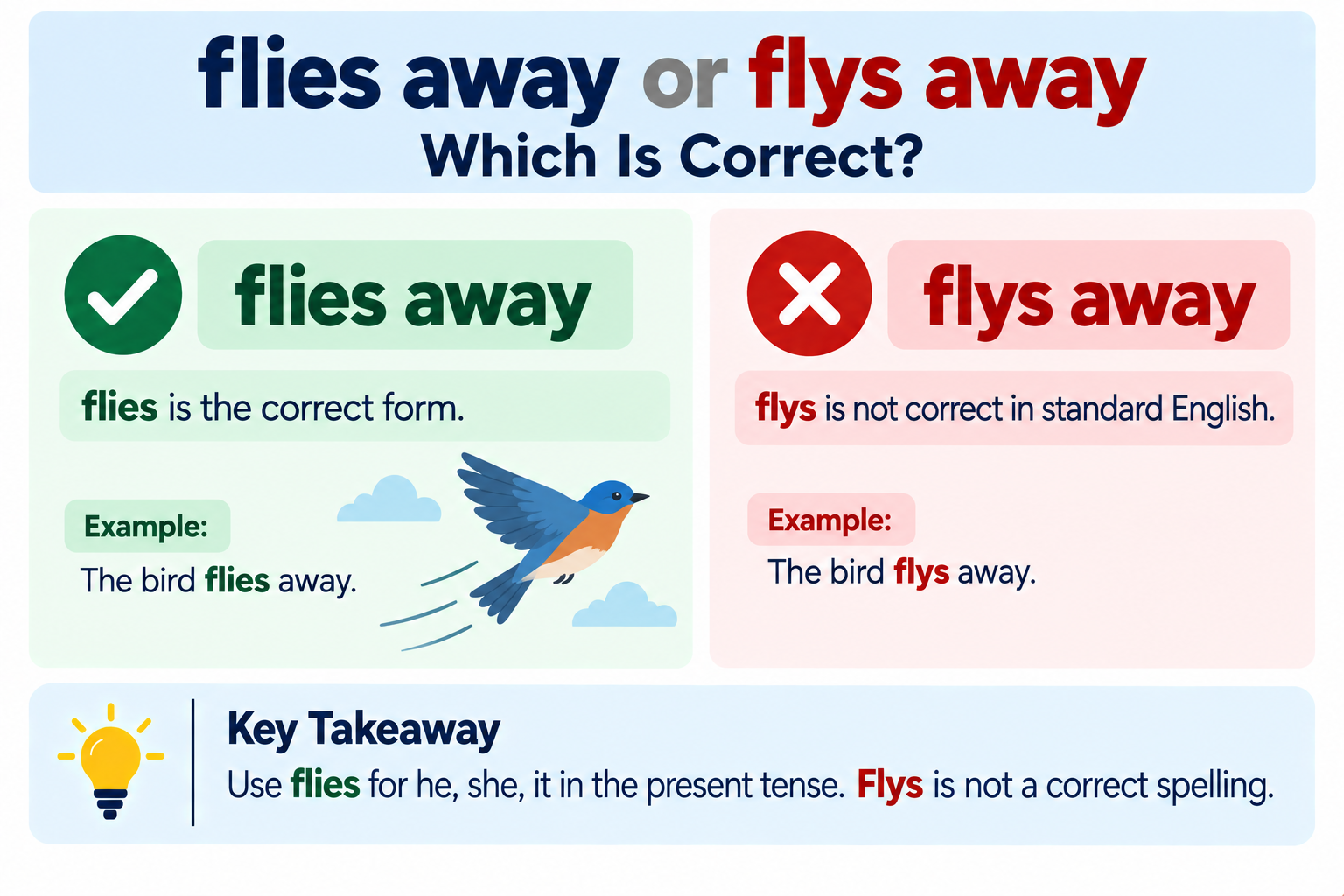
flies away or flys away can look like a tiny spelling question but it points to one of the most useful verb rules in English. The correct form is flies away. You should write The bird flies away and The plane flies away. The spelling flys away is not standard English.
The confusion happens because the base verb is fly and English usually keeps the y when we use the base form with I you we or they. However the spelling changes when a verb ending in consonant plus y takes the third person singular ending. Instead of simply adding s you change y to ies. That gives you flies. The second word stays away because it works as an adverb that shows direction or movement.
Once you see the pattern it becomes much easier to remember. This rule also applies to verbs such as try becomes tries and cry becomes cries. In this guide you’ll learn the spelling rule meaning pronunciation grammar pattern common mistakes regional usage and plenty of natural examples.
Quick Answer
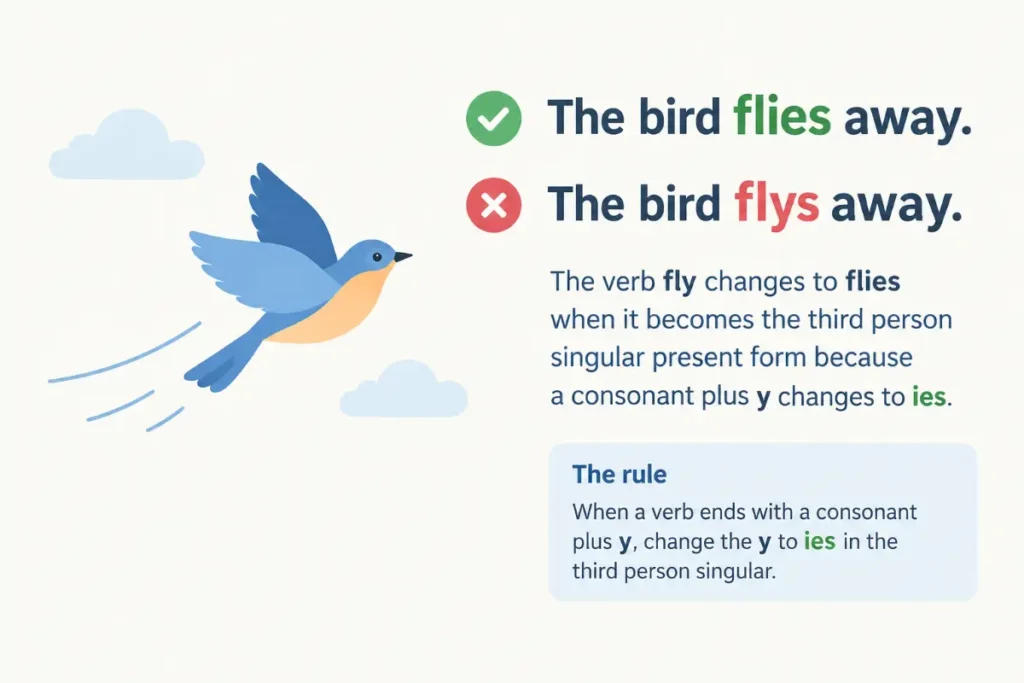
The correct form is flies away. The form flys away is incorrect in standard English. The verb fly changes to flies when it becomes the third person singular present form because a consonant plus y changes to ies. So you write The bird flies away rather than The bird flys away.
Quick Answer
The correct phrase is flies away.
Use flies with he she it or a singular noun.
For example:
- The bird flies away.
- My cat flies away from the noise.
- The airplane flies away into the clouds.
Use fly with I you we and they.
For example:
- Birds fly away when they feel threatened.
- They fly away every winter.
- We fly away tomorrow morning.
The key difference comes from subject and verb agreement. Flys is not the standard third person singular form of fly.
Comparison Table
| Form | Meaning | Part of Speech | Spelling Pattern | Usage Frequency | Formality | Common Contexts | Example |
|---|---|---|---|---|---|---|---|
| Flies away | Moves away through the air | Verb phrase | Fly changes to flies before away | Common | Standard | Conversation writing school work news stories | The bird flies away. |
| Flys away | Intended meaning is usually the same but spelling is incorrect | Incorrect verb phrase | Incorrectly adds s to fly | Not standard | Nonstandard | Typing errors spelling mistakes | The bird flys away is incorrect. |
Meaning and Definition
Meaning of the Incorrect Form
Flys away is normally a spelling mistake rather than a separate English expression. Writers often create it by applying a simple rule that seems logical at first. They see fly plus s and produce flys.
That pattern works for many regular verbs.
For example:
- Walk becomes walks.
- Jump becomes jumps.
- Read becomes reads.
- Play becomes plays.
The problem is that English has a special spelling rule for verbs ending in a consonant followed by y. When the verb needs the third person singular present form the y changes to ies.
So:
- Fly becomes flies.
- Try becomes tries.
- Cry becomes cries.
- Carry becomes carries.
- Hurry becomes hurries.
The incorrect form may still appear in searches social media posts messages or informal online writing. Its appearance does not make it an accepted spelling.
Meaning of the Correct Form
Flies away describes one person animal bird aircraft insect or other subject moving away through the air.
The phrase contains two parts. Flies is the verb. Away is an adverb that describes movement from the current place or position.
Consider this sentence.
The butterfly flies away.
Flies tells us how the butterfly moves. Away tells us that the butterfly moves farther from the speaker or from its previous location.
The phrase can describe literal flight.
The bird flies away from the tree.
It can also appear in more imaginative or figurative writing.
Her worries seem to fly away when she listens to music.
In that example the phrase does not describe physical flight. It creates an image of worries disappearing quickly.
The Grammar Rule Behind The Spelling
The spelling becomes simple once you understand the subject.
In the present tense the base form of the verb is fly.
Use fly with I you we and they.
- I fly home tomorrow.
- You fly across the country often.
- We fly to Chicago every summer.
- They fly away at sunset.
Use flies with he she it and singular nouns.
- He flies away every morning.
- She flies to Boston every month.
- It flies away when I open the window.
- The bird flies away.
The spelling changes because English uses the third person singular ending with certain verbs.
For verbs that end in a consonant plus y the general pattern is:
Consonant + y becomes ies.
That gives us:
- Fly becomes flies.
- Try becomes tries.
- Study becomes studies.
- Carry becomes carries.
- Reply becomes replies.
- Deny becomes denies.
This is different from verbs that end in a vowel plus y.
For example:
- Play becomes plays.
- Enjoy becomes enjoys.
- Stay becomes stays.
- Obey becomes obeys.
The difference is the letter before y.
In fly the letter before y is l which is a consonant. Therefore fly becomes flies.
In play the letter before y is a which is a vowel. Therefore play simply becomes plays.
That small spelling distinction explains the entire problem.
Key Differences Explained
Spelling
The standard spelling is flies away. The first word changes from fly to flies.
The form flys away does not follow the standard spelling rule.
Meaning
Both forms are usually intended to express the same idea when someone writes them. However only the standard form communicates that idea correctly in formal and standard English.
Grammar
Flies is the third person singular present form of fly.
Fly is the base form.
Away is an adverb that indicates movement from a particular place.
Pronunciation
Fly and flies have different endings but share the main vowel sound. Flies is pronounced with a long i sound followed by a z sound.
Formality
Flies away is appropriate in school assignments professional writing academic work news writing and everyday conversation.
Flys away should be corrected before publication or submission.
Context
The phrase can describe birds insects aircraft people in imaginative contexts and even abstract ideas.
Regional Usage
American British Canadian and Australian English all use flies as the standard third person singular form of fly. There is no major regional spelling variation that makes flys acceptable in standard English.
Which Form Is Correct?
Flies away is correct.
The reason is grammatical as well as orthographic. Fly ends in a consonant followed by y. When this verb takes the third person singular present ending the y changes to ies.
The structure is:
Fly + third person singular ending = flies.
Then add away to show movement from a place.
Flies + away = flies away.
This pattern is not unique to fly. English uses the same spelling change in many common verbs.
Try becomes tries.
Cry becomes cries.
Study becomes studies.
Copy becomes copies.
Apply becomes applies.
That pattern gives you a reliable way to check the spelling instead of simply memorizing one word.
Why Flys Looks Correct At First
Flys feels logical because many English verbs simply take s in the third person singular.
Jump becomes jumps.
Run becomes runs.
Sing becomes sings.
Walk becomes walks.
So it’s natural for a learner to think fly should become flys.
English spelling has another rule for consonant plus y endings. The y changes to i and the ending becomes es.
This is one of those moments where English asks you to look at the final two letters instead of only the whole word.
If you remember one question ask yourself this.
What letter comes before the y?
In fly the letter is l. Since l is a consonant the y changes to ies.
Sentence Examples
Here are natural examples using the standard form.
- The bird flies away whenever I get too close.
- A small butterfly flies away from the flowers.
- The plane flies away into the evening sky.
- The eagle flies away before the storm begins.
- My little brother watches as the kite flies away.
- The insect flies away when the light turns on.
- The paper flies away in the strong wind.
- The character watches sadly as the magical creature flies away.
- Every morning the bird flies away from its nest to search for food.
- When the door opens the frightened bird quickly flies away.
These examples show how the phrase works in different settings. In each sentence the subject is singular so the verb takes the flies form.
You can also change the subject and see how the verb changes.
The bird flies away.
The birds fly away.
The butterfly flies away.
The butterflies fly away.
The plane flies away.
The planes fly away.
This comparison is useful because it shows that the spelling depends on the subject rather than the meaning of the phrase.
Common Mistakes and Misspellings
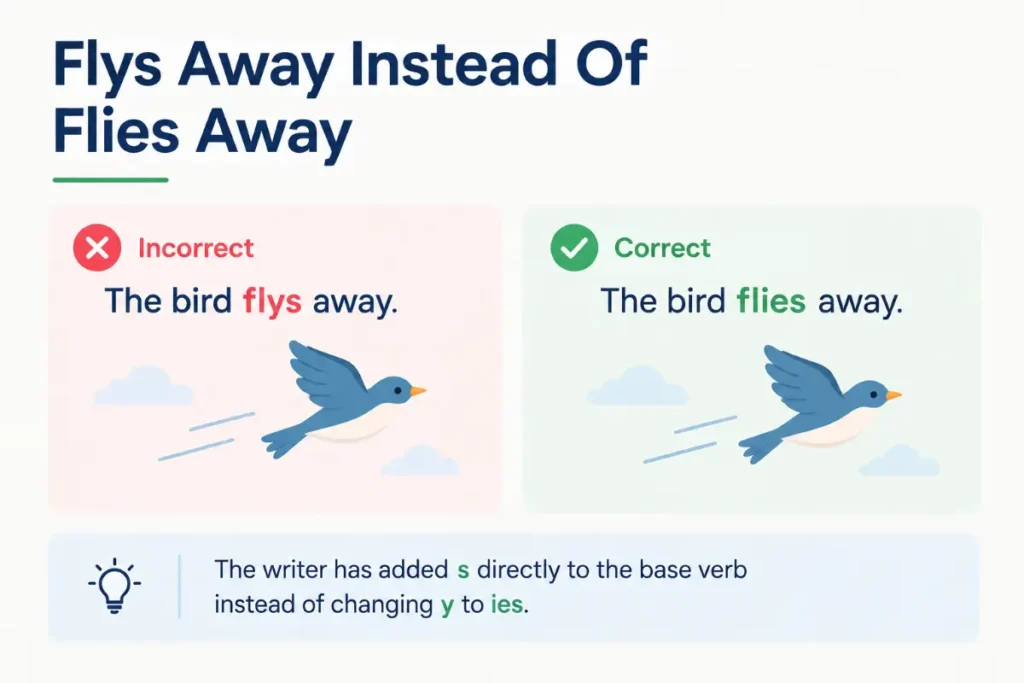
Flys Away Instead Of Flies Away
Incorrect: The bird flys away.
Correct: The bird flies away.
The writer has added s directly to the base verb instead of changing y to ies.
Flyes Away
Incorrect: The bird flyes away.
Correct: The bird flies away.
This mistake comes from adding an unnecessary e before s. English does not form the third person singular of fly this way.
Flies Away With A Plural Subject
Incorrect: The birds flies away.
Correct: The birds fly away.
This error is different from the spelling mistake. Birds is plural so the base form fly is required.
Fly Away With A Singular Subject
Incorrect: The bird fly away.
Correct: The bird flies away.
The subject bird is singular. The verb needs the third person singular form.
Using Flies After A Modal Verb
Incorrect: The bird can flies away.
Correct: The bird can fly away.
After modal verbs such as can could may might should and will the base form of the verb follows.
This gives you an important contrast.
The bird flies away.
The bird can fly away.
The first sentence uses the present tense third person singular form. The second uses a modal and therefore keeps the base form.
Pronunciation Guide
The word flies is commonly pronounced /flaɪz/.
It has one syllable.
An easy pronunciation guide is:
flyz.
The vowel sound is the same main sound you hear in fly. The ending has a z sound rather than a separate pronounced syllable.
The complete phrase sounds like:
flyz uh way.
Away is pronounced /əˈweɪ/ and has two syllables.
The phrase therefore has three spoken syllables in total.
flies a way.
One common mistake is to pronounce the s as a strong separate syllable. That isn’t how the word normally sounds.
Another useful point is that flies and flys would not normally create a meaningful pronunciation distinction in ordinary speech. This is one reason spelling mistakes can survive when someone relies only on sound.
You cannot always hear the spelling difference. You have to know the grammar rule.
Etymology and Word Origin
The verb fly has very old Germanic roots. It comes from the Old English word flēogan which meant to move through the air or take flight. The word developed through the history of English into the modern form fly.
The modern spelling flies reflects the development of English grammar and spelling conventions.
The phrase flies away combines the verb with away. Away comes from an older English expression connected with being at a distance or moving from a particular place.
Together the words create a straightforward idea.
Something flies and moves away from its current position.
The expression has remained natural because both parts are common everyday English words.
Regional Usage
American English
American English uses flies as the standard third person singular form of fly. The phrase is common in everyday speech school writing journalism fiction and professional communication.
For example:
The bird flies away before we can take a picture.
The spelling flys is normally treated as an error.
British English
British English follows the same grammar rule. The correct form is flies.
A British writer would normally write:
The bird flies away.
There is no standard British spelling that changes flies to flys.
Australian English
Australian English also uses flies as the standard form. The grammar pattern is the same as in American and British English.
Canadian English
Canadian English follows the same standard form as well. Writers use flies for the third person singular present tense of fly.
The spelling difference is therefore not a regional issue. It is a standard grammar and spelling issue across major English varieties.
Grammar Rules and Part of Speech
Flies is a verb.
More specifically it is the third person singular present form of fly.
Away is an adverb.
Together they form a verb phrase.
The bird flies away.
Here the subject is the bird. The verb is flies. The adverb away tells us about the direction of movement.
The phrase can appear in several sentence positions.
At The End Of A Sentence
The bird flies away.
This is the most basic structure.
With A Time Expression
The bird flies away every morning.
The time expression gives more information about the action.
With A Place Or Direction
The bird flies away from the tree.
The preposition from identifies the point the bird moves away from.
With An Adverb
The bird quickly flies away.
Quickly tells us how the action happens.
You can also place quickly after the verb.
The bird flies away quickly.
Both versions can work naturally.
In A Negative Sentence
The bird does not fly away.
Notice the important grammar change. Once you use does not the main verb returns to the base form fly.
You should not write:
The bird does not flies away.
The correct structure is:
The bird does not fly away.
This happens because does already carries the third person singular marking.
In A Question
Does the bird fly away?
Again the base form follows does.
Not:
Does the bird flies away?
But:
Does the bird fly away?
This rule is extremely useful because it shows that flies does not appear simply because the subject is singular. It appears when the third person singular present form is needed without an auxiliary such as does.
Real Life Usage Examples
Daily Conversation
People use the phrase naturally when talking about animals birds travel or things moving through the air.
The bird flies away every time I open the window.
That balloon flies away if you let go of it.
The wording is simple and natural in casual speech.
Email And Workplace Communication
The phrase may appear in workplace writing when someone describes an image process movement or a situation.
The animation shows how the object flies away from the center.
The file appears correctly until the icon flies away from its original position.
The phrase is less common in business writing than in everyday conversation but the grammar remains the same.
Academic Writing
Academic writing may use the phrase when describing animal behavior physics movement or a visual model.
The bird flies away when it detects a nearby predator.
As the object loses contact with the surface it flies away from the original position.
Academic style generally favors precise descriptions so the surrounding sentence should make the direction or cause clear.
News Writing
News writing may use the phrase in stories about wildlife weather aviation or unusual events.
The bird flies away before rescuers can reach it.
The aircraft flies away from the storm area after receiving clearance.
Literature And Storytelling
Writers often use flight as an image of freedom escape distance or change.
The white bird flies away into the fading light.
She watches as the last paper lantern flies away into the night.
Literary writing gives the phrase more emotional possibilities while keeping the same grammar.
Related And Confused Terms
Several words and phrases connect closely with this expression.
Fly
Fly is the base form of the verb. Use it with I you we and they in the present tense.
Birds fly south in winter.
Flies
Flies is the third person singular present form.
The bird flies south in winter.
Flew
Flew is the simple past form of fly.
The bird flew away yesterday.
Flying
Flying is the present participle and gerund form.
The bird is flying away.
Fly Away
Fly away is the base verb phrase.
Birds often fly away when people approach.
Flew Away
Flew away describes an action that happened in the past.
The bird flew away before sunrise.
Flying Away
Flying away describes an ongoing action or can work as a participial phrase.
The bird is flying away now.
Move Away
Move away has a broader meaning. It does not necessarily involve flight.
The bird moves away from the tree.
The phrase flies away specifically suggests movement through the air.
Understanding these related forms helps you see why the subject and tense determine the spelling.
The Difference Between Fly And Flies
The most useful comparison is not simply flies versus flys. It is fly versus flies.
Fly is the base form.
Flies is the third person singular present form.
Consider these sentences.
I fly to Denver tomorrow.
You fly to Denver tomorrow.
We fly to Denver tomorrow.
They fly to Denver tomorrow.
But:
He flies to Denver tomorrow.
She flies to Denver tomorrow.
The plane flies to Denver tomorrow.
The same rule applies to the phrase involving away.
They fly away.
He flies away.
The birds fly away.
The bird flies away.
Once you understand this pattern the spelling becomes much easier.
Why The Y Changes To Ies
The y to ies pattern is one of the standard spelling rules used for many English verbs.
When a verb ends in a consonant plus y the third person singular present form normally changes y to ies.
You can see this in everyday words.
- Try becomes tries.
- Cry becomes cries.
- Study becomes studies.
- Carry becomes carries.
- Worry becomes worries.
- Hurry becomes hurries.
- Copy becomes copies.
- Reply becomes replies.
Fly follows exactly the same pattern.
Fly becomes flies.
This rule also explains why flys feels wrong once you know the pattern. It treats fly as though it were a verb ending in a vowel plus y.
Compare fly with play.
Fly becomes flies.
Play becomes plays.
The letter before y determines the spelling.
A Simple Memory Trick
Use the phrase consonant plus y becomes ies.
Think of fly.
The letter before y is l.
L is a consonant.
Therefore:
Fly becomes flies.
Now think of play.
The letter before y is a.
A is a vowel.
Therefore:
Play becomes plays.
This quick check works for many verbs and is more useful than memorizing each word separately.
You can also remember the phrase through the word tries.
Try becomes tries.
Fly follows the same pattern.
Try and fly both end with consonant plus y. Both change y to ies in the third person singular present form.
Common Questions About The Spelling
A reader may wonder why English does not simply add s to every verb. The answer is that English spelling rules developed to make written forms easier to read and pronounce across different word patterns.
Another common question is why the rule applies to fly but not play. The answer lies in the letter immediately before y. A consonant plus y follows the ies pattern. A vowel plus y usually keeps the y and adds s.
This distinction also appears with other common verbs.
Study becomes studies.
Enjoy becomes enjoys.
Carry becomes carries.
Stay becomes stays.
The rule is consistent enough to make the spelling predictable in most ordinary cases.
Expert Editor Insight
An experienced editor would correct flys immediately because the problem is a standard subject and verb spelling issue rather than a stylistic preference. The easiest way to catch it is to identify the subject first and then check the verb form. If the subject is he she it or a singular noun and the sentence uses the simple present tense you need flies. Spellcheckers may catch flys but grammar tools can also miss context based errors, so knowing the rule yourself remains the safest editing method.
Conclusion
flies away is the correct form and flys away is a spelling error in standard English. The reason is simple. Fly ends with a consonant followed by y so its third person singular present form changes the y to ies. That gives us flies. Away then works as an adverb to show movement from a place or position.
The rule becomes clearer when you compare singular and plural subjects. The bird flies away is correct while The birds fly away is also correct. You can also use the base form after words such as does can and will. That gives you forms such as Does the bird fly away and The bird can fly away.
For an easy memory trick remember that consonant plus y changes to ies. Fly becomes flies just like try becomes tries and study becomes studies. If you check the subject first and then apply this spelling pattern you’ll avoid the error in school work professional writing and everyday messages.
FAQs
Is flys away a correct English expression?
No. Flys away is not the standard spelling of the third person singular form of fly. The correct phrase is flies away. The error usually happens because writers add s directly to fly. Since fly ends in a consonant followed by y the y changes to ies when the verb takes the third person singular present form.
Why is flies spelled with ies?
Flies follows the standard spelling pattern for verbs ending in consonant plus y. When these verbs become third person singular in the present tense the y changes to ies. For example try becomes tries and carry becomes carries. Fly follows the same pattern so the correct form is flies rather than flys.
What is the difference between fly and flies?
Fly is the base form of the verb. Flies is the third person singular present form. You use fly with I you we and they. You use flies with he she it and singular nouns. For example They fly away is correct while The bird flies away is correct.
Can I say the birds flies away?
No. The correct sentence is The birds fly away. Birds is plural so it takes the base form fly. The form flies is used with a singular third person subject such as the bird. Compare The bird flies away with The birds fly away. The change in subject changes the verb form.
Is flies away grammatically correct?
Yes. Flies away is grammatically correct when a singular third person subject performs the action in the simple present tense. For example The butterfly flies away is correct. The word flies is the verb and away is an adverb that shows movement from the current location or position.
Can flies away describe something that is not a bird?
Yes. The phrase can describe birds insects aircraft balloons or other things that move through the air. It can also work figuratively in creative writing. For example The plane flies away describes literal movement while The sadness flies away uses the phrase in an imaginative sense.
How do you pronounce flies?
Flies is pronounced /flaɪz/ and has one syllable. It sounds close to flyz. The vowel sound is the same main vowel sound found in fly. The final sound is z. The phrase flies away can be approximated as flyz uh way in relaxed American English.
Is flies away suitable for formal writing?
Yes. Flies away is standard English and works in formal writing as well as everyday speech. You can use it in school assignments academic writing reports journalism professional communication and storytelling. The main point is to match the verb with the subject. A singular subject takes flies while a plural subject takes fly.
