
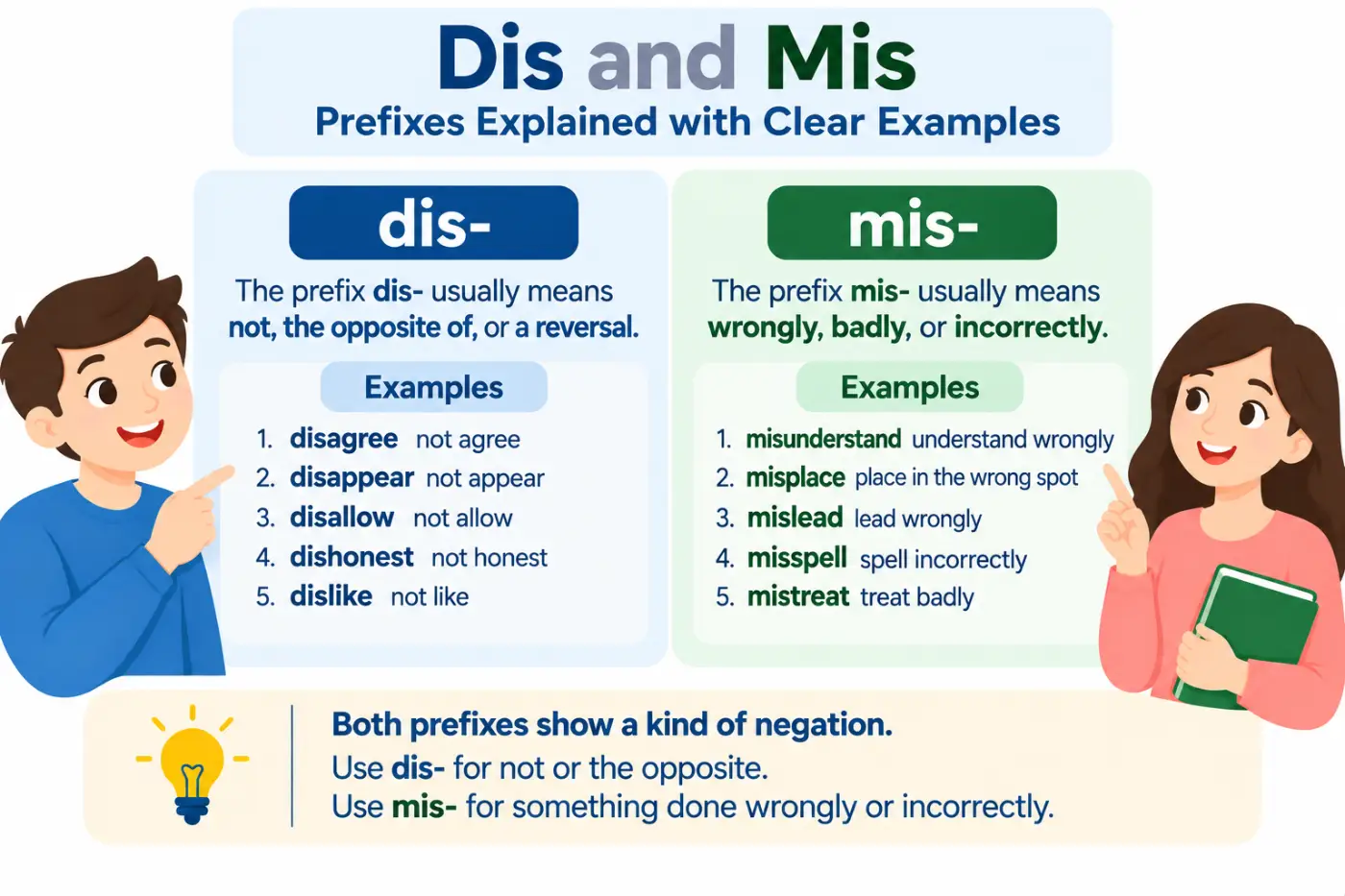
The prefixes dis and mis prefixes can look similar because both can give a word a negative meaning. That similarity causes plenty of confusion. The simplest answer is that dis often expresses separation, reversal, refusal, or an opposite idea, while mis usually means wrongly, badly, incorrectly, or mistakenly.
Once you see that basic difference, many words become easier to understand. Disagree means to have a different opinion. Disconnect means to separate or break a connection. Misunderstand means to understand something incorrectly. Misplace means to put something in the wrong place. The prefixes change the meaning of the base word in different ways.
The tricky part is that English prefixes don’t always follow one perfect rule. Some words developed through centuries of language change and became fixed forms in modern English. So you need both the general meaning and familiarity with common words. This guide explains how these prefixes work, how they differ, when to use them, how they sound, and how to recognize them in unfamiliar vocabulary.
Quick Definition
Dis and mis are prefixes that change the meaning of a base word. Dis commonly expresses separation, reversal, negation, or opposition. Mis usually expresses an incorrect, mistaken, or improper action. For example, disconnect means separate while misunderstand means understand incorrectly.
Quick Answer
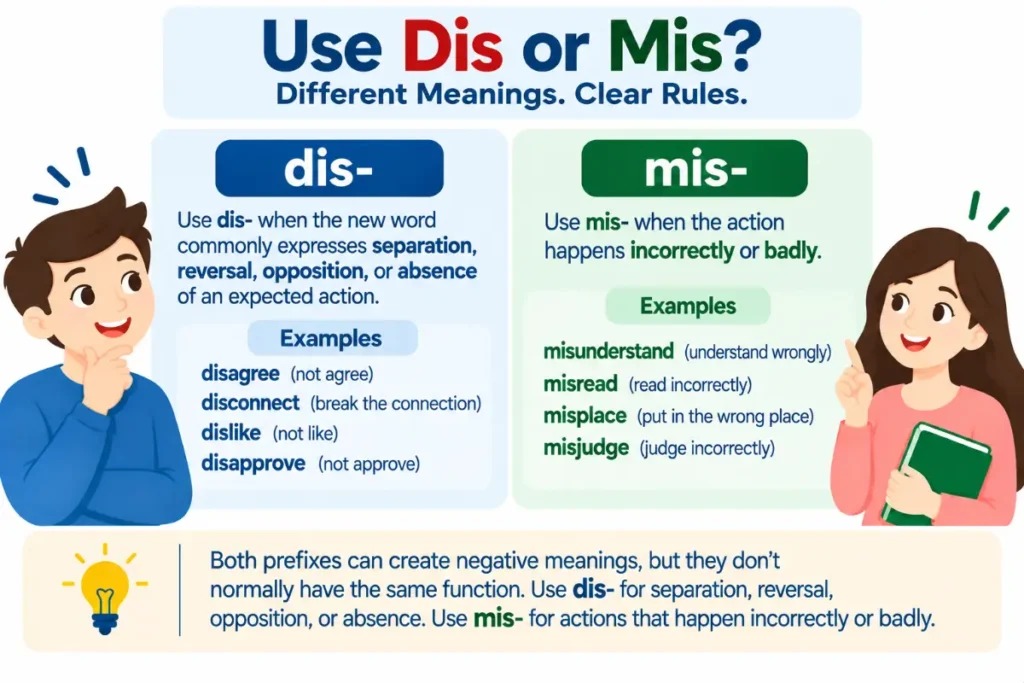
Use dis when the new word commonly expresses separation, reversal, opposition, or absence of an expected action. Examples include disagree, disconnect, dislike, and disapprove. Use mis when the action happens incorrectly or badly. Examples include misunderstand, misread, misplace, and misjudge. The prefixes can both create negative meanings, but they don’t normally have the same function.
Comparison Table
| Prefix | Core Meaning | Main Function | Common Word Types | Typical Sense | Example Word | Example Meaning |
|---|---|---|---|---|---|---|
| Dis | Apart, opposite, reversal, negation | Changes a word toward separation or opposition | Verbs, adjectives, nouns | Not, opposite, apart, reverse | Disagree | Have a different opinion |
| Mis | Wrongly, badly, incorrectly | Shows that an action or judgment is incorrect | Mostly verbs and related forms | Incorrect action or result | Misread | Read incorrectly |
Meaning and Definition
What dis means
Dis is a productive English prefix with several related meanings. It can express separation, reversal, negation, opposition, or the removal of an expected condition.
Consider the word disconnect. The base idea is connect. Adding dis changes the meaning toward separation. To disconnect something means to break or remove its connection.
Now consider disagree. The base word agree means to share the same opinion. Disagree means to have a different opinion or not share that agreement.
The same pattern appears in disapprove. Approve means to accept or support something. Disapprove means to have a negative opinion of it or not approve of it.
The prefix doesn’t always translate neatly into one English word such as not. Its exact meaning depends on the base word and the history of the complete word.
Common examples include:
- Disagree means to have a different opinion.
- Dislike means to not like something.
- Disconnect means to separate a connection.
- Disobey means to refuse to obey.
- Disable means to make something unable to function normally.
- Disappear means to cease being visible or present.
- Disapprove means to have a negative opinion of something.
- Disrespect means to show a lack of respect.
Notice that these words don’t all express exactly the same idea. That’s why treating dis as a simple replacement for not can lead to mistakes.
What mis means
Mis usually relates to something being done wrongly, incorrectly, badly, or in an unsuitable way.
Look at misunderstand. Understand means to grasp the meaning of something. Misunderstand means to grasp that meaning incorrectly.
The difference becomes even clearer with misread. Read means to interpret written words. Misread means to interpret them incorrectly.
Similarly, misplace means to put something somewhere and then lose track of its location. The action involves an incorrect or unsuitable result.
Other common examples include:
- Mishear means to hear something incorrectly.
- Misjudge means to form an incorrect judgment.
- Mislead means to cause someone to believe something incorrect or false.
- Miscalculate means to calculate incorrectly.
- Misquote means to repeat someone’s words incorrectly.
- Misprint means to print something incorrectly.
- Misuse means to use something in the wrong way.
- Mismanage means to manage something poorly.
The central idea is error. Something goes wrong in the action or result.
The Core Difference Between The Two
The easiest distinction is this.
Dis often points toward separation, opposition, reversal, or negation.
Mis usually points toward an incorrect action, understanding, judgment, or use.
Compare these pairs.
Disagree means you don’t share the same opinion.
Misunderstand means you understand something incorrectly.
Disconnect means separate something that was connected.
Misplace means put something in the wrong location.
Disapprove means not approve of something.
Misjudge means judge something incorrectly.
This distinction is useful because it gives you a meaning clue when you meet an unfamiliar word.
Suppose you encounter misinterpret. Even if you have never studied the word, the prefix mis gives you a strong clue. Interpret means explain or understand meaning. Misinterpret therefore suggests understanding or explaining something incorrectly.
Now consider disarm. The prefix points toward reversal or removal. To disarm someone means to remove their weapons or ability to use them.
The meaning isn’t always perfectly predictable, but the prefix gives you a useful starting point.
Key Differences Explained
- Meaning
Dis often signals separation, opposition, reversal, or negation. Mis usually signals an incorrect or improper action.
- Function
Dis can change the meaning of an action toward its opposite or toward separation. Mis usually tells you that the action happened incorrectly.
- Examples
Disagree means not having the same opinion. Misunderstand means having an incorrect understanding.
- Grammar
Both can form words from existing bases. Many common examples are verbs, although both prefixes also appear in adjectives and nouns.
- Pronunciation
The pronunciation of the prefix can change depending on the word. Dis commonly sounds like dis in words such as disagree and dislike. Mis commonly sounds like miss in words such as misread and mistake.
- Formality
Both prefixes appear throughout everyday English and formal writing. Words such as disagreement, misunderstanding, misuse, and disapproval are common in professional and academic contexts.
- Context
Dis frequently appears where an idea of opposition or separation exists. Mis frequently appears where an action has gone wrong.
- Spelling
The prefixes themselves are stable in spelling. The challenge usually comes from knowing which prefix belongs with a particular base word.
Which Prefix Should You Use?
You can often make a strong choice by asking one simple question.
Does the word describe something being wrong or done incorrectly?
If the answer is yes, mis may be the appropriate prefix.
Misunderstand means understand incorrectly.
Miscalculate means calculate incorrectly.
Misjudge means judge incorrectly.
Misuse means use incorrectly.
Then ask a second question.
Does the word express separation, opposition, reversal, refusal, or lack of something?
If the answer is yes, dis may fit.
Disagree expresses opposition in opinion.
Disconnect expresses separation.
Disapprove expresses a negative response.
Disobey expresses refusal to follow an instruction.
Still, English has many established words that you must learn as vocabulary. You can’t always create a new word by attaching either prefix and expect native speakers to accept it.
For example, you can’t freely replace the prefix in a familiar word just because the meaning seems logical. English vocabulary develops through actual usage. Dictionaries record established words rather than every combination that could theoretically be understood.
That is an important point for learners. Prefix rules help you understand words. They don’t give you unlimited permission to invent new forms.
Sentence Examples
Here are natural examples showing how these prefixes work in real English.
- I disagree with your opinion about the new policy.
- Please disconnect the device before cleaning it.
- She dislikes driving in heavy traffic.
- The employee was warned not to disobey the safety rules.
- The manager disapproved of the proposed changes.
- I misunderstood your message and thought the meeting was tomorrow.
- He misread the instructions and completed the wrong task.
- She misplaced her keys somewhere in the house.
- The witness may have misjudged the distance.
- I misheard your last sentence because the room was noisy.
These examples show that the two prefixes create different kinds of negative meaning.
In the first five examples the words point toward opposition, separation, refusal, or lack of approval.
In the final five examples the words point toward mistakes in understanding, reading, location, judgment, or hearing.
Common Mistakes
Treating dis as a simple form of not
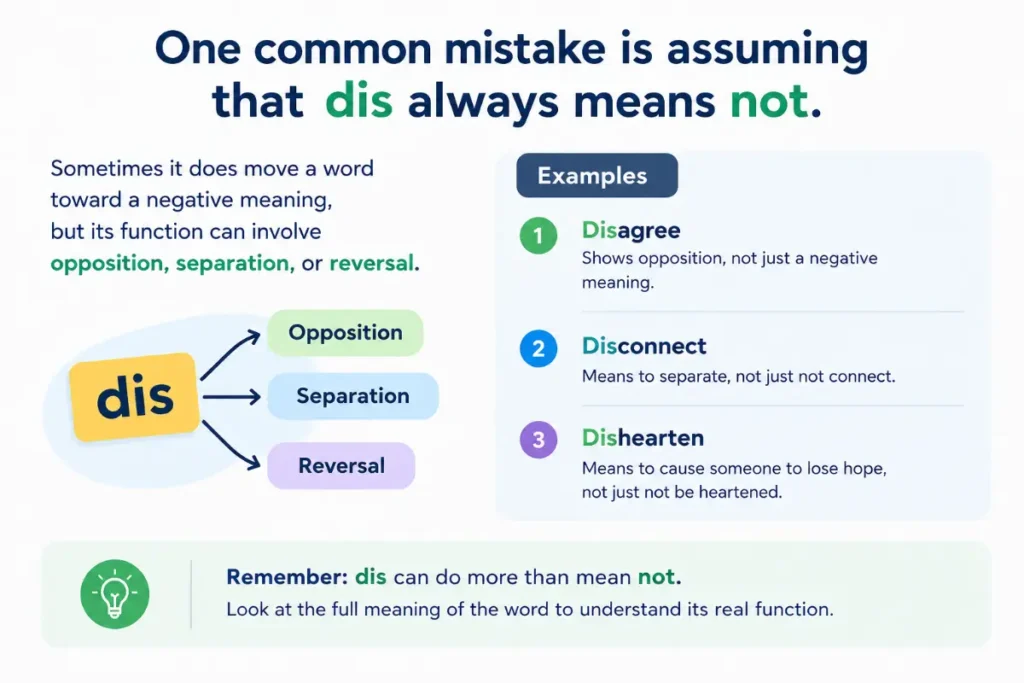
One common mistake is assuming that dis always means not. Sometimes it does move a word toward a negative meaning, but its function can involve opposition, separation, or reversal.
For example, disconnect doesn’t simply mean not connect in every context. It usually means to separate or break a connection.
Treating mis as a general negative prefix
Mis doesn’t simply mean bad or negative. It usually suggests that an action was performed incorrectly or produced an incorrect result.
Misunderstand doesn’t mean not understand. It means understand incorrectly.
That distinction matters.
You can say I didn’t understand the lesson. That means you failed to understand it.
You can say I misunderstood the lesson. That means you formed an incorrect understanding of it.
Assuming every base word accepts both prefixes
English doesn’t work like a mathematical formula. You can’t take every word and attach dis or mis to create a standard word.
For example, some combinations may look understandable but still sound unnatural to native speakers. Established vocabulary matters.
Confusing misuse with disuse
These words look similar but have different meanings.
Misuse means use something incorrectly.
Disuse means a state in which something is no longer used.
The difference is important.
The machine was damaged because of misuse.
The old building fell into disuse.
Confusing distrust with mistrust
These words overlap but can carry slightly different shades of meaning.
Distrust commonly means a lack of trust.
Mistrust also means a lack of trust or suspicion.
Both are established English words. This is a good reminder that prefixes can overlap in meaning without being interchangeable in every word.
Pronunciation Guide
The prefix dis commonly has the sound /dɪs/ in many words.
For example:
disagree sounds roughly like dih uh GREE.
disconnect sounds roughly like dih kuh NEKT.
dislike sounds roughly like dih LIKE.
The prefix mis commonly has the sound /mɪs/.
For example:
misunderstand sounds roughly like miss un der STAND.
misread commonly sounds like miss REED when the word describes past action and like miss REED or miss RED depending on the grammatical form and context. English pronunciation can make this word especially interesting because the spelling stays the same while pronunciation changes with tense.
misjudge sounds roughly like miss JUDGE.
The main pronunciation point is simple. Dis commonly begins with a short ih sound. Mis commonly begins with the same short ih sound but starts with m rather than d.
Learners sometimes pronounce every prefix too strongly. Native speakers usually blend prefixes naturally into the rest of the word. You don’t need to separate each part dramatically.
Etymology and Word Origin
The history of these prefixes helps explain why their meanings overlap in some places but differ in others.
The prefix dis entered English through French and Latin influences. It is connected with Latin forms that expressed separation, apartness, reversal, or negation. Over time it became part of many English words and developed several related functions.
The prefix mis has Germanic roots and is associated with ideas such as wrongness, error, bad action, or an unfavorable result. It became productive in English and appears in many words describing incorrect actions.
The two prefixes therefore come from different historical backgrounds. That history helps explain why they aren’t simply two interchangeable ways to make a word negative.
Their modern meanings have also developed through centuries of actual English use. Some words preserve a meaning close to their original prefix. Others have developed specialized meanings that modern speakers learn as complete vocabulary items.
This is common in English. Prefixes provide clues, but word history and established usage determine the final meaning.
Regional Usage
American English
American English uses both prefixes extensively. Words such as disagree, disconnect, dislike, misunderstand, misread, and misuse are standard vocabulary.
There’s no major American spelling difference involving these prefixes. The same basic forms appear in everyday conversation, education, workplace writing, journalism, and formal documents.
British English
British English also uses the same common forms. There is no major regional distinction in the spelling or basic meaning of these prefixes.
Words such as disagreement, disapproval, misunderstanding, and misuse are familiar in British writing and speech.
Australian English
Australian English follows the same general pattern. The prefixes are used in standard vocabulary with meanings that closely match American and British English.
There isn’t a significant Australian variant that changes the basic distinction between them.
Canadian English
Canadian English also uses the standard forms. Speakers and writers use both prefixes naturally in casual and formal settings.
The important point is that this isn’t mainly a regional spelling issue. The distinction comes from meaning and established word formation.
Grammar Rules and Part of Speech
Prefixes don’t normally function as independent parts of speech. They are attached to a base word to create another word.
The resulting word can belong to different grammatical categories.
Verbs
Many common examples are verbs.
Disagree is a verb.
Disconnect is a verb.
Misunderstand is a verb.
Misjudge is a verb.
These words describe actions or mental processes.
Nouns
The prefixes also appear in nouns.
Disagreement is a noun.
Disapproval is a noun.
Misunderstanding is a noun.
Misuse can function as a noun.
For example:
Her disagreement with the decision was clear.
The misunderstanding caused unnecessary tension.
Adjectives
Some words formed with these prefixes function as adjectives.
Disrespectful describes behavior that lacks respect.
Misguided describes an idea or action based on poor judgment or incorrect thinking.
Sentence position
The position of the resulting word depends on its grammatical role rather than the prefix itself.
For example:
I disagree with you.
The word disagree follows the subject and functions as the main verb.
She made a serious mistake because of a misunderstanding.
Here misunderstanding functions as a noun.
Punctuation
The prefixes themselves don’t require special punctuation. In normal modern English they are generally attached directly to the base word.
You write:
disagree
misunderstand
misuse
disconnect
You don’t normally separate the prefix from the base with punctuation.
How Native Speakers Understand These Prefixes
Native speakers usually don’t stop and consciously translate every prefix. They recognize familiar words as complete vocabulary units.
If someone says I misunderstood you the listener immediately understands that an incorrect understanding occurred. The listener doesn’t need to analyze mis plus understand first.
Still, prefix awareness becomes useful when reading unfamiliar words.
Suppose you encounter miscommunication. You probably already know communication. The prefix gives you a clue that the communication went wrong or failed to work correctly.
Now consider disconnection. You already know connection. The prefix suggests separation or the breaking of a connection.
This is one of the best reasons to study prefixes. They help you make educated guesses about unfamiliar vocabulary.
The guess may not give you the exact dictionary definition, but it can often point you in the right direction.
Real Life Usage Examples
Daily Conversation
In everyday speech you’ll hear both prefixes constantly.
- I think we disagree about how to handle the problem.
- Sorry. I misunderstood what you meant.
The first example expresses a difference of opinion. The second describes an incorrect understanding.
Workplace Communication
Professional communication also uses both forms naturally.
- Please disconnect the equipment before beginning the inspection.
- There seems to be a misunderstanding about the project deadline.
These expressions sound natural in emails, meetings, instructions, and workplace discussions.
Academic Writing
Academic writing often uses words such as disagreement, misconception, misinterpretation, and disconnection.
- The researchers disagreed about how the evidence should be interpreted.
- The results were misinterpreted by several readers.
News Writing
Journalists commonly use these terms to describe conflicts and mistakes.
- Officials disagreed over the proposed changes.
- The spokesperson said the earlier statement had been misunderstood.
These forms are concise and clear. They help writers explain events without unnecessary wording.
Literature and Storytelling
Storytellers also use both prefixes to show conflict and misunderstanding.
- The two friends disagreed after hearing different versions of the story.
- He realized that he had misunderstood her intentions.
These words can carry emotional weight because disagreement and misunderstanding often drive conflict in stories.
Related and Confused Terms
Several words are closely connected to the ideas expressed by these prefixes.
Un
The prefix un often expresses negation or reversal. It appears in words such as unhappy, unfair, and unlock.
Un and dis can sometimes overlap in meaning, but they aren’t interchangeable across all words.
Non
Non usually means not or absence of a particular quality or category. Examples include nonfiction and nonverbal.
It often creates a neutral classification rather than suggesting that something went wrong.
In
The prefix in and its related forms can also express negation. Examples include incorrect, inactive, and impossible.
Its form can change depending on the following sound and the word.
Misunderstanding
A misunderstanding occurs when someone interprets information incorrectly. It’s closely related to the central meaning of mis.
Disagreement
A disagreement occurs when people hold different opinions or positions. It connects directly with the opposition meaning associated with dis.
Misinterpretation
A misinterpretation happens when someone gives something an incorrect meaning or explanation.
Disapproval
Disapproval means a negative judgment or lack of approval. It doesn’t necessarily mean that an action was performed incorrectly.
Misuse
Misuse means using something incorrectly or improperly. It clearly demonstrates the error related to mis.
These related terms show why learning meaning is more useful than memorizing a single translation for each prefix.
A Simple Memory Trick
Here’s a practical way to remember the difference.
Think of mis as the prefix of mistakes.
Misread means read incorrectly.
Mishear means hear incorrectly.
Misjudge means judge incorrectly.
Misunderstand means understand incorrectly.
Miscalculate means calculate incorrectly.
That pattern is strong and easy to remember.
For dis, think about distance, difference, or departure from an expected state.
Disagree means a difference in opinion.
Disconnect means separation.
Disapprove means opposition or lack of approval.
Disobey means going against an instruction.
This isn’t a perfect rule for every English word, but it gives you a useful mental shortcut.
Expert Editor Insight
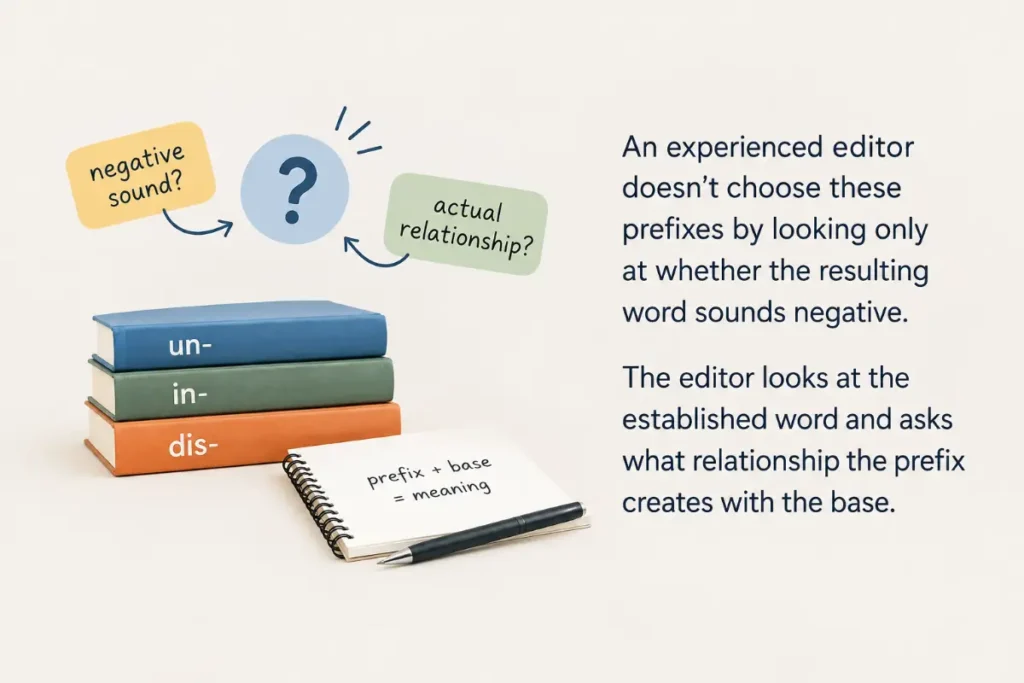
An experienced editor doesn’t choose these prefixes by looking only at whether the resulting word sounds negative. The editor looks at the established word and asks what relationship the prefix creates with the base. If the idea involves an incorrect action or mistaken result, mis is often the right clue. If the idea involves opposition, separation, reversal, or negation, dis may fit. Spelling tools can catch many errors, but they can’t always judge meaning in context. That’s why understanding the word itself remains more reliable than depending entirely on automatic correction.
Conclusion
The main distinction between dis and mis prefixes comes down to the relationship between the prefix and the base word. Dis commonly points to separation, opposition, reversal, refusal, or negation. Mis usually points to an incorrect, mistaken, or improper action. That’s why disagree and misunderstand have very different meanings even though both words have a negative sense.
The best way to learn these forms is through familiar word families. Think of mis as a clue for mistakes such as misread, misjudge, and mishear. Think of dis as a clue for difference or separation such as disagree and disconnect. These patterns make unfamiliar vocabulary much easier to decode.
One practical editing tip can save you a lot of confusion. Don’t choose a prefix just because its meaning seems logical. Check the established word and then consider its meaning in context. English rewards familiarity as much as rules, and common examples will gradually make the correct form feel natural.
FAQs
What is the main difference between dis and mis?
Dis commonly expresses separation, opposition, reversal, or negation. Mis usually describes an action that happened incorrectly or produced a wrong result. For example, disagree expresses a difference of opinion, while misunderstand describes an incorrect understanding. The prefixes can both create words with negative meanings, but their specific functions depend on the base word and established English usage.
Does mis always mean wrong?
Mis usually carries an idea of wrongness, error, or improper action, but it doesn’t mean wrong in exactly the same way in every word. Misread means read incorrectly, while misuse means use something improperly. The prefix gives you a strong clue about meaning, but the complete word and its established usage determine the precise definition.
Does dis always mean not?
No. Dis can express several related ideas. It may indicate opposition, separation, reversal, refusal, or negation. Disagree means to hold a different opinion, while disconnect means to separate something that was connected. Treating dis as a simple replacement for not can make unfamiliar words harder to understand because its meaning depends on the complete word.
Can both prefixes be added to the same base word?
Not usually. English word formation isn’t a free system where you can attach any prefix to any base and automatically create a standard word. Some bases accept dis, some accept mis, and some may accept neither. Established vocabulary determines which forms are recognized. Prefix meanings can help you understand a word, but they don’t guarantee that a newly created combination is standard English.
Why is misunderstand different from disagree?
The words describe different problems. Disagree means two people hold different opinions or positions. Misunderstand means one person has interpreted information incorrectly. You can disagree with someone even after understanding their argument perfectly. You can also misunderstand someone without disagreeing with what they actually meant. The distinction is about opposition in one case and incorrect understanding in the other.
Is misuse the same as disuse?
No. Misuse means using something incorrectly or improperly. Disuse means a condition in which something is no longer used. For example, misuse of a machine could damage it. An old machine might fall into disuse simply because nobody uses it anymore. The prefixes create two different meanings even though the base word use remains visible.
Are these prefixes used in formal writing?
Yes. Both appear regularly in formal and academic English. Words such as disagreement, disapproval, misunderstanding, misinterpretation, misuse, and disconnection are standard vocabulary. The prefixes themselves aren’t informal. What matters is the complete word and the context. A formal writer should choose the established word that expresses the intended meaning rather than creating an unusual form.
How can I remember which prefix to use?
Connect mis with mistakes. Misread, mishear, misjudge, miscalculate, and misunderstand all involve an incorrect action or result. For dis, think about difference, separation, opposition, or reversal. Disagree, disconnect, disapprove, and disobey illustrate those ideas. This memory trick won’t solve every unusual word, but it gives you a strong starting point when you meet unfamiliar vocabulary.
