
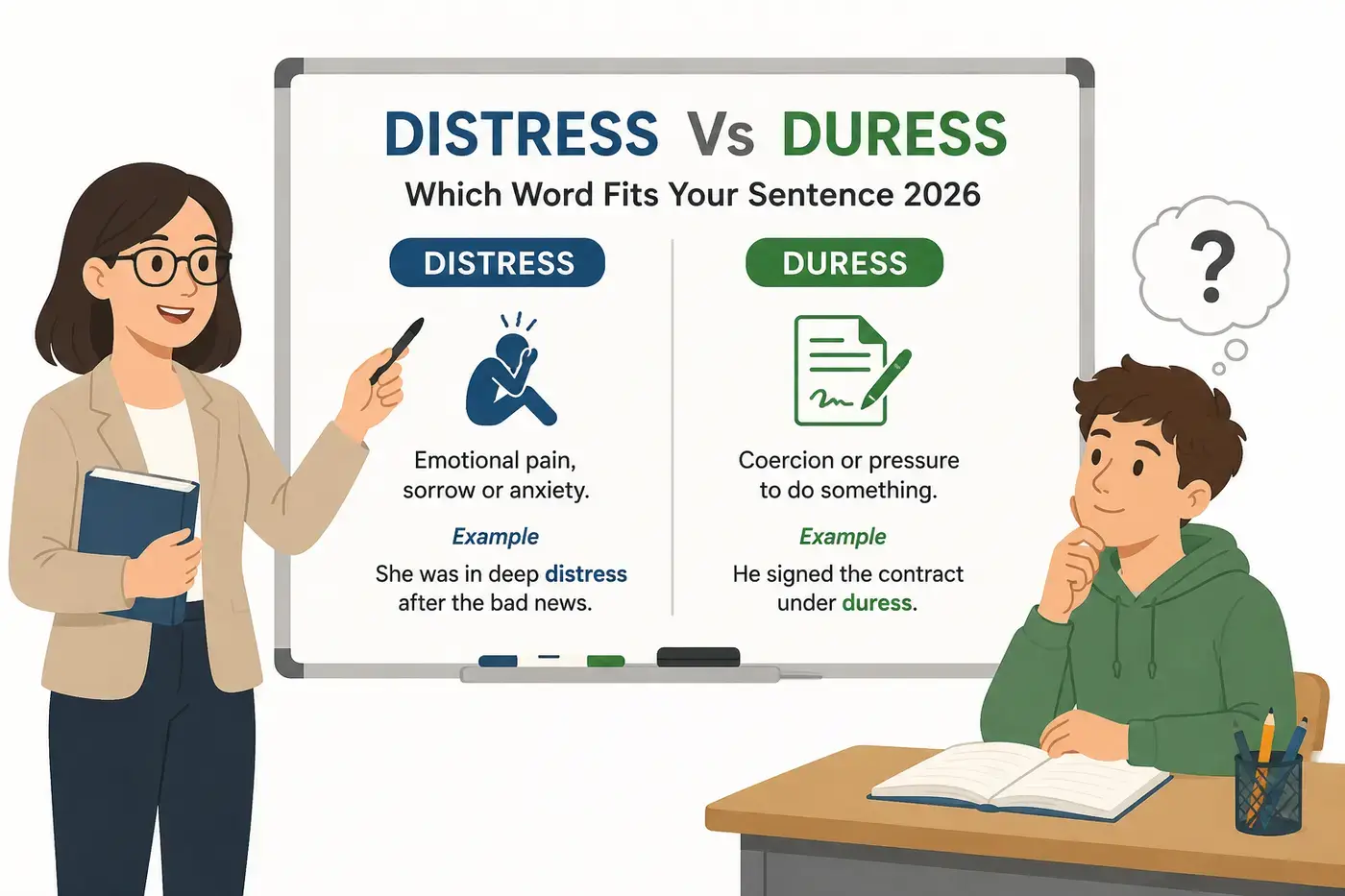
Distress vs duress can be confusing because both words describe difficult situations and both can involve pressure or suffering. They are not interchangeable, though. Distress usually describes emotional pain, worry, discomfort, or suffering, while duress refers to pressure or threats that force someone to do something against their will.
The distinction becomes especially important in legal writing. A person can be in distress because they feel frightened or deeply upset. A person can act under duress because another person has used threats, force, or unlawful pressure to make them act. Those ideas can overlap in a real situation, but the words focus on different parts of it.
Once you see that difference, choosing the right term becomes much easier. This guide explains the meanings, grammar, pronunciation, origins, common mistakes, legal use, everyday examples, related terms, and practical differences. You’ll also learn a simple memory trick that can help you choose the right word quickly when you’re writing or speaking.
Quick Definition
Distress means severe emotional or physical suffering, worry, discomfort, or trouble. Duress means pressure, threats, or force used to make someone do something against their will. In simple terms, distress describes the suffering a person experiences, while duress describes the coercive pressure imposed on a person.
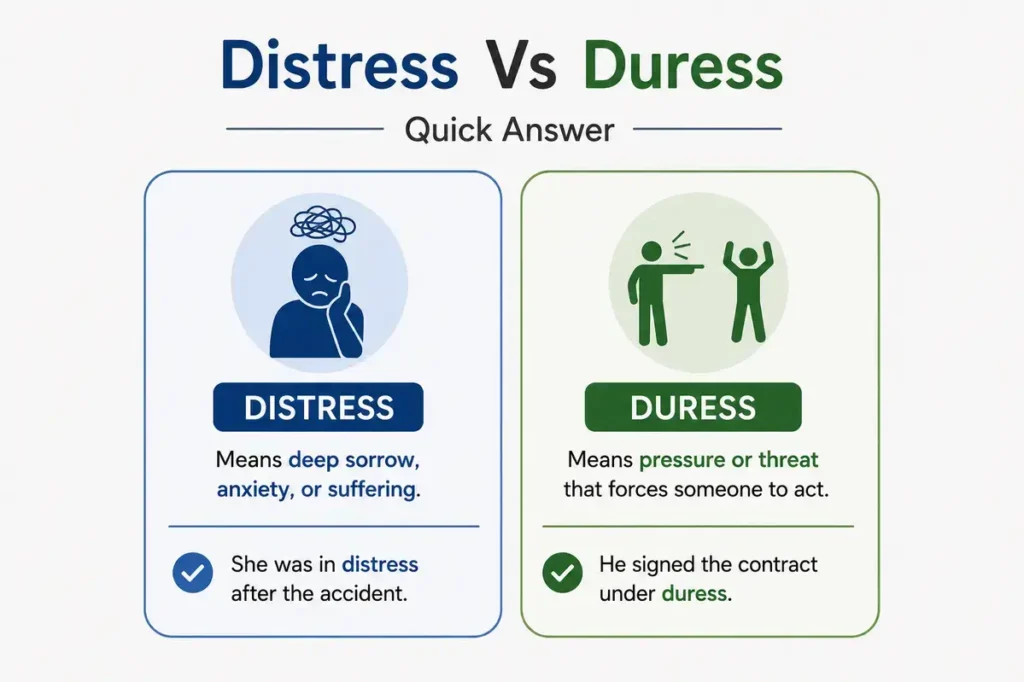
Quick Answer
Distress and duress are both correct English words, but they have different meanings. Use distress for suffering, anxiety, grief, pain, or serious difficulty. Use duress for coercion, threats, or pressure that forces someone to act against their free choice.
A useful shortcut is this: distress focuses on the person experiencing the hardship, while duress focuses on the pressure forcing the action.
Comparison Table
| Form | Meaning | Part of Speech | Origin | Usage Frequency | Formality | Common Contexts | Example |
|---|---|---|---|---|---|---|---|
| Distress | Severe suffering, anxiety, pain, or difficulty | Noun and verb | Old French and Latin roots | Very common | Neutral to formal | Daily speech, health, work, psychology, law | The news caused her great distress. |
| Duress | Threats or coercive pressure that force someone to act | Noun | Old French and Latin roots | Less common | Formal | Law, contracts, crime, coercion | He signed the agreement under duress. |
Meaning and Definition
Meaning of Distress
Distress refers to serious suffering or discomfort. It can describe an emotional state, a physical condition, a difficult situation, or an urgent problem.
If someone loses a loved one, receives frightening news, or faces a major personal crisis, that person may experience emotional distress. The word can describe feelings such as fear, sadness, anxiety, helplessness, or deep worry.
For example:
The accident caused considerable distress among the family.
Here the word describes the emotional suffering caused by the event.
Distress can also describe physical discomfort.
The patient showed signs of respiratory distress.
In this context, the word refers to a serious physical or medical problem rather than ordinary sadness.
The word also works as a verb.
The situation distressed her.
That sentence means the situation caused her emotional suffering or upset.
The key idea stays the same across these uses. Something causes serious discomfort, suffering, worry, or trouble.
Meaning of Duress
Duress refers to pressure that takes away or seriously limits a person’s freedom to choose. The pressure often involves threats, force, intimidation, or other forms of coercion.
The word appears most often in legal and formal contexts.
For example:
He signed the contract under duress.
This means he didn’t freely agree to the contract. Someone pressured or threatened him in a way that affected his ability to make a free decision.
Duress can involve physical threats, threats of serious harm, or other coercive conduct. The exact legal meaning can depend on the jurisdiction and the facts of a case.
That legal context matters. In everyday speech, people sometimes use duress simply to mean extreme pressure. In legal writing, however, the concept is more specific. It generally concerns improper pressure that causes a person to act against their free will.
The central idea is coercion.
Distress describes suffering.
Duress describes coercive pressure.
Key Differences Explained
- Meaning
Distress describes suffering, worry, pain, anxiety, or serious difficulty. Duress describes pressure or coercion that forces a person to act.
- Focus
Distress focuses on the person’s condition or emotional response. Duress focuses on the source of pressure and its effect on free choice.
- Grammar
Distress can function as both a noun and a verb. Duress is primarily used as a noun.
- Everyday use
Distress is common in ordinary conversation. People regularly talk about emotional distress, financial distress, physical distress, or distress caused by bad news.
Duress is less common in casual conversation and appears more often in legal, professional, or serious discussions.
- Legal meaning
Distress has several legal uses depending on context. Duress has a particularly important legal meaning involving coercion and lack of voluntary consent.
- Emotional suffering
Use distress when you want to describe someone who is deeply upset or suffering.
She was visibly distressed after the accident.
- Forced action
Use duress when someone does something because another person applies serious improper pressure.
He claimed that he had signed under duress.
- Relationship between the ideas
A person under duress may experience distress. However, a person can experience distress without being under duress.
That distinction is the heart of the matter.
Which Form Is Correct?
Both forms are correct. The choice depends on what you mean.
Use distress when the sentence centers on suffering, anxiety, pain, discomfort, or serious difficulty. Use duress when the sentence centers on coercion or pressure that removes or limits free choice.
Consider these two examples:
She was in distress after receiving the news.
She signed the document under duress.
The first sentence describes her emotional condition. The second describes the circumstances surrounding her decision.
Dictionary based usage supports this distinction. Standard English dictionaries treat the two words as separate entries with different meanings and grammatical functions. Their similar appearance does not make them interchangeable.
An experienced editor would also look at the surrounding verb and noun patterns. Phrases such as emotional distress, financial distress, physical distress, and distress signal are natural. Phrases such as under duress and act under duress are strongly associated with coercion.
Sentence Examples
Here are natural examples showing how distress works in different settings.
- The sudden news caused her considerable distress.
- The child began crying in distress after becoming separated from his parents.
- Financial distress can make it difficult for a company to continue operating.
- The doctor checked the patient for signs of respiratory distress.
- He was visibly distressed by the argument.
- The family experienced deep distress after the unexpected loss.
- The emergency signal warned rescuers that someone was in distress.
- She tried to hide her distress during the difficult meeting.
- The ongoing conflict caused emotional distress for many residents.
- The company entered financial distress after several months of falling sales.
Now consider examples using duress.
- He said he signed the agreement under duress.
- The defendant claimed that threats had forced him to make the payment under duress.
- A contract signed under genuine duress may raise serious legal questions.
- She argued that she had acted under duress and had not made the decision freely.
- The witness said the statement was obtained through threats and coercion.
These examples show why the words shouldn’t be swapped casually. The first group describes suffering or difficulty. The second group describes forced action.
Common Mistakes and Confusions
Using Duress for Ordinary Stress
A common mistake is using duress to describe everyday pressure.
You might hear someone say that a busy week put them under duress. In casual speech, the listener may understand the idea. Still, stress or pressure would usually sound more natural.
Better:
I’ve been under a lot of pressure at work.
The formal word duress carries a stronger idea of coercion.
Using Distress for Coercion
Another mistake is using distress when the sentence is really about forced action.
For example:
He signed the contract in distress.
This tells us that he was suffering or upset. It doesn’t clearly tell us that someone forced him to sign.
If coercion is the intended meaning, a stronger sentence is:
He signed the contract under duress.
Confusing Emotional Pain With External Pressure
Distress and duress can appear in the same real life situation. Someone threatened with harm may feel distress because of the threat. The threat itself can create duress.
That overlap causes confusion.
Think about the difference between the experience and the pressure.
The fear and suffering are distress.
The coercive threat is duress.
Assuming Similar Spelling Means Similar Meaning
The two words share several letters and have similar sounds. English contains many such pairs where visual similarity can create confusion.
This is sometimes called lexical confusion. A reader recognizes a familiar word shape and selects a related looking word without checking the precise meaning.
The solution is simple. Look at the action or condition described by the sentence.
Treating Duress as a General Synonym for Stress
Duress is stronger and more specific than ordinary stress.
A difficult deadline can cause stress.
A serious threat that forces someone to act can amount to duress.
Using the stronger term for ordinary pressure can make your writing sound legally loaded or unnecessarily dramatic.
Pronunciation Guide
Distress is commonly pronounced /dɪˈstrɛs/ when used as a noun or verb.
A simple pronunciation guide is:
di STRESS.
The second syllable carries the main stress.
Duress is commonly pronounced /djʊˈrɛs/ in American English.
A simple guide is:
dyoo RESS.
The second syllable carries the main stress.
Some speakers may use a slightly different first vowel depending on accent. That variation doesn’t change the meaning.
A useful pronunciation trick is to pay attention to the stressed second syllable in both words. The similar ending can make them sound related, but their meanings remain distinct.
Etymology and Word Origin
Distress has a long history in English and ultimately connects to Latin roots associated with pulling apart, pressing, or constraint. It passed through Old French before developing into Middle English and then modern English. Over time its meaning expanded toward suffering, trouble, anxiety, and hardship.
Duress also has roots connected to ideas of hardness, severity, pressure, and constraint. It entered English through Anglo French and Old French forms linked to Latin roots associated with harshness or force.
Their histories help explain why both words can appear in discussions of difficult circumstances and pressure. They belong to different but historically related word families.
The modern meanings have become more specialized. Distress developed broad everyday uses for emotional and physical suffering. Duress became strongly associated with coercion and legal pressure.
That historical development also explains why duress feels more formal to modern English speakers.
Regional Usage
American English
Both words are standard in American English. Distress is common in everyday speech as well as professional and academic writing. Americans use it for emotional suffering, physical problems, financial hardship, and emergency situations.
Duress appears less often in casual conversation. It is especially common in legal writing and discussions involving contracts, criminal cases, coercion, and forced decisions.
British English
British English uses both terms with essentially the same core meanings. Distress commonly describes emotional suffering, hardship, or serious discomfort.
Duress has a strong formal and legal association in British usage. The phrase under duress is well established and generally refers to coercive pressure.
Australian English
Australian English also uses the standard meanings of both words. Distress is widely understood in ordinary communication. Duress tends to appear in formal situations, especially legal discussions.
There is no major regional spelling difference between American, British, Australian, and Canadian English for these words.
Canadian English
Canadian English follows the same basic distinction. Distress can describe emotional or physical suffering and difficult circumstances. Duress usually describes coercion or pressure that affects a person’s freedom of choice.
The difference is semantic rather than regional.
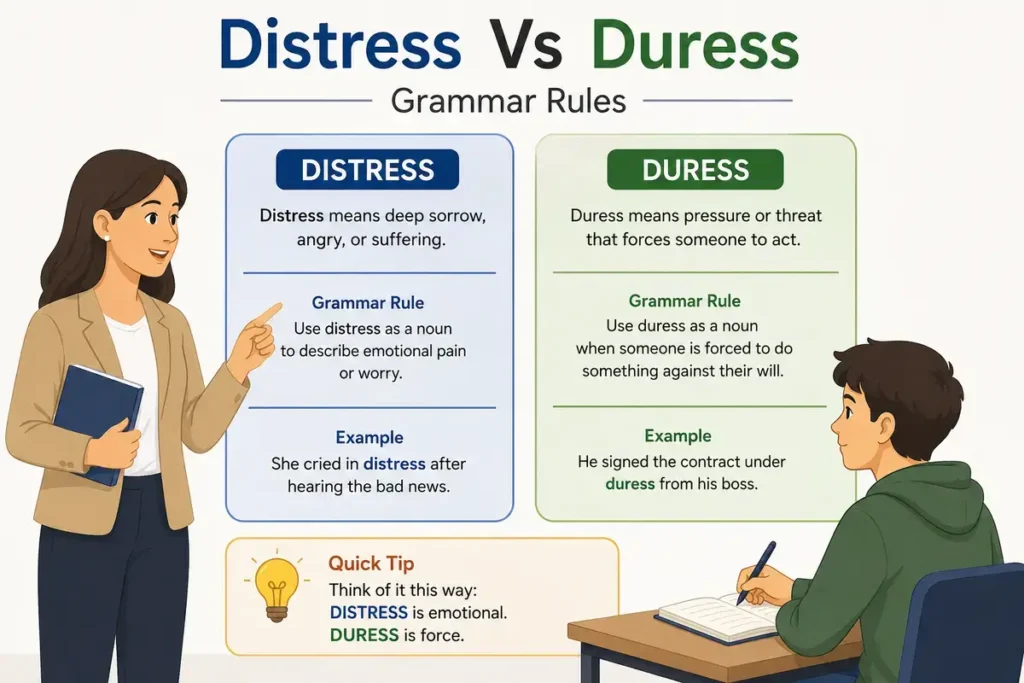
Grammar Rules and Part of Speech
Distress has two main grammatical roles.
As a noun, it refers to a state of suffering or difficulty.
The family was in distress.
As a verb, it means to cause someone to feel upset or troubled.
The news distressed him.
The noun can appear in several common patterns.
In distress
This describes someone who needs help or is suffering.
The sailor was found in distress.
Emotional distress
This refers to serious emotional suffering.
The accident caused emotional distress.
Financial distress
This describes serious financial difficulty.
The business is experiencing financial distress.
Physical distress
This refers to serious physical discomfort or difficulty.
The patient showed signs of physical distress.
Duress functions primarily as a noun.
The most familiar structure is under duress.
She agreed under duress.
Another common pattern is act under duress.
He claimed that he had acted under duress.
You may also encounter sign under duress.
They alleged that the document had been signed under duress.
The word is usually uncountable in these constructions. You normally don’t say a duress or several duresses in ordinary modern usage.
Because duress has a formal tone, it can sound out of place in casual writing when simpler words such as pressure or coercion express the idea more naturally.
Real Life Usage Examples
Daily Conversation
Distress appears naturally in everyday speech.
I could tell she was in distress.
The child started crying because he was in distress.
In these sentences the focus is clearly on suffering or emotional difficulty.
Duress is less common in casual conversation.
He says he agreed because he was under duress.
She claimed she was acting under duress.
Even in conversation the phrase often sounds serious because of its legal and formal associations.
Email and Workplace Communication
Distress can describe personal hardship or a business problem.
The sudden loss caused considerable distress among the staff.
The company is experiencing financial distress and may need to reduce costs.
Duress can appear in workplace communication when discussing formal agreements or allegations of coercion.
The employee stated that the agreement had been signed under duress.
The legal team is reviewing the claim of duress.
Academic Writing
Academic writers often use distress when discussing psychology, health, social conditions, or human behavior.
The study examined emotional distress among students facing financial hardship.
Researchers observed higher levels of distress among participants exposed to prolonged uncertainty.
Duress may appear in academic work involving law, ethics, criminology, or political science.
The paper examines how duress can affect voluntary decision making.
The court considered the claim that the agreement resulted from duress.
News and Journalism
News writing commonly uses distress to describe people affected by accidents, disasters, or crises.
Rescuers responded after receiving a distress signal from the vessel.
Several residents reported emotional distress after the evacuation.
Duress appears in legal or criminal reporting.
The defendant claimed that he had acted under duress.
The court heard evidence concerning allegations of duress.
Literature and Storytelling
Writers often use distress to show a character’s emotional state.
She tried to remain calm despite the distress written across her face.
His voice revealed the distress he had tried to hide.
Duress can create a more formal or legal tone.
He insisted that his confession had been made under duress.
The character finally revealed the threats that had placed him under duress.
Related and Confused Terms
Stress
Stress refers to mental or physical strain caused by demanding circumstances. It is much broader than duress.
A difficult exam can cause stress without involving coercion.
Anxiety
Anxiety describes worry, nervousness, or fear about something that may happen. It often overlaps with emotional distress but has a more specific psychological meaning.
Suffering
Suffering is a broad term for physical or emotional pain. Distress is one form of serious suffering.
Pressure
Pressure can mean demands or influence that make someone feel compelled to act. It can be ordinary or extreme depending on context.
Coercion
Coercion means using force or threats to make someone do something. It is closely related to duress and is often the clearest plain English explanation.
Intimidation
Intimidation involves making someone afraid in order to influence their behavior. It can contribute to a situation involving duress.
Hardship
Hardship refers to difficult living or working conditions. Financial hardship can cause distress without involving coercion.
At Risk
Being at risk means facing the possibility of harm or loss. A person can be at risk without experiencing duress or distress.
These related terms show why context matters. The best word depends on the exact idea you want the reader to understand.
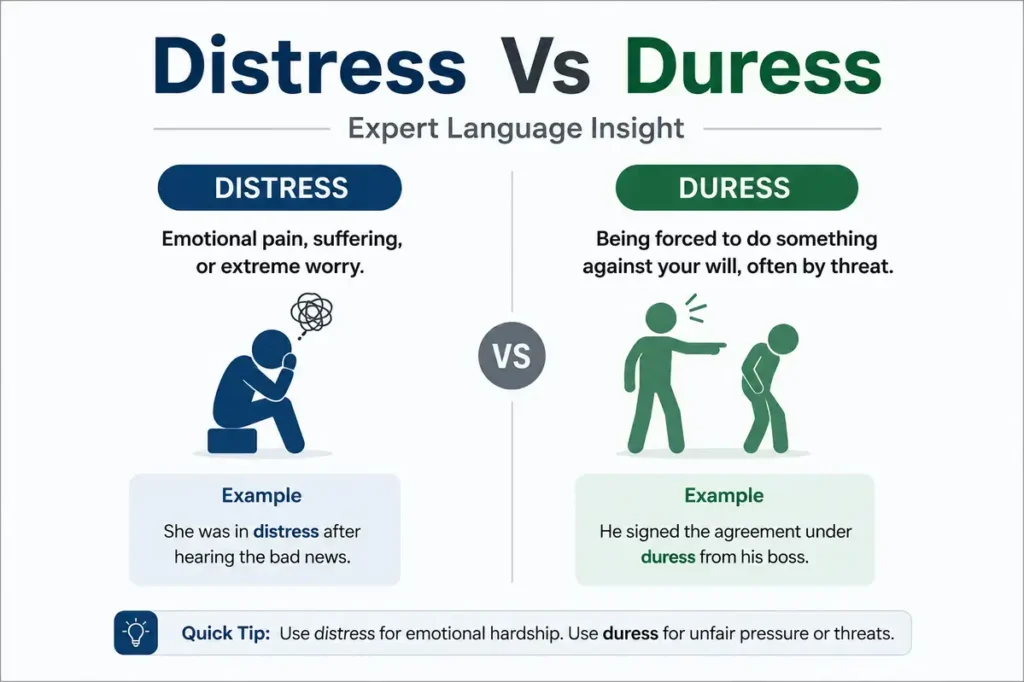
Expert Editor Insight
An experienced editor looks first at the relationship between the person and the problem. If the sentence describes fear, grief, anxiety, pain, hardship, or suffering, distress is usually the natural choice. If another person or force is compelling someone to act through threats or improper pressure, duress is more precise. Editing software may recognize both words as correct because neither is a spelling error. The real challenge is semantic accuracy. My practical tip is to ask one question before choosing the word: am I describing the suffering or the coercion? That answer usually settles the choice immediately.
Conclusion
Distress vs duress becomes much easier once you separate suffering from coercion. Distress describes emotional pain, physical discomfort, hardship, worry, or serious difficulty. Duress describes pressure, threats, or force that cause someone to act against their free choice. Both words are correct, but they serve different purposes.
The simplest way to remember the difference is to focus on what the sentence is describing. If you’re talking about the suffering a person experiences, choose distress. If you’re talking about the pressure that forces a person to act, choose duress.
When you’re editing your writing, ask yourself one quick question: am I describing the person’s suffering or the force behind the decision? That small check can prevent one of the most common meaning based word choices in formal English.
FAQs
What is the main difference between distress and duress?
Distress describes suffering or serious emotional, physical, or financial difficulty. Duress describes coercive pressure that forces someone to act against their free choice. A person can experience distress because of many situations that involve no coercion at all. Duress is more specific and often appears in legal contexts involving threats, force, intimidation, or improper pressure.
Is distress a stronger word than stress?
Distress generally describes a more serious or harmful state than ordinary stress. Stress can result from work, deadlines, exams, or daily responsibilities. Distress suggests significant suffering, anxiety, discomfort, or difficulty. The exact strength depends on context. Someone can experience mild stress without distress, while a serious crisis may cause considerable emotional distress.
Is duress only a legal term?
No. Duress is an English word that can be used outside legal writing, but its strongest and most familiar use is formal and legal. In everyday conversation, people usually choose words such as pressure, coercion, or intimidation. Duress is especially useful when the pressure is serious enough to affect a person’s freedom to make a voluntary decision.
Can someone be in distress and under duress at the same time?
Yes. The two conditions can occur together because they describe different aspects of a situation. A person threatened into signing a document may be under duress because coercive pressure affected the decision. That person may also experience fear, anxiety, or suffering as a result. Those emotional effects can be described as distress.
What does under duress mean?
Under duress means acting because of serious pressure, threats, force, or coercion rather than making a completely free choice. The phrase is especially common in legal contexts. For example, if someone claims they signed an agreement under duress, they’re saying that improper pressure affected their decision and that they didn’t act with full freedom.
Can distress be a verb?
Yes. Distress can function as a verb as well as a noun. As a verb, it means to cause someone significant emotional suffering or upset. For example, The news distressed her means the news caused her emotional pain or serious worry. Duress doesn’t normally function as a verb in standard modern English.
What is a simple synonym for duress?
Coercion is one of the closest simple synonyms for duress. Depending on the context, pressure, intimidation, force, or compulsion may also work. The best replacement depends on the situation. Coercion is particularly useful because it clearly communicates the idea of forcing someone to act through threats, pressure, or other improper influence.
Which word should I use in formal writing?
Use the word that matches the precise meaning. Distress is appropriate for emotional suffering, physical difficulty, hardship, or serious trouble. Duress is appropriate when coercion or threats have affected a person’s freedom of choice. In legal or professional writing, precision matters more than choosing the more formal sounding word. Don’t use duress simply to make ordinary pressure sound stronger.
