
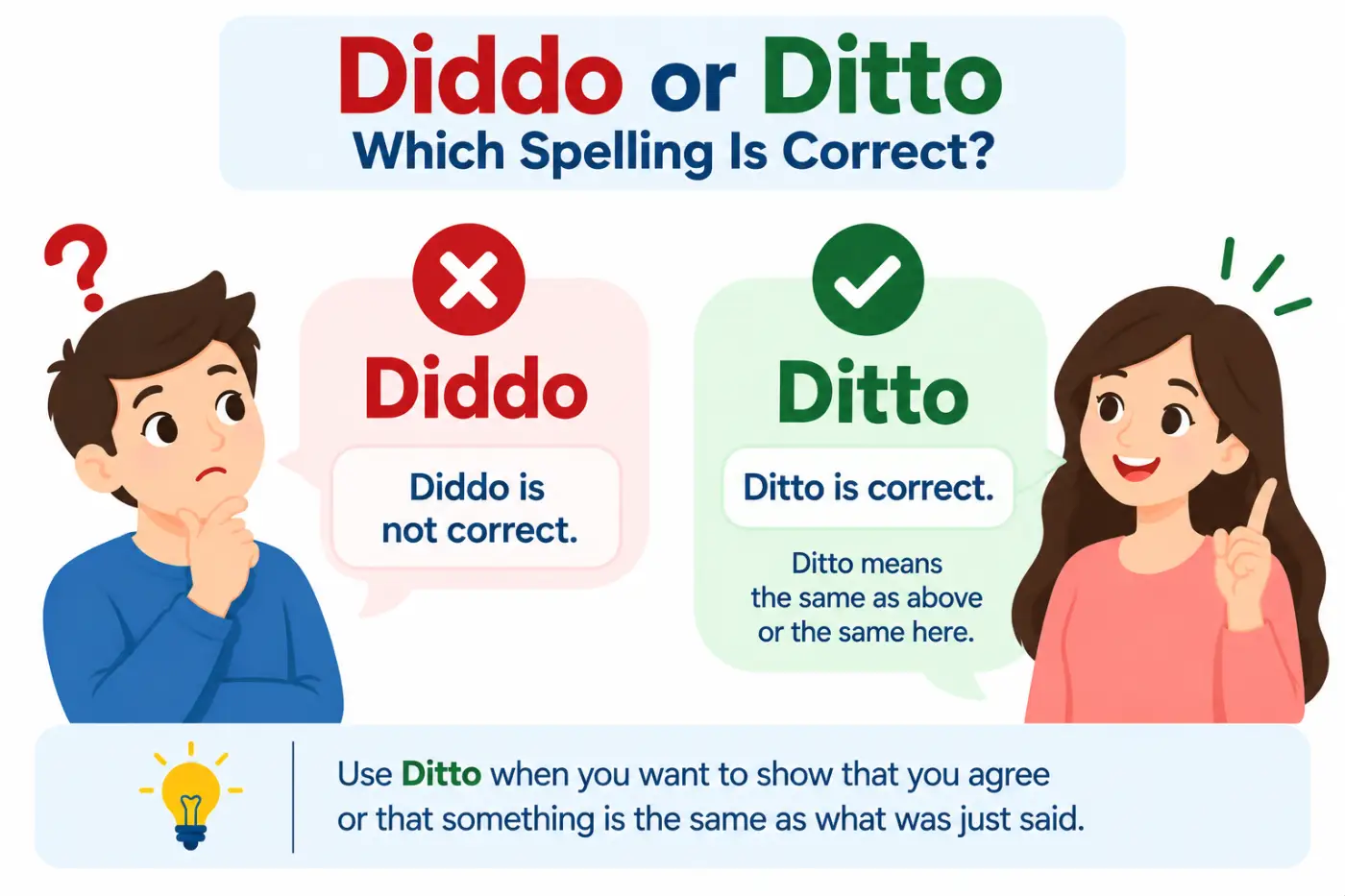
Diddo or ditto can be confusing because the two forms sound very similar when spoken quickly. The correct standard spelling is ditto. Diddo is generally a misspelling that comes from writing the word the way it may sound in casual speech. If you’re trying to say that you agree with someone or that the same thing applies to you then ditto is the word you want.
The confusion makes sense. English spelling often doesn’t match pronunciation perfectly and the middle consonant in ditto can sound softer in fast speech. People may also associate the word with phrases they’ve heard without ever seeing it written down. That can lead to a spelling based on sound instead of the established written form.
In this guide you’ll learn what ditto means how it works grammatically how Americans commonly use it how to pronounce it and where it came from. You’ll also see natural examples common mistakes related expressions and practical editing advice so you can recognize the correct form instantly.
Quick Definition
Ditto is the standard English spelling. It can mean the same as something previously mentioned and is also used informally to express agreement with another person. Diddo is not the standard spelling of this word. It usually appears as a phonetic spelling mistake.
Quick Answer
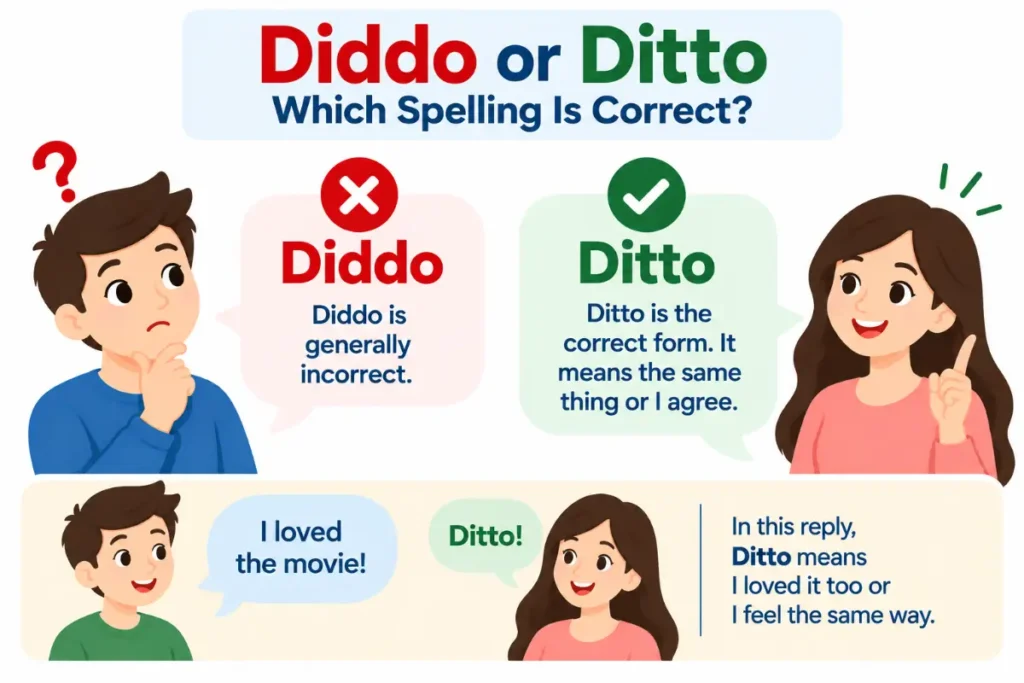
The correct form is ditto. The spelling diddo is generally incorrect when you mean the same thing or I agree. Ditto works as a noun and as an informal conversational expression. For example someone might say I loved the movie and another person could reply Ditto. In that reply the speaker means I loved it too or I feel the same way.
Comparison Table
| Correct Form | Meaning | Part of Speech | Origin | Usage Frequency | Formality | Common Contexts | Example |
|---|---|---|---|---|---|---|---|
| Ditto | The same thing or the same as previously stated | Noun and informal conversational expression | Italian ditto meaning said or mentioned | Common | Neutral to informal | Conversation writing notes agreement repeated information | I feel the same way. Ditto. |
| Diddo | No standard meaning as the spelling of this expression | Nonstandard spelling | Usually a phonetic misspelling of ditto | Uncommon | Nonstandard | Typing mistakes informal messages mistaken spellings | Diddo should normally be changed to ditto. |
Meaning and Definition
Meaning of Diddo
Diddo is generally not the standard English spelling of the word people intend when they write it to mean the same thing or I agree.
You may still encounter it online or in informal messages. That doesn’t make it an accepted spelling. People often create spellings from the way words sound and this is a classic example of that process.
The spelling problem is easy to understand. When someone hears ditto in quick conversation the first consonant in the second syllable may not sound as sharply distinct as it looks in writing. A person who relies on sound alone can therefore type diddo.
For standard English writing the safer choice is simple. Use ditto.
There can be unusual situations where Diddo appears as a name or other proper label. A proper name follows the conventions of the person or organization using it. That special possibility doesn’t change the normal English spelling of the word.
Meaning of Ditto
Ditto has a simple core meaning. It means the same thing as something already mentioned.
Imagine that two friends are talking about a restaurant.
The first person says I love the pasta there.
The second person says Ditto.
The second speaker is saying that they also love the pasta. The short response avoids repeating the entire statement.
The word can also refer to an exact copy or repetition. For example a person might say The second report is basically a ditto of the first one. This use is less common in everyday conversation but it reflects the word’s broader idea of repetition or sameness.
Another familiar use appears in written lists or notes. Historically ditto could indicate that the same information from the line above should be repeated. This helped people avoid writing the same word or phrase again and again.
In modern speech the agreement use is especially recognizable. If someone says I’m tired and you answer Ditto you’re saying that you’re tired too.
The word is short but expressive. It saves you from repeating information while still making your meaning clear.
Key Differences Explained
- Spelling. Ditto is the standard spelling. Diddo is generally a misspelling.
- Meaning. Ditto means the same thing or the same as something already stated. Diddo doesn’t have a standard meaning in this context.
- Grammar. Ditto can function as a noun and can also appear independently as an informal response.
- Pronunciation. Ditto is commonly pronounced with a short i sound followed by a t sound and a long o sound. Casual speech can make the middle sound less distinct.
- Formality. Ditto is perfectly understandable but its use as a one word response tends to feel conversational. In formal writing a clearer phrase such as the same applies or likewise may fit better.
- Context. You’ll often see ditto in conversations messages humorous writing informal commentary and situations where repetition needs to be avoided.
- Regional usage. The standard spelling remains ditto across major varieties of English.
- Standard usage. If you mean the same thing or I agree then ditto is the established spelling to choose.
The difference is therefore not a case of two competing English words with separate meanings. It is mainly a standard spelling versus a common phonetic mistake.
Which Form Is Correct?
Ditto is the correct form for standard English.
The word entered English from Italian. Its history helps explain why its spelling may look slightly unusual to modern English speakers. The original Italian word was ditto which carried the sense of said or mentioned and developed into a term used to indicate repetition or sameness.
Modern dictionaries treat ditto as an established English word. It isn’t simply internet slang or a recent shortcut. It has been part of English usage for centuries.
The most useful rule is also the easiest one. If you could replace the word with same or me too then ditto may be the form you need.
For example:
I want pizza tonight.
Ditto.
That short response means I want pizza too.
In a more formal sentence you might write:
The second document contains the same information as the first.
That version is clearer for formal communication because it spells out the relationship instead of relying on a conversational shortcut.
Sentence Examples
Here are ten natural examples using the standard form.
- I loved the concert last night. Ditto.
- She said she was ready to leave and I said ditto.
- He ordered the chicken, and I got ditto.
- I’m exhausted after that workout. Ditto.
- The second paragraph is almost a ditto of the first.
- The manager asked us to use the same format for the next report, so I used ditto information from the previous section.
- I feel the same way about the new policy. Ditto.
- They complained about the long wait, and several other customers said ditto.
- If you want another cup of coffee, ditto.
- The later version repeats much of the earlier material almost word for word, making it little more than a ditto.
Here are five examples showing the common misspelling. These examples are included only to make the error easy to recognize.
- I agree with you. Diddo is incorrect here.
- She wrote diddo instead of the standard spelling.
- The message contained the misspelling diddo.
- He typed diddo because he remembered the sound but not the spelling.
- If your draft contains diddo in this sense, replace it with ditto.
Common Mistakes and Misspellings
Several mistakes can surround this word. Some involve spelling while others involve using the expression in a context where a clearer phrase would work better.
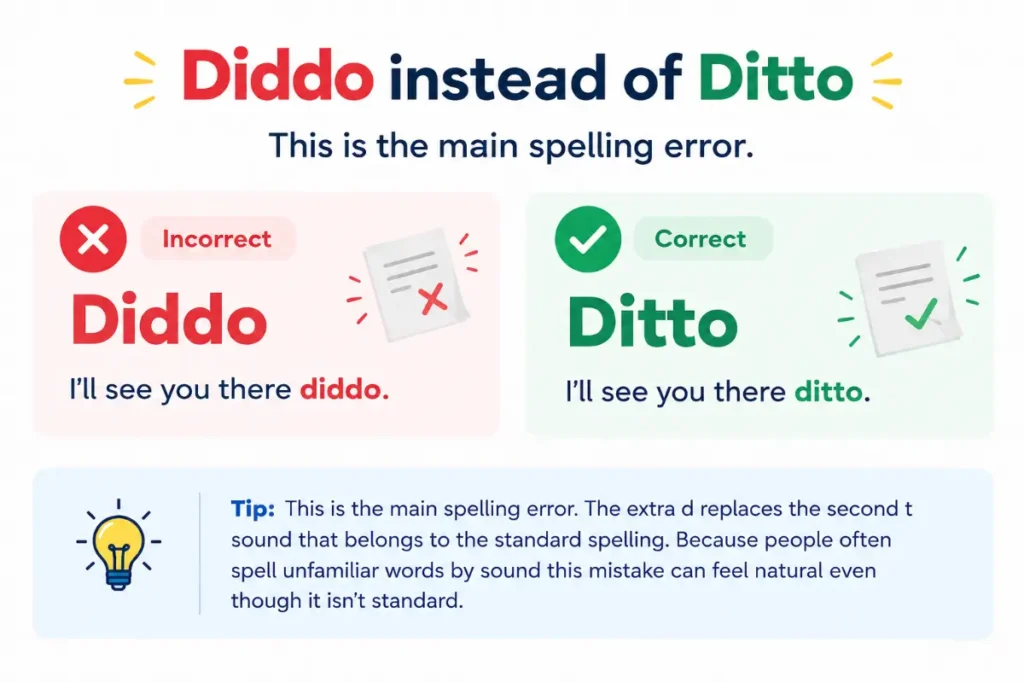
- Diddo instead of ditto. This is the main spelling error. The extra d replaces the second t sound that belongs to the standard spelling. Because people often spell unfamiliar words by sound this mistake can feel natural even though it isn’t standard.
- Dittoed instead of dittoed with confusion about the base. The verb form exists in informal usage and means copied or repeated. Writers sometimes become unsure about how to build related forms because ditto doesn’t look like an ordinary English base word.
- Using ditto when the reader needs specific information. A short response such as ditto works well in conversation but can become vague in formal writing. If a report says the second section has ditto without explaining what is repeated the reader may have to search backward for the reference.
- Assuming ditto always means agreement. The agreement sense is common but not the only meaning. The word can also indicate repetition or something that matches an earlier item.
- Treating diddo as an alternative spelling. This is the biggest conceptual mistake. The fact that people use a spelling online doesn’t automatically make it a standard English variant.
NLP systems can recognize spelling variation from context. A search engine may understand that someone typing diddo intended ditto. That kind of contextual correction helps users find information but it doesn’t change the standard spelling itself.
Pronunciation Guide
Ditto is commonly pronounced /ˈdɪtoʊ/ in American English.
You can divide it into two syllables:
DIT oh
The stress falls on the first syllable.
The first part has the short i sound found in words such as sit and bit. The second part has the long o sound found in go and so.
Say it naturally as:
DIT oh
The most common pronunciation issue isn’t usually a major sound error. Instead the problem comes from connecting the spoken sound with the written form. In quick speech the two t sounds can blend slightly and the word may sound less sharply articulated than its spelling suggests.
That can help explain why someone might hear the word and later write diddo.
A useful learning method is to connect the spelling directly to the sound:
Ditto = DIT + oh.
Don’t try to spell it from the sound alone. Learn the written form as a complete word.
Etymology and Word Origin
Ditto has an interesting history. It entered English from Italian detto and ditto forms connected with the idea of something being said or mentioned. The Italian term became associated with repeating information already given.
English adopted the word as a practical way to indicate repetition. It became especially useful in written records and lists where repeating the same information could waste space.
That historical function is closely connected to the meaning we still recognize today. When someone says ditto they’re essentially pointing back to something already stated.
Over time the word moved beyond clerical and written use and became part of everyday English. The conversational sense of using it to mean the same here or I agree became especially familiar.
This is a good example of how a word can move from a practical written function into ordinary speech. Today most people recognize ditto as a compact way to express sameness or agreement.
Regional Usage
American English
Ditto is well established in American English. You’ll hear it most often in casual conversation when someone wants to agree with a previous statement without repeating it. It also appears in writing when the writer wants to indicate repetition or similarity.
In a workplace conversation someone might say I’m concerned about the deadline. Another person can answer Ditto. The meaning is immediately clear.
For formal American writing a fuller expression may be preferable when precision matters. Phrases such as the same applies or likewise can sometimes sound more polished.
British English
British English also uses ditto with essentially the same spelling and meanings. There isn’t a major British spelling alternative for the word.
British speakers can use it as an informal agreement response or as a reference to repetition. The context determines the tone.
Australian English
Australian English follows the same standard spelling. Ditto can appear in casual conversation and informal writing. Its meaning remains closely tied to sameness repetition and agreement.
There’s no established Australian spelling that replaces ditto with diddo.
Canadian English
Canadian English also uses ditto as the standard form. The word has the same basic meanings found in American and British English.
Regional pronunciation can vary slightly across speakers but the spelling remains stable. Diddo is still best treated as a misspelling when it is intended to represent the standard word.
Grammar Rules and Part of Speech
Ditto has more than one grammatical role.
It can work as a noun when it refers to a duplicate or something that repeats what came before.
For example:
The second paragraph is a ditto of the first.
Here the word acts as a noun. It refers to a repeated version.
It can also function as an informal response that means the same applies to me.
For example:
I’m ready to go.
Ditto.
In this use it behaves more like a standalone conversational expression. You don’t need to attach it to a full sentence for the meaning to work.
The word can also appear in phrases that describe repetition.
For example:
The same mistake appeared again and again with little change from one version to the next. It was almost a ditto of the original.
The exact grammar depends on how the speaker uses the word.
Punctuation With Ditto
When ditto appears as a one word response it may stand alone.
I loved the show.
Ditto.
In dialogue you can also write:
I loved the show too.
Ditto.
In formal writing it’s usually better to spell out the intended relationship if there’s any chance of confusion.
Instead of:
The second result was ditto.
You could write:
The second result was the same as the first.
That version gives the reader more information.
Formal and Informal Usage
Ditto is widely understood but the one word response has a casual feel. It works naturally in conversation texts social media comments and friendly emails.
In academic or highly formal writing it can sometimes feel too conversational. The writer should choose the expression that gives the reader the clearest information.
For example:
The second study produced ditto results.
A clearer formal version would be:
The second study produced the same results.
The second sentence leaves less room for interpretation.
Real Life Usage Examples
Daily Conversation
Ditto appears naturally when people agree without wanting to repeat an entire sentence.
- I could eat something right now. Ditto.
- That was the best part of the trip. Ditto for me.
The first example is especially casual. The second makes the meaning explicit while still keeping the tone relaxed.
Email and Workplace Communication
You may see the word in friendly workplace communication.
- I’m available after three. Ditto.
- The client wants the revised draft by Friday. Ditto for our team.
Still, workplace writing often benefits from clarity. If the message will become part of a formal record it may be better to write exactly what you mean instead of relying on a short reference word.
Academic Writing
Ditto is less common in formal academic prose. Writers normally choose precise language such as similarly the same pattern or the same result.
An informal research note might say:
- The second experiment produced ditto results.
- The later observation showed a ditto pattern.
A polished academic version would usually replace ditto with a more specific phrase. Academic readers shouldn’t have to guess what information is being repeated.
News and Journalism
Journalistic writing can use ditto when the tone permits it but direct wording is usually stronger.
- Several residents praised the decision. Others offered a ditto response.
- The second proposal followed a pattern that was nearly a ditto of the first.
These uses work best when the writer wants a conversational or slightly playful tone.
Literature and Storytelling
Authors can use ditto to reveal personality. A character who responds with Ditto may sound casual impatient humorous or deliberately brief.
- I never want to come back here again. Ditto, he replied.
- She said the town felt strangely quiet. Ditto was his immediate response.
In storytelling the word can do more than express meaning. It can also show how a character talks.
Related and Confused Terms
Understanding nearby words makes it easier to choose the right expression.
- Same. This is the simplest related term. If someone says I want coffee and you say Same you’re expressing a similar idea to ditto.
- Likewise. This means similarly or in the same way. It can sound more polished and works better than a casual one word response in some formal settings.
- Me too. This is one of the clearest conversational alternatives. It directly tells the listener that you share the same feeling or preference.
- Same here. This is common in American conversation. It means the same thing applies to the speaker.
- Similarly. This is more suitable for formal or academic writing. It signals that two situations share an important feature.
- Identical. This describes things that are exactly the same. It is stronger than ditto when used to describe similarity.
- Duplicate. A duplicate is another copy of something. This word focuses on copying rather than agreement.
- Likewise. This can express agreement or a matching response. It often sounds slightly more formal than ditto.
These expressions overlap but they aren’t interchangeable in every sentence. The best choice depends on the relationship between the two ideas and the tone you want.
Why The Misspelling Happens
The spelling error has a straightforward explanation. People often use phonological information when spelling unfamiliar words. In other words they hear a sound and try to map that sound onto letters.
That strategy works surprisingly well for some English words. It fails for others because English spelling preserves historical patterns that pronunciation doesn’t always reveal.
Ditto is short enough that a person may assume the spelling is obvious. Yet the repeated t pattern can become less noticeable in casual speech. Someone who has mostly heard the word rather than read it may therefore produce a spelling such as diddo.
There’s also a memory effect. If you’ve seen an incorrect spelling several times online your brain may begin to treat it as visually familiar. Familiarity and correctness aren’t the same thing.
This is why proofreading should focus on established word forms rather than simply asking if a spelling looks familiar.
How To Remember The Correct Spelling
A simple memory trick can make the spelling stick.
Think:
ditto has two t letters.
The word starts with dit and then moves into to. You can picture it as:
dit + to = ditto.
Another useful trick is to connect the word with its meaning of repetition. The repeated t letters can serve as a small visual reminder that the word itself refers to something being repeated.
You don’t need a complicated spelling rule. You just need a stable visual pattern.
If you’re writing quickly and suddenly hesitate between the two forms ask yourself what word you’d see in a dictionary. The standard answer is ditto.
Is Ditto Appropriate In Formal Writing?
It depends on the sentence and the level of formality.
The word itself is legitimate English and doesn’t become incorrect just because it can sound casual. The issue is usually clarity and tone.
In a formal report you might write:
The second group produced the same result.
That is direct and precise.
In a friendly email you might write:
I’m available Friday afternoon.
Ditto.
That sounds natural in a casual exchange but would probably feel too relaxed in a formal report.
Professional editing is often less about labeling words as good or bad and more about matching language to the reader and purpose. Ditto is a useful word. You simply need to know when its compact conversational style helps and when a fuller expression communicates better.
Expert Editor Insight
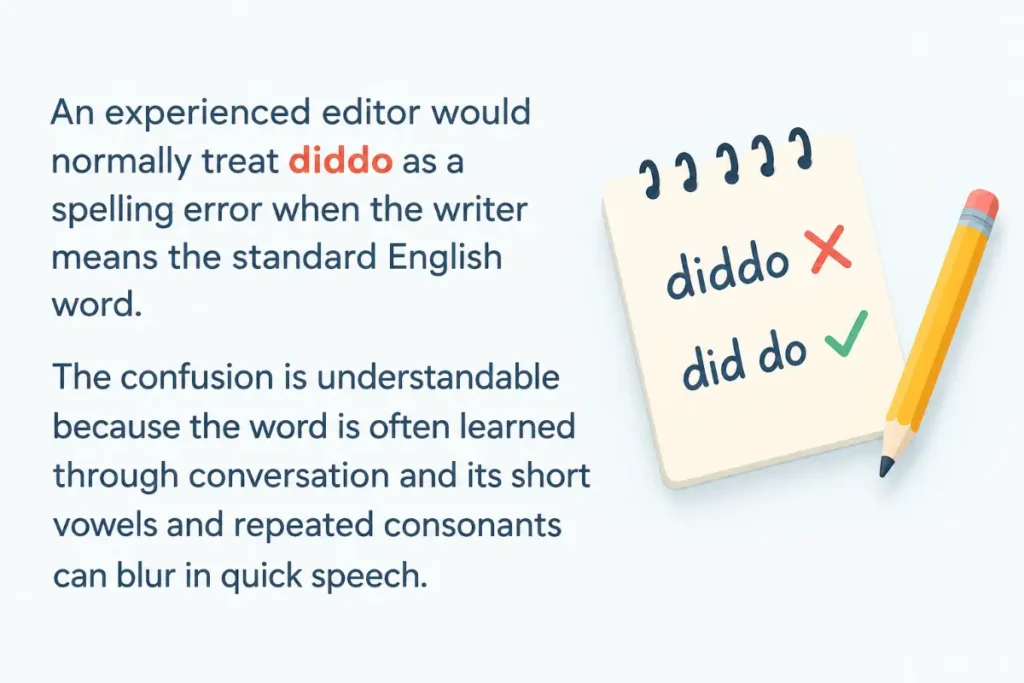
An experienced editor would normally treat diddo as a spelling error when the writer means the standard English word. The confusion is understandable because the word is often learned through conversation and its short vowels and repeated consonants can blur in quick speech. Editors also look beyond spelling. If ditto appears in formal prose they ask if the reference is clear enough for the reader. Spellcheck tools usually flag the nonstandard spelling while recognizing ditto as an established word. A useful editing habit is to read the sentence for meaning first and then check the spelling against the standard form.
Conclusion
Diddo or ditto has a clear answer. Ditto is the standard spelling when you mean the same thing or you want to express agreement with something someone has just said. Diddo is generally a spelling mistake rather than a recognized alternative form.
The word can work as a noun and as a short conversational response. You’ll often hear it in everyday American English when someone wants to say me too without repeating the whole statement. It can also describe repetition or a copy of earlier information.
For an easy memory trick remember the two t letters in ditto. If you mean the same thing think ditto. That small visual cue can save you from making the same spelling mistake in future writing.
FAQs
Is diddo a real word?
Diddo is generally not the standard spelling of the English word used to mean the same thing or I agree. It commonly appears as a phonetic misspelling of ditto. A proper name or specialized label could use a similar spelling for its own reasons but that doesn’t make it a standard alternative for ordinary English. In normal writing choose ditto.
What does ditto mean?
Ditto means the same thing as something previously mentioned. It can also work as an informal response meaning I agree or the same applies to me. For example if someone says I’m ready to leave and you reply Ditto you’re saying that you’re ready too. The word can also refer to something that repeats or copies earlier information.
Which is correct diddo or ditto?
Ditto is the standard spelling. Diddo is generally a misspelling created by writing the word according to how it may sound in casual speech. The correct form contains two t letters. If you’re writing an email article school assignment report or other standard English text and you mean the same thing use ditto.
How do you pronounce ditto?
Ditto is commonly pronounced /ˈdɪtoʊ/ in American English. It has two syllables and the stress falls on the first one. An easy pronunciation guide is DIT oh. The first syllable has the short i sound found in sit. The second syllable sounds like oh. Fast speech can make the middle consonants less distinct.
Can ditto be used by itself?
Yes. Ditto can stand alone as an informal conversational response. If someone says I’m tired you can answer Ditto to mean I’m tired too. This use is especially common in casual conversation and messages. In formal writing a complete phrase such as I agree or the same applies may provide more clarity.
What is a synonym for ditto?
Useful alternatives include same me too same here likewise similarly and the same applies. The best choice depends on context. Same and me too sound very conversational. Likewise can work in both casual and formal settings. Similarly is more common in formal writing. The phrase the same applies is especially clear when precision matters.
Why do people confuse the spelling?
People often confuse the spelling because they learn the word from speech. The sounds in casual conversation can make the two t letters less noticeable. Someone who hasn’t often seen the word written may try to spell it phonetically and produce diddo. Repeated exposure to the misspelling online can also make the incorrect form look familiar.
Is ditto appropriate in formal writing?
Ditto is a legitimate English word but its suitability depends on the context. The informal response Ditto can sound too casual for academic papers formal reports or official documents. In those settings phrases such as the same applies similarly or the same result may communicate the idea more precisely. In less formal professional communication the word can be perfectly natural.
