
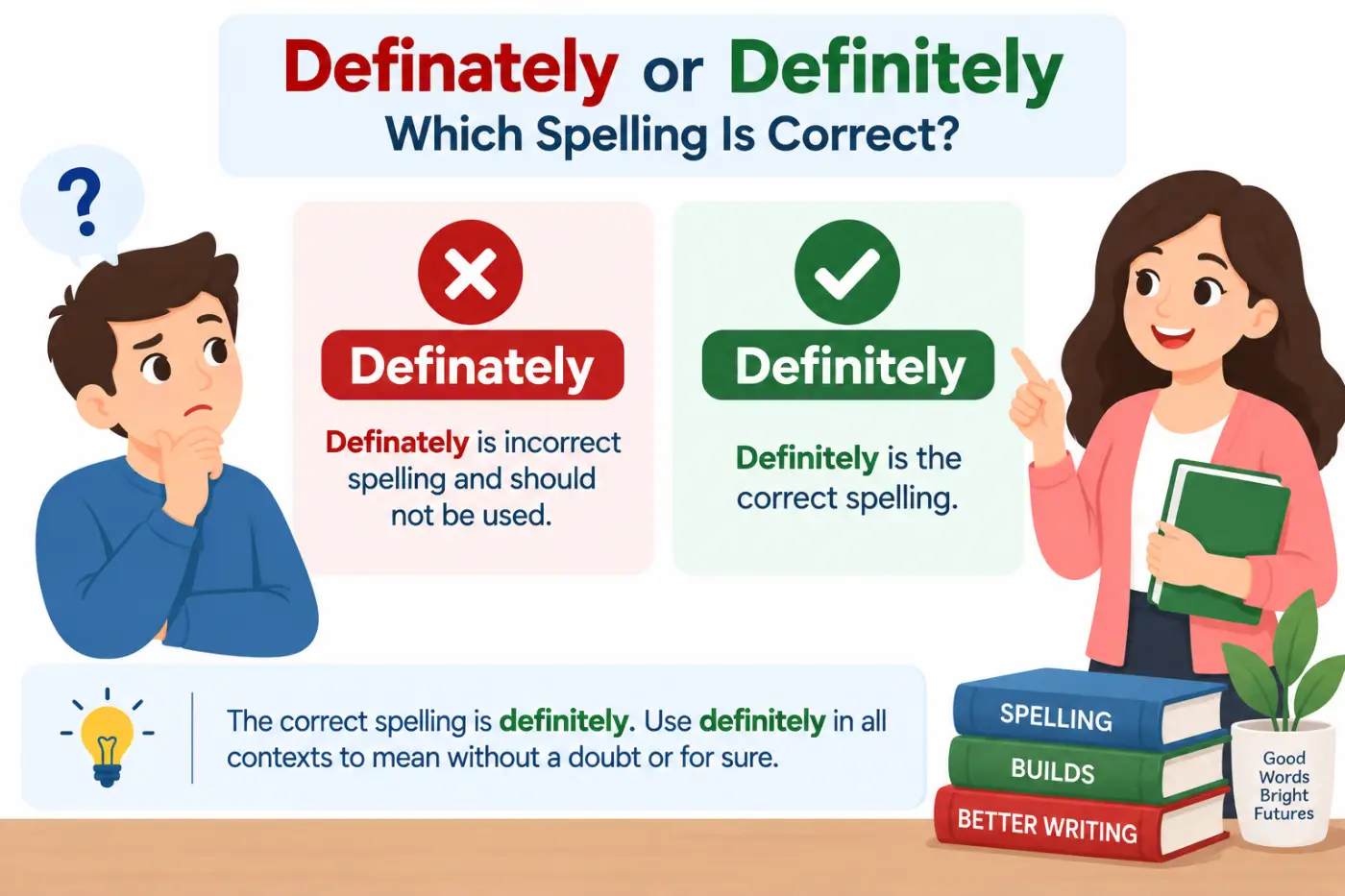
definately or definitely can cause a surprisingly common spelling problem. The correct spelling is definitely. Definately is a misspelling and isn’t the standard form used in edited English. The mistake usually happens because the word is pronounced in a way that makes its written vowels less obvious.
If you’ve ever typed the word quickly and stopped to wonder about the spelling you’re not alone. Definitely has several vowels in a row and its connection to the word definite can be easy to overlook. Once you recognize that connection the spelling becomes much easier to remember. The word itself is an adverb that means certainly or without doubt. It can also add strong agreement to a statement.
This guide explains the difference between the two forms in plain English. You’ll learn the correct spelling the meaning pronunciation grammar word history common mistakes regional usage related expressions and natural examples. You’ll also get a simple editing trick that can help you avoid the mistake the next time you write the word.
Quick Definition
Definitely is the standard English spelling of an adverb meaning certainly or without doubt. Definately is a common misspelling created by changing the vowel pattern in the middle of the word. The correct form comes from definite and keeps the middle sequence that many writers accidentally alter when spelling from memory.
Quick Answer
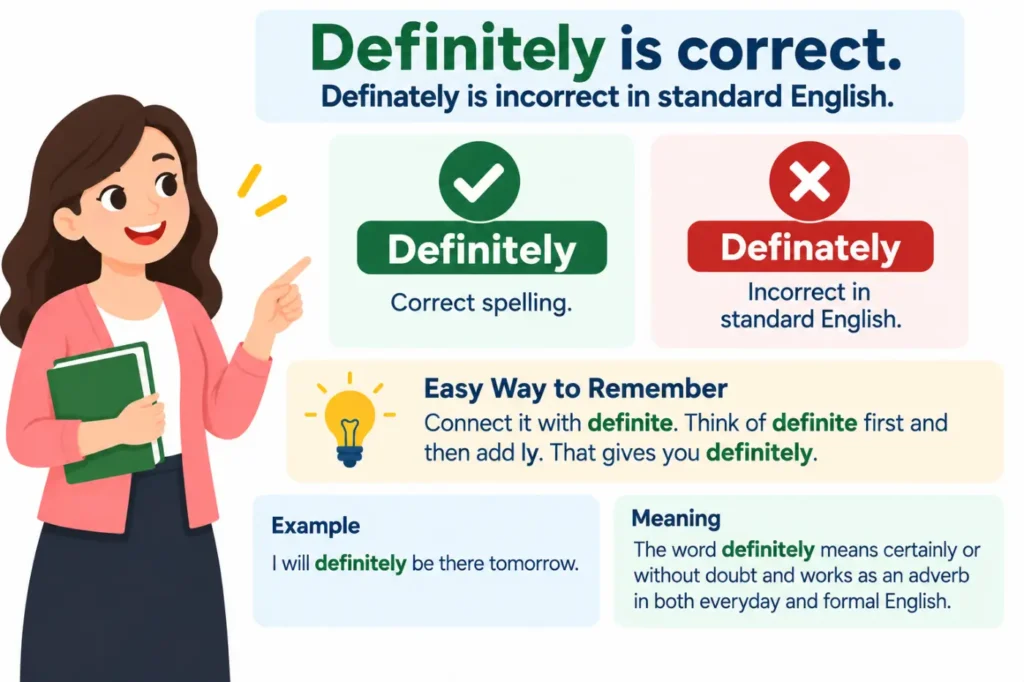
Definitely is correct. Definately is incorrect in standard English. The easiest way to remember the spelling is to connect it with definite. Think of definite first and then add ly. That gives you definitely. The word means certainly or without doubt and works as an adverb in both everyday and formal English.
Comparison Table
| Correct Form | Meaning | Part of Speech | Origin | Usage Frequency | Formality | Common Contexts | Example |
|---|---|---|---|---|---|---|---|
| Definitely | Certainly or without doubt | Adverb | From Latin through French and English | Very common | Neutral and formal | Conversation email school work reports articles | I will definitely call you tomorrow. |
| Definately | No standard English meaning | Nonstandard misspelling | Incorrect spelling of definitely | Common as an error | Not appropriate in edited writing | Typing mistakes informal posts drafts | I will definately call you tomorrow. |
Meaning and Definition
Meaning of the Incorrect Form
Definately is not the standard spelling of an English word. In most situations it is simply a spelling mistake for definitely. You may see it in text messages social media comments online discussions school drafts and quickly written emails. Its frequent appearance can make it look familiar. Familiarity doesn’t make a spelling standard.
This distinction matters because English contains many genuine spelling variants. Some differences are tied to regional usage. Others reflect changes in historical spelling. This isn’t one of those cases. Definately isn’t an accepted American or British alternative to the standard form. The main error occurs in the middle of the word. Writers often replace the vowel pattern found in definite with an easier pattern based on pronunciation or memory.
For example:
- I will definitely attend the meeting.
- I will definately attend the meeting.
The first sentence uses the standard spelling. The second contains a common spelling error.
Meaning of the Correct Form
Definitely is an adverb. Its central meaning is certainly or without doubt.
Consider this sentence:
I definitely want to go.
The speaker isn’t expressing uncertainty. The word adds strong confidence to the statement.
It can also confirm an answer.
Yes I definitely agree with you.
Here the adverb strengthens the speaker’s agreement.
The word can describe a firm intention too.
She definitely plans to apply for the position.
In everyday American English definitely is common and natural. It doesn’t sound overly formal. You can use it with friends coworkers teachers customers and readers in many different settings.
The word can also appear in more formal writing.
The evidence definitely supports the conclusion.
In this example the writer expresses strong confidence in the relationship between the evidence and the conclusion.
Although definitely expresses certainty it doesn’t always mean absolute proof. Context matters. A person can say I definitely think this is the best option while still expressing a personal judgment rather than a mathematical fact.
Key Differences Explained
- Spelling. Definitely is the standard spelling. Definately contains an incorrect vowel sequence.
- Meaning. Definitely means certainly or without doubt. Definately has no separate standard meaning.
- Grammar. Definitely is an adverb. It can modify a verb adjective another adverb or an entire statement.
- Pronunciation. The spoken form can make the spelling harder to remember because some unstressed sounds become less distinct in normal speech.
- Formality. Definitely works in casual conversation and formal writing. The incorrect spelling should be corrected in edited material.
- Context. You can use the standard form in texts emails essays reports articles conversations and professional communication.
- Regional usage. American British Canadian and Australian English all use definitely as the standard spelling.
- Word family. Definitely is closely connected to definite and definition. This word family provides the strongest spelling clue.
Which Form Is Correct
Definitely is the correct form in standard English. Definately is a misspelling.
The most useful linguistic clue comes from the base adjective definite. When English forms the adverb definitely from definite the spelling preserves the connection to the base word.
Compare these forms:
Definite.
Definitely.
Definition.
Definitive.
Definitively.
They all belong to the same word family and share the spelling pattern built around definit.
This gives you a practical way to check your spelling without relying only on memory.
Major English dictionaries recognize definitely as the standard adverb. Dictionary based spelling guidance also treats the single a version as an error rather than a competing English form.
One common mistake is to remember the pronunciation rather than the written structure. English pronunciation often reduces unstressed vowels. That means the sound you hear isn’t always enough to reconstruct the spelling.
A better strategy is to remember the family.
Definite becomes definitely.
Once that pattern becomes familiar the spelling is much harder to lose.
Sentence Examples
The word fits naturally into many types of sentences.
- I definitely want to see that movie this weekend.
- She definitely knows how to solve the problem.
- We will definitely need more time to finish the project.
- He definitely made the right decision.
- You should definitely try the new restaurant downtown.
- I definitely remember meeting her at the conference.
- The team will definitely benefit from the extra training.
- This is definitely one of the best books I’ve read this year.
- They definitely deserve another chance.
- I definitely agree with your suggestion.
The following examples show the common spelling mistake. These are useful for recognition but should not be copied into standard writing.
- I definately want to come with you.
- She definately knows the answer.
- We definately need another meeting.
- He definately made the right choice.
- They definately enjoyed the event.
In every case the incorrect form should be replaced with definitely.
Common Mistakes and Misspellings
Definately
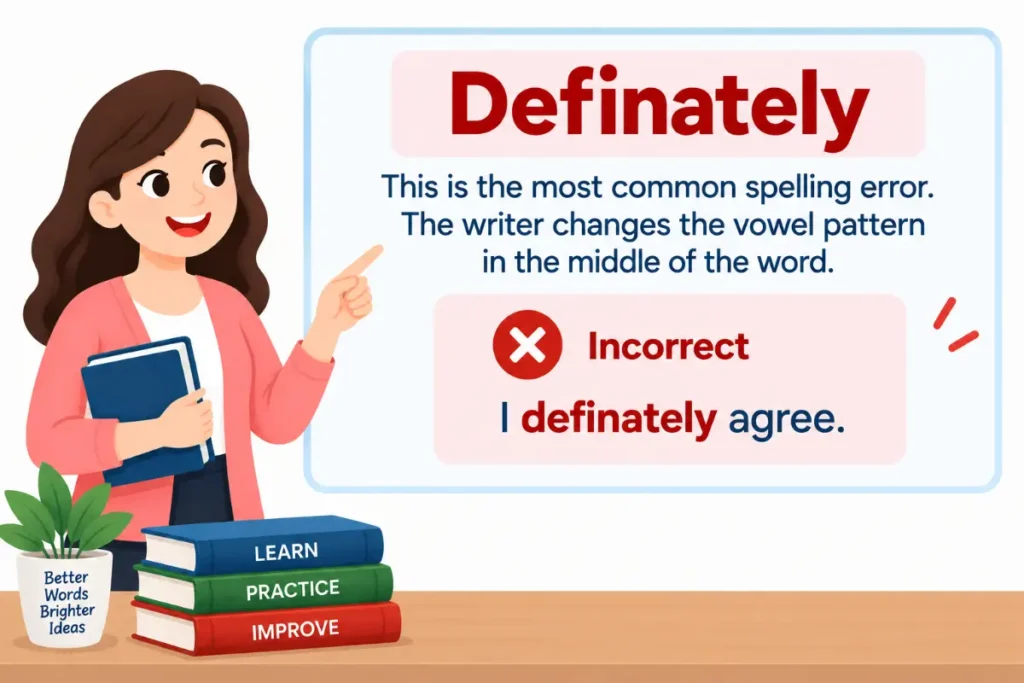
This is the most common spelling error. The writer changes the vowel pattern in the middle of the word.
Incorrect:
I definately agree.
Correct:
I definitely agree.
The error often comes from spelling the word according to how it sounds rather than how its related word is written.
Definatly
Some writers remove the vowel before the final ly ending.
Incorrect:
I will definatly attend.
Correct:
I will definitely attend.
This version can appear during fast typing because the writer mentally jumps from definit to ly.
Definitly
This spelling stays closer to the correct form but drops one vowel.
Incorrect:
She definitly wants to go.
Correct:
She definitely wants to go.
The word contains more written information than its fast spoken form suggests. That can make this omission tempting.
Definatelyy
An extra y can appear when someone types quickly or edits the ending repeatedly.
Incorrect:
I definatelyy agree.
Correct:
I definitely agree.
This is clearly a typing error rather than a competing spelling.
Definitelly
Some writers add an extra l because they associate the ending with other adverbs.
Incorrect:
He definitelly understands.
Correct:
He definitely understands.
English spelling patterns can encourage this kind of visual confusion. The safest approach is still to connect the adverb with definite.
Why People Misspell The Word
The mistake has several practical causes.
First the word is long enough to create memory pressure. When a word contains several syllables writers are more likely to reconstruct it from sound instead of recalling every letter.
Second pronunciation doesn’t provide a perfect spelling guide. In natural speech unstressed vowels may become weaker. A person can know the word perfectly well and still hesitate when writing it.
Third the word contains a familiar ending. Many English adverbs end in ly. Writers may focus on getting the beginning and ending right while losing one of the vowels in the middle.
Fourth people often encounter the misspelling online. Repeated exposure can create a false sense that a nonstandard form looks normal.
This is where pattern recognition helps. Your brain doesn’t read every familiar word letter by letter. It often recognizes the overall shape. A common misspelling can therefore pass unnoticed during quick reading.
Professional proofreading slows that process down. An editor checks the internal structure of a word rather than trusting visual familiarity.
Pronunciation Guide
The standard pronunciation is commonly represented in American English as:
/ˈdɛfənətli/
You can think of the word as several sound groups:
DEF uh nit lee
The strongest stress falls near the beginning of the word.
The pronunciation may vary slightly among speakers. In fast speech some middle sounds become less distinct. That’s normal. The important point is that pronunciation doesn’t clearly reveal every letter used in the written form.
A common learner mistake is to pronounce every written vowel with equal strength. English doesn’t work that way. Unstressed syllables often become shorter and weaker.
Another mistake is assuming that the spelling should match the spoken rhythm exactly. That approach can lead directly to forms such as definately.
Instead learn the sound and spelling together.
Say:
Definitely.
Then connect it with:
Definite plus ly.
That combination gives you both the pronunciation and the written pattern.
Etymology and Word Origin
The history of definitely helps explain its relationship to other words in the same family.
The deeper root comes from Latin definire which carried the idea of limiting defining or setting boundaries. Latin definitus developed from this root and contributed to later forms connected with something clearly defined or settled.
English received related vocabulary through French and later developed its own forms. The adjective definite came into English with the sense of clearly defined or certain. The adverb definitely developed from that adjective.
The modern word therefore belongs to a larger family that includes definite definition definitive and definitively.
This history is useful for spelling because the family shares a recognizable core.
definit
Once you see that core the middle of the adverb becomes less mysterious.
The word isn’t built from the sound people sometimes hear in casual speech. Its spelling reflects its relationship to the adjective definite.
That is why remembering the base word works so well.
Regional Usage
American English
American English uses definitely as the standard spelling. The word is extremely common in everyday speech and writing. People use it to express certainty agreement or strong intention.
For example:
I definitely want to go.
I’ll definitely send it tonight.
The misspelled form may appear in casual online communication but it isn’t considered standard American spelling.
British English
British English also uses definitely. There is no meaningful British spelling alternative that replaces the standard form with definately.
The same word works in conversation academic writing journalism business communication and general prose.
Australian English
Australian English follows the same standard spelling. Definitely is the accepted form in normal written English.
The spelling isn’t changed because of Australian pronunciation or vocabulary. Writers who use formal or edited English should choose the standard form.
Canadian English
Canadian English also uses definitely. There isn’t a regional spelling distinction that makes definately acceptable.
Canadian writers can use definitely in casual and formal contexts just as American and British writers do.
Across these major varieties of English the standard spelling remains the same.
Grammar Rules and Part of Speech
Definitely is an adverb. Its job is to add information about certainty emphasis or the speaker’s confidence.
One common position is before the main verb.
I definitely remember him.
She definitely wants to attend.
We definitely need more information.
It can also appear after a form of the verb be.
She is definitely ready.
They are definitely prepared.
It can modify an adjective.
That is definitely possible.
It can also strengthen another adverb.
He definitely works very hard.
Finally the word can modify the whole sentence.
Definitely I would make the same choice.
This last structure is grammatical but may sound less natural in everyday American English. More natural options include:
I would definitely make the same choice.
Definitely, I would make the same choice.
Punctuation depends on placement and sentence rhythm. When definitely appears as an introductory sentence adverb a comma can make the structure clearer.
For example:
Definitely, we need more time.
Still many speakers prefer placing the word directly before the verb because it sounds smoother.
Definitely isn’t a conjunction. It doesn’t connect two independent clauses.
It also isn’t an adjective. You wouldn’t use it to describe a noun directly.
For example:
Correct: That is definitely the right answer.
Incorrect: That is a definitely answer.
The adjective you need there is definite.
This distinction between definite and definitely is worth remembering.
Definite is an adjective.
Definitely is an adverb.
Compare:
We need a definite answer.
We definitely need an answer.
The first word describes answer. The second modifies need.
Definitely In Formal Writing
Definitely is acceptable in formal writing. It isn’t limited to casual conversation.
You can use it in business emails academic prose reports essays professional correspondence and explanatory writing.
Still context matters. Strong certainty should match the evidence behind the statement.
For example:
The results definitely show that the treatment worked.
That sentence makes a strong claim. In a formal research setting the writer should make sure the available evidence supports that level of certainty.
In some academic contexts writers may choose more precise language such as clearly strongly consistently or the evidence indicates. The choice depends on the claim.
Definitely itself isn’t informal or incorrect. It simply expresses a high level of confidence.
In workplace writing it can sound perfectly natural.
I can definitely have the report ready by Friday.
In a formal report it can also work.
The findings definitely support further investigation.
The main concern isn’t the word. The main concern is using the right level of certainty for the situation.
Real Life Usage Examples
Daily Conversation
Definitely is common in ordinary speech because people often need a quick way to show agreement or certainty.
- Friend: Are you coming tonight?You: Definitely. I’ll be there.
- Friend: Should we leave early?You: Definitely. Traffic will probably be heavy.
The word sounds natural because it gives a clear confident response without requiring a long explanation.
Email and Workplace Communication
- I can definitely send you the revised document this afternoon.
- We should definitely discuss the schedule before the meeting.
In workplace communication the word can sound friendly and confident. It works especially well when you’re confirming a plan.
Academic Writing
- The results definitely suggest that the two groups responded differently.
- The historical record definitely provides evidence of continued trade between the regions.
Academic writers should use strong certainty carefully. The word is grammatically fine but the evidence should support the strength of the claim.
News and Journalism
- Officials said the decision will definitely affect the local economy.
- The new policy will definitely receive attention from business leaders.
Journalistic writing may use the word when reporting a strong prediction or statement. Writers still need to distinguish facts from opinions and predictions.
Literature and Storytelling
- She knew she would definitely remember that night.
- He had definitely made a mistake but refused to admit it.
In storytelling the word can reveal a character’s confidence. It can also strengthen the narrator’s description.
Related and Confused Terms
Definite
Definite is an adjective meaning clear certain or clearly established.
We need a definite answer.
Definitely is the related adverb.
We definitely need an answer.
Definition
Definition is a noun that explains the meaning of a word idea or concept.
The dictionary gives a clear definition.
Definitive
Definitive is an adjective describing something that settles an issue or provides a final authoritative answer.
The study provided definitive evidence.
Definitively
Definitively is an adverb meaning in a conclusive or final way.
The issue was settled definitively.
Certainly
Certainly is a close synonym. It often expresses strong agreement or confidence.
I will certainly help you.
Surely
Surely can express strong belief or expectation. Depending on context it may carry more emotion or surprise than definitely.
Surely he knows the answer.
Absolutely
Absolutely is another strong expression of agreement or certainty.
I absolutely agree.
It often sounds more emphatic in conversation.
Undoubtedly
Undoubtedly means without reasonable doubt. It tends to sound more formal than definitely.
She is undoubtedly talented.
These related words help show the semantic range around certainty. They aren’t always perfect substitutes. Good writing depends on choosing the word that matches the exact strength and tone you intend.
A Simple Memory Trick
The best spelling trick is to avoid memorizing the entire word as one long sequence.
Start with definite.
Then add ly.
That gives you:
definite + ly = definitely
You can also remember the shared spelling core.
definit
This appears in:
definite
definitely
definition
definitive
definitively
The more often you recognize this family the easier the spelling becomes.
Another useful trick is to remember that the common error changes the internal vowel pattern. If you’re unsure about the spelling stop and ask yourself which base adjective belongs with the adverb.
The answer is definite.
That gives you the correct structure.
How Spellcheck Tools Treat The Error
Most modern spelling tools recognize definitely as a standard English word. A misspelled form such as definately will commonly receive a correction suggestion.
Still spellcheck should be treated as a safety net rather than your only proofreading method.
Automated tools work by comparing text against language patterns and dictionaries. They can catch many obvious spelling errors. They don’t always understand your intended meaning or the quality of the surrounding sentence.
A good editor combines tool support with human judgment.
For this particular mistake the correction is straightforward. If the sentence needs the adverb meaning certainly then definitely is the form you want.
Expert Editor Insight
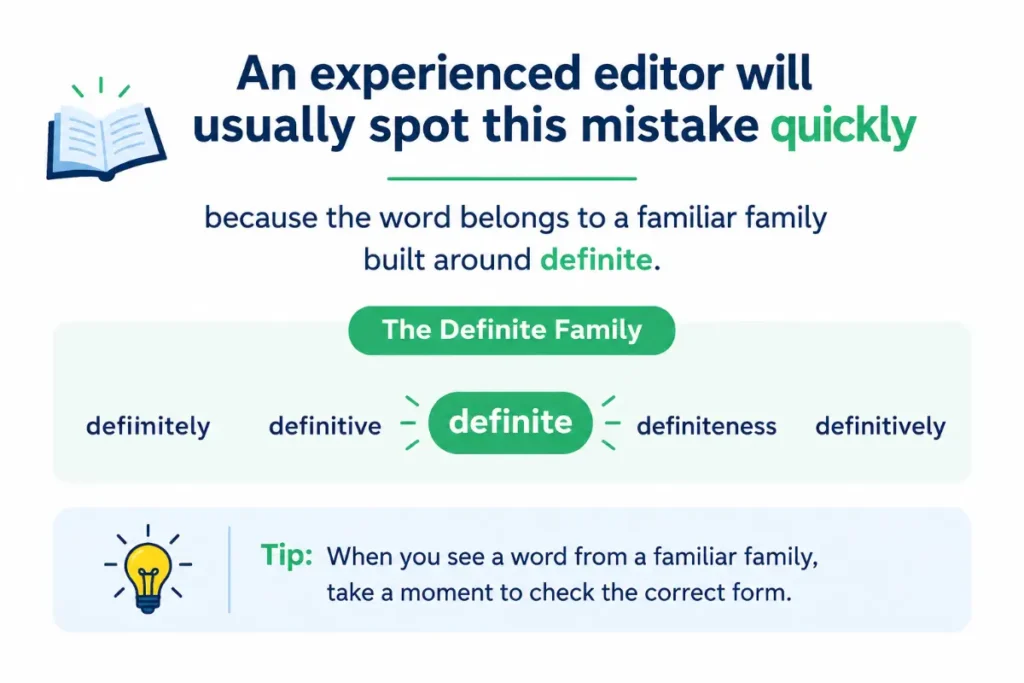
An experienced editor will usually spot this mistake quickly because the word belongs to a familiar family built around definite. The confusion survives because writers often remember the sound rather than the internal spelling pattern. My practical editing tip is to replace memory with word structure. If you hesitate over the middle of the word write definite first and then add ly. That small habit is faster and more reliable than repeatedly guessing between two spellings.
Conclusion
definately or definitely has a clear answer. Definitely is the correct spelling and definately is a common misspelling. The standard form is an adverb meaning certainly or without doubt. It works naturally in everyday speech professional communication academic writing and many other forms of English.
The spelling becomes easier once you connect the adverb with its base word definite. The shared spelling pattern also appears in related words such as definition and definitive. That connection explains why the middle of the word contains the letters that writers often leave out or replace.
For a simple editing habit write definite in your mind first and then add ly. If you remember that small pattern you’ll have a reliable way to check the spelling instead of guessing. Use definitely whenever you want to express clear confidence or certainty in standard English.
FAQs
Is definately a real word?
Definately isn’t a standard English word. It is a common misspelling of definitely. You may encounter it in informal online writing or quickly typed messages but it doesn’t function as an accepted alternative spelling in standard edited English. If you’re writing an email essay report application or professional document use definitely.
What does definitely mean?
Definitely means certainly or without doubt. It is an adverb used to show strong confidence agreement or intention. For example I definitely want to go means the speaker is sure about wanting to go. The word can appear in casual conversation as well as formal writing and is common throughout major varieties of English.
Which spelling is correct?
Definitely is the correct spelling. Definately is a common spelling error caused by changing the vowel pattern in the middle of the word. A useful memory trick is to start with the adjective definite and add ly. The resulting form is definitely. This connection also links the word to related forms such as definition and definitive.
How do you pronounce definitely?
Definitely is commonly pronounced /ˈdɛfənətli/ in American English. A simple guide is DEF uh nit lee. The strongest stress occurs near the beginning. Some middle sounds become weaker in natural speech so the pronunciation may not make every written vowel obvious. That difference between sound and spelling helps explain why the word is often misspelled.
Can definitely start a sentence?
Yes. Definitely can begin a sentence when it adds emphasis or expresses strong agreement. For example you could write Definitely, we should leave early. However many speakers place the adverb closer to the verb because that position often sounds smoother. The word can also stand alone as a response in conversation when the meaning is clearly understood.
What is a synonym for definitely?
Useful synonyms include certainly absolutely surely undoubtedly clearly and unquestionably. Each has a slightly different tone or strength. Certainly is a close everyday alternative. Absolutely can sound more emphatic. Undoubtedly tends to sound more formal. Surely can express expectation or surprise. Choose the synonym that best matches the confidence and tone of your sentence.
Why do people confuse the spelling?
People often confuse the spelling because the word is long and its pronunciation doesn’t clearly reveal every vowel. Fast typing can also cause writers to reconstruct the word from sound. Another factor is the familiar adverb ending ly. A useful solution is to remember the base adjective definite. Adding ly gives you the standard adverbial form.
Is definitely appropriate in formal writing?
Yes. Definitely is standard English and works in formal writing. You can use it in reports essays professional emails academic discussions and other edited material. The main consideration is the strength of the claim. Since the word expresses strong certainty make sure your evidence or context supports that confidence. The spelling itself isn’t a problem in formal writing.
