
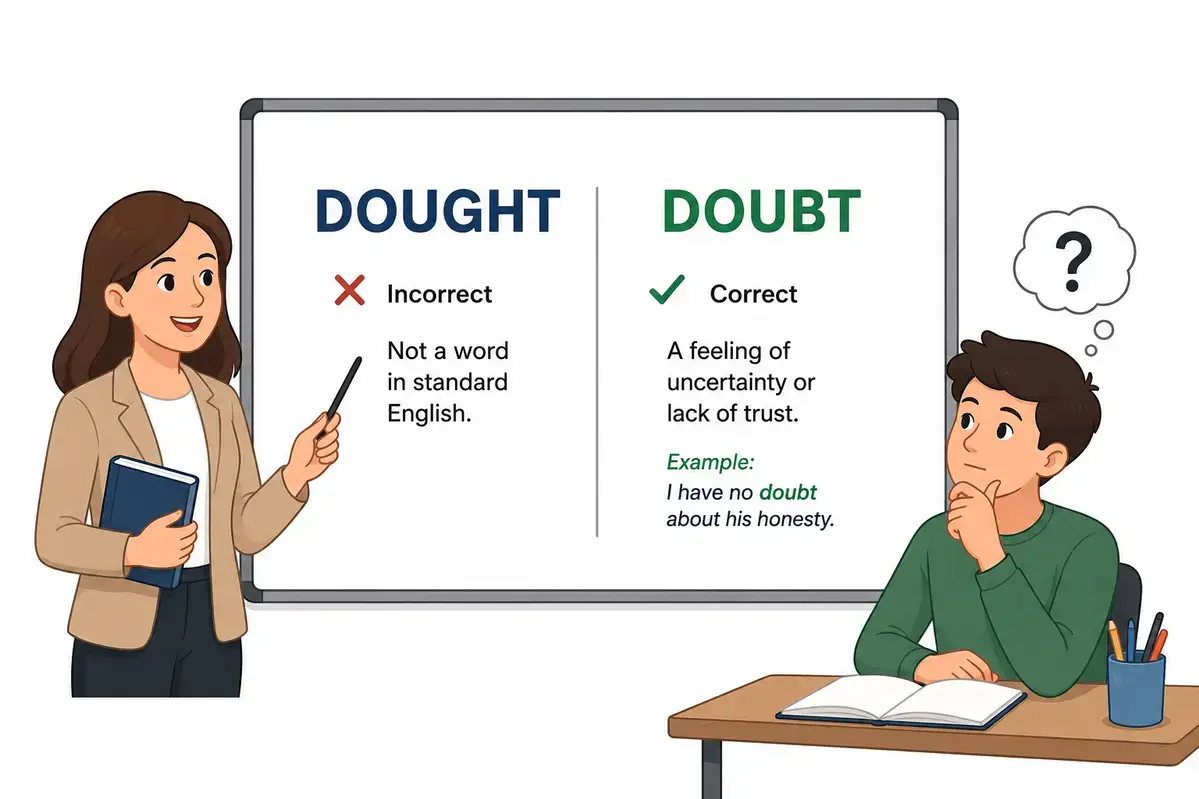
If you’re searching for dought vs doubt, you’re probably wondering which spelling is correct. The answer is simple. Doubt is the correct word when you mean uncertainty or a lack of confidence, while dought is generally a spelling mistake. The confusion often comes from the silent b in doubt because you can’t hear that letter when you say the word aloud.
Doubt can work as both a noun and a verb. You can have doubt about a claim, have doubts about a decision, or doubt that something will happen. It’s common in everyday conversation and appears just as naturally in emails, school assignments, professional writing, academic work, journalism, and other forms of standard English.
In this guide, you’ll learn why the two forms are confused, how doubt is pronounced, and how to use it correctly in different sentences. You’ll also see common spelling mistakes, grammar patterns, related words, and a simple memory trick that can help you remember the silent b whenever you write this word.
Quick Answer
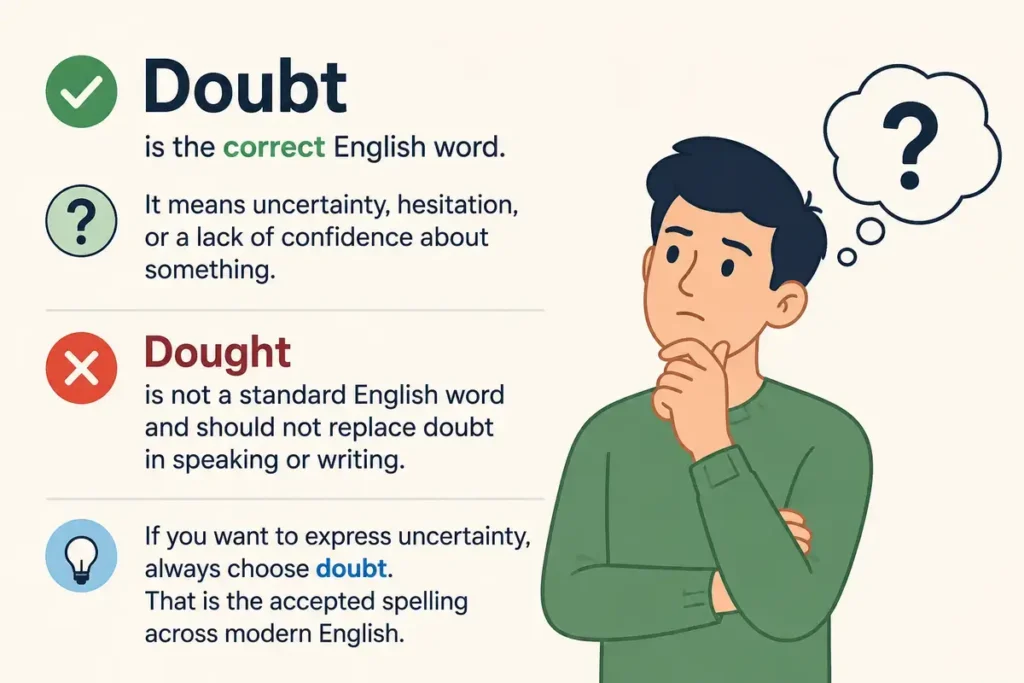
Doubt is the correct English word. Dought is not the standard spelling of the word that means uncertainty or lack of confidence in something.
The confusion usually happens because the letters in doubt do not match the way the word sounds. The b is silent so the written form can feel less obvious than the pronunciation.
Quick Definition
Doubt is a noun and verb that describes uncertainty or a lack of confidence about something. For example you can have doubt about a claim or doubt that something will happen. Dought is not the standard English form for this meaning and should be treated as a spelling mistake in normal writing.
Comparison Table
| Correct Form | Meaning | Part of Speech | Origin | Usage Frequency | Formality | Common Contexts | Example |
|---|---|---|---|---|---|---|---|
| Doubt | A feeling of uncertainty or lack of confidence | Noun and verb | From Old French and Latin roots | Very common | Neutral and formal | Conversation writing school work business journalism academic writing | I doubt that he knows the answer. |
| Dought | No standard modern English meaning for this intended use | Nonstandard form or misspelling | Not the standard form of doubt | Rare as an intended word | Not appropriate for standard writing | Typing mistakes spelling errors informal posts | Dought is usually a misspelling of doubt. |
Meaning and Definition
Meaning of Dought
Dought is not the standard modern English spelling of the word used for uncertainty.
If someone writes I have dought about the plan they almost certainly mean I have doubt about the plan. The missing b changes the spelling even though it doesn’t change the sound you hear.
You may occasionally encounter unusual forms in historical texts names or specialized contexts. Those cases depend on the source and don’t make dought a standard replacement for doubt in present day English.
For everyday writing the rule is simple. If you mean uncertainty hesitation or a lack of confidence use doubt.
This distinction matters because spelling carries meaning and helps readers recognize words quickly. A reader may understand dought from context but that doesn’t make it an accepted spelling.
Meaning of Doubt
Doubt refers to uncertainty. It can describe a feeling that makes you question something or a lack of belief that a statement or event is true.
As a noun it can describe the feeling itself.
I have some doubt about his story.
In this sentence doubt means uncertainty about whether the story is reliable.
As a verb it means to feel uncertain about something or to question its truth or likelihood.
I doubt his story.
Here the word describes the speaker’s lack of confidence in the truth of the story.
The word can also describe uncertainty about a future result.
She has doubts about getting the job.
Doubt works in everyday speech as well as formal English. You can use it in a casual conversation with a friend or in a serious academic discussion.
The word also appears in several common expressions.
No doubt means certainly or very likely.
Without a doubt means with complete confidence.
Beyond doubt means in a way that leaves no reasonable uncertainty.
There’s no doubt that practice improves your skills.
These expressions are common and useful because they show how flexible the word can be.
Key Differences Explained
- Spelling
Doubt is the standard spelling. It contains a silent b after the u. Dought leaves out that b and therefore doesn’t represent the standard written form.
- Meaning
Doubt means uncertainty or lack of confidence. The incorrect form doesn’t carry that standard meaning.
- Grammar
Doubt can function as both a noun and a verb. This gives it much more grammatical flexibility than a simple spelling label might suggest.
- Pronunciation
Doubt is pronounced without the b sound. That silent letter is one of the main reasons learners struggle with its spelling.
- Formality
Doubt is appropriate in casual speech professional writing academic work journalism and formal documents.
- Context
You can use doubt when discussing beliefs decisions claims evidence predictions or personal feelings.
- Regional usage
American British Canadian and Australian English all use doubt as the standard spelling for this meaning.
- Standard usage
Doubt is the accepted modern form. Dought should not be used as a substitute in standard English writing.
Why The Spelling Causes Confusion
The biggest problem is the silent b.
When you hear doubt you don’t hear every letter that appears on the page. The word sounds like dout. That creates a gap between pronunciation and spelling.
English has many words like this. Their spelling often preserves older forms even after pronunciation changes over time. Native speakers learn these spellings through repeated exposure while learners may try to spell the word exactly as it sounds.
That approach works for some English words but fails badly with words containing silent letters.
Doubt is especially tricky because the sequence ough appears in many English words with different pronunciations. Compare though through thought rough and cough. The same letters can behave very differently from one word to another.
That makes English spelling feel like a puzzle at times.
The good news is that you don’t need to memorize a complicated linguistic rule every time. Learn doubt as a whole word and remember that the b stays silent.
A useful memory trick is to connect doubt with doubtful. When you see doubtful you can clearly recognize the b in the middle. That can help reinforce the spelling of the shorter word.
Which Form Is Correct?
Doubt is the correct form for the standard English word meaning uncertainty or lack of confidence.
The spelling includes a silent b. That letter is part of the established modern spelling even though it doesn’t appear in pronunciation.
Standard English dictionaries list doubt as both a noun and a verb. The word has a long history in English and its modern spelling reflects its historical development rather than its present pronunciation alone.
This is a useful point for English learners. Spelling doesn’t always work as a direct sound map. Some English spellings preserve letters that became silent during language change.
That’s why writing dout or dought based on pronunciation doesn’t produce the accepted word.
If you’re proofreading an essay email report application or article and see dought used to mean uncertainty change it to doubt.
Sentence Examples
Here are natural examples that show how the standard word works in different situations.
- I have some doubt about the accuracy of that report.
- She began to doubt her decision after hearing the new information.
- There’s no doubt that he worked hard for the result.
- I doubt they’ll arrive before dinner.
- His sudden change of attitude raised doubts about his intentions.
- The evidence leaves little doubt about what happened.
- She never doubted that her team could succeed.
- If you have any doubt about the instructions ask your teacher.
- Without a doubt this was the most difficult part of the project.
- The experience made him doubt his original plan.
These examples show an important feature of the word. It can express a feeling of uncertainty as a noun or an act of questioning as a verb.
Now consider how the common spelling mistake might appear in real writing.
- I have some dought about the decision.
- I dought that he will come today.
- There is no dought that she worked hard.
- He began to dought his own ability.
- I have no dought about the answer.
Each sentence should use doubt instead.
Common Mistakes and Misspellings
Dought Instead Of Doubt
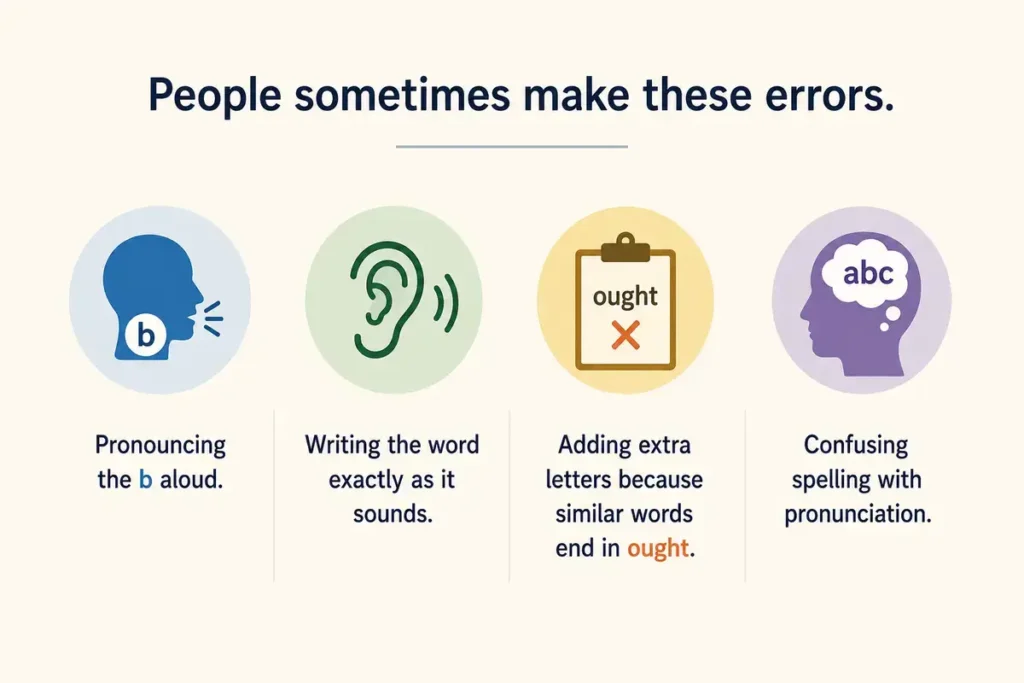
This is the main error. Writers hear the word without the b sound and spell it according to pronunciation.
Incorrect: I dought his story.
Correct: I doubt his story.
The silent b is easy to forget because it contributes nothing to the spoken form.
Dout Instead Of Doubt
Some people remove both the silent b and the unusual gh sequence and write dout.
Incorrect: I dout that she knows.
Correct: I doubt that she knows.
This spelling follows the pronunciation more closely but still isn’t standard English.
Doubtful Without The B
Learners sometimes write douhtful or doutful because the spelling pattern feels unfamiliar.
Correct: doubtful.
The relationship between doubt and doubtful is worth learning because the longer form makes the spelling pattern easier to see.
Doubting Without The Correct Base
Another common error appears when people add an ending to the word and lose track of its original spelling.
Correct forms include doubted doubtful doubting and doubts.
The silent b remains part of the spelling family.
Confusing Doubt With Similar Words
Some writers use uncertainty words interchangeably without checking the exact meaning.
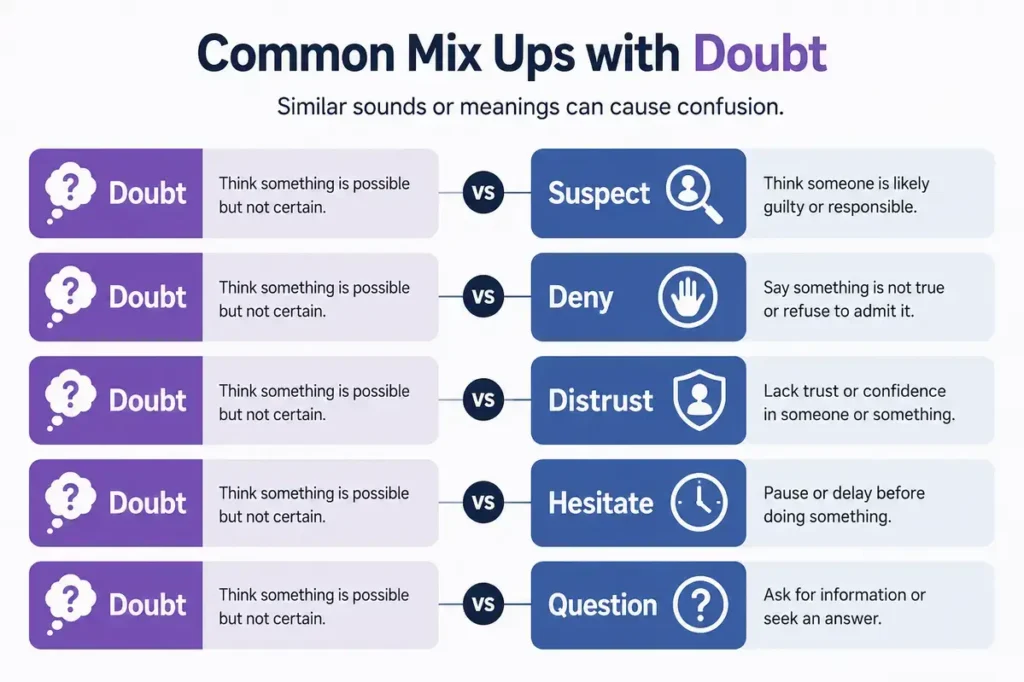
Doubt usually focuses on uncertainty or lack of confidence. Suspicion often suggests that you believe something may be wrong or dishonest. Hesitation describes difficulty making a decision. Disbelief means that you don’t accept something as true.
These words overlap but they aren’t identical.
Pronunciation Guide
Doubt is pronounced /daʊt/.
It has one syllable.
An easy pronunciation guide is:
dowt
The sound rhymes with out about and shout.
The b is completely silent.
You don’t say the word like doobout or doubt with a separate b sound. The spoken word moves directly from the vowel sound into the final t.
The silent b is the key pronunciation point for learners.
This is also why spelling by sound can lead to errors. If someone has only heard the word in conversation they may never realize that a b appears in the written form.
Try saying these words aloud.
Doubt.
Doubted.
Doubtful.
Doubting.
The b remains silent in each form.
American English and British English use the same basic pronunciation for the word. Small differences in accent can affect the vowel sound but not the essential spelling or silent letter.
Etymology and Word Origin
Doubt has a long history that helps explain its unusual spelling.
The word entered English through Anglo French and Old French forms related to douter. These forms developed from Latin dubitare which meant to hesitate or be uncertain.
The Latin root is closely connected with the idea of two possibilities or uncertainty. That historical connection also relates to the Latin word duo meaning two.
Over time the word moved through French into Middle English. English spelling changed considerably during this period and later became more standardized.
The silent b reflects the word’s historical relationship with its Latin and French forms. Modern pronunciation no longer gives the b a sound but the spelling retains it.
This is a good example of a broader truth about English. Modern spelling often contains traces of older pronunciation and older language relationships.
So the unusual spelling isn’t random. It is part of the word’s linguistic history.
Regional Usage
American English
Doubt is standard in American English. It appears frequently in everyday conversation and written communication.
Americans commonly use it in phrases such as I doubt it no doubt and without a doubt.
The spelling doesn’t change in American usage.
British English
British English also uses doubt as the standard form.
There is no major spelling difference between American and British English for this word. The silent b remains in the written form and the word carries the same basic meanings.
Australian English
Australian English follows the same standard spelling.
Doubt is used naturally in conversation education journalism business writing and general communication.
Dought isn’t an accepted regional alternative.
Canadian English
Canadian English also uses doubt.
The spelling and core meanings match standard American and British usage. Canadian writers can use the word in both formal and informal settings without changing its spelling.
Grammar Rules and Part of Speech
Doubt is both a noun and a verb. Understanding the difference makes the word much easier to use correctly.
Doubt As A Noun
As a noun doubt refers to uncertainty or a lack of confidence.
I have serious doubt about the plan.
The word can also appear in the plural form doubts.
She had doubts about moving to another city.
The plural often works well when a person has several concerns or questions about something.
Doubt As A Verb
As a verb doubt means to question something or feel uncertain about it.
I doubt his explanation.
They doubt that the plan will work.
The verb often appears before a noun phrase or a clause beginning with that.
You can also use it with an object.
I doubt him.
However the meaning can depend on context. This sentence may mean that you don’t trust what he says or that you don’t believe his claim.
Common Sentence Patterns
Several patterns appear often in natural English.
Doubt + noun
I doubt his story.
Doubt + that clause
I doubt that she knows the answer.
Have doubt about + noun
I have some doubt about the plan.
Have doubts about + noun or gerund
He has doubts about moving abroad.
No doubt + clause
No doubt she’ll understand.
Without a doubt
Without a doubt this was the right decision.
Negative Forms
The word also works naturally with negative structures.
I don’t doubt his ability.
This means I believe in his ability.
Notice the difference between I doubt him and I don’t doubt him. The addition of not completely changes the speaker’s position.
Punctuation
Doubt itself doesn’t require special punctuation.
The punctuation depends on the complete sentence.
For example:
I doubt that he’ll arrive today.
There’s no doubt that she made the right choice.
If doubt appears inside an introductory phrase the normal punctuation rules for that sentence still apply.
Real Life Usage Examples
Daily Conversation
Doubt is extremely common in ordinary speech because people often talk about uncertainty plans predictions and decisions.
- I doubt he’ll be there by eight.
- There’s no doubt she can handle the job.
The first example expresses uncertainty about a future event. The second expresses strong confidence.
Email And Workplace Communication
In professional communication doubt can sound measured and careful.
- I have some doubt about the proposed timeline.
- I don’t doubt the team’s ability to complete the work.
The first sentence raises a concern without making an overly strong accusation. The second communicates confidence.
Academic Writing
Academic writing often uses doubt when discussing evidence claims and conclusions.
- The findings cast doubt on the original assumption.
- Researchers may doubt the reliability of the result when the sample is too small.
In academic contexts the word often relates to evidence and confidence rather than personal emotion.
News And Journalism
Journalists use doubt when reporting uncertainty surrounding events or claims.
- Officials expressed doubt about the reported figures.
- The new evidence has raised doubts about the earlier conclusion.
News writing often uses the word because it allows writers to describe uncertainty without presenting an unsupported conclusion as fact.
Literature And Storytelling
Stories use doubt to reveal a character’s inner conflict.
- For the first time she felt doubt about the path she had chosen.
- His doubt disappeared when he saw the results with his own eyes.
Here the word can carry emotional weight. It can show fear hesitation uncertainty or a change in belief.
Related And Confused Terms
Several words sit close to the meaning of doubt but each one has its own use.
Uncertainty
Uncertainty means a lack of certainty or clear knowledge.
I’m facing some uncertainty about the future.
It is broader than doubt and can describe situations where the facts themselves are unclear.
Suspicion
Suspicion suggests a feeling that something may be wrong or dishonest.
She had a suspicion that he wasn’t telling the truth.
Suspicion can involve doubt but often adds concern about possible wrongdoing.
Hesitation
Hesitation describes a pause or reluctance before making a choice.
His hesitation made everyone wonder what he was thinking.
Doubt can cause hesitation but the two words describe different things.
Disbelief
Disbelief means that someone finds something difficult to accept as true.
She stared at the message in disbelief.
Disbelief is usually stronger than ordinary doubt.
Skepticism
Skepticism means a questioning attitude toward claims or ideas.
His skepticism made him ask for more evidence.
Doubt can be temporary while skepticism can describe a broader approach to information.
Suspicion
Suspicion involves a feeling that something may be wrong.
The police had suspicions about the story.
This term can overlap with doubt but carries a different emotional and contextual meaning.
Question
Question can work as a verb when you challenge the truth or validity of something.
She questioned his explanation.
Questioning can be deliberate and active while doubt can simply be an internal feeling of uncertainty.
Confidence
Confidence is close to the opposite of doubt.
She has complete confidence in her decision.
The more confidence someone has the less doubt they may feel.
Helpful Expressions With Doubt
Learning common expressions can make the word easier to remember and use naturally.
No Doubt
No doubt usually means certainly or very likely.
It can also introduce a statement that the speaker considers obvious.
Without A Doubt
Without a doubt means with complete confidence.
She is without a doubt one of the strongest players on the team.
This phrase is common in both speech and writing.
In Doubt
In doubt means uncertain or undecided.
His future with the company is in doubt.
Beyond Doubt
Beyond doubt means established with enough certainty that reasonable uncertainty has been removed.
The evidence proved the claim beyond doubt.
Cast Doubt On
To cast doubt on something means to make people less confident that it is true or reliable.
The new evidence cast doubt on the earlier report.
This expression appears often in journalism academic writing and professional discussions.
Have Doubts
To have doubts means to feel uncertain or unconvinced.
I have doubts about the plan.
This is one of the most natural everyday uses.
Why Silent Letters Matter In English
The spelling issue here is part of a much larger English learning challenge.
English contains many words with letters that don’t appear clearly in pronunciation. Words such as know honest write island and doubt all contain spelling patterns that can’t be predicted simply by listening.
That’s why pronunciation alone isn’t always enough to learn spelling.
A strong learner strategy is to connect the written form with a related word.
For doubt the word doubtful can help.
For write the related word written can help reinforce the initial w.
This approach creates a visual word family in your memory instead of forcing you to memorize isolated letters.
It also helps during proofreading. If a spelling looks unfamiliar compare it with a related form you already know.
An Easy Memory Trick
Think of the phrase:
Doubt has a silent b.
Then connect it with doubtful.
When you see doubtful the b becomes easier to remember. You can mentally move from doubtful back to doubt.
Another useful trick is to remember that doubt rhymes with out.
Doubt.
Out.
Shout.
About.
The b stays silent even though it stays visible.
This gives you two memory anchors. One helps with pronunciation and the other helps with spelling.
Formal And Informal Usage
Doubt is suitable for almost every level of English.
You can use it in a text message.
I doubt it.
You can use it in a workplace email.
I have some doubt about the proposed schedule.
You can use it in an academic paper.
The findings raise doubt about the reliability of the original assumption.
You can also use it in formal legal or professional language.
The evidence leaves little doubt about the sequence of events.
The word doesn’t sound too casual or too formal. That flexibility makes it a useful part of everyday English vocabulary.
The spelling remains the same in all these contexts.
Expert Editor Insight
An experienced editor would treat dought as a straightforward spelling error when it is intended to mean uncertainty. The mistake is understandable because the b is silent and English spelling often preserves letters that modern pronunciation no longer reveals. Professional proofreading focuses on the written form rather than the sound alone. A useful editing habit is to check related forms such as doubtful and doubted whenever you hesitate over the spelling. Spellcheck tools can catch many errors but a writer who understands the word family is less likely to make the mistake in the first place.
Conclusion
dought vs doubt has a clear answer. Doubt is the correct standard English word for uncertainty or a lack of confidence. Dought is normally a spelling error caused by leaving out the silent b. The correct form works as both a noun and a verb and appears naturally in casual conversation professional writing academic work journalism and many other contexts.
The unusual spelling becomes easier once you remember that the b is silent but still necessary. Words such as doubtful doubted and doubting can reinforce the same spelling pattern and make the word family easier to recognize. This is more useful than trying to spell the word entirely from its pronunciation.
For a quick editing check remember one simple rule. You hear the word as dowt but you write it as doubt. If you see dought in a normal sentence where uncertainty is the intended meaning change it to doubt before you publish or submit the text.
FAQs
Is dought a real English word?
Dought isn’t the standard modern English spelling for the word meaning uncertainty or lack of confidence. In most ordinary writing it is simply an error for doubt. You should use doubt in school assignments professional documents emails articles and other standard English contexts. Unusual historical or proper name uses may exist but they don’t make it a normal alternative spelling.
What does doubt mean?
Doubt means uncertainty or a lack of confidence in something. As a noun it describes the feeling itself such as I have doubt about his claim. As a verb it means to question or feel uncertain about something such as I doubt his explanation. The word can describe personal feelings as well as uncertainty about evidence claims decisions or future events.
Which spelling should I use?
Use doubt when you mean uncertainty or questioning. The word contains a silent b that must remain in the written form. The alternative spelling dought is not standard for this meaning. If you’re unsure remember the related word doubtful. Seeing the b in the longer form can help you recall that the same letter belongs in the shorter word.
How do you pronounce doubt?
Doubt is pronounced /daʊt/ and has one syllable. An easy pronunciation guide is dowt. The b is silent so you don’t pronounce it as a separate sound. The word rhymes with out and shout. This silent letter is one of the main reasons learners may spell the word according to its sound and accidentally leave the b out.
Can doubt be a noun and a verb?
Yes. Doubt works as both a noun and a verb. As a noun it describes uncertainty such as She has doubts about the plan. As a verb it means to question something or feel uncertain about it such as I doubt his explanation. This dual role makes the word useful in many different sentence patterns.
What is a good synonym for doubt?
Useful related words include uncertainty skepticism hesitation suspicion disbelief and questioning. The best choice depends on the context. Uncertainty is broad while skepticism suggests a questioning attitude. Suspicion can suggest concern about wrongdoing and disbelief can indicate stronger rejection of a claim. These terms overlap with doubt but they don’t always express exactly the same idea.
Why do people misspell doubt?
The main reason is pronunciation. The b is silent so someone who has learned the word primarily by hearing it may not realize that the letter belongs in the written form. The unusual ough spelling can add another layer of confusion. Fast typing and sound based spelling can make the mistake more likely. Learning doubtful alongside doubt provides a useful visual reminder.
Is doubt appropriate in formal writing?
Yes. Doubt is completely suitable for formal writing. It appears naturally in academic work professional communication journalism reports and serious discussion. Phrases such as cast doubt on and beyond doubt are especially common in formal contexts. The word is also perfectly natural in everyday conversation. Its level of formality depends more on the surrounding sentence than on the word itself.
