
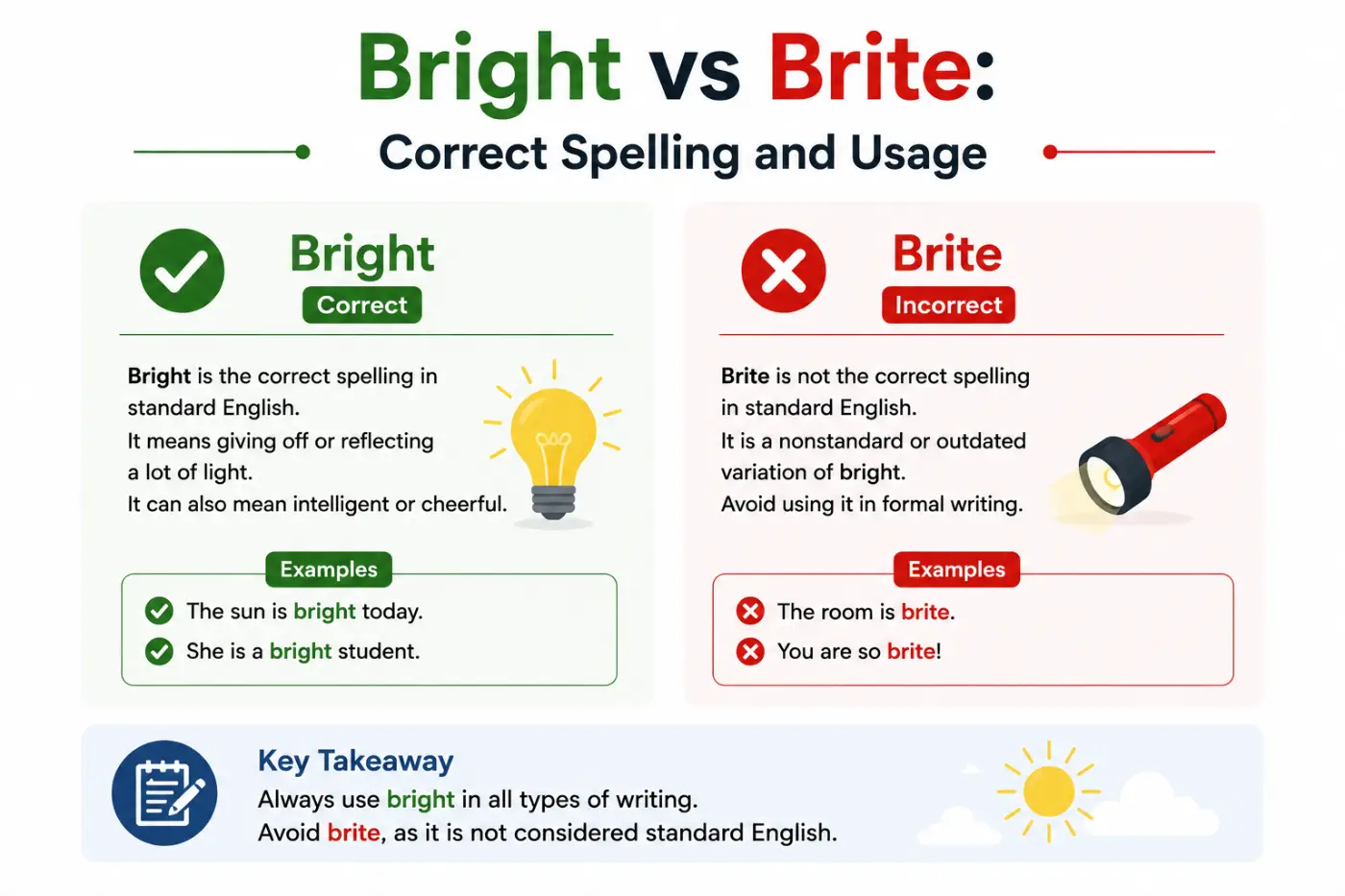
The spelling question bright vs brite looks simple until you see both forms in real life. The standard English spelling is bright. Brite is not the normal spelling of the adjective in standard English, although it can appear in brand names, product names, names of organizations, and other proper names. If you are writing an email, school assignment, article, report, or ordinary sentence, bright is the form you should use.
The confusion often comes from the way English sounds. The word ends with the same long i sound that appears in words such as light and night, so a writer may shorten the spelling mentally and type brite. English also contains legitimate spellings that use ite, which makes the mistake feel more reasonable than it really is.
This guide explains the difference clearly. You will learn what each form means, how bright works grammatically, how to pronounce it, where Brite appears, and why the misspelling happens. You will also see practical examples that show how native speakers use the standard form.
Featured Snippet
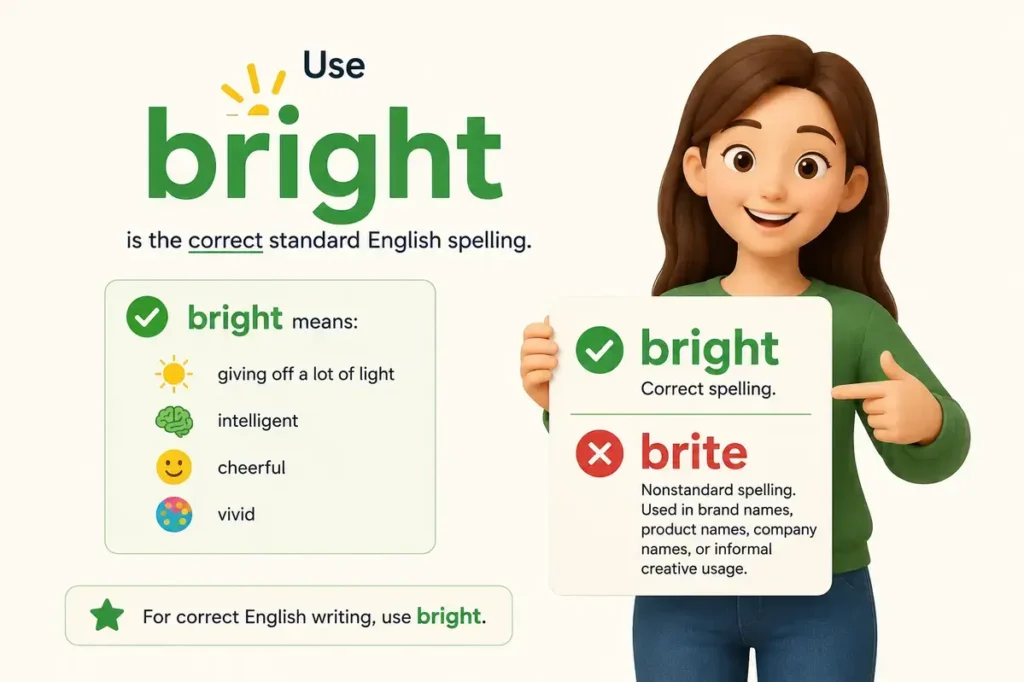
Bright is the standard English spelling of the adjective meaning full of light, vivid in appearance, intelligent, cheerful, or promising. Brite is not normally used as the standard spelling of this adjective. It can appear in brand names, proper names, or stylized wording, but ordinary English writing calls for bright.
Quick Answer
The correct spelling in standard English is bright. It can describe light, color, intelligence, mood, or something that looks promising.
Brite is generally not the standard spelling when you mean the ordinary English adjective. You may still encounter it in names, branding, and stylized commercial language.
Comparison Table
| Correct Form | Meaning | Part of Speech | Origin | Usage Frequency | Formality | Common Contexts | Example |
|---|---|---|---|---|---|---|---|
| Bright | Full of light, vivid, intelligent, cheerful, or promising | Adjective and adverb in limited uses | Old English roots through Middle English | Very common | Standard and fully formal | Everyday speech, education, business, literature, news | The room was bright and welcoming. |
| Brite | Usually a stylized or proper name form rather than the standard adjective | Usually part of a name or branding expression | Modern stylization or name usage | Rare in ordinary English | Context dependent | Brands, products, names, commercial wording | The company used Brite as part of its product name. |
Meaning and Definition
Meaning of Brite
Brite does not normally function as the standard spelling of the common English adjective. If you want to say that something gives off a lot of light, has a vivid color, shows intelligence, or seems promising, standard English uses bright.
That does not mean you will never see Brite. English speakers and businesses sometimes alter familiar words for names, trademarks, product labels, websites, organizations, and advertising. A stylized name can intentionally use a spelling that differs from ordinary dictionary English.
This distinction matters. A brand can choose its own spelling, but a writer cannot automatically transfer that spelling into standard prose. If a company calls a product Brite, preserve the official name when referring to that product. In a normal sentence, however, use bright when you mean the adjective.
Meaning of Bright
Bright has several closely connected meanings. Its most basic sense relates to light. A bright room has plenty of illumination. A bright lamp produces strong light.
The word also describes color. A bright red shirt has a vivid and noticeable red color. Bright yellow tends to look intense and energetic compared with a muted yellow.
Bright can describe intelligence. If someone is described as bright, the speaker usually means that the person learns quickly, understands ideas easily, or shows strong mental ability.
The word can also describe mood and personality. A bright smile may look cheerful and lively. A bright person can seem optimistic, energetic, or pleasant.
Finally, bright can describe something promising. A student may have a bright future. A young athlete may have bright prospects. In these examples, the word suggests that good things are likely to happen.
The central idea across these meanings is something noticeable, strong, vivid, or positive.
Key Differences Explained
The most useful way to distinguish the two forms is to look at spelling, grammar, meaning, tone, and context.
Spelling
Bright is the established standard spelling. It follows the historical development of the English word and appears throughout standard dictionaries and edited writing.
Brite does not replace that spelling in ordinary prose. Seeing the shorter looking form does not make it an acceptable alternative spelling.
Grammar role
Bright normally functions as an adjective. It can modify a noun directly, as in a bright room, or appear after a linking verb, as in the room is bright.
It also has some adverbial uses in informal or specialized expressions, although adjective use is by far the most important pattern for learners.
Meaning
Bright has several established meanings connected with light, color, intelligence, cheerfulness, and promise. Brite does not normally carry an independent standard meaning that replaces those senses.
Tone
Bright works naturally in casual, professional, academic, and formal writing. Brite usually signals a name, a stylized expression, or a spelling choice made for branding.
Context
Use bright in ordinary sentences. Keep Brite when it forms part of an official name or branded expression.
Which Spelling Is Correct?
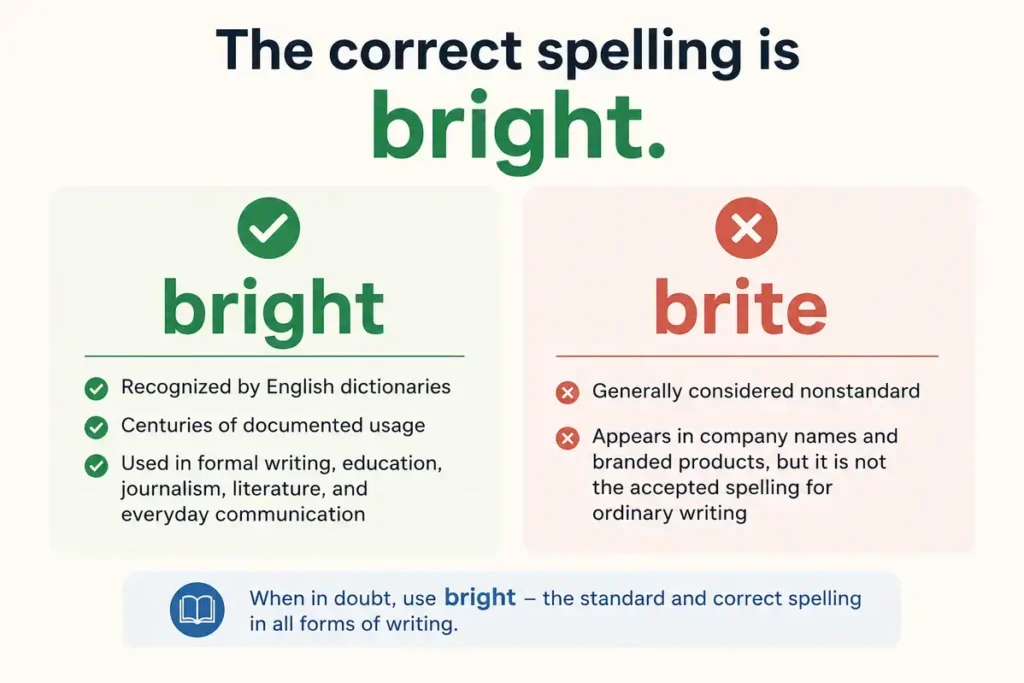
Bright is the correct spelling in standard English.
The reason is straightforward. Standard dictionaries recognize bright as the established English word for the meanings discussed above. Major English dictionaries such as Merriam Webster, Cambridge Dictionary, and Oxford English Dictionary follow the established spelling and usage of bright.
The spelling also reflects the historical development of the word. English did not create the word from the modern pronunciation alone. Its written form developed through earlier stages of the language, which helps explain why the spelling contains gh even though those letters are not pronounced in the modern word.
This is a useful lesson in English spelling. Pronunciation and spelling do not always match letter for letter. A spelling that seems more logical from sound alone is not automatically correct.
If you are editing standard English, choose bright. If you are reproducing a registered name that uses Brite, keep the name exactly as officially written.
Sentence Examples
Here are natural examples showing the standard form in different meanings.
- The kitchen is bright because it has large windows.
- She wore a bright blue jacket to the meeting.
- Daniel is a bright student who learns new concepts quickly.
- We woke up to a bright and sunny morning.
- The children had bright smiles as they opened their gifts.
- Her future looks bright after completing the training program.
- The bright lights made it difficult to see the stars.
- He chose a bright color to make the room feel more energetic.
- That was a bright idea that saved everyone several hours.
- The moon looked unusually bright against the dark sky.
The following examples show the kind of mistake writers make when they type the nonstandard form. - I bought a brite lamp for my desk. The standard spelling is bright.
- She has a brite future ahead of her. The standard spelling is bright.
- The room was very brite this morning. The standard spelling is bright.
- He is a brite student. The standard spelling is bright.
- They painted the wall brite yellow. The standard spelling is bright.
The error in these examples is not caused by a difference in meaning. In each case, the intended word is bright.
Common Mistakes and Misspellings
Several spelling patterns can lead writers toward brite.
- Writing from pronunciation
The modern pronunciation does not clearly reveal the written form. Because the word sounds like it ends with the sound found in words such as bite, some writers naturally reach for ite. - Removing silent letters
English contains many words with silent letters. Learners sometimes assume that a shorter spelling must be more logical. That assumption does not work reliably in English. - Analogy with similar words
Words such as bite, site, and white can influence spelling choices. The brain often searches for familiar patterns when producing a word. - Exposure to branding
People may encounter Brite in company names, product labels, advertisements, and commercial language. Repeated exposure can make the spelling look familiar even though it is not the normal form in general writing. - Keyboard and NLP confusion
From an NLP perspective, spelling mistakes often involve orthographic similarity and phonological similarity. The brain recognizes the intended sound and searches for a familiar letter pattern. Autocomplete systems and predictive keyboards can also reinforce an incorrect form after repeated user input.
Pronunciation Guide
Bright is pronounced with one syllable.
IPA: /braɪt/
Syllable breakdown: one syllable.
Audio style: brite.
The pronunciation is straightforward once you separate the sound from the spelling. The vowel sound is the long i sound heard in words such as light, night, and right. The final sound is t.
The gh in bright is silent. It does not add an extra sound after the vowel.
A common pronunciation mistake is trying to pronounce the gh. Another mistake is treating the word as two syllables. Native speakers pronounce bright as one syllable.
Brite, when encountered as a name, is normally pronounced in the same way because it is generally a stylized spelling based on the familiar word.
Etymology and Word Origin
Bright has a long history in English. It comes from Old English beorht, which carried meanings connected with brightness, light, and radiance. The word developed through Middle English forms before reaching the modern spelling bright. The historical path helps explain something that can otherwise seem strange to modern learners. The letters gh do not represent a sound in modern standard pronunciation, but they remain part of the established spelling.
English spelling preserves many traces of earlier pronunciation and historical development. Words often retain letters after sounds change or disappear. That is why modern spelling cannot always be reconstructed simply by listening to a word. The meaning of bright also expanded over time. The original connection with light naturally extended into related ideas such as vivid color. From there, the word developed figurative senses associated with intelligence, happiness, and promise.
The meaning of an intelligent person as bright is therefore metaphorical. Mental ability is imagined as a kind of light or clarity. The same conceptual connection appears in expressions such as a brilliant mind and a clear thinker. Brite does not represent a competing historical development of the ordinary adjective in modern standard English. Its modern appearances are more commonly connected with stylization, naming, branding, or informal spelling choices.
Regional Usage in the United States
American English uses bright as the standard spelling across ordinary writing. You will see it in school materials, professional documents, newspapers, books, websites, and everyday communication.
Brite may appear in American commercial names or product branding. That usage does not change the standard spelling of the adjective.
For American readers, bright should be the automatic choice when describing light, color, intelligence, mood, or future prospects.
Regional Usage in the United Kingdom
British English also uses bright as the standard spelling. There is no general British spelling rule that changes bright into brite.
British writers may encounter Brite in a company name, product name, or other proper name. As with American English, that special usage should not be treated as a general spelling rule.
Regional Usage in Australia
Australian English follows the same standard spelling. Bright is the normal form in everyday, educational, professional, and formal writing.
A writer in Australia may still see Brite in commercial or organizational names. The presence of that form in a name does not establish it as a general alternative spelling.
Regional Usage in Canada
Canadian English also uses bright as the standard form. Canadian dictionaries and edited English follow the established spelling rather than treating brite as a general replacement.
The same practical rule applies. Use bright in ordinary writing and preserve Brite only when it belongs to an official name or stylized expression.
Grammar Rules and Part of Speech
Bright is primarily an adjective. It describes a noun or gives information about a person, place, object, color, idea, or situation.
An adjective can appear directly before a noun.
The bright room felt comfortable.
The bright flowers attracted several bees.
It can also appear after a linking verb.
The room is bright.
Her future looks bright.
The colors seem bright.
The word can be modified by adverbs.
The room is extremely bright.
The screen is surprisingly bright.
The yellow paint looks very bright.
Bright can also appear in comparative and superlative forms when the intended meaning allows it.
This room is brighter than the other one.
That was the brightest star in the sky.
The context determines the exact meaning. Bright can refer to physical light, visual intensity, intelligence, emotional energy, or future promise.
Punctuation does not change the spelling. If bright appears at the beginning of a sentence, it is capitalized because it begins the sentence. If it appears in the middle, it normally remains lowercase unless it forms part of a proper name.
Real Life Usage Examples
Daily Talk
People use bright constantly in everyday conversation.
The kitchen is really bright in the morning.
You look bright and cheerful today.
These sentences sound completely natural because the word is part of ordinary vocabulary.
Professional email also uses the standard form.
We are looking forward to a bright start to the new project.
The room was too bright for the presentation.
There is no reason to choose the stylized spelling in normal business communication.
Academic Writing
Academic writing may use bright when discussing light, color, intelligence, or metaphorical ideas.
The experiment was conducted under bright illumination.
The study suggests a bright outlook for future research.
In academic prose, spelling accuracy matters because unusual spellings can distract the reader and reduce confidence in the writer.
News Writing
News writing may use the word in descriptions of events, weather, people, and prospects.
The city experienced a bright and clear morning after several days of rain.
The young player has a bright future in professional sports.
News editors normally use established dictionary spelling unless a different form belongs to a proper name.
Literature
Literary writers often use bright both literally and figuratively.
A bright moon appeared above the hills.
She remembered his bright smile long after the conversation ended.
The word works well in descriptive writing because it can create both visual and emotional imagery.
Expert Editor Insight
A senior editor would make a simple distinction between standard vocabulary and stylized naming. When the sentence describes light, color, intelligence, mood, or prospects, bright is the expected spelling. If Brite appears inside an official product or company name, the editor should preserve that spelling rather than silently correct it. Editing tools may flag brite as an unknown or misspelled word because their dictionaries are designed around standard vocabulary. A proper name can therefore trigger a warning even when the spelling is intentional.
Expert Tip
Do not decide English spelling by sound alone. When a word feels uncertain, ask what grammatical role it plays and check its established dictionary form. For this pair, that method quickly leads to bright for standard English.
A useful memory trick is to connect bright with light. Both words belong to a familiar group of words that contain the historical gh spelling even though the letters are not pronounced.
Conclusion
The spelling choice in bright vs brite is straightforward in standard English. Bright is the correct form for describing light, vivid color, intelligence, cheerfulness, or a promising situation. Brite may appear as a stylized name or branding choice, but it does not normally replace the standard adjective in ordinary writing.
The safest rule is simple. Use bright in emails, essays, articles, reports, schoolwork, professional documents, and everyday sentences. If you encounter Brite as part of an official name, keep the spelling because proper names can follow their own conventions.
The practical tip is to separate pronunciation from spelling. The word sounds simple, but its written form reflects the history of English rather than a letter by letter representation of modern speech. When in doubt, remember that the standard adjective is bright.
FAQs
Is brite a real word?
Brite can be a real form when it appears in a brand name, product name, company name, or other stylized expression. However, it isn’t the standard spelling of the English adjective meaning full of light, vivid, intelligent, or cheerful. In normal writing, use bright.
What does bright mean?
Bright has several meanings. It can describe something that gives off or reflects a lot of light, such as a bright room. It can describe a vivid color, an intelligent person, a cheerful expression, or a promising future. The exact meaning depends on the context in which the word appears.
Bright or brite which is correct?
Bright is the correct spelling in standard English. Brite isn’t normally an alternative spelling of the adjective. You may see Brite in commercial names or branding, but that specialized use doesn’t change the standard spelling. Use bright in essays, emails, reports, articles, and everyday English.
How do you pronounce bright?
Bright is pronounced /braɪt/ and has one syllable. It sounds like brite when spoken. The gh is silent, which can make the spelling seem confusing. The vowel has the long i sound found in words such as light, night, and right. Don’t try to pronounce the gh separately.
Can bright describe a person?
Yes. Bright can describe someone who is intelligent, quick to learn, or mentally capable. For example, you might say, She is a bright student. The word can also describe someone’s cheerful or lively appearance. Context determines the intended meaning, so bright can refer to intelligence or personality.
Is bright formal or informal?
Bright is suitable for both informal and formal English. Native speakers use it in everyday conversation as well as academic, professional, and literary writing. Expressions such as bright future, bright colors, and bright light are completely natural. You don’t need a more formal replacement simply because you’re writing professionally.
Why do people spell bright as brite?
The mistake usually happens because the pronunciation doesn’t reveal the complete spelling. Bright sounds like it could be written with the simpler brite pattern. English also contains many words where pronunciation and spelling differ. Exposure to stylized names using Brite can reinforce the confusion, but standard English uses bright.
Is brite acceptable in formal writing?
Generally, no. If you’re using the word as an ordinary adjective, bright is the appropriate spelling in formal writing. Brite should normally be retained only when it is part of an official name, brand, product, or other intentional spelling. In edited prose, replacing bright with brite can look like a spelling error.
