
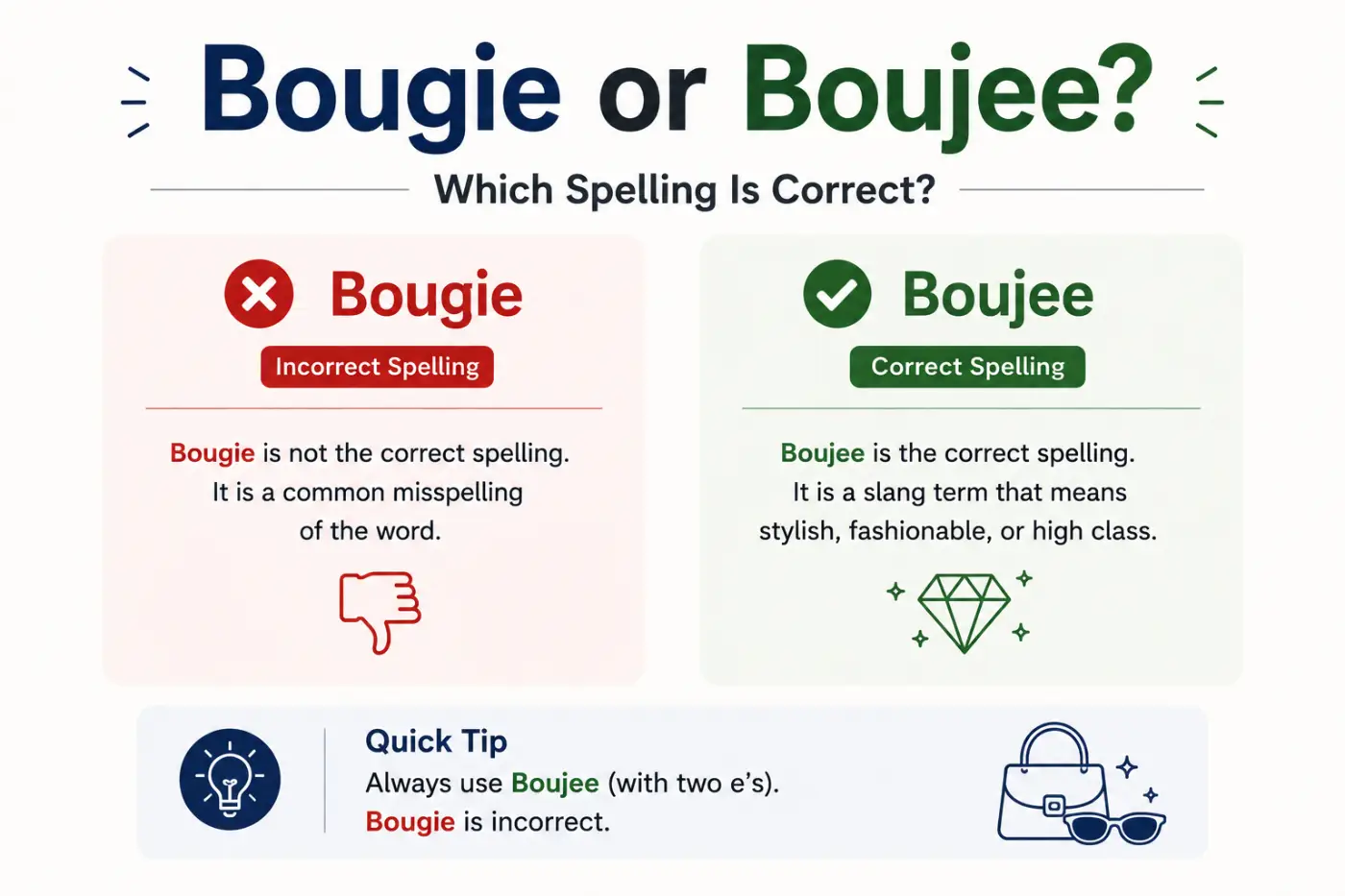
If you’ve ever seen someone describe a restaurant outfit neighborhood or lifestyle as fancy you may have wondered about the spelling. Is it bougie or boujee? The short answer is that bougie is the established spelling in standard English usage while boujee is a popular informal variant associated especially with modern slang and internet culture. They can refer to similar ideas but they don’t carry exactly the same history or tone.
The confusion exists because English often absorbs words from other languages and then reshapes them through speech culture and popular media. The word comes from French bourgeois and originally had a connection with the middle class. Modern English uses it more loosely to describe something perceived as upscale luxurious pretentious or overly concerned with status. Meanwhile the spelling boujee gained visibility through hip hop culture and later spread widely through social media.
This guide explains the difference between the two spellings how native speakers use them how they are pronounced and what they mean in different contexts. You’ll also see practical examples common mistakes regional usage and advice for choosing the right form in casual and formal writing. By the end you’ll know exactly which spelling to use when you want your writing to sound natural and polished.
Featured Snippet Quick Definition
Bougie is the established spelling for an informal English word meaning fashionable upscale luxurious or concerned with appearing wealthy. Boujee is a common slang variant with a similar meaning. Use bougie in edited writing and general English. Use boujee when deliberately reflecting casual slang internet culture or a particular social voice.
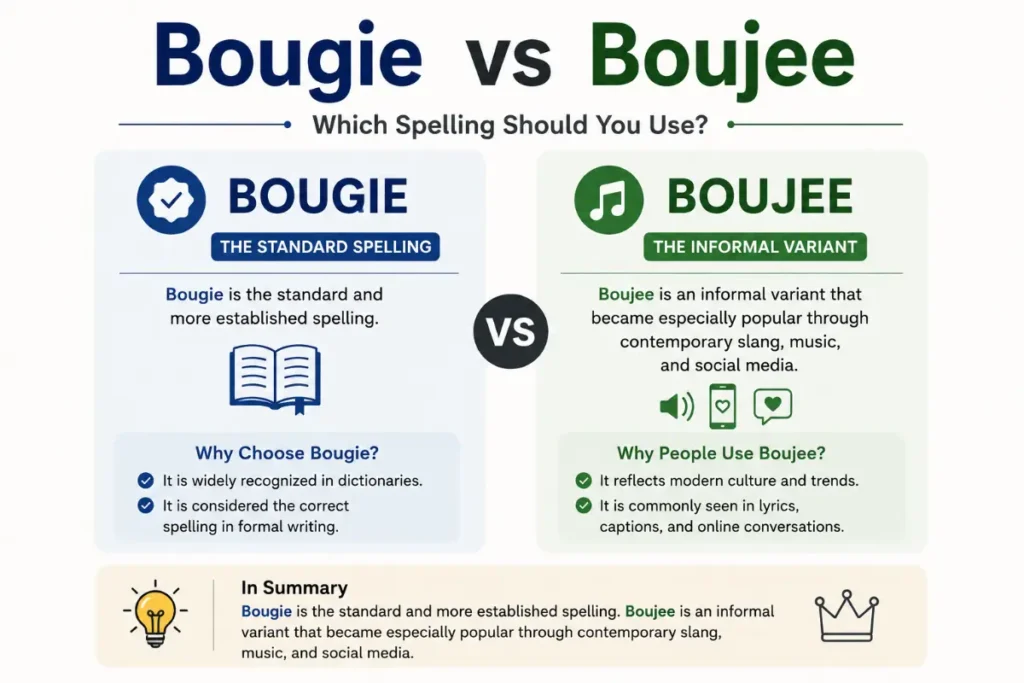
Quick Answer
Bougie is the standard and more established spelling. Boujee is an informal variant that became especially popular through contemporary slang music and social media.
If you’re writing an article email school assignment business document or other edited text use bougie. If you’re intentionally reproducing a casual voice or slang expression boujee can work.
Comparison Table Bougie or Boujee
| Correct Form | Meaning | Part of Speech | Origin | Usage Frequency | Formality | Common Contexts | Example |
|---|---|---|---|---|---|---|---|
| Bougie | Fashionable upscale luxurious or concerned with status | Adjective and noun in informal usage | French bourgeois | More established | Informal | Lifestyle food fashion neighborhoods and social commentary | That restaurant has a very bougie atmosphere. |
| Boujee | A slang variant suggesting luxury wealth style or status | Adjective | Modern slang development related to bougie | Common in casual speech and online culture | Very informal | Social media music captions jokes and conversational slang | She felt boujee ordering room service. |
Meaning and Definition
Meaning of Bougie
Bougie is an informal English adjective used for something that appears luxurious fashionable expensive or associated with an affluent lifestyle. Depending on context it can be complimentary sarcastic playful or mildly critical.
For example a person might call a candle bougie because it is expensive and beautifully packaged. Someone might describe a hotel as bougie because it offers expensive furnishings gourmet food and polished service. Another person might use the same word sarcastically to tease a friend for ordering an expensive coffee.
The word can therefore carry more than one shade of meaning. It doesn’t automatically mean genuinely wealthy. Often it describes the appearance or performance of luxury.
As a noun it can also describe a person perceived as overly concerned with sophistication wealth or social status. This use is informal and can sound judgmental.
Meaning of Boujee
Boujee generally communicates the same broad idea as bougie but has a stronger connection to contemporary slang. It often suggests being fancy luxurious stylish or enjoying expensive things.
The spelling became particularly visible through popular culture and hip hop. It later became widespread on social platforms where users began applying it playfully to food fashion travel home decor beauty products and everyday experiences.
For example someone might post a picture of an elaborate breakfast and caption it as a boujee morning. The point isn’t necessarily that the breakfast is genuinely expensive. The word can exaggerate the luxury for humor.
Key Differences Explained
- Spelling. Bougie is the established form in dictionaries and edited English. Boujee is a slang variant that developed through popular usage.
- Grammar role. Both forms are mainly used as informal adjectives. Bougie also appears as a noun in some contexts.
- Meaning. Both can describe luxury sophistication wealth or status consciousness. The exact meaning depends heavily on tone.
- Tone. Bougie can sound descriptive playful or critical. Boujee often feels more deliberately casual humorous and slang oriented.
- Context. Bougie works more comfortably in general informal writing. Boujee is especially natural in social media captions music related language casual conversation and stylized dialogue.
- Editorial choice. A professional editor will generally choose bougie unless the surrounding voice specifically calls for the slang variant.
Which Spelling Is Correct?
Bougie is the better choice for standard English. Major dictionaries treat it as an established informal word while boujee is generally recognized as a slang or variant spelling.
The linguistic reason is fairly straightforward. English vocabulary doesn’t always preserve the spelling of the language from which a word ultimately comes. Once a borrowed term becomes established English speakers develop familiar spellings and pronunciations. Bougie has become the conventional written form for the modern English adjective.
Dictionary logic also matters. Established dictionaries such as Merriam Webster and Oxford English Dictionary use evidence from actual English usage to document words and their meanings. Contemporary dictionaries and language references also recognize the slang development around boujee.
That doesn’t make boujee meaningless or automatically wrong. Context matters. A writer quoting a social media post reproducing dialogue or creating a deliberately informal voice may reasonably choose boujee.
Sentence Examples
Natural Examples Using Bougie
- The new café has a bougie atmosphere with marble tables and expensive pastries.
- My sister loves finding bougie little hotels when she travels.
- That candle looks incredibly bougie but it actually smells amazing.
- We went somewhere a little too bougie for my usual budget.
- His apartment is stylish without feeling overly bougie.
- The restaurant is known for its bougie brunch menu.
- She bought a bougie coffee machine even though she rarely makes coffee at home.
- The neighborhood has become much more bougie over the past few years.
- They wanted a relaxed wedding instead of something extremely bougie.
- That tiny dessert looks bougie enough for a luxury hotel.
Examples Showing the Common Misspelling or Slang Variant
- She described the restaurant as boujee on social media.
- The caption was intentionally written in a playful boujee style.
- He joked that his weekend had become extremely boujee.
- The song uses boujee as part of its casual slang vocabulary.
- Her post had a deliberately exaggerated boujee tone.
These examples show an important distinction. Calling the second spelling a simple spelling mistake can be misleading. In edited standard English bougie is normally preferred. In slang and cultural contexts boujee can function as an intentional stylistic choice.
Common Mistakes and Misspellings
- Treating both forms as identical in every context. They overlap in meaning but differ in register. One is more established while the other has a stronger slang identity.
- Assuming boujee is always a typo. It can be intentional. Writers often choose it to create a particular conversational or cultural tone.
- Using bougie in formal academic writing without considering tone. Although it is an established word its informal nature means a more precise expression may be better in serious academic prose.
- Assuming the word always means wealthy. Bougie can describe the appearance of luxury rather than actual financial status.
- Using it as a direct synonym for elegant. Something can be elegant without being bougie. The latter often contains an idea of status display or perceived extravagance.
People may type boujee because spelling follows sound. The ending can be interpreted as a long e sound represented through ee. This is a common NLP pattern in informal language where speakers create expressive spellings based on pronunciation rather than established dictionary conventions.
Social media also strengthens this process. Once a variant becomes visually recognizable users repeat it because it signals familiarity with a particular style of speech. Repetition can make an informal spelling feel as natural as the established spelling even when professional editors still prefer the conventional form.
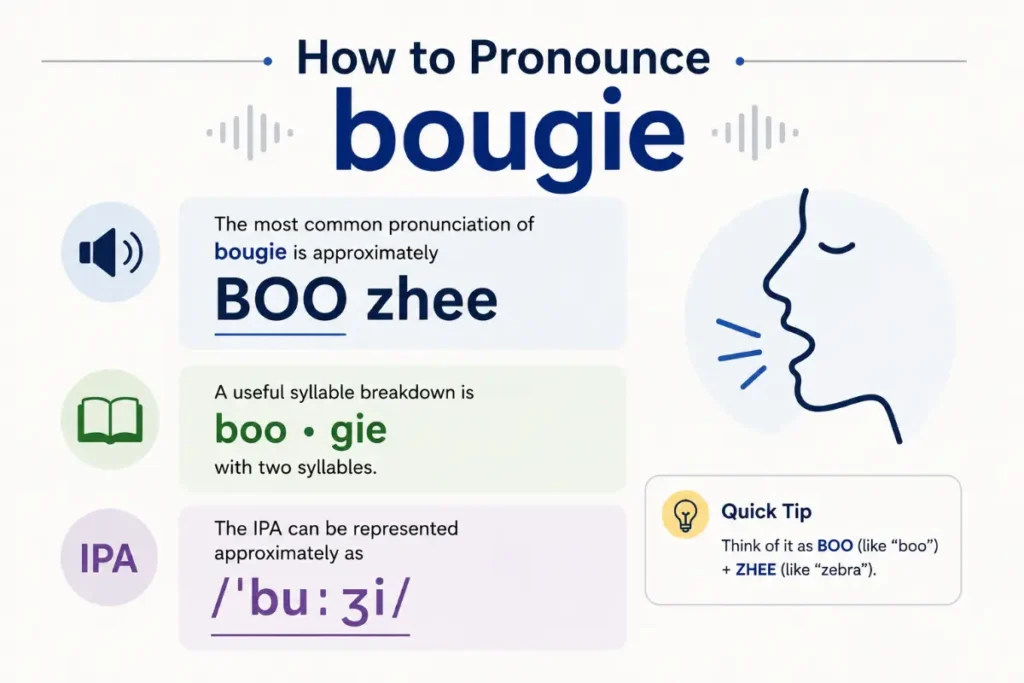
Pronunciation Guide
The most common pronunciation of bougie is approximately BOO zhee.
A useful syllable breakdown is boo gie with two syllables.
The IPA can be represented approximately as /ˈbuːʒi/.
The first syllable sounds like the word boo. The second contains the soft sound heard in the middle of words such as vision or measure.
Many English speakers pronounce boujee in essentially the same way. The difference is primarily written rather than phonetic.
A common pronunciation mistake is trying to pronounce the word according to the spelling letter by letter. Because the word comes through French and later English slang development its written form doesn’t behave like a simple phonetic English word.
For everyday conversation the easiest approximation is BOO zhee.
Etymology and Word Origin
The history of the word explains much of its modern meaning.
The English word ultimately connects to French bourgeois. The French term historically referred to a member of the middle class or a person associated with the town based social class between aristocracy and the working population.
Over time bourgeois developed broader social and political meanings. It could refer to middle class values material interests social respectability and attachment to property.
English speakers later created informal forms influenced by pronunciation and popular culture. Bougie became a modern slang adjective associated with luxury refinement consumer culture and perceived status consciousness.
The word therefore carries an interesting semantic shift. Its older historical associations were connected to social class. Its modern slang meaning is much more flexible.
Someone can call a $12 pastry bougie even if the person buying it isn’t wealthy. A small apartment with designer furniture can be described as bougie. A vacation can feel bougie because of its expensive hotel or polished atmosphere.
This is a classic example of semantic broadening. A word that once pointed toward a social category can develop into a descriptive label for behaviors objects styles and experiences associated with that category.
The modern spelling boujee reflects another stage in that evolution. Popular culture reshaped the pronunciation and spelling into a form that feels more overtly slang based. The two forms now coexist but they signal different levels of informality.
Regional Usage US
In American English bougie is widely understood in informal conversation. It frequently appears in discussions of food fashion neighborhoods travel beauty home design and lifestyle.
American speakers may use it positively to describe something stylish or negatively to suggest unnecessary extravagance. Tone does much of the work.
Boujee is also recognizable in the United States and has strong associations with contemporary slang popular culture music and social media. It often sounds more playful than the established spelling.
Regional Usage UK
British English speakers generally understand bougie because the word has entered international English through popular culture and online communication.
It remains informal. In formal British writing a writer may choose words such as luxurious pretentious fashionable or upscale depending on the intended meaning.
The slang spelling boujee is understood by many younger speakers but remains strongly informal.
Regional Usage AU
Australian English uses bougie in much the same way as other varieties of English influenced by American popular culture and internet language.
The word is most natural in casual conversation lifestyle writing social media and entertainment contexts. It isn’t normally the first choice for formal or technical prose.
Boujee can appear in casual online language but usually carries a more deliberate slang flavor.
Regional Usage CA
Canadian English speakers generally recognize bougie and use it in informal contexts.
Its meaning closely follows broader North American usage. It can describe something upscale fashionable expensive or overly concerned with appearances.
Boujee also appears in casual online communication but is less suitable for formal edited writing.
Grammar Rules and Part of Speech
Bougie functions primarily as an informal adjective.
You can place it before a noun.
The restaurant has a bougie interior.
You can also use it after a linking verb.
The restaurant is bougie.
The word can modify people objects places experiences and lifestyles.
She has a bougie taste in furniture.
That hotel feels bougie.
The adjective doesn’t require special punctuation. It should simply be integrated into the sentence according to normal English grammar.
It can also appear as a noun in informal contexts.
He’s acting like a bougie.
This noun use is more marked and can sound judgmental. Writers should therefore consider the audience before using it.
Because the word is informal it may not fit naturally into every academic or professional sentence. A formal writer might replace it with a more specific word such as luxurious affluent status conscious pretentious or upscale.
The best synonym depends on the intended meaning. If you mean expensive and elegant use luxurious. If you mean concerned with social status use status conscious. If you mean unnecessarily fancy use pretentious or ostentatious when appropriate.
Real Life Usage Examples
Daily Talk
- That brunch place is so bougie.
- I bought a bougie little lamp for my bedroom.
In everyday conversation the word often creates a playful sense of exaggeration. The speaker usually doesn’t intend a strict sociological definition.
- The client prefers a more polished setting rather than a bougie atmosphere.
- We can choose a comfortable restaurant without making the event feel too bougie.
In professional email the word can work in casual workplace communication. For formal business writing a more precise adjective is usually better.
Academic Writing
- Researchers may examine how consumers associate luxury products with bougie lifestyles.
- The term can describe popular attitudes toward affluent consumption and social status.
Academic writers should define the term if they use it because slang can be interpreted differently across audiences.
News
- The neighborhood has gained a reputation for bougie restaurants and luxury apartments.
- Local businesses are responding to demand for more upscale and fashionable dining experiences.
News writing often favors precise descriptive language. The word may appear when reporting on popular culture or quoting informal language.
Literature
- The character mocked the bougie crowd at the exclusive party.
- Her narration gave the old neighborhood a newly bougie personality.
In literature the word can help establish character voice social tension humor or cultural setting.
Related and Confused Terms
Several expressions overlap with bougie but aren’t perfect replacements.
- At last. This normally means something happens after a long wait. It isn’t a synonym for luxury.
- Eventually. This means something happens at some later point. It focuses on time rather than social style.
- Ultimately. This refers to the final result or conclusion. It has a logical or chronological meaning.
- At the end. This identifies the final point of an event process or period.
- Conclusively. This means in a way that settles an issue or proves something decisively.
- In the end. This often introduces the final outcome of a situation.
- Lastly. This introduces the final item in a sequence.
- Upscale. This is one of the closer semantic alternatives when bougie means expensive fashionable or associated with high quality.
These terms demonstrate why synonym matching requires care. A word can share part of another word’s meaning without being interchangeable in every sentence.
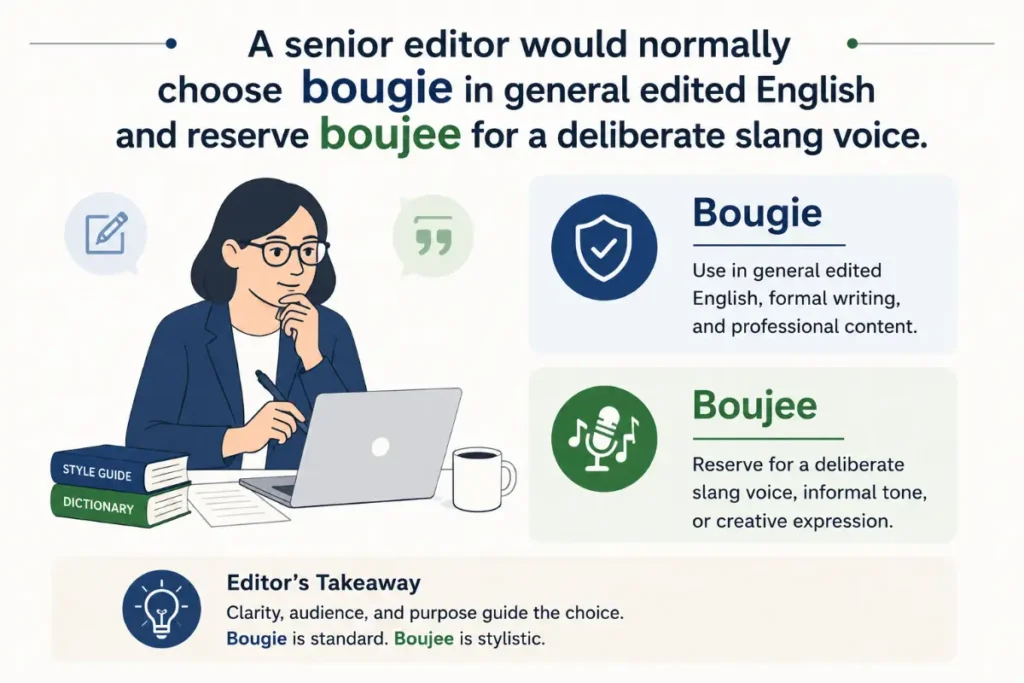
Expert Editor Insight
A senior editor would normally choose bougie in general edited English and reserve boujee for a deliberate slang voice. The choice should reflect the purpose of the text rather than a simple belief that one spelling is always right and the other is always wrong. Spell checkers may flag either form depending on the dictionary and software settings, but a professional editor looks beyond automated flags. The real question is what the writer wants the word to communicate. If the goal is conventional spelling and broad readability choose bougie. If the goal is authentic casual slang choose boujee.
Expert Tip
Don’t judge the spelling without judging the voice. In a polished article bougie usually looks more natural. In a social media caption where slang and personality matter boujee may be exactly the effect the writer wants.
Conclusion
Bougie or boujee can both appear in modern English but they serve slightly different stylistic purposes. Bougie is the established spelling and the safer choice for edited English. Boujee is a recognizable slang variant that carries a stronger connection to casual speech popular culture music and social media. Both can describe luxury fashion status or an exaggerated upscale lifestyle.
The main difference isn’t simply correct versus incorrect. Context and voice matter. Bougie is more conventional while boujee deliberately signals informality. If you’re writing an article professional message academic assignment or other polished text choose bougie unless you have a specific reason to reproduce slang. If you’re writing dialogue a playful caption or culturally specific casual language the alternative spelling may fit naturally.
The practical tip is simple: use bougie by default and use boujee when the style calls for slang. That small distinction can make your writing feel more deliberate and authentic. Good editing isn’t only about finding a spelling in a dictionary. It’s about choosing the form that matches your meaning audience and voice.
FAQs
Is bougie or boujee correct?
Bougie is the established spelling in standard English, while boujee is a popular informal slang variant. Both can describe something luxurious, fashionable, expensive, or associated with an upscale lifestyle. For professional, academic, or edited writing, bougie is the safer choice. Use boujee when you intentionally want a casual, playful, or slang based tone.
What does bougie mean?
Bougie is an informal adjective that describes someone or something perceived as fancy, upscale, luxurious, or concerned with status. It can be positive, negative, or humorous depending on context. For example, calling a restaurant bougie might mean that it has expensive food, stylish decor, and an upscale atmosphere. The word can describe people, places, products, and lifestyles.
What does boujee mean?
Boujee is a slang variant of bougie with essentially the same broad meaning. It often suggests luxury, wealth, fashion, or an upscale lifestyle. The spelling has strong connections to contemporary popular culture, music, and social media. Because of its informal tone, it works best in casual conversation, captions, dialogue, and other situations where a relaxed slang style is appropriate.
Bougie or boujee which spelling should I use?
Use bougie when you want the more established and widely accepted spelling. Choose boujee when you’re intentionally using contemporary slang or want to create a playful informal voice. The choice depends on context rather than meaning alone. In professional or edited content, bougie generally looks more polished. In casual social media language, boujee can sound natural.
How do you pronounce bougie?
Bougie is commonly pronounced BOO zhee, with two syllables. Its IPA pronunciation is approximately /ˈbuːʒi/. The first syllable sounds like boo, while the second contains the soft sound heard in words such as vision. Boujee is normally pronounced in essentially the same way. The main difference between the two forms is spelling and stylistic association.
Is bougie a formal word?
Bougie is an established English word, but it remains informal. It commonly appears in casual conversation, lifestyle writing, entertainment, social media, and popular culture. In highly formal writing, a more precise word may be better. Depending on the meaning, alternatives include luxurious, upscale, affluent, pretentious, or status conscious. The best choice depends on the intended shade of meaning.
Why do people spell bougie as boujee?
People spell bougie as boujee partly because informal English often develops alternative spellings based on pronunciation. Popular culture, music, and social media helped spread the second spelling. The ending ee can make the pronunciation feel more obvious to readers. Over time, repeated use made boujee recognizable as a slang form rather than simply a random spelling mistake.
Can bougie and boujee be used interchangeably?
They can often communicate the same general idea, but they aren’t identical in tone. Bougie is the more established spelling and works better in general edited English. Boujee has a stronger slang and pop culture feel. For example, both can describe an expensive restaurant, but boujee may make the sentence sound more playful or deliberately casual.
