
English plural spelling can look deceptively simple until a word already ends in s. That is exactly what happens with boss, because adding a plural ending creates a form that can feel visually unusual. Many writers know that a regular noun often takes s in the plural, so they may wonder if adding another s is enough. That can lead to forms such as bosss.
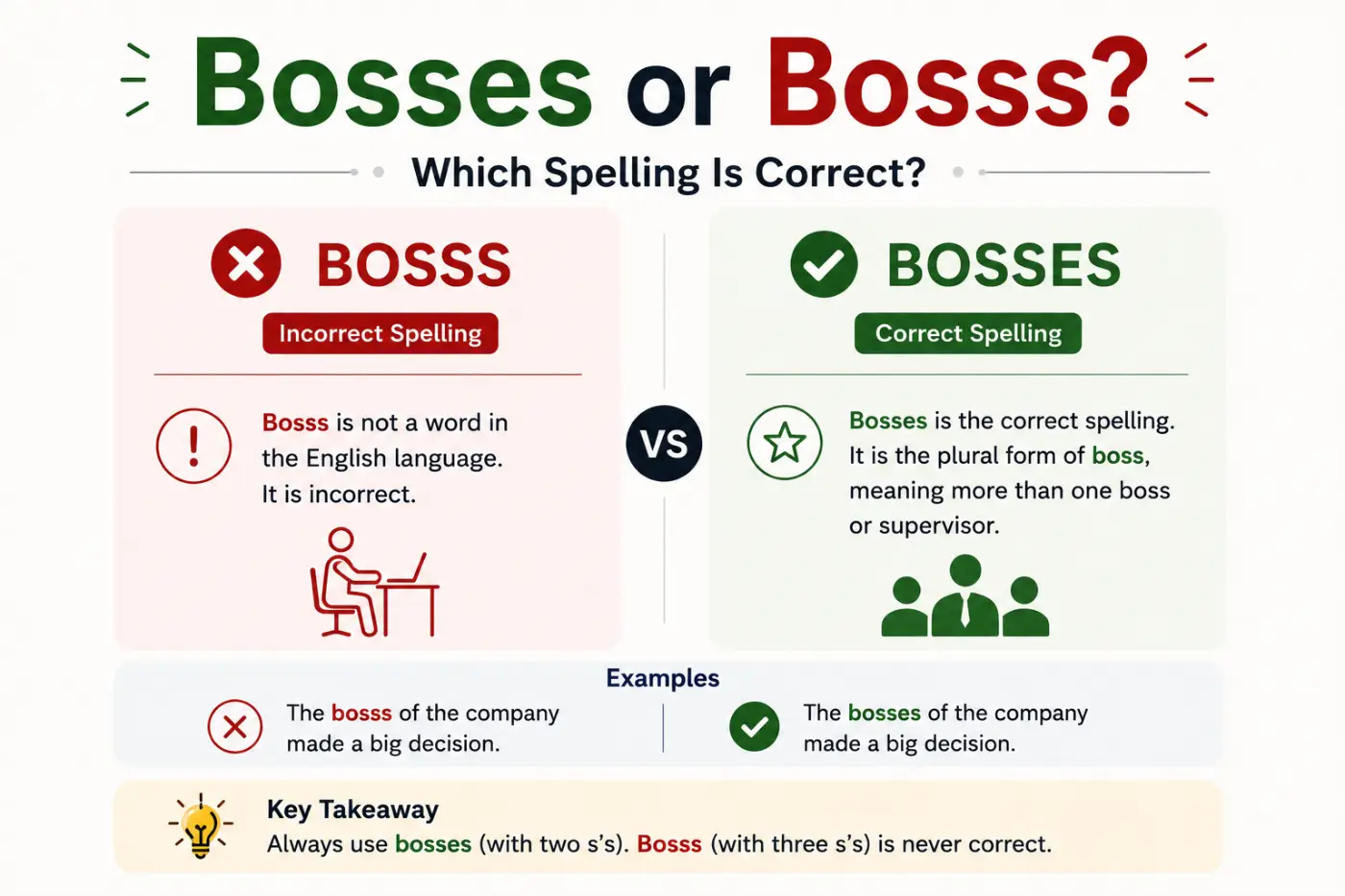
The direct answer is simple. Bosses is the correct standard English spelling, while bosss is a misspelling. The word boss ends in s, but English does not normally form its plural by simply adding another s to the written word. Instead, nouns ending in sounds such as s commonly take the plural ending es. The result is bosses.
This guide explains why the spelling works this way, how to pronounce the plural, and how to use it naturally in American and international English. You will also see practical examples, common mistakes, grammar rules, regional usage, related expressions, and editor level advice that can help you remember the correct form without having to think twice.
Featured Snippet Quick Definition
Bosses is the correct plural form of boss. It means two or more people who supervise, manage, or direct others. Bosss is not a standard English spelling. Because boss ends in the s sound, its plural uses es, producing bosses.
Quick Answer
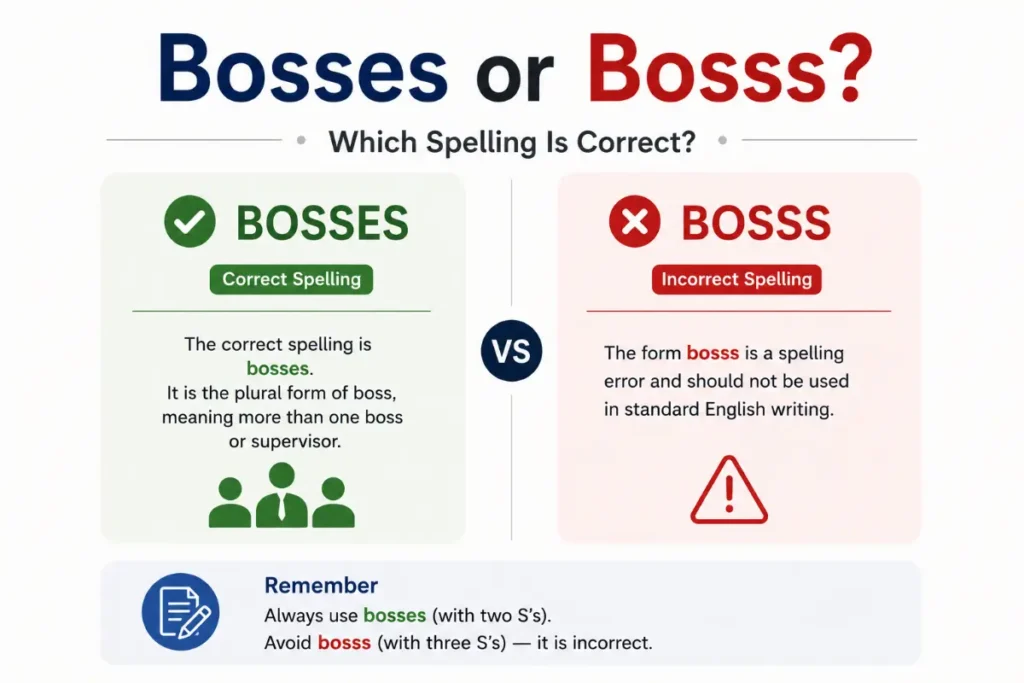
The correct spelling is bosses. The form bosss is a spelling error and should not be used in standard English writing. The reason is grammatical as well as visual. The noun boss already ends in s, so English adds es to form the plural. Boss becomes bosses, just as class becomes classes and glass becomes glasses.
Comparison Table: bosses or bosss
| Correct Form | Meaning | Part of Speech | Origin | Usage Frequency | Formality | Common Contexts | Example |
|---|---|---|---|---|---|---|---|
| bosses | More than one person who manages or supervises others | Noun | From boss, ultimately associated with Dutch baas | Very common | Standard | Workplaces, management, business, conversation | The bosses approved the new schedule. |
| bosss | No standard plural meaning | Noun spelling error | Not an established standard English form | Very rare | Nonstandard | Typing mistakes and informal errors | The writer accidentally typed bosss instead of bosses. |
Meaning and Definition
Meaning of bosss
Bosss is not a standard English word. It does not have an accepted dictionary meaning as the plural of boss. In most cases, seeing this spelling simply indicates a typing or spelling mistake. A person may understand the intended meaning immediately because the surrounding sentence makes the word obvious, but recognition does not make the spelling correct.
The extra s often appears because the writer knows that boss must become plural and instinctively adds another s. That approach seems logical at first glance. After all, many English nouns form their plurals by adding s. However, English plural formation depends on the ending and pronunciation of the singular noun. For standard writing, editing, education, business communication, and professional documents, use bosses.
Meaning of bosses
Bosses is the plural form of boss. A boss is a person who has authority over employees or directs their work. Depending on context, the word can refer to a supervisor, manager, employer, executive, or person in charge.
For example, if one manager supervises a team, that person can be called a boss. If several managers supervise different teams, they can be called bosses.
The word can also appear in informal expressions. Someone might say, “My bosses want the report by Friday.” The sentence means that more than one person with authority has requested the report.
Boss has a long history in English. The word entered English from Dutch baas, a term meaning master or overseer. Its modern workplace sense developed over time and became especially familiar in American English.
Key Differences Explained
- SpellingBosses is the accepted spelling. Bosss is not the standard plural form.
- Grammar roleBosses is a plural noun. It refers to more than one boss.
- MeaningThe meaning remains connected to supervision, authority, management, or leadership. The spelling error does not create a different standard meaning.
- ToneBosses works in casual, professional, academic, and formal contexts. Bosss should be avoided in all polished writing.
- ContextYou can use bosses when discussing workplaces, companies, managers, supervisors, or people with authority. The form appears naturally in conversations, emails, reports, articles, and everyday speech.
Which Spelling Is Correct?
Bosses is the correct spelling.
The linguistic reason is straightforward. English commonly uses es to form the plural of nouns ending in s, especially when the resulting pronunciation would otherwise become difficult or unclear.
Consider these familiar examples.
- Bus becomes buses.
- Class becomes classes.
- Glass becomes glasses.
- Address becomes addresses.
- Dress becomes dresses.
- Boss becomes bosses.
The spelling pattern reflects English pronunciation. The plural ending adds an extra syllable, making bosses easier to pronounce as boss iz rather than trying to compress several s sounds together.
Standard dictionaries list bosses as the plural of boss. That dictionary treatment supports the conventional spelling used by native speakers, professional editors, schools, publishers, and major style guides.
An easy editing test is to say the plural aloud. If you hear the extra syllable in bosses, the spelling should include es.
Sentence Examples
Natural Examples Using bosses
- The bosses approved the proposal after reviewing the final numbers.
- Our bosses asked everyone to attend the meeting on Monday.
- The two bosses have different management styles.
- Some bosses prefer written updates, while others prefer quick conversations.
- The bosses praised the team for finishing the project early.
- Several department bosses met to discuss the new policy.
- Her former bosses still speak highly of her work.
- The bosses decided to give employees more flexible schedules.
- Good bosses listen carefully before making difficult decisions.
- The company has several regional bosses who oversee local offices.
Examples Showing bosss as a Misspelling
- The writer accidentally typed bosss instead of bosses.
- The document contained the misspelled form bosss several times.
- A spell checker may flag bosss as an unknown word.
- The student corrected bosss to bosses during proofreading.
- The searcher wondered if bosss was an accepted plural form.
These examples demonstrate an important distinction. The incorrect spelling can appear in real text, but its appearance does not establish it as a legitimate variant.
Common Mistakes and Misspellings
- Writing bosssThis is the most direct error. The writer adds one s to boss instead of using the plural ending es.
- Forgetting the plural endingA writer may use boss when the sentence clearly refers to multiple managers. For example, “The boss approved the plans” refers to one person, while “The bosses approved the plans” refers to more than one.
- Confusing spelling with pronunciationSome writers hear the final s sound and assume another written s should be added. English spelling does not always work through direct sound to letter conversion.
- Adding apostrophesBosses and boss’s have different functions. Bosses is plural. Boss’s normally shows possession by one boss.
- Using bosses’ incorrectlyBosses’ can show possession by multiple bosses. For example, “The bosses’ decision affected everyone.” The apostrophe comes after the plural form because several bosses possess or are associated with the decision.
Why People Type bosss
The spelling mistake often comes from a predictable language processing pattern. A writer recognizes boss as the base word and applies the familiar plural rule of adding s. This produces an intuitive but incorrect sequence.
From an NLP perspective, this is an orthographic pattern problem. The brain is attempting to apply a productive rule without fully considering the phonological ending of the noun. Similar errors occur with words such as class, glass, bus, and dress.
There is also a visual factor. Because boss already contains two s letters, adding another s can seem plausible when someone is typing quickly. Yet standard English resolves the plural through es.
Pronunciation Guide
The singular boss is commonly pronounced /bɔːs/ in many varieties of English and /bɑːs/ in General American English.
The plural bosses is pronounced approximately /ˈbɔːsɪz/ in many varieties and /ˈbɔːsəz/ or /ˈbɑːsəz/ depending on accent.
A simple American English approximation is:
Bosses = BOSS iz
The plural has two syllables.
Bosses
BOSS iz
That extra syllable is one of the clearest clues that the plural ending is es.
A common pronunciation mistake is to treat the written form as though it should sound like a single syllable. Native speakers normally pronounce the plural with an additional vowel sound.
The final sound is also voiced. This matters because English plural endings change pronunciation according to the sound that comes before them. After the s sound in boss, the plural ending is pronounced with an extra syllable.
Etymology and Word Origin
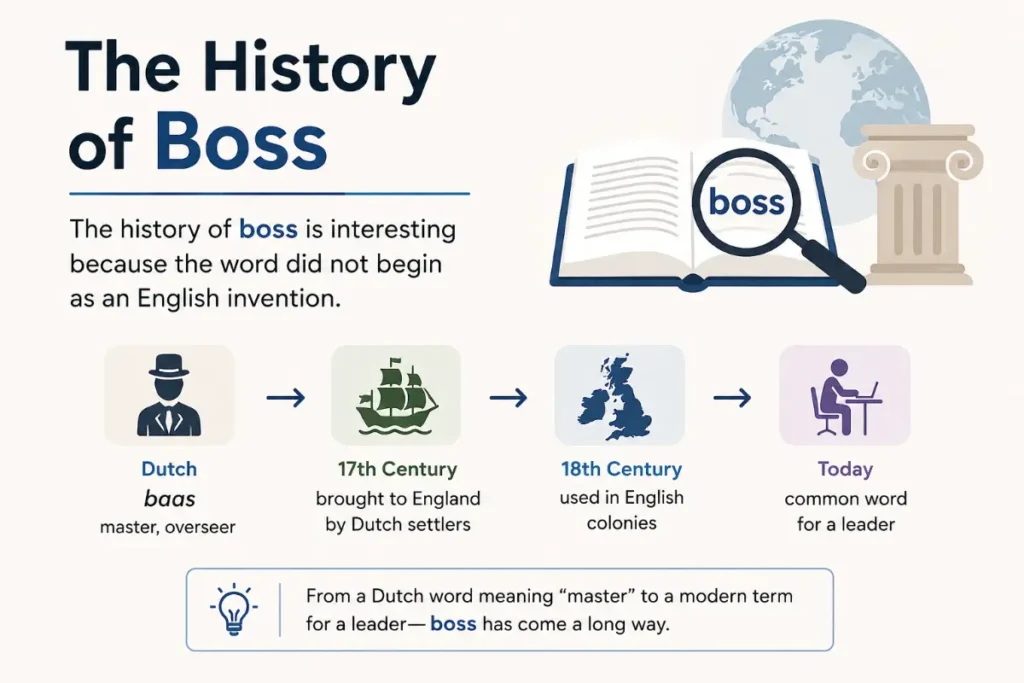
The history of boss is interesting because the word did not begin as an English invention.
English borrowed boss from Dutch baas, which meant master, chief, or overseer. The term became established in American English and gradually developed its familiar workplace meaning.
Over time, boss became a common word for someone who directs employees or has authority over a group. The noun then follows ordinary English plural grammar.
The historical origin does not create a special plural rule. Once boss became an established English noun, its plural developed according to English spelling and pronunciation conventions.
That is why the correct modern form is bosses rather than bosss.
Understanding the history can help with vocabulary, but you do not need to remember Dutch etymology to spell the plural correctly. The practical rule is enough: a noun ending in the s sound often takes es in the plural.
Regional Usage
United States
In American English, bosses is the normal plural form. It appears frequently in workplace conversations, business writing, news coverage, employee discussions, and informal speech.
American speakers also commonly use boss in broader informal expressions. The plural remains bosses regardless of the context.
United Kingdom
British English also uses bosses as the standard plural. There is no established British spelling variant that changes the plural to bosss.
Differences between American and British English can affect vocabulary, pronunciation, and some spelling conventions, but this word does not create a regional plural difference.
Australia
Australian English uses bosses as the standard plural form as well. Workplace discussions, journalism, education, and everyday conversation all follow the same spelling.
The pronunciation can vary according to Australian accent patterns, but the written plural remains unchanged.
Canada
Canadian English also uses bosses. Canadian speakers may use a mixture of American and British vocabulary conventions, but there is no standard Canadian variant spelled bosss.
Across these major English varieties, the spelling rule stays consistent.
Grammar Rules and Part of Speech
Bosses is a plural common noun. It identifies more than one person who has authority, supervises workers, manages an organization, or directs a particular activity.
The singular form is boss.
The plural form is bosses.
The possessive singular is boss’s.
The possessive plural is bosses’.
These forms have different grammatical functions.
Consider the difference.
“The boss called me.”
One boss is involved.
“The bosses called me.”
More than one boss is involved.
“The boss’s office is upstairs.”
The office belongs to or is associated with one boss.
“The bosses’ offices are upstairs.”
The offices belong to or are associated with multiple bosses.
The placement of bosses in a sentence is flexible because nouns can function in different grammatical positions.
“The bosses agreed.”
Here bosses is the subject.
“I spoke with the bosses.”
Here bosses is the object of the preposition with.
“We thanked the bosses.”
Here bosses is the direct object.
You do not normally need a special punctuation mark simply because the word is plural. The apostrophe belongs to possessive forms, not ordinary plurals.
This distinction is one of the most useful rules to remember. Bosses means more than one boss. Boss’s generally indicates something belonging to one boss. Bosses’ indicates something belonging to several bosses.
Real Life Usage Examples
Daily Talk
“I need to ask my bosses before I change the schedule.”
“The bosses are meeting this afternoon.”
These sentences sound natural in everyday conversation and clearly refer to multiple people in positions of authority.
“Several bosses will attend the meeting tomorrow.”
“I’ve attached the report for the bosses to review.”
In workplace emails, bosses can sound perfectly natural, especially in conversational internal communication. In highly formal corporate writing, terms such as managers, supervisors, or department heads may sometimes sound more precise.
Academic Writing
“Different organizational structures can influence how bosses communicate with employees.”
“The study examined how employees perceive their bosses.”
Academic writing can use bosses, particularly when discussing workplace relationships. A more technical paper may choose supervisors or managers when greater precision is needed.
News
“Several bosses met with workers after the announcement.”
“Union representatives criticized the bosses for delaying negotiations.”
News writing can use bosses when the context calls for an accessible, direct term. The word may sound more informal than executives or company leaders, but it remains standard English.
Literature
“His bosses expected him to finish the work before sunset.”
“She had learned that different bosses demanded different things.”
Writers often choose bosses because it is short, familiar, and expressive. The word can also carry an emotional tone depending on the character and situation.
Related and Confused Terms
Several words and expressions overlap with boss in workplace contexts, but they are not exact replacements in every sentence.
- ManagerA manager typically oversees people, processes, or departments. The term often sounds more professional and specific than boss.
- SupervisorA supervisor usually oversees employees or daily operations. This word can be more precise in organizational settings.
- EmployerAn employer is a person or organization that employs workers. A boss can be an employer, but the two terms are not always identical.
- ExecutiveAn executive generally holds a senior organizational position. Calling every boss an executive would be too broad.
- LeaderA leader guides people or an organization. Leadership does not always involve formal authority.
- ChiefChief can refer to someone at the highest level of a particular group or department. Its exact meaning depends on the title and organization.
- DirectorA director often manages a department, program, company function, or organization. The term has a more specific professional meaning in many contexts.
- HeadHead can mean the person responsible for a department or group. For example, department head is common professional terminology.
The key point is that synonyms are related by meaning but not always interchangeable. Boss is broad and conversational. Manager and supervisor can provide greater precision. Executive and director may describe specific levels or roles.
Expert Editor Insight
A senior editor would normally correct bosss immediately to bosses because there is no standard English plural variant that competes with it. Native speakers recognize bosses instantly because the spelling matches both established grammar and familiar pronunciation. Spell checkers and grammar tools may flag bosss as an unknown or misspelled word, but the strongest test is still human language knowledge: the plural of boss is bosses. When editing quickly, remember the sound rather than counting letters. Say “BOSS iz,” and the es ending becomes much easier to recall.
Expert Tip
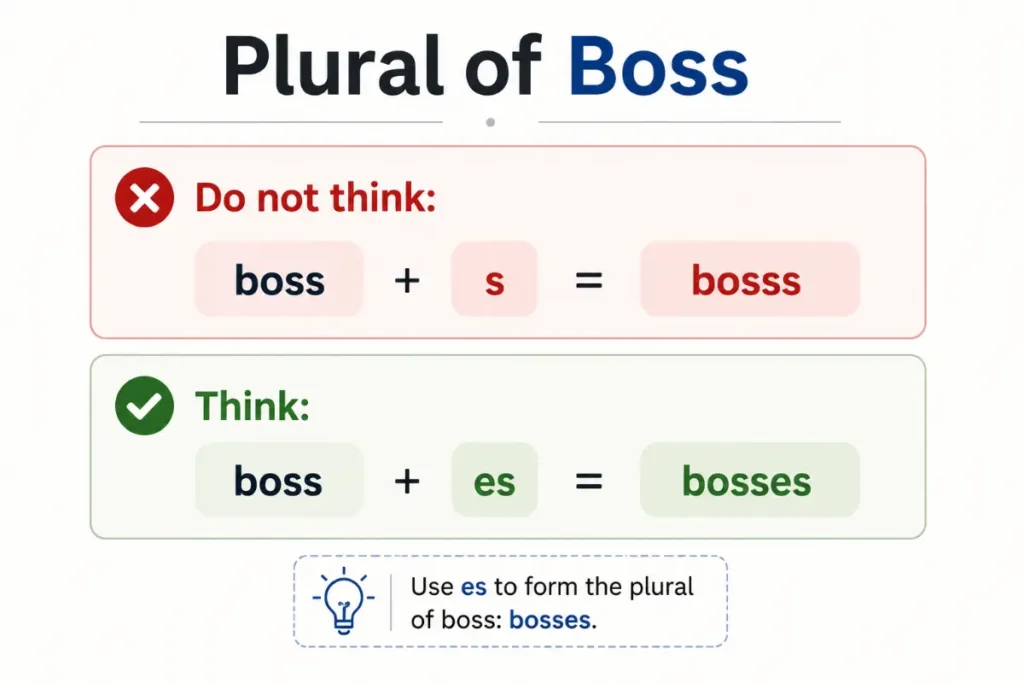
Think of the plural as a sound pattern rather than a letter adding exercise.
Do not think:
boss + s = bosss
Think:
boss + es = bosses
Then say it aloud:
BOSS iz
That small shift makes the spelling much easier to remember.
Conclusion
Bosses or bosss has a straightforward answer. Bosses is the correct standard English spelling, while bosss is a misspelling. The plural form follows a familiar English pattern in which nouns ending in the s sound commonly take es. That produces bosses, with two syllables when pronounced aloud. The word refers to more than one boss and works naturally in conversations, emails, reports, academic writing, journalism, and literature.
The confusion usually comes from treating every plural as a simple matter of adding one s. That rule works for many English nouns, but it does not work for every ending. Words such as class, glass, bus, dress, and boss show why spelling and pronunciation need to work together. The extra vowel sound in bosses makes the plural easier to say and reflects the standard written form.
For a practical memory trick, say the word aloud as BOSS iz. Once you hear that second syllable, the spelling becomes much more intuitive. If you’re proofreading a sentence and see bosss, correct it to bosses. That single adjustment gives you the standard form used throughout modern English.
FAQs
Is bosss a real word?
No. Bosss is not the standard English plural of boss. In ordinary writing, it is treated as a spelling error. The correct plural is bosses. If you see bosss in an email, document, school assignment, or online post, the writer most likely intended bosses. Standard dictionaries and normal English usage support bosses as the accepted plural form.
What does bosses mean?
Bosses is the plural of boss. It refers to two or more people who supervise employees, manage departments, direct work, or hold authority in an organization. For example, “My bosses approved the plan” means that more than one person with managerial authority approved it. The word can be used in casual, professional, academic, and general writing.
bosses or bosss which is correct?
Bosses is correct, and bosss is incorrect in standard English. The plural ending is written es because boss ends in the s sound. English uses this pattern with many nouns ending in s, including class, glass, bus, and dress. Adding only another s produces bosss, which is not the accepted spelling.
How do you pronounce bosses?
Bosses is generally pronounced with two syllables. A simple American English pronunciation guide is “BOSS iz.” The exact vowel can vary across English accents, but the plural normally contains an additional syllable. That extra syllable corresponds to the plural ending and helps explain why the written form uses es rather than another standalone s.
Can bosses start a sentence?
Yes. Bosses can begin a sentence when it functions as the subject. For example, “Bosses often have to make difficult decisions.” There is no grammar rule preventing a plural noun from appearing at the beginning of a sentence. The same word can also appear in the middle or at the end depending on its grammatical role.
What is a synonym of bosses?
Depending on the context, possible synonyms include managers, supervisors, employers, leaders, executives, directors, and department heads. These terms are not always exact substitutes because each can describe a different role or level of authority. Bosses is broader and more conversational, while managers and supervisors often sound more precise in professional writing.
Why do people misspell bosses?
People may misspell bosses because boss already ends in s, making the plural visually unusual. A writer may apply the simple rule of adding s and produce bosss. Fast typing can make the problem more likely. Pronunciation also plays a role because English plural endings do not always follow a simple one letter to one sound pattern.
Is bosses appropriate in formal writing?
Yes. Bosses is grammatically correct and acceptable in formal writing. However, word choice depends on context. In a professional report, manager, supervisor, executive, or department head may sometimes provide more precise information. Bosses is still a standard English plural noun and is not grammatically informal or incorrect simply because it is common in everyday conversation.
