
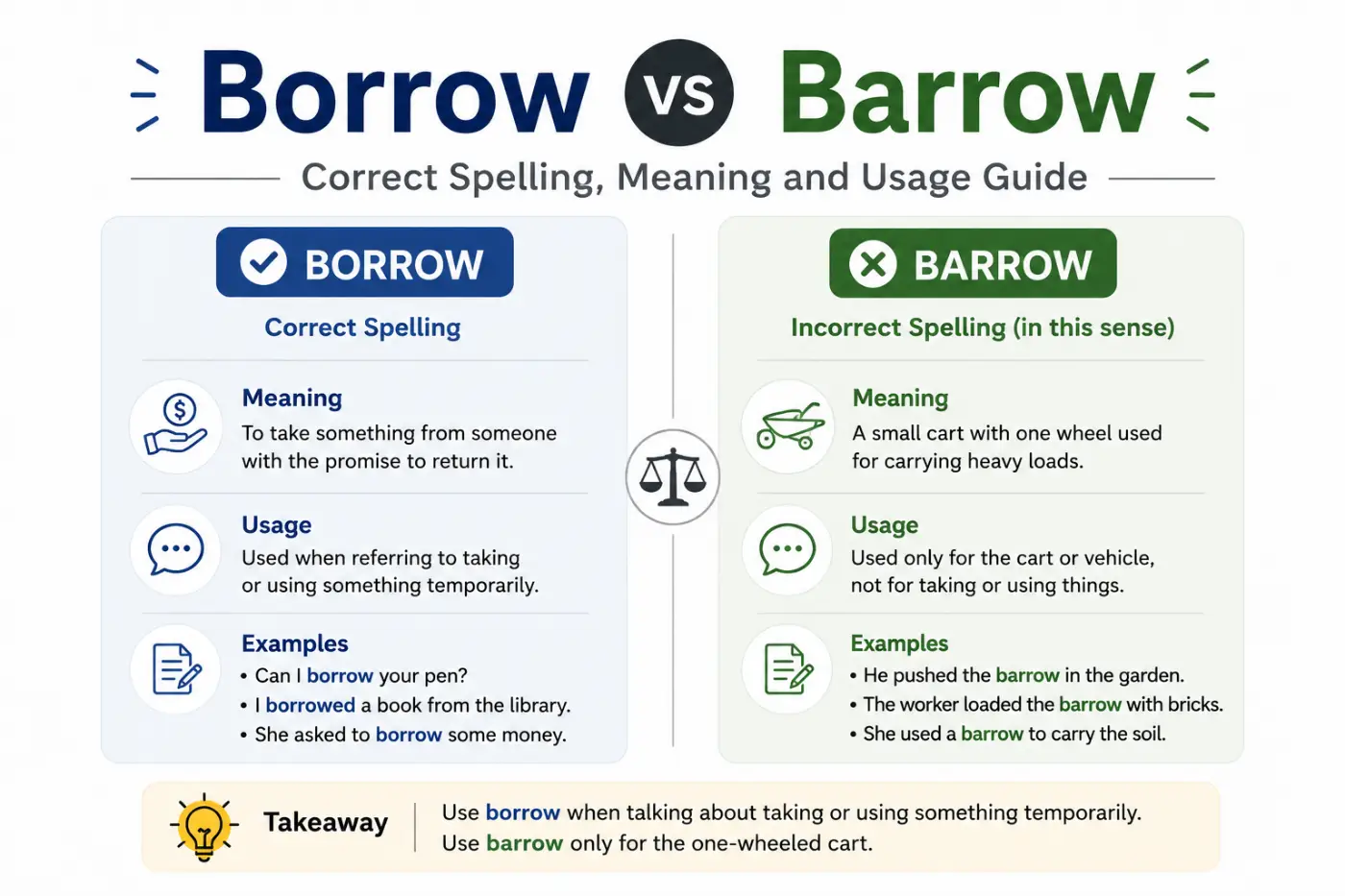
Borrow vs barrow can confuse English learners because the two words look and sound closely related at first glance. The direct answer is simple: borrow is the common verb meaning to take something temporarily with the intention of returning it, while barrow is a different word with meanings connected to a small cart, a wheelbarrow, or an ancient burial mound. They aren’t
interchangeable. The confusion usually comes from their similar spelling and pronunciation. Both contain the letters b, r, and o, and both can appear in everyday English. A quick spelling mistake can turn a perfectly clear sentence into one that means something completely different. For example, saying that you will “barrow a book” is incorrect when you mean that you will take the book temporarily and return it later.
This guide explains the difference in plain English. You’ll learn the meanings, grammar roles, pronunciation, origins, regional usage, common mistakes, and practical examples. By the end, you’ll know exactly when to use each form and why native English speakers choose one over the other.
Featured Snippet Quick Definition
Borrow is a verb meaning to take and use something belonging to another person with the intention of returning it. Barrow is mainly a noun referring to a small cart or wheelbarrow, or an ancient burial mound. The words have different meanings and grammatical roles, so they cannot normally replace each other.
Quick Answer
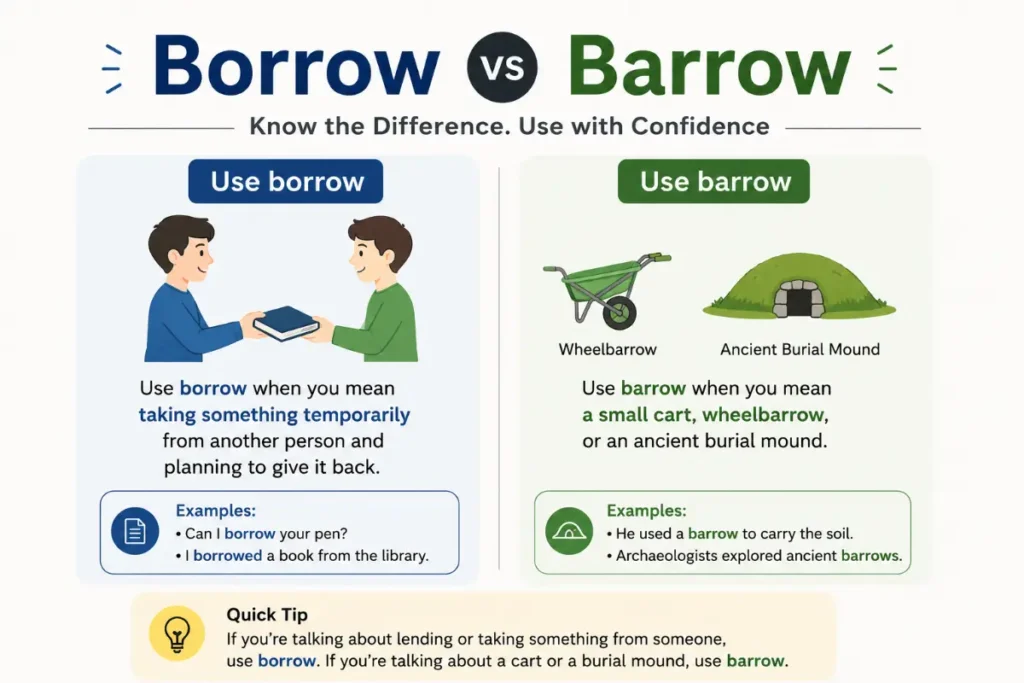
Use borrow when you mean taking something temporarily from another person and planning to give it back. Use barrow when you mean a small cart, wheelbarrow, or an ancient burial mound.
For example, “Can I borrow your pen?” is correct. “Can I barrow your pen?” is incorrect because the intended meaning requires the verb borrow.
Comparison Table: borrow vs barrow
| Correct Form | Meaning | Part of Speech | Origin | Usage Frequency | Formality | Common Contexts | Example |
|---|---|---|---|---|---|---|---|
| borrow | Take and use something temporarily with the intention of returning it | Verb | Old English and related Germanic roots | Very common | Neutral | Money, books, clothes, tools, ideas | Can I borrow your book? |
| barrow | A small cart or wheelbarrow, or an ancient burial mound | Noun | Old English and Germanic roots | Less common | Neutral to formal depending on sense | Gardening, farming, archaeology, history | He pushed the barrow across the yard. |
Meaning and Definition
Meaning of borrow
Borrow is a verb. It describes receiving or taking something from another person for temporary use, normally with an expectation that it will be returned.
You can borrow physical objects such as books, pens, tools, cars, clothes, and equipment. You can also borrow money from a person, bank, or financial institution. In a broader sense, English speakers can borrow ideas, phrases, methods, or concepts from another source.
The central idea is temporary use followed by return.
Consider these examples.
- I need to borrow your calculator.
- She borrowed some money from her brother.
- We borrowed chairs from the next room.
- The writer borrowed an idea from an earlier study.
The word can also appear in expressions such as “borrow time,” where the meaning becomes figurative. Someone who is “living on borrowed time” is in a situation where they have more time than might normally be expected.
Meaning of barrow
Barrow is primarily a noun, and it has more than one established meaning.
One meaning refers to a small cart used for carrying materials. A wheelbarrow is the most familiar example. In some varieties of English, especially British usage, barrow can refer to a handcart or similar vehicle.
Another meaning is historical and archaeological. A barrow can be a mound of earth built over a burial site. Archaeologists and historians use the word when discussing ancient burial practices and prehistoric landscapes.
For example, “The archaeologists examined the burial barrow” uses the word in its historical sense.
These meanings have nothing to do with temporarily taking something from someone. That is why barrow cannot replace borrow in ordinary sentences about receiving something for temporary use.
Key Differences Explained
- Spelling. The two words differ by one letter in the middle. Borrow contains an o after the first r, while barrow contains an a. That small difference changes the word completely.
- Grammar role. Borrow is normally a verb. Barrow is normally a noun.
- Meaning. Borrow concerns temporary possession or use. Barrow refers to a cart or an ancient mound.
- Tone. Borrow is ordinary everyday English. Barrow is also a standard English word, but its cart and archaeological meanings occur less frequently in everyday American conversation.
- Context. You use borrow when talking about books, money, clothing, tools, vehicles, or other things you temporarily receive. You use barrow when discussing carts, farming, gardening, archaeology, history, or related subjects.
Which Spelling Is Correct?
Both spellings are correct English words, but they aren’t interchangeable.
Use borrow for the action of temporarily taking or receiving something with the intention of returning it. Use barrow for a noun referring to a cart or an ancient burial mound.
This distinction follows standard dictionary logic. Major English dictionaries such as Merriam Webster, Oxford English Dictionary, Cambridge Dictionary, and Collins English Dictionary treat the forms as separate entries with separate meanings. That makes the spelling distinction especially clear.
A useful editing test is to ask what the sentence is trying to describe. If the sentence describes an action involving temporary use, choose borrow. If it describes a cart or a mound, choose barrow.
For example, “I need to borrow a shovel” describes an action. “The gardener moved soil in a barrow” describes an object.
Sentence Examples
Examples with borrow
- Can I borrow your pen for a minute?
- I forgot my umbrella, so I need to borrow one.
- She asked if she could borrow my laptop.
- We borrowed some chairs for the meeting.
- Did you borrow this book from the library?
- He borrowed money from his parents.
- May I borrow your phone?
- They borrowed a car for the weekend.
- I don’t like to borrow things without asking first.
- She borrowed my jacket because it was cold outside.
Examples showing the common spelling mistake
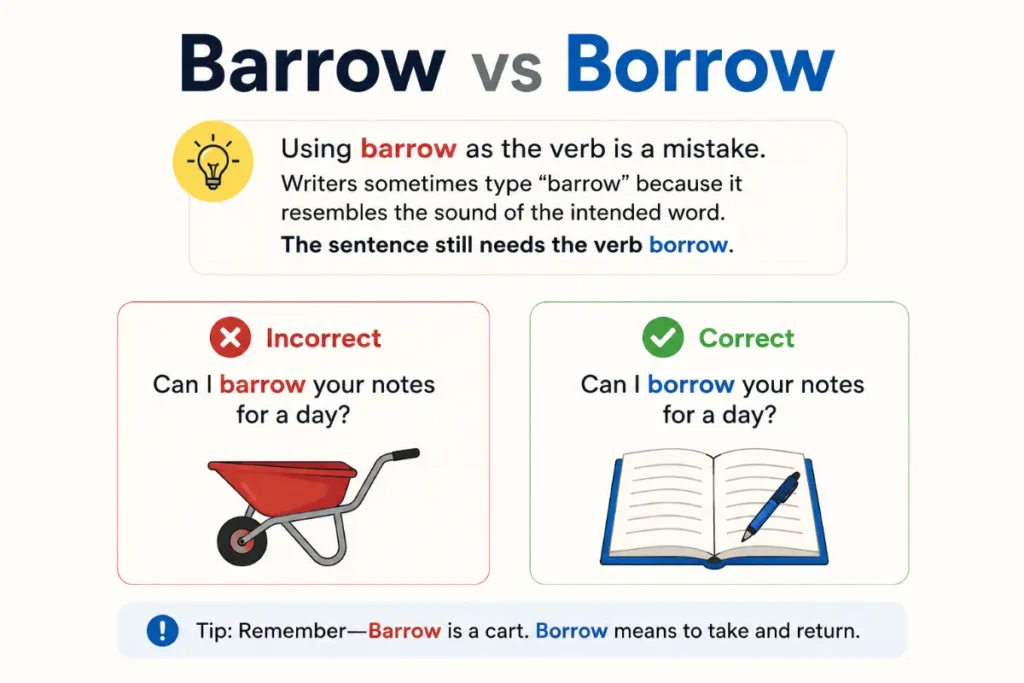
- Incorrect: Can I barrow your pen? Correct: Can I borrow your pen?
- Incorrect: I need to barrow some money. Correct: I need to borrow some money.
- Incorrect: She wants to barrow my book. Correct: She wants to borrow my book.
- Incorrect: Did you barrow my calculator? Correct: Did you borrow my calculator?
- Incorrect: We need to barrow some chairs. Correct: We need to borrow some chairs.
These examples show why context matters. The intended meaning in every incorrect sentence involves temporary use, so borrow is the appropriate word.
Common Mistakes and Misspellings
- Using barrow as the verb. This is the most direct mistake. Writers sometimes type “barrow” because it resembles the sound of the intended word. The sentence still needs the verb borrow.
- Confusing the vowel. The difference between o and a is visually small, particularly during fast typing. A person may know the correct word but still produce the wrong spelling.
- Relying only on sound. English spelling doesn’t always map neatly onto pronunciation. Listening alone can make two forms appear closer than they are.
- Assuming similar words have related meanings. The visual similarity doesn’t mean the words belong to the same semantic family. Their meanings developed separately.
- Using spelling correction without checking meaning. Automatic correction tools can catch many errors, but a careful editor checks the meaning of the complete sentence rather than trusting a replacement automatically.
The NLP confusion behind this error is fairly straightforward. Orthographic similarity means words look similar in written form, while phonological similarity concerns similarities in sound. Borrow and barrow can create both kinds of confusion for learners, especially during rapid writing.
Pronunciation Guide
In standard American English, borrow is commonly pronounced BAIR oh, represented approximately as /ˈbɑːroʊ/ in many pronunciation systems. The exact vowel quality can vary by accent.
Barrow is also commonly pronounced BAIR oh or very similarly in many English varieties. In standard American pronunciation, it is often represented as /ˈbæroʊ/.
The key point is that pronunciation alone may not reliably distinguish the two words for every speaker. This makes spelling and context especially important.
Break borrow into two syllables:
BOR row
Break barrow into two syllables:
BAR row
Say them slowly and pay attention to the first vowel. The distinction becomes clearer in careful speech, although regional accents can reduce the contrast.
A common learner mistake is to hear the first syllable and then choose the spelling that seems visually familiar. That’s risky because English contains many words whose spelling cannot be predicted perfectly from sound.
Etymology and Word Origin
The history of borrow reaches back into Old English and the Germanic language family. Its development is connected with older forms expressing the idea of receiving something temporarily or obtaining something for use.
The modern sense remained closely connected to temporary possession. Over centuries, the word expanded naturally into financial contexts and then into figurative expressions.
The history of barrow is more complicated because the noun has distinct historical senses. The word referring to a cart has Old English and Germanic connections. The archaeological meaning refers to a mound or raised earthwork associated with burial and comes through a separate historical development.
This is a useful reminder that spelling similarity doesn’t necessarily indicate a shared origin. English contains many word pairs that look or sound alike while having separate etymological histories.
Regional Usage
United States
In American English, borrow is extremely common in everyday speech and writing. People routinely borrow money, books, cars, tools, clothing, and other objects. The cart meaning of barrow is less common than wheelbarrow, so many American readers encounter the longer form more often. The archaeological meaning remains established in historical and academic writing.
United Kingdom
British English uses borrow in the same basic sense as American English. Barrow can be more familiar in certain contexts because British English retains several traditional uses of the noun. It may refer to a handcart or appear in historical and archaeological discussions. The distinction between the two spellings remains clear.
Australia
Australian English follows the same basic distinction. Borrow is the normal verb for temporarily taking or receiving something for later return. Barrow appears mainly in contexts involving carts, historical subjects, or archaeological sites. Australian writers don’t normally treat the two as spelling variants.
Canada
Canadian English also follows the standard distinction. Borrow is the everyday verb, while barrow is a separate noun. Canadian usage generally aligns closely with American English for ordinary conversations involving loans and temporary use, although British influenced vocabulary can appear in specialized contexts.
Grammar Rules and Part of Speech
Borrow is a transitive verb when it takes a direct object.
For example:
“I borrowed her book.”
The verb is borrowed, and her book is the object.
You can also use a prepositional phrase to identify the source.
“I borrowed the book from Sarah.”
The natural structure is borrow something from someone.
This is different from lend, which describes the action from the other person’s perspective.
“I borrowed a book from Tom.”
“Tom lent me a book.”
The two actions describe the same exchange from opposite directions.
You should also avoid the common construction “borrow me.” In standard English, a person borrows something from someone. A person lends something to someone.
For example:
“Can I borrow your pen?”
“Can you lend me your pen?”
Both sentences are natural, but “Can you borrow me your pen?” is not standard American English.
Barrow, by contrast, is normally a noun.
For example:
“The worker pushed the barrow.”
“The ancient barrow stood on the hill.”
Because it functions as a noun, it doesn’t normally describe the action of receiving something temporarily.
Real Life Usage Examples
Daily Talk
- “Can I borrow your charger for a few minutes?”
- “The gardener pushed the barrow across the yard.”
The first sentence uses the common verb. The second uses the less frequent noun.
- “Could I borrow the projector for tomorrow’s presentation?”
- “The report discusses an ancient burial barrow discovered near the village.”
The first belongs to ordinary workplace communication. The second fits historical or archaeological writing.
Academic Writing
- “The researchers borrowed the experimental method from an earlier study.”
- “The archaeological team documented the Bronze Age barrow.”
Academic writers may use both words, but their meanings remain completely separate.
News Writing
- “The company borrowed funds to expand its operations.”
- “Archaeologists uncovered a previously unknown burial barrow.”
News writing often uses borrow in financial reporting and barrow in archaeological or historical reporting.
Literature
- “He asked to borrow a book before leaving the house.”
- “The ancient barrow rose above the surrounding fields.”
Literary writers can use both words effectively because context makes the intended meaning clear.
Related and Confused Terms
Several words and phrases can overlap with the meaning of borrow, but they don’t all mean exactly the same thing.
- At last. This often describes something happening after a long wait. “She finally arrived at last” can sound repetitive because both expressions communicate completion after delay.
- Eventually. This means something happens after a period of time, often following delays or developments.
- Ultimately. This focuses on the final result or outcome rather than simply the moment something happens.
- At the end. This points more directly to the final part of a period, event, story, or process.
- In the end. This commonly introduces the final result or conclusion of a situation.
- Lastly. This normally introduces the final item in a sequence or list.
- Conclusively. This means in a way that settles an issue or establishes something decisively. It isn’t a direct replacement for finally in every sentence.
- Ultimately. This can emphasize the final consequence or conclusion of a process rather than the timing of an event.
These terms are useful semantic neighbors for understanding English usage, but they aren’t substitutes for borrow or barrow. The central distinction here remains grammatical and lexical.
Expert Editor Insight
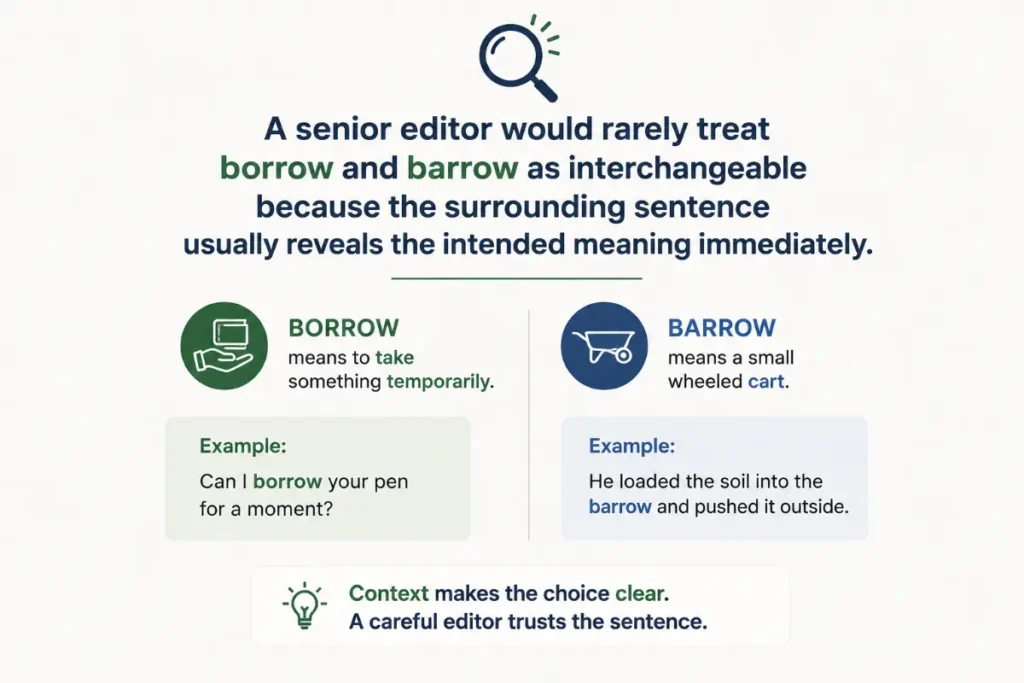
A senior editor would rarely treat borrow and barrow as interchangeable because the surrounding sentence usually reveals the intended meaning immediately. If the sentence contains words such as money, book, car, pen, tool, or from, the writer almost certainly needs borrow. If the sentence refers to a cart, wheelbarrow, mound, burial, or archaeological site, barrow may be correct. Spellcheckers can identify many obvious mistakes, but semantic checking is stronger because a correctly spelled word can still be the wrong word.
Conclusion
borrow vs barrow becomes easy to separate once you connect each spelling with its meaning. Borrow is the verb used when you take or receive something temporarily with the intention of returning it. Barrow is a noun that can describe a small cart or an ancient burial mound. Neither spelling is a replacement for the other.
The biggest source of confusion is their visual and phonetic similarity. That similarity can cause a quick typing error, especially when you’re writing quickly or relying on sound alone. Context provides the best solution. Think about the object or action before choosing the spelling.
A practical editing tip is to remember borrow means receive temporarily, while barrow means a cart or mound. Once you connect the spelling to the meaning, the distinction becomes much easier to remember and apply naturally.
FAQs
Is barrow a real word?
Yes. Barrow is a genuine English word with established dictionary meanings. It can refer to a small cart or a wheelbarrow, and it can also refer to an ancient burial mound. It isn’t an alternative spelling of borrow. The correct choice depends entirely on the meaning and grammatical role required by your sentence.
What does borrow mean?
Borrow means to take or receive something from another person for temporary use with the expectation that it will be returned. You can borrow physical objects such as books and tools, or borrow money. The word is a verb. For example, “I need to borrow your calculator” describes a temporary transfer of use.
borrow vs barrow which is correct?
Both are correct words, but they have different meanings. Use borrow when you temporarily take or receive something that belongs to someone else. Use barrow when referring to a small cart or an ancient burial mound. If you’re asking someone for temporary use of a book, pen, car, or tool, borrow is the correct choice.
How do you pronounce borrow?
In many standard English accents, borrow has two syllables and sounds approximately like BOR oh or BAIR oh, depending on the speaker’s accent. American English commonly represents it with an IPA form such as /ˈbɑːroʊ/. Because accents vary, the safest way to distinguish it from barrow is through spelling and context.
Can borrow start a sentence?
Yes. Borrow can begin a sentence whenever the grammar and meaning call for it. For example, “Borrow my umbrella if you need one” is grammatically possible as an imperative. You can also begin a question with it, such as “Borrowed anything from the library?” in informal speech, although a complete formal sentence would normally use a fuller construction.
What is a synonym for borrow?
Possible synonyms depend on context. Take temporarily, use temporarily, and obtain temporarily can explain the basic idea, but they don’t always sound natural as direct replacements. In financial contexts, take out a loan can express a related idea. None of these expressions should be confused with barrow, which refers to a different noun.
Why do people misspell borrow?
People can confuse borrow with barrow because the words look and sound similar. Fast typing, uncertainty about the vowel, pronunciation differences between accents, and visual memory can all contribute. This is a form of orthographic and phonological confusion. The best solution is to connect the spelling with meaning instead of relying only on sound.
Is borrow suitable for formal writing?
Yes. Borrow is completely standard in formal writing. It appears in academic, financial, legal, journalistic, business, and everyday contexts. The word itself isn’t informal. The main requirement is using it accurately. For example, “The company borrowed funds to finance the expansion” is perfectly appropriate in professional and formal writing.
