
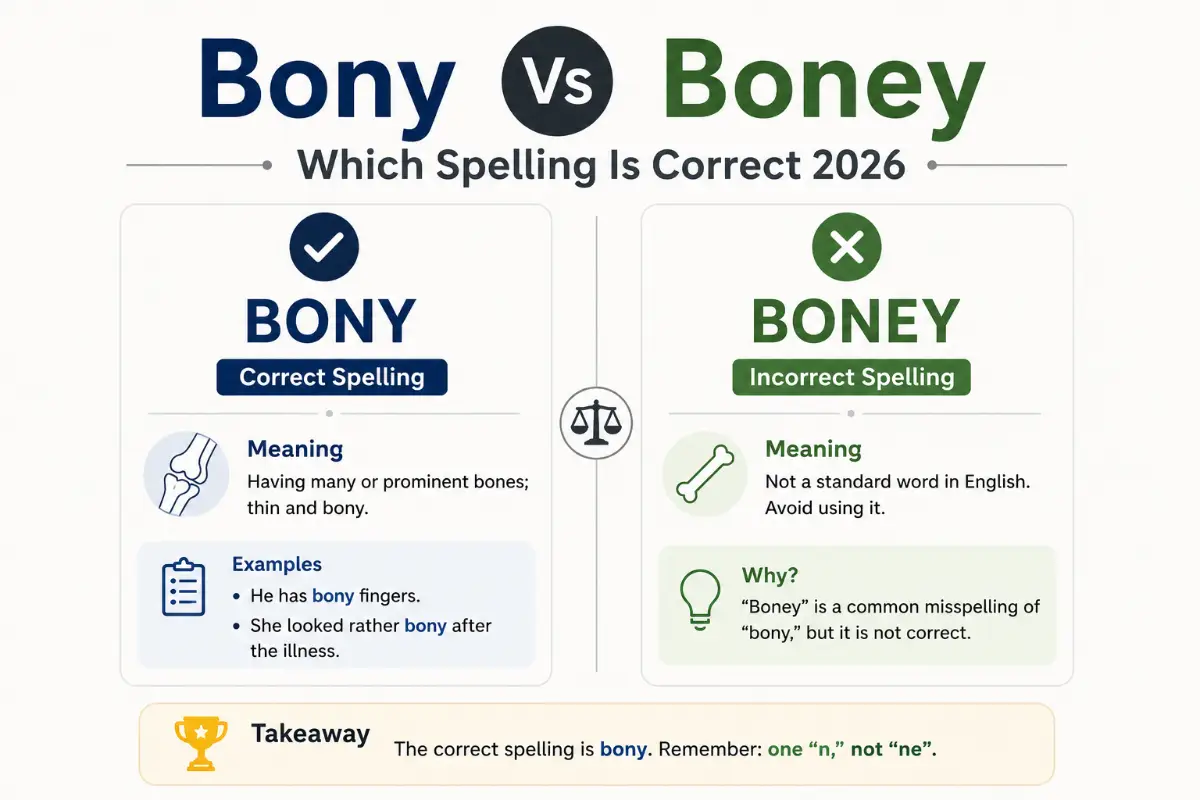
Spelling differences can be surprisingly tricky when two forms look almost identical and sound exactly the same. Bony vs boney is a good example because both spellings appear in English writing, yet they don’t have the same level of acceptance or frequency. If you’ve ever stopped while writing and wondered which form looks right, you’re not alone.
The short answer is simple. Bony is the standard and much more common spelling. Boney is also found as a variant spelling, but it is considerably less common and isn’t the form most editors would choose for ordinary writing. So, if you’re describing someone with very little body fat, something containing many bones, or a skeletal appearance, bony is the safest choice.
The confusion comes from a familiar English spelling pattern. Words ending in a consonant plus y can sometimes look as if they should take an extra letter before the ending. English also contains legitimate spelling variants, which makes visual intuition unreliable. This guide explains the meaning, pronunciation, grammar, history, regional usage, common mistakes, and practical differences between the two forms so you can choose confidently.
Featured Snippet Quick Definition
Bony is the standard spelling of the adjective meaning having prominent or visible bones, containing many bones, or resembling a skeleton. Boney is a less common variant spelling with the same basic meaning. For everyday, academic, professional, and formal writing, bony is the preferred choice.
Quick Answer
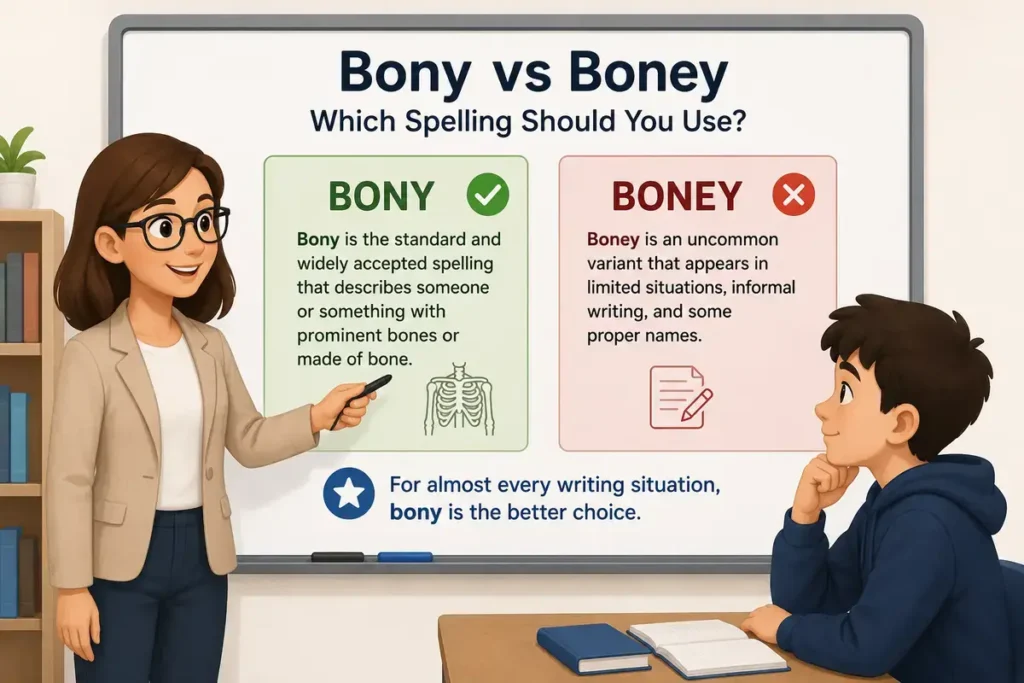
Bony is the preferred spelling in standard English. Boney exists as a less common variant, so it isn’t best described as a simple spelling error in every context.
If you’re writing an email, article, essay, report, or other standard English text, choose bony. It is the familiar form used by major dictionaries and is overwhelmingly more common in ordinary modern usage.
Comparison Table: Bony or Boney
| Correct Form | Meaning | Part of Speech | Origin | Usage Frequency | Formality | Common Contexts | Example |
|---|---|---|---|---|---|---|---|
| Bony | Having prominent bones, containing many bones, or resembling a skeleton | Adjective | From bone plus the adjective ending y | Very common | Standard and neutral | People, animals, anatomy, fish, food, structures | The dog had a bony frame. |
| Boney | Having prominent bones or a skeletal appearance | Adjective | Variant formation from bone plus y | Much less common | Standard as a variant but uncommon | Descriptive writing, names, informal usage, historical or regional contexts | The old horse looked boney after the winter. |
Meaning and Definition
Meaning of Bony
Bony is an adjective derived from the noun bone. It generally describes something connected with bones or something in which bones are especially noticeable.
When you describe a person or animal as bony, you usually mean that the person’s bones are prominent because there is relatively little flesh or body fat covering them.
For example, you might say that someone has a bony face. That doesn’t necessarily mean the person is unhealthy. It can simply describe facial structure, such as prominent cheekbones or a narrow jaw.
The word also has broader meanings. A fish can be called bony because it contains many bones. A bony structure can refer to something involving the skeleton or composed largely of bone.
Context determines the precise shade of meaning.
Meaning of Boney
Boney carries essentially the same basic meaning as bony. It can describe someone or something that has prominent bones or a skeletal appearance.
The key difference isn’t usually meaning. The difference is spelling frequency and editorial preference.
Some dictionaries recognize boney as a variant of bony, which means calling it completely nonexistent would be inaccurate. However, it is much less common in general modern writing. Many readers are more likely to perceive boney as an unusual spelling because bony is the overwhelmingly familiar form.
That distinction matters when you’re choosing a spelling for professional writing. A word can exist as a legitimate variant and still be a poor choice for most situations.
Key Differences Explained
- Spelling. The main visual difference is the additional e in boney. The preferred standard form is bony.
- Meaning. Both forms can describe something associated with bones or something with prominent bones. Their core meanings overlap.
- Grammar role. Both forms function primarily as adjectives. They can modify nouns such as face, body, fish, structure, hand, frame, or appearance.
- Tone. Bony sounds natural and familiar to modern English speakers. Boney can sound unusual because readers encounter it much less often.
- Context. Bony works comfortably in casual conversation, journalism, academic writing, professional prose, and general description. Boney is more likely to appear as a variant, in names, or in less common usage.
- Editorial preference. Professional editors will normally choose bony unless there is a specific reason to preserve boney, such as a proper name or an established source spelling.
Which Spelling Is Correct?
Bony is the correct and preferred spelling for standard everyday English.
There is one useful qualification. Boney is not simply a meaningless collection of letters. It appears as a variant spelling in English sources and dictionaries. That means an editor should distinguish between an uncommon variant and an outright misspelling.
Major dictionary references such as Merriam Webster, Oxford English Dictionary, Cambridge Dictionary resources, and Collins support the established use of bony. Dictionary treatment also shows why context matters when evaluating a less common variant.
For practical writing, the rule is easy: use bony.
If you’re writing a sentence such as “The cat has a bony frame,” there is no reason to choose the less familiar form. Bony is clearer, more conventional, and less likely to distract the reader.
Sentence Examples
Examples With Bony
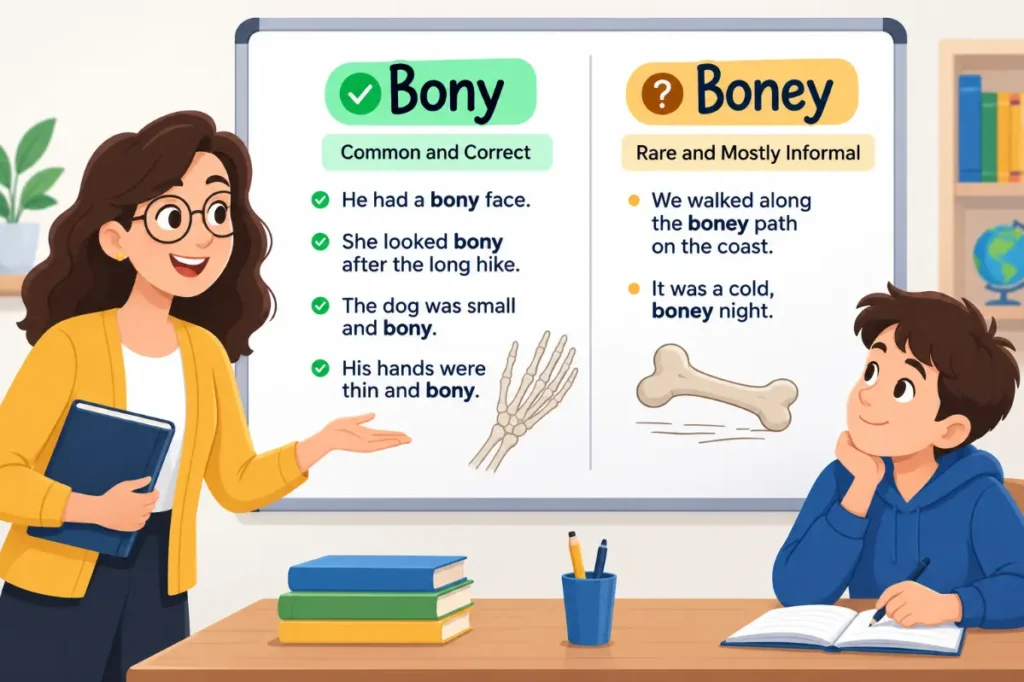
- The rescue dog had a bony frame when it arrived at the shelter.
- His bony fingers moved slowly across the keyboard.
- The fish has a bony skeleton that makes it difficult to eat without careful preparation.
- She has a naturally bony face with prominent cheekbones.
- The old horse looked bony after months of poor nutrition.
- The doctor examined the bony structure of the patient’s hand.
- A bony ridge was visible along the animal’s back.
- The artist used a bony figure to create a sense of age in the portrait.
- The bird’s bony wings were surprisingly strong.
- The thin jacket did little to hide his bony shoulders.
Examples With Boney as a Variant
- The old horse looked boney after the harsh winter.
- The character was described as a tall and boney man with narrow shoulders.
- The artist gave the creature a long and boney appearance.
- The dog had a noticeably boney frame when it was first rescued.
- The novel describes the character as thin and boney.
These examples demonstrate an important point. Boney can be encountered as a variant, but bony is the form most readers expect.
Common Mistakes and Misspellings
Why People Type Boney
The extra e in boney is understandable. English spelling contains many words in which an e appears before a suffix, so writers sometimes create a spelling based on how the word feels visually rather than on established usage.
The word bone already ends in e. When the adjective ending y is added, English generally produces bony, not boney.
This is similar to other spelling patterns where a silent final e disappears before a suffix beginning with a vowel. The spelling process isn’t perfectly consistent across English, which is why learners often rely on memory.
Common Error One
Writing boney automatically assuming that the e from bone must remain.
The noun is bone, but the common adjective is bony.
Common Error Two
Assuming that boney must be completely wrong because it looks unfamiliar.
That conclusion goes too far. Variant spellings can exist even when one form is strongly preferred.
Common Error Three
Treating pronunciation as a spelling guide.
Both forms are normally pronounced the same way, so sound alone doesn’t help you select the preferred spelling.
Common Error Four
Using a spelling checker as the only authority.
A spell checker can flag unusual variants, but software isn’t a complete substitute for a dictionary or professional editorial judgment.
Common Error Five
Changing a quoted or proper name into the preferred spelling.
If a person’s name, title, historical source, or established name uses Boney, don’t automatically change it to Bony. Proper names follow their established spelling.
Pronunciation Guide
Both bony and boney are normally pronounced the same way.
The common pronunciation is:
IPA: /ˈboʊni/
You can think of it as:
BOH nee
The word has two syllables:
BOH + nee
The first syllable receives the main stress. The vowel sound in the first syllable is the long o sound commonly heard in words such as “go” and “home.”
The second syllable sounds like the ending in words such as “sunny” and “funny.”
A common learner mistake is to pronounce the word as two equally stressed syllables. Natural English places stronger stress on the first syllable.
Another useful point is that the spelling difference doesn’t normally create a pronunciation difference. The extra e in boney doesn’t give it a separate standard sound.
Etymology and Word Origin
The story begins with bone, one of the oldest and most fundamental words in the English vocabulary.
Bone comes from Old English bān, which referred to the hard skeletal material found in humans and animals. The word has deep Germanic roots and is related to similar words in other Germanic languages.
English frequently creates adjectives by adding y to nouns. The ending generally conveys the idea of having, containing, resembling, or being characterized by something.
That pattern gives us words such as:
- Cloudy from cloud.
- Rainy from rain.
- Hairy from hair.
- Muddy from mud.
- Bony from bone.
The spelling becomes slightly less obvious because the final e in bone is not retained in the standard adjective bony.
Historically, English spelling developed through several stages and was influenced by Old English, Middle English, French, Latin, and later printing conventions. Modern spelling therefore contains many patterns that aren’t perfectly predictable from pronunciation alone.
The form boney developed as a variant spelling, preserving the visual connection with bone. Although that spelling can be found in English, bony became the established mainstream form.
Regional Usage
United States
In American English, bony is the normal spelling. It appears naturally in general writing, medical and anatomical descriptions, journalism, fiction, and everyday conversation. Boney may be understood, but most American readers are more accustomed to bony.
United Kingdom
British English also commonly uses bony. There isn’t a major British spelling rule that requires boney. The variant may appear, but bony remains the safer choice in standard British writing.
Australia
Australian English generally follows the same pattern. Bony is the familiar standard spelling, while boney is considerably less common. Writers seeking a conventional spelling should choose bony.
Canada
Canadian English likewise favors bony. The less common variant can still be recognized, but it isn’t normally the first choice in edited Canadian prose.
The broader regional pattern is therefore straightforward. Unlike pairs such as American color and British colour, this isn’t a major regional spelling difference. English speakers across these varieties generally prefer bony.
Grammar Rules and Part of Speech
Both forms function primarily as adjectives.
An adjective modifies or describes a noun. In this case, the word can describe a physical feature, anatomical structure, animal, food, or anything else associated with noticeable bones.
Consider these examples:
- She has a bony face.
- The dog developed a bony appearance.
- The fish has a bony skeleton.
- His bony hands rested on the table.
The adjective can appear before a noun. It can also appear after a linking verb.
For example:
“The horse looked bony.”
Here, bony follows the linking verb “looked” and describes the horse.
You can also use it in a phrase such as:
“the bony structure of the shoulder.”
Punctuation doesn’t change simply because the word appears in a particular position. It follows the normal punctuation rules of the sentence.
There is also an important meaning distinction based on context. Calling a person bony can describe body shape, but it may sound negative or insensitive in some situations. In medical, anatomical, or objective contexts, the word can be purely descriptive.
Good writing considers both grammar and tone.
Real Life Usage Examples
Daily Talk
- “That dog looks a little bony. Has it been eating properly?”
- “He has a naturally bony face and sharp cheekbones.”
These examples show how the word can describe physical appearance in ordinary conversation.
- “The horse appeared unusually bony when it arrived at the farm.”
- “The report includes an image of the bony structure for reference.”
In professional communication, the word can be useful when the description needs to be precise.
Academic Writing
- “The study examines the development of bony structures in early vertebrates.”
- “Researchers compared the bony anatomy of several related species.”
Academic writing often uses the word in anatomy, biology, zoology, paleontology, and related fields.
News Writing
- “The rescue team found several bony animals in the abandoned property.”
- “The researchers discovered a bony structure preserved in the fossil layer.”
News writing tends to favor the conventional spelling because clarity and familiarity matter.
Literature
- “His bony hands rested against the worn wooden table.”
- “The creature’s bony silhouette appeared against the moonlit wall.”
Writers can use the word for atmosphere, characterization, and visual imagery.

Expert Editor Insight
As an editor, I’d recommend a simple rule: choose bony unless you have a specific reason to preserve boney. A native English reader will immediately understand both in most contexts, but bony feels natural and conventional. Automated writing tools may flag boney as unusual because their dictionaries and frequency models strongly favor the common form. That doesn’t automatically prove that every appearance of the variant is an error. Dictionary evidence, context, and the purpose of the text should guide the final decision.
Expert Tip
When you’re unsure about a spelling variant, don’t ask only whether the alternative exists. Ask which form is standard, frequent, and appropriate for your audience.
That three part test is especially useful for English spelling questions.
A dictionary may recognize a variant while professional editors still prefer another form. This happens because dictionary inclusion and editorial recommendation are not identical things.
For normal writing, the practical answer remains bony.
Conclusion
Bony vs boney is mainly a question of standard usage rather than a dramatic difference in meaning. Bony is the preferred spelling and the form you should normally use in everyday, academic, professional, and formal English. Boney exists as a less common variant, so it isn’t accurate to label every appearance as completely invalid.
The two forms generally share the same pronunciation and basic adjective meaning. The main practical difference is familiarity. Readers are far more accustomed to bony, which makes it the clearer choice in most situations. The spelling also follows a familiar English pattern in which the final e of bone isn’t retained before the adjective ending y.
The easiest tip is to remember bone becomes bony. If you’re writing for a general audience and want the conventional form, choose bony. That small spelling choice keeps your writing natural, polished, and easy to read.
FAQs
Is boney a real word?
Yes. Boney can be found as a variant spelling of bony in English sources. However, it is much less common than bony. Its existence doesn’t make it the preferred choice for ordinary writing. If you’re writing an essay, article, email, report, or professional document, bony is normally the better option because readers are more familiar with it.
What does bony mean?
Bony is an adjective meaning having prominent or noticeable bones, containing many bones, or relating to bone. You can describe a person as having a bony face, a dog as having a bony frame, or a structure as being bony. The exact meaning depends on context, but the central idea involves visible, prominent, or skeletal bone.
Bony or boney which is correct?
Bony is the preferred spelling in standard modern English. Boney is recognized as a less common variant, so it isn’t accurate to treat every occurrence as an outright spelling error. Still, bony is the form you should normally choose for clear and conventional writing. It is substantially more familiar to English readers.
How do you pronounce bony?
Bony is normally pronounced /ˈboʊni/, which can be represented as “BOH nee.” It has two syllables, with the main stress on the first syllable. Boney normally has the same pronunciation. The additional e in the less common spelling doesn’t normally create a different standard pronunciation.
Can bony start a sentence?
Yes. Bony can begin a sentence whenever it functions as an adjective modifying a noun or introducing a descriptive phrase. For example, “Bony fingers rested on the edge of the desk.” There is no grammar rule that prevents an adjective from appearing at the beginning of a sentence. Sentence position depends on the structure and intended meaning.
What is a synonym of bony?
Depending on context, possible alternatives include skeletal, thin, gaunt, angular, lean, or osseous. These words aren’t perfect substitutes in every situation. Skeletal can emphasize a very thin or bone like appearance, while osseous is more technical and specifically relates to bone. Choose the synonym that matches the intended meaning.
Why do people misspell bony?
People often write boney because they naturally connect the adjective with the spelling of the noun bone. Since the noun contains a final e, it can feel logical to keep that letter before adding y. English spelling doesn’t always follow the most visually obvious pattern. Familiarity with established word forms is therefore more reliable than spelling by intuition.
Is bony suitable for formal writing?
Yes. Bony is fully suitable for formal writing when its meaning fits the context. It can appear in academic, medical, scientific, journalistic, and professional prose. In formal writing, use bony rather than the less common boney unless you’re preserving a specific name, quotation, source spelling, or established variant. Precision and conventional usage usually make the first form preferable.
