
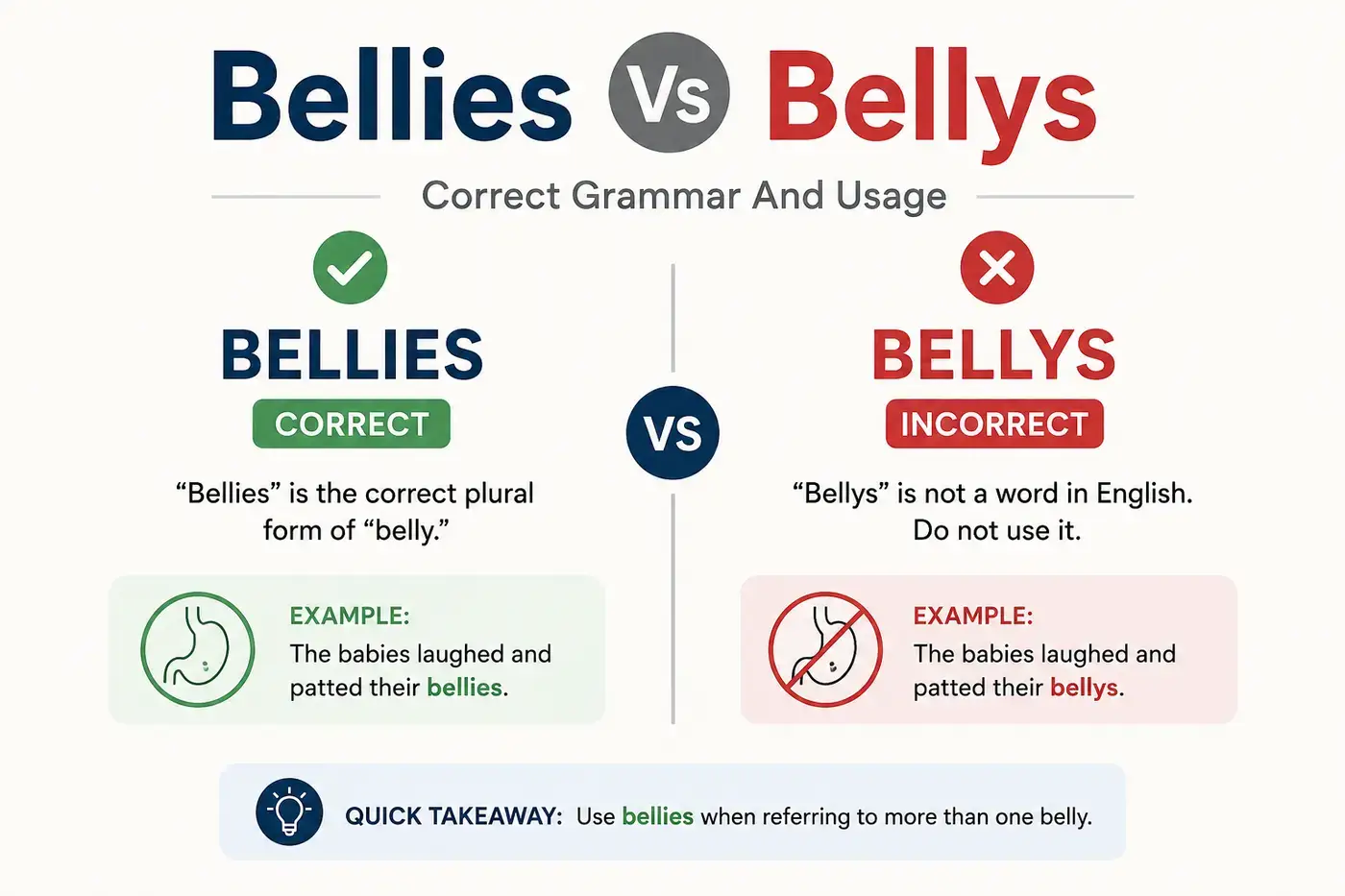
A small spelling mistake can make an otherwise polished sentence look careless. The confusion between bellies vs bellys is a good example because the correct form doesn’t follow the pattern people often expect. If you know the singular word belly then you might naturally think that adding s gives you bellys. That seems logical at first glance.
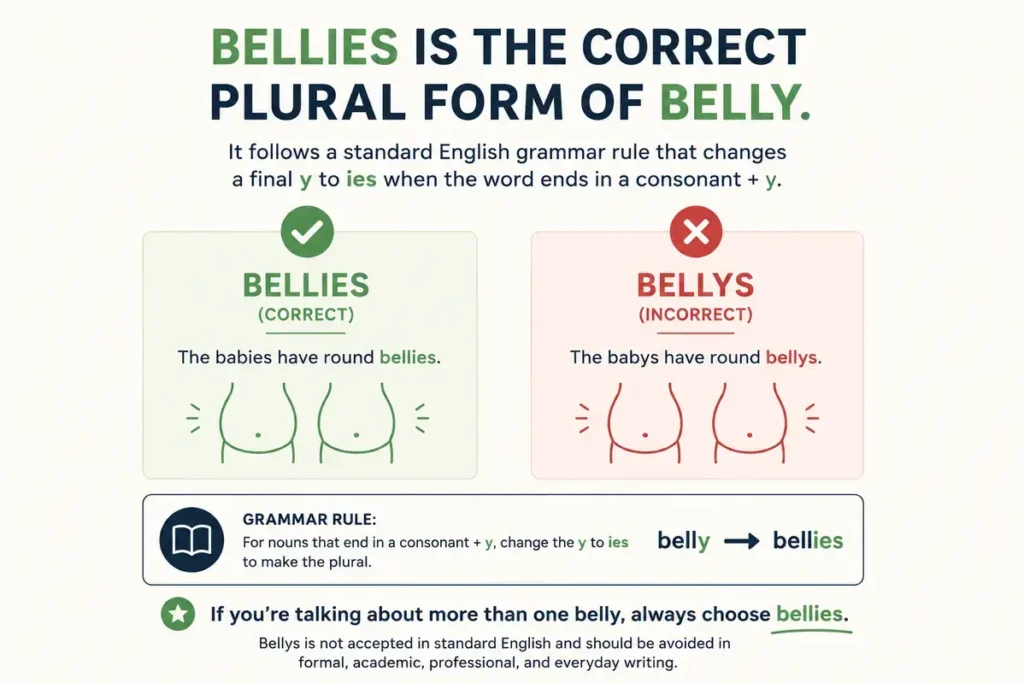
The correct spelling is bellies. Bellys is a misspelling in standard English. When belly becomes plural the final y changes to i before the plural ending es is added. So you get bellies rather than bellys.
This spelling rule causes confusion because English has several different ways to form plurals. Words ending in y don’t all behave in exactly the same way. In this guide you’ll learn why the spelling changes, how to pronounce the plural form, how to use it naturally in American English, and which related words can cause similar mistakes. You’ll also see clear examples that show how native speakers actually use the word.
Quick Definition
Bellies is the correct plural form of belly. It means more than one belly or stomach area. The spelling changes the final y to i and adds es. Bellys isn’t the standard plural spelling. If you’re writing about two or more bellies, use bellies.
Quick Answer
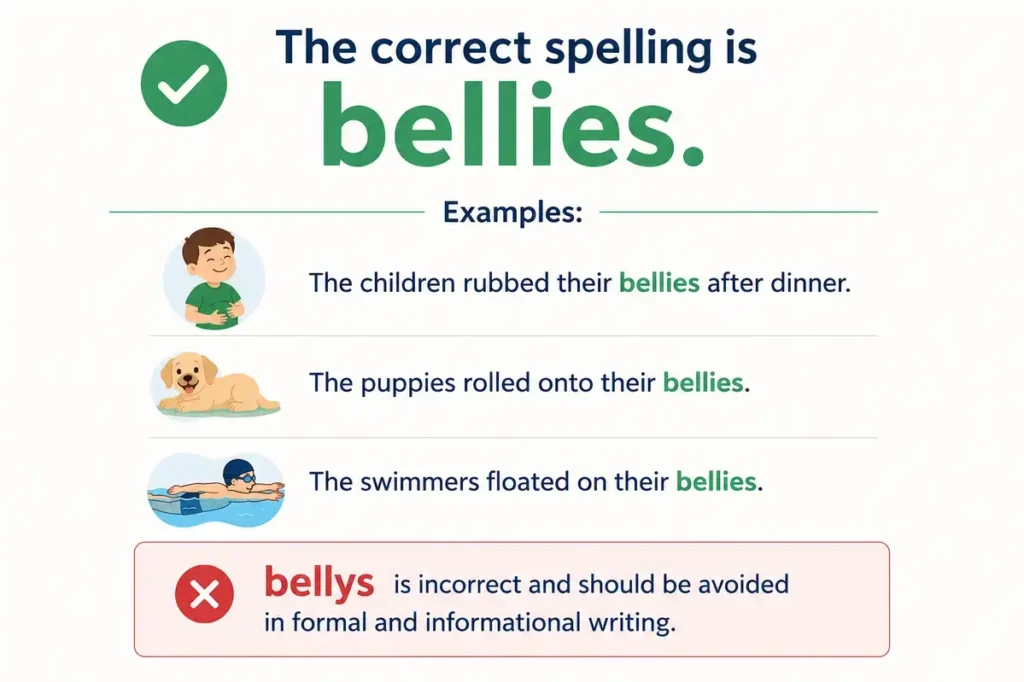
The correct spelling is bellies.
The word belly ends in a consonant followed by y. To make it plural, English changes the y to i and adds es. Therefore, belly becomes bellies. The form bellys is a common spelling mistake and shouldn’t be used in standard English.
Comparison Table For The Two Spellings
| Correct Form | Meaning | Part of Speech | Origin | Usage Frequency | Formality | Common Contexts | Example |
|---|---|---|---|---|---|---|---|
| Bellies | More than one belly | Noun | Middle English and Old English roots | Common | Standard | People animals food and figurative writing | The babies had full bellies after dinner. |
| Bellys | No standard plural meaning | Noun form used incorrectly | Not a standard English plural | Very uncommon | Nonstandard | Spelling mistakes or accidental typing | Bellys is incorrect in standard English. |
The Meaning Of Belly
The word belly is a common noun with several related meanings. Its most basic meaning refers to the front part of the human body between the chest and hips. In everyday American English, people often use belly as a friendly or informal alternative to stomach.
For example, someone might say that they have a full belly after a large meal. A parent might talk about a baby’s little belly. A person may also say that they have a belly when talking about weight around the middle of the body.
The word can describe animals too. A dog has a belly. A horse has a belly. A bird has a belly. The word can also describe the underside or rounded part of an object or structure. That broader meaning explains why belly appears in many different contexts.When the noun refers to more than one belly, the plural is bellies.
Meaning Of Bellys
Bellys isn’t the standard plural form of belly. In ordinary English writing, it should be treated as a spelling error. You may occasionally encounter bellys online because people often type words quickly or apply the wrong plural rule. A search engine or spell checker may also encounter the form in user generated content. That doesn’t make it an accepted plural.
There are also situations where a nonstandard spelling might appear as part of a username, business name, product name, character name, or other proper name. In that specific setting, the spelling belongs to that name rather than representing the standard English plural. For normal writing, don’t use bellys. Write bellies.
Meaning Of Bellies
Bellies is the plural noun formed from belly. It refers to two or more bellies. The meaning depends on context. It can refer to human bodies, animal bodies, or the rounded underside of something.
Consider these examples.
- The children rubbed their bellies after eating.
- The puppies slept with their bellies facing the sun.
- The campers filled their bellies before heading back to the trail.
- The fish have silver bellies.
The word can also appear in figurative expressions. For example, full bellies can suggest that people have enough food. The expression can carry a warm and comforting feeling because food and a full stomach are closely connected with satisfaction.
Why The Spelling Changes
The key to understanding this plural is the final y. English has a common spelling pattern for nouns that end in a consonant followed by y. When you make these words plural, the y usually changes to i and es is added.
That gives you this pattern.
- Belly becomes bellies.
- Baby becomes babies.
- City becomes cities.
- Story becomes stories.
- Family becomes families.
This isn’t just a random spelling trick. It’s a standard English pluralization pattern. The spelling becomes different when a word ends in a vowel followed by y. In those words, the y normally stays in place and you simply add s.
For example.
- Boy becomes boys.
- Toy becomes toys.
- Day becomes days.
- Key becomes keys.
- Journey becomes journeys.
This distinction is one reason people make mistakes. They see the final y and assume every word behaves the same way. It doesn’t.
In belly, the letter before y is l, which is a consonant. That places the word in the group that normally changes y to i before the plural ending.
The Key Difference Between The Forms
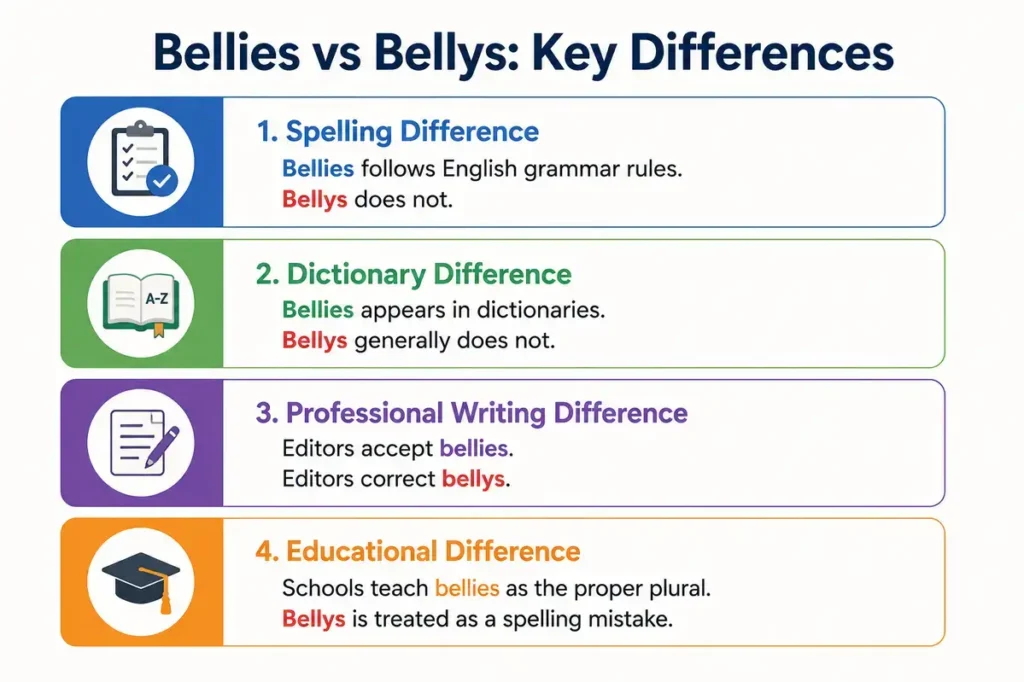
The difference between the two spellings isn’t a difference in meaning. It’s a difference between a standard plural and a spelling error.
Spelling
Bellies follows the standard English plural rule.
Bellys doesn’t.
The spelling changes from y to i before the plural ending is added.
Grammar Role
Bellies is a plural noun. It refers to more than one belly.
The singular noun is belly.
You can use the word as the subject or object of a sentence.
For example.
- Their bellies were full.
- The children covered their bellies with blankets.
- The puppies have round bellies.
Meaning
Both forms may appear to represent the same intended idea, but only bellies correctly expresses the plural of belly in standard English.
Tone
There isn’t a special difference in tone between the two spellings. Bellies works in casual conversation and formal writing when the meaning fits the context.
The word belly itself can sound more conversational than abdomen. In medical or highly technical writing, abdomen may be more appropriate.
Context
You’ll find bellies in everyday speech, fiction, journalism, descriptions of animals, food writing, parenting discussions, and many other settings.
For example, a writer might say that the puppies have round bellies. A journalist might describe people waiting with empty bellies after a food shortage. A novelist might describe characters laughing until their bellies hurt.
Which Spelling Is Correct
Bellies is the correct spelling. The reason comes from a standard English plural formation rule. When a singular noun ends in a consonant followed by y, the y usually changes to i and es is added. The same pattern appears in baby to babies, city to cities, and story to stories.
Major English dictionaries recognize belly as a noun and give bellies as its plural form. This dictionary based approach matters because spelling isn’t determined simply by what looks logical. Standard usage and established grammatical patterns determine the accepted form.
A useful editing habit is to check the singular word before forming the plural. If you know that the singular is belly, remember the pattern instead of simply attaching s.
Sentence Examples With Bellies
Seeing the word in natural sentences makes the spelling easier to remember.
- The children had full bellies after the family dinner.
- The puppies rolled onto their backs and showed their round bellies.
- The hikers stopped for lunch and filled their bellies before continuing.
- The babies had tiny bellies and chubby cheeks.
- The kittens slept with their bellies pressed against each other.
- The fish had pale bellies and dark backs.
- Everyone laughed until their bellies hurt.
- The horses had dusty bellies after running through the field.
- The campers went to bed with warm food in their bellies.
- The little children rubbed their bellies after eating too much cake.
These examples also show that the word works naturally across many situations. It can describe people, animals, physical features, and figurative experiences.
Examples Showing The Misspelling
The form bellys is incorrect in standard English. These examples show how the mistake might appear.
- Incorrect: The babies have round bellys.
- Incorrect: Their bellys were full after dinner.
- Incorrect: The puppies have soft bellys.
- Incorrect: Everyone laughed until their bellys hurt.
- Incorrect: The fish have white bellys.
In each sentence, replace bellys with bellies. This is a useful correction because the mistake is usually easy to fix once you remember the plural rule.
Common Spelling Mistakes
The spelling error doesn’t happen in isolation. English learners and native speakers can make several related mistakes when forming plurals.
- Bellys
This is the most direct mistake. The writer adds s without changing the y.
- Bellyes
Some writers recognize that an extra ending is needed but add es without changing y. The result isn’t correct.
- Belies
This form changes the spelling too much. It can also be confused with the verb belie, which has a completely different meaning.
- Bellieses
This happens when someone adds another plural ending after already forming the plural correctly. The standard form is simply bellies.
- Belly’s
An apostrophe doesn’t form an ordinary plural. Belly’s usually indicates possession or represents a contraction in a completely different construction. It isn’t the normal plural form.
Why People Type The Wrong Form
There are several reasons the misspelling feels natural. First, many English nouns form their plurals by simply adding s. Writers learn patterns such as book to books and car to cars very early. That pattern can become automatic.
Second, the letter y creates visual confusion. Some words keep y when they become plural while others change it. Third, typing habits can make the problem worse. People often type according to sound rather than spelling. The pronunciation doesn’t clearly announce that the written form needs an i and es.
From an NLP perspective, this is a form of orthographic confusion. The writer recognizes the correct lexical item but selects an incorrect written form. The brain understands the word while the spelling process produces a competing pattern. This is why a person can know exactly what bellies means and still type bellys.
Pronunciation Guide
The singular belly is pronounced differently from how some learners might expect from the spelling. The standard pronunciation of belly is approximately BEL ee. The plural bellies is pronounced approximately BEL eez.
The IPA pronunciation is commonly represented as:
belly: /ˈbɛli/
bellies: /ˈbɛliz/
You can think of the plural as two syllables.
BEL eez.
The first syllable receives the main stress. The final sound is similar to the sound in words such as easy and busy.
A common pronunciation mistake is to treat the plural ending like the sound in cats. That doesn’t fit here. The final sound in bellies is voiced.
Say it slowly.
BEL eez.
Then say it naturally.
bellies.
The spelling change from y to ies doesn’t create a major pronunciation surprise. The plural still sounds very close to what you’d expect once you’ve heard it spoken.
Etymology And Word Origin
The history of belly reaches far back into English. The modern word developed from Old English belig or related forms referring to a bag or belly. Over time, the word developed into Middle English forms that moved closer to the modern spelling and pronunciation.
The word has Germanic roots rather than coming directly from Latin. That history is useful because it shows how ordinary body words often preserve very old parts of the English vocabulary. English speakers have used belly for the body area for centuries. The word also developed broader meanings. It can describe the inside or lower part of something or a rounded section of an object.
That broader use can be seen in expressions such as the belly of a ship or the belly of a curve. The plural follows the regular spelling pattern that developed within English. The historical origin doesn’t change the modern rule. In contemporary standard English, belly becomes bellies.
Regional Usage In The United States
American English uses bellies as the standard plural of belly. There isn’t a separate American plural such as bellys. The word belly itself is common in everyday American speech. It can sound informal and friendly compared with more technical words such as abdomen.
For example, an American speaker might say, “My belly hurts” in casual conversation. In a medical setting, a doctor might use abdomen instead. The plural follows the same spelling rule across American English.
Regional Usage In The United Kingdom
British English also uses bellies as the standard plural.
The spelling difference sometimes seen between American and British English doesn’t apply here. Words such as color and colour can vary by region, but belly and bellies don’t have a regional plural distinction of this kind.
A British writer would normally write bellies.
Regional Usage In Australia
Australian English follows the same standard spelling.
The plural is bellies. The form bellys isn’t an accepted regional alternative.
Australian speakers may use belly in informal conversation just as American and British speakers do. The context can affect tone, but the spelling rule remains the same.
Regional Usage In Canada
Canadian English also uses bellies.
Canadian spelling combines influences from British and American English in different areas, but this particular word doesn’t create a regional spelling split.
If you’re writing for a Canadian audience, bellies is the standard choice.
Grammar Rules And Part Of Speech
Belly is primarily a noun. Its plural form is bellies.
The word can serve as the subject of a sentence.
- The bellies of the puppies were round.
It can also serve as the object.
- The children covered their bellies.
The word can appear after possessive determiners.
- Their bellies were full.
- The babies held their bellies.
It can also appear in idiomatic expressions.
- They laughed until their bellies hurt.
- He had enough food in his belly to last the afternoon.
The position of the word depends on its grammatical role. You don’t need special punctuation simply because the word is plural.
An apostrophe isn’t used to create the plural.
Write:
The puppies have round bellies.
Not:
The puppies have round belly’s.
If you need to show possession, the apostrophe becomes relevant.
For one belly, you can write:
The dog’s belly was dirty.
For multiple dogs, you can write:
The dogs’ bellies were dirty.
Notice the difference. The apostrophe expresses possession. The ies ending expresses plurality.
Real Life Usage Examples
The word appears in many kinds of writing. The surrounding context can change the feeling without changing the spelling.
Daily Talk
- My belly is so full after that meal.
This sounds casual and natural in everyday American conversation.
- The kids are rubbing their bellies because they ate too much.
This sentence has a friendly conversational tone.
Email Writing
- The children arrived with empty bellies after the long trip.
This could fit a friendly message about travel or family.
- We’ll make sure everyone has full bellies before we leave.
This sounds warm and informal.
Academic Writing
Academic writing usually favors precise terminology. Bellies can still appear when the subject requires the word.
- The study examined how the body shapes of the animals differed around their bellies.
- The researchers measured the animals’ bellies before and after feeding.
If the subject is anatomy, abdomens may be more appropriate in a technical paper.
News Writing
- The community kitchen served hundreds of meals and sent families home with full bellies.
- The rescued animals arrived with thin bodies and empty bellies.
News writing can use the word when a more human and accessible tone is appropriate.
Literature
Writers often choose belly and bellies because the words feel vivid and physical.
- The children laughed until their bellies ached.
- The puppies slept peacefully with their warm bellies against the blanket.
These examples show why word choice matters. Abdomens would sound more clinical. Bellies sounds warmer and more personal.
An Expert Editor Insight
As an editor, one of the easiest ways to avoid this mistake is to stop thinking of the plural as simply adding a letter. Look at the ending of the singular word first. When a noun ends in a consonant plus y, check the y to i pattern before adding the plural ending. Belly becomes bellies, just as city becomes cities and family becomes families. Spell checkers will usually flag bellys, but don’t rely entirely on software. A dictionary and a basic understanding of plural formation give you a much stronger editing habit. If you remember one rule, remember this: consonant plus y usually changes to i before the plural ending.
A Note About The Two Spelling Questions
There is an easy trap in spelling discussions. A reader may search for one word pair while the article accidentally shifts to another. That can make an otherwise useful explanation confusing.
For the primary spelling question in this article, the answer is straightforward.
Belly becomes bellies.
The incorrect form is bellys.
The spelling pattern is the same one you see in several familiar English nouns. Baby becomes babies. City becomes cities. Story becomes stories. Once you recognize the pattern, the correct spelling becomes much easier to remember.
The separate question involving finaly and finally follows a different spelling issue. Finally is the correct form there, but it isn’t the plural of belly. Keeping those two word pairs separate helps prevent one spelling lesson from becoming tangled with another.
A Simple Memory Trick
If you regularly forget the plural spelling, use a short visual trick.
Think:
belly → bellies
Then connect it with:
baby → babies
The two words follow the same basic pattern.
You can also remember the sentence:
One belly becomes two bellies.
That simple rhythm can stick in your mind better than a long grammar explanation.
Another useful method is to look at the letter immediately before the final y. In belly, the letter is l. That’s a consonant. A consonant plus y commonly changes to ies in the plural.
So:
belly → bellies
But:
boy → boys
The difference becomes much easier to see when you compare the two patterns.
Why Standard Spelling Matters
Spelling isn’t just about passing a grammar test. Correct spelling helps readers understand your meaning without interruption.
When someone sees bellies, they immediately recognize the plural of belly. When they see bellys, many readers pause because the form looks unfamiliar.
That pause is small, but clear writing removes unnecessary friction.
This matters in emails, school assignments, websites, professional documents, social media posts, and published work. A single misspelling usually won’t destroy communication, but repeated errors can affect how polished the writing feels.
The good news is that this particular mistake is easy to prevent. You don’t need to memorize a complicated exception. Just remember the consonant plus y plural pattern.
Conclusion
Bellies vs bellys has a simple answer. Bellies is the correct plural form of belly, while bellys is a standard spelling error. The change happens because belly ends in a consonant followed by y. English normally changes that y to i and adds es when forming the plural.
The rule becomes easier when you compare it with familiar words such as baby to babies, city to cities, and story to stories. The same spelling pattern appears in all of them. The word works naturally in casual conversation, formal writing, descriptions of people and animals, and many figurative expressions.
The easiest practical tip is to remember belly becomes bellies. If you pause for one second and check the final y before adding the plural ending, you’ll avoid the mistake almost every time.
FAQs
Is Bellies A Correct Word?
Yes. Bellies is the correct plural form of belly. For example, “The babies had full bellies.”
Is Bellys Correct Spelling?
No. Bellys is not the standard spelling. The correct plural form of belly is bellies.
Why Is Belly Spelled Bellies In The Plural?
When a word ends in a consonant followed by y, the y usually changes to ies in the plural. So belly becomes bellies.
What Is The Plural Of Belly?
The plural of belly is bellies. For example, “The children rubbed their bellies after dinner.”
Is It Two Bellies Or Two Bellys?
The correct phrase is two bellies. The spelling bellys is incorrect.
What Is The Difference Between Bellies And Bellys?
Bellies is the correct plural of belly. Bellys is a misspelling and should not be used in standard English.
How Do You Spell Bellies?
The correct spelling is B E L L I E S. It is the plural form of belly.
Is Bellies Used In American English?
Yes. Bellies is standard in American English and is commonly used when referring to more than one belly.
