
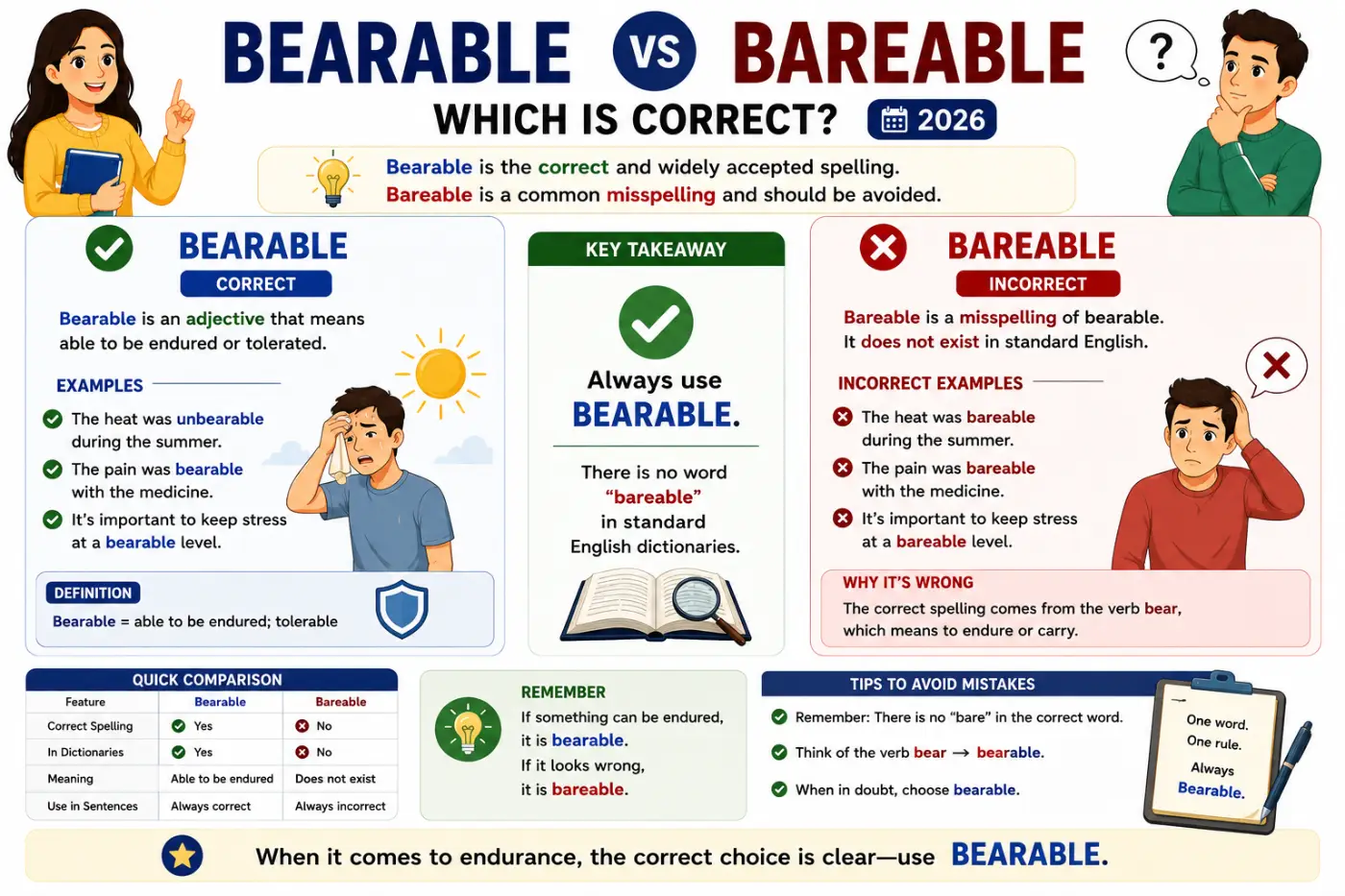
Bearable vs bareable is a common spelling confusion because the two forms can sound almost identical when spoken. If you’ve ever paused while writing the word and wondered which spelling belongs on the page you’re not alone. The correct spelling is bearable. It means something can be endured tolerated or handled without becoming too difficult.
The confusion comes from the words bear and bare. They can sound alike in many accents but they have completely different meanings. Bear can mean to endure or tolerate something while bare means uncovered or exposed. That difference explains why bearable is the correct form when you’re talking about pain heat pressure stress cost or any other difficult experience that you can handle.
In this guide you’ll learn the exact meaning of bearable and bareable. You’ll also see how the spelling developed why the mistake happens how to pronounce bearable and how native English speakers use it in everyday and formal writing. By the end you’ll have a simple way to remember the correct spelling every time.
Quick Definition
Bearable is the correct standard English spelling. It means capable of being endured or tolerated. Bareable is not the standard spelling for this meaning. The confusion comes from the words bear and bare because they sound alike in many varieties of English. When you mean something can be endured you need bearable.
Quick Answer
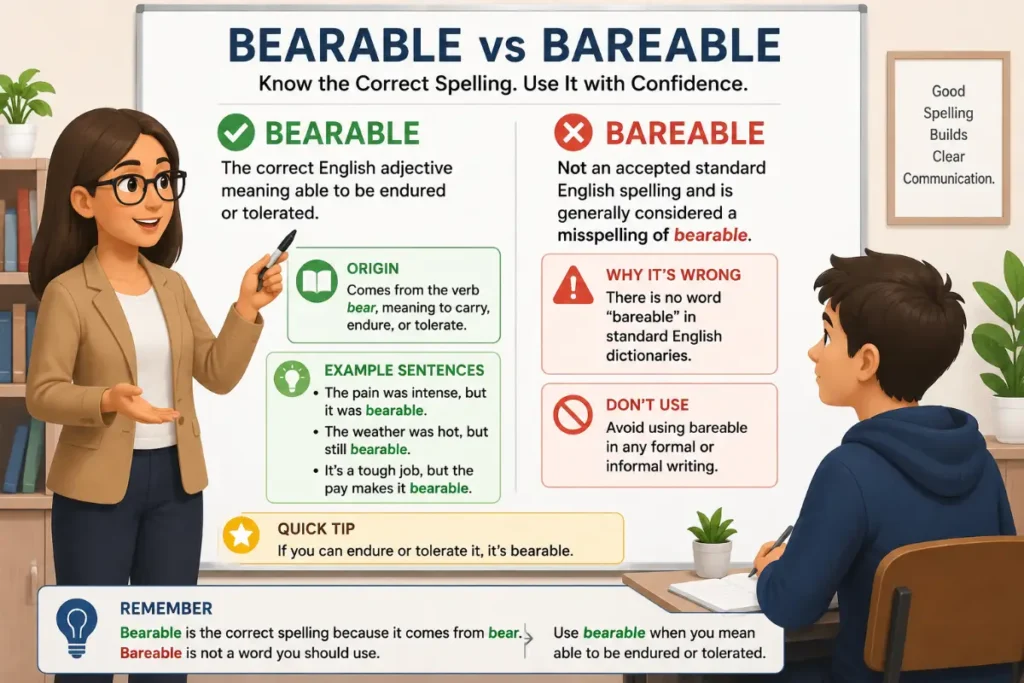
The correct spelling is bearable. It means something can be endured or tolerated such as pain heat pressure noise or an unpleasant situation. Bareable is a common spelling mistake and isn’t the standard English form.
The easiest way to remember it is to connect bearable with the verb bear. If you can bear something then it can be bearable. The word bare has a different meaning connected with being uncovered or exposed.
Comparison Table
| Correct Form | Meaning | Part of Speech | Origin | Usage Frequency | Formality | Common Contexts | Example |
|---|---|---|---|---|---|---|---|
| Bearable | Capable of being endured or tolerated | Adjective | Bear plus the suffix able | Common | Standard | Pain heat stress cost noise conditions | The heat was bearable after sunset |
| Bareable | Not the standard spelling for this meaning | None in standard English | Confusion with bare | Uncommon as a nonstandard spelling | Not recommended | Usually appears as a spelling error | The heat was bareable is incorrect |
Meaning and Definition
Meaning of bareable
Bareable isn’t the standard English spelling of the adjective meaning capable of being endured. In normal edited American English you shouldn’t use it to describe something that can be tolerated.
Most people who type bareable aren’t trying to create a new word. They’re usually reaching for bearable and choosing the spelling bare because the two words sound similar. This is a classic example of a spelling mistake caused by sound rather than meaning.
The mistake becomes easier to understand once you look at the two base words. Bear can mean to carry endure tolerate or withstand. Bare means uncovered exposed or lacking something. Those meanings are completely different.
For example you can bear pain. You can bear pressure. You can bear an unpleasant situation. From that verb we get bearable.
By contrast you can bare your arms. You can bare your teeth. You can bare the facts. In those examples bare means to uncover or expose.
So the spelling isn’t just a matter of choosing the more familiar looking word. The spelling reflects the word’s history and meaning.
Meaning of bearable
Bearable is an adjective that describes something you can endure tolerate accept or deal with.
Merriam Webster defines it as capable of being borne and lists endurable and tolerable among its close synonyms. The dictionary also records its first known use around 1557.
Cambridge gives a closely related explanation. It describes something as bearable when an unpleasant situation can be accepted or dealt with. It also identifies tolerable as a synonym and unbearable as the opposite.
That definition covers a wide range of everyday situations.
You might describe pain as bearable. You might say a long meeting was bearable. A high price can be bearable if you have enough money. A difficult summer can become more bearable when the weather cools down.
The word doesn’t necessarily mean something is pleasant. That’s an important detail. If you call something bearable you usually mean it isn’t too much to handle. It may still be unpleasant difficult painful or annoying.
Compare these sentences.
The pain was bearable.
The pain was enjoyable.
The first sentence says the pain could be endured. The second says the pain was pleasant. Those ideas are worlds apart.
Key Differences Explained
Spelling
The first and most important difference is spelling. Bearable is the standard form. Bareable is not the standard spelling for the meaning discussed here.
The spelling comes from the verb bear. Adding the suffix able gives bearable.
Bear plus able becomes bearable.
The spelling may look slightly awkward at first because English doesn’t always spell words exactly as they sound. Still the connection is useful because it gives you a reliable memory trick.
Grammar Role
Bearable is an adjective. It describes a noun.
You can experience a bearable temperature.
You can face a bearable workload.
It can also appear after linking verbs.
The pain is bearable.
The situation became bearable.
The conditions remained bearable.
Meaning
Bearable relates to endurance and tolerance.
Bare relates to exposure and the absence of covering.
That difference gives you a simple mental test. If the idea involves enduring something then think bear. If the idea involves uncovering something then think bare.
Tone
Bearable is neutral and widely useful. It works in casual conversation academic writing professional communication journalism and formal prose. It isn’t slang. You can use it comfortably in most situations.
Context
Bearable often appears with words connected to difficult experiences.
Common combinations include bearable pain bearable heat bearable cost bearable pressure bearable noise bearable conditions and bearable workload.
It also works in more abstract contexts.
The uncertainty was barely bearable.
Her support made the situation more bearable.
The extra income made the cost bearable.
Which Spelling Is Correct?
Bearable is correct. Bareable is not the standard spelling.
The linguistic reason is straightforward. The adjective comes from bear in the sense of endure or tolerate plus the suffix able. The result is bearable.
This is supported by major dictionaries. Merriam Webster lists bearable as an adjective meaning capable of being borne. Cambridge likewise lists bearable as an adjective meaning something unpleasant that can be accepted or dealt with.
That dictionary evidence matters because it confirms more than personal preference. Standard dictionaries record established English forms based on usage and language history. Since bearable is the established form you should use it in school writing professional documents emails essays articles and other edited text.
An easy editor’s rule is this.
If you mean endure then use bearable.
If you mean uncover then use bare.
That small distinction clears up the entire problem.
Sentence Examples
Here are natural examples showing how the correct form works in everyday English.
- The pain was bearable after she took a short break.
- The heat became more bearable when the sun went down.
- The monthly payment is bearable on my current budget.
- The noise was annoying but still bearable.
- A little music made the long drive more bearable.
- The workload is bearable as long as we stay organized.
- The waiting period became more bearable after we found something to do.
- The cold was bearable because we had warm clothes.
- His kindness made an otherwise difficult day more bearable.
- The cost seems bearable compared with the other options.
These examples show why the adjective is so useful. It can describe physical discomfort emotional pressure financial demands environmental conditions and ordinary inconveniences.
Now look at five examples that contain the common misspelling. These are incorrect in standard English. - The pain was bareable after a few minutes.
- The heat became more bareable in the evening.
- The long wait was finally bareable.
- The noise was annoying but bareable.
- The cost was barely bareable for the family.
In each sentence the intended word should be bearable.
Common Mistakes and Misspellings
People often make this mistake because English spelling doesn’t always give you a perfect map from sound to letters.
Why People Type bareable
The main problem is homophone confusion. Bear and bare can sound alike in many varieties of English. When two words sound the same but have different meanings and spellings the brain can select the wrong written form.
There is also a useful NLP concept here called phonological similarity. Your brain processes speech sounds quickly and often uses context to predict the intended word. When you write the word later you have to retrieve its spelling separately. That’s where the wrong form can slip through.
Another factor is morphological confusion. Someone may know the word bare and recognize the suffix able. They then produce bareable even though the base word for this adjective is bear.
Here are five common mistakes to watch for.
- Writing bareable when you mean capable of being endured.
- Assuming bearable comes from the animal bear.
- Choosing bare because it looks familiar.
- Trusting pronunciation to determine spelling.
- Forgetting that bear can mean tolerate or endure.
The second mistake deserves attention. Bearable is connected to the verb bear. It isn’t named after the animal. The word bear has several meanings and forms but the relevant sense here is to endure or carry something.
Pronunciation Guide
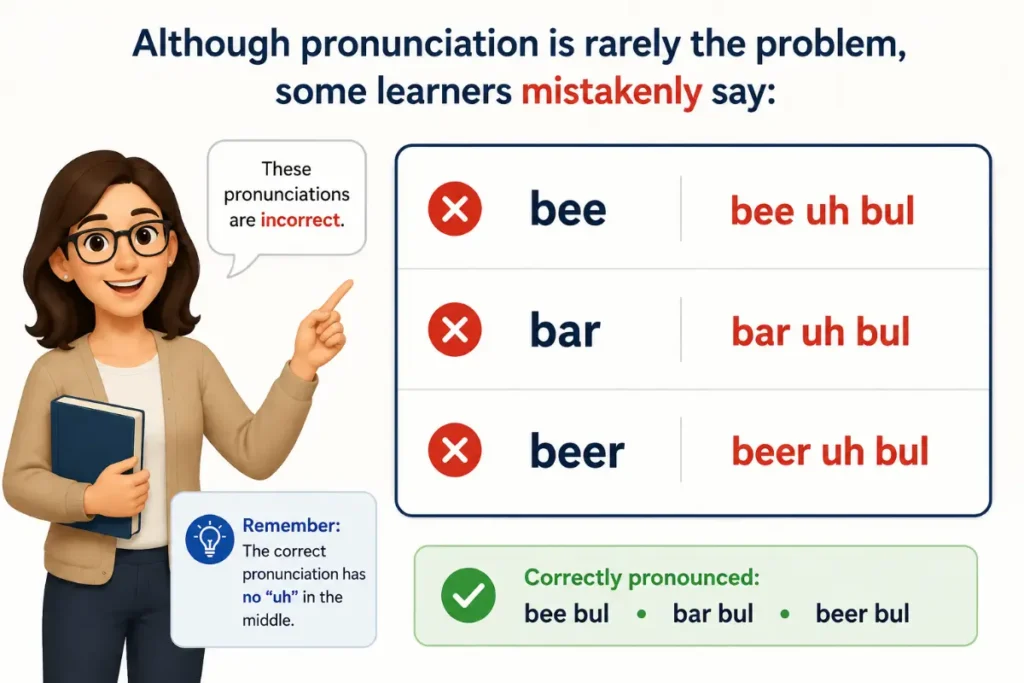
In American English bearable is commonly pronounced approximately like BAIR uh bul.
Cambridge gives the American pronunciation as /ˈber.ə.bəl/. Merriam Webster gives a closely related pronunciation as ˈber ə bəl.
The word has three syllables.
bear a ble
The strongest stress falls on the first syllable.
Think of it as.
BAIR uh bul
The exact vowel sound can vary slightly among speakers and accents. That doesn’t change the spelling.
This is another reason the error can happen. In many accents bear and bare are pronounced alike or almost alike. If you hear the word without seeing it written you can’t reliably determine the spelling from sound alone.
That’s why meaning is a better guide than pronunciation.
If the meaning is able to be endured then the spelling is bearable.
Etymology and Word Origin
The history of the word gives us an even stronger reason for the spelling.
The verb bear has very old Germanic roots. It traces back to Old English beran and related Germanic forms connected with carrying or bringing. Over time the verb developed several related meanings including carrying a physical load and enduring something difficult.
English later formed bearable from bear plus the productive suffix able.
The suffix able ultimately has roots in Latin and entered English through French influence. It appears in many English adjectives that describe something as capable of receiving or performing an action.
Consider similar formations.
Accept becomes acceptable.
Comfort becomes comfortable.
Reason becomes reasonable.
Bear becomes bearable.
The pattern isn’t always perfectly predictable in English but it is clear in this word.
Merriam Webster records the first known use of bearable around 1557.
The word therefore has centuries of established use in English. It isn’t a recent spelling preference or a modern invention.
The confusion with bare is much more recent in practical terms. The two words have different histories and different meanings even though their pronunciation can overlap.
The word bare is much older as an English word. It has long been used for something uncovered exposed empty or lacking an expected covering. Merriam Webster traces its use to before the twelfth century.
That historical difference reinforces the modern spelling rule.
Regional Usage
American English
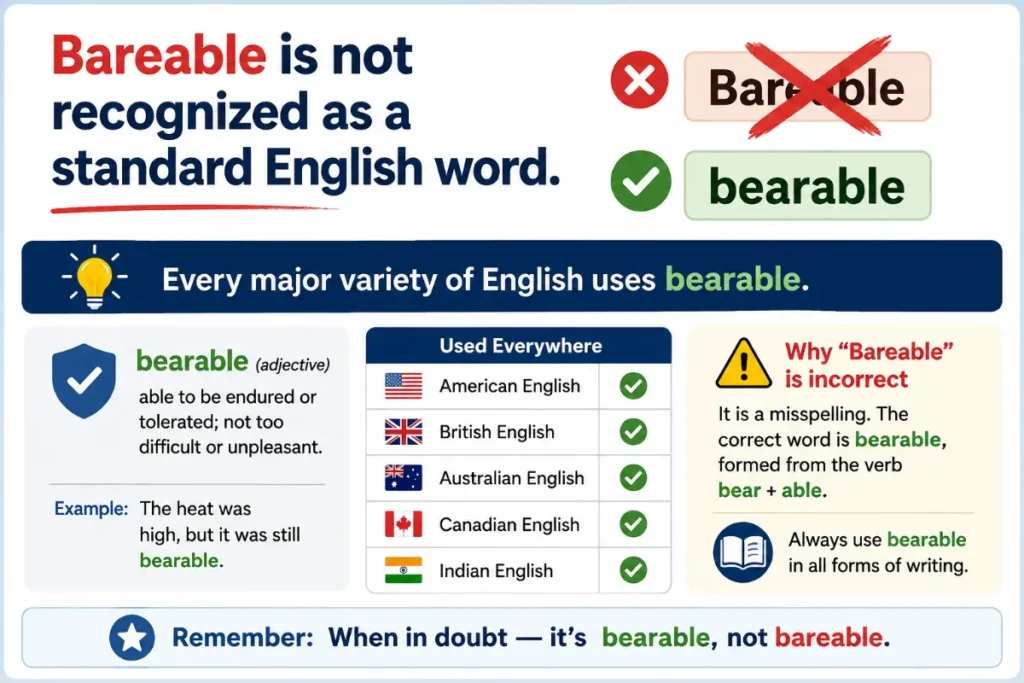
American English uses bearable as the standard spelling. It appears naturally in conversation journalism academic writing workplace communication and everyday descriptions. There is no standard American variant spelled bareable for the meaning capable of being endured.
British English
British English also uses bearable. The pronunciation may differ from common American pronunciation but the spelling remains the same. Cambridge lists the British pronunciation separately while retaining bearable as the standard form.
Australian English
Australian English follows the same standard spelling. Writers should use bearable when describing something that can be endured or tolerated. Bareable isn’t a standard regional alternative.
Canadian English
Canadian English also uses bearable as the standard spelling. The writers may encounter both American and British spelling conventions in different settings but this particular word doesn’t change between those varieties.
So there isn’t a regional spelling split here. You don’t need to choose between bearable and bareable based on your audience.
Grammar Rules and Part of Speech
Bearable is an adjective.
Its job is to describe a noun or complement a linking verb.
You can put it before a noun.
The bearable temperature allowed us to continue.
The doctor recommended a bearable level of activity.
You can also place it after a linking verb.
The pain is bearable.
The situation became bearable.
The cost remained bearable.
You can modify it with adverbs.
The pain was barely bearable.
The heat was surprisingly bearable.
The conditions became much more bearable.
The word barely deserves special attention. Barely means only just or by a very small amount. It isn’t the same as bareable.
For example.
The pain was barely bearable.
This means the pain could be endured but only just.
You can also form the adverb bearably. Cambridge defines bearably as in a way that is bearable.
There is also the noun bearability.
The bearability of the conditions improved.
That form refers to the quality or degree of being bearable.
The opposite adjective is unbearable.
The noise became unbearable.
This word family makes the spelling easier to remember because the same base appears throughout.
Bear.
Bearable.
Bearably.
Bearability.
Unbearable.
The punctuation around bearable depends on the sentence rather than the word itself. You don’t need special punctuation simply because you use this adjective.
Real Life Usage Examples
Daily Talk
- The traffic was awful but bearable.
- This coffee is hot but still bearable.
These sound natural because everyday speakers often use the word to describe something that isn’t pleasant but isn’t impossible to handle.
- The revised schedule should make the workload more bearable.
- Moving the deadline made the waiting period more bearable for everyone.
The word works well in workplace writing because it communicates difficulty without sounding dramatic.
Academic Writing
- The study examined how social support can make stressful conditions more bearable.
- The researchers found that lower costs made the treatment more bearable for participants.
Academic writers can use the word when discussing tolerance endurance conditions or human experience.
News
- Cooler temperatures made the region’s summer heat more bearable.
- Additional assistance helped make the rising cost of living more bearable for some households.
News writing often uses bearable because it expresses a practical degree of difficulty without adding unnecessary emotion.
Literature
- Her presence made the silence more bearable.
- The character found the long journey bearable only because of the hope of returning home.
Literary writing can use the word in a more emotional way. It can describe not just physical discomfort but loneliness fear uncertainty grief and other difficult experiences.
Related and Confused Terms
Several expressions overlap with bearable but they don’t always carry exactly the same shade of meaning.
- At last usually emphasizes that something finally happened after a period of waiting. The train arrived at last.
- Eventually emphasizes something that happens after time or a sequence of events. She eventually found a solution.
- Ultimately often points to the final result or conclusion. The decision ultimately benefited everyone.
- At the end refers to the final point of a period place event or sequence. At the end of the meeting we voted.
- Conclusively means in a way that settles an issue or establishes something firmly. The evidence conclusively proved the claim.
- In the end often introduces the final outcome after considering what happened. In the end we chose the cheaper option.
- Lastly introduces the final item in a sequence. Lastly we need to review the budget.
- Endurable is a close synonym of bearable. It means capable of being endured and often has a similar tone.
These terms belong to different semantic groups even though some may appear in related contexts. Bearable describes tolerability. Finally and its related expressions usually describe sequence timing or conclusion.
Expert Editor Insight
A senior editor would look at the meaning before looking at the letters. If the sentence describes something you can tolerate or endure then bearable is the natural choice. Native speakers don’t normally treat bareable as an alternative spelling. Spell checkers and grammar tools may flag it because standard dictionaries don’t recognize it as the established adjective for this meaning. The best editing habit is to connect the word with its base verb. If you can bear the situation then the situation is bearable.
Expert Tip
When you’re unsure about the spelling remember this sentence.
I can bear it so it is bearable.
That simple connection is more reliable than trying to remember how the word sounds.
Why Bear And Bare Cause So Much Confusion
The problem becomes much clearer when you compare the two base words.
Bear can function as a verb meaning to carry endure tolerate or support.
I can’t bear the noise.
She bore the pain quietly.
He couldn’t bear the pressure.
Bare can function as a verb meaning to uncover or reveal.
She bared her shoulders.
The dog bared its teeth.
The report bared the truth.
Merriam Webster specifically notes confusion between bear and bare and explains that bare has the sense of uncovering while bear covers several other uses including enduring stress or weight.
That distinction gives you a powerful spelling test.
Ask yourself what the sentence means.
If the idea is endure use bear.
If the idea is uncover use bare.
Once you see the semantic difference the spelling becomes much easier.
Bearable In Formal Writing
Bearable is completely acceptable in formal writing.
You can use it in an essay.
You can use it in journalism.
The word isn’t overly casual and it doesn’t sound childish. Still context matters. In highly technical writing you may sometimes prefer a more precise word. For example a medical report might use tolerable if that term matches the intended technical meaning. A financial report might describe an acceptable cost rather than a bearable cost if it needs a more formal business tone.
That doesn’t make bearable informal or incorrect. It simply shows that good writing chooses the word that best fits the situation.
When To Use Tolerable Instead
Tolerable is one of the closest synonyms of bearable. Merriam Webster defines tolerable as capable of being borne or endured and also gives it a second sense meaning moderately good or agreeable.
The two words often work interchangeably.
The pain was bearable.
The pain was tolerable.
Both sentences tell the reader that the pain could be endured.
However bearable can sound slightly more focused on the experience of carrying or enduring something. Tolerable can sometimes suggest that something meets a minimum acceptable standard.
For example.
The food was tolerable.
This can mean the food was acceptable but not especially good.
The food was bearable.
This more strongly suggests that eating it wasn’t too difficult or unpleasant.
The difference is subtle. Context does most of the work.
Bearable And Unbearable
Bearable and unbearable form a natural opposite pair.
Unbearable means something cannot be endured.
The room was hot but bearable.
The room became unbearably hot by noon.
The distinction is useful because it gives you another spelling clue. If you know the word unbearable then bearable is simply the positive form without the negative prefix.
This is also common in everyday English.
The noise was bearable.
The noise became unbearable.
The wait was bearable.
The delay became unbearable.
The pain was bearable.
The pain became unbearable.
Learning word families can be more effective than memorizing isolated spellings. Once the base is secure the related forms usually become easier to recognize.
How To Remember The Correct Spelling
Use a meaning based memory trick instead of relying on pronunciation.
Think of bear as a verb meaning endure.
Then connect it directly to the adjective.
Bear it.
Bearable.
You can also remember the opposite.
Bearable.
Unbearable.
Both words keep the same base.
Another useful comparison is this.
Bare means exposed.
Bear means endure.
So you might bare your arms but you bear the pain.
You might bare your teeth but you bear the pressure.
You might bare the facts but you bear the consequences.
Once you build that mental connection the spelling becomes much harder to forget.
Conclusion
Bearable vs bareable has a simple answer. Bearable is the correct standard spelling when you mean capable of being endured or tolerated. Bareable is a common misspelling caused mainly by the similar pronunciation of bear and bare. Major dictionaries including Merriam Webster and Cambridge recognize bearable and define it around the idea of enduring or dealing with something unpleasant.
The key is to remember the base word. Bear can mean endure while bare means uncover or expose. That difference explains the spelling and gives you a reliable way to choose the right form. If you can bear the pain then the pain is bearable. If you bare your arms then you’re uncovering them. Those meanings are separate even though the words can sound alike.
For a quick memory trick connect bearable with unbearable. Both contain bear because both describe the ability or inability to endure something. When you’re writing and the choice feels uncertain don’t trust the sound alone. Think about the meaning first. If the idea is endurance use bearable.
Frequently Asked Questions
Is bareable a real word?
Bareable isn’t the standard English spelling of the adjective meaning capable of being endured. Standard dictionaries list bearable instead. If you’re writing an essay email report or other edited text use bearable. The confusion usually happens because bear and bare can sound alike. The correct base word here is bear because the meaning involves enduring or tolerating something.
What does bearable mean?
Bearable means capable of being endured tolerated or dealt with. It often describes something unpleasant but manageable. You can describe pain heat noise pressure cost stress or difficult circumstances as bearable. The word doesn’t mean pleasant. It simply means the situation isn’t too difficult to handle. Cambridge and Merriam Webster both give definitions centered on accepting or enduring something.
bearable vs bareable which is correct?
Bearable is the correct spelling. Bareable is a common misspelling. The correct form comes from the verb bear in the sense of endure or tolerate plus the suffix able. Bare has a different meaning related to being uncovered or exposed. So when you mean something can be endured the correct spelling is bearable. There isn’t a standard regional spelling difference here.
How do you pronounce bearable?
In American English bearable is commonly pronounced approximately like BAIR uh bul. Cambridge gives the American IPA as /ˈber.ə.bəl/ while Merriam Webster gives a closely related pronunciation. The word has three syllables with the main stress on the first syllable. Pronunciation can vary slightly by accent but the spelling remains bearable.
Can bearable start a sentence?
Yes. Bearable can start a sentence when it functions as an adjective phrase or part of a larger construction. For example you could write Bearable temperatures made the outdoor event possible. More commonly the adjective appears before a noun or after a linking verb. The placement depends on the sentence structure rather than any special rule attached to the word itself.
What is a synonym of bearable?
Common synonyms include tolerable and endurable. Depending on context you might also use acceptable manageable survivable sustainable or supportable. The best choice depends on the exact meaning. Tolerable often works when something is acceptable or can be endured. Endurable focuses more directly on the ability to withstand something difficult.
Why do people misspell bearable?
People often misspell bearable because bear and bare sound alike or very similar in many accents. That creates a sound based spelling problem. Writers may also know bare as a familiar word and automatically connect it with the suffix able. The mistake is understandable but the meaning provides the solution. If the sentence means you can endure something then the correct base is bear.
Is bearable suitable for formal writing?
Yes. Bearable is a standard English adjective and works in formal writing. You can use it in reports essays academic discussions professional emails and edited articles. The word is neutral rather than slangy. In highly technical contexts a more precise term such as tolerable or acceptable may sometimes fit better. Still there is no general formality problem with using bearable.
