
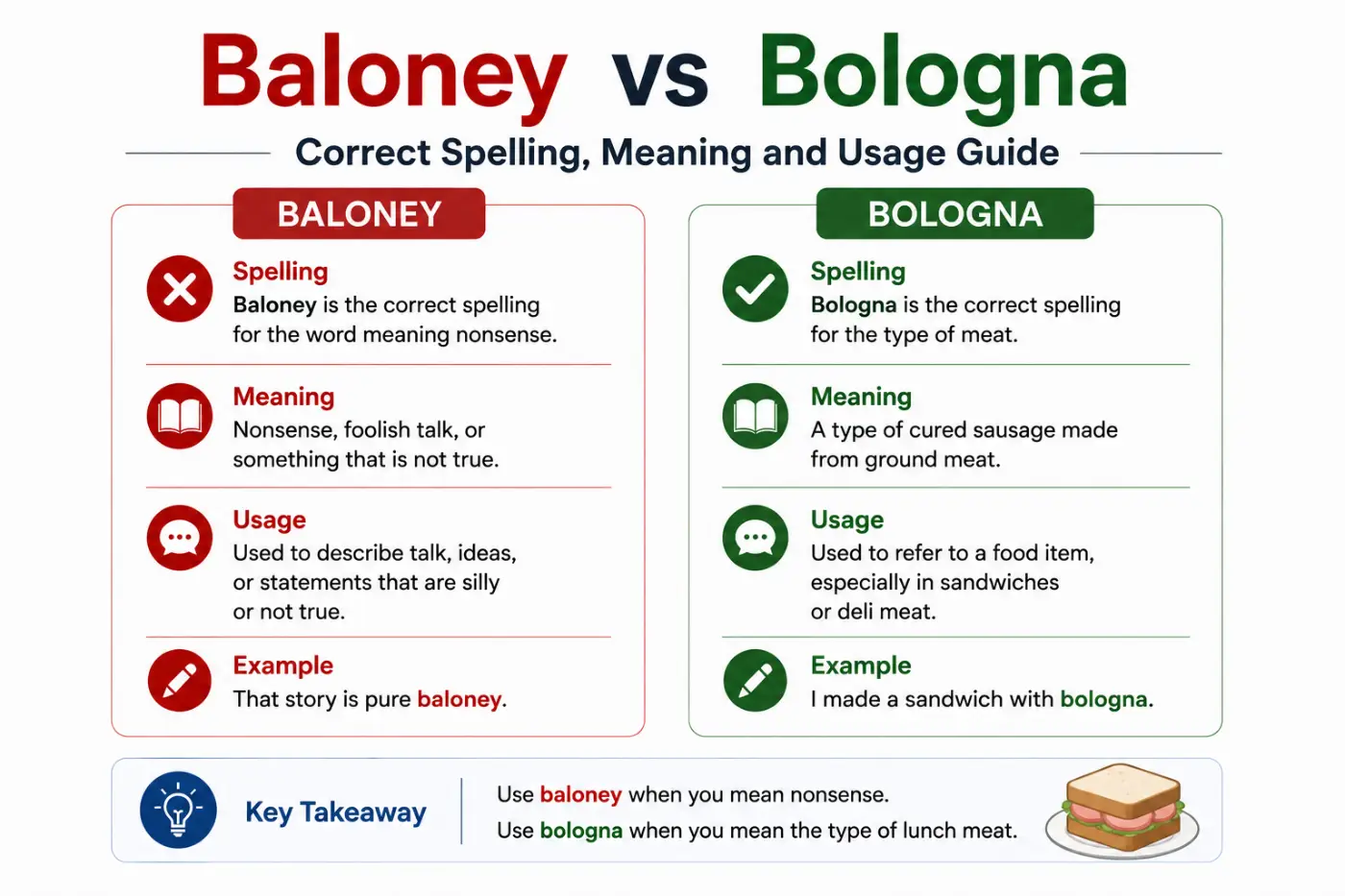
Have you ever written baloney or bologna and stopped to wonder which word belongs on the page? You’re not alone. These words are closely connected in spelling and pronunciation but they don’t always mean the same thing. Baloney vs bologna can be confusing because both forms are associated with the familiar deli meat while baloney also has a completely different informal meaning.
The short answer is simple. Bologna is the standard spelling for the sausage named after Bologna in Italy. Baloney is the standard spelling when you mean foolish talk or nonsense. In American English the meat is also commonly pronounced like baloney which makes the spelling difference even harder to remember.
The confusion comes from English borrowing words from other languages and then changing their spelling and pronunciation over time. In this guide you’ll learn the meanings of both words the difference between them their history pronunciation grammar regional usage and common mistakes. You’ll also see natural examples that show exactly how native English speakers use each form.
Quick Definition
Bologna is the standard spelling for the sausage associated with Bologna in Italy. Baloney has two uses. It can refer informally to the same type of sausage and it can mean nonsense or foolish talk. Context usually makes the intended meaning clear.
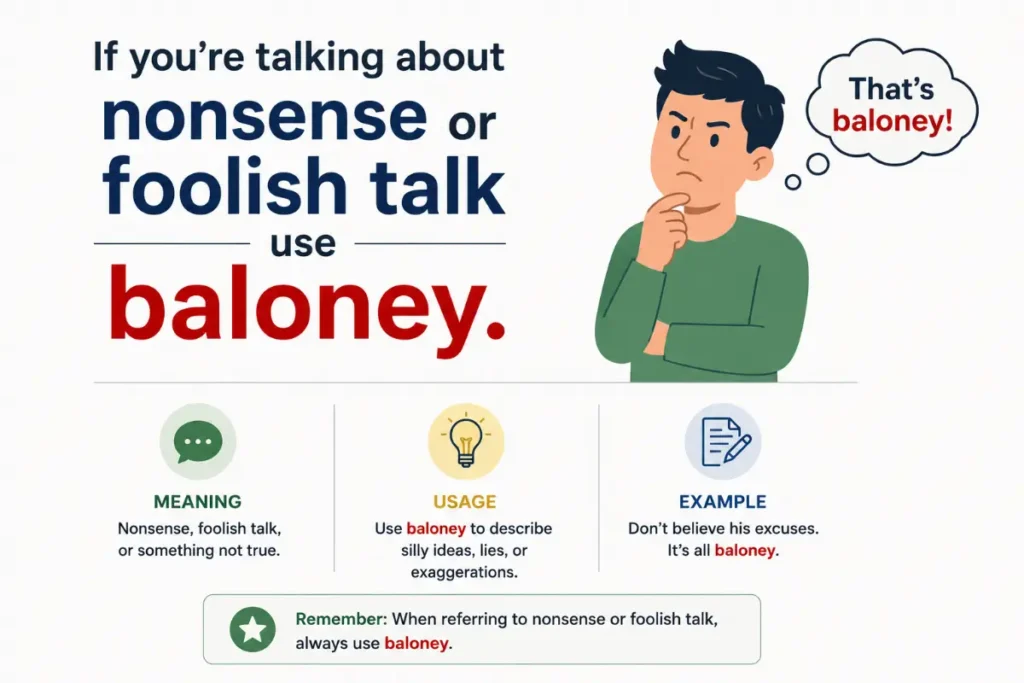
Quick Answer
If you’re talking about nonsense or foolish talk use baloney.
If you’re naming the sausage use bologna in standard writing. In American English the sausage is often pronounced like baloney which explains much of the spelling confusion.
Comparison Table
| Correct Form | Meaning | Part of Speech | Origin | Usage Frequency | Formality | Common Contexts | Example |
|---|---|---|---|---|---|---|---|
| Baloney | Nonsense or foolish talk | Noun | American English usage with uncertain origin | Very common in informal speech | Informal | Conversation and criticism | That excuse is pure baloney. |
| Bologna | A type of sausage or the Italian city | Noun | Italian Bologna | Common | Neutral | Food writing geography and cooking | I bought some bologna for sandwiches. |
| Baloney | Informal name for bologna sausage | Noun | American English variant | Common in casual US speech | Informal | Deli food and conversation | He made a baloney sandwich. |
| Bologna | Sausage made in the style associated with Bologna | Noun | Italian | Common | Neutral | Menus groceries recipes | She sliced the bologna for lunch. |
Meaning and Definition
Meaning of Baloney
Baloney has two main meanings in modern American English.
The first meaning is nonsense. When someone says something that sounds foolish false exaggerated or unbelievable you can call it baloney.
For example.
That story is baloney.
His excuse was complete baloney.
I’ve heard enough of that baloney.
In these sentences baloney has nothing to do with food. It’s an informal way to dismiss something as nonsense.
The second meaning is an informal spelling of the name for the sausage. In American English people often write baloney when referring to the familiar sandwich meat. You’ll see the form especially in casual writing.
For example.
I made a baloney sandwich.
He grew up eating baloney and cheese.
That second use is closely connected to the pronunciation of bologna in American English.
Meaning of Bologna
Bologna is the standard spelling associated with the Italian city of Bologna and with the sausage traditionally connected to that city.
When you’re talking about food the spelling bologna is the safer standard choice in formal writing.
For example.
We bought sliced bologna at the grocery store.
She added bologna to the sandwich.
The recipe calls for several slices of bologna.
Bologna can also refer to the city in Italy. The context usually makes the meaning obvious.
For example.
Bologna is a historic city in northern Italy.
The city of Bologna is known for its food and university.
That distinction matters because the same spelling can identify a place or a food depending on the sentence.
Key Differences Explained
- Spelling. Bologna is the standard spelling connected with the Italian city and the sausage. Baloney is the standard spelling for the informal word meaning nonsense.
- Grammar role. Both words are nouns when used in their ordinary meanings. Bologna names a place or food. Baloney can name food in informal American usage or refer to nonsense.
- Meaning. This is the biggest difference. If you call an argument baloney you’re saying it’s nonsense. If you put bologna on bread you’re talking about food.
- Tone. Baloney meaning nonsense is informal. It can sound playful or mildly dismissive rather than harsh. Bologna is neutral when it refers to food or the Italian city.
- Context. Context usually solves the problem. A sentence about an argument probably means nonsense. A sentence about lunch probably means sausage.
A useful memory trick is to connect the g in bologna with the Italian origin. Think of Bologna the city first. Then remember that baloney has its own informal meaning.
Which Spelling Is Correct
Both spellings can be correct but they aren’t interchangeable in every sentence.
Use bologna for the standard name of the sausage and for the Italian city. Use baloney when you mean nonsense or foolish talk.
For example.
The deli sells bologna.
That claim is baloney.
Changing the words in those sentences would change the meaning or make the sentence sound wrong.
Major English dictionaries recognize these distinctions. Dictionary treatment is especially useful here because pronunciation alone doesn’t tell you the spelling. English has many words that sound different from the way they look. Bologna is one of the clearest examples.
An editor’s practical rule is simple. If you mean food in formal or standard writing use bologna. If you mean nonsense use baloney.
Sentence Examples
Examples With Bologna
- I packed a bologna sandwich for lunch.
- The grocery store has several brands of sliced bologna.
- She added cheese and mustard to her bologna sandwich.
- He bought fresh bologna from the deli counter.
- The children wanted bologna sandwiches after school.
- The recipe uses thin slices of bologna.
- We stopped at the market to pick up bread and bologna.
- Bologna is a city in northern Italy.
- The restaurant serves a dish inspired by the food traditions of Bologna.
- She learned about Bologna while studying Italian history.
Examples With Baloney Meaning Nonsense
- That explanation is complete baloney.
- Don’t believe that story. It’s baloney.
- He knew the advertisement was baloney.
- I’m tired of listening to that kind of baloney.
- Her excuse sounded like pure baloney.
Examples Showing the Common Misspelling
- Incorrect: That argument is bologna.
- Correct: That argument is baloney.
- Incorrect: I made a baloney sandwich in a formal food description.
- Correct: I made a bologna sandwich.
- Incorrect: The city of Baloney is in Italy.
The last examples show why context matters. Baloney isn’t simply a wrong version of bologna in every situation. It has developed its own established meaning.
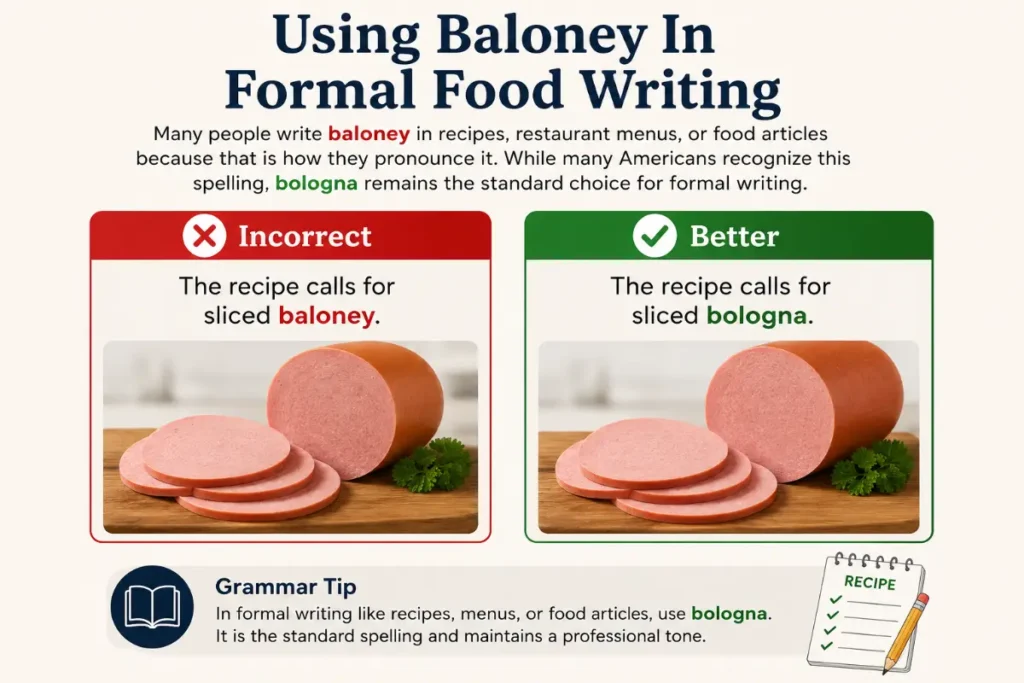
Common Mistakes and Misspellings
The confusion between these words comes from several overlapping language patterns.
- Using bologna for nonsense. This mistake happens because the words sound similar. In standard American English the food word doesn’t normally carry the meaning of nonsense.
- Using baloney for formal food writing. You may see baloney used casually for the sausage but bologna is the better choice when you want the standard spelling.
- Assuming pronunciation determines spelling. This is one of the biggest traps. The American pronunciation of the sausage can sound much closer to baloney than its written form suggests.
- Confusing the city with the food. Bologna is also the name of an Italian city. The sausage takes its name from that place.
- Treating every sound alike word as a spelling variant. English contains many words that share pronunciation but have different meanings and spellings. These are often called homophones or near homophones depending on the exact relationship.
From an NLP perspective this is a classic example of phonological similarity creating lexical confusion. When people hear a word before they see it written they often create a spelling based on the sound. That strategy works for many simple English words but fails with borrowed words such as bologna.
The brain also tends to favor familiar letter patterns. Baloney looks like the way the sausage sounds in American English. Bologna looks less intuitive to many English speakers. That mismatch makes the informal spelling easier to produce.
Pronunciation Guide
The pronunciation creates much of the confusion.
In American English baloney meaning nonsense is commonly pronounced approximately like:
buh LOH nee
Its IPA pronunciation is commonly represented as /bəˈloʊni/.
The familiar American pronunciation of bologna as the sausage is also commonly heard as:
buh LOH nee
Depending on the dictionary and speaker you may see slightly different phonetic representations. The key point for learners is that the written form bologna doesn’t have to be pronounced the way a beginner might expect from the letters.
The Italian city name has a pronunciation that differs from the common American pronunciation of the sausage. English speakers often adapt foreign place names to English pronunciation patterns.
The biggest pronunciation mistake is trying to sound out every letter in bologna. English doesn’t always work that way. Borrowed words often keep historical spellings even after their pronunciation changes.
If you’re learning the word for the first time remember the sound separately from the spelling. Think buh LOH nee for the common American pronunciation and then attach the correct spelling to the meaning you intend.
Etymology and Word Origin
The history behind these words explains why they seem almost designed to confuse English learners.
Bologna is the English name associated with the Italian city of Bologna. The sausage takes its name from the city and from the Italian food tradition associated with it.
The Italian form is connected to the name of the city itself. English speakers adopted the word and adapted its pronunciation to English speech patterns. Over time the written form remained closer to its Italian spelling while the everyday American pronunciation moved in a different direction.
That created a familiar English problem. The word looks foreign but sounds much more familiar.
Baloney has a more complicated history when it means nonsense. The exact origin of this sense is uncertain. It has been connected by some scholars with the name bologna and with the idea of cheap or inferior meat. Other theories have proposed different influences. Dictionaries generally treat the origin as uncertain rather than presenting one theory as settled fact.
This uncertainty is worth mentioning because word histories are sometimes repeated online as if they were proven facts. A good dictionary distinguishes established etymology from speculation.
The nonsense meaning became established in American English during the early twentieth century. It developed into a familiar informal expression for foolishness false claims or empty talk.
That gives the two words an interesting relationship. They sound alike in common American speech and may have historical connections yet modern speakers use them differently depending on context.
Regional Usage in the US
American English is where the contrast is most noticeable.
In the United States bologna is the standard spelling for the sausage in formal writing. Baloney is also widely used informally for the same food.
Baloney is especially familiar because it has a second meaning. When an American says That’s baloney they almost certainly mean That’s nonsense.
The pronunciation of bologna as a food also contributes heavily to the spelling confusion. Many Americans hear the sausage name as something very close to baloney.
Regional Usage in the UK
British English also recognizes bologna in food related contexts but usage can differ from everyday American speech.
The word baloney meaning nonsense is understood in British English but can sound distinctly American or informal. British speakers have other familiar expressions for nonsense such as rubbish or nonsense itself.
The spelling bologna remains useful when discussing the sausage or the Italian city.
Regional Usage in Australia
Australian English generally follows the standard spelling bologna for the food when the word is used in that form. Baloney meaning nonsense is understood because of American cultural influence but it isn’t necessarily the first everyday choice for every Australian speaker.
Local vocabulary can vary considerably. Context and audience should guide the choice.
Regional Usage in Canada
Canadian English shares many features with American English so speakers are familiar with both forms.
Bologna is the standard spelling for the sausage. Baloney is commonly understood as informal language for nonsense and can also appear as a casual spelling for the food.
In polished Canadian writing bologna is generally the better choice for the food.
Grammar Rules and Part of Speech
Both forms are primarily nouns.
When bologna refers to food it functions as a noun.
For example.
We bought bologna for lunch.
When bologna refers to the city it is also a proper noun.
For example.
Bologna is located in northern Italy.
When baloney means nonsense it functions as an uncountable noun in many sentences.
For example.
That’s baloney.
He was talking baloney.
You wouldn’t normally say one baloney to mean one piece of nonsense. Instead you might say a piece of baloney in a particular context.
Baloney can also be used as a food noun in informal American English.
For example.
He ordered a baloney sandwich.
Placement is straightforward because both words usually act as nouns. Punctuation depends on the larger sentence rather than the word itself.
For example.
Finally we finished the project.
The word finally is an adverb and belongs to a completely different spelling issue. It’s worth keeping that separate from the baloney and bologna comparison.
Real Life Usage Examples
Daily Talk
- Food. I’ll make you a bologna sandwich if you’re hungry.
- Nonsense. That’s baloney and you know it.
The first sentence refers to food. The second rejects an idea.
- Food. I picked up some bologna for the office lunch.
- Nonsense. Please remove that claim from the draft because it isn’t supported by evidence and sounds like baloney.
Professional email usually favors bologna when discussing the food. Baloney is fine when the informal tone is intentional.
Academic Writing
- Food. The study examines the cultural history of bologna and other processed meats.
- Nonsense. The researcher would usually avoid calling an unsupported argument baloney in formal academic prose.
Academic writing tends to prefer precise terms such as unsupported claim false assertion or inaccurate statement instead of informal language.
News Writing
- Food. The article described the history of bologna in American grocery stores.
- Nonsense. A columnist might use baloney when criticizing a political claim or public statement.
News writing varies by genre. Straight reporting tends to favor neutral language while opinion writing allows more personality.
Literature
- Food. The character made a simple bologna sandwich before leaving home.
- Nonsense. The character laughed and called the excuse baloney.
Writers can use baloney effectively because it has a distinctly conversational feel. It can make dialogue sound relaxed and natural.
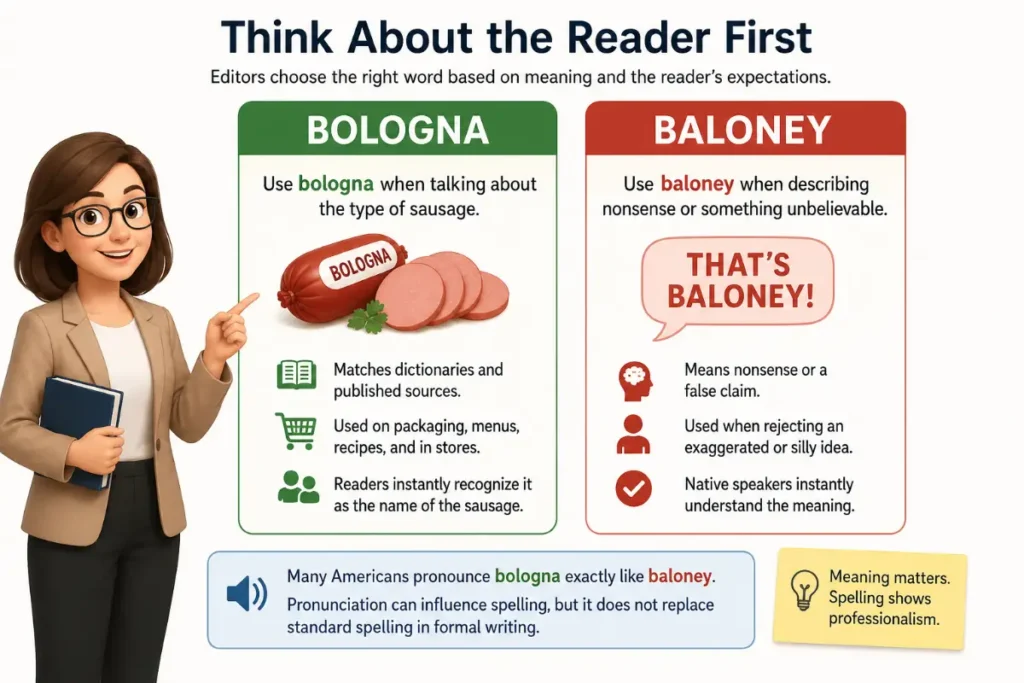
Expert Editor Insight
As a senior editor I’d use a simple context test. First ask what you mean. If you mean the food use bologna in standard writing. If you mean nonsense use baloney. Don’t let pronunciation make the decision for you. Native speakers often say the food name in a way that sounds like baloney so the ear can’t reliably tell you which spelling belongs on the page. Dictionaries are useful here because they separate spelling meaning pronunciation and historical usage instead of treating sound as the only guide. My expert tip is to remember Bologna as the place and bologna as the standard food spelling. Then reserve baloney for nonsense unless you’re intentionally writing in a casual American style.
Conclusion
Baloney vs bologna becomes much easier once you separate meaning from sound. Bologna is the standard spelling for the sausage and the Italian city. Baloney means nonsense or foolish talk and can also appear as an informal American spelling for the sausage. The pronunciation of the food is the main reason these forms cause so much confusion.
When you’re writing about food use bologna as the standard choice. When you’re calling an idea nonsense use baloney. Context does most of the heavy lifting here. A sentence about lunch points toward bologna while a sentence criticizing a ridiculous claim points toward baloney.
One practical tip can save you from the mistake. Remember Bologna as the Italian place and the standard food spelling. Keep baloney connected with nonsense. Once you make that mental connection the spelling becomes much easier to remember and use naturally.
FAQs About Baloney vs Bologna
Is baloney or bologna the correct spelling?
Both baloney and bologna are correct words, but they have different uses. Bologna is the standard spelling for the Italian city and the type of sausage. Baloney is commonly used for the sausage in American English and can also mean nonsense or foolish talk.
What does baloney mean?
Baloney can mean nonsense, foolish talk, or something that isn’t true. It can also refer to a type of sausage in American English.
What does bologna mean?
Bologna is the standard spelling for the Italian city. It also refers to a type of processed sausage that is commonly called bologna in American English.
Is baloney a misspelling of bologna?
No. Baloney is an established English word. It isn’t simply a spelling mistake for bologna. The two forms have different histories and uses.
How do you pronounce baloney and bologna?
In American English, baloney is pronounced like buh LONE ee. Bologna, when referring to the sausage, is also commonly pronounced buh LONE ee. The Italian city has a different Italian pronunciation.
Why do baloney and bologna sound the same?
The pronunciation of baloney developed alongside the American pronunciation of bologna. Although the spellings look different, both are commonly pronounced buh LONE ee when referring to the sausage.
Can baloney mean nonsense?
Yes. Baloney can mean nonsense, foolish talk, or something that you consider untrue. For example, That excuse is complete baloney.
Which should I use in American English?
Use bologna when you want the standard spelling for the sausage or the Italian city. Use baloney when you mean nonsense. Baloney can also be used for the sausage in informal American English.
