
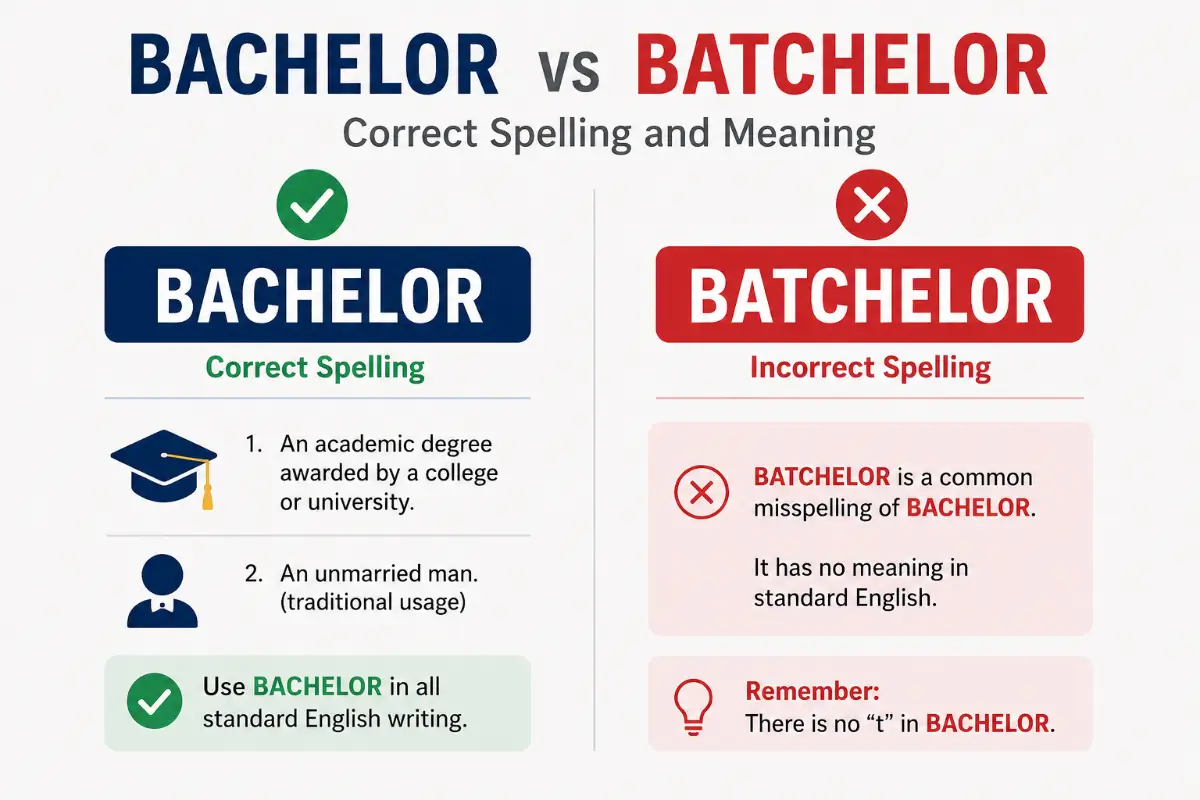
Some English spelling mistakes are easy to understand because the wrong version looks completely different from the correct one. Others are much trickier. Bachelor vs batchelor belongs to the second group. Both forms look familiar and both seem possible when you say the word aloud. Only one belongs in standard English. Bachelor is the correct spelling. Batchelor is incorrect.
If you’re writing about an unmarried man a university degree or a person who has earned a first degree then bachelor is the form you should use. The confusion usually comes from pronunciation. Bachelor is commonly pronounced with a sound like batch at the beginning. That can make the spelling batchelor feel natural because the spoken word seems to contain the sound batch. However English spelling doesn’t always follow pronunciation one sound at a time.
This guide explains the spelling difference in detail. You’ll learn what bachelor means how to pronounce it where the word came from how it works grammatically and how native speakers use it. You’ll also see examples involving marriage education apartments and common expressions. By the end you’ll have a simple way to remember the correct spelling without relying on guesswork.
Quick Definition
Bachelor is the correct standard English spelling. It can mean an unmarried man or a person who has earned a first university degree. In Canadian English it can also refer to a small apartment for one person. Batchelor is not the standard spelling and is normally a misspelling of bachelor.
Quick Answer
The correct form is bachelor. Batchelor is a spelling mistake and should not be used in standard English.
Bachelor is a noun that can refer to an unmarried man or to someone who holds a bachelor’s degree. The word also appears in expressions such as bachelor party and Bachelor of Arts.
Comparison Table for bachelor vs batchelor
| Correct Form | Meaning | Part of Speech | Origin | Usage Frequency | Formality | Common Contexts | Example |
|---|---|---|---|---|---|---|---|
| bachelor | An unmarried man or a person with a first university degree | Noun | Middle English from Old French bacheler | Very common | Neutral and formal | Marriage education university housing and everyday conversation | He earned a bachelor degree in history. |
| batchelor | Not the standard English spelling | None in standard usage | Common misspelling of bachelor | Uncommon in edited writing | Not standard | Spelling errors and typing mistakes | He earned a batchelor degree. |
Meaning and Definition
Meaning of batchelor
Batchelor is not the standard spelling of the English word bachelor. In ordinary writing it is considered a misspelling.
Most readers can still understand batchelor because the intended word is obvious from context. If someone writes She is dating a batchelor then readers will almost certainly understand that the person means bachelor. The fact that a reader can understand a misspelling doesn’t make it an accepted spelling.
You may occasionally encounter Batchelor as part of a surname or another proper name. Proper names can follow their own historical spelling traditions. A surname such as Batchelor doesn’t mean that batchelor is an accepted spelling of the common noun bachelor.
That distinction matters. A word can appear legitimately as a name while still being incorrect as an ordinary English word.
If you’re writing a sentence about an unmarried man or a university degree use bachelor.
Meaning of bachelor
Bachelor has several established meanings.
The most familiar meaning is an unmarried man. Oxford defines bachelor as a man who has never been married. It also lists the educational meaning for a person who has a bachelor’s degree. In Canadian English the word can also refer to a small apartment designed for one person.
For example:
He remained a bachelor for many years.
Here bachelor refers to an unmarried man.
Bachelor also appears in education.
She earned a Bachelor of Science degree.
In this context bachelor is part of the formal name of an academic qualification.
The word can also refer to the degree itself in ordinary usage.
He has a bachelor’s degree in biology.
In that sentence bachelor’s is the possessive form of bachelor.
The meaning changes with context but the spelling doesn’t. Bachelor remains bachelor in each standard use.
What Bachelor Means in Modern English
The word is useful because it connects two major areas of English. One meaning relates to marital status and another relates to education.
Bachelor as an unmarried man
Traditionally bachelor means an unmarried man. This is the sense you’ll find in phrases such as eligible bachelor and confirmed bachelor.
An eligible bachelor usually refers to an unmarried man who is considered a desirable potential partner.
A confirmed bachelor describes a man who has chosen not to marry or is not expected to marry. The expression can carry different social implications depending on context so modern writers should consider the surrounding language carefully.
The word itself is neutral in many ordinary contexts.
For example:
My uncle was a bachelor until he was forty.
The sentence simply describes his marital status.
Bachelor as an academic degree
Bachelor also has a major educational meaning.
A bachelor’s degree is generally a first university or college degree. Oxford lists Bachelor of Arts and other degree names under this sense.
Common examples include:
Bachelor of Arts.
Bachelor of Science.
Bachelor of Business Administration.
The exact degree structure varies by country and institution. Still the word bachelor remains part of many degree titles around the English speaking world.
Bachelor as a type of apartment
In Canadian English bachelor can also refer to a small apartment intended for one person. Oxford identifies bachelor apartment as a Canadian English usage.
For example:
He rented a bachelor near downtown.
This meaning may sound unfamiliar to some US speakers because bachelor apartment is especially associated with Canadian English.
Key Differences Explained
Spelling
The standard spelling is bachelor. It contains the sequence bachelor.
The incorrect form batchelor adds a letter that doesn’t belong in the standard spelling.
The easiest way to spot the mistake is to remember that bachelor begins with bach rather than batch.
Grammar Role
Bachelor is primarily a noun.
It can refer to a person or appear as part of an academic title.
For example:
He is a bachelor.
She earned a Bachelor of Arts.
Batchelor has no standard grammatical role because it isn’t the accepted spelling.
Meaning
Bachelor has established dictionary meanings connected with unmarried men education and in Canadian English certain types of apartments.
Batchelor doesn’t have a separate standard meaning. In normal English it represents an attempt to spell bachelor.
Tone
Bachelor is neutral. It works in casual conversation as well as professional and academic writing.
However some expressions can have cultural or historical associations. The phrase bachelor party is common in American English while expressions involving marital status may sound more formal depending on the context.
Context
Bachelor appears in education marriage discussions housing terminology and common expressions.
Because the word is used across many settings learning the correct spelling is useful. You might encounter it in a résumé a university application a biography a news story or an ordinary conversation.
Which Spelling Is Correct?
Bachelor is the correct spelling. Batchelor is incorrect as a standard English spelling.
The dictionary evidence is consistent. Oxford lists bachelor as a noun and gives meanings related to an unmarried man a person with a bachelor’s degree and a Canadian apartment.
The spelling also appears consistently in established academic terms such as Bachelor of Arts and Bachelor of Science. Oxford identifies Bachelor of Arts as a first university degree in an arts subject and gives Bachelor of Science as the corresponding science degree.
There is no comparable standard dictionary entry that treats batchelor as an alternative spelling.
From an editorial perspective the distinction is straightforward. If you’re writing normal English then use bachelor. If you see batchelor in a draft then correct it unless it is intentionally being used as part of a proper name.
Why Bachelor Looks Like Batchelor
This spelling mistake makes sense once you listen to the word.
Bachelor is commonly pronounced:
BATCH uh ler
The first syllable sounds very close to batch. That makes the spelling batchelor seem logical because the writer may try to capture the sound directly.
But English spelling often preserves historical patterns rather than providing a perfect sound map.
The first part of bachelor comes from an older form that did not develop from the modern English word batch. The resemblance in sound is accidental.
This is a useful lesson in English spelling. A word can sound as if it contains one familiar word while having a completely different spelling history.
Think of bachelor as its own spelling pattern rather than as batch plus something.
Sentence Examples
Here are natural examples using the correct spelling.
- He has been a bachelor for most of his adult life.
- She met an eligible bachelor at the conference.
- My brother earned a Bachelor of Science degree.
- He completed his bachelor degree last year.
- The university offers a Bachelor of Arts in English.
- The young bachelor moved into his own apartment.
- She is studying for a bachelor’s degree in psychology.
- He received his Bachelor of Engineering from a local university.
- The article describes the life of a wealthy bachelor.
- His bachelor apartment was small but comfortable.
The following examples contain the common misspelling. They are incorrect in standard English. - He has been a batchelor for ten years.
- She met a wealthy batchelor at dinner.
- He earned a Batchelor of Science degree.
- The university offers a Batchelor of Arts program.
- She wrote about the life of a young batchelor.
In each sentence replace batchelor with bachelor.
Common Mistakes and Misspellings
Adding the letter t
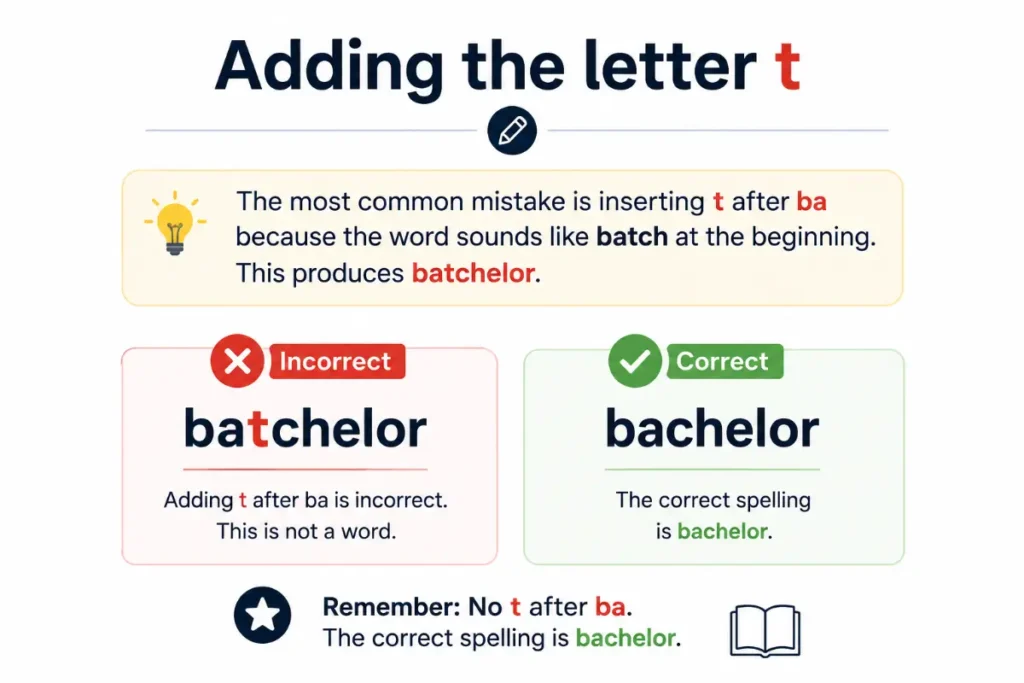
The most common mistake is inserting t after ba because the word sounds like batch at the beginning.
This produces batchelor. The correct spelling is bachelor.
Spelling from pronunciation
Many writers try to spell unfamiliar words exactly as they sound. That strategy works for some simple words but fails with words whose history and pronunciation don’t line up neatly.
Bachelor is one of those words.
Confusing bachelor with batch
The visual similarity between bachelor and batch can influence spelling. The brain recognizes the familiar sound batch and then tries to build the longer word around it.
This is an orthographic confusion rather than a meaning problem.
Treating the wrong form as a variant
Some people assume batchelor might be a British or American variation. It isn’t a standard regional spelling.
American British Canadian and Australian English all use bachelor as the ordinary spelling.
Confusing bachelor with bachelorette
Bachelorette is the feminine counterpart commonly used for an unmarried woman. It is derived from bachelor with the French influenced ending ette. The existence of bachelorette doesn’t create a spelling variant called batchelor.
From an NLP perspective these mistakes are interesting because the writer usually has the correct lexical concept. The problem occurs during orthographic encoding. In simple terms the brain knows which word it wants but produces the wrong sequence of letters.
Pronunciation Guide
Bachelor is commonly pronounced with three syllables.
US IPA: /ˈbætʃələr/
UK IPA: /ˈbætʃələ/
Oxford gives American pronunciations including /ˈbætʃlər/ and /ˈbætʃələr/ and British pronunciation around /ˈbætʃələ(r)/.
A simple American style pronunciation guide is:
BATCH uh ler
The first syllable receives the main stress.
The first sound is the one that causes the spelling problem. Bachelor sounds like it begins with batch.
That does not mean the word is spelled batchelor.
The middle vowel is usually weak. In natural speech the final part may sound like ler or luh depending on accent and speaking style.
A common mistake is to pronounce every syllable with equal strength. Native speakers generally stress the first syllable and reduce the following vowels.
Another useful point is that the spelling doesn’t change with pronunciation. The word remains bachelor in American English British English Canadian English and Australian English even though accents may produce slightly different sounds.
Etymology and Word Origin
Bachelor has a surprisingly long history.
Oxford traces the word to Middle English and Old French bacheler. Its deeper origin is uncertain.
The Online Etymology Dictionary dates the English noun to around 1300 and explains that Old French forms included bacheler bachelor and bachelier. Early meanings included a young man and a young knight or novice in arms. The word later developed meanings associated with unmarried men and university education.
This history is worth knowing because it explains why bachelor doesn’t follow the modern spelling logic suggested by batch.
The exact deeper origin remains uncertain. One proposed source is Medieval Latin baccalarius. Other theories have been suggested over the centuries. The important point for modern spelling is that bachelor developed through older French and English forms rather than being formed from the modern English word batch.
The academic meaning developed in medieval university culture. By the late fourteenth century the word had acquired a meaning associated with a person holding the lowest university degree at the time. The modern bachelor’s degree grew from this historical use.
The word therefore carries several centuries of linguistic history inside a form that now looks perfectly ordinary.
Regional Usage in the US
American English uses bachelor as the standard spelling.
The word is common in everyday conversation and formal writing. Americans use it when talking about unmarried men and university degrees.
Common expressions include bachelor degree and bachelor’s degree. In careful academic writing bachelor’s degree is usually the natural possessive form when referring to the degree in general.
For formal degree names capitalization depends on the exact name. For example Bachelor of Arts and Bachelor of Science are normally capitalized as official degree titles.
American English also uses bachelor party for a pre wedding celebration traditionally held for a groom and his friends.
Batchelor is not an accepted American spelling of the word.
Regional Usage in the UK
British English also uses bachelor as the standard spelling.
The word has long been established in British English and appears in discussions about marital status and university education.
British usage also includes degree names such as Bachelor of Arts and Bachelor of Science.
Pronunciation can differ slightly from American pronunciation. The spelling remains bachelor.
Batchelor isn’t a British spelling variant.
Regional Usage in Australia
Australian English follows the standard spelling bachelor.
The word appears in university terminology and ordinary descriptions of unmarried men. Australian universities use degree titles such as Bachelor of Arts and Bachelor of Science.
The pronunciation may reflect Australian speech patterns but the written form stays the same.
If you encounter batchelor in Australian writing it should normally be treated as a spelling mistake unless it is part of a proper name.
Regional Usage in Canada
Canadian English uses bachelor as the standard spelling.
Canada has an additional use that makes the word especially interesting. A bachelor or bachelor apartment can refer to a small apartment suitable for one person. Oxford identifies this usage specifically as Canadian English.
Canadian English also uses bachelor in university degree terminology.
Batchelor isn’t a Canadian alternative spelling.
Grammar Rules and Part of Speech
Bachelor is primarily a noun. Its grammatical use depends on the meaning you intend.
Bachelor as a common noun
When bachelor refers to an unmarried man it is a common noun.
For example:
He is a bachelor.
The word describes the person.
You can use an article before it:
He is a bachelor.
She met a bachelor at the event.
You can also make it plural:
They are bachelors.
Bachelor as part of a degree title
When referring to an academic qualification bachelor can appear in a formal title.
For example:
She earned a Bachelor of Arts.
He is studying for a Bachelor of Science.
In these formal degree names Bachelor is capitalized because it forms part of the title.
Bachelor’s as a possessive form
When referring to a bachelor’s degree in general use the possessive form.
For example:
She has a bachelor’s degree in history.
He is pursuing a bachelor’s degree in engineering.
The apostrophe matters because bachelor’s functions as a possessive modifier before degree.
Bachelors as a plural
Bachelors means more than one bachelor.
For example:
The club attracted several bachelors.
Don’t confuse bachelors with bachelor’s.
The first is plural.
The second is possessive.
Bachelor as an adjective
Bachelor can appear before another noun in expressions such as bachelor party or bachelor apartment. Traditional grammar often treats these uses as noun modifiers rather than ordinary adjectives.
For practical writing purposes the important point is that bachelor can modify another noun in established phrases.
Bachelor’s Degree Versus Bachelor Degree
This is another area where writers sometimes hesitate.
In standard American English bachelor’s degree is the common form when you’re referring generally to the degree someone earns.
For example:
She has a bachelor’s degree in chemistry.
The possessive form is natural because the expression historically relates to a degree associated with a bachelor.
However official degree titles use Bachelor without the possessive.
For example:
She earned a Bachelor of Science.
The distinction is useful.
Use bachelor’s degree as a general term.
Use Bachelor of Science or Bachelor of Arts when naming a specific degree title.
This isn’t a spelling difference between bachelor and batchelor. It is a grammar and capitalization distinction involving the same correct word.
Bachelor of Arts and Bachelor of Science
Bachelor appears in many academic degree names.
A Bachelor of Arts is commonly abbreviated as BA or B.A. depending on regional and institutional style. Oxford lists BA as a first university degree in an arts subject.
A Bachelor of Science is commonly abbreviated as BSc in British usage and BS or B.S. in North American usage. Oxford identifies these forms as abbreviations of Bachelor of Science.
The important spelling point is consistent across all of them.
Bachelor.
Not batchelor.
Real Life Usage Examples
Daily Talk
Bachelor appears naturally in conversations about relationships and education.
- My cousin is still a bachelor.
- He just finished his bachelor degree.
The first example focuses on marital status. The second focuses on education.
Professional emails often use bachelor when discussing qualifications.
- I completed my Bachelor of Science last year.
- She holds a bachelor’s degree in accounting.
The correct form helps keep professional documents polished.
Academic Writing
Academic writing uses bachelor mainly when discussing degrees and university education.
- The participants were enrolled in a Bachelor of Arts program.
- Students must complete the requirements for a bachelor’s degree.
The word is especially common in university websites applications research biographies and education records.
News Writing
News articles may use bachelor when describing a person or an academic achievement.
- The award recipient holds a Bachelor of Engineering.
- The story follows a young bachelor who moved to the city.
The exact meaning depends on context.
Literature
Literary writing can use bachelor to describe social identity or character.
- The novel introduces a wealthy bachelor living alone.
- The young bachelor avoided the expectations of his family.
In literature the word may carry character information beyond simple marital status.
Related and Confused Terms
Unmarried Man
This is the broadest plain English description of a bachelor in the marital sense.
Single
Single is broader than bachelor. It can describe a person who isn’t married or isn’t currently in a relationship. It doesn’t specifically identify a man.
Bachelorette
Bachelorette is commonly used for an unmarried woman. It is related historically to bachelor.
Bachelor’s Degree
A bachelor’s degree is a first university degree in many education systems. Oxford describes it as a first degree obtained through university study.
Undergraduate
An undergraduate is a student studying for a first degree. The terms aren’t identical because a bachelor can describe a degree holder while undergraduate describes a student pursuing a first degree. Oxford makes this distinction clearly.
Graduate
Graduate can refer to someone who has completed a degree. In North American English it can also describe someone who has completed high school. The meaning depends on context.
Baccalaureate
Baccalaureate is historically connected with the bachelor degree tradition. The word comes through Medieval Latin and developed as a term for a university degree.
Bachelor Party
A bachelor party is a traditional celebration held for a groom before marriage. The expression is particularly common in American English.
Bachelor and Single Are Not Always the Same
These words overlap but they aren’t perfect synonyms.
Bachelor specifically refers to an unmarried man. Single is broader and can apply to anyone who isn’t married or isn’t currently partnered.
For example:
He is single.
This doesn’t necessarily tell us if he has ever been married.
He is a bachelor.
This traditionally identifies him as an unmarried man.
Modern language can be more nuanced than these traditional labels. A person may prefer single because it focuses on current relationship status rather than an identity label.
Good writers choose the term that matches the intended meaning.
Bachelor and Undergraduate Are Not the Same
The educational meaning creates another possible confusion.
A bachelor is associated with a degree. An undergraduate is a student who is studying for a first degree.
For example:
She is an undergraduate at the university.
This tells us that she is currently studying.
She has a bachelor’s degree.
This tells us that she has completed the degree.
A student can be pursuing a bachelor’s degree without yet being a bachelor in the educational sense.
That distinction becomes especially useful in academic writing because precision matters.
Common Search Confusions
People often search for several related forms when they aren’t sure how the word is spelled.
These can include:
Bachelor or batchelor.
Batchelor or bachelor.
Bachelor spelling.
How to spell bachelor.
Bachelor meaning.
Bachelor pronunciation.
Bachelor’s degree spelling.
The answer remains consistent. The standard spelling is bachelor.
Search behavior also shows why spelling mistakes can persist. People often type the version that feels correct before they know the dictionary form. Once they see the correct version they can usually remember it easily.
Why Native Speakers Can Still Misspell Bachelor
Spelling mistakes aren’t limited to language learners.
Native speakers can make errors when writing quickly. They may know the word perfectly well but produce a wrong letter sequence because they are writing from sound or typing automatically.
Bachelor is especially vulnerable because the opening sound strongly resembles batch.
If you hear:
BATCH uh ler.
It is easy to imagine:
batchelor.
But the correct written form is:
bachelor.
This is a good reminder that spelling and pronunciation are related but separate skills.
A Simple Memory Trick
The easiest way to remember bachelor is to focus on the first five letters.
B A C H E.
Think of bachelor as beginning with bach rather than batch.
You can also connect the word with bachelorette. Both forms share the bachelor base.
Another useful strategy is visual repetition. Write these three forms together:
Bachelor.
Bachelor’s.
Bachelors.
Once the correct pattern becomes familiar the incorrect t tends to stand out immediately.
If you see batchelor in your draft ask yourself one question.
Does the word begin with bach or batch?
The answer is bach.
That tiny check can save you from a surprisingly common spelling mistake.
Expert Editor Insight
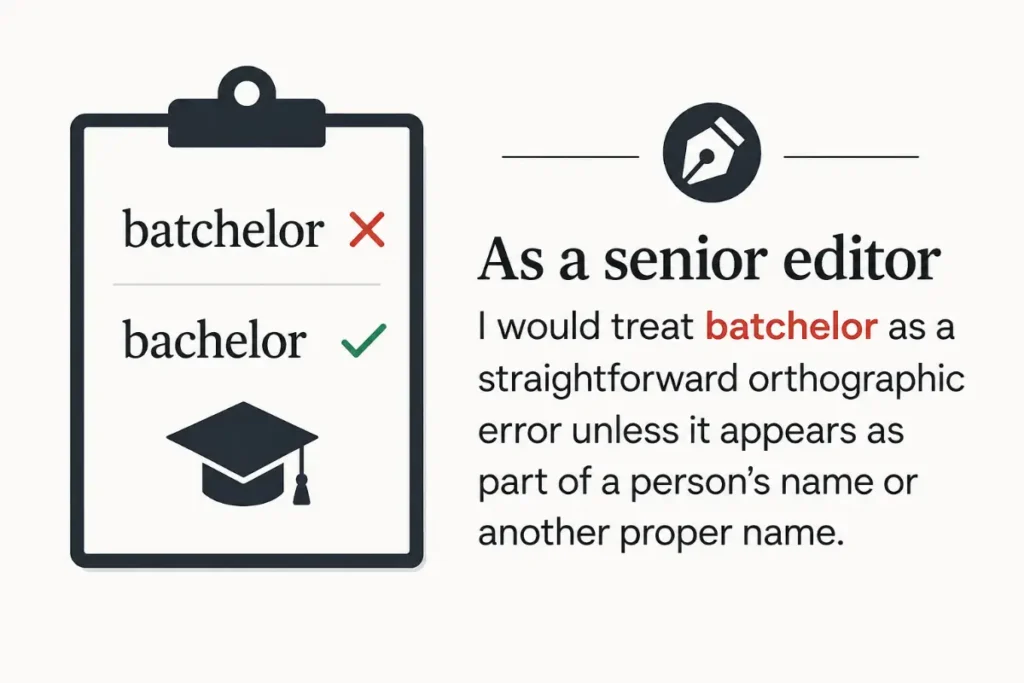
As a senior editor I would treat batchelor as a straightforward orthographic error unless it appears as part of a person’s name or another proper name. Native readers usually understand the intended word immediately but professional writing still requires the standard form. Spellcheckers generally flag batchelor because it isn’t the accepted spelling of the common noun. The stronger editing habit is to understand why the mistake happens. The first syllable sounds like batch so the incorrect t feels natural. Once you separate pronunciation from spelling and remember the bach pattern the error becomes much easier to catch.
Conclusion
When comparing bachelor vs batchelor the correct answer is clear. Bachelor is the standard English spelling while batchelor is a common misspelling. The word can describe an unmarried man and it also appears in academic terms such as Bachelor of Arts and bachelor’s degree.
Its pronunciation explains the mistake because the opening sound resembles batch. However the spelling begins with bach. A useful practical tip is to remember that the first five letters are B A C H E. If you see batchelor in your writing pause and check that opening pattern. Once you separate the sound from the spelling you’ll find the correct form much easier to remember.
Frequently Asked Questions
Is batchelor a real word?
Batchelor isn’t the standard spelling of the common English noun bachelor. It is normally treated as a misspelling. You may see Batchelor as a surname or another proper name because names can preserve unusual historical spellings. In ordinary writing about an unmarried man or a university degree use bachelor instead.
What does bachelor mean?
Bachelor commonly means an unmarried man. It can also refer to a person who holds a bachelor’s degree or to the degree itself in certain contexts. In Canadian English bachelor can describe a small apartment for one person. The intended meaning depends on context but the standard spelling remains bachelor.
bachelor vs batchelor which is correct?
Bachelor is correct and batchelor is incorrect in standard English. The extra t in batchelor comes from the pronunciation because bachelor sounds like it begins with batch. However the spelling developed through older French and English forms and isn’t based on the modern word batch. Use bachelor in standard writing.
How do you pronounce bachelor?
Bachelor is commonly pronounced BATCH uh ler in American English. Oxford gives American pronunciations such as /ˈbætʃlər/ and /ˈbætʃələr/ while British pronunciation is represented around /ˈbætʃələ(r)/. The first syllable receives the main stress. The pronunciation explains why people sometimes add a t when spelling the word.
Can bachelor refer to a degree?
Yes. Bachelor is part of many university degree names such as Bachelor of Arts and Bachelor of Science. In general writing you can also say bachelor’s degree. Oxford defines a bachelor’s degree as a first university degree and lists examples such as Bachelor of Arts and Bachelor of Science.
What is a synonym for bachelor?
The best synonym depends on the meaning. For the marital sense you might use unmarried man or single man. Single is broader and doesn’t necessarily imply the person has never married. For the educational sense you might use degree holder in some contexts. These alternatives aren’t exact replacements in every sentence.
Why do people misspell bachelor?
People often misspell bachelor because the first syllable sounds like the word batch. That makes batchelor seem logical when someone spells the word from pronunciation. Fast typing can make the problem worse. The simplest solution is to remember that bachelor begins with bach rather than batch. This visual cue separates the correct spelling from the common error.
Is bachelor suitable for formal writing?
Yes. Bachelor is completely appropriate in formal writing. It appears in academic records professional biographies university documents business writing journalism and ordinary conversation. Use Bachelor with capitalization when it forms part of an official degree title such as Bachelor of Science. Use bachelor’s degree when referring generally to the qualification.
