
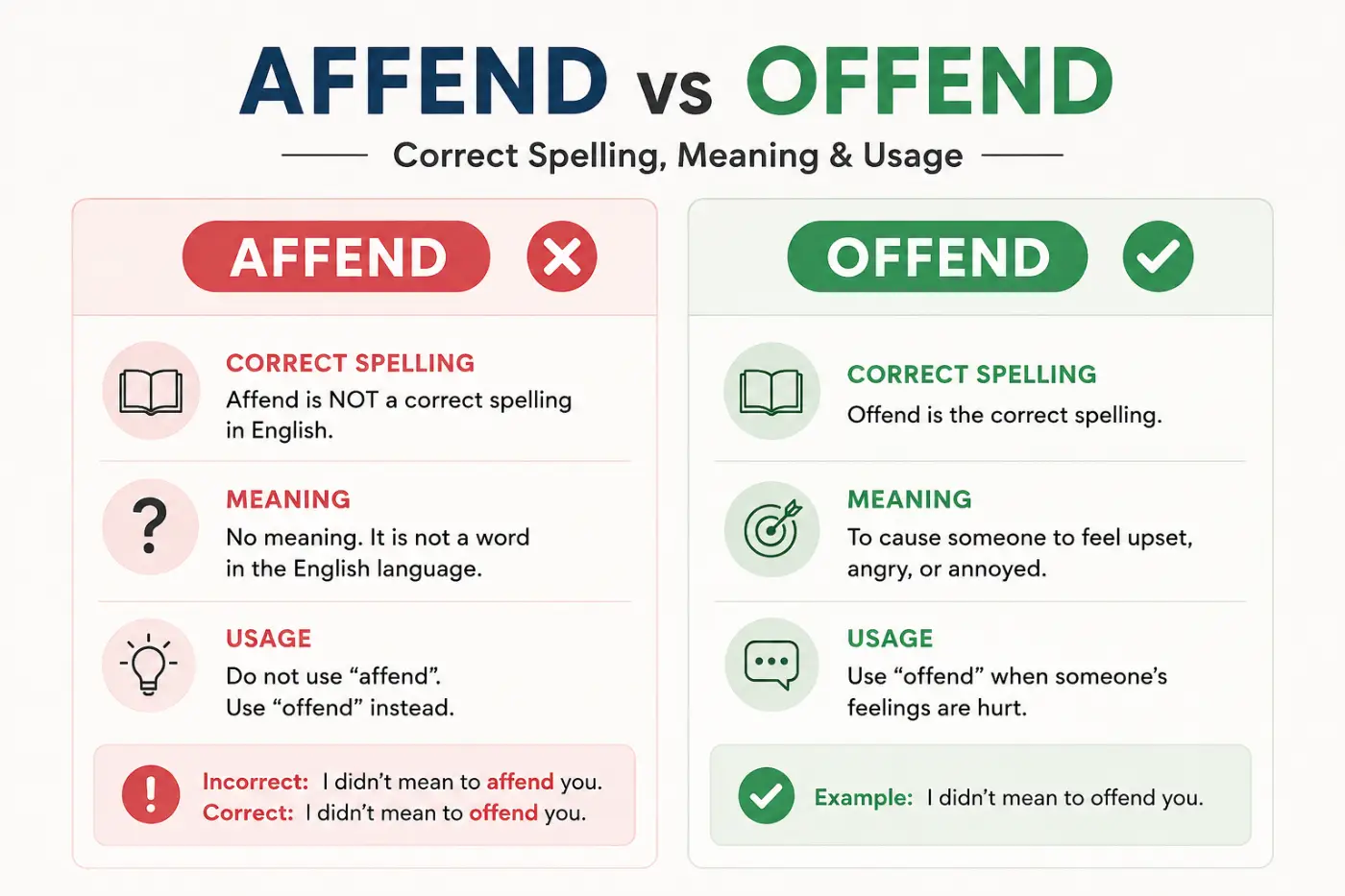
Have you ever typed a word that looks right on the screen but suddenly feels wrong? Affend vs offend is one of those spelling questions that can make even confident writers stop and check. The direct answer is simple: offend is the correct spelling. Affend is not the standard spelling of the English verb.
The confusion is understandable because the pronunciation of offend does not make the spelling especially obvious. When people hear the word they may mentally build the spelling from its sound. The result can be an extra or misplaced letter pattern that produces affend instead of offend.
In this guide you’ll learn the difference between the two forms. You’ll also see the meaning of offend its part of speech pronunciation word history sentence patterns regional usage and common spelling mistakes. We’ll also look at why people make this particular error and how to remember the correct form without relying on guesswork.
Quick Definition
Offend is the correct English spelling. It is a verb meaning to upset someone hurt someone’s feelings or cause someone to feel insulted. It can also mean to break a law or rule. Affend is a common spelling mistake and is not the standard English form.
Quick Answer
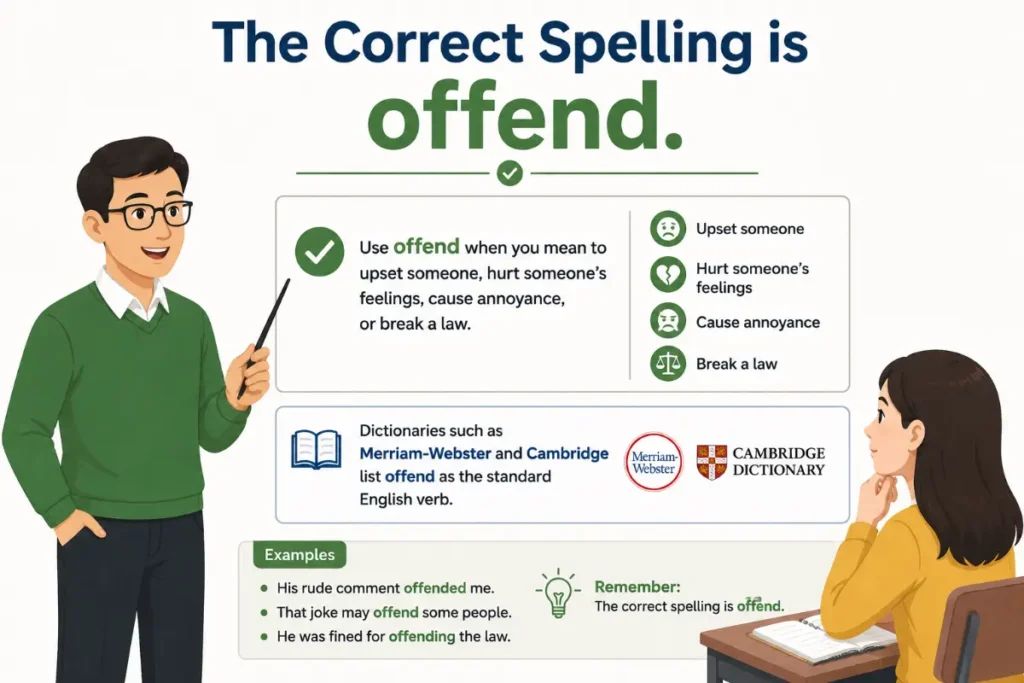
The correct spelling is offend. Use offend when you mean to upset someone hurt someone’s feelings cause annoyance or break a law. Dictionaries such as Merriam Webster and Cambridge list offend as the standard English verb.
If you write affend in an essay email report or professional document you should change it to offend. A useful memory trick is to connect the word with offense and offensive. The shared beginning helps reinforce the spelling.
Comparison Table Of Affend And Offend
| Correct Form | Meaning | Part of Speech | Origin | Usage Frequency | Formality | Common Contexts | Example |
|---|---|---|---|---|---|---|---|
| Affend | No standard English meaning as the verb intended here | None in standard English | Not an established standard form of offend | Very uncommon as a spelling | Not standard | Spelling mistakes and informal typing errors | I did not mean to offend anyone |
| Offend | To upset someone hurt feelings or break a law | Verb | From Middle English through Anglo French and Latin | Common | Standard | Conversation writing law relationships and public communication | I hope I didn’t offend you |
The distinction is straightforward. Offend belongs to standard English vocabulary. Affend does not function as the accepted spelling of this verb.
Meaning And Definition
Meaning Of Affend
Affend is not the standard English spelling of the verb you are looking for. When someone writes affend they almost always intend to write offend. The form can appear because of a typing mistake a spelling mistake or confusion between the sound of the word and its written form.
It is useful to separate a spelling error from a genuine alternative word. English contains many words that have regional forms unusual historical spellings or specialized meanings. This is not the situation here. Standard English dictionaries identify offend as the relevant verb. Merriam Webster gives meanings that include causing displeasure and hurting feelings and also records its use in legal contexts.
So if you are writing a sentence such as I didn’t mean to affend you the correction is simple:
I didn’t mean to offend you.
The same correction applies in formal writing casual messages school assignments business communication and published content.
Meaning Of Offend
Offend is a verb with several related meanings. nThe most common meaning is to make someone upset angry or hurt because of something you say or do. Cambridge defines the word in this sense as causing someone to become upset or angry.
For example:
I didn’t mean to offend you.
Here the speaker means that they did not intend to hurt or upset the other person.
The word can also describe breaking a law. Cambridge lists this as another verb sense.
For example:
He was arrested after he offended again.
In legal language the meaning can relate to committing an offense.
The word also appears in expressions connected with rules principles and standards. A person can offend against a law or accepted standard. This sense is more formal and less common in everyday American conversation.
The important point is that offend is not limited to personal feelings. Its meaning changes slightly according to context.
Key Differences Explained
- Spelling.
The standard spelling is offend. The form affend is a misspelling when the writer intends this verb. - Grammar role.
Offend is a verb. You can say someone offends another person or that someone offended someone in the past. - Meaning.
The word can mean to upset someone hurt their feelings or cause resentment. It can also refer to committing a crime. - Tone.
The word works in casual conversation as well as formal writing. It is not slang. - Context.
You can use it when discussing relationships manners criticism social behavior laws rules or personal reactions.
The spelling difference is therefore not a matter of style. It is a matter of correctness.
Which Spelling Is Correct
Offend is the correct spelling. There is a useful linguistic reason behind this. The word belongs to a family that includes offense, offensive, offended, and offending. These related forms preserve the offend spelling.
Merriam Webster traces the word to Middle English offenden and identifies Anglo French and Latin sources. Its entry records the first known use in the 14th century. Cambridge also lists offend as a standard verb and gives the pronunciation /əˈfend/.
This dictionary evidence matters because spelling questions sometimes involve genuine variants. American and British English can differ in words such as color and colour or center and centre. That is not happening here. There is no standard American versus British spelling distinction that turns affend into an accepted version of offend.
Expert Tip
When you are unsure about the spelling remember the related noun offense. The same opening sound appears in the word family. If you can remember offense you can usually reconstruct offend correctly.
Sentence Examples
The best way to understand a word is to see it doing real work in a sentence. Here are natural examples of offend and its related forms.
- I hope my comment didn’t offend you.
- She didn’t intend to offend anyone at the meeting.
- His joke managed to offend several people.
- I was careful with my words because I didn’t want to offend my host.
- Some people may be offended by that kind of language.
- He apologized after realizing that his remarks had offended his coworker.
- The restaurant changed the wording because it didn’t want to offend its customers.
- I didn’t think the question would offend her.
- The article discusses language that can offend different audiences.
- He was worried that his criticism might offend the team.
Now compare those examples with the common misspelling:
- I didn’t mean to affend you.
Correct: I didn’t mean to offend you. - I hope I didn’t affend anyone.
Correct: I hope I didn’t offend anyone. - She was afraid her comment would affend him.
Correct: She was afraid her comment would offend him. - I never wanted to affend my teacher.
Correct: I never wanted to offend my teacher. - His words could affend some readers.
Correct: His words could offend some readers.
These examples show why proofreading matters. The incorrect form can look convincing when you read quickly.
Common Mistakes And Misspellings
Spelling errors rarely appear out of nowhere. Most have a reason. Affend is a good example of how sound patterns memory and typing habits can interact.
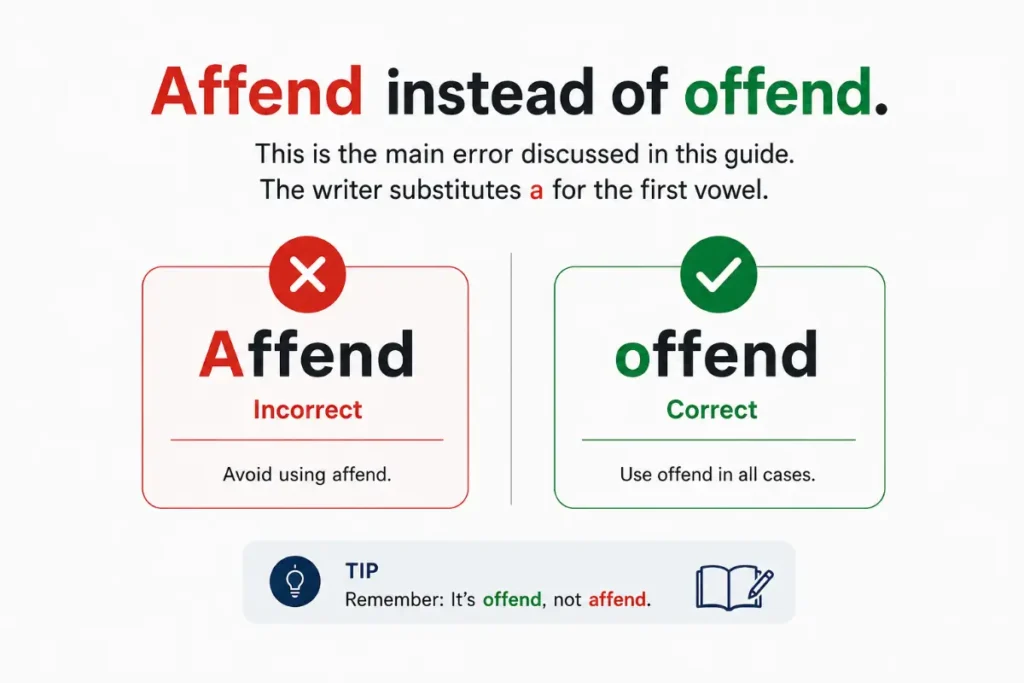
- Affend instead of offend.
This is the main error discussed in this guide. The writer substitutes a for the first vowel. - Offended instead of offend.
Writers sometimes choose the wrong grammatical form because they are thinking about a past reaction. The sentence determines the correct form. For example She offended him yesterday uses the past tense while She may offend him uses the base form. - Offending instead of offend.
The ending changes according to grammar. You might write His behavior is offending people but His behavior may offend people. - Offense instead of offend.
These words belong to the same family but have different grammatical jobs. Offense is normally a noun while offend is a verb. - Offensive instead of offend.
Offensive is generally an adjective. For example The remark was offensive differs grammatically from The remark offended her.
From an NLP perspective several factors can contribute to the error.
Phonetic confusion happens when a writer builds spelling from sound.
Orthographic substitution happens when one familiar letter pattern replaces another.
Lexical competition occurs when similar stored word patterns compete during writing.
Keystroke omission can also produce unexpected spellings when typing quickly.
Visual pattern matching matters because English contains many words where an initial vowel can change the spelling pattern.
These processes don’t make the mistake correct. They simply explain why a familiar word can sometimes come out wrong on the page.
Pronunciation Guide
Cambridge gives offend the pronunciation /əˈfend/ in both British and American English.
The word has two syllables:
uh FEND
The second syllable receives the main stress.
A simple audio style spelling is:
uh FEND
The first vowel is weak. The second syllable sounds like fend.
This pronunciation helps explain one reason people can struggle with the spelling. The first syllable is unstressed and relatively short. When people hear an unstressed vowel they may not immediately know which letter belongs on the page.
Say the word slowly:
uh FEND
Then connect it to:
offend
offended
offending
offense
offensive
Notice how the spelling family stays connected.
One common mistake is to pronounce the word as if it begins with a strong a sound. Standard pronunciation does not support that spelling. The Cambridge pronunciation is /əˈfend/.
Etymology And Word Origin
The history of offend reaches back many centuries. Merriam Webster traces the English word to Middle English offenden and identifies Anglo French and Latin sources. The Latin source is offendere. Etymonline explains that the Latin verb originally carried the literal idea of striking against or stumbling against something. Over time the figurative meanings developed toward making a mistake breaking a rule displeasing someone or provoking someone.
That history gives the modern word an interesting shape. The meaning has moved far beyond a literal physical collision. The English verb appeared in the early 14th century. Later senses included violating a law committing a wrong and hurting someone’s feelings. The related noun offense also has a long history. Etymonline traces it through Old French to Latin offensa and records meanings connected with hurt harm wrongdoing and displeasure.
This history also helps explain why offend, offense, and offensive belong together. They are members of the same historical word family. The modern spelling is therefore not an arbitrary arrangement of letters. It comes from a long linguistic history that passed through Latin French and Middle English before becoming part of modern English.
Regional Usage In The US
American English uses offend as the standard spelling.
You will find it in everyday speech professional writing academic work journalism legal language and dictionaries intended for American readers. Cambridge’s American Dictionary entry gives the same core meaning and pronunciation.
American writers should not use affend as an alternative spelling. It is best treated as an error that needs correction.
Regional Usage In The UK
British English also uses offend.
There is no standard British spelling affend. Cambridge’s British English entry gives offend as the standard form and includes both the emotional sense and the legal sense.
British English does have the related noun offence with a c. That difference can sometimes create confusion because American English commonly uses offense with an s. The verb itself remains offend in both varieties.
Regional Usage In Australia
Australian English follows the standard spelling offend. The related noun is commonly written offence in Australian English because Australian spelling generally follows many British conventions. That does not change the spelling of the verb.
So an Australian writer can correctly write:
I didn’t mean to offend you.
The incorrect form affend is not an Australian spelling variant.
Regional Usage In Canada
Canadian English also uses offend. Canadian spelling draws from both British and American traditions depending on the word and context. Even so there is no standard Canadian spelling affend for this verb.
The safest form for Canadian writing is therefore the same one used across the major English varieties:
offend
Grammar Rules And Part Of Speech
Offend is primarily a verb.
It can take a direct object when someone causes another person to feel upset or insulted.
For example:
His comment offended me.
Here comment is the subject. Offended is the verb. Me is the object.
You can also use offend without directly naming the person affected.
For example:
Try not to offend.
This structure is less common in everyday conversation but is grammatically possible.
The verb also changes form according to tense and grammatical structure.
Present: I offend.
Third person present: She offends.
Past: She offended.
Present participle: She is offending.
Past participle: She has offended.
The base form offend commonly appears after modal verbs and auxiliary constructions.
You could offend someone.
He might offend his audience.
They may offend customers.
It also appears after to in the infinitive.
I didn’t want to offend her.
In this sentence to offend is the infinitive form.
Placement In A Sentence
The position of offend depends on the sentence structure.
I didn’t mean to offend you.
His comments offended the audience.
Some jokes can offend people.
She was worried that she might offend her manager.
The word does not require special punctuation simply because it is offend. Punctuation depends on the structure of the entire sentence.
For example:
I apologized because I thought I had offended him.
The comma is unnecessary because the sentence uses a closely connected dependent clause after the main idea.
Real Life Usage Examples
Daily Talk
Everyday conversation often uses offend when people discuss feelings manners and misunderstandings.
- I hope I didn’t offend you.
This is a common way to soften a statement after realizing that someone might have taken offense.
- I didn’t mean to offend anyone.
The speaker is making their intention clear after saying something that could be misunderstood.
Professional and personal emails can use the word naturally.
- I apologize if my earlier message offended you.
This sentence acknowledges the other person’s reaction without becoming overly dramatic.
- I hope my feedback didn’t offend the team.
Here the writer is separating criticism from personal disrespect.
Academic Writing
Academic writing often uses the word when discussing language behavior culture or social interaction.
- Certain expressions may offend readers when used without cultural context.
- The study examines how public comments can offend members of different communities.
The word works well in these contexts because it is standard and precise.
News Writing
News reports may use offend when discussing public controversy social reactions or legal matters.
- The remarks offended several members of the audience.
- The law applies to people who offend repeatedly.
The exact meaning depends on context. In the first example the word concerns emotional reaction. In the second it refers to committing an offense.
Literature
Writers have long used forms of offend to describe insult conflict and emotional injury.
- She feared that her refusal might offend her host.
- His pride was offended by the accusation.
Literary use can sound more expressive because the word fits naturally into descriptions of character and conflict.
Related And Confused Terms
Several words and phrases overlap with offend in meaning. They are not perfect substitutes because each carries its own shade of meaning.
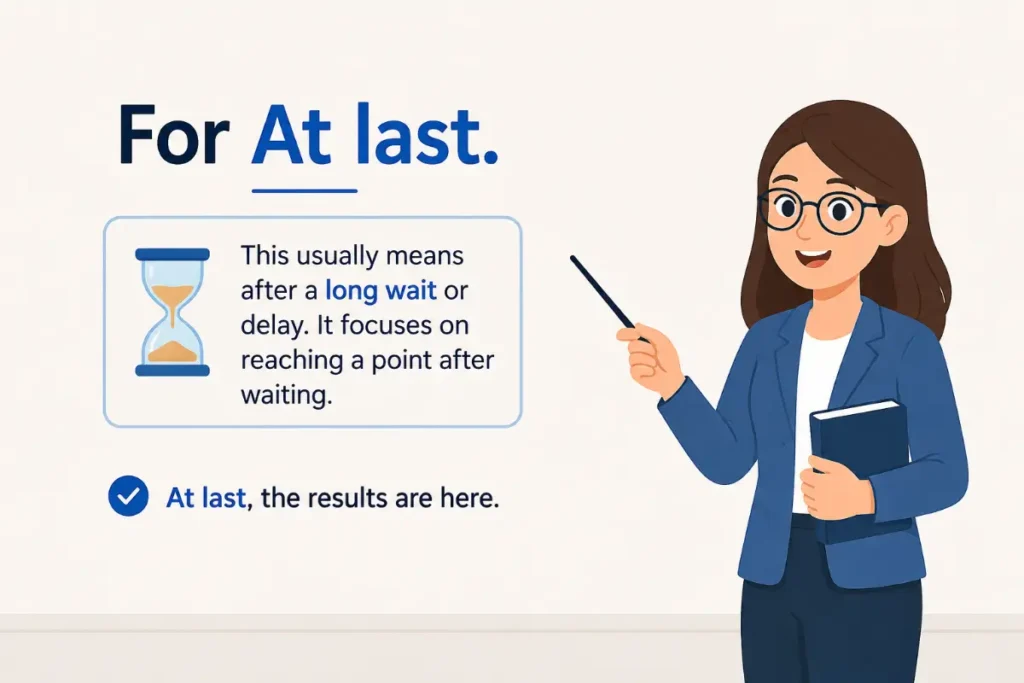
- At last.
This usually means after a long wait or delay. It focuses on reaching a point after waiting. - Eventually.
This means something happens after some time. It often emphasizes the final result of a process. - Ultimately.
This points to the final result or final conclusion of a situation. - At the end.
This refers to the final part of something. It can describe time or position. - Conclusively.
This means in a way that settles an issue or establishes something firmly. - In the end.
This often introduces the final outcome of a situation. - Lastly.
This usually introduces the final item in a sequence. - Offensive.
This is closely related to offend but serves a different grammatical role. It is generally an adjective describing something that causes offense.
These terms belong to different semantic groups. The first seven concern finality or sequence. Offensive belongs directly to the word family of offend.
Expert Editor Insight
As an editor I would treat affend as a straightforward spelling error rather than a stylistic choice. Native English writers recognize offend as the established form because they have encountered it repeatedly in phrases such as offended by, offend someone, offensive language, and take offense. Spellcheckers and grammar tools commonly flag affend because it does not match the standard lexical form. The best correction is not to rewrite the sentence. Simply replace the incorrect spelling with offend and then check the surrounding grammar.
A useful editing habit is to examine the whole word family rather than memorizing one isolated spelling. If you remember offend, you can connect it with offended, offending, offense, and offensive. That creates a stronger mental pattern than memorizing four unrelated words.
Why People Write Affend
The error is easy to understand once you look at how English spelling works. First the pronunciation does not clearly announce the first vowel. The initial syllable is weak. That can make the written form harder to retrieve.
Second English contains many words where a and o create different but familiar spelling patterns. A writer may select the wrong vowel simply because the alternative looks plausible. Third typing changes the situation. When someone writes quickly they may depend on visual memory rather than carefully recalling every letter. If the word has not been written recently the wrong form can slip through.
Fourth the human brain is excellent at recognizing approximate patterns. You can often read a misspelled word without noticing the error because your brain automatically predicts the intended word. That is why proofreading should involve more than simply reading for meaning. A sentence can make perfect sense while still containing a spelling error.
A Simple Way To Remember The Spelling
Use the word family.
Think:
offend
offended
offending
offense
offensive
The opening off stays visible across the family.
You can also connect offend with the phrase take offense. If someone takes offense they feel insulted or upset. The noun and verb are closely related.
Another useful memory sentence is:
I do not want to offend anyone.
Say it aloud and picture the spelling at the same time.
This method is more reliable than trying to remember the pronunciation alone.
Final Verdict
The answer to affend vs offend is clear: offend is the correct spelling. Affend is a misspelling and should be corrected in standard English writing. The verb means to upset someone hurt their feelings or cause displeasure. It can also mean to commit a crime in legal contexts.
Its pronunciation is /əˈfend/ and its history reaches through Middle English Anglo French and Latin. When you hesitate over the spelling remember the related words offense, offended, and offensive. That shared word family gives you a reliable memory cue. One practical tip is simple: if you type affend, stop and replace it with offend before you submit or publish your writing.
FAQs
Is Affend A Real Word?
No. Affend is not the standard English spelling of the verb offend. If you want to say that someone upset another person hurt their feelings or caused annoyance you should use offend. Standard dictionaries such as Merriam Webster and Cambridge list offend as the accepted verb.
What Does Offend Mean?
Offend usually means to upset someone hurt their feelings or make them angry because of something you say or do. It can also have a legal meaning involving committing a crime. Cambridge lists both the emotional sense and the legal sense. The exact meaning depends on the sentence and the context.
Affend Or Offend Which Is Correct?
Offend is correct. Affend is a misspelling when the writer intends the standard English verb. There is no standard American British Australian or Canadian spelling rule that makes affend an accepted alternative. Use offend in school writing professional documents emails articles and everyday communication.
How Do You Pronounce Offend?
Offend is pronounced /əˈfend/. It has two syllables and the stress falls on the second syllable. A simple pronunciation guide is uh FEND. Cambridge gives /əˈfend/ for both British and American English. The first syllable is weak while the second syllable carries the main stress.
Can Offend Start A Sentence?
Yes. Offend can begin a sentence when the grammatical structure calls for the base verb. For example Offend someone and you may damage the relationship is grammatically possible. More commonly the word appears after another subject or verb such as I didn’t mean to offend you. Sentence position depends on the surrounding grammar.
What Is A Synonym For Offend?
Useful synonyms include upset, insult, displease, hurt, annoy, and affront. The best choice depends on the situation. Upset is broad and conversational. Insult suggests disrespect. Affront sounds stronger and more formal. Hurt emphasizes emotional pain. No synonym fits every sentence exactly.
Why Do People Misspell Offend?
People may misspell offend because the first unstressed vowel is not strongly pronounced. That makes the spelling less obvious from sound alone. Fast typing and visual pattern recognition can add to the problem. The incorrect form can also look believable because English has many words where an initial vowel changes the entire spelling pattern.
Is Offend Suitable For Formal Writing?
Yes. Offend is a standard English verb suitable for formal and informal writing. You can use it in academic work professional emails journalism legal discussions and everyday conversation. The word itself is not informal. Your choice of surrounding vocabulary and the sentence structure determines the overall level of formality. Merriam Webster and Cambridge both recognize it as standard English.
