
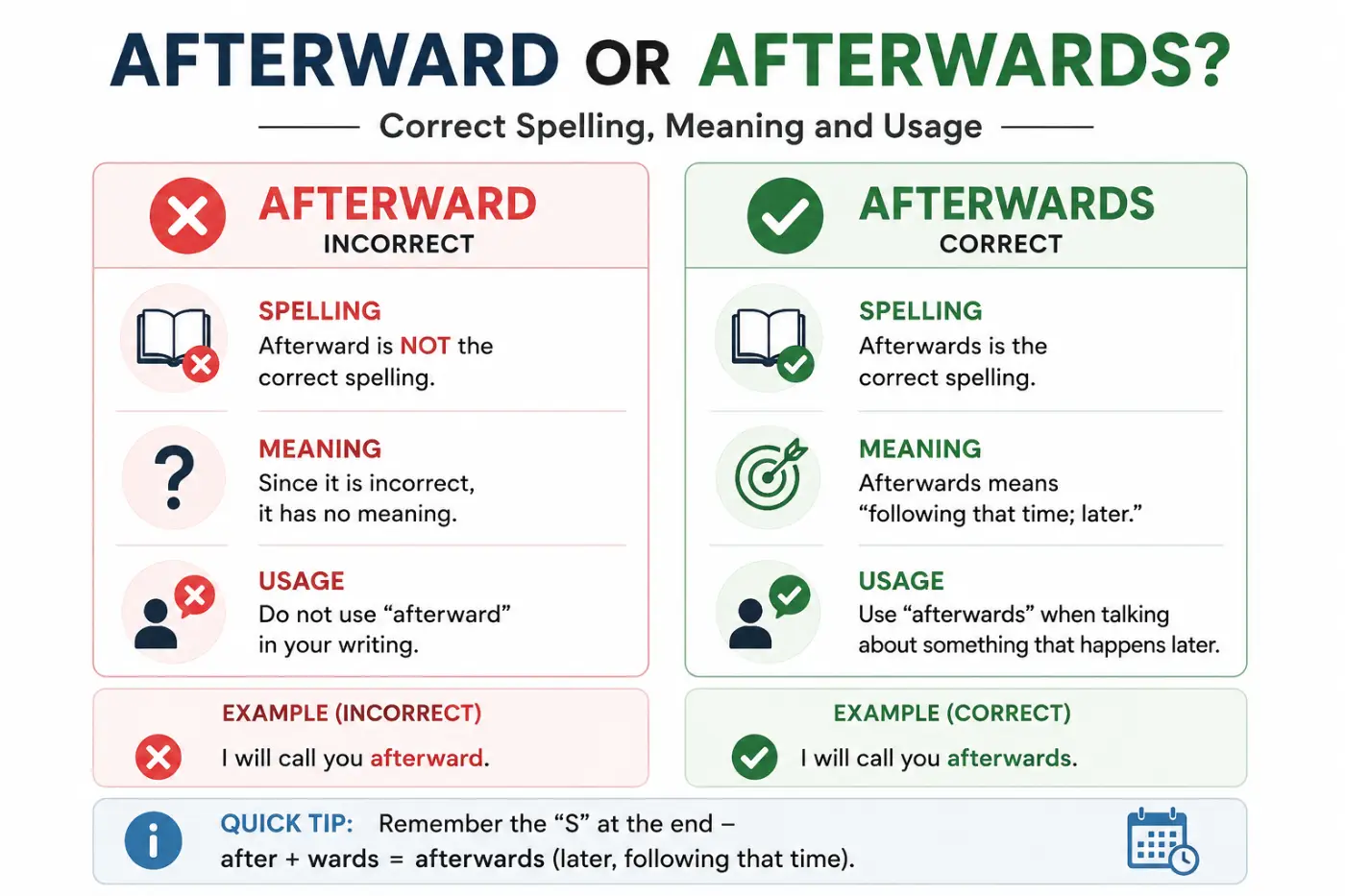
Have you ever typed afterward or afterwards and stopped to wonder if one of them is wrong? It’s an easy question to have because the two forms look almost identical and mean the same basic thing. The difference comes mainly from regional English usage rather than from a difference in meaning.
The short answer is simple. Afterward and afterwards are both correct English words. In American English afterward is usually the preferred form. In British English afterwards is especially common. Major dictionaries recognize both forms.
The confusion often comes from the extra s at the end. English has many adverbs that can appear in related forms and that makes it tempting to assume one version must be incorrect. In this case the extra letter doesn’t create a new meaning. It marks a recognized variant.
In this guide you’ll learn the exact difference between the two forms. You’ll also see how native speakers use them in everyday conversation, emails, academic writing, news writing, and more. We’ll cover pronunciation, grammar, history, regional preferences, common mistakes, synonyms, and practical examples so you can choose the form that sounds right for your audience.
Quick Definition
Afterward and afterwards are adverbs meaning at a later time or after something has happened. Both are grammatically correct. Afterward is especially common in American English, while afterwards is mainly associated with British English. The meaning stays the same regardless of the spelling you choose.
Quick Answer
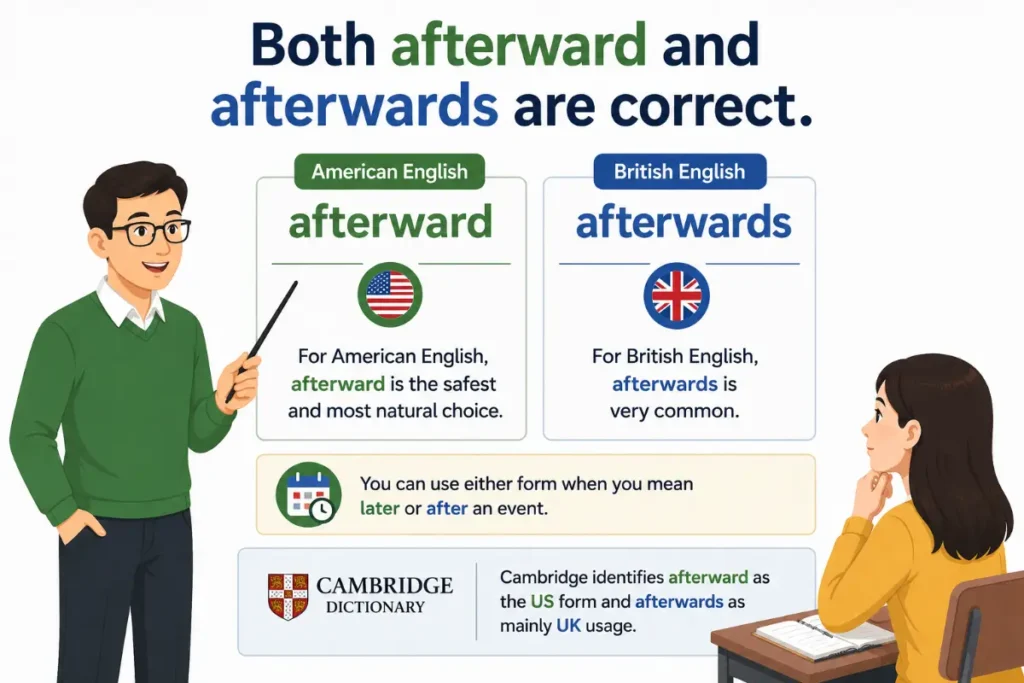
Both afterward and afterwards are correct. For American English, afterward is the safest and most natural choice. For British English, afterwards is very common. You can use either form when you mean later or after an event. Cambridge identifies afterward as the US form and afterwards as mainly UK usage.
For example:
We went out for dinner afterward.
We went out for dinner afterwards.
Both sentences are correct. The difference is mainly regional style.
Comparison Table
| Correct Form | Meaning | Part of Speech | Origin | Usage Frequency | Formality | Common Contexts | Example |
|---|---|---|---|---|---|---|---|
| afterward | At a later time | Adverb | Old English and Middle English roots | Very common in US English | Neutral | American speech and writing | We talked afterward. |
| afterwards | At a later time | Adverb | Developed from afterward with an adverbial s | Very common in UK English | Neutral | British speech and writing | We talked afterwards. |
Both forms are established English words rather than one correct spelling and one mistake. Merriam Webster lists afterward as an adverb and gives afterwards as a variant. Cambridge makes the regional distinction more explicit by identifying afterward with US English and afterwards mainly with UK English.
Meaning and Definition
Meaning of afterward
Afterward means at a later time or after something has happened. It usually points back to an event that has already been mentioned. Instead of repeating the entire time phrase, you can use this adverb to show that another action happened later.
For example:
We finished the meeting and went to lunch afterward.
The word afterward tells the reader that lunch happened after the meeting.
It can also appear at the beginning of a sentence.
Afterward, she realized that she had left her phone at home.
Merriam Webster defines the word in terms of a later time and traces its recorded history to the Middle English period. Its first known use is listed in the 13th century.
Meaning of afterwards
Afterwards has the same basic meaning.
It means at a later time or after something else has happened.
For example:
We watched a movie and went for coffee afterwards.
There is no change in the event sequence when you replace afterwards with afterward.
We watched a movie and went for coffee afterward.
The meaning remains the same.
Cambridge identifies afterwards as an adverb used mainly in UK English. It gives examples showing the word in situations where one action follows another.
Why the extra s does not change the meaning
The final s can make the two forms look like they should have different grammatical jobs. They don’t.
English has a long history of forming adverbs with different endings. Afterwards developed as a variant of afterward. The additional ending became part of the established word rather than changing its basic meaning.
That’s why you don’t need to learn two separate definitions. Learn one core meaning and one regional preference.
Key Differences Explained
Spelling
The spelling difference is simple.
Afterward ends with ward.
Afterwards ends with wards.
Neither spelling is inherently wrong.
The choice depends largely on the variety of English you’re using.
Grammar role
Both forms function as adverbs. They modify an action by telling the reader when something happened.
For example:
She called me afterward.
They left afterwards.
In both sentences the adverb gives information about time.
Meaning
The meaning is essentially identical.
Both words can mean later, after that, or at a later point in time.
You can usually replace one with the other without changing the meaning of the sentence.
Tone
Neither word is automatically more formal.
Both are neutral English adverbs.
A business email can use afterward. A research paper can use afterwards. A casual conversation can use either one.
Regional preference matters more than formality.
Context
American readers generally expect afterward more often.
British readers commonly see afterwards.
Canadian and Australian English can use both forms, although local style and individual preference can influence the choice.
The key is consistency. If you’re writing for a specific audience, follow the variety of English used by that audience.
Which Spelling Is Correct?
Both afterward and afterwards are correct. If you’re writing for a general American audience, choose afterward. It’s the form most closely associated with US English in major learner dictionaries.
If you’re writing for a British audience, afterwards is a natural choice and appears frequently in British English. This isn’t a case where one spelling is proper and the other is a misspelling. Merriam Webster lists afterwards as a variant of afterward, while Cambridge explicitly labels afterward as US usage and afterwards as mainly UK usage.
That dictionary evidence matters because it separates actual regional variation from internet spelling myths. A useful editor’s rule is this: match the spelling to your audience and stay consistent. If your entire article follows American English, using afterward throughout will usually sound natural. If you’re writing in British English, afterwards may fit better.
Sentence Examples
Here are natural examples using afterward.
- We went to a coffee shop afterward.
- She called me afterward to explain what happened.
- I felt much better afterward.
- They discussed the problem afterward.
- We can talk about the details afterward.
- He apologized afterward for his rude comment.
- The team celebrated afterward at a nearby restaurant.
- I realized my mistake afterward.
- She sent me an email afterward.
- We went home shortly afterward.
Now compare the same idea with afterwards.
We went to a coffee shop afterwards.
She called me afterwards to explain what happened.
I felt much better afterwards.
The difference is not in the action or the timing. The difference is simply the regional form.
Common Mistakes and Misspellings
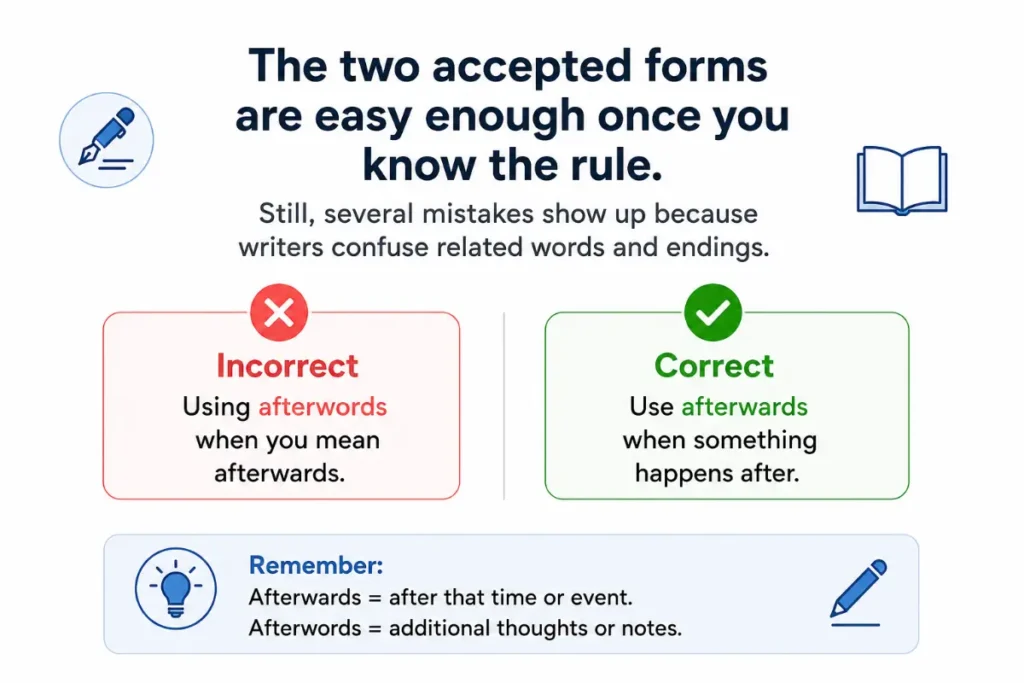
The two accepted forms are easy enough once you know the rule. Still, several mistakes show up because writers confuse related words and endings.
- Using afterwords when you mean afterwards.
Afterword is a different word. It usually refers to a section at the end of a book. If you mean later then afterward or afterwards is the correct choice.
- Writing afterword when you mean afterward.
These words sound similar but serve different purposes. An afterword belongs to a book. Afterward refers to time.
- Assuming afterwards is always wrong in American English.
It isn’t wrong. American dictionaries recognize it as a variant. It simply isn’t the usual American preference.
- Assuming afterward is wrong in British English.
It isn’t wrong either. British English can use afterward, although afterwards is more common.
- Using both forms inconsistently in one piece.
Switching between the two forms without a reason can make your writing look careless. A consistent style is cleaner.
People may also type the wrong form because of NLP confusion between similar words. Natural language processing systems often classify words by their spelling patterns and surrounding context. Human writers do something similar mentally. When two forms have nearly identical sounds and meanings, the brain can treat them as interchangeable during fast typing.
That’s why errors such as afterwords or confusion with afterword can happen even to experienced writers.
Pronunciation Guide
In American English, afterward is commonly pronounced approximately as:
AF ter werd
Cambridge gives the US pronunciation as /ˈæf.tɚ.wɚd/.
The word has three main spoken parts:
AF ter werd
The stress falls on the first syllable.
For afterwards, Cambridge gives the US pronunciation as /ˈæf.tɚ.wɚdz/. The final s produces a z sound in normal pronunciation.
A simple pronunciation guide is:
afterward: AF ter werd.
afterwards: AF ter werdz.
One common mistake is overpronouncing every written letter. Native speakers usually say these words smoothly rather than giving each part equal weight.
The pronunciation also shifts slightly across regional accents. British English commonly uses a pronunciation represented by Cambridge as /ˈɑːf.tə.wəd/ for afterward and /ˈɑːf.tə.wədz/ for afterwards.
Etymology and Word Origin
The history of these words reaches far back into English. Merriam Webster traces afterward to Middle English afterward, which developed from Old English æfterweard, meaning behind or following. The word combines an older form related to after with ward, an element associated with direction. Merriam Webster records the first known use of the modern word in the 13th century.
Etymonline gives a similar history and explains that Old English æfterwearde carried meanings connected with being behind or at the rear. Over time, the word developed its temporal sense of something happening later.
The history of afterwards is especially interesting.
Etymonline dates afterwards to around 1300 and explains it as a form developed from afterward with an adverbial s. So the extra s isn’t a modern invention. It has been part of the history of the word for centuries.
The root after itself is much older. Etymonline traces it to Old English æfter, meaning behind or later in time. Related Germanic forms appear in several older languages.
That history explains something useful about modern English. Spelling differences don’t always arise because one writer made a mistake. Sometimes languages preserve multiple forms that developed naturally over hundreds of years.
That’s exactly what happened here.
Regional Usage in the US
American English generally favors afterward.
Cambridge labels afterward as US English and describes afterwards as mainly UK usage. Merriam Webster also recognizes afterwards as a variant.
If you’re writing an American article, school assignment, business email, website, or social post, afterward will usually feel like the most natural choice.
For example:
We can discuss the contract afterward.
That sentence sounds completely normal to an American reader.
Regional Usage in the UK
British English commonly uses afterwards.
Cambridge specifically labels afterwards as mainly UK usage and gives examples such as using the word to describe an action that happens after an earlier event.
For example:
We went for dinner afterwards.
That sentence is perfectly natural in British English.
British writers can also use afterward. It isn’t an incorrect Americanism that British readers cannot understand. It simply has a different frequency and regional feel.
Regional Usage in Australia
Australian English can use both forms.
You may encounter afterward and afterwards in Australian writing because Australian English shares characteristics with several English varieties. Local publishing style and individual preference can influence the choice.
If your Australian publication follows a particular style guide, follow that guide. Otherwise, either established form can work.
Regional Usage in Canada
Canadian English also allows both forms.
Canadian writing sits between several English traditions, so you can encounter both spellings. Afterward is fully established, while afterwards is also recognizable and accepted.
For a Canadian publication, consistency matters more than trying to force one universal spelling rule.
Grammar Rules and Part of Speech
Both forms are adverbs.
An adverb can provide information about time, place, manner, frequency, or other circumstances. Here, the job is to show that an event happens later.
Consider this sentence:
We finished the presentation and talked afterward.
The word afterward modifies the action talked by telling us when the conversation happened.
You can place the word in several positions.
At the beginning:
Afterward, we went home.
In the middle:
We afterward discussed the results.
The second structure is grammatically possible but sounds less natural in everyday American English.
At the end:
We went home afterward.
The final position is extremely natural.
You can also combine it with words such as soon, shortly, and immediately.
Soon afterward, the company announced the decision.
Shortly afterward, the weather changed.
The same patterns work with afterwards.
Soon afterwards, the company announced the decision.
Shortly afterwards, the weather changed.
Punctuation depends on sentence structure rather than the word itself.
When the adverb begins the sentence as an introductory element, a comma often improves readability.
Afterward, we discussed the results.
At the end of a simple sentence, you normally don’t need a comma before it.
We discussed the results afterward.
The important point is that neither form requires special punctuation simply because it ends in ward or wards.
Real Life Usage Examples
Daily Talk
Everyday conversation tends to favor short and natural constructions.
- We’ll grab something to eat afterward.
- I’ll call you afterward.
These sentences sound natural because the adverb quickly tells the listener when the next action will happen.
In professional email writing, both forms work.
- I’ll send the revised document afterward.
- We can discuss the remaining details afterward.
For an American business audience, afterward will usually be the cleaner default.
Academic Writing
Academic writing often needs precise time relationships.
- The researchers collected the samples and analyzed them afterward.
- Participants completed the survey and were interviewed afterward.
There’s nothing informal about the word. It can work perfectly well in serious academic prose.
News Writing
News writers often need to establish the sequence of events quickly.
- Officials met with residents and released a statement afterward.
- The suspect was questioned and later released.
The word can help create a clear timeline without repeating a longer phrase.
Literature
Writers have used these forms to move characters and events through time.
- She thought about the conversation afterward.
- They spoke for a few minutes and left shortly afterward.
Literary writing often benefits from concise time markers because they keep the narrative moving.
Related and Confused Terms
Several words and phrases overlap with the meaning of afterward but aren’t always perfect substitutes.
- At last. This usually means finally after waiting or difficulty. It can carry a sense of relief.
- Eventually. This means at some point after a period of time or a series of events.
- Ultimately. This often refers to the final result or outcome rather than simply the next event.
- At the end. This usually points to the final part of a period or process.
- In the end. This often introduces the final outcome of a situation.
- Lastly. This normally introduces the final item in a sequence.
- Later. This is one of the closest everyday alternatives to afterward.
- Thereafter. This means after that time or event and often sounds more formal.
These terms are related but not interchangeable in every sentence.
For example:
We ate dinner and went home afterward.
This simply tells us what happened later.
We ate dinner and eventually went home.
This can suggest that going home took some time or happened after other events.
We ate dinner and ultimately decided to stay.
Here ultimately focuses on the final decision rather than simply the next event.
Choosing the right synonym depends on the relationship you want to express.
Afterward or Afterwards in American English
If your main concern is American English, the answer is especially straightforward.
Use afterward as your default.
For example:
We’ll discuss the issue afterward.
I’ll send the report afterward.
They spoke with the manager afterward.
You can still encounter afterwards in American writing. It isn’t an error. Merriam Webster recognizes it as a variant, and Cambridge notes that Americans usually use afterward.
So if you’re writing a website article for US readers, preparing an American school assignment, or drafting a business email for an American audience, afterward is usually the most natural choice.
Afterward or Afterwards in British English
British English commonly favors afterwards.
For example:
We went for a walk afterwards.
She called me afterwards.
They discussed the problem afterwards.
Cambridge specifically describes afterwards as mainly UK usage.
Still, British English can use afterward too. There’s no grammar rule that bans it.
This distinction matters because English is not one single fixed system. American English, British English, Canadian English, Australian English, and other varieties share the same foundation while developing their own preferences.
Does Afterwards Sound Less Formal?
No.
The extra s does not make the word casual.
Afterward and afterwards are both neutral adverbs. Neither one is inherently more professional or more academic.
Consider these sentences:
The researchers reviewed the data afterward.
The researchers reviewed the data afterwards.
Both are perfectly suitable for formal writing.
The important factor is regional style and consistency.
If you’re writing for an American audience, afterward will normally fit better. If you’re writing for a British audience, afterwards may sound more natural.
Is Afterward One Word?
Yes.
Afterward is written as one word.
Afterwards is also written as one word.
Do not split either form into separate words.
Incorrect forms such as after word create a different phrase and can change the meaning completely.
This matters especially when using automated writing tools or spell checkers. If the intended meaning is at a later time, keep the word together.
Afterward Versus After
These words are related but don’t always work in the same grammatical position.
Afterward is an adverb.
After can function as a preposition, conjunction, adjective, or adverb.
For example:
We went home afterward.
Here afterward stands alone as an adverb.
Compare:
We went home after dinner.
Here after introduces the noun phrase dinner.
You can also say:
We went home after we finished dinner.
Here after introduces a clause.
Cambridge explains that after can function in several grammatical roles, while afterwards and afterward are adverbs referring to later time.
This distinction is useful because writers sometimes try to replace after with afterward without checking the sentence structure.
Afterward Versus Later
Later is one of the closest synonyms for afterward.
Still, they can carry slightly different emphasis.
Consider:
I’ll call you later.
This simply means at a future time.
Now compare:
I’ll call you afterward.
This usually refers to something already understood in the conversation.
For example:
I have a meeting at three. I’ll call you afterward.
The reference point is clear. The call will happen after the meeting.
That’s one reason afterward works so well when you want to connect two events.
Why This Spelling Confuses Writers
The confusion isn’t surprising.
First, the words are nearly identical.
Second, both are pronounced similarly.
Third, both mean the same basic thing.
Fourth, English readers are exposed to multiple regional varieties online.
An American reader may see afterward most of the time, then encounter afterwards in a British publication. A writer might assume the unfamiliar form must be an error.
It isn’t.
English has many regional spelling differences. Some involve major changes such as color and colour. Others are much smaller, like afterward and afterwards.
The smart approach is to recognize the variation instead of treating every difference as a spelling mistake.
A Simple Rule to Remember
If you want one practical rule, use this:
American English usually prefers afterward. British English commonly prefers afterwards. Both are correct.
That’s all you need for most writing situations.
If you’re not writing for a specific regional audience, afterward is a safe choice for general American English content.
If your audience is British, afterwards will often sound more natural.
Expert Editor Insight
As an editor, I’d recommend choosing the form that matches your established variety of English rather than treating this as a right versus wrong spelling problem. For American content, afterward is the natural default. For British content, afterwards often sounds more native. Grammar and spell checking tools generally recognize both because both are legitimate English forms. The bigger editorial mistake is inconsistency. If you switch randomly between the two forms, readers may wonder if the change was intentional. Pick the form that fits your audience and keep it consistent.
Expert Tip
If you write primarily for readers in the United States, use afterward unless a specific style guide tells you otherwise.
If you write for a British audience, afterwards is often the more natural choice.
Don’t waste time trying to memorize a complicated grammar rule. The core distinction is regional usage.
Think of it like two roads leading to the same destination. Both words mean later. The road you choose depends on the variety of English you’re using.
Conclusion
Afterward and afterwards are both correct English forms. They mean at a later time or after something has happened. The main difference is regional preference. American English generally favors afterward, while British English commonly uses afterwards. Major dictionaries recognize both forms and support this distinction.
You don’t need to memorize a complicated grammar rule. Just match the form to your audience. If you’re writing for Americans, afterward is the easiest default. If you’re writing for British readers, afterwards is a natural choice. Most importantly, don’t mistake regional variation for incorrect spelling.
Frequently Asked Questions
Is finaly a real word?
The spelling finaly is generally a misspelling of finally. The standard English spelling contains two l letters before the y. If you’re asking about afterward and afterwards, both of those forms are correct. They differ mainly in regional preference rather than correctness. In American English, afterward is usually preferred, while afterwards is mainly associated with British English.
What does finally mean?
Finally is an adverb meaning at last, after a long wait, or as the last point in a sequence. It can describe an event that happens after delay or introduce the last item in an explanation. For example, you might say, We finally arrived home. This word is unrelated in meaning to afterward, which simply refers to a later time.
finaly or finally which is correct?
Finally is the correct spelling. Finaly is a common spelling mistake because writers may forget that the word keeps two l letters before the final y. The spelling issue is separate from afterward and afterwards, which are both legitimate forms. If you’re checking the time related word, use afterward for the common American form or afterwards for the common British form.
How to pronounce finally?
Finally is commonly pronounced approximately FY nuh lee. The first syllable receives the strongest stress. It contains three syllables in ordinary pronunciation. Don’t confuse its pronunciation with final plus a separate ending spoken too carefully. Natural speech blends the sounds together. If you meant afterward, its American pronunciation is approximately AF ter werd.
Can finally start a sentence?
Yes. Finally can begin a sentence when it introduces the last point in a sequence or describes something that happened after a long wait. For example, you can write, Finally, we reached the station. The same punctuation principle applies to many introductory adverbs. A comma after the opening word can make the sentence easier to read.
What is the synonym of finally?
Common synonyms for finally include at last, eventually, ultimately, and in the end. The best choice depends on the meaning you need. At last often suggests relief after waiting. Eventually focuses on something happening after time passes. Ultimately often focuses on the final result. These words shouldn’t automatically replace one another in every sentence.
Why do people misspell finally?
People often misspell finally because the pronunciation doesn’t clearly remind them to write two l letters. Fast typing can also cause the second l to disappear. Another reason is pattern confusion with words that use a single consonant before an ending. Familiarity helps. Seeing the correct spelling often enough makes finally easier to recognize and remember.
Finally in formal writing?
Yes. Finally is completely acceptable in formal writing. It can introduce the last point in an argument, describe the final stage of a process, or indicate that something happened after a delay. The word itself isn’t informal. Just make sure you use it for its correct meaning. It should not be confused with afterward, which refers simply to a later time.
