
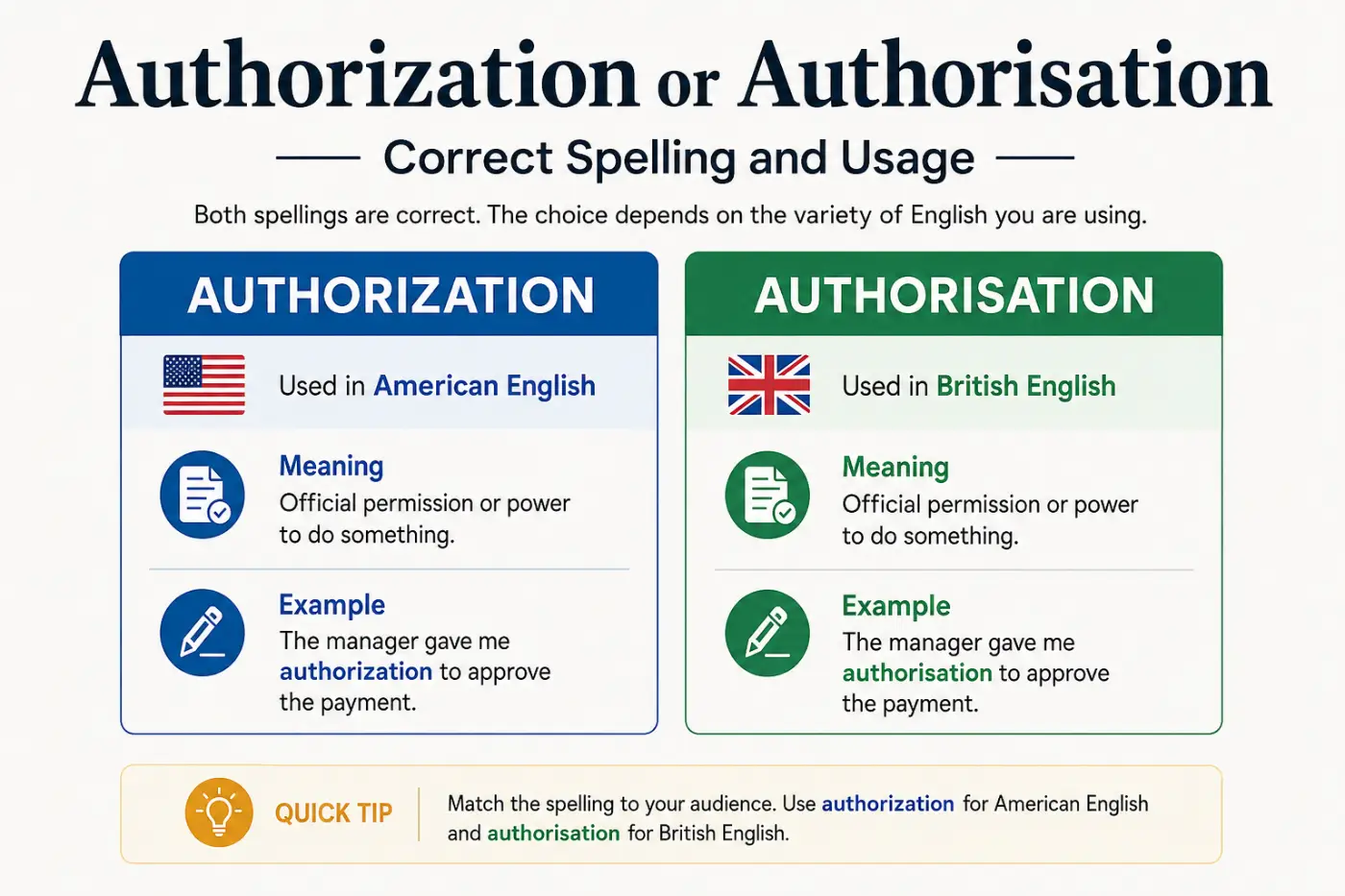
Have you ever typed authorization and stopped because authorisation also looked right. You weren’t imagining the difference. Both spellings are legitimate English forms. The main difference is regional. Authorization is the standard spelling in American English while authorisation is widely used in British English and in several other varieties of English. Neither form changes the basic meaning of the word.
The confusion usually comes from a larger spelling pattern in English. American English often uses words ending in ize and ization while British English commonly uses ise and isation in many words. That pattern appears in authorize and authorise and then carries into the noun authorization and authorisation.
If you’re writing for an American audience then authorization is the form you should normally choose. If you’re following British English then authorisation is the natural choice. In this guide you’ll learn the difference between the two spellings their meaning pronunciation grammar history regional use common mistakes and practical examples.
Quick Definition
Authorization and authorisation have the same meaning. They refer to official permission or the act of giving someone permission or power to do something. Authorization is the standard American spelling while authorisation is commonly used in British English. Both forms are grammatically correct in their appropriate regional varieties.
Quick Answer
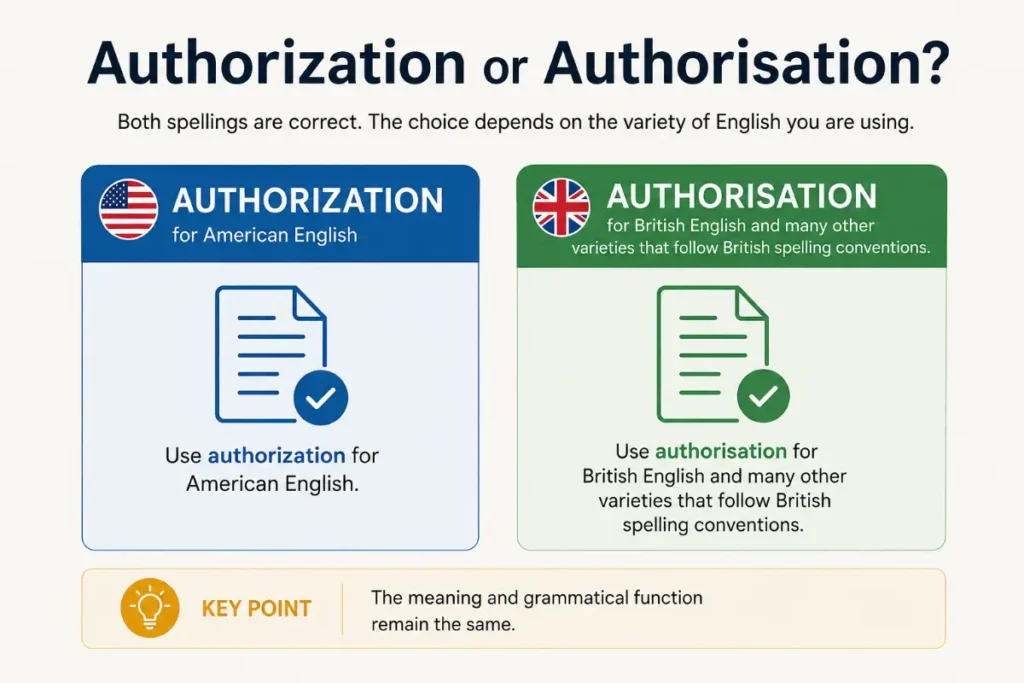
Both authorization and authorisation are correct spellings.
Use authorization for American English. Use authorisation for British English and many other varieties that follow British spelling conventions. The meaning and grammatical function remain the same. )
If your audience is in the United States then authorization is the safer and more natural choice. For a British audience authorisation will usually fit the expected spelling style.
Comparison Table Authorization or Authorisation
| Correct Form | Meaning | Part of Speech | Origin | Usage Frequency | Formality | Common Contexts | Example |
|---|---|---|---|---|---|---|---|
| Authorization | Official permission or power | Noun | From authorize and earlier French and Latin forms | Very common in American English | Formal and neutral | Law business banking security government | The bank requires authorization before processing the payment. |
| Authorisation | Official permission or power | Noun | British spelling of authorization | Very common in British English | Formal and neutral | Law business banking security government | The bank requires authorisation before processing the payment. |
Meaning and Definition
Meaning of Authorization
Authorization means official permission or official power to do something. It can describe the act of giving permission or the permission itself. It can also refer to a document or formal approval that proves someone has the right to act.
For example a manager may give an employee authorization to approve expenses. A bank may require authorization before releasing money. A government agency may issue authorization for a regulated activity.
Oxford defines authorization as official permission or power to do something and also identifies it as the act of giving permission. Oxford also recognizes a second noun sense for a document that gives someone official permission.
The word often appears in formal settings because official permission usually involves some kind of authority. You might see it in contracts company policies government documents legal writing medical records banking instructions and security procedures.
Meaning of Authorisation
Authorisation has exactly the same basic meaning as authorization. The difference is spelling rather than definition.
British English commonly uses authorisation with an s. Cambridge identifies authorization as the main entry and notes that the UK usually uses authorisation. Oxford likewise lists authorisation as the British English form.
So these two sentences communicate the same idea.
The manager gave authorization to release the records.
The manager gave authorisation to release the records.
The only meaningful difference is the spelling convention followed by the writer.
Meaning of the Related Verb
The related verb is authorize in American English and authorise in British English.
To authorize something means to officially approve it or give someone permission or power to do it. Cambridge defines authorize as giving official permission for something to happen or giving someone official permission to do something.
For example you might write:
The director authorized the payment.
The director authorised the payment.
The same regional pattern continues in related words.
American English uses authorized and authorizing.
British English commonly uses authorised and authorising.
This consistency matters in professional writing. If you choose one spelling system then keep related forms consistent throughout the document.
Key Differences Explained
Spelling
The clearest difference is the letter s.
American English generally uses authorization.
British English commonly uses authorisation.
The same distinction appears in authorize and authorise. Cambridge and Oxford both identify the British forms with s while their American entries use z.
Grammar Role
Both forms are nouns.
They can function as subjects objects or complements depending on the sentence.
For example:
Authorization is required.
We received authorization.
The document serves as authorization.
Authorisation works in exactly the same grammatical positions.
Meaning
There is no difference in meaning.
Both words can describe official permission official approval or the formal power to act.
The context can make the word sound legal financial administrative technical or everyday but the spelling does not change the meaning.
Tone
Both forms can appear in formal professional writing.
Authorization may feel more natural to an American reader.
Authorisation may feel more natural to a British reader.
Neither spelling is automatically more formal or more sophisticated.
Context
The words often appear in situations involving permission and authority.
Common contexts include banking security employment government regulation medical records contracts software access travel and business operations.
A simple rule works well. Match the spelling to the English variety used by your audience.
Which Spelling Is Correct
Both spellings are correct.
If you’re writing American English use authorization.
If you’re writing British English use authorisation.
This isn’t a case where one spelling is right and the other is wrong. Major dictionaries recognize the regional distinction. Cambridge lists authorization and notes that the UK usually uses authorisation. Oxford lists authorization and identifies authorisation as the British English form. (
The linguistic reason comes from the long standing variation between ize and ise spellings in English. The noun ending follows the same pattern. American English strongly favors ize forms while British usage often favors ise forms. The history is more complicated than a simple American versus British rule but the practical writing choice is straightforward.
An Expert Tip
Don’t switch between authorization and authorisation inside the same document unless you’re deliberately discussing regional spelling. Consistency makes professional writing look controlled and polished.
If you’re preparing an American business document then authorization should normally appear throughout. If you’re editing a British document then authorisation should normally remain consistent with the rest of the spelling system.
Sentence Examples
Here are natural examples using authorization.
- The bank requires authorization before it can transfer the funds.
- You need written authorization to access the restricted records.
- The manager gave me authorization to approve the purchase.
- The system blocked the request because authorization was missing.
- We received authorization from the agency yesterday.
- The employee cannot enter the secure area without proper authorization.
- The doctor requested authorization before ordering the procedure.
- The company requires prior authorization for certain expenses.
- The government granted authorization for the project.
- The card was declined because the transaction failed the authorization check.
Here are examples showing authorisation as the British spelling.
- The bank requires authorisation before processing the payment.
- You need written authorisation to enter the restricted area.
- The manager gave her authorisation to approve the request.
- The project cannot begin without official authorisation.
- The agency requested prior authorisation from the department.
The two sets mean the same thing. The spelling changes to match the regional writing convention.
Common Mistakes and Misspellings
Confusing Authorization With Authorisation
This is the most common point of confusion. Writers sometimes assume one must be a spelling error because American and British English use different conventions.
It isn’t an error when the spelling matches the intended variety of English.
Writing Authorize In British English Without Checking Style
British English often uses authorise rather than authorize. Some British publications and style systems may still use ize in certain words. That means the broader spelling system can depend on the publication or institution.
The safest approach is to follow the style guide used by your organization.
Mixing Spellings
A document that uses authorisation in one paragraph and authorization in another can look inconsistent.
The reader may not care about the difference in meaning but editors notice consistency problems quickly.
Confusing Authorization With Permission
Authorization and permission overlap but they aren’t always interchangeable.
Permission is a broad term for allowing someone to do something. Authorization often carries a stronger sense of official approval or delegated authority.
For example a friend might give you permission to borrow a book. A company might give you authorization to approve financial transactions.
Misspelling the Ending
Common typing mistakes include forms such as authorizaton and authorisationn.
These usually happen because the word is long and contains several unstressed syllables.
The safest strategy is to build the word from its familiar parts.
Authorize becomes authorization.
Authorise becomes authorisation.
Why People Confuse the Two Forms
NLP based spelling systems often encounter the same word family across different regional corpora. A writer may see authorization in American content and authorisation in British content. Both forms can therefore appear familiar.
Pronunciation doesn’t help much because the spoken word sounds essentially the same across these spelling variants. The ear cannot reliably tell you which ending to write.
This is a classic example of English spelling carrying regional information that pronunciation does not clearly reveal.
Pronunciation Guide
Authorization is pronounced approximately like:
aw thor uh ZAY shun
A common American pronunciation is represented in IPA as:
/ˌɑː.θɚ.əˈzeɪ.ʃən/
Cambridge gives an American pronunciation in this form and a British pronunciation with a slightly different phonetic pattern.
The word can be divided into syllables like this:
au thor i za tion
The strongest stress falls on the syllable that sounds like ZAY.
Authorisation is pronounced essentially the same way because the spelling difference does not create a separate meaning or a major pronunciation difference.
A useful spoken approximation is:
aw thor uh ZAY shun
Avoid stressing every syllable equally. Native speakers usually give the strongest emphasis to the middle portion of the word.
The related verb authorize is pronounced approximately:
AW thor eyes
Cambridge lists the American pronunciation as /ˈɑː.θɚ.aɪz/.
Etymology and Word Origin
The history of authorization reaches much further back than the modern spelling suggests.
The word comes from the verb authorize. The Online Etymology Dictionary traces authorize to late Middle English forms such as auctorisen and autorisen. Those forms came from Old French autoriser and auctoriser and ultimately from Medieval Latin auctorizare.
The Latin connection leads back to auctor which is also connected with the history of author and authority.
The original idea centered on giving formal approval or confirming something as authentic or trustworthy. By the middle of the fifteenth century authorize had developed the sense of giving authority or legal power.
Authorization appeared as a noun around the beginning of the seventeenth century. The Online Etymology Dictionary records an earlier form auctorisation from the late fifteenth century and describes authorization as a noun referring to the act of authorizing or conferring legality.
The difference between authorization and authorisation developed from the broader history of ize and ise spelling patterns.
The ending ize has roots connected with Greek and Latin word formation and passed through French into English. British English developed strong preferences for ise in many words while American English generally retained or favored ize spellings.
So the spelling difference isn’t random. It reflects centuries of English spelling development.
Regional Usage
US English
American English strongly favors authorization.
You’ll commonly see it in government documents legal writing business policies banking instructions technology documentation and workplace communication.
The related forms are authorize authorized and authorizing.
For an American audience use authorization unless a specific quoted name or institutional style requires another form. Cambridge’s American entry uses authorization and identifies the corresponding verb as authorize.
UK English
British English commonly uses authorisation.
The related forms are authorise authorised and authorising.
Oxford identifies authorisation as the British English form while Cambridge says the UK usually uses authorisation.
British usage isn’t completely uniform because individual publishers and style guides can make their own choices. The important point is that authorisation is an established British spelling rather than a mistake.
Australian English
Australian English generally follows British spelling conventions in many formal contexts. As a result authorisation is commonly preferred.
The same pattern can appear in related forms such as authorise and authorised.
If you’re writing for an Australian organization then following its house style is still the best choice. Consistency matters more than trying to force one spelling across every English speaking country.
Canadian English
Canadian English sits between American and British influences.
Both z and s spellings can appear in Canadian writing depending on the word and the style guide. For professional Canadian content you should check the organization’s preferred spelling system rather than assuming that every word must follow American or British rules.
If the document already uses authorise and authorised then authorisation will usually fit the established style. If it consistently uses authorize and authorized then authorization will be the natural match.
Grammar Rules and Part of Speech
Authorization is a noun.
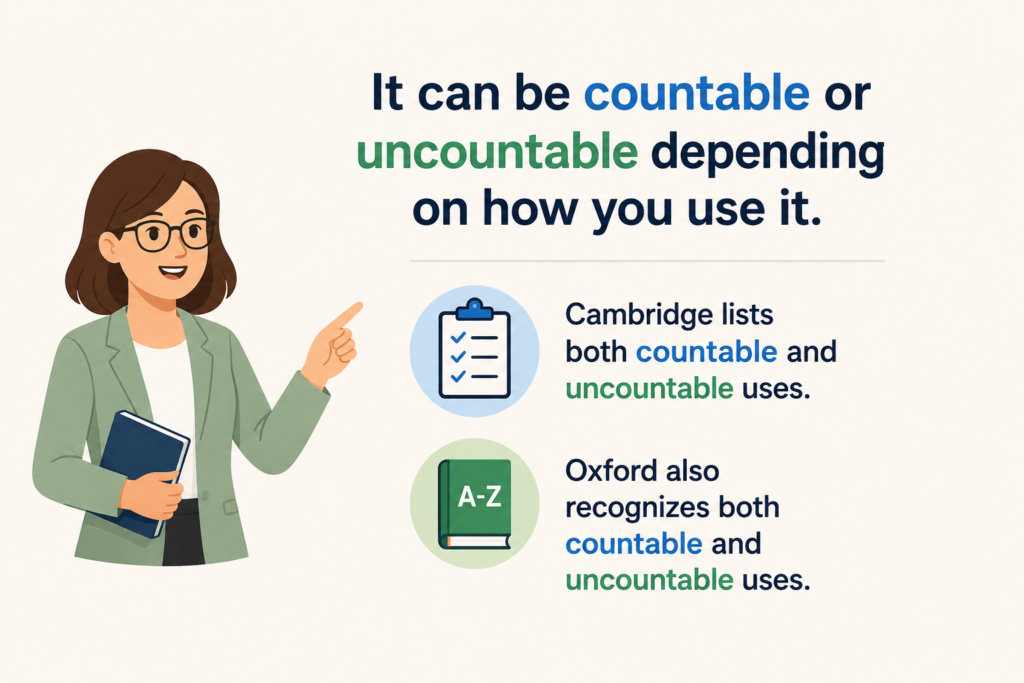
It can be countable or uncountable depending on how you use it. Cambridge lists both countable and uncountable uses while Oxford also recognizes both uses.
When you mean official permission in a general sense the noun often appears without an article.
For example:
Authorization is required before access is granted.
We cannot proceed without authorization.
When you mean a specific approval or document you can use an article.
For example:
The manager gave an authorization.
She presented an authorization from the agency.
In many natural contexts the phrase prior authorization is especially common.
You may also see authorization followed by for.
The company requested authorization for the purchase.
Another common structure uses to followed by a verb.
She received authorization to access the records.
The department granted authorization to begin the project.
The related verb has a different grammatical role.
The manager authorized the payment.
The manager authorized the employee to approve the payment.
That distinction is useful because authorization names the permission while authorize describes the action of giving it.
Punctuation doesn’t change based on the spelling. You don’t need special punctuation simply because the word is formal.
Real Life Usage Examples
Daily Talk
Authorization can sound formal in casual conversation. People often use permission instead.
Still you may hear it in situations involving banks technology workplaces or official processes.
For example:
The app needs authorization before it can access your account.
I don’t have authorization to make that change.
Professional email often uses authorization because the word fits administrative communication.
For example:
Please confirm your authorization before we proceed with the request.
We are still waiting for authorization from the finance department.
In a British workplace the same emails may use authorisation.
Academic Writing
Academic writing uses authorization when discussing institutional approval legal permission research access or formal decision making.
For example:
The researchers obtained authorization before accessing the archived records.
The study required authorization from the relevant institution.
Academic writers should follow the spelling style required by their university or publication.
News
News writing may use authorization in stories involving government action law enforcement military decisions business regulation or public policy.
For example:
Officials said the project received authorization from the relevant agency.
British news publications may instead use authorisation.
Literature
Authorization is less common in everyday narrative prose because writers often choose simpler words such as permission or approval.
However the word can appear naturally when a character deals with institutions or formal power.
For example:
She waited for authorization before opening the sealed file.
The British spelling authorisation works in the same context when the surrounding text follows British conventions.
Related and Confused Terms
Permission
Permission means being allowed to do something. It is broader and more common in everyday speech.
Approval
Approval means that someone accepts or agrees with something. It can involve permission but doesn’t always mean someone has been given formal power to act.
Consent
Consent focuses on agreement or willingness. It is especially common in medical legal and personal contexts.
At Last
At last means something happened after a long wait. It often expresses relief.
It doesn’t mean official permission.
Eventually
Eventually means something happened after some time or after a sequence of events. It focuses on time and outcome rather than authority.
Ultimately
Ultimately refers to the final result or final stage of a process. It isn’t a synonym for authorization.
In the End
In the end means finally or after everything has happened. Again it relates to outcome rather than permission.
License
A license is an official permission or document that allows someone to do something under specific rules. Authorization can be broader and may describe approval without referring to a formal license.
Expert Editor Insight
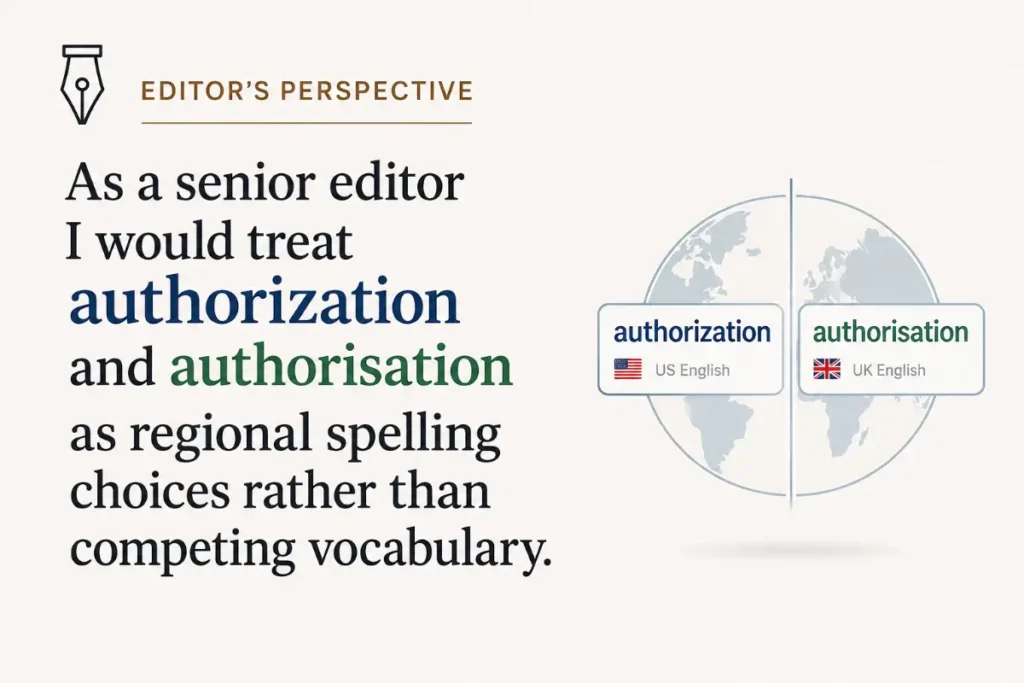
As a senior editor I would treat authorization and authorisation as regional spelling choices rather than competing vocabulary items. If the document targets US readers then authorization is the clean choice. If the document follows British conventions then authorisation is appropriate. Modern spelling tools can flag one form based on the selected language setting even though the word is correct in another variety. That is why the dictionary and style setting matter more than a generic spell checker. Cambridge and Oxford both recognize the regional distinction.
One practical editing habit can save you a lot of trouble. Check the spelling of the related verb before you finalize the noun. If your document consistently uses authorize then authorization will usually fit. If it uses authorise then authorisation will keep the word family consistent.
Conclusion
Authorization and authorisation are both correct. The difference is regional spelling rather than meaning. American English generally uses authorization while British English commonly uses authorisation. Both forms function as nouns meaning official permission official approval or formal power to act.
The easiest way to remember the difference is to look at the related verb. American English uses authorize while British English commonly uses authorise. Keep the entire word family consistent throughout your document.
If you’re writing for readers in the United States use authorization. If you’re following British spelling use authorisation. When in doubt check the style guide for your audience and keep one spelling system throughout the document. That small choice makes your writing look deliberate and professionally edited.
FAQs
Is finaly a real word?
No. Finaly is not the standard spelling of the English word finally. The correct spelling is finally with two l letters before the y. Finaly commonly appears as a typing or spelling mistake. It is unrelated to the authorization and authorisation distinction discussed in this guide.
What Does Authorization Mean?
Authorization means official permission or official power to do something. It can also describe the act of giving that permission or a document that proves someone has been given permission. The word commonly appears in legal business banking security government and administrative contexts. Authorisation has the same meaning and is mainly a regional spelling variation.
Authorization or Authorisation Which Is Correct?
Both are correct. Authorization is the standard American spelling while authorisation is commonly used in British English. Australian English also commonly follows the British form. Canadian usage can vary by style and institution. The meaning does not change. Choose the spelling that matches the English variety used by your audience.
How Do You Pronounce Authorization?
Authorization is commonly pronounced approximately like aw thor uh ZAY shun. Cambridge gives the American IPA pronunciation as /ˌɑː.θɚ.əˈzeɪ.ʃən/. The strongest stress falls on the ZAY sound. Authorisation has essentially the same pronunciation because the difference between the two forms is mainly written spelling rather than spoken meaning.
Can Authorization Start a Sentence?
Yes. Authorization can naturally begin a sentence when it functions as the subject. For example Authorization is required before the records can be released. Starting with the noun doesn’t create a grammar problem. The sentence simply needs to follow normal capitalization and punctuation rules. The same applies to authorisation in British English.
What Is a Synonym for Authorization?
Common alternatives include permission approval consent clearance approval power authority and sanction. The best choice depends on context. Permission is usually the simplest everyday alternative. Approval focuses on agreement. Consent focuses on willing agreement. Clearance often suggests official permission to proceed. Authorization is especially useful when formal authority or delegated power is involved.
Why Do People Misspell Authorization?
People often misspell authorization because it is a long word with several unstressed syllables and because English spelling varies by region. Writers may also switch between authorize and authorise without realizing that the noun ending changes with the same regional pattern. Typing quickly can make the problem worse. A spell checker set to the correct regional English can catch many mistakes.
Is Authorization Suitable for Formal Writing?
Yes. Authorization is common in formal writing and works naturally in legal business academic government financial and technical contexts. Oxford lists it as a noun meaning official permission or power and gives examples involving official decisions and institutional approval. American writers can use authorization confidently in professional documents. British writers will often choose authorisation instead.
