
You’re writing an email and suddenly stop at one word. You type accross vs across into a search box because both forms look familiar. If you’ve ever written an essay, resume, text, or work message and wondered which spelling is correct, you’re not alone. This mistake happens because the word sounds like it could contain a double c.
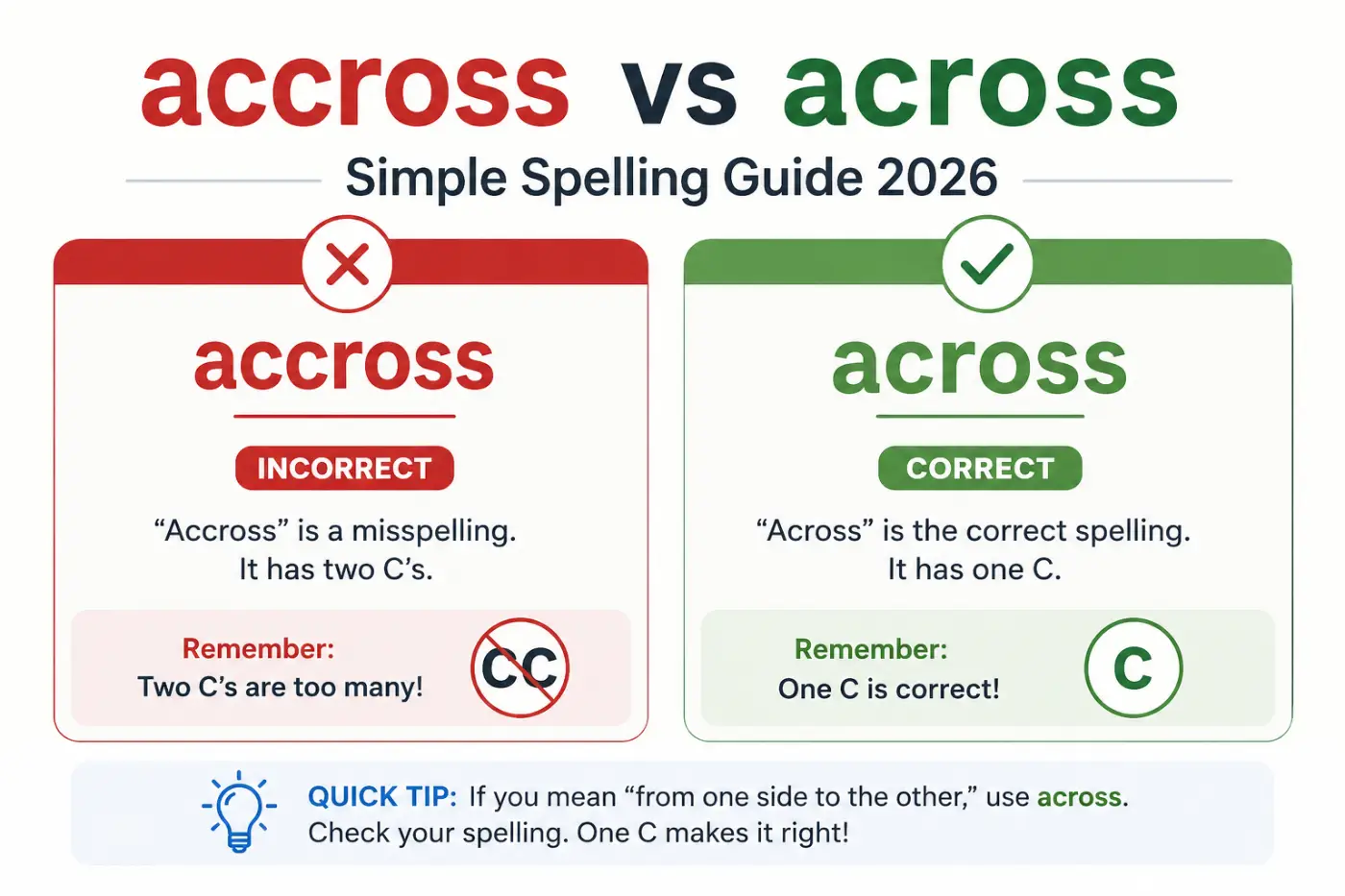
Across is the correct spelling. Accross is a common misspelling and should not be used in standard English.
The correct word is across with one c after the a. It can mean from one side to another, on the opposite side, throughout an area, or from one point to another. Once you remember the spelling pattern, this is an easy word to get right.
This guide explains why the mistake happens, where across comes from, how it works in sentences, and which alternatives fit different situations. You’ll also see a large synonym guide, examples for emails and resumes, common mistakes, regional notes, and practical tips for remembering the correct spelling.
Is across or accross correct?
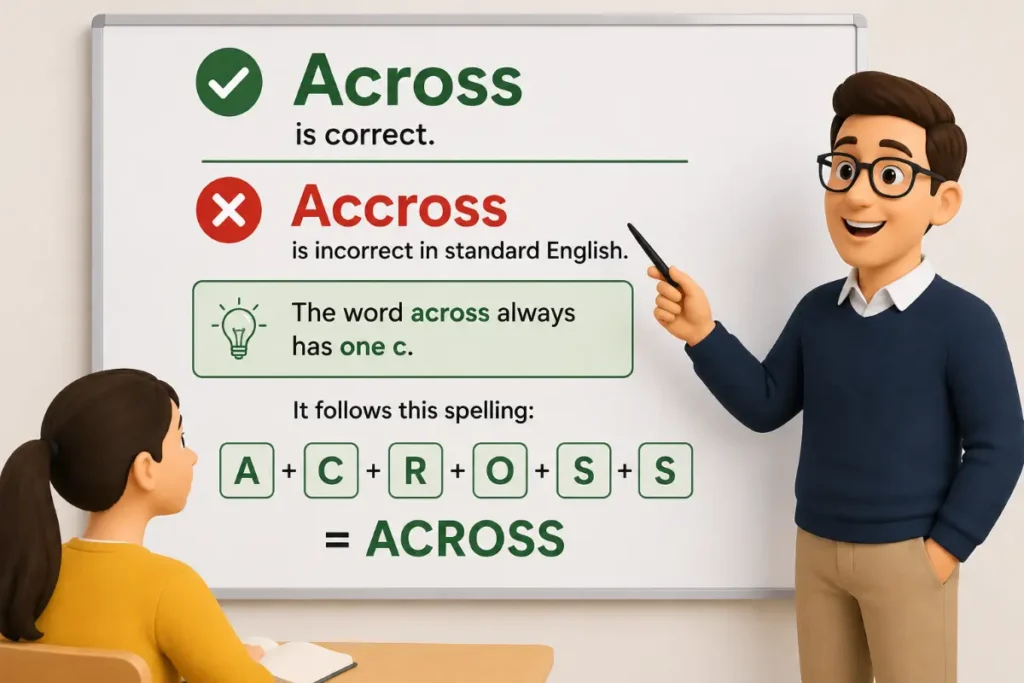
Across is correct. Accross is incorrect in standard English.
The word across always has one c. It follows this spelling:
A + C + R + O + S + S = ACROSS
The incorrect form adds an extra c:
A + C + C + R + O + S + S = ACCROSS
That extra c doesn’t belong there.
A useful way to remember this is to focus on the beginning of the word. Think a cross rather than ac cross. The phrase “a cross” isn’t the historical source of the modern spelling, but it can work as a simple memory trick.
| Form | Correct | Example |
|---|---|---|
| Across | Yes | We walked across the street. |
| Accross | No | This spelling is a common mistake. |
If you’re checking accross vs across while writing something important, choose across every time.
What does across mean?
Across usually describes movement from one side to another. It can also describe something positioned on the opposite side or spread over an area.
Consider these examples.
“She ran across the field.”
Here, across shows movement from one side of the field to the other.
“The bank is across the street.”
Here, across shows location. The bank is on the opposite side of the street.
“The news spread across the country.”
Here, across means throughout a large area.
“The message was shared across several departments.”
In this sentence, across shows distribution among different parts of an organization.
The meaning changes slightly based on context, but the central idea often involves movement, position, connection, or coverage from one side or part to another.
Where does the word across come from?
The spelling of across has a long history in English.
The modern word developed from older forms related to the idea of moving or being positioned from one side to another. It is connected to the word cross, which comes from the idea of crossing from one side to another.
The prefix like form a in older English helped create expressions meaning “on cross” or “across.” Over time, the expression developed into the single modern word across.
The historical connection to cross can help explain why the word has its current structure.
Notice something important.
Across contains one c followed by ross.
It does not contain across with a double c after the first letter.
English spelling often preserves older word forms even when pronunciation changes over time. That’s one reason spelling can feel less logical than it seems.
For everyday writing, though, you don’t need to memorize the full history. The useful fact is simple: across is the established modern spelling.
Why do people spell across as accross?
The mistake usually comes from pronunciation and visual patterns.
When people say across, the first vowel is followed by a strong consonant sound. Some writers assume that the consonant should be doubled.
English has many words with doubled consonants, so the guess can feel reasonable.
For example:
- Address.
- Accident.
- Accompany.
- Account.
- Accept.
These words begin with ac and contain a double consonant in some forms or related spelling patterns. That can make accross look believable even though it isn’t correct.
Another reason is the word cross itself. A writer may mentally combine ac and cross and accidentally create accross.
The safest solution is to memorize the visual pattern:
ACROSS = one C and two S letters.
That small spelling detail prevents the most common error.
How do you pronounce across?
Across is usually pronounced like uh CROSS.
The first part has a relaxed vowel sound. The second part sounds like cross.
A simple pronunciation guide is:
uh KROSS
The word has two syllables.
The stress usually falls on the second syllable:
a CROSS
The incorrect spelling accross does not create a different standard pronunciation. It is simply a misspelling of across.
What are the main meanings of across?
The word has several common uses. Understanding them makes it easier to choose the right synonym.
Across can mean from one side to another
This is probably the most familiar use.
“We walked across the bridge.”
The movement starts on one side and ends on the other.
Across can describe something on the opposite side
“My office is across the hall.”
The office is positioned on the other side of the hall.
Across can mean throughout an area
“The company has offices across the United States.”
Here, the meaning is spread throughout the country.
Across can describe communication between groups
“The manager worked across several teams.”
This means the manager worked with or between different teams.
Across can mean from one point to another
“The wire runs across the ceiling.”
The wire extends from one part of the ceiling toward another.
These meanings overlap, but context tells the reader exactly what you mean.
What are the best synonyms for across?
The best synonym depends on the meaning you want.
There isn’t one replacement that works in every sentence. Across is flexible because it can describe physical movement, location, distribution, communication, and coverage.
| Word | Meaning | Tone | Example |
|---|
| Over | From one side or point to another | Simple | She walked over the bridge. |
| Through | From one side or part to another within something | Everyday | We drove through the tunnel. |
| Throughout | In every part of an area | Formal | The policy applies throughout the company. |
| Beyond | On the other side or farther than something | Neutral | The village lies beyond the hill. |
| Opposite | Directly facing another place | Neutral | The store is opposite the library. |
| Crosswise | From side to side | Neutral | Place the board crosswise. |
Some of these alternatives overlap with across, but they aren’t interchangeable in every sentence. A strong writer chooses based on meaning rather than simply replacing one word with another.
Which synonyms for across are simple and everyday?
For casual writing and conversation, the easiest alternatives are over, through, on the other side, all over, and across the way.
For example:
“The pharmacy is across the street.”
You could say:
“The pharmacy is on the other side of the street.”
That version is longer but very clear.
“We drove across the state.”
You could say:
“We drove through the state.”
The meaning changes slightly. Across emphasizes moving from one side toward another. Through focuses more on movement within or through the area.
That distinction matters.
Which formal synonyms can replace across?
Formal alternatives include throughout, spanning, extending over, ranging across, and distributed throughout. These work well in academic, professional, or technical writing when they match the intended meaning.
For example:
“The survey was conducted across five states.”
A formal alternative is:
“The survey was conducted throughout five states.”
However, throughout can suggest broad coverage rather than movement from one side to another. In many cases, across is actually the clearer choice.
Another example is:
“The bridge spans the river.”
Here, spans is more precise than across because it emphasizes the structure extending from one side of the river to the other.
Are there slang alternatives to across?
There aren’t many true slang synonyms for across.
In casual American English, people often use phrases such as all over, across the way, on the other side, or over there.
These expressions are conversational rather than strict synonyms.
For example:
“She lives across the street.”
Casual speech might use:
“She lives over there.”
But over there doesn’t always mean across. It simply points to another location. That’s why context matters. A phrase can sound natural while still carrying a slightly different meaning.
How do synonyms change the strength of meaning?
Synonyms for across can be grouped by intensity and precision.
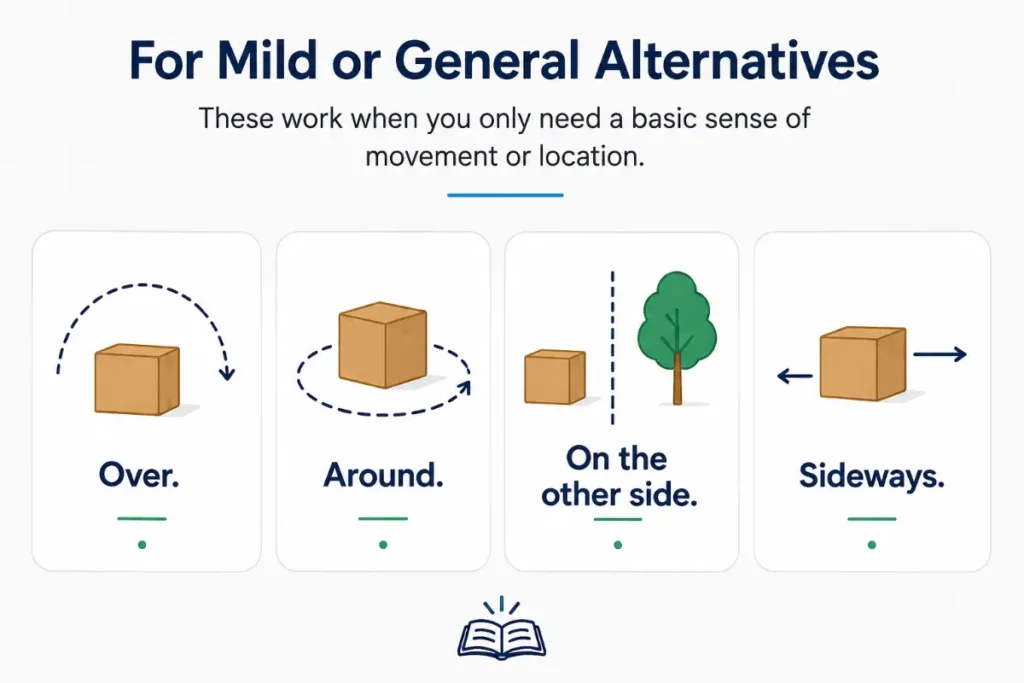
Mild or general alternatives
These work when you only need a basic sense of movement or location.
- Over.
- Around.
- On the other side.
- Sideways.
Example:
“The dog ran across the yard.”
A simple alternative is:
“The dog ran over the yard.”
However, that sentence may sound less natural because over doesn’t always carry the same side to side meaning.
More specific alternatives
These give the reader a clearer picture.
- From side to side.
- From one end to the other.
- Through.
- Crosswise.
- Spanning.
Example:
“The rope stretched from side to side.”
This is more visual than simply saying:
“The rope stretched across the room.”
Stronger coverage words
These work when you mean that something is present in many parts of a place or group.
- Throughout.
- All over.
- Across the region.
- Distributed throughout.
- Spread across.
For example:
“The program operates across the country.”
You could say:
“The program operates throughout the country.”
The second version strongly emphasizes broad coverage.
What part of speech is across?
Across can work as both a preposition and an adverb.
Across as a preposition
A preposition connects the word to a noun or noun phrase.
Examples:
“She walked across the street.”
“He lives across the river.”
“The news spread across the country.”
In each sentence, across connects the action or position to a location.
Across as an adverb
An adverbial use can stand without a noun immediately following it.
Examples:
“Come across.”
“The dog ran across.”
“Please move across.”
The exact grammar can depend on the larger sentence, but the key point is that across has more than one grammatical role.
What is the best word for a resume?
For a resume, across is often the best choice when you need to describe work involving several teams, regions, departments, or functions.
For example:
“I collaborated across five departments to improve customer support.”
That sentence is concise and professional.
You could also use throughout when the meaning involves broad coverage.
Example:
“I implemented training throughout the organization.”
The two words create slightly different impressions.
Across often emphasizes connection between separate groups.
Throughout often emphasizes coverage across all or most parts of something.
If you’re describing collaboration, across is usually natural.
How should you use across in an essay?
In an essay, across works well for geography, comparisons, historical periods, fields of study, and broad patterns.
For example:
“Education systems vary across different regions.”
You could also write:
“Social attitudes changed across the twentieth century.”
The word is useful because it keeps academic sentences concise.
Avoid replacing it with an overly formal phrase just to sound academic. Clear writing usually beats complicated wording.
For example:
“Research findings vary across populations.”
is often better than:
“Research findings vary throughout the entirety of different population groups.”
The second version adds words without adding useful meaning.
What is the best word for an email?
Across is usually excellent for professional emails because it sounds natural and direct.
For example:
“Could you share this update across the team?”
Or:
“We need consistent communication across all departments.”
These sentences are clear without sounding stiff.
You can use throughout when you want to emphasize broad distribution.
“Please share the announcement throughout the organization.”
Both can work, but the exact meaning should guide the choice.
How do you use across in texting?
In texting, across is simple and natural.
Examples include:
“I’m across the street.”
“I’ll meet you across the road.”
“She lives across town.”
“You can find one across the way.”
There’s no reason to replace across with a more formal word in casual messages.
Shorter is often better in texting, but clarity still matters.
How should you use across when speaking?
In everyday speech, across is extremely common.
You might say:
“The store is across the street.”
“We walked across the park.”
“He lives across town.”
“She looked across the room.”
These expressions are so common that using an unusual synonym can actually make your speech sound less natural.
If the normal word works, use it.
What are examples of across in real sentences?
Here are original examples covering several common situations.
- The children ran across the playground after school.
This shows movement from one part of the playground to another.
- My friend lives across the street from the library.
Here, across describes an opposite location.
- The company has customers across the United States.
This means customers are located throughout the country.
- She looked across the room and smiled.
The word describes the direction of her gaze.
- We drove across the bridge before sunset.
The action involves moving from one side of the bridge to the other.
- The message was shared across several departments.
Here, the word describes distribution among groups.
- A narrow trail stretches across the mountain.
The trail extends from one part of the mountain toward another.
- The teacher wrote the answer across the top of the board.
The word describes placement over the width of the board.
- People from across the world joined the event online.
The phrase means people from many parts of the world.
- The storm caused delays across the region.
This means the delays affected many parts of the region.
- He waved from across the parking lot.
The word identifies a position at some distance on the other side.
- The team worked across multiple time zones.
This describes work involving people in different geographic areas.
- A bright line ran across the screen.
The line extended from one side of the screen toward the other.
- She carried the box across the warehouse.
The action involved movement through the warehouse from one point to another.
- The policy applies across all company offices.
This describes coverage among multiple offices.
Across vs through — what’s the difference?
Across usually emphasizes movement from one side to another. Through usually emphasizes movement within or inside something.
Compare these sentences.
| Across | Through |
|---|---|
| We walked across the field. | We walked through the forest. |
| She swam across the pool. | She swam through the tunnel. |
| He drove across the country. | He drove through the mountains. |
You can sometimes use both words, but the mental picture changes.
“She walked across the park.”
The focus is on crossing the park.
“She walked through the park.”
The focus is on moving within the park.
This distinction is useful in essays and professional writing because the wrong choice can subtly change the meaning.
Across vs throughout — what’s different?
Across can describe movement or distribution. Throughout usually emphasizes presence in every part of an area or period.
Compare:
“The company operates across the country.”
This can mean the company has operations in many regions.
“The company operates throughout the country.”
This strongly suggests broad coverage across the entire country.
Another example:
“Temperatures varied across the region.”
This emphasizes differences from one part of the region to another.
“Temperatures remained high throughout the region.”
This emphasizes that high temperatures were present across the whole region.
Both words are useful. The best choice depends on the exact idea.
Across vs over — which sounds more natural?
Across often suggests crossing from one side to another. Over can suggest movement above something or movement from one point to another.
“She walked across the bridge.”
“She walked over the bridge.”
Both can sound natural, but across more clearly focuses on crossing from one end to the other.
Now compare:
“The plane flew over the bridge.”
Here, over means above the bridge. Across would change the image.
“The plane flew across the bridge.”
That sounds unusual unless you mean its path crossed the area of the bridge.
This shows why synonyms shouldn’t be swapped automatically.
Across vs opposite — what is the difference?
Across can describe something located on the other side.
“The restaurant is across the street.”
Opposite can describe a directly facing position.
“The restaurant is opposite the library.”
The two sentences may describe the same general location, but opposite emphasizes direct facing.
Across often works naturally with a place or boundary.
Opposite often works naturally when two things face each other.
What are the most common mistakes with across?
The most common mistake is adding an extra c.
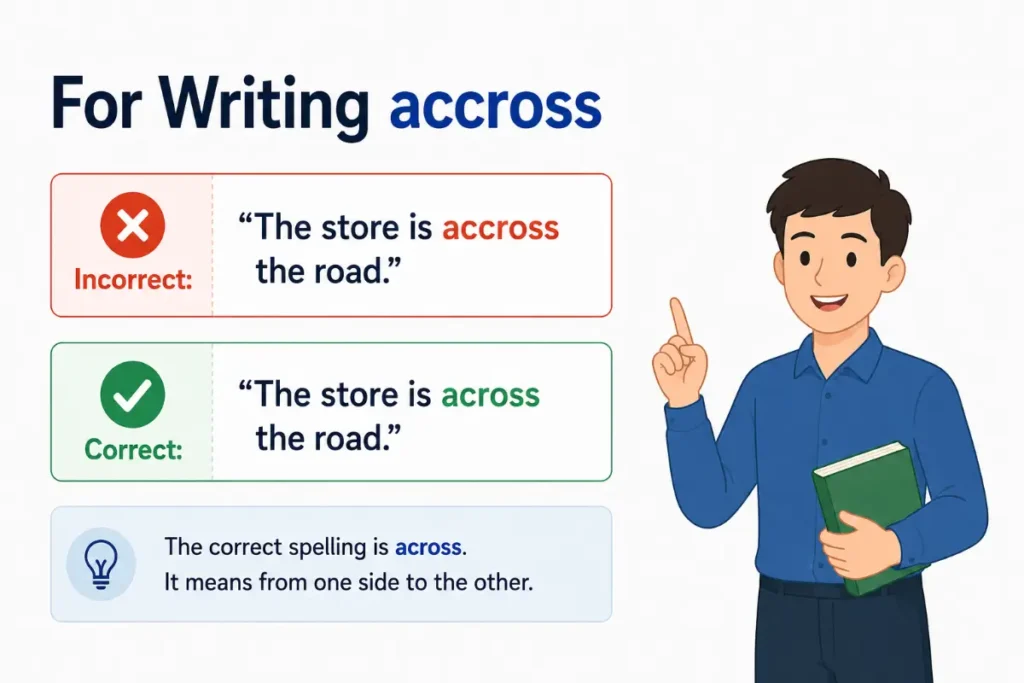
Writing accross
Incorrect:
“The store is accross the road.”
Correct:
“The store is across the road.”
Writing acrosss
Another mistake is adding an extra s.
Incorrect:
“She walked acrosss the field.”
Correct:
“She walked across the field.”
Remember the pattern:
A C R O S S
One c.
Two s letters.
Confusing across with a cross
The phrase a cross can be written as two words when it refers to the noun cross.
For example:
“She drew a cross.”
But across is one word when it means from one side to another.
For example:
“She walked across the room.”
These are completely different uses.
Using an unnecessary synonym
Some writers try to avoid repeating across by replacing it with a complicated phrase.
That can make writing less natural.
For example:
“The company operates in locations extending over the breadth of the country.”
A clearer version is:
“The company operates across the country.”
Simple words often communicate the idea better.
When should you not use across?
Avoid across when the intended meaning is clearly different.
If you mean complete coverage, throughout may fit better.
If you mean above something, over is often the better choice.
Consider these examples.
“The bird flew over the house.”
This means above the house.
“The child walked across the yard.”
This means from one part of the yard toward another.
“The hikers walked through the forest.”
This means they moved within the forest.
“The pharmacy is opposite the hospital.”
This emphasizes a facing position.
Choosing the right preposition can make a sentence more precise.
What are the antonyms of across?
There isn’t one universal opposite of across because its meaning changes with context.
Possible opposites include:
- Along.
- Beside.
- Within.
- Near.
- Here.
- On the same side.
- Toward the starting point.
For example:
“She walked across the street.”
A contextual opposite might be:
“She stayed on the same side of the street.”
The opposite depends on what across means in the original sentence.
How can you remember the spelling of across?
A few simple tricks can make the spelling stick.
Remember one c and two s letters
Think:
AC + ROSS
Not:
ACC + ROSS
The correct visual pattern is:
ACROSS
Connect it with cross
The word is strongly related in meaning to cross.
Think of moving across something as crossing from one side to another.
That mental connection can help you remember the spelling.
Watch the middle
The middle of the word is:
C R O
There isn’t another c after the first one.
If you see ACCR, stop and check the spelling.
Use the word in a sentence
Writing the correct form repeatedly can reinforce the pattern.
“I walked across the street.”
“The store is across the road.”
“The news spread across the country.”
After seeing the correct spelling in context several times, the incorrect version starts to look obviously wrong.
What should you check before using across?
Use this quick mental check.
- Am I talking about movement from one side to another?
- Am I describing something on the opposite side?
- Am I talking about something spread over several places?
- Am I describing a connection between groups or areas?
- Does through, throughout, over, or opposite express the meaning more precisely?
- Did I spell the word with one c and two s letters?
If the answer to the last question is yes, you’re on the right track.
What are the best quick tips for choosing across?
Across is usually the strongest choice when you mean movement from one side to another.
Use through when the idea is movement within something.
Use over when the idea involves movement above something or general movement from one point to another.
Choose opposite when two places directly face each other.
Use spanning when something extends across a measurable distance or range.
Use all over in casual speech when you mean many places.
And when you’re checking accross vs across, remember the simplest rule of all:
Across has one c and two s letters.
How does across work in professional English?
Professional English often rewards concise wording.
Consider:
“Our team works across several departments.”
This sentence is short and clear.
You could write:
“Our team works collaboratively between several different organizational departments.”
The second version isn’t necessarily better. It uses more words without adding much information.
Another example:
“The company expanded across three states.”
This is direct.
In business writing, across can describe collaboration, geographic reach, departments, markets, teams, projects, and functions.
Examples include:
“Communication across teams needs improvement.”
“Sales increased across all regions.”
“The policy applies across the organization.”
“The project requires coordination across departments.”
These constructions are common because they communicate broad relationships efficiently.
How does across work in academic English?
Academic writers use across when discussing patterns that vary by location, group, period, or category.
Examples include:
“Results varied across age groups.”
“Patterns changed across different regions.”
“The study compares outcomes across three populations.”
“Attitudes shifted across generations.”
These uses are especially useful when comparing multiple groups.
Still, academic writing doesn’t require replacing ordinary words with formal alternatives. Across is already standard and professional.
How does across work in American English?
Across is extremely common in American English.
Americans use it for physical movement:
“Walk across the street.”
They use it for location:
“The store is across the road.”
They use it for geography:
“People across the country watched the event.”
They use it for organizations:
“The change affected teams across the company.”
They also use common phrases such as:
“Across the world.”
“Across the board.”
These expressions are natural in everyday American English.
Is across different in British English?
The word across is standard in both American and British English.
The spelling does not change.
American English:
“Across.”
British English:
“Across.”
The same spelling is used in both varieties.
Some expressions and preposition preferences can differ between regions, but across itself is not a major regional spelling issue.
That means you don’t need a separate American or British spelling for this word.
Why does correct spelling matter?
A single spelling mistake usually doesn’t prevent someone from understanding your meaning. Still, repeated spelling errors can affect how polished your writing looks.
This matters in resumes, applications, school assignments, professional emails, websites, and published content.
Compare:
“Customers from accross the country visited the store.”
with:
“Customers from across the country visited the store.”
The second sentence looks professional because the spelling is correct.
Good spelling also makes writing easier to scan. Readers can focus on the message instead of noticing errors.
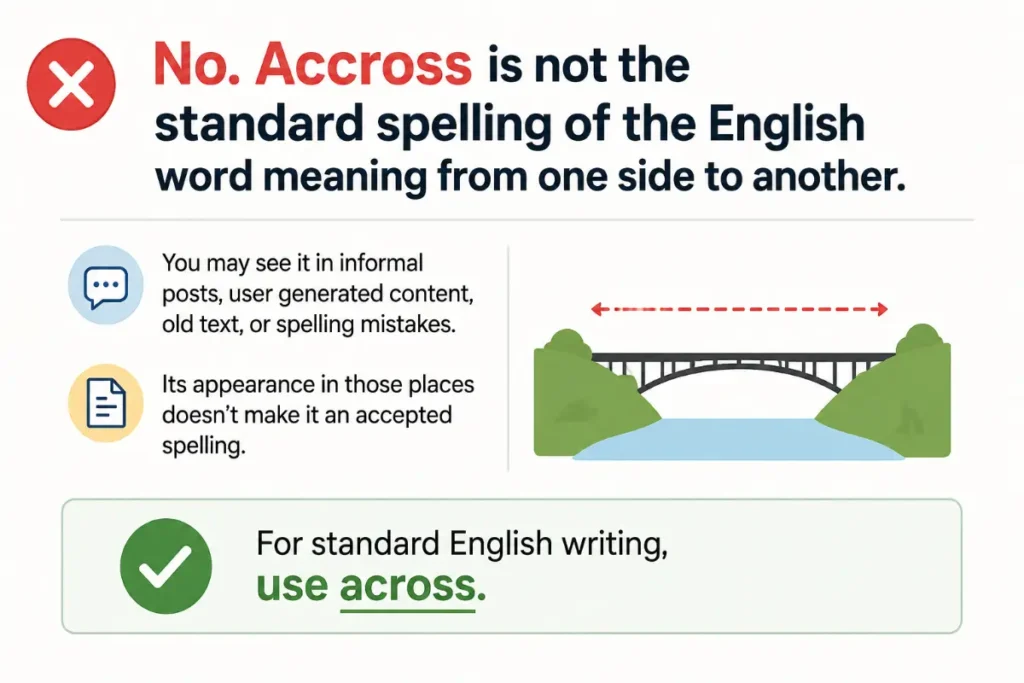
Is accross ever correct?
No. Accross is not the standard spelling of the English word meaning from one side to another.
You may see it in informal posts, user generated content, old text, or spelling mistakes. Its appearance in those places doesn’t make it an accepted spelling.
For standard English writing, use across.
What should you use instead of accross?
Always use across.
For example:
Incorrect: “She walked accross the street.”
Correct: “She walked across the street.”
Incorrect: “We have offices accross the country.”
Correct: “We have offices across the country.”
Incorrect: “The message was shared accross the team.”
Correct: “The message was shared across the team.”
The correction is simple. Remove the extra c.
Conclusion
The key lesson from accross vs across is simple. Across is the correct spelling, and accross is a misspelling. The correct word has one c and two s letters.
Beyond spelling, across is a flexible word that can describe movement, location, distribution, comparison, and broad coverage. It works naturally in everyday conversation, professional emails, resumes, academic writing, and formal documents.
When choosing a synonym, focus on the exact meaning. Use through for movement within something, throughout for broad coverage, over for movement above something, and opposite for a directly facing location.
If you remember the basic spelling pattern and pay attention to context, you’ll have little trouble using this useful word correctly.
Frequently Asked Questions
Is across the correct spelling?
Yes. Across is the correct spelling. Accross is a common misspelling.
Why do people spell across as accross?
People often add an extra c because the word can look like a combination of “ac” and “cross.” The pronunciation and familiar double consonant patterns in English can also cause confusion.
Is accross vs across a spelling or grammar issue?
It’s mainly a spelling issue. Across is the correct standard spelling while accross is an incorrect spelling.
What’s another way to say across?
Depending on the meaning, you can use over, through, throughout, opposite, spanning, all over, or on the other side. The best alternative depends on the sentence.
Can I use across in formal writing?
Yes. Across is completely acceptable in formal writing. It’s common in academic, professional, business, and technical English.
Is across the same in American and British English?
Yes. Across has the same standard spelling in American and British English. Regional differences don’t normally affect the spelling of this word.
How do I remember the spelling of across?
Remember that across has one c and two s letters. Think of the pattern as ACROSS rather than ACCROSS.
