
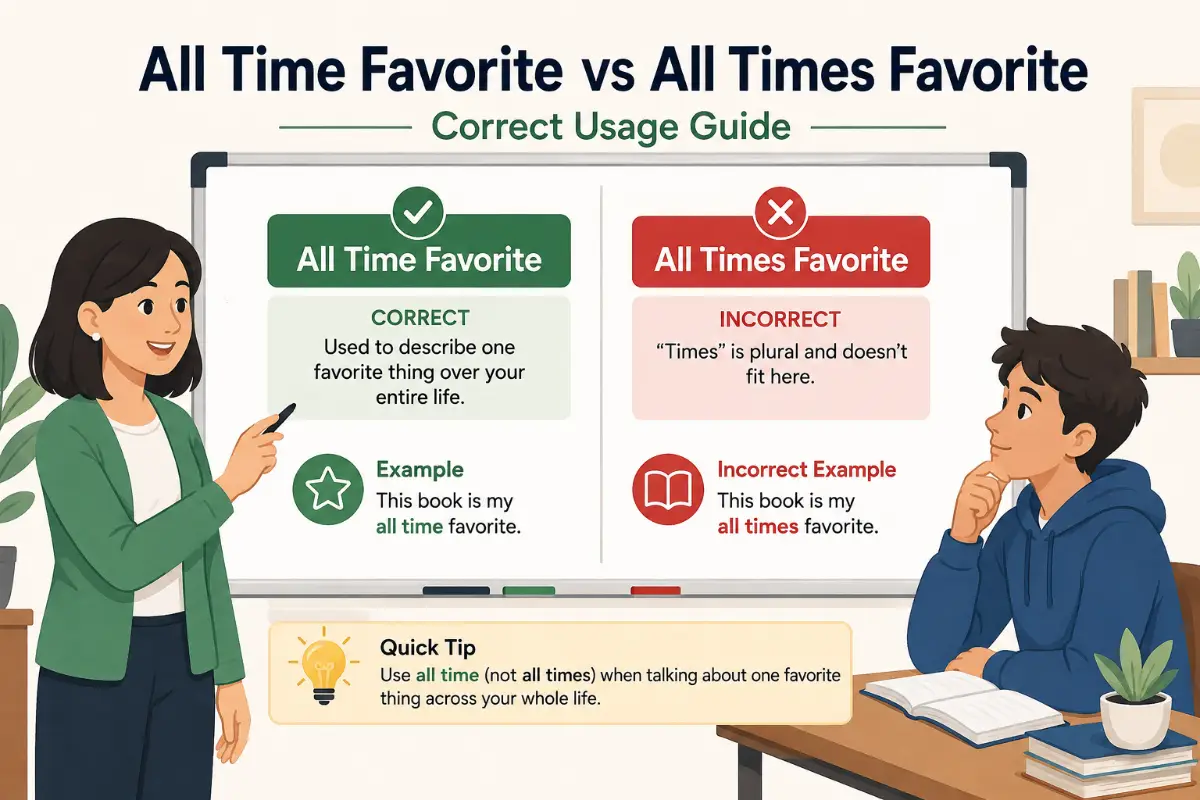
English has many phrases that look almost right even when one small change makes them incorrect. All-time favorite is one of them. People often wonder if the correct expression is all-time favorite vs all-times favorite. The answer is simple. All-time favorite is the standard form.
You can say that a movie is your all-time favorite movie. You can also say that a movie is your favorite movie of all time. Both expressions communicate the same basic idea. The form all-times favorite is not standard English. The confusion usually comes from the word times. Since the phrase refers to every period across history or across your experience it can seem logical to make time plural. English does not work that way in this expression.
This guide explains the spelling meaning grammar pronunciation history and everyday use of the phrase. You’ll also see examples that show exactly when to use all-time favorite and when to use favorite of all time.
Quick Definition
All-time favorite means the person thing place or experience that you have liked more than any other throughout your experience or across the relevant history. All-time works as a compound adjective before the noun favorite. All-times favorite is not the standard form.
Quick Answer
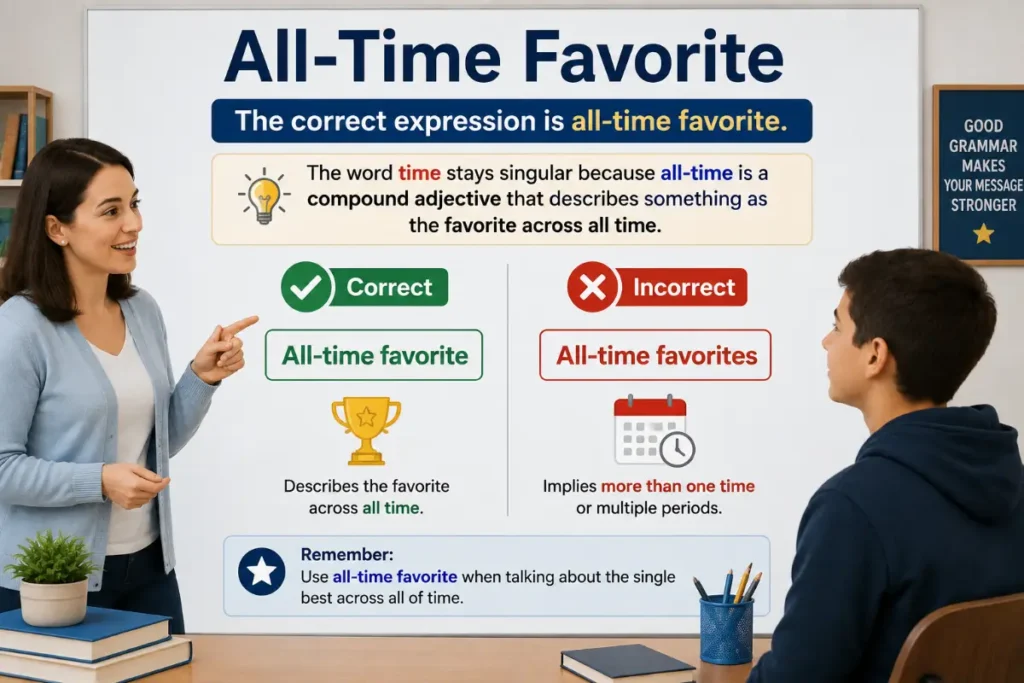
The correct expression is all-time favorite. The word time stays singular because all-time is a compound adjective that describes something as the favorite across all time.
You can also write favorite of all time when the phrase comes after the noun. For example you can say This is my all-time favorite song or This is my favorite song of all time.
Comparison Table
| Correct Form | Meaning | Part of Speech | Origin | Usage Frequency | Formality | Common Contexts | Example |
|---|---|---|---|---|---|---|---|
| all-time favorite | The favorite across all time | Compound adjective plus noun | Modern English compound | Very common | Neutral | Conversation writing reviews media | This is my all-time favorite movie. |
| all-times favorite | Intended to mean the favorite across all time | Nonstandard form | Not an established standard expression | Rare | Nonstandard | Spelling mistakes informal searches | All-times favorite is not the standard form. |
| favorite of all time | The favorite across all time | Noun phrase with prepositional phrase | Established English phrase | Very common | Neutral | Conversation writing reviews rankings | This is my favorite movie of all time. |
| all time | The whole period of time in a phrase | Noun phrase | Older English phrase | Common in specific structures | Neutral | History comparisons idioms | She was the best player of all time. |
Meaning and Definition
Meaning of All Times Favorite
All-times favorite is not the standard English expression for describing something as your favorite across your entire experience or across history.
The problem is the plural times. English does use times in many normal expressions. You can talk about difficult times happy times ancient times or several times. In all-time favorite however all-time functions as a single compound adjective.
The adjective is all-time. The noun it modifies is favorite.
That structure gives us:
all-time favorite
It does not give us:
all-times favorite
The second form may appear in online searches because people often spell familiar phrases based on sound or intuition. A search result or an informal post does not automatically make a form standard English.
Meaning of All-Time Favorite
All-time favorite describes something that stands above all other favorites. It can refer to a movie book song food restaurant athlete hobby place or almost anything else that can be ranked by personal preference.
For example:
Pizza is my all-time favorite food.
This means pizza is the food you have liked more than any other food across the relevant span of your experience.
The phrase can also describe something regarded as one of the greatest examples in its category.
That novel remains an all-time favorite among readers.
Merriam Webster defines all-time as an adjective referring to something being for or of all time up to and including the present. Its examples include phrases such as all-time bestseller and all-time high.
Oxford gives the same basic grammatical pattern. It identifies all-time as an adjective used before a noun and specifically gives my all-time favorite song as an American English example.
Cambridge also identifies all-time as an adjective used before a noun when comparing things to determine the best or highest level ever reached.
Key Differences Explained
Spelling
The standard compound adjective is all-time. It contains all and singular time.
The nonstandard form all-times adds an unnecessary plural ending to time.
Grammar Role
All-time functions as an adjective before a noun.
In my all-time favorite movie the compound adjective describes favorite movie.
Meaning
All-time favorite means the favorite across all relevant time or experience.
All-times favorite does not have an established standard meaning in English.
Tone
All-time favorite sounds natural in casual conversation professional writing journalism reviews and general online writing.
All-times favorite sounds like a spelling or grammar mistake to most proficient English speakers.
Context
Use all-time favorite when it comes directly before the noun.
Use of all time when you build the expression as a phrase after the noun.
Compare these examples:
She is my all-time favorite singer.
She is my favorite singer of all time.
Both are natural.
Which Spelling Is Correct?
All-time favorite is the correct standard expression.
The reason comes from grammar rather than personal preference. All-time is a compound adjective. It describes the noun that follows it. The singular form time belongs inside that compound adjective.
Oxford lists all-time favorite as a normal American English collocation. Merriam Webster also defines all-time as an adjective and gives examples involving records and favorites. Collins provides examples such as all-time favorite artist and describes all-time as an adjective used for comparisons across everything that has existed in the relevant category.
There is another useful way to express the same idea.
My all-time favorite book is this one.
This is my favorite book of all time.
The first sentence uses the compound adjective all-time. The second uses the phrase of all time. That distinction is worth remembering because it solves several common questions about this expression.
Sentence Examples
Here are natural examples of all-time favorite in everyday English.
- The Shawshank Redemption is one of my all-time favorite movies.
- Chocolate cake has always been an all-time favorite dessert in my family.
- That song is still my all-time favorite from the album.
- She became an all-time favorite with the team’s fans.
- This is easily my all-time favorite restaurant in the city.
- What is your all-time favorite book?
- My all-time favorite childhood game was hide and seek.
- That was one of my all-time favorite performances.
- He remains an all-time favorite among basketball fans.
- This recipe has become an all-time favorite at family gatherings.
Now compare those with common incorrect uses.
- Incorrect: This is my all-times favorite movie.
- Correct: This is my all-time favorite movie.
- Incorrect: She is my all-times favorite singer.
- Correct: She is my all-time favorite singer.
- Incorrect: That was my all-times favorite meal.
The pattern is consistent. When all-time works as the adjective before favorite the word time remains singular.
Common Mistakes and Misspellings
All Times Favorite
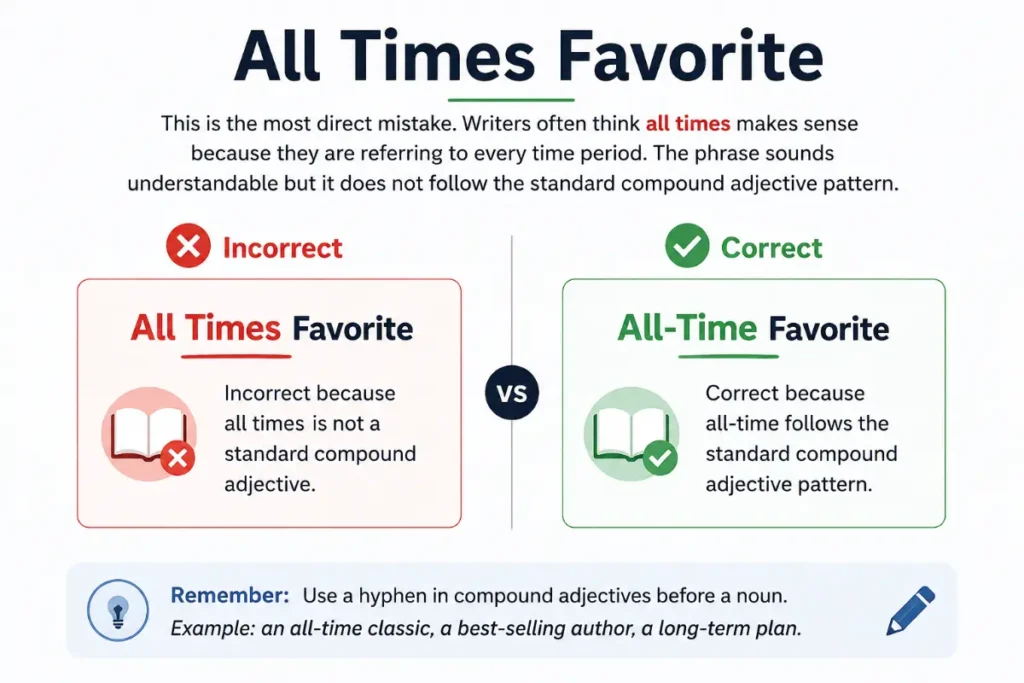
This is the most direct mistake. Writers often think all times makes sense because they are referring to every time period. The phrase sounds understandable but it does not follow the standard compound adjective pattern.
All Time Favorite
This form is often seen in casual writing. The meaning is clear but standard edited English generally uses all-time when the words function together as a compound modifier before a noun.
Alltimes Favorite
Some writers treat the expression as one word. That form is not standard.
All Time Fav
This shortened form appears frequently in texting and social media. It can work in highly informal writing but it is not the best choice for an essay article professional email or polished publication.
All Times Fav
This combines two common informal habits. It shortens favorite to fav and changes time to times. The meaning may still be understood but it does not represent standard edited English.
The reason people make these mistakes is partly linguistic prediction. When people hear a familiar phrase they often reconstruct its spelling from sound. All time and all times can sound similar in quick speech. The brain then fills in the spelling based on familiar plural patterns.
This is a type of orthographic confusion. The pronunciation does not always give you enough information to decide if a noun is singular or plural.
Another source of confusion comes from familiar expressions that genuinely use times.
You might hear:
Several times.
Many times.
Hard times.
Good times.
Because times is perfectly normal in those expressions it can feel natural in all-times favorite. The grammar of the compound adjective is different.
Pronunciation Guide
The pronunciation of all-time is straightforward.
The American English pronunciation is commonly represented as:
/ˈɔːl taɪm/
You can think of it as:
AWL TIME
There are two spoken parts.
all
time
The main stress falls naturally on all in many dictionary pronunciations of the compound.
The word favorite is commonly pronounced in American English as:
/ˈfeɪvərɪt/
In everyday American speech it can sound close to:
FAY vuh rit
When you say the complete phrase all-time favorite try not to add an extra syllable to time.
The incorrect written form all-times can encourage learners to imagine a different ending even though fluent speakers normally pronounce the standard phrase simply as all-time.
One useful pronunciation habit is to learn the entire expression as a unit. Instead of memorizing three separate words think of all-time favorite as one familiar phrase.
Etymology and Word Origin
The history of all-time is relatively modern compared with the history of the individual words all and time. The word all has deep Germanic roots and has been part of English for many centuries. Time also has ancient Germanic origins and has existed in English since the early stages of the language.
The compound all-time developed much later as English became increasingly comfortable with compound modifiers. The structure became useful because English often combines words to create compact descriptive units.
Consider:
all-time leader
all-time favorite
These expressions allow speakers to communicate a broad comparison in just a few words. The underlying idea is simple. Something is being compared with the complete range of relevant examples across time. English also has the related expression of all time. Merriam Webster defines of all time as an idiom referring to something that has ever lived or existed. That explains why both of these sentences work.
She is my all-time favorite singer.
She is my favorite singer of all time.
The grammatical construction changes but the core meaning remains closely related.
Regional Usage
United States
American English commonly uses all-time favorite before a noun. Oxford’s American English dictionary specifically gives my all-time favorite song as an example. The spelling favorite with no extra u is also the standard American form.
United Kingdom
British English also uses all-time. The main spelling difference is usually favourite rather than favorite.
A British writer may therefore write:
That is my all-time favourite song.
The compound adjective remains all-time. The plural all-times does not become standard simply because the variety of English changes.
Australia
Australian English generally follows the same basic structure. All-time favorite or all-time favourite can appear depending on the preferred spelling convention. The compound adjective keeps time singular.
Canada
Canadian English also uses all-time. Canadian spelling can vary between American and British conventions depending on the word and publication style. The structure of the expression remains the same.
The broad regional pattern is clear. The standard compound uses singular time.
Grammar Rules and Part of Speech
The key grammar point is that all-time functions as a compound adjective.
An adjective describes or modifies a noun. In this expression all-time helps describe the noun favorite.
Consider:
This is my all-time favorite book.
The phrase all-time favorite tells us what kind of favorite book it is. The compound works as a single descriptive unit.
You can use the phrase with many nouns.
all-time favorite restaurant
all-time favorite recipe
The expression can also appear with plural nouns.
These are some of my all-time favorite books.
Notice that favorite becomes plural because the noun is plural. Time does not become plural.
That distinction is easy to miss.
favorite can become favorites because it is the main noun.
time stays singular because it belongs to the compound adjective all-time.
There is also an important distinction between all-time and of all time.
Use all-time before the noun as a compound adjective.
That is my all-time favorite song.
Use of all time when the phrase comes after the noun.
That is my favorite song of all time.
The second structure does not need a hyphen because all time is not functioning as a compound adjective directly before a noun.
This distinction follows a broader English pattern in which compound modifiers can be joined to make their relationship clear.
Real-Life Usage Examples
Daily Talk
What is your all-time favorite food?
This is a natural question when talking with friends or family.
That beach is still my all-time favorite place to relax.
The phrase adds a strong personal sense of preference.
Thank you for recommending that book. It has quickly become one of my all-time favorites.
This sounds natural in a friendly professional email.
That was one of my all-time favorite team events.
The phrase can work in workplace communication when the tone is relaxed.
Academic Writing
Academic writing may use the expression when discussing rankings cultural influence or historical significance.
The novel remains one of the author’s all-time favorite works among readers.
A more formal academic sentence might avoid personal preference and use a phrase such as one of the most influential works of all time.
The key is context. All-time favorite is grammatical but often carries a personal or conversational tone.
News Writing
Journalists often use all-time in phrases involving records rankings and achievements.
The athlete moved into the all-time top ten after another record breaking season.
The film became an all-time favorite among fans.
News writing often favors concise expressions because readers need information quickly.
Literature
Writers can use all-time favorite to reveal a character’s preferences.
That old mystery novel was his all-time favorite.
The phrase can add personality without requiring a long explanation.
Conclusively
Conclusively means in a way that settles a question or proves something.
The evidence conclusively showed that the theory was wrong.
It belongs to a different semantic field.
Expert Editor Insight
As a senior editor I would treat all-time favorite as the clean standard choice when the phrase appears directly before a noun. The safest editing test is simple. Look at the role of the words. If all-time is describing a noun then keep the compound together. If you are using of all time after the noun then leave the phrase open. Major dictionaries support this distinction. Oxford explicitly lists all-time favorite in American English and Merriam Webster defines all-time as an adjective.
One practical editor tip is to stop thinking about the phrase as all + times + favorite. Think of it as one established adjective followed by a noun.
all-time + favorite
That mental pattern makes the correct form much easier to remember.
Expert Tip
If you are unsure about the expression read the sentence aloud and test the alternative structure.
This is my all-time favorite movie.
or
This is my favorite movie of all time.
Both are natural.
If you find yourself writing all-times favorite change it to one of those two structures.
The second option is especially useful when you want to avoid the compound adjective entirely.
Why All Times Favorite Sounds Wrong
The form all-times favorite creates a number problem.
The word times is plural. In ordinary English that means multiple instances or periods.
For example:
I called three times.
We met several times.
Those were difficult times.
But all-time does not mean multiple separate times. It refers to the whole span of relevant time as one conceptual range.
That is why the adjective uses singular time.
Think of the phrase as meaning:
favorite across all time
not:
favorite across all times
The first meaning is the established English construction.
There is also a useful comparison with other compound adjectives.
full-time student
part-time worker
long-time friend
all-time favorite
English does not normally make the first element plural just because the expression refers broadly to many situations.
You would not say parts-time worker or long-times friend. The same structural logic helps explain all-time favorite.
All Time Favorite vs Favorite Of All Time
These expressions are closely related but grammatically different.
All-time favorite places the compound adjective before the noun.
Favorite of all time uses a noun followed by a prepositional phrase.
Compare:
This is my all-time favorite book.
This is my favorite book of all time.
Both sound completely natural.
The first version is shorter and more compact. The second version can feel slightly more conversational in some contexts.
You can also use the phrase without my.
The song became an all-time favorite.
The song became a favorite of all time.
The first sentence is more idiomatic for this meaning.
Why Time Stays Singular
The singular form is not an accident.
In all-time favorite the word time belongs to a compound adjective. The phrase describes something in relation to the complete span of time.
English frequently uses singular nouns inside compound modifiers even when the overall idea covers many examples.
Consider:
year-round event
full-time employee
long-term plan
life-long interest
The nouns inside these compounds do not automatically become plural.
The same pattern appears in all-time.
The meaning is broad but the grammatical form remains singular.
That is why all-times favorite is not the normal standard form.
Can You Write All Time Favorite Without The Hyphen
This question deserves a careful answer. When all-time directly modifies a noun as a compound adjective the standard dictionary form includes the hyphen. Oxford lists all-time as the adjective form. Merriam Webster also gives the headword as all-time.
So in polished writing use:
my all-time favorite movie
rather than:
my all time favorite movie
However you can correctly write all time without a hyphen in a different grammatical structure.
This is my favorite movie of all time.
Here all time belongs to the phrase of all time. It is not a compound adjective placed directly before movie. This is one of the most useful distinctions to remember.
Is All-Time Favorite Formal
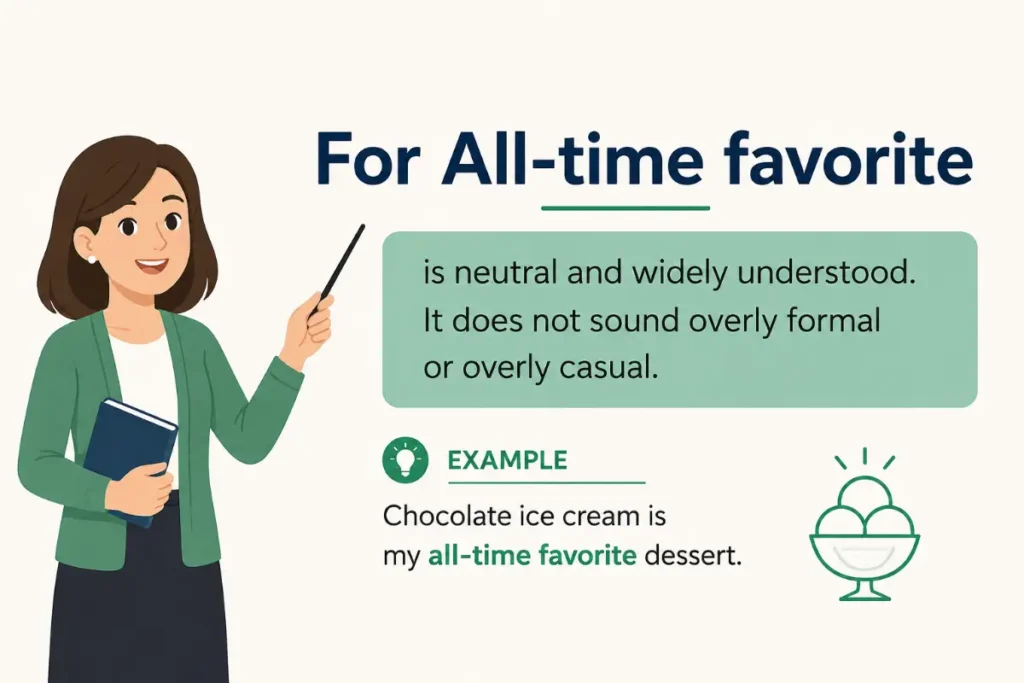
All-time favorite is neutral and widely understood. It does not sound overly formal or overly casual.
You can use it in everyday conversation.
That is my all-time favorite song.
You can use it in a review.
The film remains an all-time favorite among fans.
You can use it in general professional writing.
This has become one of our all-time favorite team traditions.
In highly formal academic writing you may prefer more precise language depending on the purpose.
For example:
The study has become one of the most frequently cited works in the field.
That sentence provides a measurable claim instead of a personal preference.
So the phrase itself is perfectly acceptable. The right choice depends on what you want to communicate.
Conclusion
The correct form is all-time favorite. The word time stays singular because all-time functions as a compound adjective before favorite. The form all-times favorite is not standard English.
You can also avoid the compound adjective by writing favorite of all time. Both structures express the idea of something being your favorite across the full span of relevant time.
The easiest rule to remember is this. Use all-time favorite before a noun. Use of all time after the noun. If you ever catch yourself typing all-times favorite stop and switch to one of those two forms. That small correction will make your writing sound natural and polished.
Frequently Asked Questions
Is All Time Favorite Or All Times Favorite Correct?
All-time favorite is the correct standard form. The word time stays singular because all-time works as a compound adjective before the noun favorite. All-times favorite is not standard English. You can also use favorite of all time with the same basic meaning.
Should I Write All Time Favorite With A Hyphen?
Yes. When all-time comes directly before a noun as a compound adjective it should normally be hyphenated. For example This is my all-time favorite movie. The hyphen shows that all-time works as one descriptive unit.
Why Is All Times Favorite Incorrect?
All-times favorite adds an unnecessary plural ending to time. In this expression all-time refers to the complete span of relevant time rather than several separate times. English treats all-time as a fixed compound adjective. That is why the singular form is standard.
Is All Time Favorite The Same As Favorite Of All Time?
Yes. Both expressions usually communicate the same idea. All-time favorite places the compound adjective before the noun. Favorite of all time uses a prepositional phrase after the noun. For example That is my all-time favorite song and That is my favorite song of all time are both correct.
Can I Say My All Time Favorite Book?
Yes. The meaning is clear but standard polished writing uses the hyphen in all-time when it comes before the noun. The preferred form is My all-time favorite book is this novel. When the phrase appears as favorite of all time the hyphen isn’t needed.
Is All Times Favorite Used In English?
You may see all-times favorite online or in informal writing but it isn’t the standard expression. It’s generally a spelling or grammar mistake. If you’re writing an article email essay review or professional document use all-time favorite instead.
What Does All Time Favorite Mean?
All-time favorite means the person thing or experience that you like more than any other across your experience or the relevant period of time. For example Pizza is my all-time favorite food means pizza is the food you prefer above all others.
What Is Another Way To Say All Time Favorite?
A natural alternative is favorite of all time. You can also use phrases such as favorite ever or greatest favorite depending on the context. For example She is my all-time favorite singer can become She is my favorite singer of all time
