
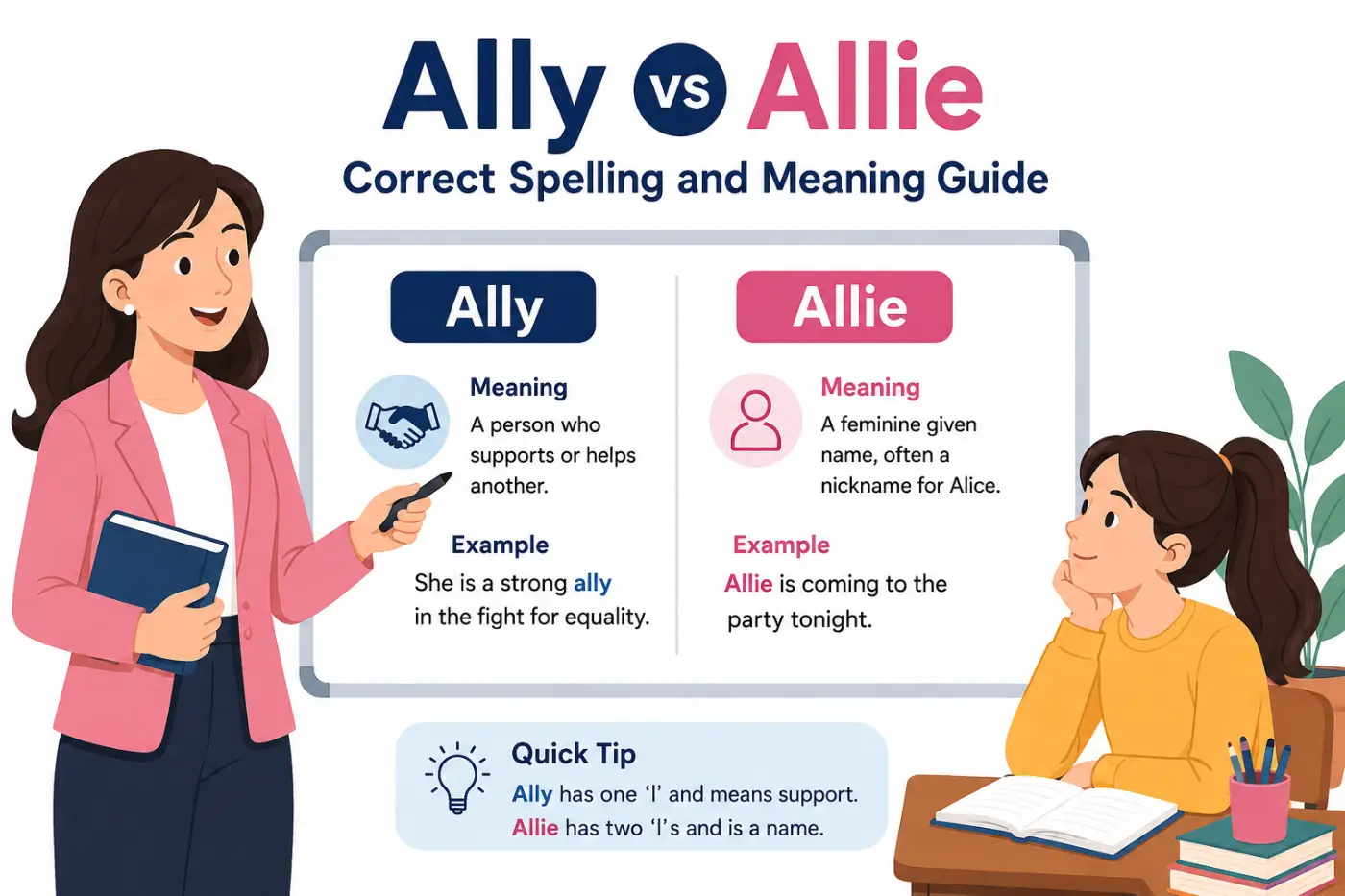
Spelling mistakes often happen when two words look and sound close enough to blur together. Ally vs Allie is a good example because both forms are familiar in English but they don’t serve the same purpose. The correct standard English word is ally. It means a person, group, or country that supports another person or works with them toward a shared goal. Allie is usually a personal name or nickname. It isn’t the standard spelling of the English noun meaning a supporter or partner.
The confusion makes sense. English has many names that look like ordinary words. The ending in Allie also resembles familiar names such as Ellie and Millie. When someone hears the word ally without seeing it written down, they may naturally guess a spelling that ends in ie.
This guide explains the difference in plain English. You’ll learn what each form means, how to spell it, how to pronounce it, how to use it in a sentence, where it came from, and why ally is the correct choice when you mean a supporter or partner.
Quick Definition
Ally is the standard English word for a person, group, or country that supports another or joins with them for a shared purpose. Allie is generally a personal name or nickname. It isn’t an alternative spelling of the common noun ally. Cambridge and Merriam Webster both list ally as a standard English noun and verb.
Ally vs Allie Quick Answer
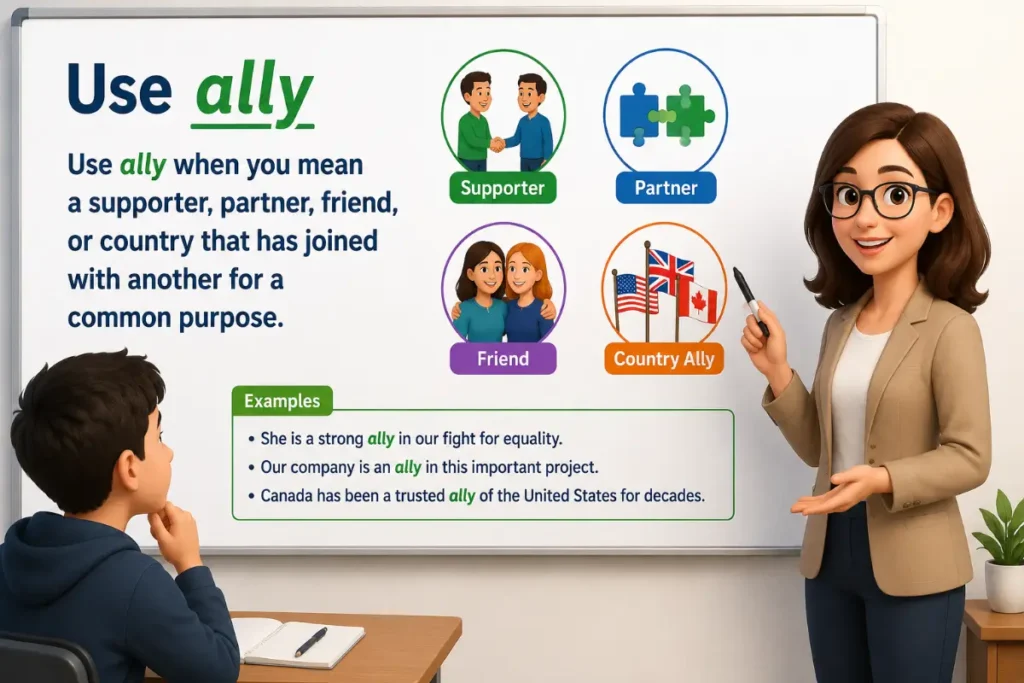
Use ally when you mean a supporter, partner, friend, or country that has joined with another for a common purpose. Use Allie when you’re referring to someone whose name is Allie. The two forms aren’t interchangeable.
For example:
Correct: She became a strong ally during the campaign.
Correct: Allie joined us for dinner.
Incorrect: She became a strong allie during the campaign.
The difference isn’t a matter of American versus British spelling. It is a difference in word identity and function.
Comparison Table for Ally and Allie
| Correct Form | Meaning | Part of Speech | Origin | Usage Frequency | Formality | Common Contexts | Example |
|---|---|---|---|---|---|---|---|
| ally | A person group or country that supports another | Noun or verb | Middle English from Anglo French and Latin | Very common | Neutral to formal | Politics friendship war teamwork | She is a trusted ally. |
| Allie | A personal name or nickname | Proper noun | English usage as a diminutive of names such as Alison and Alexandra | Common as a given name | Personal | Names introductions stories and conversations | Allie called me yesterday. |
The table captures the central distinction. Ally belongs to the standard English vocabulary. Allie generally functions as a proper name. The name Allie has a different role. Behind the Name identifies Allie as an English feminine name used as a diminutive of Alison and Alexandra among other names with the same sound.
Meaning and Definition
Meaning of Ally
Ally has several closely connected meanings. As a noun it refers to someone who supports another person or group. It can also describe a country that has agreed to support another country. In a broader sense it can refer to a person or organization that works alongside another because they share an interest or goal.
For example:
- Maria has always been an ally of the project.
- Canada was an ally of the United States during the war.
- The organization found an unexpected ally in the local community.
The word can also have a social meaning. Someone can be an ally to a group or cause even if they aren’t personally part of that group. Merriam Webster includes this modern sense in its definition of the noun
As a verb, ally means to join or associate with another person or group.
For example:
- The two organizations allied to protect the river.
- Several countries allied against a common threat.
Cambridge likewise lists ally as both a noun and a verb. Its noun definition centers on support and cooperation while its verb use refers to joining or forming an alliance.
Meaning of Allie
Allie is normally a personal name. It can be a full given name or a nickname for names such as Alison or Alexandra. Its exact origin can depend on the person using it. Some people are simply named Allie from birth while others use it as a shortened form of another name.
For example:
- Allie works at the local library.
- I met Allie after the meeting.
- Allie sent the documents this morning.
Notice the capitalization. Allie begins with a capital letter because it is normally a proper name. You wouldn’t replace ally with Allie in a sentence about support.
Incorrect: My closest Allie helped me through the problem.
Correct: My closest ally helped me through the problem.
The first sentence changes the word into a name. The second uses the standard noun.
Key Differences Explained
Spelling
Ally contains a y at the end.
Allie contains ie at the end.
That small difference completely changes the role of the word. The spelling ally is established in English dictionaries as the noun and verb. Allie generally functions as a personal name.
Grammar Role
Ally can be a noun or a verb.
As a noun:
She is my closest ally.
As a verb:
The two groups decided to ally.
Allie is normally a proper noun.
Allie lives in Texas.
That means capitalization also helps you recognize the difference.
Meaning
Ally carries a meaning connected to support, cooperation, association, or partnership.
Allie identifies a person.
One describes a relationship. The other usually identifies the individual involved.
Tone
Ally is neutral and suitable for everyday conversation, professional writing, academic writing, journalism, and formal discussion.
Allie has the tone of a personal name. Its style depends on the person who has the name and the context in which you use it.
Context
You might discuss political allies, military allies, social allies, business allies, or personal allies.
You might introduce Allie at a meeting, mention Allie in an email, or write about a character named Allie in a story.
The contexts rarely overlap.
Which Spelling Is Correct
If you’re trying to say that someone supports you or works with you toward a common goal, ally is the correct spelling.
This isn’t simply a matter of personal preference. Major dictionaries recognize ally as a standard English word. Merriam Webster lists it as both a noun and verb and gives its plural as allies. Cambridge also lists the noun and verb forms and provides pronunciation information for both uses.
The spelling allie isn’t the standard form of the noun.
There is one important exception to keep in mind. A person’s name can have its own spelling. If someone’s name is Allie, you should write Allie because names belong to the individual. You don’t correct someone’s chosen name to Ally just because ally is the standard English word.
This distinction is a useful editing principle. Standard vocabulary follows dictionary conventions. Personal names follow the person’s actual name.
Sentence Examples
Here are natural examples of ally in everyday English.
- The senator found an unexpected ally in a rival politician.
- She became an important ally during the difficult negotiations.
- The two countries have remained close allies for decades.
- He knew he could count on his brother as an ally.
- The company needs a strong ally in the local market.
- The teacher became an ally for students who needed extra support.
- Several nations agreed to ally against the growing threat.
- The two organizations allied to promote cleaner water.
- A good friend can become your strongest ally when life gets difficult.
- The group gained a powerful ally in the community.
Now compare those sentences with examples where Allie is a name.
- Allie called me after work.
- I met Allie at the conference.
- Allie has lived in Chicago for five years.
- We asked Allie to review the report.
- Allie and her sister opened a small bookstore.
These examples show why context matters. Ally describes a relationship or action. Allie normally identifies a person.
Examples of the Common Misspelling
The following examples show allie used incorrectly as a common noun.
- Incorrect: She has always been a loyal allie.Correct: She has always been a loyal ally.
- Incorrect: We need an allie who understands the situation.Correct: We need an ally who understands the situation.
- Incorrect: He became an allie of the reform movement.Correct: He became an ally of the reform movement.
- Incorrect: Every leader needs a trusted allie.Correct: Every leader needs a trusted ally.
- Incorrect: The organization found an unexpected allie.Correct: The organization found an unexpected ally.
If Allie is someone’s actual name, however, the capitalization and spelling are correct.
Common Mistakes and Misspellings
Several errors can push writers toward allie.
Adding ie Because of Familiar Names
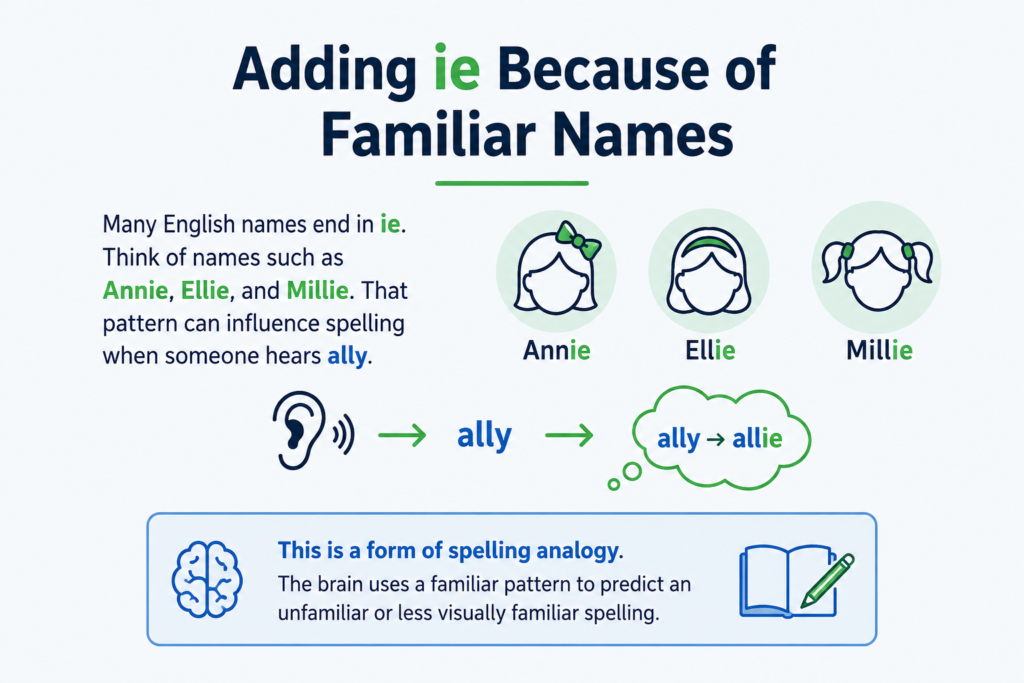
Many English names end in ie. Think of names such as Annie, Ellie, and Millie. That pattern can influence spelling when someone hears ally.
This is a form of spelling analogy. The brain uses a familiar pattern to predict an unfamiliar or less visually familiar spelling.
Confusing Sound With Spelling
English spelling doesn’t always provide a perfect map of pronunciation. The sound of ally can lead someone to search for a spelling that feels familiar.
The noun is commonly pronounced /ˈæl.aɪ/ in Cambridge’s pronunciation guide.
Treating Names as Vocabulary Variants
Because Allie is a real and familiar name, writers may assume it is another spelling of ally. It isn’t.
This is a lexical category error. The writer recognizes the sound but assigns it to the wrong word.
Forgetting the Plural Pattern
The plural of ally is allies.
For example:
Our allies supported the agreement.
That spelling pattern can also cause confusion because the plural changes the y to ies.
Relying Only on Sound
Pronunciation can help you identify a word, but spelling requires context. If you’re writing about a supporter, partner, or friendly nation, the dictionary form is ally.
Pronunciation Guide
The pronunciation of ally depends slightly on its grammatical role.
As a noun, Cambridge gives the pronunciation /ˈæl.aɪ/ in both British and American English.
A simple syllable breakdown is:
AL ly
The spoken sound is close to:
AL eye
The stress falls on the first syllable.
As a verb, pronunciation can shift. Cambridge lists /əˈlɑɪ/ for the American verb form. Merriam Webster also gives pronunciation information for the noun and verb.
Allie has a different sound. Behind the Name gives it as /ˈæl.i/.
You can think of the difference like this:
Ally: AL eye.
Allie: AL ee.
That pronunciation difference can make the spelling distinction easier to remember.
Etymology and Word Origin
The history of ally helps explain why its meaning centers on connection and cooperation.
Merriam Webster traces the word to Middle English allien and Anglo French alier. The deeper Latin source is alligare, meaning to bind to. The Latin elements are connected with the ideas of joining and binding.
Etymonline traces the verb to the late 13th century and explains its development from Old French alier, meaning to combine or unite, with a connection to Latin alligare. The noun developed later from the same word family.
The early history is a good reminder that words often carry traces of their older meanings. An ally is someone connected to you through a shared purpose. The modern meaning grew naturally from the older idea of joining or binding people together.
The noun developed meanings related to relatives and people connected by an agreement. By the middle of the 15th century it had the sense of someone united with another through a treaty or league.
The modern word now reaches far beyond military relationships. You can have a political ally, business ally, personal ally, community ally, or social ally.
Allie has a completely different history as a name. Behind the Name describes it as an English feminine name and a diminutive of Alison, Alexandra, and other names beginning with a similar sound.
So the two forms don’t represent competing spellings from the same vocabulary history. They belong to different naming systems.
Regional Usage in the US
American English uses ally as the standard spelling for the noun and verb.
The meaning is familiar in politics, international relations, personal relationships, education, business, and social discussions. Cambridge’s American Dictionary gives ally as a noun for a country or person that gives support and as a verb meaning to join or associate.
Allie can appear as a personal name in American English. Its use as a name doesn’t create an American spelling variant of ally.
Regional Usage in the UK
British English also uses ally as the standard word.
Cambridge lists ally with the same basic meanings in British English. It can describe a country that provides support or a person who helps another person.
There isn’t a British spelling rule that changes ally to allie.
If Allie is someone’s name, British writers preserve that spelling because proper names aren’t changed to match ordinary vocabulary.
Regional Usage in Australia
Australian English follows the same basic spelling distinction.
Ally is the standard English word for a supporter, partner, or associated country. Allie can be used as a person’s name.
The difference isn’t an American versus Australian spelling issue. It is a distinction between a standard vocabulary word and a proper name.
Regional Usage in Canada
Canadian English also uses ally as the standard spelling.
Canadian writers can use Allie as a personal name when that is the person’s actual name. They don’t normally use it as a variant spelling of the noun ally.
So across the major English varieties discussed here, the spelling rule stays consistent.
Grammar Rules and Part of Speech
Ally can function as both a noun and a verb.
Ally as a Noun
As a noun, ally identifies a person, group, or country that supports another.
Examples:
- She is a trusted ally.
- The country gained a new ally.
- We need allies who understand the problem.
The plural form is allies.
Ally as a Verb
As a verb, ally means to join or associate with another.
Examples:
- The groups allied against the proposal.
- The company allied with a local organization.
- Several nations allied themselves with the new government.
Merriam Webster notes that the verb is commonly used with with or to.
Sentence Placement
As a noun, ally can appear after a linking verb.
She is an ally.
It can also appear after a determiner.
They found an ally.
It can appear in a longer noun phrase.
She became a valuable ally to the community.
As a verb, it usually appears near the subject and can take a prepositional phrase.
The two groups allied with each other.
Punctuation
There is no special punctuation rule for ally.
Use normal sentence punctuation based on the structure of the sentence. Don’t add an apostrophe simply because the word describes possession.
For possession, use the standard possessive forms:
The ally’s support was valuable.
The allies’ agreement changed the situation.
Real Life Usage Examples
Daily Talk
In everyday conversation, ally often describes someone who stands beside you when you need support.
- I know she’ll be an ally when things get difficult.
- He has always been a loyal ally.
The word sounds natural in ordinary conversation even though it can also appear in formal writing.
Professional emails often use ally when discussing cooperation.
- We need to identify an ally within the organization.
- Our new partner could become a valuable ally.
The word works well because it clearly communicates support without sounding overly technical.
Academic Writing
Academic writing may use ally when discussing political relationships, social movements, organizations, or historical events.
- The smaller state sought a powerful ally.
- Several organizations became allies during the campaign.
The meaning stays consistent. The surrounding subject determines the specific sense.
News Writing
News reports frequently use ally in political and international contexts.
- The president met with regional allies.
- The country is seeking stronger allies in the region.
Cambridge provides examples involving political leaders, governments, NATO allies, and international relationships.
Literature
Writers can use ally to describe relationships between characters.
- She discovered an unexpected ally in the old merchant.
- The hero needed an ally before entering the city.
The word works well in storytelling because it quickly communicates trust, cooperation, and shared purpose.
These terms aren’t direct replacements in every sentence. For example, a supporter can agree with your cause without having a close cooperative relationship with you. An ally usually suggests a stronger connection or shared purpose.
Common Mistakes and Misspellings
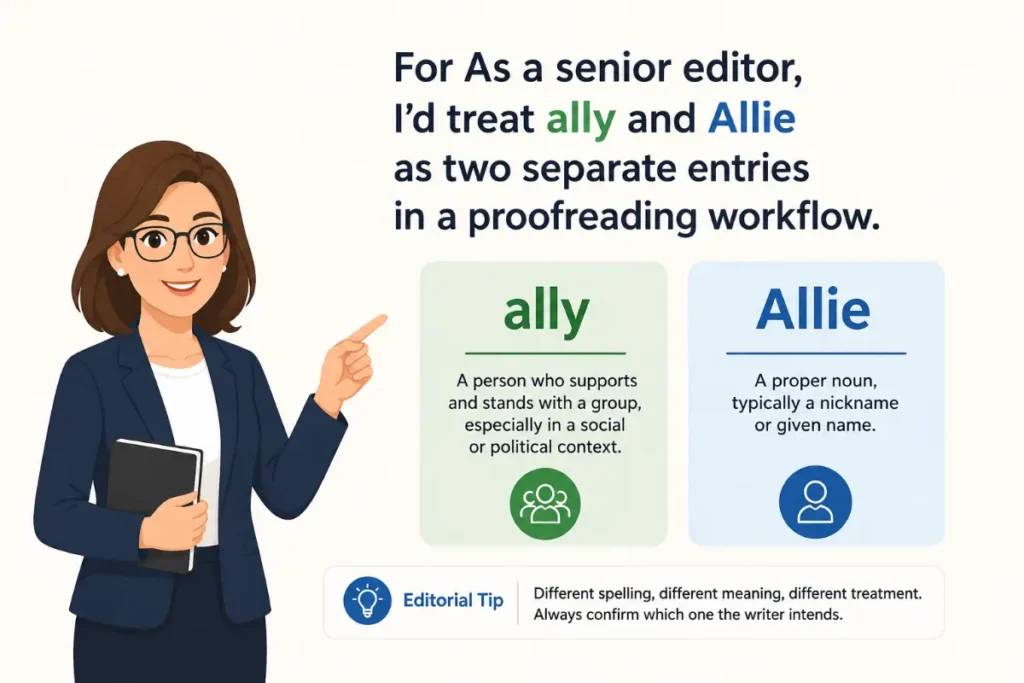
As a senior editor, I’d treat ally and Allie as two separate entries in a proofreading workflow. If the sentence describes support, cooperation, partnership, or an international relationship, ally is almost certainly the form you need. If the word identifies a person, check the person’s actual name before making any correction. Grammar and spelling tools generally recognize ally as standard vocabulary. A spell checker may also accept Allie because proper names can appear in dictionaries or personal databases. That doesn’t make the two forms interchangeable. Context still wins.
Expert Tip
When you’re unsure, replace the word with supporter.
If the sentence still makes sense, ally is probably the word you need.
For example:
She is my strongest supporter.
She is my strongest ally.
Both work.
But:
I spoke with Allie yesterday.
Replacing Allie with supporter changes the meaning completely.
That quick substitution test can help you catch the error before you publish.
Final Takeaway
The difference between ally and Allie is straightforward once you separate vocabulary from names. Ally is the standard English word for a supporter, partner, or person or country that joins another for a shared purpose. It also works as a verb meaning to unite or associate. Allie is normally a personal name or nickname.
It isn’t a spelling variant of ally. When writing about support or cooperation, choose ally. When you’re referring to someone named Allie, use Allie exactly as that person spells it. The simplest practical tip is to substitute supporter in your sentence. If that meaning fits, ally is probably the spelling you need.
Frequently Asked Questions
Is Allie a Real Word?
Yes. Allie is a real name. It is commonly used as a feminine given name and can also function as a nickname for names such as Alison or Alexandra. It isn’t the standard spelling of the English noun that means a supporter or partner. If you’re describing someone who supports you, use ally. If you’re referring to someone named Allie, preserve the name’s spelling.
What Does Ally Mean?
Ally means a person, group, or country that supports another person or joins with them for a shared purpose. It can also work as a verb meaning to unite or form an association. For example, you can call a trusted friend an ally or say that two organizations decided to ally. Major dictionaries recognize both the noun and verb forms.
Ally vs Allie Which Is Correct?
Ally is correct when you mean a supporter, partner, or person or country that has joined with another for a common purpose. Allie is normally a personal name or nickname. The two forms aren’t alternative spellings of the same word. Use ally in sentences such as She is my strongest ally. Use Allie only when it refers to someone whose name is Allie.
How Do You Pronounce Ally?
The noun ally is commonly pronounced /ˈæl.aɪ/. You can think of it as sounding like AL eye. Cambridge lists this pronunciation for both British and American English. The verb can have a different stress pattern and is listed with /əˈlɑɪ/ in the American pronunciation guide. Allie sounds different and is pronounced /ˈæl.i/.
Can Ally Start a Sentence?
Yes. Ally can start a sentence when it functions as a noun or verb. For example, you could write, Ally support can make difficult work easier. You could also write, Ally with experienced partners to improve your chances, although the verb construction depends on the sentence. Capitalization at the beginning of a sentence doesn’t turn the word into the name Allie.
What Is a Synonym for Ally?
The best synonym depends on the context. Supporter, partner, associate, friend, and collaborator can work in different situations. A supporter may simply favor your cause. A partner usually suggests active cooperation. An ally often combines support with a shared interest or purpose. For political or military contexts, partner and supporting nation may also fit depending on the sentence.
Why Do People Misspell Ally?
People may write allie because familiar English names often end in ie. The spelling can also be influenced by pronunciation and visual patterns. This is a common kind of lexical confusion where the brain connects a familiar sound with a familiar spelling pattern. The fact that Allie is already a real name makes the confusion more understandable. Still, the standard vocabulary word is ally.
Is Ally Suitable for Formal Writing?
Yes. Ally is fully suitable for formal writing. It appears in academic work, journalism, political analysis, historical writing, business communication, and everyday conversation. Its formality depends more on the context than on the word itself. For example, political ally and military ally are perfectly natural in formal writing. The important point is to use ally for the common noun and Allie for the personal name.
