
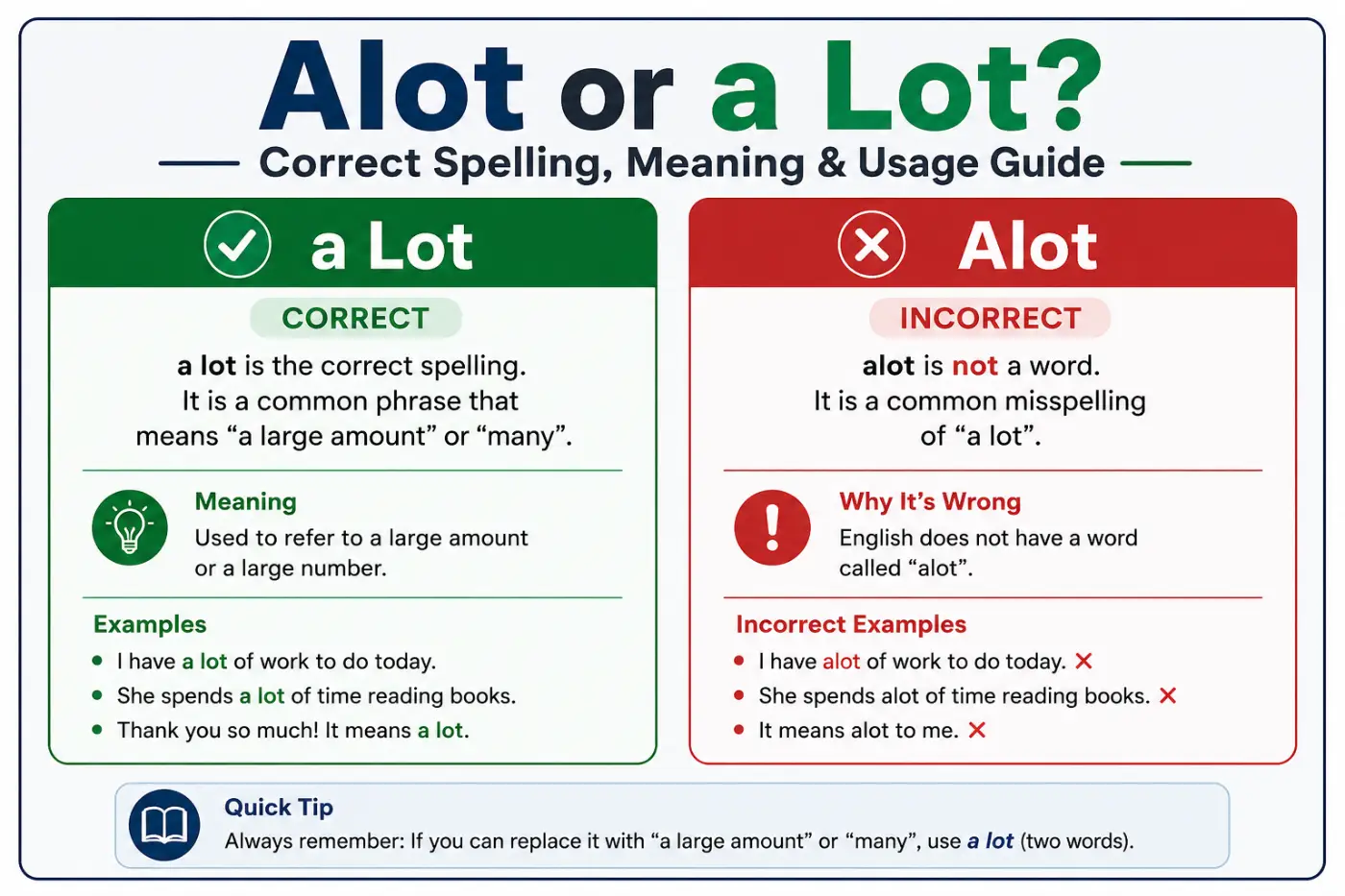
Have you ever typed a sentence and suddenly wondered if alot or a lot is the correct spelling. You’re not alone. This mistake is extremely common because the two forms sound exactly the same when people speak quickly.
The correct form is a lot. It must be written as two separate words when you mean a large amount a large number or something frequently or to a great degree. Alot is not the standard spelling of this expression in modern English. Major dictionaries and usage guides treat it as an error.
The confusion makes sense. English has many words that began as separate words and later became one word. That pattern can make a phrase like a lot feel as if it should eventually become alot. However standard English still keeps the article a separate from the noun lot.
This guide explains the correct spelling meaning grammar pronunciation word history common mistakes regional usage and practical examples. You’ll also see how native English speakers use this expression and when a more formal alternative might sound better.
Quick Definition
A lot is the correct spelling when you mean a large amount a large number a great degree or something frequently. It can work as a noun phrase determiner or adverbial expression. Alot is generally treated as a misspelling in standard English.
Quick Answer
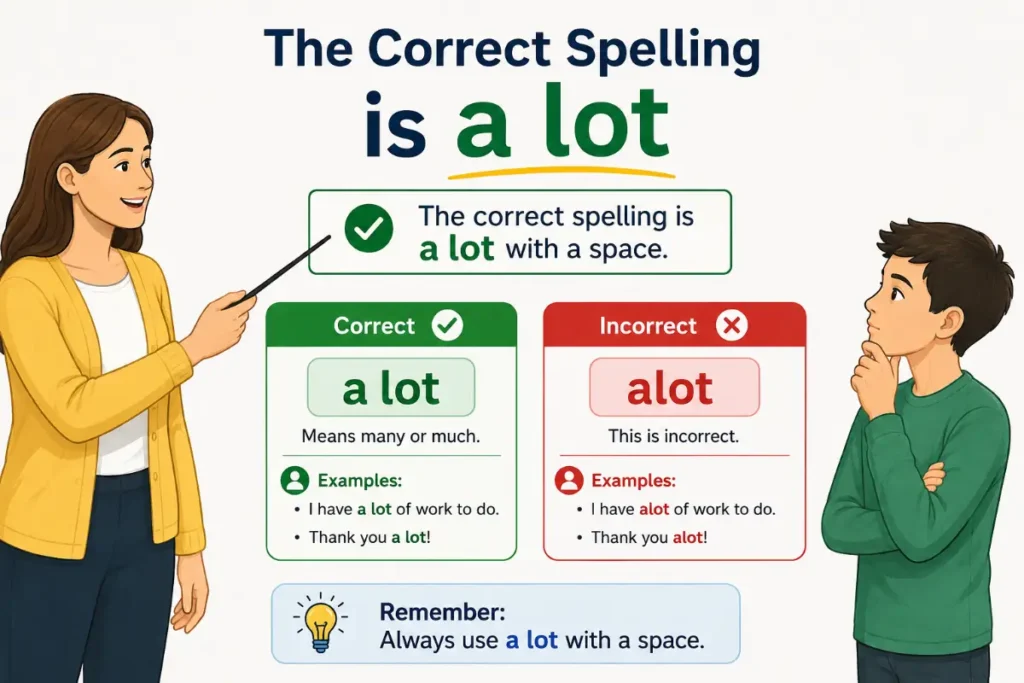
The correct spelling is a lot with a space.
Use a lot to mean a large amount a large number very much or very often. For example you can say I have a lot of work or She travels a lot. Alot is not the standard spelling of this expression.
Comparison Table for Alot or a Lot
| Correct Form | Meaning | Part of Speech | Origin | Usage Frequency | Formality | Common Contexts | Example |
|---|---|---|---|---|---|---|---|
| a lot | A large amount or number | Noun phrase or determiner | From the noun lot with the article a | Very common | Informal to neutral | Conversation writing email general communication | I have a lot of work today. |
| a lot | Very much or very often | Adverbial expression | From the noun lot | Very common | Informal to neutral | Conversation personal writing everyday speech | She exercises a lot. |
| alot | Usually intended to mean a large amount or number | Nonstandard spelling | A mistaken joining of a and lot | Common as an error | Nonstandard | Informal online writing and typing errors | I have alot of work today. |
Meaning and Definition
Meaning of Alot
Alot is generally not a standard English word when someone intends to express the meaning of a large amount or number.
Most people who write alot simply mean a lot. The problem comes from treating the two spoken words as one written word. Merriam Webster specifically recommends using a lot rather than alot and describes the joined form as an error.
You may occasionally encounter alot in usernames brand names creative writing or other names. That doesn’t make it the standard spelling of the common English expression. A proper name can follow its own spelling conventions. Standard English still uses a lot for the everyday phrase.
There is another word that can cause confusion here. Allot is a real English verb. It means to assign distribute or give someone a particular share.
For example:
The committee will allot ten minutes to each speaker.
That meaning has nothing to do with a lot.
This distinction matters because alot can sit visually between a lot and allot. They may look related on the page but they perform different jobs.
Meaning of Finally
The original prompt supplied finally in several heading requirements even though the primary keyword for this article is alot or a lot. That appears to be a leftover instruction from a different spelling article. The correct focus here is a lot and alot.
A lot has several closely related uses.
First it can mean a large amount or number.
She has a lot of books.
Second it can mean very much.
I like this restaurant a lot.
Third it can mean very often.
We visit our grandparents a lot.
Cambridge defines a lot as a phrase referring to a large amount or number and also records its use to mean very much or very often.
The expression is especially common in everyday English. Oxford describes a lot as informal and notes that it can work as an adverb with verbs and with adjectives or adverbs to express degree.
Key Differences Explained
- Spelling
The biggest difference is simple. A lot contains two words. Alot joins them into one word and is normally considered incorrect.
- Grammar role
A lot can function as part of a noun phrase or as an adverbial expression. Alot doesn’t have a standard grammatical role in this meaning because it isn’t the accepted form.
- Meaning
The intended meaning is usually the same in someone’s mind. A person writing alot normally means a large amount a large number very much or very often.
- Tone
A lot sounds natural and familiar. It works well in ordinary American English. It can appear in professional communication too although more formal alternatives may sometimes be preferable.
- Context
Use a lot in conversations emails personal writing general nonfiction and many other everyday situations. Avoid alot in edited writing because readers and grammar tools will generally recognize it as a spelling mistake.
Which Spelling Is Correct
A lot is correct when you mean a large amount a large number very much or very often.
The linguistic reason is straightforward. The expression contains the indefinite article a followed by the noun lot. Merriam Webster explains that a lot developed from this combination and notes that the article remains separate from the noun. The fact that other words can appear between them also shows why they aren’t simply one inseparable word.
For example:
They caused a whole lot of trouble.
You can’t turn this structure into awholelot. The phrase has internal grammar and meaning. That same structure helps explain why a lot remains two words.
Dictionary evidence supports this spelling consistently. Cambridge lists a lot as a phrase and gives examples such as a lot of people and a lot of travelling.
Oxford likewise lists a lot as a standard expression and distinguishes its use as a quantity expression from its use as an adverb.
A useful editorial rule is this.
If you mean a large amount, a large number, very much, or very often, write a lot.
Sentence Examples
Here are ten natural examples using the standard form.
- I have a lot of work to finish tonight.
- She learned a lot from her first teaching job.
- We spend a lot of time together on weekends.
- There were a lot of people at the concert.
- He talks a lot when he gets excited.
- I enjoyed the movie a lot.
- They travel a lot for work.
- This new computer is a lot faster than my old one.
- You have a lot to be proud of.
- My parents helped me a lot when I was starting my business.
Now look at five examples containing the common misspelling.
- I have alot of homework tonight.
- She knows alot about photography.
- We talked alot after the meeting.
- He spends alot of time reading.
- There were alot of questions after the presentation.
Every sentence above should use a lot instead.
The corrected versions would be:
I have a lot of homework tonight.
She knows a lot about photography.
We talked a lot after the meeting.
He spends a lot of time reading.
There were a lot of questions after the presentation.
Common Mistakes and Misspellings
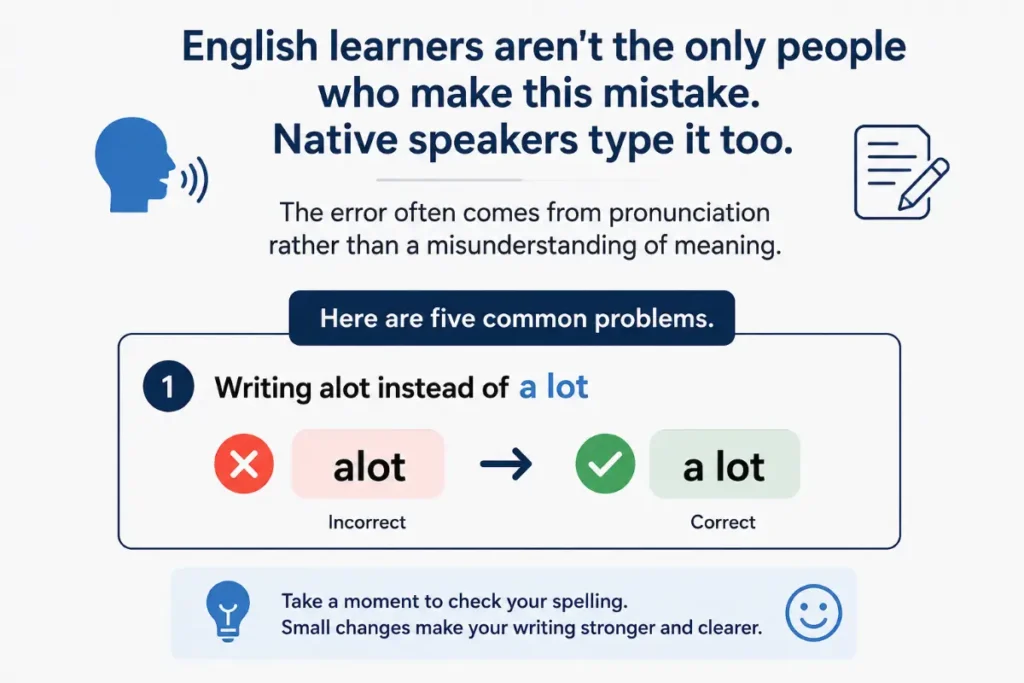
English learners aren’t the only people who make this mistake. Native speakers type it too. The error often comes from pronunciation rather than a misunderstanding of meaning.
Here are five common problems.
- Writing alot instead of a lot
This is the central mistake. The words are pronounced together so writers sometimes treat them as one unit.
- Confusing a lot with allot
Allot is a legitimate word but it means to distribute or assign something.
The manager will allot each employee two hours.
That is different from:
The manager has a lot of work.
- Using a lot of without a noun
When a lot is used before a noun as a quantity expression you normally need of.
She has a lot of patience.
We saw a lot of birds.
But when the noun is understood you can use a lot by itself.
I enjoyed it a lot.
- Using much in places where a lot sounds more natural
In everyday affirmative American English a lot of is extremely common.
I have a lot of friends.
The sentence I have much friends is incorrect because friends is countable and plural. Much does not work that way.
- Assuming pronunciation determines spelling
English spelling doesn’t always follow speech perfectly. Words that sound connected can remain separate in writing. A lot is one of those expressions.
From an NLP perspective this is a segmentation problem. The brain processes familiar speech as a continuous sound stream while writing requires the speaker to decide where word boundaries belong. That makes phrases like a lot easy to merge mentally.
Pronunciation Guide
In American English lot is commonly pronounced approximately /lɑt/.
The phrase a lot can be represented approximately as /ə lɑt/ with the first word reduced to an unstressed sound.
The easiest pronunciation guide for an English learner is:
uh LOT
The stress falls on lot.
For a lot of you can think of the sound as:
uh LOT uhv
In natural speech the sounds may run together. That connected pronunciation is one reason people sometimes write alot.
The spelling mistake has nothing to do with a different pronunciation. Alot and a lot are generally intended to sound the same. The difference appears in writing.
One useful learning trick is to hear the phrase as two grammatical pieces rather than one sound.
Think:
a + lot
rather than:
alot
That small mental pause can help you remember the correct spelling.
Etymology and Word Origin
The history of a lot begins with the older word lot.
Oxford traces lot to Old English hlot and identifies it as a word of Germanic origin. The early sense involved an object used to determine someone’s share or fate by drawing lots.
Etymonline traces the word even further through Proto Germanic roots and related Germanic forms. Early meanings involved a share or portion assigned to someone. Over time the word developed several meanings including a portion a group a plot of land and eventually a large number or amount.
The modern quantity meaning developed from the idea of a lot as a group or collection. Etymonline records lots in the generalized sense of a great many from the early nineteenth century.
This history gives us a useful clue. The expression is not an arbitrary modern combination. A lot developed naturally from the article a and the noun lot.
The joined spelling alot is a later misdivision rather than the standard historical development of the phrase. Etymonline describes alot as a misdivision of a lot and notes that it appears in printed transcripts from around the 1960s.
That history explains why alot can look plausible while still being nonstandard.
Regional Usage in the US
In American English a lot is extremely common in everyday conversation and general writing.
You might hear:
I like this place a lot.
We have a lot of time.
She works a lot.
The spelling remains a lot across ordinary American usage. Cambridge’s American dictionary gives the same spelling and explains that a lot can mean much or often while a lot of can mean a large amount or number.
For formal American writing you may sometimes choose a more precise expression such as many, much, a large number of, or a great deal of.
Regional Usage in the UK
British English also uses a lot as the standard spelling.
The main difference is not spelling but style. Oxford notes that a lot of and lots of can feel informal in British English and recommends more formal alternatives such as much, a great deal of, or a large amount of in formal writing.
So a British writer would still write:
She has a lot of experience.
The writer may choose a great deal of experience in a more formal context.
Regional Usage in Australia
Australian English follows the same standard spelling.
A lot is used in everyday Australian English to express quantity degree or frequency. Alot isn’t a standard regional alternative.
A sentence such as:
I see my friends a lot.
uses the same spelling expected in American British and Canadian English.
Regional Usage in Canada
Canadian English also uses a lot as the standard form.
There is no established Canadian spelling variant alot for this expression. Canadian writers may choose a lot in everyday communication and more formal alternatives in academic professional or official contexts.
The important point is consistency. The spelling does not change simply because the variety of English changes.
Grammar Rules and Part of Speech
A lot has more than one grammatical function.
A Lot as a Quantity Expression
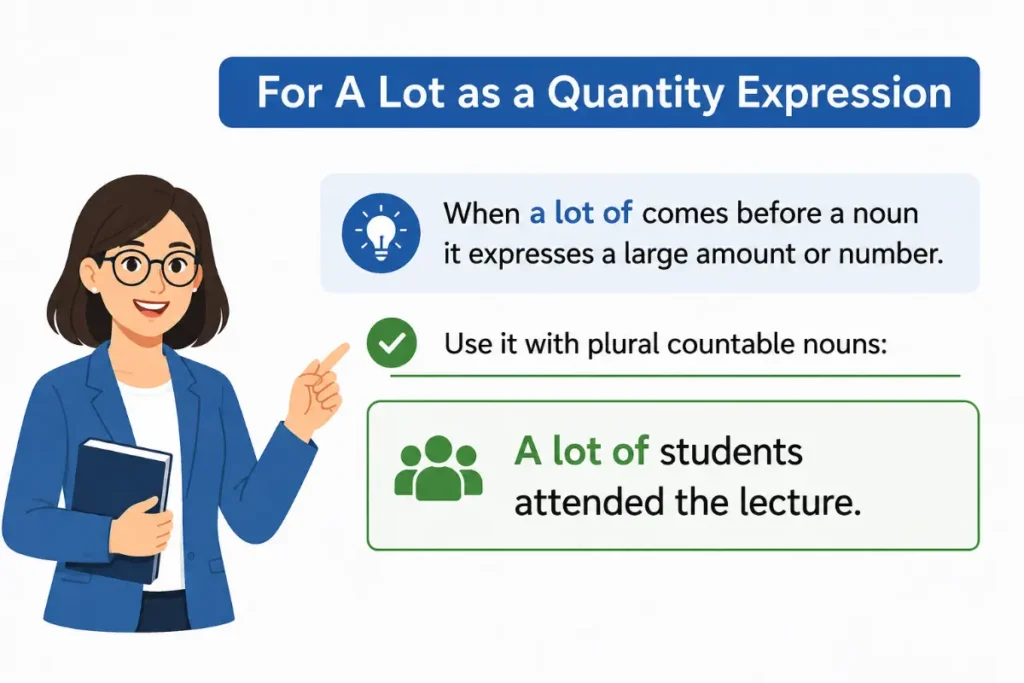
When a lot of comes before a noun it expresses a large amount or number.
Use it with plural countable nouns:
A lot of students attended the lecture.
Use it with singular uncountable nouns:
A lot of information was available.
Cambridge explains that a lot of can be used with plural countable nouns and singular uncountable nouns.
A Lot as an Adverbial Expression
You can also place a lot after a verb to express frequency or degree.
She reads a lot.
I miss my family a lot.
They travel a lot.
Oxford identifies this use as an adverbial expression meaning a great amount or frequently.
A Lot With Comparatives
You can use a lot before comparative adjectives and adverbs to make the comparison stronger.
This car is a lot cheaper.
He runs a lot faster now.
The new system works a lot better.
Oxford specifically records this pattern.
Punctuation
You don’t normally need special punctuation around a lot.
I enjoyed the book a lot.
There were a lot of interesting ideas.
The phrase follows ordinary sentence punctuation rules.
Don’t add a hyphen.
Write:
a lot
Not:
a-lot
And don’t join the words.
Write:
a lot
Not:
alot
Real Life Usage Examples
Daily Talk
I eat out a lot when I’m busy.
We had a lot of fun at the beach.
These sentences sound natural in everyday American conversation.
Thanks a lot for your help with the project.
We still have a lot of work to complete before Friday.
Both examples fit ordinary professional email although a more formal message may benefit from more precise wording.
Academic Writing
The study provides a lot of useful information about language development.
This sentence is understandable and grammatical. However academic writing often benefits from greater precision.
A more formal version could be:
The study provides a great deal of useful information about language development.
Oxford and Cambridge both recognize the informal character of a lot and suggest more formal alternatives in formal writing.
News Writing
A lot of residents expressed concern about the proposal.
News writing may use a lot of in direct quotes or conversational reporting. In tighter formal prose a journalist may prefer many residents.
Literature
He had a lot to remember before leaving town.
She had changed a lot since they last met.
Literary writing can use a lot naturally when the voice calls for an ordinary conversational tone. Writers don’t need to avoid it simply because it is informal.
Related and Confused Terms
Several expressions overlap with the meaning of a lot but aren’t interchangeable in every sentence.
- At last
This usually means something happened after a long wait.
At last the train arrived.
- Eventually
This means something happened after some time or after a series of events.
Eventually they found the missing file.
- Ultimately
This refers to the final result or conclusion.
Ultimately the decision belongs to the board.
- At the end
This refers to the final point of something.
At the end of the meeting we voted.
- Conclusively
This means in a way that settles an issue or proves something.
The evidence did not conclusively establish the cause.
- In the end
This often introduces the final outcome.
In the end we decided to stay home.
- Lastly
This usually introduces the final item in a sequence.
Lastly we need to review the budget.
- Lots of
This has essentially the same quantity meaning as a lot of but is generally more informal.
We have lots of options.
Cambridge notes that lots and a lot are similar in meaning while lots tends to be even more informal.
These expressions are useful alternatives but they don’t all replace a lot. Context determines the best choice.
Expert Editor Insight
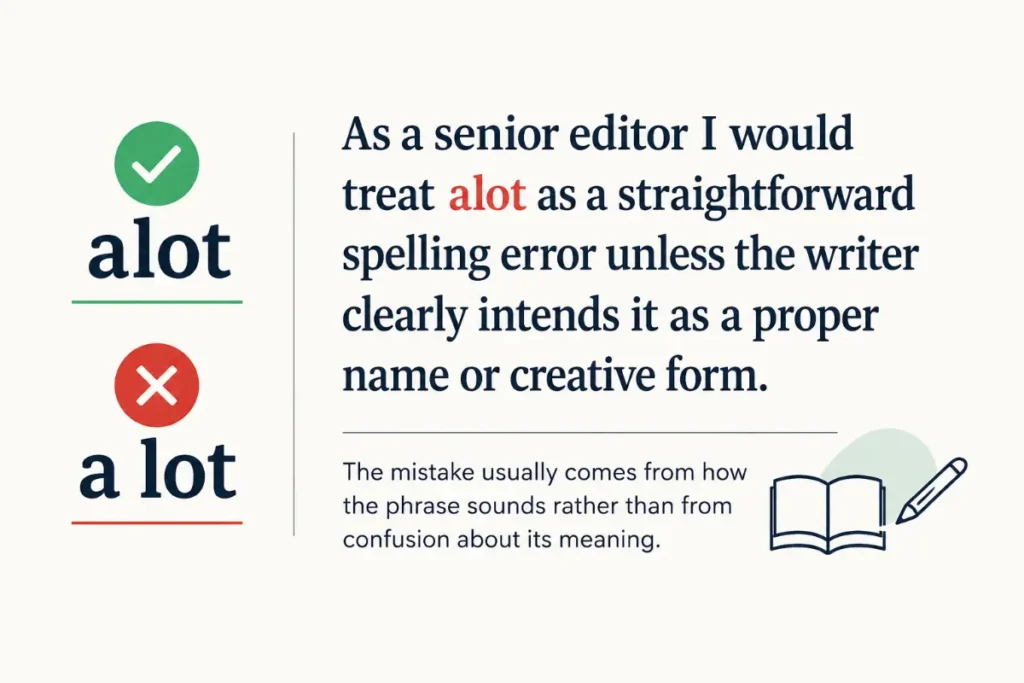
As a senior editor I’d treat alot as a straightforward spelling error unless the writer clearly intends it as a proper name or creative form. The mistake usually comes from how the phrase sounds rather than from confusion about its meaning. Native speakers often pronounce a lot as a tightly connected unit. That doesn’t change the written word boundary. Grammar checkers and spell checkers commonly flag alot because standard dictionaries recognize a lot as the accepted expression. The best editing habit is simple. Learn the phrase as two grammatical units rather than memorizing it as one sound.
Conclusion
The correct spelling is a lot. Keep the two words separate when you mean a large amount a large number very much or very often. Alot is generally a misspelling rather than a standard English word.
The reason is simple. A lot comes from the article a and the noun lot. Its two word structure remains part of standard English usage. Dictionaries such as Merriam Webster Cambridge and Oxford all support this form.
One practical tip can make the spelling stick. When you write the phrase think a plus lot. That tiny mental pause helps you preserve the space and avoid the common alot mistake.
Frequently Asked Questions
Is Alot a Real Word?
Alot is not the standard spelling of the common English expression meaning a large amount a large number very much or very often. Most dictionaries and usage authorities treat it as an error. You may see alot in usernames brand names or creative contexts but those special uses don’t make it the standard form. In normal writing use a lot.
What Does a Lot Mean?
A lot can mean a large amount or number. It can also mean very much or very often. For example I have a lot of work refers to a large amount while I exercise a lot means I exercise frequently. Cambridge lists these meanings and identifies the expression as informal.
Alot or a Lot Which Is Correct?
A lot is correct when you mean a large amount a large number very much or very often. The two words should remain separate because a is an article and lot is the noun from which the expression developed. Alot is normally a spelling error. Merriam Webster specifically advises writers to use a lot instead.
How Do You Pronounce a Lot?
In American English a lot is commonly pronounced approximately /ə lɑt/. An easy pronunciation guide is uh LOT with the main stress on lot. In natural speech the two words may sound closely connected. That connected pronunciation can make the spelling error alot tempting. Remember that natural speech flow doesn’t mean the words should be joined in writing.
Can a Lot Start a Sentence?
Yes. A lot can appear at the beginning of a sentence when the grammar and meaning support it. For example A lot of people enjoy working from home. Here a lot of functions as a quantity expression before the plural noun people. Starting a sentence with the phrase is completely acceptable in standard English.
What Is a Synonym for a Lot?
The best synonym depends on the sentence. For quantity you can use many, much, numerous, a large number of, or a great deal of. For degree you can use very much or considerably. Don’t swap synonyms mechanically because grammar and tone can change with each choice.
Why Do People Misspell a Lot?
People often misspell a lot because the phrase sounds like one connected unit in normal speech. English speakers frequently reduce the vowel in a and blend the phrase together. That creates the impression of one word. Familiar compounds such as already, almost, and although may also reinforce the mistaken idea that common phrases naturally become single words.
Is a Lot Suitable for Formal Writing?
A lot is grammatical but it can sound informal in formal writing. Oxford notes that a lot of and lots of are informal and recommends alternatives such as much, a great deal of, or a large amount of for more formal contexts. For academic or professional writing choose the more precise option when it improves the tone
