
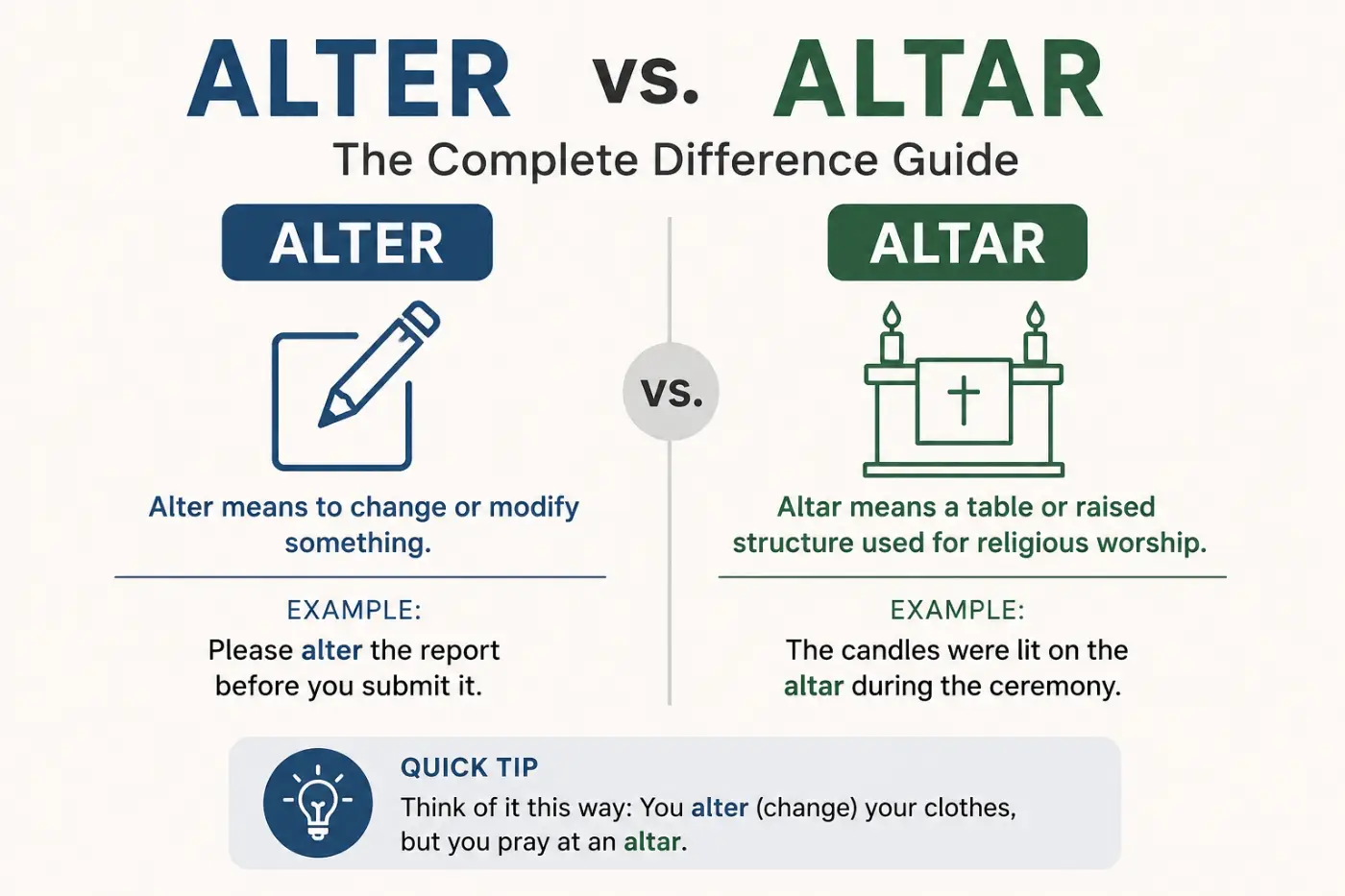
Alter vs altar can be confusing because these words sound alike in American English but have completely different meanings. Choosing the right spelling depends on what you want to say.
Alter is a verb that means to change or modify something. Altar is a noun that refers to a sacred table or structure used during religious ceremonies. The two words aren’t interchangeable even though they can sound exactly the same when spoken.
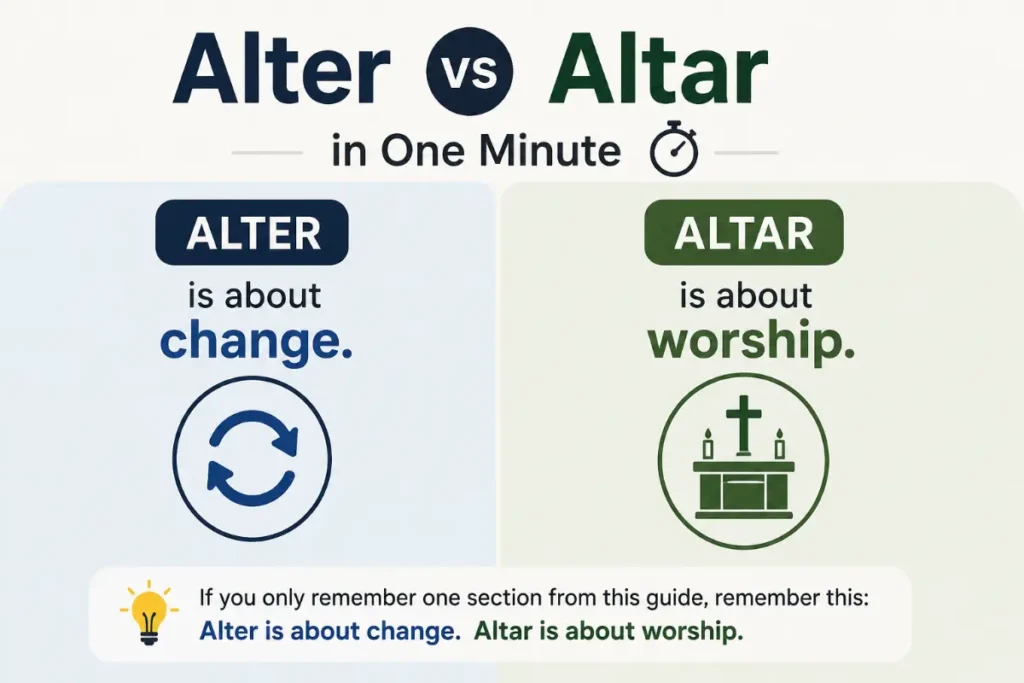
The easiest way to remember the difference is to connect each word with its meaning. Think of alter as changing something and altar as a religious place or structure. Once you link the spelling to the meaning you intend, choosing the correct word becomes much easier.
Quick Definition
Alter is a verb meaning to change or modify something. Altar is a noun referring to a table or raised structure used in religious worship. The words sound similar in many varieties of English but have different meanings, spellings, and grammatical roles.
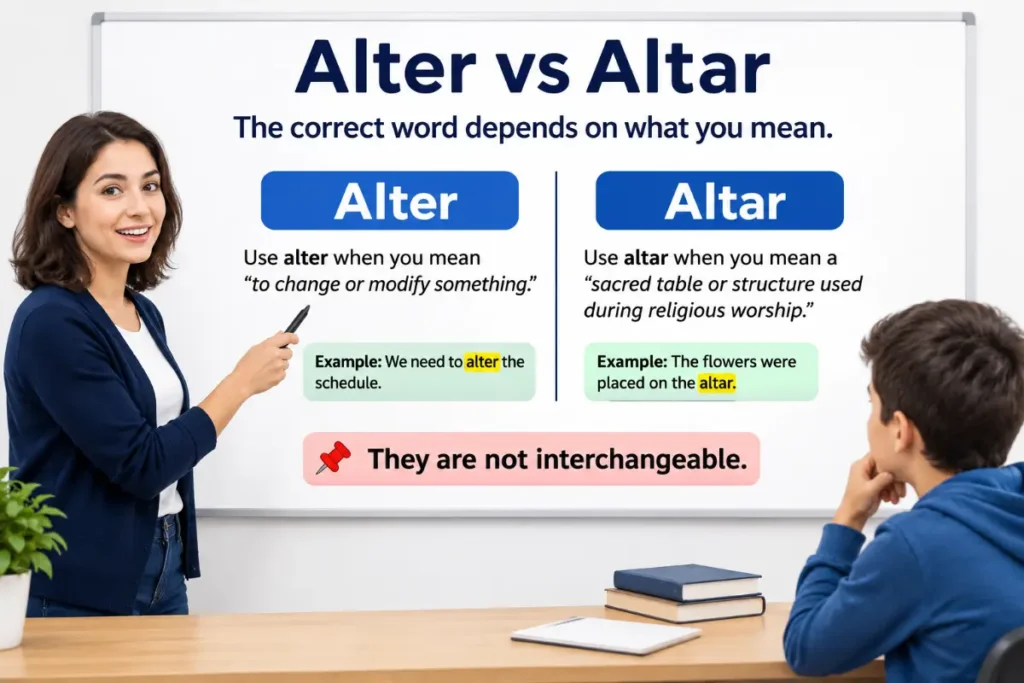
Quick Answer
Use alter when you mean change or modify.
Use altar when you mean a religious structure or table used for worship.
For example, you might say, The tailor will alter my jacket. You might also say, The flowers were placed on the altar. The first word describes an action. The second names a physical or symbolic place.
Comparison Table
| Correct Form | Meaning | Part of Speech | Origin | Usage Frequency | Formality | Common Contexts | Example |
|---|---|---|---|---|---|---|---|
| alter | To change or modify | Verb | Latin through French and Middle English | Very common | Neutral to formal | Plans clothing rules documents | We need to alter the schedule. |
| altar | A place or table used for worship | Noun | Latin through Old English and Middle English | Common | Neutral to formal | Religion weddings churches rituals | The couple stood near the altar. |
The dictionary distinction is clear. Cambridge classifies alter as a verb meaning to change something or cause its characteristics to change. It classifies altar as a noun for a structure used in religious ceremonies.
Meaning and Definition
Meaning of Alter
Alter means to change something. The change can be small or significant but the word often suggests that the original thing remains recognizable.
You can alter a plan. You can even alter someone’s perception of a situation.
Cambridge defines the verb as changing something usually slightly or causing its characteristics to change. Merriam Webster similarly defines it as making something different without necessarily changing it into something else.
The word works naturally in everyday English.
I need to alter my plans.
The designer altered the dress.
The company altered its policy.
The storm altered our travel plans.
Alter is a verb so it usually describes an action or process. Its common forms include alters, altered, and altering.
The noun form is alteration.
For example:
The alteration improved the design.
The tailor made several alterations to the suit.
That relationship between alter and alteration can help you remember the spelling.
Meaning of Altar
Altar is a noun. It refers to a structure or table used during religious worship or ceremony.
An altar can appear in a church, chapel, temple, shrine, or another place of worship. The exact form and religious function can vary across traditions.
Cambridge describes an altar as a structure with a flat top that is often shaped like a table and used for religious ceremonies. Merriam Webster also includes figurative uses in which something is described as being sacrificed on the altar of another goal or value.
You might see an altar in sentences such as these:
The priest stood beside the altar.
Flowers decorated the altar.
They placed candles on the altar.
The bride walked toward the altar.
Altar also appears in familiar expressions connected with marriage.
The phrase at the altar can refer to the point of a wedding ceremony where the couple stands before the religious structure. Someone who is left at the altar has been abandoned by a partner immediately before or during the planned marriage ceremony.
Key Differences Explained
- Spelling
Alter contains an e before the final r. Altar contains an a before the final r.
That single vowel changes the word completely.
- Grammar role
Alter is primarily a verb. It describes an action involving change.
Altar is a noun. It names a thing or place associated with worship.
- Meaning
Alter means change, modify, adjust, or make different.
Altar refers to a religious table or structure.
- Tone
Both words can appear in casual and formal writing. Alter is especially common in practical and professional contexts. Altar is more closely associated with religion, ceremony, marriage, and figurative expressions.
- Context
If the sentence involves changing a plan, object, rule, design, document, or situation, you probably need alter.
If the sentence involves a church, worship, prayer, ceremony, sacrifice, or marriage, you probably need altar.
A useful mental test is simple. If you can replace the word with change, use alter. If you can replace it with religious table or worship structure, use altar.
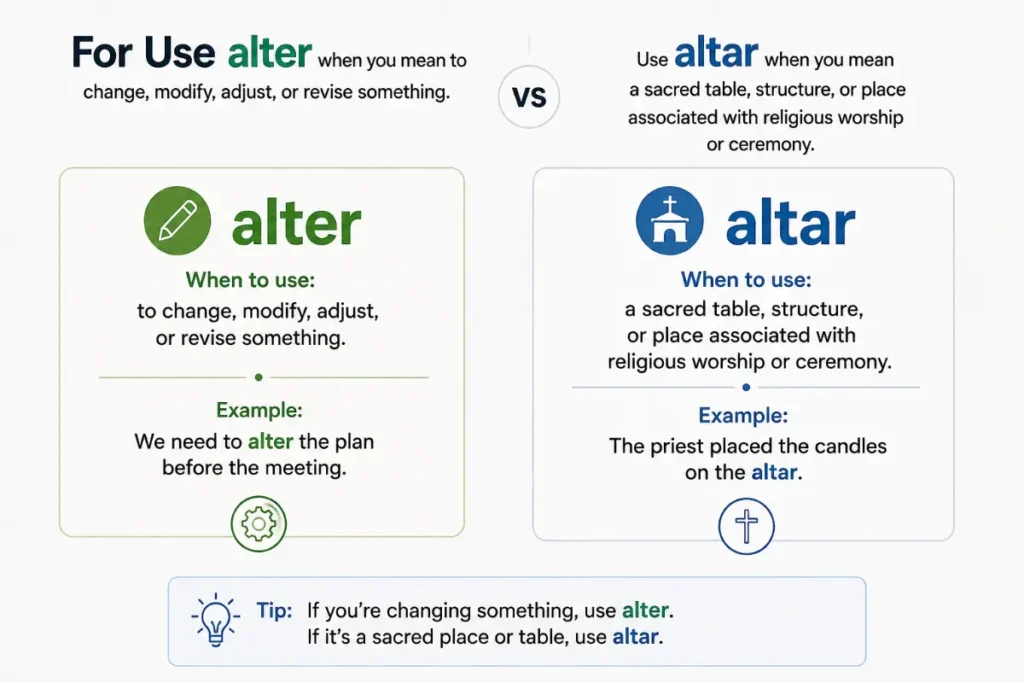
Which Spelling Is Correct
Both spellings are correct words. The mistake happens when the wrong one is used in a particular sentence.
If you mean change, the correct spelling is alter.
If you mean a religious structure, the correct spelling is altar.
This isn’t a matter of American spelling versus British spelling. Both forms are established English words. Regional pronunciation can make the distinction harder to hear but it doesn’t change the spelling rule.
Dictionary evidence supports the distinction directly. Merriam Webster lists alter as a verb meaning to make different or become different. It lists altar as a noun for a raised structure or place used in worship.
That gives you a reliable editing test. Don’t choose the spelling based on sound alone. Identify the meaning first.
Sentence Examples
Examples With Alter
- We had to alter our travel plans because of the storm.
- The tailor can alter the jacket to fit you better.
- The company decided to alter its return policy.
- One small mistake can alter the entire outcome.
- She asked me to alter the wording of the report.
- The architect altered the design after reviewing the safety concerns.
- You can alter the settings from the main menu.
- The experience completely altered his view of the situation.
- The teacher allowed students to alter their project topics.
- Rising costs may alter the company’s plans for expansion.
Notice the pattern. In every example, alter describes some kind of change. The object being changed can be physical, practical, abstract, personal, or organizational.
Examples With Altar
- The couple stood together near the altar.
- Fresh flowers covered the altar.
- The priest walked toward the altar.
- The church has a beautifully carved wooden altar.
- The family placed candles beside the altar.
The word remains a noun in each example. It identifies a structure or place connected with religious practice or ceremony.
Common Mistakes and Misspellings
The most common problem isn’t that people don’t know either word. The problem is that the similar sound creates spelling competition in the writer’s mind.
- Using altar when you mean change
Incorrect: We need to altar the schedule.
Correct: We need to alter the schedule.
The schedule isn’t a religious object. The sentence describes an action involving change.
- Using alter when you mean a religious structure
Incorrect: The couple stood before the alter.
Correct: The couple stood before the altar.
The sentence refers to the structure used during the wedding ceremony.
- Treating the words as interchangeable
They aren’t two spellings of the same word. They are separate words with different histories and meanings.
- Choosing spelling from pronunciation
This is a classic homophone problem. In many American accents, alter and altar sound the same or extremely similar. Listening alone won’t always solve the problem.
- Relying only on spell check
A spell checker may not catch this mistake because both alter and altar are legitimate dictionary words. If you type The couple stood before the alter, the software may recognize alter as correctly spelled even though the meaning is wrong.
This is a useful NLP lesson. The problem involves phonological similarity and orthographic competition. Two words can occupy similar sound patterns while having very different meanings and spellings. Context is what separates them.
The brain also uses lexical context to predict the word that belongs in a sentence. Words such as church, wedding, priest, worship, and ceremony strongly favor altar. Words such as change, plan, design, schedule, modify, and adjust strongly favor alter.
That is why context is your best friend when spelling alone isn’t enough.
Pronunciation Guide
In American English, alter is commonly pronounced approximately as:
/ˈɔːl.tɚ/
Altar is commonly pronounced approximately as:
/ˈɑːl.tɚ/
Actual pronunciation varies by speaker and accent. Cambridge gives the American pronunciation for alter as /ˈɑːl.tɚ/ and the American pronunciation for altar as /ˈɑːl.tɚ/. This means the two words are commonly homophones in American English.
Both words normally have two syllables.
Alter sounds roughly like AWL ter.
Altar sounds roughly like AWL ter in many American accents.
This is exactly why the spelling causes trouble. You may hear a sentence correctly while still being unsure which word the speaker intended.
In British English the pronunciation can show a clearer distinction for some speakers. Cambridge lists more than one British pronunciation pattern for altar while giving alter its own British pronunciation. Regional accents can therefore make the difference more noticeable.
Don’t try to solve the spelling problem by forcing a pronunciation difference that your own accent doesn’t naturally make. Learn the meanings instead.
Etymology and Word Origin
The history of these words explains why they look similar even though their meanings are unrelated in modern English. Alter entered English through Anglo French and Late Latin. Merriam Webster traces it to Middle English alteren meaning to change or transform. The Latin source is alterare, related to Latin alter meaning another or second. The word was established in English by the 14th century.
That origin connects the word with the idea of making something different. The modern meaning still reflects that basic concept. Altar has a very different historical path. Merriam Webster traces it through Middle English and Old English to Latin altare. The Latin term referred to an altar or place associated with sacrifice. Merriam Webster records its first known English use as before the 12th century.
Etymonline also traces altar to Old English and Latin and notes historical connections with sacrificial offerings. It records changes in the word’s form through Old French and Middle English before the Latin spelling became established again.
So the similarity in modern spelling doesn’t mean the words are historically the same. They come from different linguistic paths. That distinction matters because English contains many pairs that look related even though their histories don’t line up neatly. Similar spelling isn’t proof of shared meaning.
Regional Usage
United States
In American English, alter and altar are commonly pronounced the same. Cambridge gives the American pronunciation of both with the same basic phonetic representation. That makes this pair especially easy to confuse in speech. The spelling distinction remains exactly the same.
American writers should rely on meaning and sentence context rather than sound. If the sentence is about modification, use alter. If it is about worship or marriage, use altar.
United Kingdom
British pronunciation can provide a little more distinction for some speakers. Cambridge lists /ˈɒl.tə r/ for alter and gives /ˈɔːl.tə r/ and /ˈɒl.tə r/ for altar. Individual accents still vary, so pronunciation isn’t a universal spelling test.
The written forms and meanings remain the same.
Australia
Australian English follows the same standard spelling distinction. Alter means to change. Altar refers to a religious structure. Local pronunciation can vary by speaker and region, so the safest approach remains semantic context.
Canada
Canadian English also keeps the standard distinction between the two words. Writers use alter for change and altar for the religious noun. Pronunciation can overlap enough to create confusion, especially in speech influenced by North American pronunciation patterns.
No major English variety turns alter into an accepted spelling of altar or the other way around. These are established separate words.
Grammar Rules and Part of Speech
Alter is primarily a verb. It can be transitive when it takes an object.
We need to alter the plan.
She altered the dress.
The editor altered the sentence.
It can also be intransitive when the change happens without a direct object.
Things alter over time.
The situation may alter quickly.
Its common forms include alter, alters, altered, and altering.
Altar is a noun.
It can be singular.
The altar was decorated with flowers.
It can also be plural.
The church contains several altars.
You can use articles and possessive forms with it.
The altar was old.
A new altar was installed.
The church restored its altar.
The word can also appear in established phrases such as at the altar and leave someone at the altar.
Placement of Alter
Because alter is a verb, it normally appears where an action can appear.
You can alter something.
The designer altered the logo.
You can also use it after modal verbs.
We should alter the plan.
They may alter the agreement.
The company could alter its policy.
Placement of Altar
Because altar is a noun, it can function as the subject or object of a sentence.
The altar was decorated.
They approached the altar.
She placed flowers on the altar.
It can also appear after prepositions.
Beside the altar.
Near the altar.
At the altar.
Behind the altar.
Punctuation
Neither word requires special punctuation simply because of its meaning. Use normal punctuation based on the sentence structure.
For example:
We decided to alter the schedule.
The priest stood beside the altar.
The spelling choice is a vocabulary issue rather than a punctuation issue.
Real Life Usage Examples
Daily Talk
- I need to alter my plans for tomorrow.
- The flowers look beautiful near the altar.
In everyday conversation, alter often appears when someone talks about plans, clothing, schedules, or arrangements. Altar usually appears in conversations about religion, weddings, or ceremonies.
- Could you alter the document before sending the final version.
- Please confirm the flowers have been delivered to the altar.
Professional email often uses alter when discussing revisions. Altar appears in emails connected with churches, weddings, ceremonies, or event planning.
Academic Writing
- Environmental conditions can alter the behavior of a species.
- The study describes the historical role of the altar in ancient religious practice.
Academic writing uses alter frequently because researchers discuss changes in systems, behavior, conditions, and results. Altar is more specialized and usually appears in history, religion, archaeology, anthropology, or related subjects.
News
- New regulations could alter the way businesses operate.
- The historic altar was restored after years of damage.
News writing uses alter when a development may change circumstances. Altar appears in reports about religious buildings, cultural heritage, weddings, and historical discoveries.
Literature
- A single decision can alter the course of a life.
- The character knelt before the altar in silence.
Literary writing uses both words effectively because each can carry strong imagery. Alter can suggest transformation. Altar can suggest faith, sacrifice, devotion, ceremony, or commitment.
Related and Confused Terms
Several words and expressions can appear near alter or altar in natural English.
- Alteration
An alteration is a change made to something. It is the noun related to alter.
- Altered
Altered is the past form of alter and can also work as an adjective.
- Alternative
Alternative means another option or choice. It shares some letters with alter but has a different meaning.
- Alternate
Alternate can function as a verb, adjective, or noun depending on context. It often involves switching between two things or providing another choice.
- Altar cloth
An altar cloth is a cloth used to cover or decorate an altar.
- Altar call
An altar call is a religious invitation used in some Christian traditions.
- At the altar
This expression commonly refers to the location or moment associated with a wedding ceremony.
- Leave someone at the altar
This phrase means to abandon someone immediately before a planned marriage ceremony.
These related expressions reinforce an important point. Altar belongs to a family of religious and ceremonial vocabulary. Alter belongs to a family of words connected with change and modification.
Expert Editor Insight
A senior editor would not try to distinguish these words by sound alone. In American English they can be homophones, so the editor first checks the sentence meaning. A useful editing trick is to replace alter with change. If the sentence still makes sense, alter is probably correct. For altar, look for a religious or ceremonial context. Dictionary tools can confirm spelling but context still matters because both words are legitimate English entries. Cambridge and Merriam Webster both make the grammatical and semantic distinction clear.
Expert Tip
When you’re proofreading, search for both words together if you’re working on a long document. A normal spell checker may not catch the error because alter and altar are both correctly spelled words. The real mistake is semantic rather than orthographic.
A Simple Memory Trick
Think of alter as connected with alteration.
Both words contain the letters alter.
Alter means to make a change.
Altar is the word connected with worship.
You can also use a context test.
If something changes, choose alter.
If something is used for worship, choose altar.
Consider these two sentences.
I need to alter the plan.
The couple stood at the altar.
The first sentence involves change. The second involves a wedding ceremony. Once you connect each spelling with its core idea, the distinction becomes much easier.
Why This Confusion Happens
The main reason is sound.
When two words have the same or nearly the same pronunciation, your brain doesn’t receive enough information from speech to identify the spelling. It has to use context.
This happens with many English word pairs.
Words such as right and write sound alike but have different meanings. Their spellings must be learned separately.
Alter and altar create a similar problem. The difference is especially strong in American English because the two words are commonly pronounced alike.
There is also a visual reason for confusion. The words share four letters in the same basic sequence and differ mainly in the middle vowel.
That small visual difference is easy to overlook during fast typing.
Autocorrect can make the problem harder to notice. Since both words are valid dictionary entries, software may accept the wrong choice without raising a spelling warning.
This is why good proofreading involves more than checking red underlines. You also need to check meaning.
How to Choose the Right Word Quickly
Use this three step method whenever you hesitate.
- Identify the meaning.
Ask yourself what the sentence is talking about. Is something being changed. Or is the sentence describing a religious structure.
- Test the replacement.
Replace the word with change. If the sentence works, use alter.
If the sentence refers to a church structure, wedding location, worship site, or ceremonial table, use altar.
For example:
We need to change the design.
We need to alter the design.
Both sentences work.
Now consider:
The couple stood beside the religious table.
The couple stood beside the altar.
Again, the intended word becomes obvious.
Conclusion
Alter and altar are both correct English words, but they belong in completely different contexts. Alter is a verb that means to change or modify something. Altar is a noun that refers to a religious structure or table used in worship and ceremony. Their similar pronunciation makes the confusion understandable, especially in American English.
The easiest way to remember the difference is to connect alter with alteration and change. Connect altar with worship, ceremony, and religious practice. When proofreading, don’t rely only on spell check. Ask what the word means in the sentence. That quick meaning check will usually give you the right spelling.
Frequently Asked Questions
Is Alter a Real Word?
Yes. Alter is a standard English verb. It means to change something or make it different. Dictionaries such as Cambridge and Merriam Webster list it as an established verb with common uses involving plans, clothing, documents, policies, appearances, and circumstances. It has been part of English since the Middle English period.
Is Altar a Real Word?
Yes. Altar is a standard English noun. It refers to a structure or table used for religious ceremonies and worship. It also appears in expressions connected with marriage and can have figurative meanings involving sacrifice or devotion. The word has been used in English since before the 12th century.
Alter or Altar Which Is Correct?
Both are correct, but they aren’t interchangeable. Use alter when you mean change or modify. Use altar when you mean a religious structure or table. For example, You can alter a plan, but you can stand at an altar during a wedding. The correct spelling depends on the meaning of the sentence.
How Do You Pronounce Alter and Altar?
In American English, alter and altar are commonly pronounced alike. Cambridge gives the American pronunciation of alter as /ˈɑːl.tɚ/ and gives the same basic pronunciation for altar. Both normally have two syllables. Some British accents can make the two words sound more distinct.
Can Alter Be Used in Formal Writing?
Yes. Alter is completely appropriate in formal writing. It commonly appears in academic, professional, legal, scientific, technical, and general nonfiction contexts. Words such as modify, adjust, revise, and change can sometimes replace it, but alter is neither informal nor incorrect. Its precise meaning makes it useful when describing a change to an existing thing.
What Is a Synonym for Alter?
Common synonyms include change, modify, adjust, amend, revise, adapt, transform, and vary. The best choice depends on the context. Alter often suggests making something different while retaining its basic identity. Merriam Webster and Cambridge both connect alter with related ideas such as change, modify, adjust, and transform.
Why Do People Confuse Alter and Altar?
People confuse them mainly because they sound the same or very similar. The spelling difference is only one vowel, and both words are valid English words. Spell checkers may not catch the mistake because neither spelling is inherently wrong. The surrounding meaning is what determines the correct choice.
Is Altar Used Only in Religious Writing?
No. Altar is strongly associated with religion and worship, but it also appears in wedding expressions and figurative language. For example, someone can be left at the altar in a marriage context. Writers can also use altar figuratively to describe something treated as extremely important or sacrificed for another goal.
