
If you have ever typed analyzing or analysing and stopped to wonder which one looks right, you are not alone. The two spellings differ by only one letter, yet that small difference can matter in professional and academic writing.
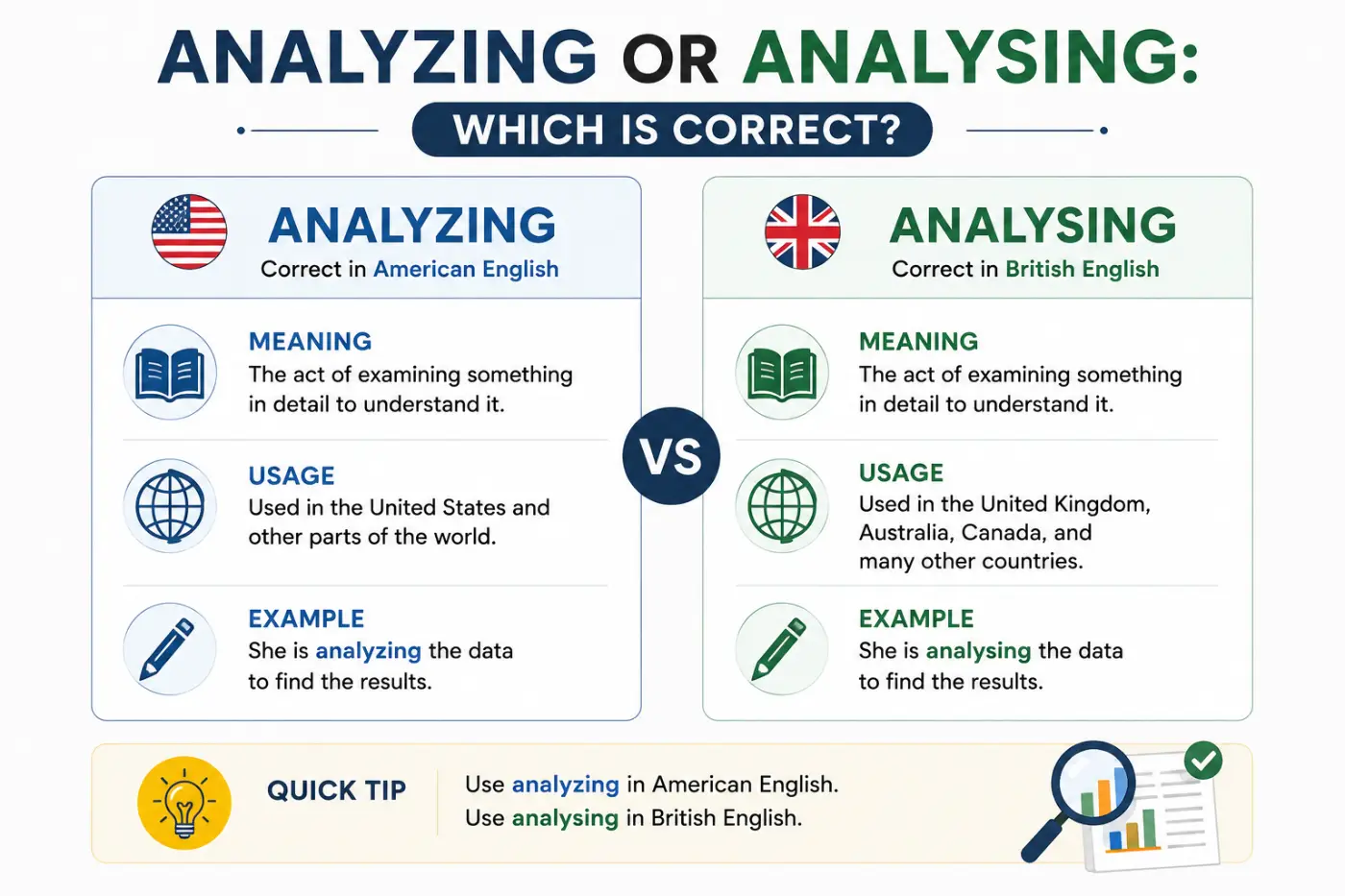
The direct answer is simple. Analyzing is the standard American English spelling. Analysing is the standard British English spelling and is also common in Australian, Canadian, and other varieties of English that follow British spelling conventions.
The confusion comes from the different spelling systems used for certain words ending in ize and ise. The verb analyze follows this pattern. American English normally uses analyze and analyzing, while British English commonly uses analyse and analysing.
In this guide, you will learn the exact difference, the meaning and grammar of the word, pronunciation, regional preferences, common mistakes, sentence examples, etymology, and practical advice for choosing the right form. You will also see how professional editors handle the spelling in academic, business, and everyday writing.
Quick Definition
Analyzing and analysing have the same meaning. Both are the present participle and gerund forms of the verb analyze or analyse. The difference is regional spelling. American English normally uses analyzing, while British English normally uses analysing. Neither spelling changes the basic meaning or pronunciation.
Quick Answer
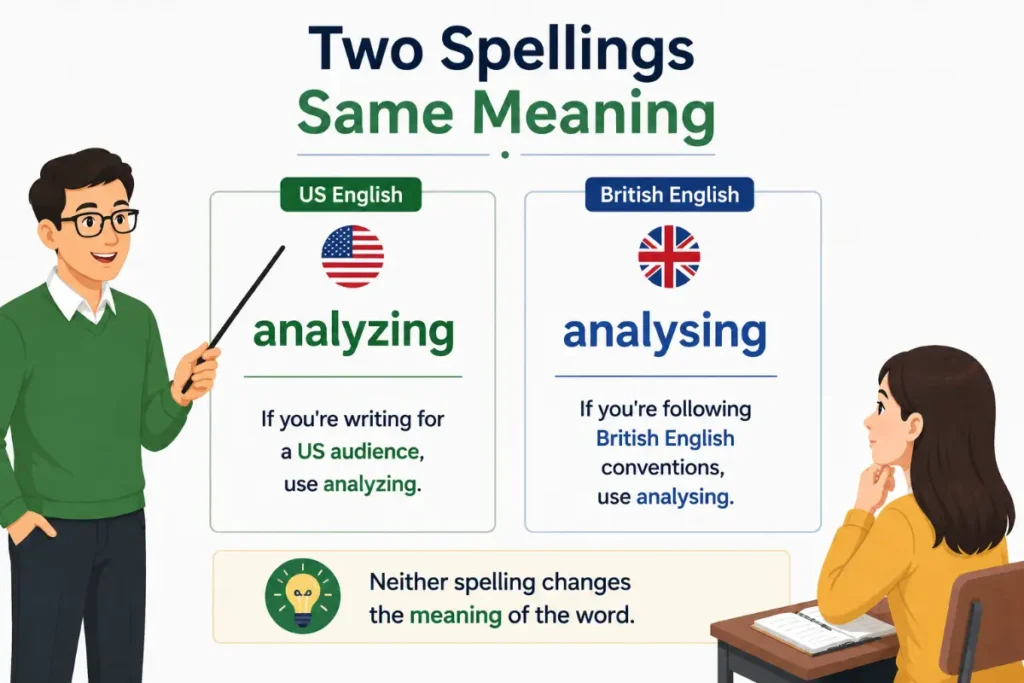
Analyzing is correct in American English. Analysing is correct in British English and is also widely used in other English varieties influenced by British spelling.
The meaning stays the same. The choice depends mainly on the English style you are following.
Comparison Table For Analyzing Or Analysing
| Correct Form | Meaning | Part of Speech | Origin | Usage Frequency | Formality | Common Contexts | Example |
|---|---|---|---|---|---|---|---|
| Analyzing | Examining something carefully to understand it | Present participle or gerund | From analyze and ultimately Greek analysis | Very common in American English | Neutral and formal | US writing, business, science, education | She is analyzing the results. |
| Analysing | Examining something carefully to understand it | Present participle or gerund | From analyse and ultimately Greek analysis | Very common in British English | Neutral and formal | UK writing, business, science, education | She is analysing the results. |
Meaning And Definition
Meaning Of Finaly
Finaly is not the standard spelling of a normal English word. In ordinary English writing, it is usually a misspelling of finally.
People often type finaly because the word sounds natural when spoken and because the repeated consonant in finally can be easy to overlook while typing. It may appear in informal online writing, user names, brand names, or other creative contexts, but those special uses do not make it the standard spelling.
The same basic principle applies to analyzing and analysing. A spelling can look almost identical to another form while still belonging to a different regional convention.
Meaning Of Finally
Finally is an adverb with several closely related uses.
First, it can show that something happens after a long wait or after a series of events.
She finally arrived at noon.
Second, it can introduce the last point in a sequence.
Finally, check your spelling before submitting the report.
Third, it can describe a final result after a process has reached its end.
The team finally reached an agreement.
The word comes from the same broader family as final. Its meaning centers on the idea of something being last, completed, or reached at the end of a process.
For analyzing, the meaning is different because the word comes from the verb analyze. To analyze something means to examine it carefully by separating information into parts and studying those parts.
For example, a scientist might analyze data. A student might analyze a poem. A business owner might analyze customer behavior.
Key Differences Explained
Spelling
The most obvious difference between analyzing and analysing is the letter combination used before the final ing.
American English generally changes analyze to analyzing.
British English generally changes analyse to analysing.
The difference comes from the spelling of the base verb.
Grammar Role
Both forms function as present participles and gerunds.
In She is analyzing the report, analyzing forms part of the progressive verb phrase.
In Analyzing the report took two hours, analyzing functions as a gerund phrase beginning the sentence.
Meaning
There is no difference in meaning between analyzing and analysing.
Both describe the process of examining something carefully.
Tone
Neither spelling is more intelligent, more formal, or more correct in every situation.
The appropriate spelling depends on the variety of English being used.
Context
A US academic paper normally uses analyzing.
A British academic paper normally uses analysing.
The strongest professional approach is to choose one spelling system and use it consistently throughout the document.
Which Spelling Is Correct
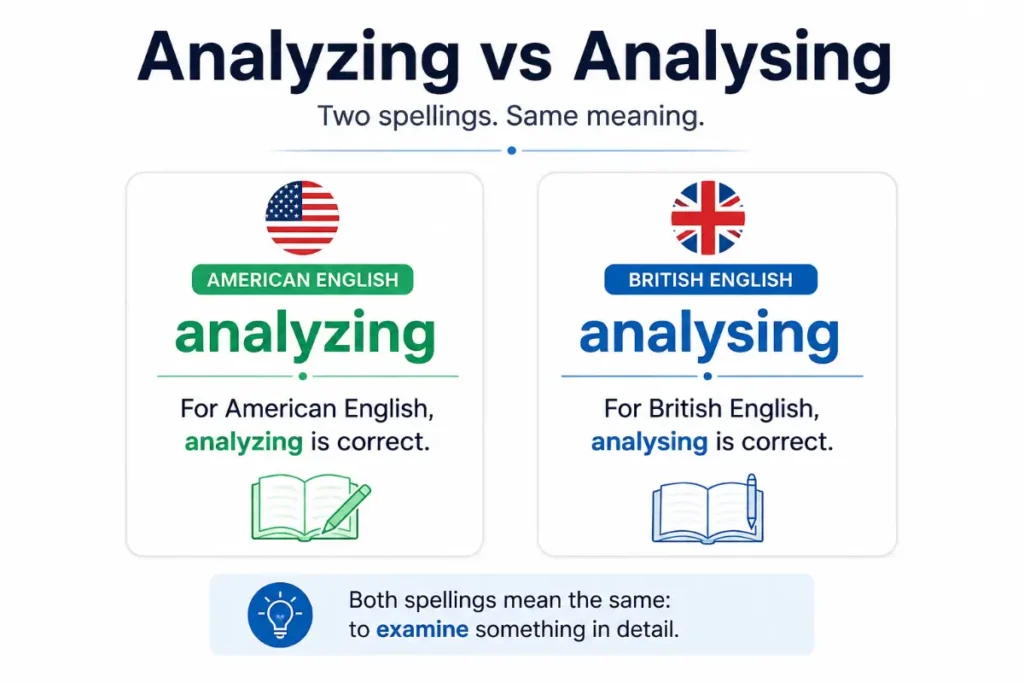
Both analyzing and analysing are correct spellings in their respective varieties of English.
If you are writing for an American audience, choose analyzing.
If you are writing for a British audience, choose analysing.
Major dictionaries reflect this regional distinction. American dictionaries such as Merriam Webster use analyze as the standard American form. British dictionaries such as the Oxford English Dictionary and Cambridge Dictionary recognize analyse as a standard British form.
This is a useful example of why spelling cannot always be judged by a single universal rule. English has several established regional standards.
An editor should first identify the intended variety of English. After that, the spelling becomes much easier to determine.
Analyzing Or Analysing In American English
American English normally uses analyzing.
The base verb is analyze. Its related forms include analyzed, analyzes, analyzer, and analyzing.
Here are a few natural examples.
- The researcher is analyzing the survey results.
- We are analyzing customer feedback before making a decision.
- She spent the afternoon analyzing the financial report.
- The software is analyzing the data automatically.
The same American spelling pattern appears in many related words.
American English uses organize rather than organise.
It uses recognize rather than recognise.
It uses realize rather than realise.
It uses analyze rather than analyse.
This does not mean every word with an ize or ise ending follows exactly the same historical pattern. English spelling contains many exceptions and historical layers. Still, this pattern is useful for understanding why analyzing is standard in American writing.
Analysing In British English
British English commonly uses analysing.
The base verb is analyse. Its related forms include analysed, analyses, and analysing.
For example:
- The researcher is analysing the survey results.
- The students are analysing the poem.
- The company is analysing its latest sales figures.
- The journalist spent hours analysing the evidence.
British spelling commonly preserves ise in words such as analyse, organise, recognise, and realise.
Some British publishers and style systems also accept or prefer ize forms in certain words. That detail can matter in specialist publishing, but analyse and analysing remain standard and widely recognized British forms.
The practical rule is simple. Follow the spelling guide used by your publication, school, employer, university, or target audience.
Sentence Examples
The following examples use the American form analyzing.
- The doctor is analyzing the test results before making a recommendation.
- We are analyzing the survey to understand what customers want.
- The student is analyzing the poem for her literature class.
- The team spent several hours analyzing the sales data.
- I am analyzing the report before the meeting.
- Researchers are analyzing samples collected from the site.
- The company is analyzing its advertising performance.
- He is analyzing the problem from several different angles.
- The program keeps analyzing new information as it arrives.
- She enjoys analyzing complex problems and finding practical solutions.
Now compare those sentences with the British spelling.
- The doctor is analysing the test results before making a recommendation.
- We are analysing the survey to understand what customers want.
- The student is analysing the poem for her literature class.
- The team spent several hours analysing the sales data.
- I am analysing the report before the meeting.
The meaning does not change. Only the regional spelling changes.
Common Misspelling Examples
The form finaly is normally a misspelling of finally. It is not an alternative spelling of analyzing or analysing.
Here are examples of how that error can appear.
- Incorrect: She finaly understood the instructions. Correct: She finally understood the instructions.
- Incorrect: We finaly reached the station. Correct: We finally reached the station.
- Incorrect: He finaly finished the assignment. Correct: He finally finished the assignment.
- Incorrect: The project is finaly complete. Correct: The project is finally complete.
- Incorrect: They finaly agreed on a price. Correct: They finally agreed on a price.
These examples also show why proofreading matters. A missing letter can create a nonstandard spelling even when the intended word is obvious from context.
Common Mistakes And Misspellings
English learners and native speakers can both make spelling mistakes with words that contain repeated letters or unfamiliar letter patterns.
- Analyzing versus analysing.
This is usually not a mistake at all. It is a regional spelling difference. Use analyzing for American English and analysing for British English.
- Analyze versus analyse.
The same regional distinction applies to the base verb. American English generally uses analyze. British English commonly uses analyse.
- Analyzing versus analyzeing.
This mistake happens when writers add ing without removing the final e. The correct form is analyzing in American English and analysing in British English.
- Analysing versus analysis.
These words belong to the same family but have different grammatical roles. Analysis is a noun. Analysing is the process of examining something.
- Finaly versus finally.
People often omit one letter because the spelling does not feel as visually obvious as the pronunciation. Standard English uses finally.
From an NLP perspective, spelling mistakes like these can involve phonological processing, visual word recognition, typing patterns, and morphological confusion. When people write quickly, they may rely on the sound of a word rather than its complete written form.
That is why proofreading software can catch errors that look almost invisible to the writer.
Pronunciation Guide
The pronunciation of analyzing and analysing is essentially the same.
The common American pronunciation can be represented in IPA as:
/ˈænəˌlaɪzɪŋ/
A simple syllable breakdown is:
an • a • lyz • ing
An audio style approximation is:
AN uh ly zing
The stress falls strongly on the first syllable of analyzing.
The pronunciation does not normally change because of the spelling difference between American and British English.
The key sound in the middle comes from the z sound in analyzing and the corresponding sound in analysing.
A common mistake is to pronounce every written letter separately. English does not work that way. The spelling helps represent the word, but the spoken form follows English sound patterns.
For learners, listening to native speakers can help more than trying to pronounce each letter individually.
Etymology And Word Origin
The history of analyze helps explain the spelling difference.
The word ultimately traces back to Greek analusis, which carries the sense of breaking something apart or loosening it into its components.
The Greek term entered Latin and later influenced French and English vocabulary. English adopted analyze and related forms through this broader European history.
The word has long been associated with the idea of separating something into parts so those parts can be examined and understood.
The noun analysis comes from the same word family.
From analysis we get analyze or analyse as the verb.
From the verb we get analyzing or analysing as the form describing an ongoing process.
English spelling developed differently across regions. American English eventually favored many ize spellings in words influenced by Greek and French forms. British English often retained ise spellings.
That historical development is one reason the two forms exist today.

Regional Usage In The US
In the United States, analyzing is the expected spelling.
You will see it in newspapers, university writing, business reports, technical documentation, and general communication.
If your target readers are American, analyzing is the safest choice.
Consistency matters more than trying to make the spelling look formal. A US document that switches repeatedly between analyzing and analysing can look poorly edited.
Regional Usage In The UK
In the United Kingdom, analysing is widely used.
British schools, universities, newspapers, publishers, and professional organizations commonly use the ise spelling.
You may still encounter analyzing in British contexts because English spelling conventions vary among publishers and style guides. However, analysing is a familiar and standard British form.
Regional Usage In Australia
Australian English generally follows British spelling conventions for this word.
As a result, analysing is commonly preferred.
Australian academic and professional writing often uses the same spelling pattern found in British English.
Regional Usage In Canada
Canadian English has influences from both American and British English.
You can therefore encounter both spelling patterns in Canadian writing. However, the preferred choice can depend on the institution, publisher, style guide, and broader editorial convention.
If you are writing for a Canadian organization, check its house style and follow it consistently.
Grammar Rules And Part Of Speech
Analyzing and analysing are present participles and gerunds of the verbs analyze and analyse.
As a present participle, the word can appear with a form of be to create a progressive verb phrase.
For example:
She is analyzing the report.
The researchers are analyzing the results.
As a gerund, the word can function like a noun.
Analyzing the data requires patience.
Carefully analyzing the evidence helped the team reach a conclusion.
The word can also appear in participial phrases.
Analyzing the results carefully, the researcher noticed an unusual pattern.
Placement matters because the opening participial phrase should clearly relate to the subject that follows it.
Punctuation also depends on sentence structure. When an introductory participial phrase comes before the main clause, a comma commonly follows the phrase.
For example:
Analyzing the data carefully, she discovered an error.
The comma separates the introductory phrase from the main clause.
Real Life Usage Examples
Daily Talk
People use analyzing in everyday conversations when they talk about examining a situation or thinking carefully about information.
- I am analyzing everything you said before I make a decision.
- He spends too much time analyzing every little detail.
British speakers can use analysing in exactly the same situations.
Professional email often uses the word when discussing reports, data, problems, or decisions.
- We are analyzing the figures and will share the results tomorrow.
- I am analyzing the latest report before our meeting.
In British English, the same sentences can use analysing.
Academic Writing
Academic writing frequently uses this word because researchers and students regularly examine evidence.
- The study focuses on analyzing patterns in student performance.
- Researchers are analyzing the data collected during the experiment.
British academic writing commonly uses analysing instead.
News Writing
Journalists use the word when describing experts examining political, economic, social, or scientific developments.
- Analysts are analyzing the latest market figures.
- Experts are analyzing the causes of the sudden change.
The British form follows the same meaning and grammar.
Literature
Literary analysis often requires close examination of language, themes, characters, and structure.
- The students are analyzing the poem’s central theme.
- She is analyzing how the author develops the main character.
Again, British English can replace analyzing with analysing without changing the meaning.
Expert Editor Insight
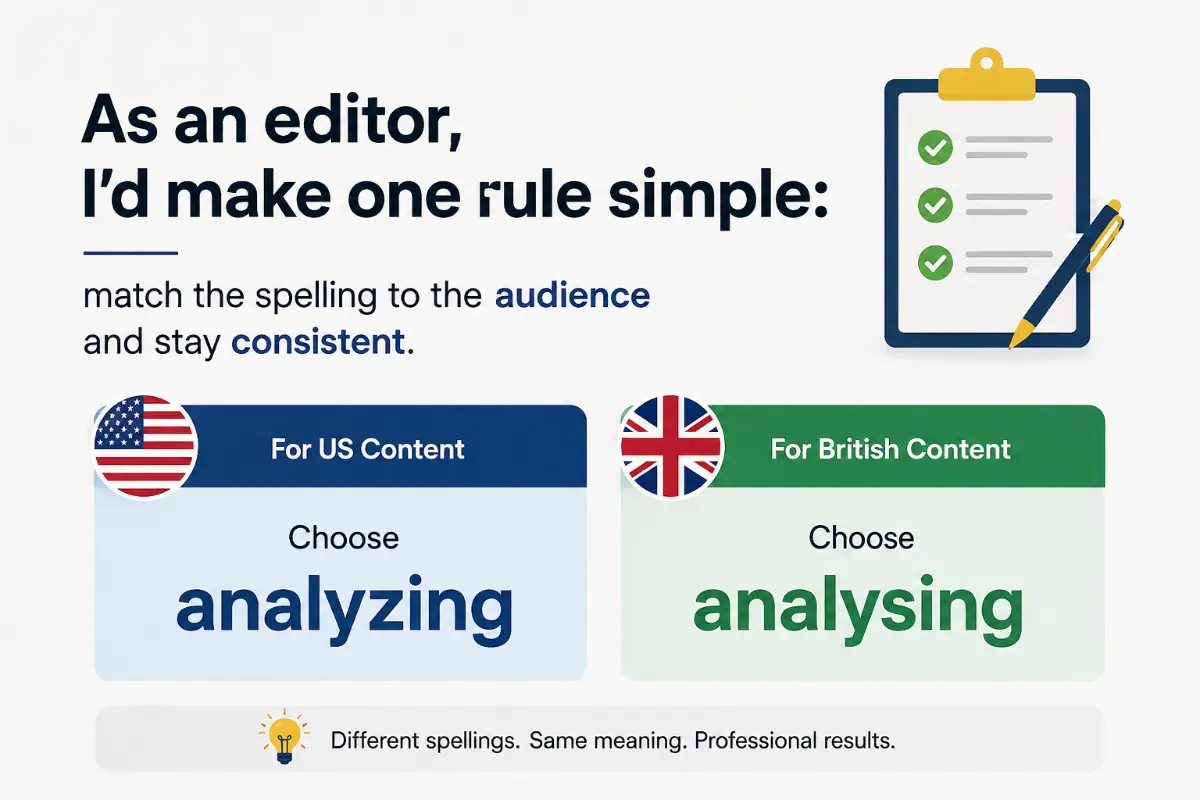
A senior editor usually makes this decision by identifying the intended variety of English before correcting the spelling. If the document follows American English, I would keep analyzing. If it follows British English, I would normally use analysing. Grammar checkers can flag one form based on their selected language setting, but that does not automatically mean the other form is wrong. A spelling checker configured for US English may flag analysing, while a British English setting may prefer it. The tool is following a language convention rather than making a universal judgment about English.
Expert Tip
Don’t correct regional spelling in isolation. First identify the document’s language style.
If a US report uses organize, recognize, analyze, and traveling, changing one word to a British form can create inconsistency. The same principle works in reverse for British writing.
Consistency is one of the simplest ways to make professional writing look carefully edited.
Conclusion
Analyzing and analysing are both correct. The difference comes from regional English spelling rather than meaning or grammar. American English normally uses analyzing, while British English commonly uses analysing. The pronunciation and underlying meaning remain the same.
If you are writing for a US audience, use analyzing. If your document follows British English conventions, use analysing. The most useful editing habit is to stay consistent with one spelling system from beginning to end. Don’t treat one form as more correct in every situation. Both belong to standard English. Choose the form that matches your audience and your chosen style guide.
Frequently Asked Questions
Is Analyzing Or Analysing Correct?
Both are correct. Analyzing is the standard American English spelling. Analysing is the common British English spelling. The meaning and pronunciation are the same.
Should I Use Analyzing In American English?
Yes. Use analyzing when writing for an American audience. It follows the American spelling of the verb analyze.
Should I Use Analysing In British English?
Yes. Analysing is widely used in British English. It comes from the British spelling analyse.
Is Analyzing More Correct Than Analysing?
No. Neither form is universally more correct. The correct choice depends on the English variety you are following. Use analyzing for American English and analysing for British English.
Do Analyzing And Analysing Have The Same Meaning?
Yes. Both words mean examining something carefully to understand it or learn more about it. The only difference is the regional spelling.
How Do You Pronounce Analyzing And Analysing?
Both forms are generally pronounced the same way. The pronunciation is approximately AN uh ly zing. The spelling difference does not normally create a pronunciation difference.
Which Spelling Should I Use In Academic Writing?
Follow the style guide and regional English used by your institution. American academic writing normally uses analyzing. British academic writing commonly uses analysing.
Why Are There Two Spellings Of Analyzing?
English developed different spelling conventions across regions. American English generally favors analyze and analyzing, while British English commonly uses analyse and analysing. Both forms became established standards.
