
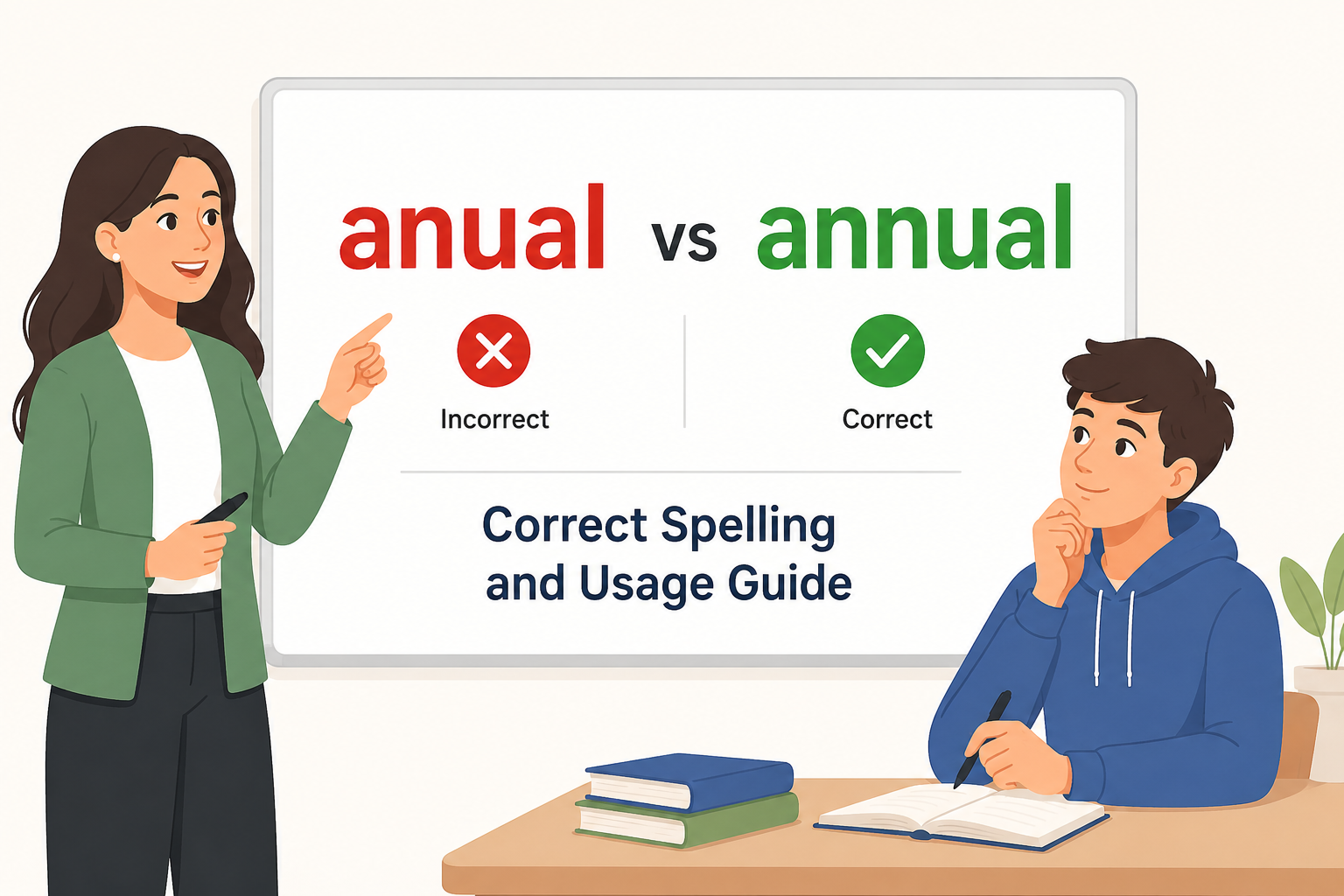
Some English spelling mistakes happen because a word sounds simpler than it looks. Anual or annual is a good example. Many writers remember the sound of the word but forget that the correct spelling contains two n letters.
The correct spelling is annual. Anual is not the standard English spelling. If you’ve written anual in an email essay report or application you simply need to add the second n.
The confusion makes sense because we pronounce the word naturally and quickly. When people hear annual they may mentally divide it into sounds that don’t make the double consonant obvious. Typing quickly can make the same mistake even easier.
Quick Definition
Annual is the correct English word. It means something that happens once every year or relates to a year. It can function as an adjective and occasionally as a noun in specific contexts. Anual is a misspelling and isn’t accepted as the standard form in English.
Quick Answer
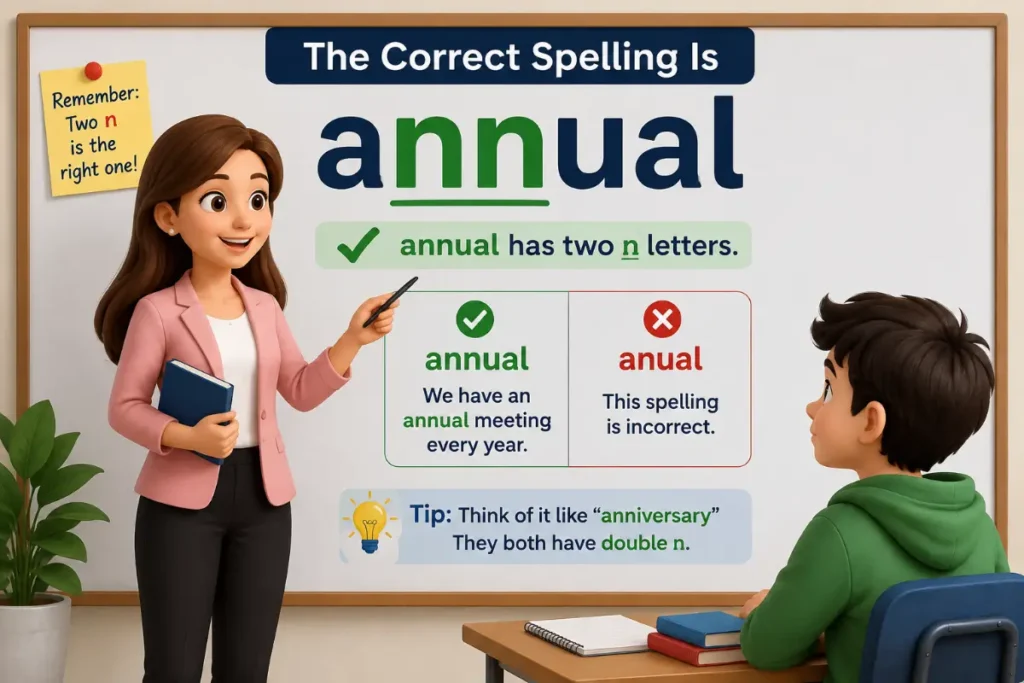
The correct spelling is annual with two n letters.
Anual is a common spelling mistake. Annual usually describes something that happens once a year or something connected with a year. For example, an annual meeting happens once every year.
Comparison Table for anual or annual
| Correct Form | Meaning | Part of Speech | Origin | Usage Frequency | Formality | Common Contexts | Example |
|---|---|---|---|---|---|---|---|
| Annual | Happening once each year or relating to a year | Adjective and noun | Latin through Old French and Middle English | Very common | Neutral to formal | Reports, meetings, events, subscriptions, finance | We attended the annual conference. |
| Anual | No standard English meaning | Not a standard English word | Spelling error based on annual | Uncommon as a correct form | Not applicable | Typing and spelling mistakes | Anual is a misspelling of annual. |
Meaning and Definition
Meaning of anual
Anual isn’t the standard English spelling of a recognized common word. In ordinary English writing it should be treated as a misspelling of annual.
When someone types anual they usually intend to write annual. The mistake doesn’t normally create a different meaning. It simply removes one of the two n letters from the correct spelling.
You may occasionally encounter Anual as part of a name or a non English expression. A proper name or a word from another language can follow different spelling conventions. That doesn’t make anual an accepted alternative spelling of annual in standard English.
For normal American English writing the safe choice is simple. Write annual.
Meaning of annual
Annual means happening once every year or relating to a period of one year.
Consider these examples.
An annual meeting happens once each year.
An annual subscription covers a yearly period.
The word can describe events schedules payments reports traditions measurements and many other things connected with a year.
Annual can also appear as a noun in some contexts. In gardening annual refers to a plant that completes its life cycle within one growing season or year. For example a gardener might say that marigolds are annuals.
The everyday meaning remains strongly connected to the idea of a year.
Key Differences Explained
- Spelling
Annual contains two n letters. Anual contains only one. The second spelling isn’t standard English.
- Grammar role
Annual commonly works as an adjective. It describes a noun connected with a year or something that occurs every year. In gardening contexts annual can also function as a noun.
- Meaning
Annual has a clear established meaning. Anual doesn’t carry a separate standard meaning in English. Most occurrences of anual are simply spelling errors.
- Tone
Annual works naturally in casual professional academic and formal writing. You can use it in a conversation or in a business report without changing the word.
- Context
You’ll see annual in phrases such as annual income annual leave annual meeting annual review annual fee annual event and annual report. The word appears across many areas of English.
Which Spelling Is Correct?
Annual is the correct spelling in standard English.
The reason comes down to the structure and history of the word. Annual entered English through French from the Latin word annuus which means yearly or lasting a year. English retained the double n in annual.
Major English dictionaries such as Merriam Webster and the Oxford English Dictionary list annual as the standard form. They don’t treat anual as a standard alternative spelling.
That dictionary evidence matters because spelling isn’t based only on pronunciation. English spelling often preserves letters that aren’t strongly noticeable when we speak.
A useful editorial rule is to trust the established dictionary form rather than spelling a word only from how it sounds.
If you’re writing a report application email school assignment or professional document use annual.
Sentence Examples
Here are natural examples showing how native speakers use annual.
- Our company holds an annual meeting every spring.
- The annual report includes the company’s financial results.
- She receives an annual salary of $60,000.
- The school hosts an annual sports competition.
- We renewed our annual membership last week.
- The family has an annual tradition of visiting the coast.
- His annual checkup is scheduled for next month.
- The organization publishes an annual review of its activities.
- The museum’s annual exhibition attracts thousands of visitors.
- Employees receive their annual benefits statement in December.
The incorrect spelling can appear in sentences like these.
- We attended the anual conference.
- The company released its anual report.
- She paid the anual membership fee.
- The school announced its anual event.
- His anual salary was listed on the form.
In each case the meaning is understandable. The spelling is still incorrect. Replace anual with annual.
Common Mistakes and Misspellings
English spelling mistakes often come from sound based assumptions. Annual is especially easy to mistype because the second n doesn’t stand out when the word is spoken quickly.
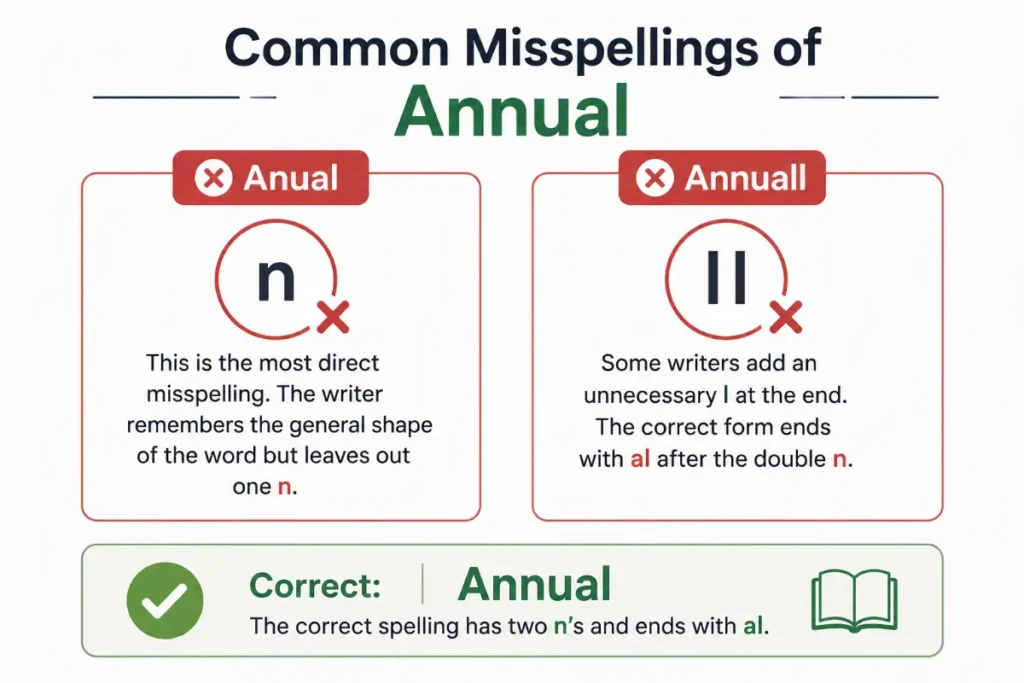
- Anual
This is the most direct misspelling. The writer remembers the general shape of the word but leaves out one n.
- Annuall
Some writers add an unnecessary l at the end. The correct form ends with al after the double n.
- Anualy
This mistake combines the missing n with confusion about the adverb form. The standard adverb is annually.
- Annualy
This version keeps both n letters but leaves out one l. The correct spelling is annually.
- Anually
This form adds the adverb ending but still loses one n. It should be annually.
There is an interesting NLP angle behind these mistakes. People don’t always store words as a complete sequence of letters. When you type from memory your brain may rely on sound patterns visual patterns and familiar letter sequences. Since the second n in annual isn’t strongly emphasized in pronunciation it can disappear during fast typing.
That doesn’t mean the spelling is unpredictable. It means your brain is taking a shortcut.
Pronunciation Guide
The standard pronunciation of annual is:
IPA: /ˈænjuəl/
In some American English speech the pronunciation can sound slightly different depending on speed and accent. The word generally has three syllables.
Syllable breakdown: an nu al.
An easy audio style approximation is:
AN yoo uhl
The stress falls on the first syllable.
The beginning sounds like the word an. The middle has a sound similar to you. The final part sounds like a soft uhl.
A common pronunciation mistake happens when speakers try to pronounce every written letter separately. English doesn’t work that way. The double n affects the spelling but doesn’t mean you should force an exaggerated double sound.
The pronunciation therefore doesn’t give you a reliable way to remember the spelling. That’s one reason people can know the word perfectly well in conversation and still type it incorrectly.
Etymology and Word Origin
Annual has a long history that reaches back to Latin.
The word comes from Latin annuus which means yearly. Latin annus means year. The same root appears in several English words connected with years and yearly periods.
The word passed into English through French. Old French forms related to annual eventually influenced the English form used in Middle English.
This history also explains the double n.
The Latin root contains the sequence nn. English ultimately preserved that structure in annual. Modern speakers don’t need to know Latin to spell the word correctly but understanding the origin can make the spelling easier to remember.
Think of the word as having a built in reminder.
ann + ual
The first part connects to the Latin idea of a year. The double n isn’t random.
Several related words share the same historical family. Annually means every year. Anniversary refers to the yearly recurrence of an event or date. These words all connect to the Latin root associated with a year.
Etymology can therefore act like a memory hook. Instead of seeing the second n as an annoying extra letter you can see it as part of the word’s history.
Regional Usage in the US
American English uses annual as the standard spelling.
You’ll find it in everyday phrases such as annual income annual leave annual meeting annual fee and annual report.
American dictionaries and professional publications use annual consistently. There isn’t a standard American spelling called anual.
The word is equally comfortable in casual and formal contexts. Someone might say their annual vacation is coming up. A financial analyst might discuss annual revenue. Both uses are completely natural.
Regional Usage in the UK
British English also uses annual.
The spelling doesn’t change between American and British English. Some English words have regional spelling differences such as color and colour. Annual isn’t one of them.
British newspapers universities businesses and government publications use annual in the same basic ways as American writers.
So you don’t need to choose between annual and another regional spelling. Annual works across standard British English.
Regional Usage in Australia
Australian English uses annual as well.
The word appears frequently in education business government finance sports and general communication.
Australian spelling has several differences from American spelling but annual remains unchanged.
If you’re writing for an Australian audience you should still use annual rather than anual.
Regional Usage in Canada
Canadian English also uses annual.
Canadian English combines influences from British and American English yet the spelling of this word remains stable.
You can safely use annual in Canadian academic business government and everyday writing.
The consistency across these major varieties of English makes this an easy spelling choice. There isn’t a legitimate regional version spelled anual.
Grammar Rules and Part of Speech
Annual is primarily an adjective.
An adjective describes a noun. Annual commonly comes before the noun it modifies.
For example:
annual meeting
annual payment
In each phrase annual tells us that the noun relates to a year or happens once each year.
You can also use annual after certain linking verbs.
For example:
The payment is annual.
Here annual describes the nature of the payment.
Annual can also function as a noun in a specialized context. In gardening an annual is a plant that completes its life cycle within one growing season.
For example:
The garden contains several colorful annuals.
The plural form in this gardening sense is annuals.
Annual Versus Annually
We have an annual meeting.
Annually is an adverb.
We meet annually.
A simple test helps.
If the word describes a noun use annual.
If it describes an action that happens every year use annually.
For example:
The company publishes an annual report.
The company publishes the report annually.
Both sentences express a yearly idea but the grammar changes.
Punctuation With Annual
Annual doesn’t require special punctuation.
You don’t need a comma simply because annual appears in a sentence.
For example:
The annual meeting begins at nine.
When annual appears in a phrase before a noun it normally sits directly before that noun.
The phrase annual report doesn’t need punctuation between the two words.
This is another reason the word is useful. Its grammar is straightforward once you understand its role.
Real Life Usage Examples
Daily Talk
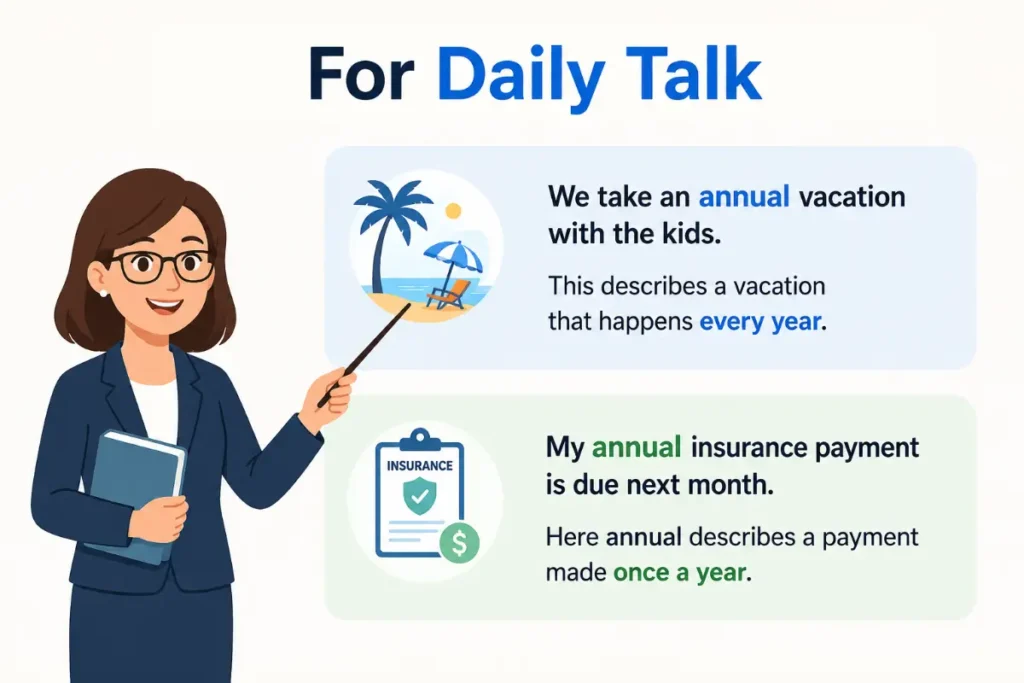
- We take an annual vacation with the kids.
This describes a vacation that happens every year.
- My annual insurance payment is due next month.
Here annual describes a payment made once a year.
- Please review the attached annual report before Friday.
This sounds natural in a professional email.
- Our annual staff meeting will take place next Tuesday.
The phrase fits ordinary workplace communication.
Academic Writing
- The researchers compared annual rainfall across several regions.
Annual describes a measurement collected or considered on a yearly basis.
- The university publishes an annual review of student performance.
The phrase works naturally in formal academic writing.
News Writing
- The company released its annual earnings report on Monday.
News writers frequently use annual when discussing financial results.
- The city announced its annual cultural festival.
The word works well when reporting recurring public events.
Literature
- Every autumn the village prepared for its annual celebration.
The word can describe recurring traditions in narrative writing.
- The annual gathering brought old friends back together.
Here annual helps establish a recurring event within the story.
Related and Confused Terms
Several words and phrases overlap with annual but don’t always mean exactly the same thing.
- At last
At last means finally after a delay or period of waiting. It focuses on an outcome rather than a yearly cycle.
- Eventually
Eventually means at some point after time has passed. It doesn’t necessarily suggest a yearly event.
- Ultimately
Ultimately refers to the final result or final stage of something. It often appears in discussions about outcomes and decisions.
- At the end
At the end identifies the final point of a period event or sequence.
- Conclusively
Conclusively means in a way that settles an issue or proves something clearly. It has a more formal tone.
- In the end
In the end refers to the final result or outcome after considering events over time.
- Lastly
Lastly introduces the final item in a sequence. It’s especially common when presenting several points.
- Yearly
Yearly is closely related to annual. Both can refer to something happening every year. Yearly often sounds more conversational while annual can sound more professional or formal.
These terms shouldn’t be treated as perfect substitutes. Context determines the natural choice.
For example:
We hold an annual meeting.
You wouldn’t normally replace annual with ultimately or at last.
On the other hand:
She finally finished the project.
You wouldn’t replace finally with annual because the meanings have nothing to do with each other.
This distinction matters when you’re learning vocabulary through semantic relationships. Words can appear in similar topics while serving completely different grammatical and semantic functions.
Expert Editor Insight
As an editor I’d treat anual as a straightforward spelling error rather than a vocabulary problem. The writer almost always knows the intended word. The issue is the missing second n. Spell checkers usually flag anual because standard English dictionaries don’t recognize it as the normal form of annual. The fastest correction is to remember the related word annually. Seeing both forms together reinforces the double n pattern. If you proofread professional writing manually you should also search for anual because a visual scan can miss a one letter omission.
An Easy Memory Trick
If you regularly forget the second n in annual use this simple association.
Think:
Annual = Ann + ual
The first part contains Ann just like the common name Ann.
That gives you an easy visual reminder.
Ann + ual = annual.
You can also connect annual with anniversary. Both words come from the Latin root connected with a year and both contain the double n pattern.
The goal isn’t to memorize a complicated spelling rule. You just need a small mental hook that makes the correct form stand out.
Why The Mistake Happens
The mistake isn’t unusual because English spelling doesn’t always match pronunciation perfectly.
When you say annual quickly the two n letters don’t sound like two separate consonants. Your ear hears a smooth sequence of sounds. Your fingers then reproduce the sound pattern instead of the exact spelling pattern.
Fast typing adds another layer.
Suppose you’re writing:
The annual conference begins Monday.
Your brain already knows what the sentence means. It doesn’t need to consciously inspect every letter. You type the word from memory and move forward. If the second n disappears your sentence can still look familiar at a glance.
That’s why proofreading matters.
A one letter omission can turn a correct word into a spelling error without changing the meaning of the sentence.
This same pattern appears in many English spelling mistakes. Writers often leave out repeated consonants because the pronunciation doesn’t make the repetition obvious.
The best solution isn’t to slow down every time you write the word. Build a strong visual memory instead.
Annual and Yearly
Yearly tends to feel more conversational.
Compare these sentences:
The company publishes an annual report.
The company publishes a yearly report.
Both are understandable. The first sounds more conventional in business writing.
Now consider:
We go there yearly.
This is grammatically correct but every year may sound more natural in casual American conversation.
The choice depends on context. Annual is especially useful when you’re naming an official recurring event document payment or measurement.
Common professional phrases include annual revenue annual budget annual report annual salary annual review annual subscription and annual meeting.
Annual and Annually
These two forms often confuse learners because they look almost identical.
Annual is an adjective.
The annual conference starts tomorrow.
Annually is an adverb.
The conference takes place annually.
The ending changes the grammatical function.
You shouldn’t write:
We meet annual.
You should write:
We meet annually.
You also shouldn’t automatically replace annual with annually.
Annual report is correct because annual describes report.
The company reports annually is correct because annually describes the action.
Learning the pair together makes both words easier to use.
Annual in Formal Writing
Annual is completely acceptable in formal writing.
You can use it in academic papers professional reports business documents government publications financial statements applications and formal emails.
It doesn’t sound overly complicated. In fact it often provides the most precise word for a yearly event or measurement.
For example:
The annual assessment evaluates student progress.
The organization publishes an annual financial statement.
The study examines annual changes in temperature.
These sentences are clear and professional without sounding forced.
You don’t need a more complicated synonym.
Good writing often comes down to choosing the simplest accurate word. Annual does that job well.

Annual in Everyday English
You don’t need formal writing to use annual.
People say things like:
Our annual family trip is coming up.
I need to renew my annual membership.
The annual festival starts this weekend.
We get an annual discount.
The word is common enough that native speakers don’t usually think of it as formal vocabulary.
That’s useful to remember if you’re learning English. A word can appear often in business or academic writing and still be perfectly normal in everyday conversation.
Annual is one of those words.
Final Takeaway
The answer to anual or annual is straightforward. Annual is the correct English spelling and anual is a common misspelling. Annual means something that happens once each year or relates to a year. It works naturally in everyday speech as well as professional academic and formal writing.
The easiest way to remember the spelling is to notice the double n. Think of it as Ann + ual. You can also connect it with related words such as annually and anniversary. When you’re proofreading an important document pay special attention to repeated consonants. One missing letter can turn an otherwise correct sentence into a spelling error.
FAQs
Is anual a real word?
No. Anual isn’t the standard English spelling of annual. In normal English writing it should be treated as a spelling mistake. The correct form is annual with two n letters. If you see anual in an email report essay or other English text the writer most likely intended annual. Some names or foreign language expressions may use different spellings but they don’t change the standard English form.
What does annual mean?
Annual means happening once every year or relating to a year. Common examples include annual meeting annual report annual income annual payment and annual event. The word usually works as an adjective because it describes a noun. In gardening annual can also be a noun referring to a plant that completes its life cycle within one growing season.
anual or annual which is correct?
Annual is correct. Anual is a misspelling caused by leaving out one of the two n letters. The correct spelling appears in major English dictionaries and is used across American British Canadian and Australian English. There isn’t a standard regional English spelling that replaces annual with anual. For professional academic and everyday writing always choose annual.
How do you pronounce annual?
Annual is commonly pronounced /ˈænjuəl/ in standard English. It usually has three syllables and the main stress falls on the first syllable. An easy approximation for English learners is AN yoo uhl. The double n belongs to the spelling and doesn’t mean you need to pronounce an exaggerated double consonant. Listening to native speech can help you develop a natural pronunciation.
Can annual start a sentence?
Yes. Annual can start a sentence when it functions as an adjective modifying a noun that follows it. For example: Annual reports help investors understand a company’s yearly performance. Starting with annual is grammatically fine. The word doesn’t need special punctuation simply because it appears at the beginning. The same rule applies to many ordinary adjectives.
What is a synonym of annual?
Common synonyms include yearly and once a year. Yearly is often more conversational while annual can sound more professional or formal. The best choice depends on the sentence. For example annual report is a very common professional phrase. Yearly report is understandable but may sound less conventional in that setting. Once a year works naturally in everyday speech.
Why do people misspell annual?
People often misspell annual because the second n isn’t strongly noticeable in normal pronunciation. When people type quickly they may reproduce the sound pattern rather than the complete spelling. Visual memory also plays a role. Since anual still looks familiar the missing letter can escape a quick glance. Remembering Ann plus ual is a simple way to retain the correct spelling.
Is annual suitable for formal writing?
Yes. Annual is fully appropriate for formal writing and appears frequently in business academic financial government and professional documents. Expressions such as annual report annual revenue annual review and annual assessment are standard. You don’t need to replace annual with a more sophisticated word to sound professional. Clear established vocabulary is usually the stronger choice in formal writing.
