
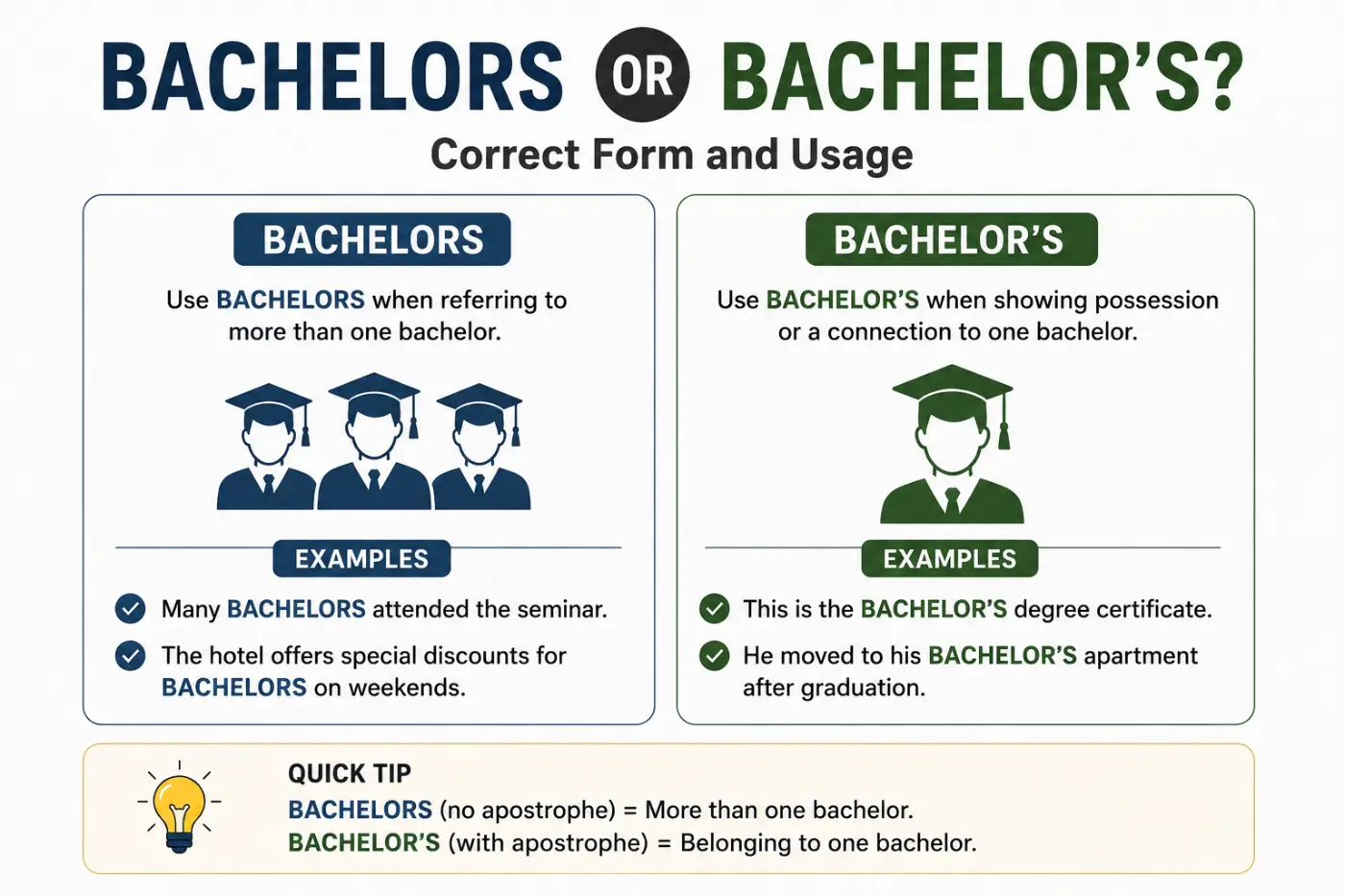
Choosing between bachelors or bachelor’s can feel like a tiny grammar decision until it appears in a resume a college application or an academic document. The two forms look almost identical but the apostrophe changes the meaning. The correct choice depends on what you want the word to express. Bachelor’s is normally the correct form when you mean a degree belonging to or associated with a bachelor.
Bachelors is the regular plural form when you mean more than one unmarried man or more than one bachelor in another accepted sense.The confusion happens because English uses apostrophes for possession and also uses different forms for singular and plural nouns. A bachelor’s degree refers to a degree associated with a bachelor level of education while bachelors refers to multiple people described as bachelors.
These forms aren’t interchangeable.In this guide you’ll learn the difference between bachelors or bachelor’s and how native English speakers use each form. You’ll also see the grammar behind the apostrophe practical examples common mistakes academic usage degree names style guidance and simple ways to choose the right form confidently.
Quick Definition
Bachelor’s is the possessive form of singular bachelor and commonly appears in the phrase bachelor’s degree. Bachelors is the plural form of bachelor and refers to two or more bachelors. Use the apostrophe when showing possession or association with one bachelor. Don’t add an apostrophe simply because a word is plural.
Quick Answer
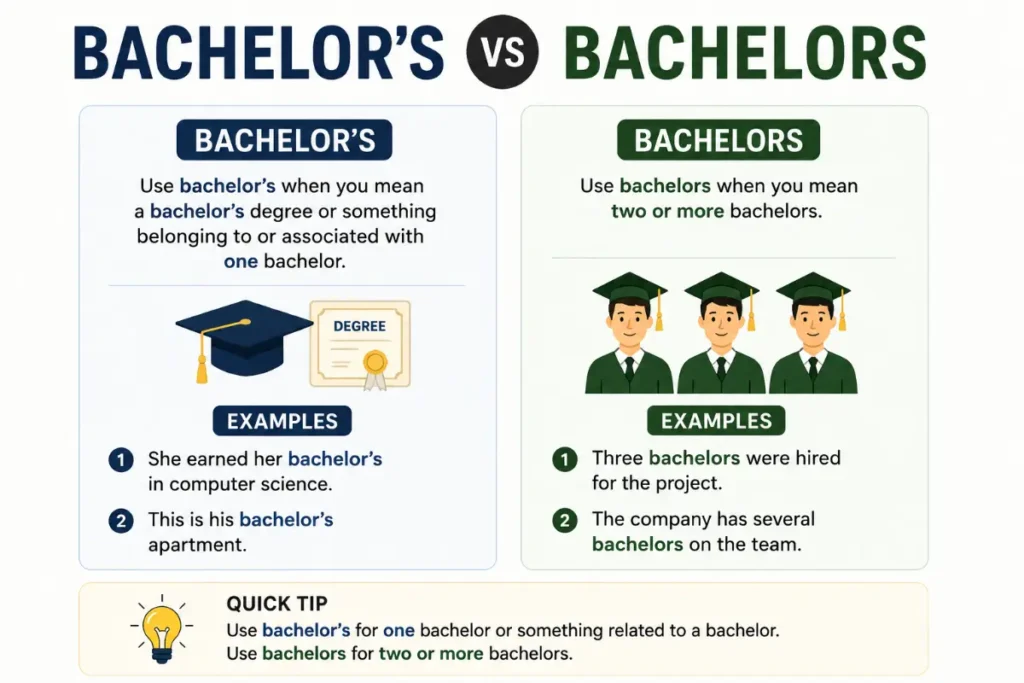
Use bachelor’s when you mean a bachelor’s degree or something belonging to or associated with one bachelor. Use bachelors when you mean two or more bachelors.
For example you can write She earned a bachelor’s degree. You can also write The club welcomed several bachelors. The apostrophe changes the grammatical function.
Comparison Table for bachelors or bachelor’s
| Correct Form | Meaning | Part of Speech | Origin | Usage Frequency | Formality | Common Contexts | Example |
|---|---|---|---|---|---|---|---|
| bachelors | More than one bachelor | Plural noun | From bachelor | Common | Neutral | People and social descriptions | Several bachelors attended the event. |
| bachelor’s | Belonging to or associated with one bachelor | Singular possessive noun form | From bachelor | Very common in education | Neutral to formal | Education degrees and possession | She earned a bachelor’s degree. |
Meaning and Definition
Meaning of bachelors
Bachelors is the plural form of bachelor. It means two or more people who are bachelors.
The noun bachelor has traditionally referred to an unmarried man. In modern English the word can also appear in broader contexts such as social descriptions and historical titles.
For example:
Several bachelors lived in the apartment building.
The sentence refers to more than one person. Since bachelors is simply a plural noun here no apostrophe is needed.
This distinction is easy to overlook because many people associate bachelor with education. Once you see the word in the context of a degree the grammar changes.
Bachelors can also appear in historical or specialized contexts. For example a medieval bachelor could refer to a person with a particular rank or status. The plural form in such contexts is still bachelors.
The important point is simple. The final s in bachelors marks plurality. It doesn’t show possession.
Meaning of bachelor’s
Bachelor’s is the possessive form of the singular noun bachelor. It can mean belonging to one bachelor or associated with one bachelor.
The most familiar example is bachelor’s degree.
A bachelor’s degree is a degree at the undergraduate level. In American English this is the standard form used in ordinary writing when referring to the degree generically.
For example:
She earned a bachelor’s degree in biology.
The apostrophe and s show the possessive relationship between bachelor and degree. In modern educational language the phrase is conventional and readers understand it as the name of a degree level.
The possessive doesn’t always indicate literal ownership. English often uses possessive forms to express association or relationship.
For example:
children’s books
teachers’ lounge
bachelor’s degree
In bachelor’s degree the degree isn’t literally owned by a person named bachelor. The form reflects an established grammatical and historical relationship.
Key Differences Explained
Spelling
Bachelors has no apostrophe. Bachelor’s has an apostrophe before the s.
That small mark carries grammatical information. It tells the reader that the word is singular possessive rather than plural.
Grammar Role
Bachelors is a plural noun.
Bachelor’s is a singular possessive form.
The difference is similar to other pairs in English where an apostrophe distinguishes possession from simple plurality.
Meaning
Bachelors means more than one bachelor.
Bachelor’s normally means belonging to or associated with one bachelor.
When discussing university degrees the second form is the one you normally need.
Tone
Neither form is automatically more formal. The difference is grammatical rather than stylistic.
Bachelor’s degree is standard in academic and professional writing. Bachelors is also standard when referring to multiple people.
Context
Context usually gives you the answer quickly.
If you’re talking about education you will probably need bachelor’s in phrases such as bachelor’s degree or bachelor’s program.
If you’re talking about several unmarried men you may need bachelors.
Which Form Is Correct?
Both bachelors and bachelor’s can be correct. The right form depends on meaning.
If you’re referring to an undergraduate degree use bachelor’s.
She has a bachelor’s degree in chemistry.
If you’re referring to more than one bachelor use bachelors.
The party attracted several bachelors.
The apostrophe isn’t decoration. It signals possession or association. Without it the word is simply plural.
Major dictionaries such as Merriam Webster and Cambridge recognize bachelor as a noun and document its educational and personal meanings. Their dictionary treatment supports the distinction between the noun and its possessive form. The apostrophe in bachelor’s degree follows standard English possessive grammar.
An editor’s approach is to ask one question. Are you talking about one bachelor in a possessive or associated relationship or are you talking about multiple bachelors? If the first meaning applies use bachelor’s. If the second applies use bachelors.
Sentence Examples
The following examples show how bachelor’s works naturally in education and related contexts.
- She earned a bachelor’s degree in psychology.
- He completed his bachelor’s degree last year.
- My sister is pursuing a bachelor’s degree in engineering.
- A bachelor’s degree is often required for this position.
- She listed her bachelor’s degree on her resume.
- He plans to finish his bachelor’s program next spring.
- The university offers a bachelor’s degree in computer science.
- Her bachelor’s education prepared her for graduate study.
- I received my bachelor’s degree from a public university.
- The job posting requires a bachelor’s degree or equivalent experience.
Now compare those examples with sentences using bachelors. - Several bachelors attended the dinner.
- The novel follows three bachelors living in the same city.
- The club was popular among young bachelors.
- The story describes a group of wealthy bachelors.
- Two bachelors shared the apartment.
These examples make the distinction clear. Bachelor’s refers to one bachelor in a possessive or associated construction. Bachelors refers to more than one person.
Common Mistakes and Misspellings
Using bachelors degree
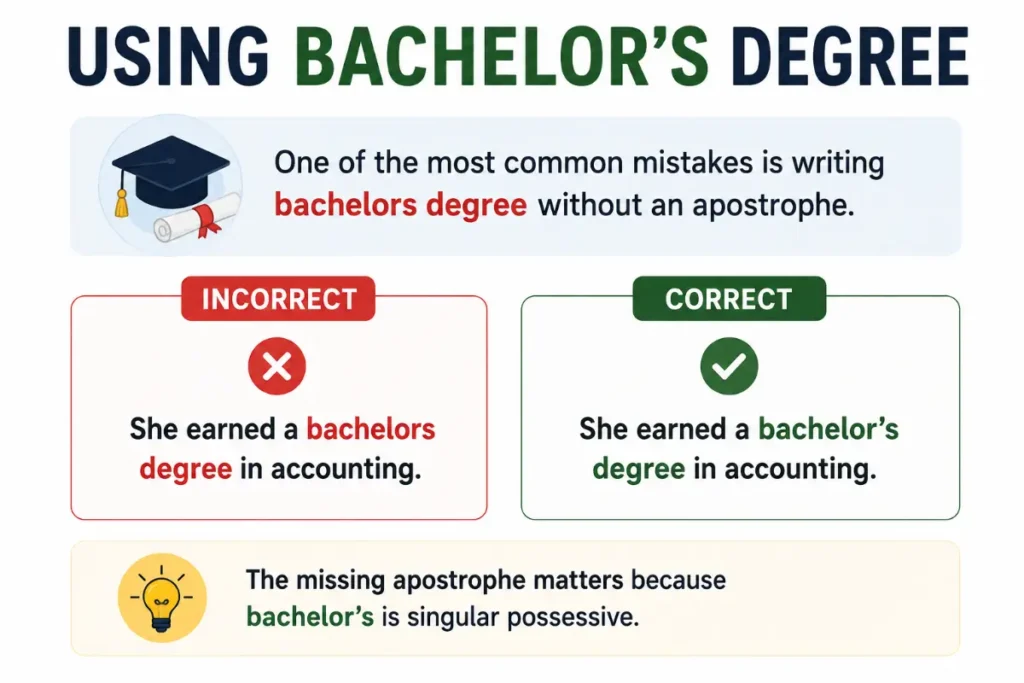
One of the most common mistakes is writing bachelors degree without an apostrophe.
Incorrect:
She earned a bachelors degree in accounting.
Correct:
She earned a bachelor’s degree in accounting.
The missing apostrophe matters because bachelor’s is singular possessive.
Using bachelor’s when you mean several people
An apostrophe shouldn’t be added simply because a noun ends in s.
Incorrect:
The event was attended by several bachelor’s.
Correct:
The event was attended by several bachelors.
The plural form doesn’t need an apostrophe.
Writing bachelor degree
You may also see bachelor degree in informal writing. The standard American English expression is bachelor’s degree.
Using bachelors’ degree
Bachelors’ degree would be a plural possessive construction. It could theoretically mean a degree associated with multiple bachelors in a special context but that isn’t the standard name of the academic qualification.
For a normal university credential write bachelor’s degree.
Capitalizing the phrase unnecessarily
A generic degree name normally doesn’t need every word capitalized.
She earned a bachelor’s degree in history.
However official degree titles can follow institutional style rules. If you’re writing the exact name of a degree as an official program title you should follow the institution’s capitalization style.
NLP confusion between plural and possessive forms
From an NLP perspective this is a morphological distinction. The base noun bachelor changes according to grammatical function.
Bachelor means one person.
Bachelors means more than one.
Bachelor’s means possession or association involving one.
Bachelors’ means possession or association involving multiple people.
These forms are visually close but grammatically different. Recognizing the morphology makes the distinction much easier.
Pronunciation Guide
Bachelors and bachelor’s are pronounced almost identically.
A common pronunciation for bachelor is:
US IPA: /ˈbætʃələr/
A simple pronunciation guide is:
BATCH uh ler
The first syllable receives the strongest stress.
Bachelors adds a plural s sound:
BATCH uh lerz
Bachelor’s commonly sounds like:
BATCH uh lerz
That creates an interesting spelling problem. The plural form bachelors and the possessive form bachelor’s can sound the same in ordinary speech.
This is one reason the distinction can be confusing. When you hear the phrase aloud you may not hear the apostrophe because punctuation has no independent sound.
The context carries the meaning.
Consider:
Several bachelors attended.
She earned a bachelor’s degree.
The first sentence uses the plural noun. The second uses the singular possessive form.
The pronunciation alone doesn’t always tell you which spelling to choose. You need to look at the grammatical role and meaning.
Etymology and Word Origin
Bachelor has an interesting history.
The word entered English through Old French and Middle English. Historical sources connect it with Old French bacheler which referred to a young man or a person of lower rank. The word later developed several meanings.
In medieval academic contexts bachelor became connected with an undergraduate or someone who had attained the first academic degree. This historical sense is the source of the educational use found in bachelor’s degree.
The personal meaning also developed around an unmarried man. That gives modern English the familiar noun bachelor.
The two major modern meanings therefore have deep historical roots. One relates to an unmarried man. The other relates to an academic degree or level of education.
The possessive construction bachelor’s degree follows normal English grammar. Bachelor is singular. Add the possessive apostrophe and s and you get bachelor’s.
The plural is different. Add s to bachelor and you get bachelors.
That gives you a useful grammatical family:
Bachelor.
Bachelors.
Bachelor’s.
Bachelors’.
Each form has a different function.
Regional Usage in the US
American English commonly uses bachelor’s degree for an undergraduate academic qualification.
You will see phrases such as bachelor’s degree in business bachelor’s degree in nursing and bachelor’s degree in computer science.
American universities often use more specific degree names such as Bachelor of Arts or Bachelor of Science. These official names are capitalized because they refer to named degree types.
There is an important style distinction here. Bachelor’s degree is a generic phrase. Bachelor of Arts can function as the formal name of a degree.
For example:
She earned a bachelor’s degree in history.
She earned a Bachelor of Arts in history.
Both can be correct. The capitalization depends on the construction and style.
Bachelors remains the ordinary plural form when referring to multiple bachelors.
Regional Usage in the UK
British English also uses bachelor’s degree in ordinary writing. The spelling and apostrophe pattern are the same.
British universities may use specific degree terminology that differs from American educational systems. You may encounter degree names such as Bachelor of Arts and Bachelor of Science as formal titles.
The underlying grammar doesn’t change. Bachelor’s is singular possessive while bachelors is plural.
There is no British rule that removes the apostrophe from bachelor’s degree.
Regional Usage in Australia
Australian English follows the same basic distinction.
A bachelor’s degree refers to an undergraduate qualification while bachelors is the plural noun form.
Australian universities may have their own official naming and capitalization conventions. Still the apostrophe in the generic phrase bachelor’s degree remains standard.
Writers should follow the style guide or institution’s preferred terminology when describing a specific qualification.
Regional Usage in Canada
Canadian English also uses bachelor’s degree in standard writing.
Canadian educational institutions may use specific degree titles and local terminology but the basic grammar remains unchanged.
Bachelors is used as the plural noun. Bachelor’s is used as the singular possessive form.
There isn’t a regional Canadian spelling that removes the apostrophe from the generic phrase bachelor’s degree.
Grammar Rules and Part of Speech
Understanding the possessive rule makes this distinction much easier.
Singular possessive
For most singular nouns English forms the possessive by adding apostrophe and s.
Bachelor becomes bachelor’s.
The same pattern appears in:
teacher’s
student’s
doctor’s
writer’s
For example:
The student’s book.
The teacher’s desk.
The bachelor’s degree.
The noun is singular and the apostrophe s marks the relationship.
Regular plural
A regular plural usually takes s without an apostrophe.
Bachelor becomes bachelors.
Student becomes students.
Teacher becomes teachers.
For example:
The students arrived early.
Several bachelors attended the event.
The apostrophe doesn’t belong in a normal plural.
Plural possessive
If you need the possessive form of a plural noun that already ends in s you generally add an apostrophe after the s.
Bachelors becomes bachelors’.
This would mean something associated with multiple bachelors.
For example:
The bachelors’ apartments were located downtown.
This is grammatically possible but uncommon compared with bachelor’s degree.
Why bachelor’s degree uses an apostrophe
The phrase is based on the singular noun bachelor.
Bachelor’s degree means a degree associated with the bachelor level.
Although the relationship isn’t literal ownership the possessive construction has become conventional.
English uses possessive structures for many relationships that aren’t physical ownership.
For example:
children’s education
company’s policy
student’s progress
bachelor’s degree
The relationship can involve connection origin category or association.
Academic Writing and Education
The phrase bachelor’s degree is especially important in academic and professional writing.
If you’re describing someone’s education you can write:
She holds a bachelor’s degree in economics.
He earned a bachelor’s degree in English.
They require a bachelor’s degree for the position.
The phrase is widely understood and grammatically standard.
You may also see Bachelor of Arts abbreviated as BA and Bachelor of Science abbreviated as BS in American English. These are formal degree names and often follow capitalization conventions.
For example:
She earned a Bachelor of Science in biology.
He received a Bachelor of Arts in history.
The generic phrase remains:
She earned a bachelor’s degree in biology.
The difference isn’t just capitalization. The two constructions have different grammatical structures.
Resume and Job Application Usage
This distinction matters on resumes because education sections are often scanned quickly by recruiters and hiring systems.
A clean entry might read:
Bachelor’s Degree in Marketing
University Name
Graduated 2025
However resume style varies. Some writers prefer:
Bachelor of Science in Marketing
University Name
Graduated 2025
If you’re using the generic phrase rather than the official degree title use bachelor’s degree.
Avoid:
Bachelors Degree in Marketing.
The missing apostrophe makes the phrase grammatically incorrect in standard edited English.
Also avoid adding an apostrophe to the plural word simply because it refers to a degree.
The key is to identify the noun relationship rather than rely on appearance.
Bachelor Degree Versus Bachelor’s Degree
Bachelor degree is often understood but bachelor’s degree is the standard expression in American English.
The apostrophe reflects the possessive structure.
Bachelor’s degree.
This construction is so established that native speakers usually expect the apostrophe.
In some institutional contexts you may see degree names written as Bachelor of Arts or Bachelor of Science. Those forms don’t use the possessive construction.
For example:
Bachelor of Science in Nursing.
Bachelor of Arts in English.
Bachelor’s degree in nursing.
Bachelor’s degree in English.
All can be appropriate depending on what you’re trying to say.
Bachelor’s Degree Versus Bachelors Degree
The difference is one small punctuation mark but the grammar changes.
Bachelor’s degree uses singular possessive form.
Bachelors degree uses plural form incorrectly in the standard phrase.
Compare:
She has a bachelor’s degree.
She has a bachelors degree.
The first sentence is standard.
The second sentence should be corrected.
If you remember that the degree is associated with the singular term bachelor you can see why the apostrophe belongs there.
Bachelors Versus Bachelors’
These forms are also easy to confuse.
Bachelors means multiple bachelors.
Bachelors’ means something belonging to or associated with multiple bachelors.
For example:
Several bachelors moved into the building.
The bachelors’ building was renovated.
The first sentence simply uses the plural.
The second uses plural possession.
This is a useful reminder that apostrophes don’t mark plurality by themselves. They mark possession or related grammatical relationships.
Real Life Usage Examples
Daily Talk
- My brother just finished his bachelor’s degree.
- Several bachelors lived in the neighborhood.
In daily conversation the educational use is much more common than the plural social use.
- Please send a copy of your bachelor’s degree certificate.
- The two applicants have bachelor’s degrees in engineering.
Notice the second example. When the subject is plural you can say bachelor’s degrees because each person has a bachelor’s degree. The possessive form remains singular before the plural noun degrees.
Academic Writing
- Students with a bachelor’s degree may apply for the program.
- The study examined students who had completed a bachelor’s degree.
Academic writing uses the phrase frequently because educational qualifications need precise naming.
News Writing
- The new program requires a bachelor’s degree.
- Several bachelors were interviewed for the feature.
The first use is related to education. The second refers to people.
Literature
- The novel introduces a wealthy bachelor living alone.
- The story follows several bachelors searching for a new home.
Literary writing often uses bachelor in its personal sense rather than its academic sense.
Related and Confused Terms
Bachelor
Bachelor is the singular noun. It can refer to an unmarried man or to a person who has earned a first academic degree in certain contexts.
Bachelors
Bachelors is the regular plural. It means more than one bachelor.
Bachelor’s
Bachelor’s is singular possessive. It commonly appears in bachelor’s degree.
Bachelors’
Bachelors’ is plural possessive. It describes something associated with multiple bachelors.
Bachelor of Arts
Bachelor of Arts is the formal name of an academic degree. It is commonly abbreviated as BA.
Bachelor of Science
Bachelor of Science is another formal degree title. It is commonly abbreviated as BS in American English.
Bachelor’s degree
Bachelor’s degree is the generic possessive expression used for an undergraduate degree.
Undergraduate degree
Undergraduate degree is a broader term that can include a bachelor’s degree and other qualifications depending on the educational system.
Why The Apostrophe Matters
Apostrophes can look tiny but they often carry a surprising amount of grammatical information.
Compare:
The student’s book.
The students’ books.
The students books.
The first means one student’s book. The second means books belonging to multiple students. The third is missing the possessive punctuation.
The same basic logic applies to bachelor.
Bachelor’s degree means a degree associated with one bachelor level.
Bachelors means more than one bachelor.
Bachelors’ would indicate possession or association involving multiple bachelors.
The apostrophe helps readers understand the structure without having to guess.
Common Questions About Degree Names
One frequent source of confusion is capitalization.
Generic degree references are often lowercase.
She earned a bachelor’s degree.
Formal degree names are often capitalized.
She earned a Bachelor of Arts.
The exact style can vary by institution or publication. If you’re writing for a university or employer check its style guide when the official title matters.
Another issue is abbreviation.
BA commonly represents Bachelor of Arts.
BS commonly represents Bachelor of Science in American English.
The full degree name can still be written in a different grammatical construction.
Expert Editor Insight
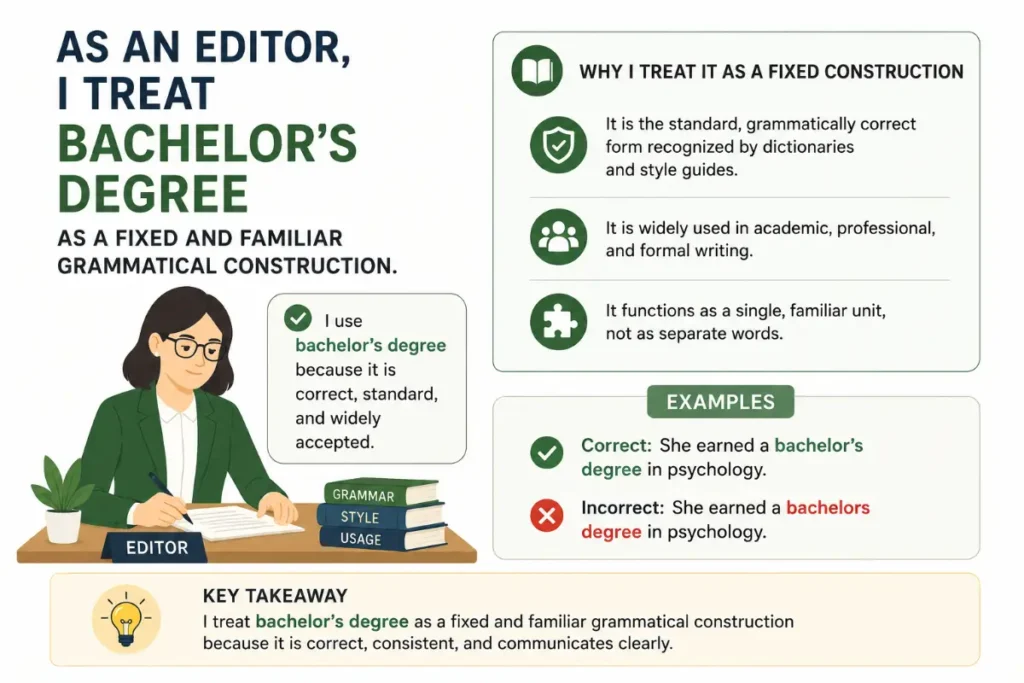
As an editor I treat bachelor’s degree as a fixed and familiar grammatical construction. If I see bachelors degree in a resume application essay or article I correct it because the missing apostrophe changes the form from singular possessive to plural. I also check the context before making any correction. Bachelors can be completely correct when the writer means multiple bachelors. The best editorial habit is to identify the intended meaning first and then choose the punctuation. Never add an apostrophe just because a word appears before another noun.
Expert Tip
When you’re unsure which form to use ask yourself what you’re counting.
If you’re counting people use bachelors.
If you’re describing one person’s association with something use bachelor’s.
This quick test works better than memorizing isolated examples because it connects the spelling with the underlying grammar.
Conclusion
When choosing between bachelors or bachelor’s the correct form depends on the meaning you need. Bachelors is the plural form of bachelor and refers to two or more bachelors. Bachelor’s is the singular possessive form and is the standard form in bachelor’s degree. The apostrophe isn’t optional decoration.
It signals a grammatical relationship. If you’re writing about education remember bachelor’s degree. If you’re talking about several people remember bachelors. A useful final check is to ask if you mean more than one person or an academic qualification. That simple question will usually tell you exactly which form belongs in your sentence.
Frequently Asked Questions
Is bachelors a correct word?
Yes. Bachelors is the correct plural form of bachelor. It refers to two or more bachelors. For example you can write Several bachelors attended the event. No apostrophe is needed because the word is simply plural. The form becomes different when you need possession. In that case bachelors’ can show that something belongs to or is associated with multiple bachelors.
Is bachelor’s a correct word?
Yes. Bachelor’s is the singular possessive form of bachelor. It is especially common in the phrase bachelor’s degree. The apostrophe shows a relationship between the singular noun bachelor and another noun. In standard writing you should use bachelor’s degree rather than bachelors degree when referring to a generic undergraduate qualification.
bachelors or bachelor’s which is correct?
Both can be correct because they serve different grammatical purposes. Bachelors is plural and refers to multiple bachelors. Bachelor’s is singular possessive and commonly appears in bachelor’s degree. The correct choice depends on meaning. If you’re writing about an academic qualification use bachelor’s degree. If you’re talking about several bachelors use bachelors.
Why does bachelor’s degree have an apostrophe?
Bachelor’s degree uses a singular possessive construction. The word bachelor is singular and the apostrophe s creates the possessive form. The relationship is one of association rather than literal ownership. English uses possessive structures for many relationships of this kind. Bachelor’s degree has become the established standard expression for this level of undergraduate education.
Should I write bachelors degree or bachelor’s degree?
You should normally write bachelor’s degree. The apostrophe is required because bachelor’s is the singular possessive form of bachelor. Bachelors without an apostrophe is simply the plural noun and doesn’t fit the standard grammatical construction. If you’re using the formal degree title Bachelor of Arts or Bachelor of Science the structure changes and the possessive apostrophe isn’t needed.
Is bachelors degree grammatically correct?
Bachelors degree isn’t the standard grammatical form for the generic name of an undergraduate degree. The standard expression is bachelor’s degree. Bachelors means multiple bachelors and doesn’t create the required possessive relationship. You may also use formal degree names such as Bachelor of Arts or Bachelor of Science when that is the official qualification name.
Can bachelor’s be plural?
Bachelor’s itself is singular possessive. The plural possessive form is bachelors’ when you mean something associated with multiple bachelors. However when discussing education you normally don’t need that plural possessive form. You can write bachelor’s degrees to refer to multiple academic degrees because bachelor’s describes the degree type while degrees carries the plural meaning.
Is bachelor’s degree formal English?
Yes. Bachelor’s degree is standard English and is completely appropriate in academic professional and formal writing. It appears in resumes university applications job descriptions research writing and educational documents. You can also use formal titles such as Bachelor of Arts or Bachelor of Science. The choice depends on the exact meaning and the naming convention used by the institution.
