
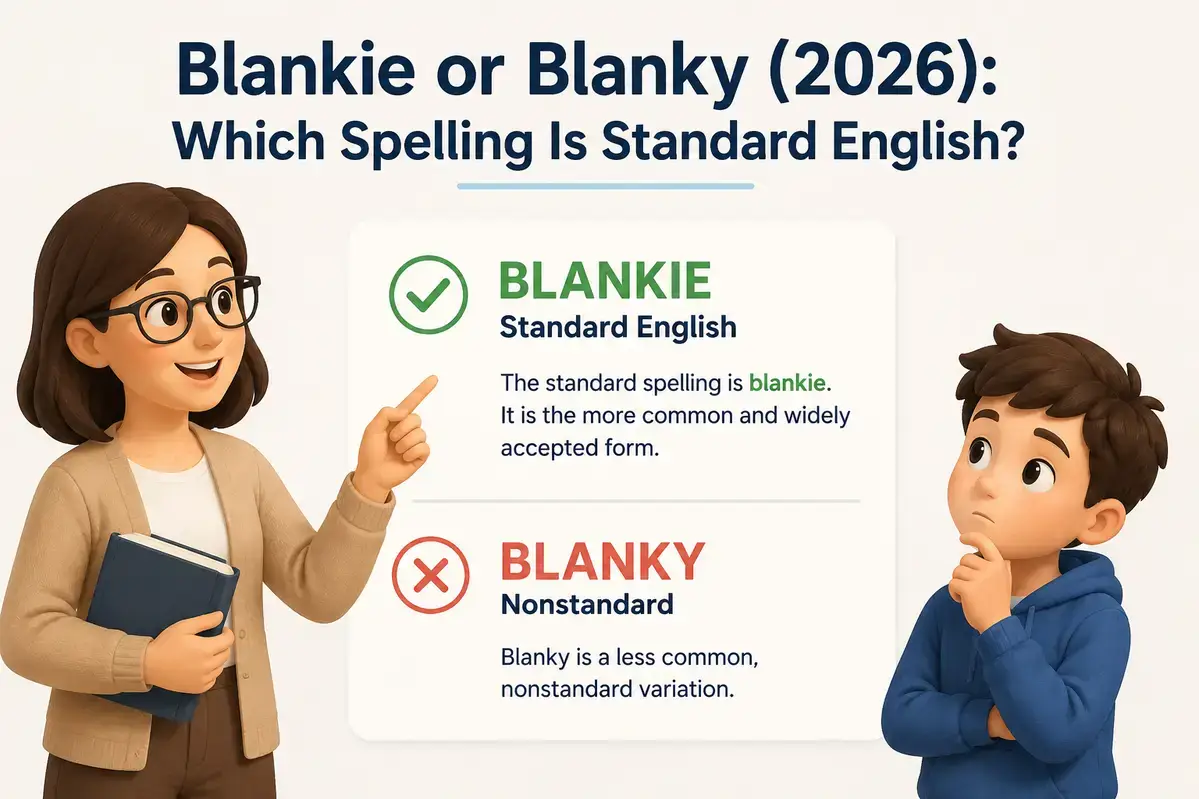
Small words can cause surprisingly big spelling debates. Blankie vs blanky is a good example because both spellings look natural when you say the word aloud. If you’re writing about a child’s favorite comfort blanket you might pause and wonder which form belongs on the page. The short answer is that blankie is the more widely recognized informal spelling while blanky also appears as a playful variant.
Neither form is the standard formal word for a blanket. The confusion comes from English pronunciation and the way people turn ordinary words into affectionate nicknames. A child may say blanket in a softer or shortened way and adults often spell that pronunciation in several different ways.
That makes forms such as blankie and blanky easy to mix up. In this guide you’ll learn what each spelling means how people use it how it sounds and which form works best in American English. You’ll also see natural examples common mistakes regional patterns and practical advice for choosing the spelling that fits your audience.
Quick Definition
Blankie and blanky are informal affectionate terms for a blanket especially a child’s favorite comfort blanket. Blankie is the more familiar spelling in general English writing while blanky is an informal variant. For formal writing use blanket instead because neither playful spelling is necessary in professional or academic prose.
Quick Answer
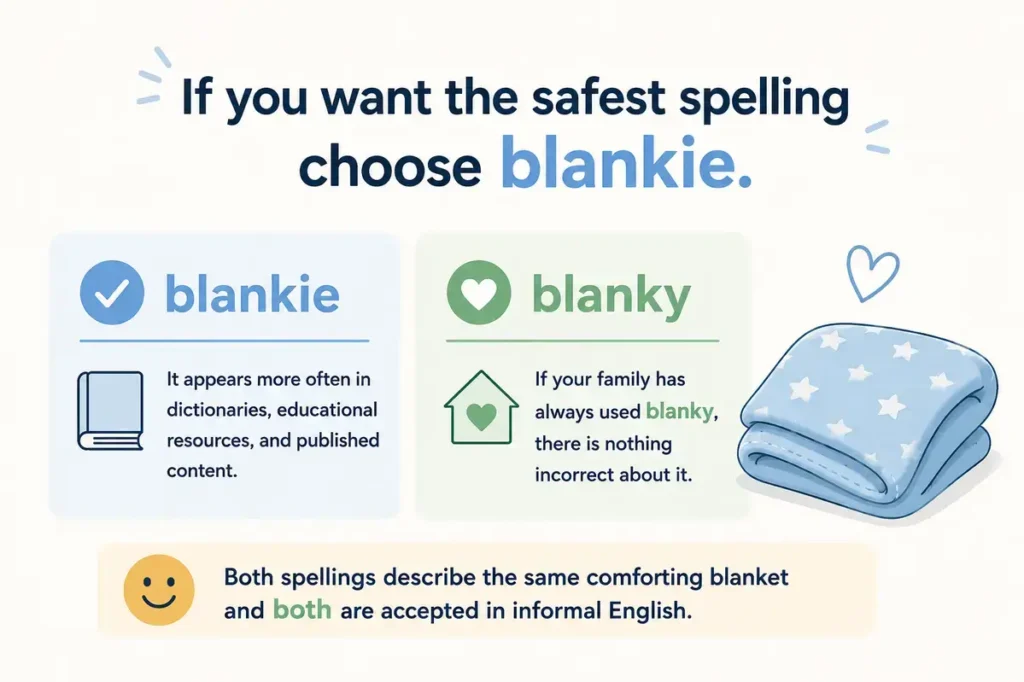
If you’re choosing between blankie vs blanky use blankie when you want the more familiar and recognizable informal spelling. Blanky is also understandable and appears in casual family language.
For formal writing use blanket. Blankie and blanky are affectionate forms rather than standard formal vocabulary.
Comparison Table
| Correct Form | Meaning | Part of Speech | Origin | Usage Frequency | Formality | Common Contexts | Example |
|---|---|---|---|---|---|---|---|
| Blankie | An informal name for a comfort blanket | Noun | Informal English formation from blanket | Common in casual family language | Very informal | Children families comfort objects | She took her blankie to bed. |
| Blanky | An informal variant meaning a comfort blanket | Noun | Playful variation of blanket | Less common than blankie | Very informal | Family speech children casual writing | The baby reached for his blanky. |
Meaning and Definition
Meaning of Blankie
Blankie is an informal noun used for a blanket that has a special emotional role. It often refers to a child’s favorite blanket or comfort object. A parent might say that a toddler cannot sleep without a particular blankie. The word can also refer to a small soft blanket used for warmth or security. The spelling is built from blanket with the familiar ending ie.
English often uses this kind of ending to create affectionate or diminutive forms. Similar patterns appear in words such as doggie and piggie. The exact formation varies from word to word but the basic idea is familiar to English speakers. Blankie isn’t normally used in formal documents. You wouldn’t usually write that a patient was given a blankie in a medical report.
You’d write blanket. In a text message to a parent or in a children’s story the informal word can sound perfectly natural. The word can also carry emotional meaning. When someone says a child wants their blankie they may be talking about more than a piece of fabric. The blanket may represent comfort routine safety or familiarity.
Meaning of Blanky
Blanky has essentially the same basic meaning. It is an informal spelling for a comfort blanket or a child’s favorite blanket. The spelling uses y instead of ie at the end.
Blanky is easy for English speakers to understand because the pronunciation is close to blankie. In casual speech the distinction may disappear completely. That means the spelling choice becomes more noticeable when the word appears in writing.
Blanky can sound playful and personal. Families sometimes develop their own names for familiar objects and those names don’t always follow a strict dictionary pattern. One family may write blankie while another may write blanky.
The important point is that blanky doesn’t create a different object. It generally refers to the same type of comfort blanket. The main difference is spelling and personal style.
Key Differences Explained
Spelling
The biggest difference is the ending. Blankie ends with ie while blanky ends with y. Both spellings represent an informal pronunciation of blanket.
Blankie is generally the safer choice if you want a familiar spelling that most readers will recognize immediately.
Grammar Role
Both forms function mainly as nouns. You can use them as the subject or object of a sentence.
For example.
- Her blankie is on the bed.
- He carried his blanky everywhere.
The grammar doesn’t change simply because the spelling changes.
Meaning
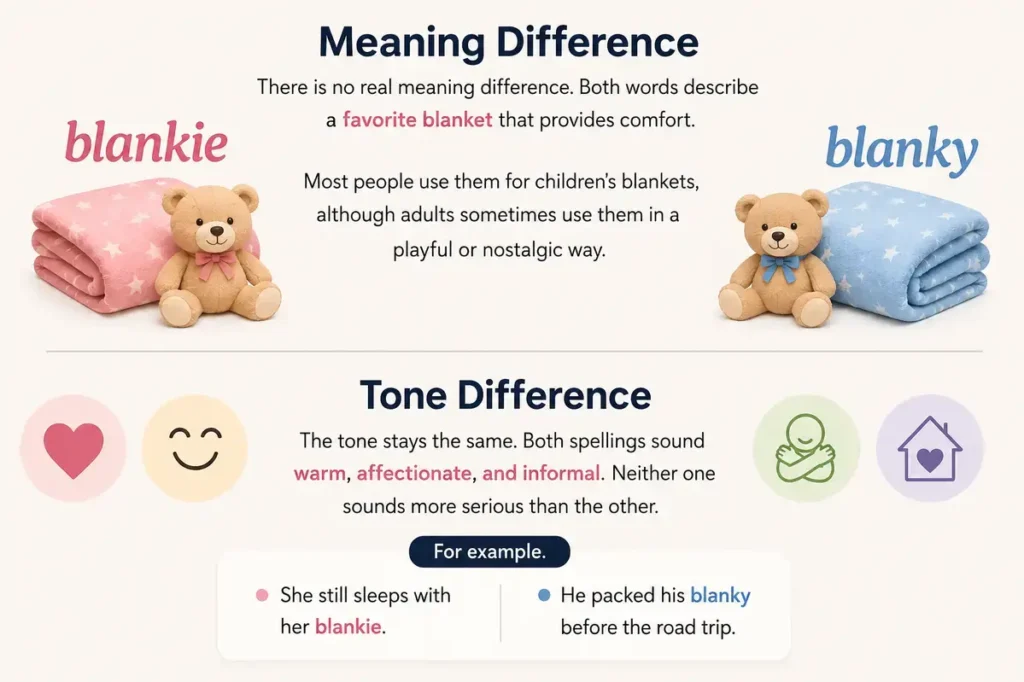
The meanings are almost identical. Both can describe a child’s comfort blanket or a familiar blanket used for emotional reassurance.
Tone
Both words sound informal and affectionate. Blankie may feel slightly more familiar because many English speakers have encountered that spelling before.
Context
Use these forms in family conversations children’s books casual messages social posts and other relaxed settings. Use blanket in professional academic legal technical and formal writing.
Which Spelling Is Correct
If you’re asking which spelling is the better general choice between blankie and blanky, blankie is usually the stronger choice. It is recognizable as an affectionate form of blanket and appears naturally in informal English.
That doesn’t make blanky impossible or automatically wrong. Informal vocabulary often has spelling variation because people write words according to how they hear or say them. Nicknames especially have flexible spelling.
Dictionary logic also supports an important distinction here. Standard dictionaries generally treat blanket as the ordinary English noun. Informal forms such as blankie may appear in dictionaries or informal lexical resources depending on the dictionary’s coverage. A form’s appearance in a dictionary can provide evidence of usage but doesn’t automatically make it appropriate for every context.
As a professional editor I’d make the choice based on audience. If the writing is formal use blanket. If you’re writing naturally about a child’s comfort object use blankie. A family’s preferred spelling can make the writing feel more personal and authentic. Keeping blanky can preserve that familiar family touch.
Sentence Examples
Natural Examples With Blankie
- Emma won’t go to sleep without her favorite blankie.
- We found the baby’s blankie under the couch.
- He carried his blue blankie everywhere.
- Please wash the blankie before bedtime.
- Her grandmother made a soft blankie for her.
- The little boy held his blankie tightly during the storm.
- We packed diapers a bottle and his blankie for the trip.
- She still keeps her childhood blankie in a drawer.
- The puppy curled up beside the child’s blankie.
- His blankie has become part of his bedtime routine.
Examples Showing Finaly As a Misspelling
The word finaly is not the usual spelling of finally. It is a common typing error caused by leaving out one l.
- I finaly finished the book.
- She finaly arrived home.
- We finaly found the missing toy.
- He finaly understood the rule.
- They finaly decided to leave.
These sentences should use finally instead. The mistake has nothing to do with the spelling of blankie or blanky. It comes from a separate spelling pattern in English.
Common Mistakes and Misspellings
Several spelling problems can appear when people write informal words. The most common issue with blankie and blanky is assuming that one spelling must have a completely different meaning from the other. Usually it doesn’t.
Blanky
Blanky is understandable but less familiar to many readers than blankie. If you’re writing for a broad American audience and don’t have a reason to use a family specific spelling blankie is often the clearer option.
Blankey
Blankey sometimes appears as another phonetic spelling. It tries to represent the long e sound before the final sound. It isn’t the standard form of the word blanket.
Blankiee
Blankiee is an exaggerated spelling that may appear in playful internet writing. It isn’t needed in ordinary writing.
Blanky Blanket
Some writers use both words together in a way that sounds repetitive. If you say the child’s blanky blanket you may be adding words without adding meaning.
Blanket
Blanket is the standard word. It’s the right choice when the tone needs to be neutral or formal.
The spelling confusion can also be understood through NLP style patterns. People often map sounds to familiar letter combinations. When a word has a playful pronunciation the brain may generate more than one plausible spelling. That’s especially common with affectionate forms because English doesn’t have one universal rule for creating them.
Real Life Usage Examples
Daily Talk
- Did you pack her blankie before we left.
- He wants his blanky before he goes to sleep.
These sentences sound natural in casual family conversation. The affectionate word fits the relaxed setting.
- We found your daughter’s blankie after the event.
- I’ll send the blanket back with your child tomorrow.
The first example works in a friendly personal email. The second is better for a school or professional setting because blanket is neutral.
Academic Writing
- The child used a blanket as a source of comfort during the transition.
- Researchers may examine how familiar objects help children manage stressful situations.
Academic writing generally favors blanket over blankie or blanky because the goal is precision and neutral tone.
News Writing
- The child was found holding a small blanket.
- The rescue team returned the child’s blanket after the family was reunited.
News writing normally uses blanket because it avoids unnecessary informality.
Literature
- She pulled her old blankie close and closed her eyes.
- The faded blanket had followed him from childhood into adulthood.
Literary writing gives authors more freedom. Blankie can create a warm childlike voice while blanket can create a more neutral or reflective tone.
Pronunciation Guide
Blankie and blanky are generally pronounced in nearly the same way.
The common pronunciation can be represented approximately as /ˈblæŋki/.
The word has two syllables.
- Blank.
- Ie or y.
An easy pronunciation guide is BLANG kee.
The first part sounds like the beginning of blanket. The final sound is similar to the ee sound in happy.
Blanket itself is pronounced differently because it has a second syllable that ends with a t sound. When speakers shorten blanket into an affectionate nickname the final t can disappear and the ending becomes softer.
That sound change helps explain the spelling variation. If you hear the word without seeing it written you have little information telling you to choose ie or y. Both spellings can represent the same sound.
Etymology and Word Origin
The story begins with blanket rather than blankie or blanky.
Blanket entered English through Anglo French and Middle English forms connected with a type of coarse or undyed woolen cloth. The word developed from the name of a kind of pale or unbleached wool fabric and eventually became the ordinary word for a covering used for warmth.
Over time blanket gained many extended meanings and uses. It can refer to a bed covering a warm covering for outdoor use or something that spreads over an area in a figurative sense.
Blankie developed much later as an affectionate informal form. English speakers often shorten familiar nouns and add endings that make them sound smaller softer or more personal. This is especially common in language used with children.
Blanky follows the same basic idea but uses y instead of ie. Informal vocabulary often develops through speech first. Once people start writing the spoken form they may choose different spellings.
That process explains why playful words can have more than one accepted informal spelling. Formal English has stronger conventions. Family language has much more freedom.
Regional Usage
United States
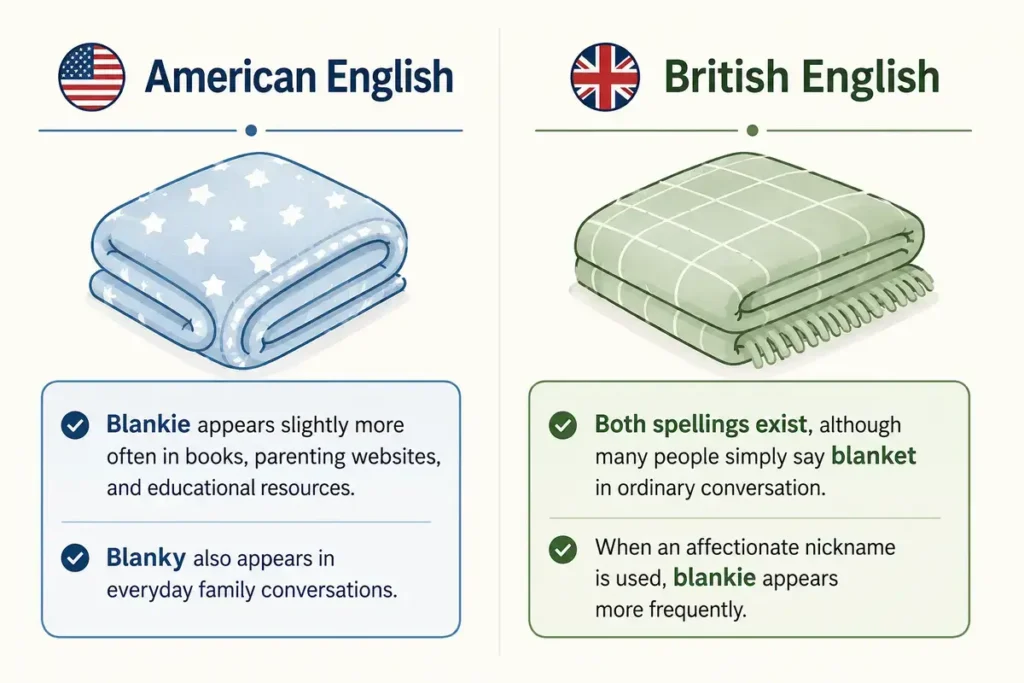
In American English blankie is a familiar informal term for a child’s comfort blanket. Blanky is also understandable and can appear in casual family language. American English doesn’t require families to use one spelling for every affectionate nickname. For formal American writing blanket remains the natural choice.
United Kingdom
British speakers can understand both forms. Blankie can appear in informal family language and children’s contexts. Blanky is also possible as a playful spelling. Regional differences are much less significant here than personal preference because neither form is the ordinary formal word for the object.
Australia
Australian English also uses playful forms of familiar words in family and child centered contexts. Blankie can be understood naturally while blanky may appear as an individual spelling choice. The formal word remains blanket.
Canada
Canadian English follows much the same pattern. Blankie is recognizable as an informal comfort word and blanky can work as a casual variant. Canadian formal writing should use blanket when the affectionate tone isn’t needed.
Related and Confused Terms
Several words and phrases overlap with the idea of finally or completion language even though they don’t mean the same thing as blankie. These terms become useful when editing sentences because word choice depends heavily on context.
- At last means something happened after a long wait.
- Eventually means something happened after some time or after a series of events.
- Ultimately means after considering the final result or outcome.
- At the end refers to the final point of a period event or sequence.
- In the end usually introduces the final result of a situation.
- Lastly introduces the final item in a sequence or list.
- Conclusively means in a way that settles an issue or proves something firmly.
- Finally can mean at the end of a sequence after a delay or as the last point in an explanation.
These words belong to a different semantic field from blankie and blanky. The connection here matters mainly when you’re editing content based on the larger spelling pattern represented by finaly and finally. They shouldn’t be treated as synonyms for the informal blanket terms.
Expert Editor Insight
As a senior editor I’d make this choice very simply. Use blankie when you want the familiar affectionate form. Use blanky when it reflects a person’s established personal or family spelling. Choose blanket when the writing needs to sound neutral or professional. Native speakers usually understand the intended meaning immediately because context does most of the work. Spell checkers can also behave differently with informal vocabulary. A program may flag blankie or blanky simply because its dictionary is conservative. A red underline doesn’t automatically mean a word is meaningless. Context and audience still matter.
Final Takeaway
The best choice in the blankie vs blanky comparison is usually blankie when you want a familiar affectionate spelling for a comfort blanket. Blanky is also understandable and can work as a playful personal variant. Neither one should replace blanket in formal writing where neutral vocabulary is the better fit.
The difference is mainly spelling style rather than meaning. Both informal forms can refer to the same treasured blanket that a child carries around or sleeps with. English gives people plenty of freedom when creating affectionate words and families sometimes settle on their own preferred spelling. The simplest practical tip is to match the word to the setting.
Use blankie for friendly casual writing. Keep blanky when it reflects an established personal spelling. Choose blanket for professional or academic writing. That small choice keeps your writing natural while making the intended tone clear.
Blankie And Blanky FAQs
Is blankie or blanky correct?
Blankie is the more familiar informal spelling for a child’s favorite comfort blanket. Blanky is also used as a playful variant. Both can be understood in casual English. For formal writing you should use blanket instead. The best choice depends on the tone and the spelling a family already uses.
What does blankie mean?
Blankie is an affectionate informal word for a blanket. It often refers to a child’s favorite blanket that provides comfort or helps them feel secure. For example you might say The baby won’t sleep without her blankie. The word sounds warm and personal so it works best in casual conversations family writing and children’s stories.
What does blanky mean?
Blanky is an informal variant of blankie. It usually means the same thing and refers to a favorite comfort blanket. The spelling is playful rather than formal. Some families may naturally prefer blanky while others use blankie. Both forms are easy for English speakers to understand from context.
Is blankie a real word?
Yes. Blankie is an established informal word used in English for a comfort blanket. It’s especially common in language involving children and families. It isn’t the best choice for formal or academic writing. In those settings blanket is the standard neutral term.
Is blanky a real word?
Blanky is also used as an informal word for a comfort blanket. It’s less familiar than blankie for many readers but its meaning is usually clear from context. It often appears in family conversations and playful writing. If you need a formal term simply use blanket.
Which spelling is more common blankie or blanky?
Blankie is generally the more recognizable spelling. It follows a familiar pattern found in affectionate words and is easy for many readers to identify immediately. Blanky still appears in casual usage and may be preferred by individual families. Neither spelling is needed in formal writing where blanket is the better choice.
Can I use blankie in formal writing?
You can use blankie in formal writing if the context specifically involves a child’s personal language or a quoted expression. In most professional and academic situations however blanket is more appropriate. Blankie has an affectionate and informal tone. Choosing blanket keeps the writing neutral clear and professional.
Should I use blankie or blanky in American English?
For general American English blankie is usually the safer informal choice because it’s widely recognizable. Blanky is understandable and can sound equally natural in personal or family settings. If you’re writing a story or message and a particular person uses blanky then keeping that spelling can make the writing feel more authentic.
