
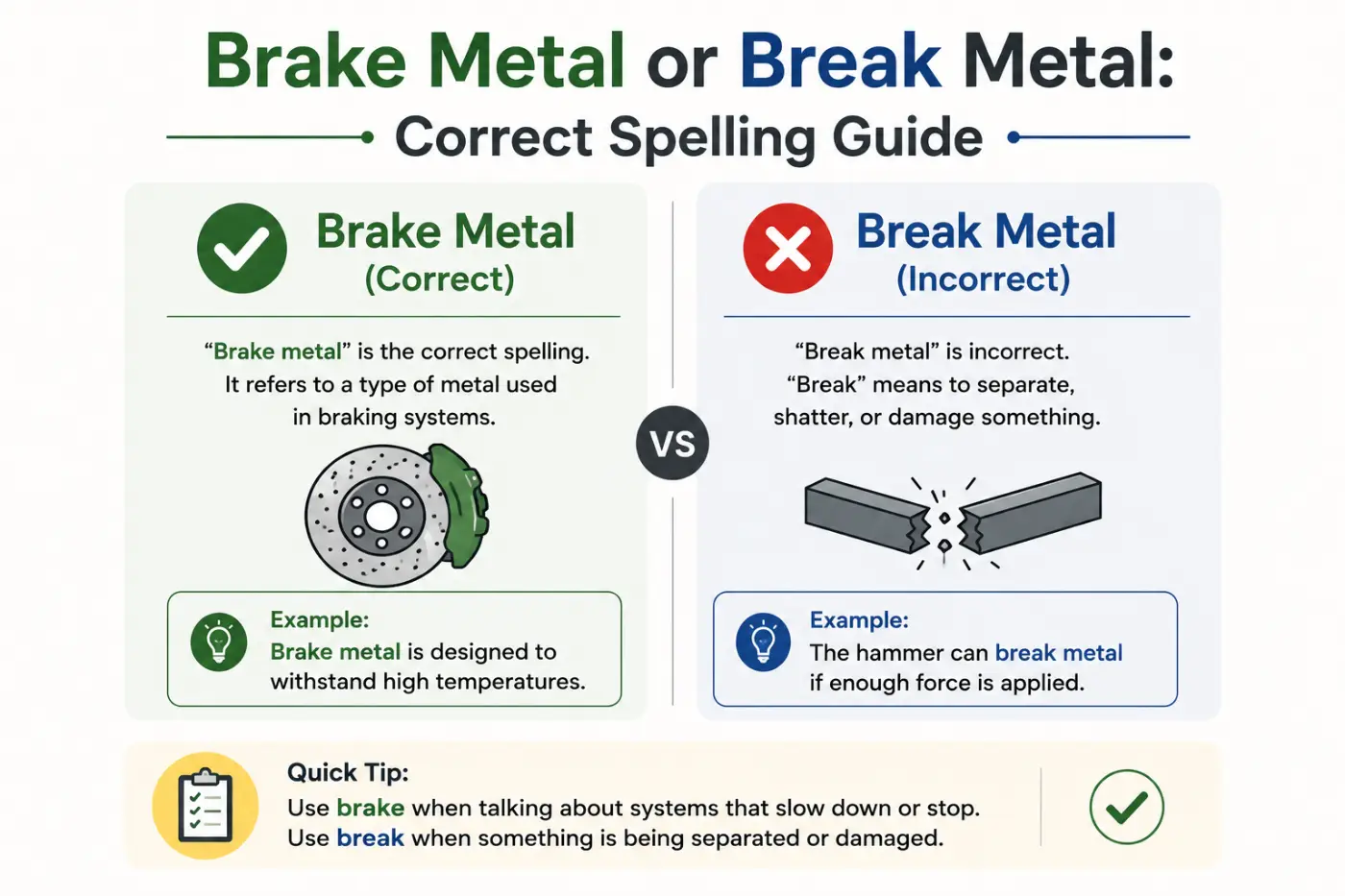
If you’ve ever typed brake metal or break metal and stopped to wonder which form belongs in your sentence, you’re not alone. The two words sound alike in many varieties of English, but they don’t mean the same thing. The spelling you choose depends entirely on what you’re trying to describe.
Brake usually relates to a device or action used to slow or stop a vehicle or machine. Break generally refers to damaging, separating, interrupting, or causing something to stop working. So, neither spelling is automatically correct without knowing the intended meaning.
The confusion becomes even stronger when people hear a phrase rather than see it written. English contains many homophones, and brake and break are classic examples. This guide explains the difference clearly, including the meanings of both words, common expressions, pronunciation, grammar, regional usage, examples, and frequent mistakes. By the end, you’ll know which form fits your sentence and why.
Featured Snippet Quick Definition
Brake metal can refer to metal associated with a brake system or metal worked using a brake machine. Break metal means metal that has been broken, fractured, or separated. The correct spelling depends on the intended meaning. Brake relates to stopping or forming metal, while break relates to damage or separation.
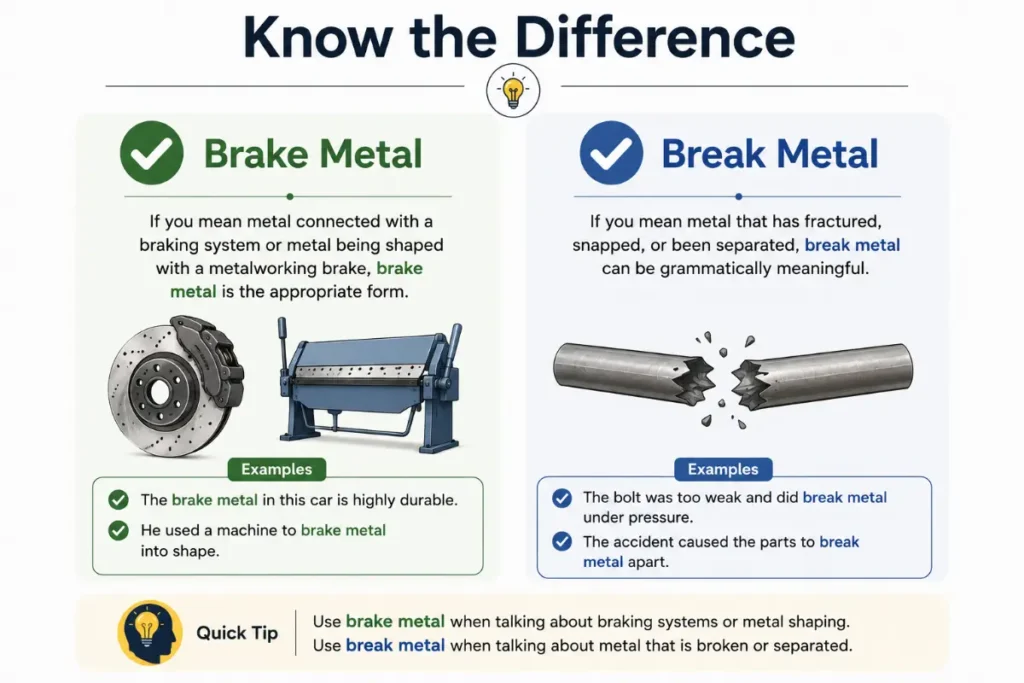
Quick Answer
If you mean metal connected with a braking system or metal being shaped with a metalworking brake, brake metal is the appropriate form. If you mean metal that has fractured, snapped, or been separated, break metal can be grammatically meaningful.
The key is the meaning. Brake and break are homophones in most forms of English, but they perform different grammatical and semantic jobs.
Comparison Table
| Correct Form | Meaning | Part of Speech | Origin | Usage Frequency | Formality | Common Contexts | Example |
|---|---|---|---|---|---|---|---|
| brake metal | Metal associated with braking or metal formed with a brake | Noun phrase | From Middle English and Old French roots connected with a device for restraining or stopping | Less common as a fixed phrase | Neutral to technical | Automotive work and metal fabrication | The technician inspected the brake metal for damage. |
| break metal | Metal that has broken or has been fractured | Verb and noun combination | From Old English roots meaning to divide or shatter | Uncommon as a fixed phrase | Neutral | Manufacturing, recycling, damage reports | The machine can break metal under extreme pressure. |
Meaning and Definition
Meaning of Brake Metal
The phrase brake metal is not normally treated as one of the most common fixed expressions in everyday American English. Its meaning depends on context.
In automotive language, brake can describe components involved in slowing or stopping a vehicle. You might encounter references to metal parts in a brake assembly, such as brake discs, calipers, brackets, backing plates, or other metal components.
The word also has a specialized meaning in metalworking. A brake can be a machine or tool used to bend, fold, or shape sheet metal. A press brake, for example, forms metal by applying controlled force. In that setting, someone may informally describe metal being worked on a brake as brake metal.
That technical context matters because the word brake does not mean damage. It points toward stopping, controlling movement, or a machine used for forming material.
Meaning of Break Metal
Break metal can make sense when break functions as a verb describing what happens to metal.
For example, a machine might break metal under extreme pressure. A metal component might break after repeated stress. A piece of metal could break during an accident.
Here, break carries its ordinary meaning of causing something to crack, fracture, split, or stop functioning.
The phrase is therefore possible, but it isn’t usually the most natural fixed noun phrase in ordinary English. Writers often choose more precise wording such as broken metal, fractured metal, cracked metal, or metal that has broken.
This distinction is useful because a reader might see the two spellings and assume one is simply a misspelling of the other. They aren’t. Both words are legitimate English words, but their meanings differ.
Meaning of Finally
The word finally is unrelated to this topic. It is an adverb meaning at last, eventually, or after a sequence of events.
It is worth mentioning because spelling comparisons often become mixed when writers focus on similar sounding or visually similar words. In this case, brake, break, and finally belong to entirely different semantic groups.
Key Differences Explained
Spelling
Brake and break have different spellings despite having the same pronunciation in most standard varieties of English.
Brake contains the letter sequence bra followed by ke.
Break contains the letter sequence brea followed by k.
The spelling difference is meaningful because each word belongs to a different lexical family.
Grammar Role
Brake can function as a noun or verb.
As a noun, it identifies a device used to slow or stop motion.
As a verb, it means to slow or stop something, especially a vehicle.
Break can function as a noun, verb, and part of numerous phrasal verbs and idiomatic expressions.
That greater grammatical flexibility makes break especially common in English.
Meaning
The most important distinction is meaning.
Brake is associated with stopping, slowing, or controlling movement.
Break is associated with damaging, fracturing, separating, interrupting, or ending something.
That semantic difference determines the correct spelling.
Tone
Neither spelling is inherently more formal than the other. Formality comes from the context.
A technical report might use brake when discussing vehicle components or metalworking equipment. A manufacturing report might use break to describe material failure.
Context
Context usually provides the fastest answer.
If the sentence involves a car, stopping system, braking mechanism, or sheet metal forming machine, brake may be the intended word.
If the sentence describes cracking, snapping, fracturing, or damage, break is more likely.
Which Spelling Is Correct?
Both brake and break are correct English words, but they aren’t interchangeable.
If you are referring to something connected with stopping motion or a machine used to form sheet metal, use brake.
If you are describing metal that fractures or an action that causes metal to fracture, use break.
This follows standard dictionary treatment. Major dictionaries such as Merriam Webster, Cambridge Dictionary, and Oxford English Dictionary distinguish brake from break according to meaning and grammatical function. They treat them as separate words rather than alternative spellings.
An experienced editor would therefore never correct one to the other simply because the words sound identical. The editor would first examine the sentence and determine what the writer means.
Sentence Examples
Examples With Brake
- The mechanic inspected the metal components around the brake system.
- The technician replaced a damaged metal brake component.
- The factory uses a press brake to shape sheet metal.
- The brake assembly contains several precision metal parts.
- The engineer checked the brake before testing the vehicle.
- The operator positioned the metal sheet inside the brake.
- The brake must withstand substantial mechanical force.
- The damaged brake bracket was made from hardened metal.
- The fabricator used a brake to bend the metal accurately.
- The vehicle developed a problem with one of its metal brake components.
Examples With Break
- Excessive pressure can break metal over time.
- The machine was powerful enough to break the metal bar.
- Repeated stress may cause the metal to break.
- The metal can break if it becomes too brittle.
- The force caused the thin metal to break.
Examples Showing the Common Mistake
- Incorrect: The mechanic inspected the break system.
- Correct: The mechanic inspected the brake system.
- Incorrect: The machine uses a break to bend sheet metal.
- Correct: The machine uses a brake to bend sheet metal.
- Incorrect: The metal break during the test.
- Correct: The metal broke during the test.
- Incorrect: The damaged part could brake under pressure.
- Correct: The damaged part could break under pressure.
- Incorrect: The technician repaired the break components.
- Correct: The technician repaired the brake components.
Common Mistakes and Misspellings
Mixing Up Homophones
The biggest problem comes from pronunciation. Because brake and break sound alike, hearing the word doesn’t tell you which spelling to use.
Treating Sound as a Spelling Guide
English spelling isn’t completely phonetic. A single sound can have several spellings, and a single spelling can sometimes represent different sounds.
Confusing Semantic Categories
Writers sometimes remember the sound but forget the meaning. This creates a lexical substitution error, where the brain selects a familiar word with the same pronunciation but the wrong semantic connection.
Using Break for Automotive Contexts
A common mistake is writing break system instead of brake system. The intended meaning is the mechanism that slows or stops the vehicle, so brake is required.
Using Brake for Damage
Another error is writing brake when describing something that fractures. If the meaning is damage or separation, break is the appropriate word.
Pronunciation Guide
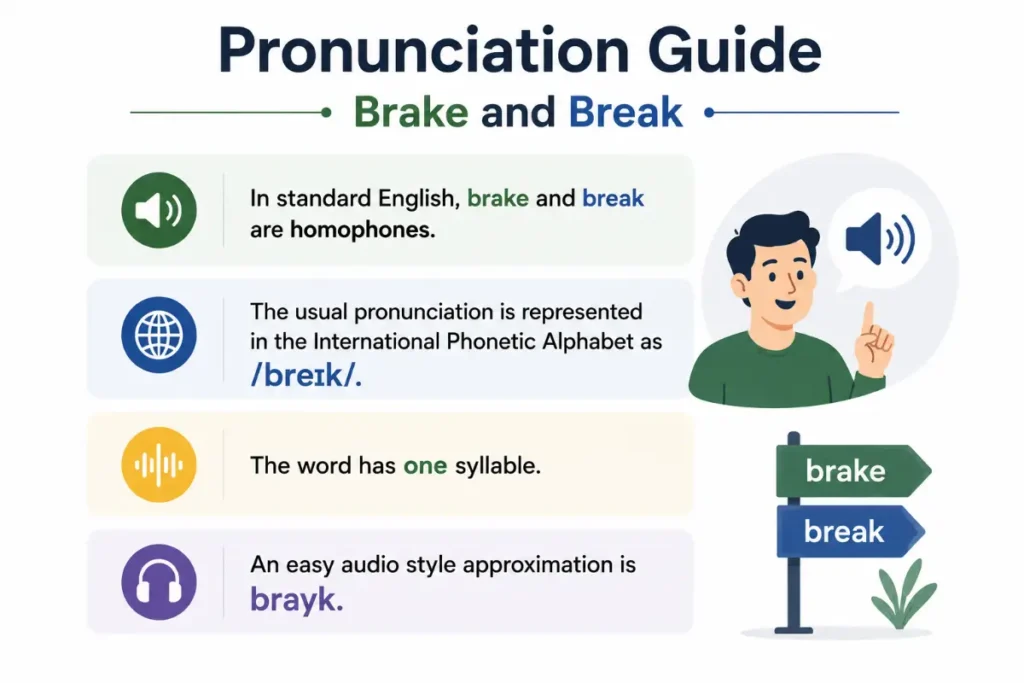
In standard English, brake and break are homophones.
The usual pronunciation is represented in the International Phonetic Alphabet as /breɪk/.
The word has one syllable.
An easy audio style approximation is brayk.
The vowel sound is the same long A sound found in words such as make, take, and cake.
A common pronunciation mistake is less about saying the word incorrectly and more about assuming that pronunciation reveals spelling. It doesn’t.
If someone says, “Check the brake,” you cannot determine from the sound alone if they mean brake or break. You need the surrounding meaning.
That is one reason homophones create so many spelling errors. The listener receives the sound but must retrieve the correct written form from context.
Etymology and Word Origin
The two words have separate histories.
Brake developed through historical forms associated with mechanisms used to restrain or control motion. English adopted the term for a device that stops or slows movement, and the modern automotive meaning developed from that general concept.
The history of break is much older in English. It traces back to Old English forms associated with breaking, fracturing, dividing, or destroying something. Related forms appear across Germanic languages.
Their separate origins help explain why the words have different meanings despite their identical pronunciation.
English has accumulated thousands of words from Old English, Old Norse, French, Latin, and other sources. As those words developed over centuries, pronunciation changed. In some cases, words that originally differed in sound eventually became homophones.
That historical process created many modern spelling traps.
Regional Usage in the US
American English uses brake and break according to their standard meanings. There is no American spelling reform that treats the two as interchangeable.
In automotive writing, American readers expect brake system, brake pedal, and brake fluid. In manufacturing contexts, press brake is also established terminology.
American writers should therefore choose the form according to meaning rather than pronunciation.
Regional Usage in the UK
British English follows the same basic distinction.
A British writer uses brake for a vehicle braking mechanism and break for fracture or separation.
Differences between American and British English can affect many spellings, such as color and colour, but this is not one of those cases. The distinction between brake and break remains consistent.
Regional Usage in Australia
Australian English also maintains the standard distinction.
Automotive and engineering contexts use brake for braking equipment. Break remains the appropriate verb or noun when the meaning involves damage, fracture, interruption, or separation.
Australian English can have vocabulary differences from American English, but those differences do not create an alternative spelling in this case.
Regional Usage in Canada
Canadian English likewise distinguishes the two words.
Canadian writers generally follow the same semantic rule used in American and British English. A braking mechanism takes brake, while fracture or damage takes break.
So, readers in the US, UK, Australia, and Canada can rely on the same basic rule.
Grammar Rules and Part of Speech
Brake works as both a noun and a verb.
As a noun, it names a device or mechanism.
Example: The brake needs inspection.
As a verb, it describes the action of slowing or stopping.
Example: The driver braked suddenly.
The related adjective appears in compounds such as brake pedal and brake system.
Break has even broader grammatical use.
As a verb, it can mean to fracture something.
Example: The machine broke the metal.
It can also mean to become fractured.
Example: The metal broke under pressure.
As a noun, break can describe an interruption or period of rest.
Example: We took a short break.
The grammatical role therefore provides another clue. If the sentence describes a mechanism for stopping motion, brake is probably the intended form. If it describes fracture or interruption, break is likely correct.
Real Life Usage Examples
Daily Talk
“I need to get my brake checked before the trip.”
“The metal could break if you bend it too far.”
These examples show how meaning controls spelling even when pronunciation stays the same.
“The mechanic found damage near the rear brake assembly.”
“The technician reported that the metal may break under excessive pressure.”
Both forms work naturally in professional communication because the context makes the meaning clear.
Academic Writing
“Brake systems rely on friction to reduce mechanical motion.”
“Repeated stress can cause a metal component to break.”
Academic writing benefits from precise terminology. Using the wrong homophone can make a technical statement appear careless.
News Writing
“Investigators examined the vehicle’s brake system after the crash.”
“Engineers determined that the metal had broken under extreme force.”
News writing normally favors direct, familiar vocabulary, so the distinction is straightforward.
Literature
“The old brake groaned as the carriage slowed.”
“The thin piece of metal broke beneath his hand.”
Creative writing can use either word naturally as long as the intended meaning remains clear.
Expert Editor Insight
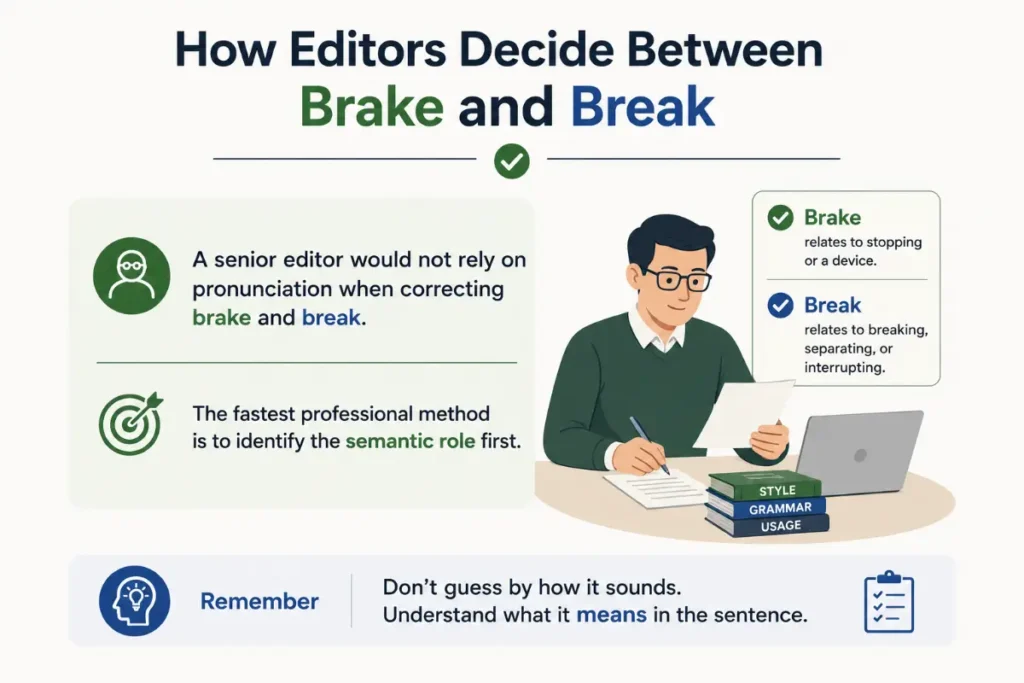
A senior editor would not rely on pronunciation when correcting brake and break. The fastest professional method is to identify the semantic role first. Ask what the word is doing in the sentence. If it refers to stopping or controlling movement, choose brake. If it refers to fracturing, damaging, separating, or interrupting, choose break. Spellcheckers can catch some mistakes, but context based tools may miss them because both forms are legitimate English words. That is why a human style check remains valuable. The best editing rule is simple: meaning first, spelling second.
Conclusion
Brake metal or break metal depends on what you mean. Use brake for something connected with stopping, braking equipment, or a metalworking brake. Use break when you mean that metal fractures, snaps, separates, or becomes damaged. The words sound the same in most English varieties, but their meanings are completely different.
The safest way to choose the spelling is to ignore the sound and examine the sentence. Ask yourself whether you are talking about stopping or about breaking. That simple meaning based test works in automotive writing, manufacturing, technical documents, emails, and everyday communication.
One practical tip can prevent most errors: connect brake with stopping and break with damage or separation. Once that association becomes automatic, this common homophone confusion becomes much easier to avoid.
FAQs
Is brake metal or break metal correct?
Both forms can be grammatically possible, but they communicate different meanings. Brake metal can refer to metal associated with a braking system or metal being shaped with a brake machine. Break metal can describe an action or situation involving metal that fractures. In many everyday sentences, more precise wording such as broken metal or metal brake component will sound more natural.
What does brake metal mean?
Brake metal is not one of the most common fixed phrases in everyday English. Its meaning depends on context. It can refer to metal components associated with a brake system or metal being formed with a metalworking brake. In technical writing, the surrounding terminology usually makes the intended meaning clear. Writers should use more specific terms when precision matters.
Brake metal or break metal which is correct?
The correct form depends on the intended meaning. Use brake when the context involves stopping, slowing, braking equipment, or a machine used to form sheet metal. Use break when the meaning involves fracturing, snapping, splitting, or damaging metal. The two words are homophones, so pronunciation alone cannot determine the correct spelling.
How do you pronounce brake and break?
Both brake and break are normally pronounced /breɪk/. They have one syllable and rhyme with words such as make, take, and cake. Because they sound the same, listeners cannot determine the spelling from pronunciation alone. You must use the meaning and surrounding words to select the correct written form.
Can brake start a sentence?
Yes. Brake can begin a sentence when it functions as a noun or verb. For example, “Brake failure caused the vehicle to stop responding normally” uses the word as part of a noun phrase. “Brake gently before entering the curve” uses it as a verb. Starting a sentence with brake is grammatically acceptable when the sentence structure supports it.
What is a synonym for break?
The best synonym depends on the meaning. When break means fracture, alternatives include crack, split, shatter, or fracture. When it means interrupt, alternatives include interrupt, pause, or disrupt. When it means stop functioning, words such as fail or malfunction may work. Context determines which replacement sounds natural and accurate.
Why do people confuse brake and break?
People confuse them mainly because they are homophones. They sound the same in most varieties of English, even though their meanings and spellings differ. English spelling also contains many historical inconsistencies, so sound does not always provide a reliable spelling clue. Writers who hear the word before writing it can easily select the wrong form.
Is brake appropriate in formal writing?
Yes. Brake is completely appropriate in formal, academic, technical, and professional writing when it expresses the correct meaning. It is standard English terminology in automotive engineering, transportation, and manufacturing. The same applies to break when the intended meaning involves fracture, separation, interruption, or failure. Formal writing requires semantic accuracy, not avoidance of either word.
