
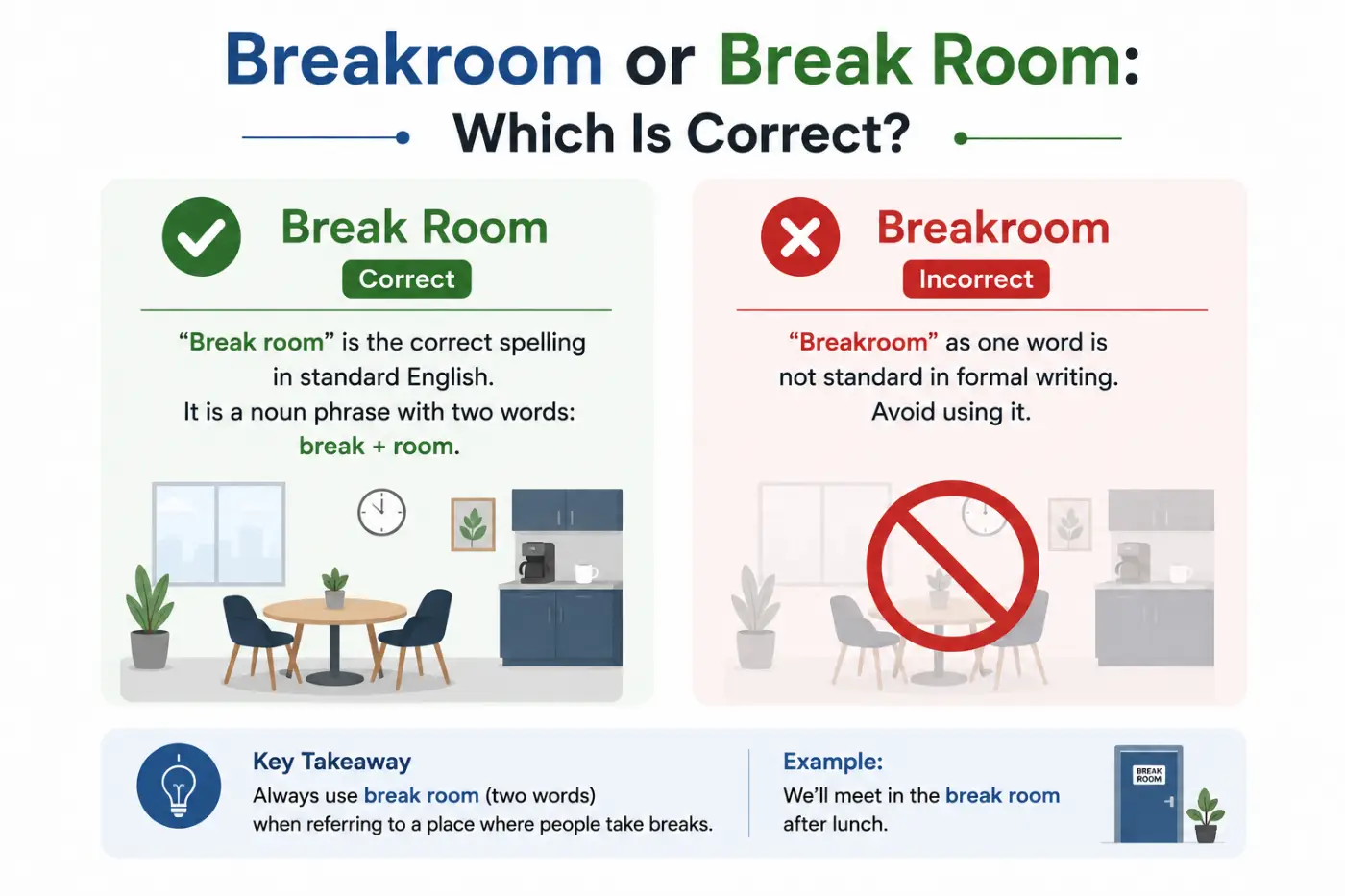
If you’ve ever typed the name of a workplace lounge and paused over the space, you’re not alone. Breakroom or break room can look like a tiny spelling choice, but compound nouns often create exactly this kind of uncertainty. The short answer is that break room is the standard preferred form in American English, while breakroom is an accepted but less common variant. Merriam Webster lists break room as the main form and identifies breakroom as a less common variant.
The confusion comes from English compound nouns. Some combinations become closed words over time, such as bedroom, classroom, and bathroom. Others remain open combinations, such as dining room, waiting room, and break room. Because English doesn’t always provide a simple rule for predicting when two words should join, writers often hesitate when they encounter a newer or workplace related compound.
In this guide, you’ll learn exactly how the expression works, what it means, how to pronounce it, why the closed spelling appears in real writing, and which version makes the safest choice in professional English. You’ll also see examples from everyday conversation, email, academic writing, news writing, and other contexts so you can use the term naturally and confidently.
Featured Snippet Section
Break room is the standard preferred spelling for a workplace room where employees rest, eat, drink, or socialize during breaks. Breakroom is also recognized in American English as a less common variant. For formal or polished writing, break room is generally the safest choice because it follows the main dictionary form.
Quick Answer
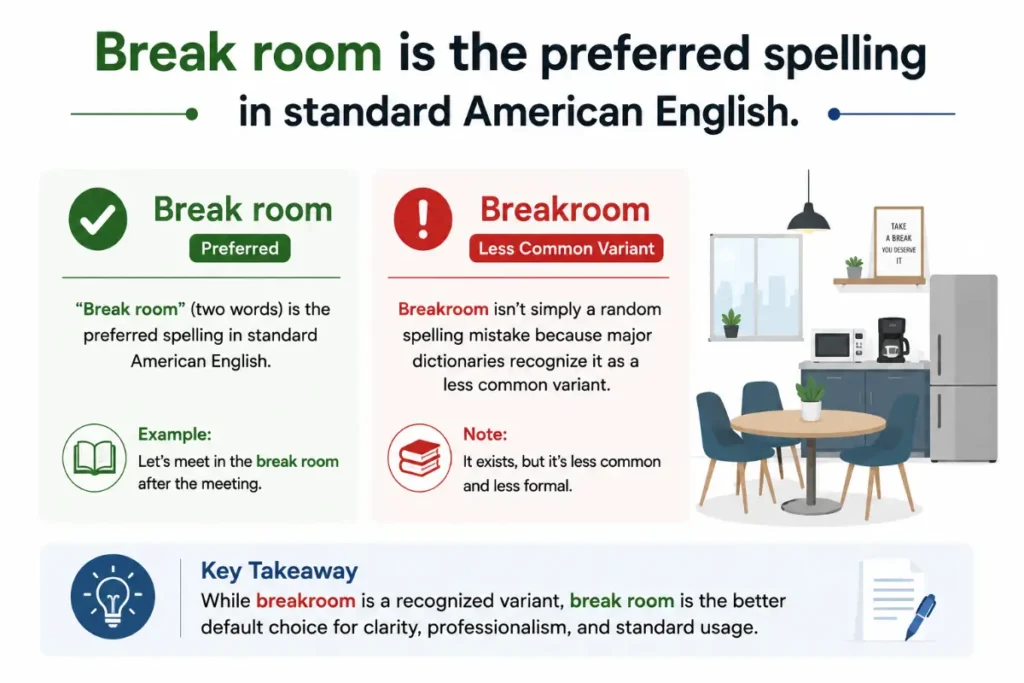
Break room is the preferred spelling in standard American English. Breakroom isn’t simply a random spelling mistake because major dictionaries recognize it as a less common variant, but the two word form is the better default for professional writing.
If you’re writing an email, report, employee handbook, article, or formal document, choose break room unless your organization’s established style specifically uses breakroom.
Comparison Table
| Correct Form | Meaning | Part of Speech | Origin | Usage Frequency | Formality | Common Contexts | Example |
|---|---|---|---|---|---|---|---|
| Break room | A workplace room used for rest or refreshments | Noun | Break plus room | More common and preferred | Standard and professional | Offices, workplaces, schools, hospitals | Employees gathered in the break room during lunch. |
| Breakroom | A workplace room used during a work break | Noun | Break plus room | Less common variant | Standard but less preferred | Workplace writing and informal usage | The new breakroom has a coffee machine. |
Meaning and Definition
Meaning of Breakroom
Breakroom is a recognized closed form of the noun referring to a room where employees can rest, eat, drink, or socialize during a work break. It isn’t merely a typing error. Merriam Webster specifically lists breakroom as a less common variant of break room. That distinction matters. Calling the closed form simply “wrong” would be too absolute because established dictionary usage recognizes it. Dictionary.com also lists breakroom as an American noun and gives break room as an alternative form. Its definition describes a workplace room set aside for employees during breaks. So, if you see breakroom in an office document, website, newspaper article, or workplace sign, don’t assume the writer has made a basic spelling error. The form exists. It simply isn’t the preferred form in every style context.
Meaning of Break Room
Break room refers to a room in a workplace where employees can take a short rest or have refreshments. Merriam Webster defines it as a room in a workplace where an employee can go for a short period of rest or refreshment. The expression is especially common in American English. A break room might contain tables, chairs, a refrigerator, a microwave, a coffee maker, vending machines, or other facilities employees can use during their scheduled breaks. The meaning is straightforward because the compound combines two familiar words. Break refers to a period away from work, while room refers to a designated physical space. The phrase can also refer to the room itself in everyday workplace speech. For example, someone might say, “I’ll meet you in the break room.” That sentence doesn’t mean the person is taking a break at that exact moment. It simply identifies the location.
Key Differences Explained
- Spelling. The preferred form is written as two words: break room. The closed form breakroom is also recognized, but it is less common in major American dictionary treatment.
- Grammar role. Both forms function as nouns. They identify a particular type of room rather than describing an action.
- Meaning. There is no meaningful difference in definition. Both forms refer to a workplace room used for breaks, rest, food, or refreshments.
- Tone. Break room generally feels more conventional and editorially safe. Breakroom can feel more compact and may appear in informal workplace writing or organizational naming.
- Context. In a polished report, handbook, or formal article, break room is usually the better choice. In a company sign, internal system, or established brand name, breakroom may be completely appropriate.
Which Spelling Is Correct?
The best answer isn’t that one form exists and the other doesn’t. Break room is the preferred standard form, while breakroom is an accepted less common variant. Merriam Webster’s dictionary entry places break room first and describes breakroom as a less common variant. It also gives the plural forms break rooms and breakrooms. That dictionary treatment gives writers a useful editorial rule. When two forms are recognized but one is presented as the main entry and the other as less common, use the main form when you want the safest general choice. This is especially useful when you’re writing for a broad American audience. A professional editor doesn’t need to treat every less common variant as an error. Instead, the editor considers frequency, dictionary status, audience expectations, house style, and consistency. An important distinction also exists between break room and unrelated compounds such as breakout room. A breakout room is a separate meeting or discussion space, especially one used for smaller groups.
Sentence Examples
Here are natural examples using the preferred form break room.
- The employees gathered in the break room after the meeting.
- I left my lunch in the break room refrigerator.
- Our manager asked everyone to keep the break room clean.
- The company renovated the break room last summer.
- She went to the break room to make a cup of coffee.
- The new office has a bright and comfortable break room.
- Please don’t leave dirty dishes in the break room sink.
- We usually eat lunch together in the break room.
- The maintenance team installed a new refrigerator in the break room.
- He ran into his coworker in the break room before the afternoon meeting.
The following examples show breakroom as a variant rather than treating it as a nonexistent word.
- The new breakroom includes a large coffee station.
- Employees decorated the breakroom for the holiday party.
- The company added more seating to the breakroom.
- A notice was posted on the breakroom refrigerator.
- The breakroom became a popular place for informal conversations.
The important point is consistency. If your document uses break room, don’t switch randomly to breakroom later unless a proper name or organizational convention requires it.
Common Mistakes and Misspellings
Several mistakes appear when writers aren’t sure how to handle this compound noun.
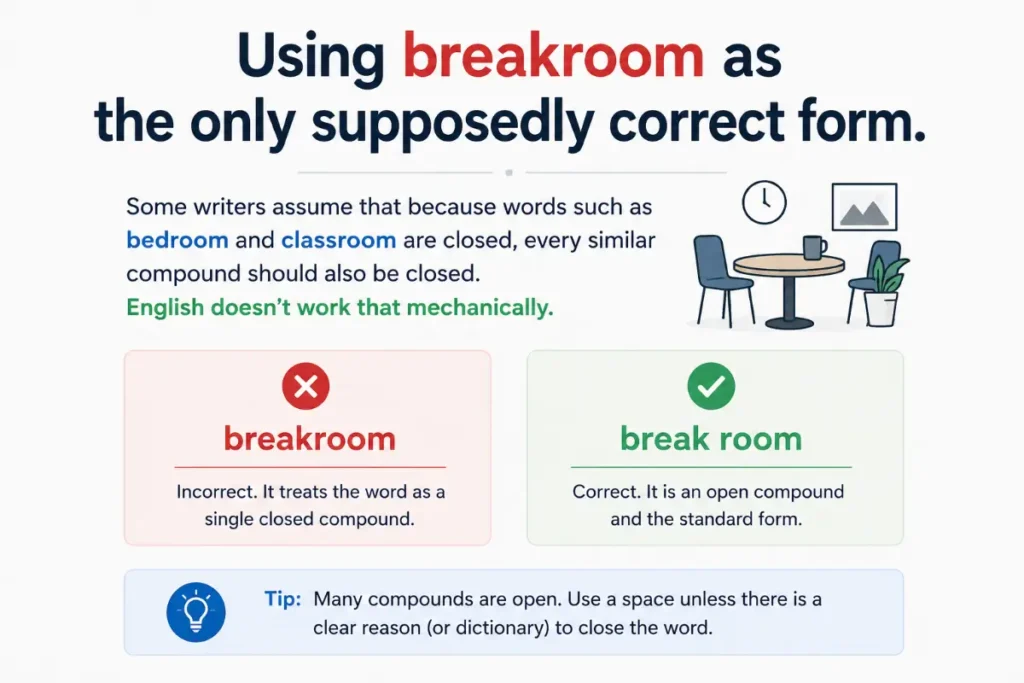
- Using breakroom as the only supposedly correct form. Some writers assume that because words such as bedroom and classroom are closed, every similar compound should also be closed. English doesn’t work that mechanically.
- Calling breakroom completely incorrect. This goes too far. Major dictionary evidence recognizes it as a less common variant.
- Writing break room as two words in one paragraph and breakroom in the next. Inconsistent spelling can make otherwise polished writing look careless.
- Confusing break room with breakout room. A break room is for taking a work break. A breakout room is generally a smaller meeting or discussion space.
- Capitalizing the expression unnecessarily. In ordinary prose, it should normally be lowercase unless it begins a sentence or appears in a formal name.
Why do people type breakroom so naturally? Part of the answer comes from the way English processes compound nouns. Readers often recognize common workplace concepts as single semantic units. Once a phrase becomes familiar, speakers may mentally process it as one word even when standard editorial spelling keeps the components separate. This is an example of lexical and orthographic variation. The meaning is stored as a familiar concept, while the written form can vary. Similar patterns occur with many English compounds. Language users don’t always make spelling decisions by consciously applying a rule. They often rely on patterns they’ve encountered before. That explains why breakroom can feel perfectly natural even when break room remains the preferred written form.
Pronunciation Guide
The pronunciation is essentially the same for both spellings. The common American pronunciation can be represented as: /ˈbreɪk ˌruːm/ The expression has two main spoken parts: break room A simple audio style approximation is: BRAYK ROOM The first word carries the strongest stress, while room receives secondary emphasis in normal speech.
There is no special pronunciation difference caused by closing the compound in writing. Someone saying breakroom and someone saying break room will normally sound the same. The word break contains the long A sound heard in words such as make and take. The word room contains the vowel sound heard in bloom and soon for many American speakers. A common mistake isn’t really a pronunciation error. It’s assuming that the spelling determines a different spoken form. It doesn’t. The distinction is primarily orthographic.
Etymology and Word Origin
The expression is a straightforward modern compound made from break and room. The word break has a long history in English and developed many meanings connected with interruption, separation, pause, and rest. The noun sense involving a short period away from work developed from the broader idea of an interruption or pause in activity. The word room is much older. Merriam Webster traces the noun to Middle English and Old English rūm, with related Germanic forms. Its earliest English uses referred broadly to space or an area and later developed the familiar meaning of a partitioned part of a building. When the two words combine, the meaning becomes highly transparent. A break room is literally a room associated with a break from work.
English has created countless compounds in this way. Some remain open, some become hyphenated, and some eventually become closed. The spelling often reflects historical usage and convention rather than a perfectly predictable grammatical formula. That’s why it would be risky to argue that the expression must be closed simply because English has other closed compounds ending in room. Words such as bedroom, classroom, bathroom, and workroom are established closed compounds. Meanwhile, English also uses open forms such as waiting room, dining room, and break room. The spelling of a compound is therefore partly a matter of established lexical convention.
Regional Usage
United States
American English commonly uses break room, particularly in professional and workplace writing. Merriam Webster gives break room as the principal form and identifies breakroom as less common. Dictionary.com also recognizes both forms. For American readers, break room is the safest general choice when you’re writing an employee handbook, business article, email, report, or other polished material.
United Kingdom
British English can use expressions such as staff room, break room, common room, or canteen, depending on the workplace and setting. The exact vocabulary can differ from American workplace terminology. A British reader will understand break room, but staff room may sound more natural in some institutional contexts, especially schools and certain workplaces. This is more a vocabulary preference than a fundamental difference in meaning.
Australia
Australian English also uses several expressions for workplace spaces where employees rest or eat. Break room is understandable, while terms such as staff room or lunch room may appear depending on the setting. The closed form breakroom shouldn’t be treated as a special Australian spelling. The major spelling question remains one of compound word convention rather than a simple US versus UK rule.
Canada
Canadian English can use break room in workplace contexts, and the meaning is readily understood. Canadian writing may reflect a mixture of American and British vocabulary and editorial conventions. There isn’t a strong reason to treat breakroom as a uniquely Canadian form. If you’re writing for a broad Canadian audience, break room remains a clear and conventional choice.
Grammar Rules and Part of Speech
Break room functions as a noun. More specifically, it is a compound noun made from break and room. The expression names a place rather than an action. You can use it after a preposition. She left her notebook in the break room. You can also modify it with an adjective. The small break room was crowded. The expression doesn’t require capitalization in ordinary prose. Correct: Employees ate lunch in the break room. Incorrect unless it is part of a proper name: Employees ate lunch in the Break Room. When used as a plural noun, the preferred open form becomes break rooms. The building has three break rooms. The closed variant can form breakrooms, but again, the open plural is the safer default for general professional writing. Merriam Webster specifically records both plural patterns. There is no special punctuation rule associated with the phrase. You don’t need a hyphen when it functions as the ordinary noun. For example: The employees cleaned the break room. You wouldn’t normally write: The employees cleaned the break-room. A hyphen can become relevant in unusual attributive constructions depending on sentence structure and style, but ordinary use doesn’t require one.
Real Life Usage Examples
Daily Talk
Example one: I’m going to the break room to grab some water. Example two: I’ll meet you in the break room after lunch. These examples sound natural because workplace speakers usually treat the expression as a familiar location.
Example one: The updated safety notice is posted in the break room. Example two: Please remember to remove your food from the break room refrigerator by Friday. In workplace email, the open form gives your writing a conventional and polished appearance.
Academic Writing
Example one: Employees reported that informal conversations often occurred in the break room. Example two: The study examined how shared spaces such as the break room influenced workplace interaction. Academic writing benefits from consistent terminology. If you’re conducting research on workplace behavior, choose one spelling and maintain it throughout the paper.
News Writing
Example one: Workers gathered in the break room after receiving the announcement. Example two: The company said the renovated break room would reopen next week. News writing typically favors familiar standard forms because the goal is immediate clarity.
Literature
Example one: She sat alone in the break room, listening to the rain outside. Example two: By noon, the break room had become the quietest place in the building. Creative writing gives authors more flexibility, but the standard open spelling remains a natural choice. One additional term deserves attention: breakout room. It isn’t a synonym for break room. A breakout room is commonly a smaller physical or virtual meeting space used for discussion, collaboration, or group work. Cambridge Dictionary gives this meaning for the term. That distinction can prevent a surprisingly common workplace misunderstanding.
Expert Editor Insight
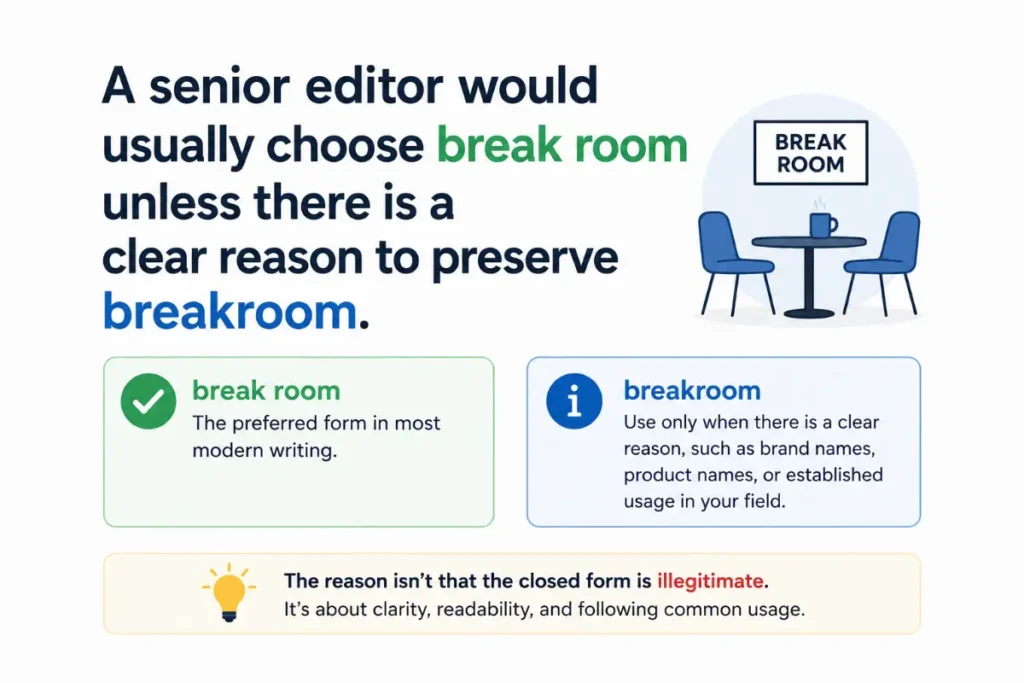
A senior editor would usually choose break room unless there is a clear reason to preserve breakroom. The reason isn’t that the closed form is illegitimate. It is that dictionary convention, frequency, audience expectations, and editorial consistency all favor the open form as the safer general choice. Merriam Webster’s treatment is especially useful because it doesn’t falsely reduce the issue to right versus wrong. It identifies the main form and acknowledges the variant.
An expert tip is simple: when a compound noun has competing forms, don’t rely only on what looks visually natural. Check the dictionary treatment and then follow one form consistently throughout the document.
Grammar and spell checking tools may flag breakroom in some contexts, while other tools may accept it. That difference doesn’t automatically prove that the closed form is incorrect. Automated tools often depend on a particular dictionary, style guide, or language model. A professional editor looks beyond the red underline and considers actual lexical evidence.
Conclusion
Breakroom or break room isn’t a case where one spelling is simply real and the other is automatically wrong. Break room is the preferred standard form, while breakroom is recognized as a less common variant. Both refer to the same workplace space where employees can rest, eat, drink, or socialize during a work break. Major dictionary treatment supports this distinction rather than treating the closed form as a meaningless typo.
For everyday conversation, you’ll encounter both forms, and the meaning will remain clear. For professional writing, however, choosing the main dictionary form gives you the safest and most conventional result. The same principle applies to many English compounds: don’t assume that similar meanings automatically produce identical spelling patterns. Established usage matters.
The practical tip is easy to remember. Use break room as your default, especially in polished writing, and keep your spelling consistent throughout the document. If your workplace has an official style that uses breakroom, follow that established convention. Good editing isn’t about declaring every variation wrong. It’s about choosing the clearest, most defensible form for your audience and context.
FAQs
Is breakroom a real word?
Yes. Breakroom is a recognized word in American English. It refers to a workplace room where employees can rest, eat, drink, or socialize during a break. Major dictionary evidence supports the form, although Merriam Webster identifies breakroom as a less common variant of break room. For general professional writing, the open form remains the safer choice.
What does break room mean?
Break room means a room in a workplace where employees can take a short break, eat, drink, rest, or socialize. It may contain tables, chairs, a refrigerator, microwave, coffee machine, or other basic facilities. The expression is a compound noun made from break and room, and it usually refers specifically to an employee area.
breakroom or break room which is correct?
Break room is the preferred form in standard American English, while breakroom is an accepted less common variant. Therefore, both forms can be found in real writing, but they aren’t equally preferred. If you’re writing a professional email, report, article, handbook, or academic paper, break room is the better default.
How do you pronounce break room?
Break room is commonly pronounced /ˈbreɪk ˌruːm/ in American English. A simple pronunciation guide is BRAYK ROOM. The spelling difference between break room and breakroom doesn’t normally create a difference in pronunciation. Both forms refer to the same workplace concept and are generally spoken the same way.
Can break room start a sentence?
Yes. Break room can appear at the beginning of a sentence when it functions as the subject. For example, you can write, “The break room needs new chairs.” You can also begin a sentence with a longer phrase containing it, such as “After lunch, the break room became unusually quiet.” There is no grammatical restriction against sentence initial use.
What is a synonym for break room?
Depending on the workplace, possible alternatives include staff room, lunch room, employee lounge, staff lounge, rest area, common room, or canteen. These terms aren’t perfect synonyms in every setting. A canteen, for example, may be primarily a place where food is served, while a break room specifically emphasizes employee rest and breaks.
Why do people misspell or close break room?
People often write breakroom because English contains many familiar closed compounds ending in room, including bedroom, classroom, bathroom, and workroom. Once speakers recognize a phrase as one concept, they may naturally write it as one word. In this case, that instinct isn’t completely unreasonable because dictionaries recognize the closed variant.
Is break room suitable for formal writing?
Yes. Break room is entirely suitable for formal writing and is usually the preferred choice. It works well in business reports, employee handbooks, academic papers, news articles, workplace policies, and professional correspondence. If your organization officially uses breakroom as part of its internal terminology or branding, consistency may take priority. Otherwise, the open form is the safest editorial choice.
