
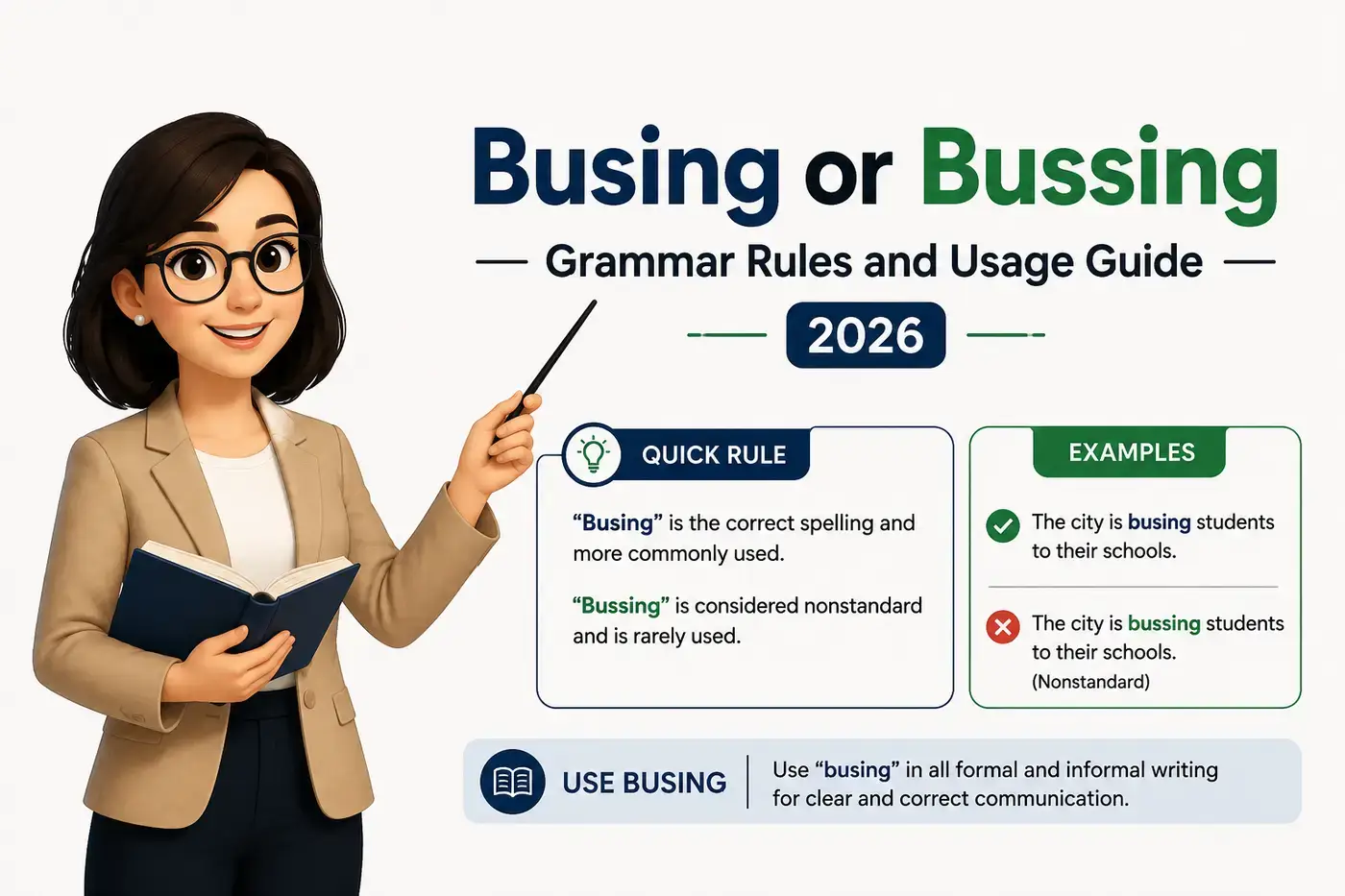
If you’ve ever typed the present participle of bus and stopped to wonder if one or two s’s belong in the word, you’re not alone. The correct answer is that busing and bussing can both be correct, but their use depends on meaning, regional style, and the verb involved. For transportation by bus, busing is especially common in American English, while bussing also appears as an accepted variant.
The confusion comes from a simple spelling rule that doesn’t always feel simple. When a short verb ends in a consonant and vowel pattern, English often doubles the final consonant before adding an ending such as ing. That rule explains forms such as running and sitting, but bus has developed more than one established spelling.
This guide explains the difference clearly. You’ll learn when to use each form, how dictionaries treat them, how pronunciation works, what changes in British and American English, and how to avoid common mistakes. You’ll also see practical examples from everyday conversation, professional writing, academic contexts, and journalism.
Featured Snippet Quick Definition
Busing and bussing are both established spellings, but they don’t always mean the same thing. Busing commonly refers to transporting people by bus, especially in American English. Bussing can also describe transportation by bus, while it is commonly used for serving or clearing tables in restaurants. Context determines the intended meaning.
Quick Answer
Both busing and bussing are legitimate spellings. When you mean transporting people by bus, busing is a common American English choice, while bussing is also found as a variant. When you mean working in a restaurant by clearing or serving tables, bussing is the usual spelling because that word comes from the verb buss in that particular sense.
Comparison Table Busing or Bussing
| Correct Form | Meaning | Part of Speech | Origin | Usage Frequency | Formality | Common Contexts | Example |
|---|---|---|---|---|---|---|---|
| Busing | Transporting people by bus | Present participle or gerund | bus + ing | Very common in American English | Standard | School transportation, public transit, travel | The district is busing students to another school. |
| Bussing | Transporting people by bus or clearing and serving tables | Present participle or gerund | bus + ing or buss + ing | Common in several contexts | Standard | Transportation, restaurants, hospitality | She is bussing tables after lunch. |
Meaning and Definition
Meaning of Busing
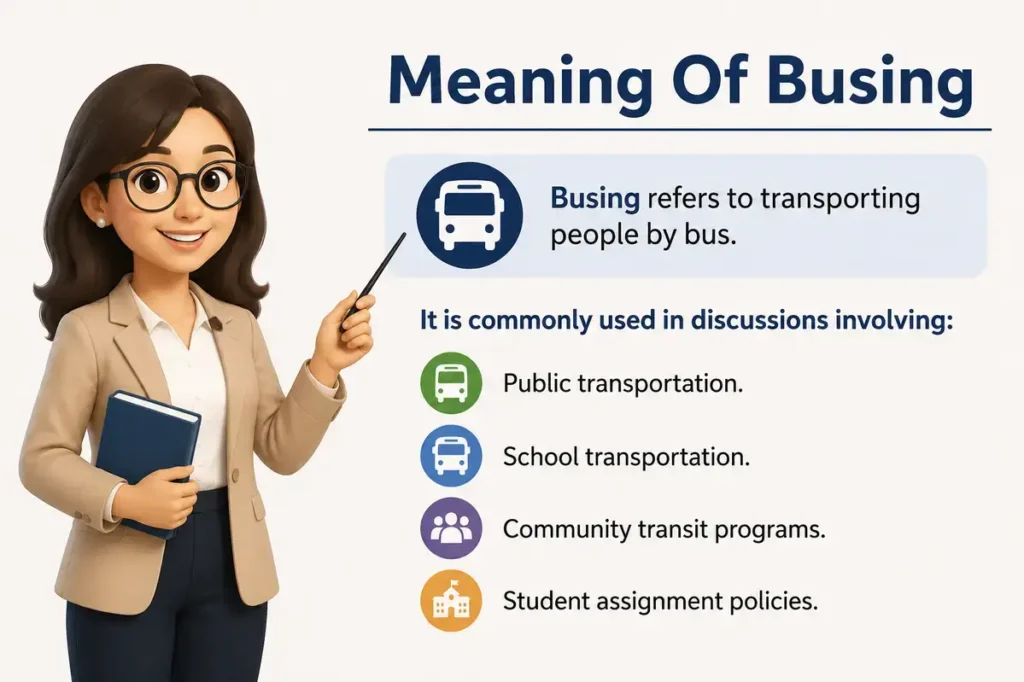
Busing is the present participle or gerund form of bus. As a verb, bus means to transport someone by bus.
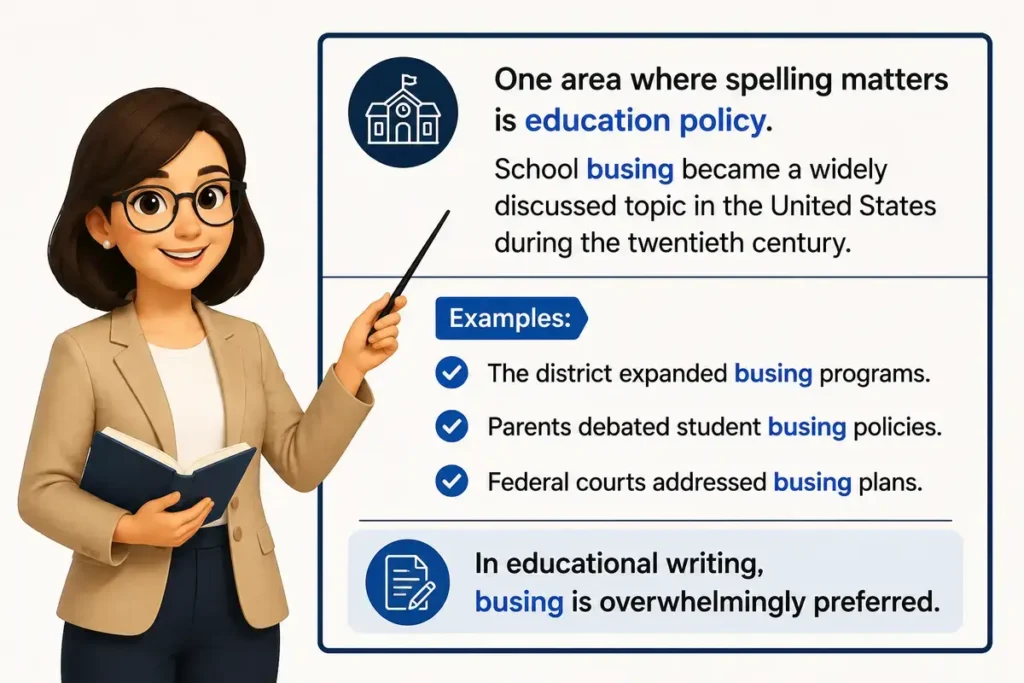
For example, a school district might bus students to a different campus. A travel company might bus passengers from one terminal to another. A city could bus residents to an emergency shelter. The word also has an important historical and social meaning in American English. Busing can refer to transporting students by bus as part of school integration policies. This use became especially prominent in discussions about desegregation in the United States during the twentieth century. The spelling with one s is particularly common in American dictionaries and edited American prose. It avoids the visual impression that the base verb is buss, which is a different word.
Meaning of Bussing
Bussing has more than one possible meaning. First, it can function as a variant spelling of busing when the verb means transporting people by bus. This usage is found in dictionaries and published English, although regional preferences differ. Second, bussing is commonly associated with restaurant work. A person who buses or busses tables clears used plates, glasses, utensils, and other items from dining tables and may help prepare tables for new customers. This distinction can matter in context. Consider these two sentences. The school is busing students to the new campus. The restaurant is bussing tables after dinner. The first sentence concerns transportation. The second concerns restaurant service.
Key Differences Explained
- Spelling. Busing contains one s after bu, while bussing contains two. Both spellings occur in standard English, but they have different frequency patterns depending on the meaning and region.
- Grammar role. Both forms can function as present participles or gerunds. They can describe an ongoing action or act as nouns.
- Meaning. Busing most often refers to transporting people by bus. Bussing can refer to the same activity, but it is also strongly associated with clearing and serving tables.
- Tone. Neither spelling is inherently informal. The appropriate choice depends more on context and regional convention than on formality.
- Context. School transportation, public transportation, and organized travel commonly use busing. Restaurant and hospitality writing commonly uses bussing for table service.
The easiest way to avoid confusion is to identify the action first. If someone is being transported by bus, busing is a safe choice in American English. If someone is clearing restaurant tables, bussing is the conventional spelling.
Which Spelling Is Correct?
There isn’t a single answer that makes one spelling universally correct and the other universally wrong. For transportation, busing is a standard and highly recognizable spelling, particularly in American English. Major English dictionaries recognize the form. Bussing also appears as a variant for transportation, so treating it as an automatic spelling error would be too simplistic. The situation becomes clearer when the meaning changes.
The restaurant sense uses bussing very commonly. A restaurant employee may be called a busser, and the associated activity is commonly described as bussing tables. Dictionary logic is useful here because English spelling doesn’t always follow one perfectly predictable formula. The spelling of an inflected word can depend on the established history and usage of the base word. Professional dictionaries record actual language use rather than forcing every verb into one mechanical spelling pattern. As an editor, I’d recommend busing for transportation in American English unless your publication follows a style guide that prefers bussing. For restaurant service, use bussing.
Sentence Examples
Examples Using Busing
- The school district is busing students to the new campus this year.
- Busing children across town can add significant travel time to the school day.
- The city started busing residents to the temporary shelter.
- The company is busing employees from the parking lot to the main entrance.
- Parents discussed the new busing schedule at the school meeting.
- The district expanded busing services after several schools reached capacity.
- Students were tired after spending nearly an hour on the bus each morning.
- The event organizers arranged busing between the hotel and conference center.
- Busing became an important part of the city’s transportation plan.
- The school announced changes to its busing routes before the fall semester.
Examples Showing Final Misspelling Patterns
- Incorrect: The district is busing students to another campus.
Correct: The district is busing students to another campus. - Incorrect: The school provides busing for younger children.
Correct: The school provides busing for younger children. - Incorrect: Parents complained about the new busing schedule.
Correct: Parents complained about the new busing schedule. - Incorrect: The city is busing families to temporary housing.
Correct: The city is busing families to temporary housing. - Incorrect: The company offers free busing from the station.
Correct: The company offers free busing from the station.
The examples above illustrate why writers can become uncertain. In ordinary American prose, the one s spelling is entirely normal for transportation.
Common Mistakes and Misspellings
- Assuming every short verb must double its final consonant. English does have consonant doubling rules, but they aren’t applied mechanically to every word. Historical usage matters.
- Treating bussing as always wrong. This creates an unnecessary correction. Bussing is an established form and has legitimate uses.
- Using busing for restaurant service. In hospitality writing, bussing tables is the conventional expression. Writing busing tables can look unusual and may create ambiguity.
- Confusing bus with buss. The verb bus can refer to transporting people or clearing tables. The word buss can have a separate meaning connected with kissing. Context and dictionary treatment help distinguish these words.
- Changing spelling without checking the intended meaning. Writers sometimes see two s’s and assume the form must be more grammatically correct. Spelling alone doesn’t determine grammatical correctness.
The NLP confusion behind this issue is fairly straightforward. Readers recognize the visual pattern of doubled consonants from words such as running, stopping, and sitting. That pattern creates a strong expectation that bus + ing should become bussing. At the same time, people encounter busing frequently in American educational and transportation contexts. Both patterns compete in the reader’s mental vocabulary.
Pronunciation Guide
The pronunciation is essentially the same when the transportation meanings of the two spellings are intended.
Busing: /ˈbʌsɪŋ/
Bussing: /ˈbʌsɪŋ/
The word has two syllables.
BUS ing
The first syllable sounds like bus, as in the vehicle. The second syllable has the weak vowel sound commonly heard at the end of words such as running and talking.
An approximate audio style spelling for American English is:
BUS ing
The stress falls on the first syllable. The double s in bussing does not normally create a longer s sound. This is an important point for learners. The two spellings don’t normally represent two different pronunciations in the transportation sense. A common mistake is to pronounce the second part too strongly. Native speakers generally produce the ending smoothly, with the unstressed ing sound.
Etymology and Word Origin
The history of bus helps explain why its inflected forms can feel unusual. The modern English word bus is a shortened form of omnibus, a Latin word meaning something like “for all.” Omnibus became associated with public vehicles that carried many passengers. English speakers gradually shortened the term to bus. Once bus became an independent English word, speakers needed ordinary grammatical forms such as buses and bused or bussed, along with the present participle. English spelling developed through usage rather than through one central authority. As a result, different varieties and periods of English sometimes settled on different conventions. The spelling busing reflects a straightforward treatment of bus as the base verb plus the ending ing. The spelling bussing reflects the familiar English tendency to double a final consonant in certain inflected forms. The restaurant sense has its own interesting history. The verb bus, meaning to clear dishes from a table, is connected with the idea of removing dishes from a dining table. The associated noun busser developed in American restaurant English.
This is why modern readers can encounter bussing in two different contexts without the spelling necessarily representing a mistake.
Regional Usage US
American English strongly favors busing when discussing transportation by bus. You will often see it in school district announcements, newspaper articles, government documents, and discussions of student transportation. American English also commonly uses bussing for restaurant work. The phrase bussing tables is immediately recognizable to most American readers. For American professional writing, context should guide the choice. Use busing for transportation when you want the clearest conventional form. Use bussing for restaurant table service.
Regional Usage UK
British English can show greater variation in spelling conventions because British writers often follow different inflection patterns from American writers. The transportation sense is generally clear from context, and readers can understand both forms. However, local style preferences can influence which spelling appears more frequently. British English also has its own vocabulary for public transportation, including terms such as coach in contexts where American English might use bus. That difference can affect how often particular forms appear.
Regional Usage AU
Australian English follows many British influenced conventions but also has its own established vocabulary and usage patterns. Both forms can be understood, but the intended meaning remains the key factor. In formal Australian writing, a house style or institutional dictionary may determine the preferred spelling. For international audiences, consistency matters more than trying to force one spelling across every English speaking region.
Regional Usage CA
Canadian English sits between American and British traditions in many areas of vocabulary and spelling. Canadian readers will generally understand both forms in context. For transportation, busing is clear and widely recognizable. For restaurant service, bussing tables is also familiar. If you’re writing for a Canadian publication, follow the publication’s style guide when it specifies a preferred spelling.
Grammar Rules and Part of Speech
Both forms can serve as present participles. In the sentence The company is busing employees to the event, the word functions as part of the progressive verb phrase is busing. It can also function as a gerund. Busing students requires careful planning. Here, busing acts as a noun because it names an activity. The word can appear in different positions depending on the sentence structure. The district is busing students to another school. Busing students across the city takes time. The district announced a new busing policy. Punctuation isn’t normally required simply because the word appears at the beginning of a sentence. Busing students to another campus can reduce pressure on overcrowded schools. If the opening phrase contains additional information, normal comma rules apply. After reviewing the routes, the district changed its busing schedule. The spelling doesn’t change the grammatical role. The surrounding sentence determines how the participle functions.
Real Life Usage Examples
Daily Talk
My kids are busing to school this year. The organizers are busing everyone back after the concert. These examples show how the word can appear naturally in conversation about transportation.
We’re busing employees from the downtown office to the training center. Please check the updated busing schedule before Friday. Professional email generally favors the clearest form that matches the organization’s preferred style.
Academic Writing
School busing played a significant role in debates over educational equality. Researchers examined the effects of long distance busing on students and families. Academic writing often uses the term in discussions of education policy, transportation, sociology, and American history.
News Writing
The district announced expanded busing services for students living outside the new attendance zone. Officials are busing residents to shelters ahead of the storm. News writing tends to favor familiar forms that readers can process quickly.
Literature
The children watched the old buses arrive one after another. By morning, the workers were busing families toward the city center. Literary usage depends heavily on the author’s voice and the period represented in the work.
Related and Confused Terms
Several expressions overlap with the idea of reaching an endpoint or completing a sequence. They aren’t exact replacements in every sentence, so context matters.
- At last. This often emphasizes relief after waiting for something.
- Eventually. This means something happens after a period of time or a sequence of events.
- Ultimately. This focuses on the final result or conclusion.
- At the end. This refers more directly to the final position or point in a sequence.
- Conclusively. This suggests that something settles an issue decisively.
- In the end. This often introduces the final outcome after considering previous events.
- Lastly. This normally introduces the final item in an ordered discussion.
- At length. This can mean after a long period or, in another sense, in considerable detail.
These expressions are useful for semantic comparison because English words often overlap without being interchangeable. A good editor chooses the term that matches the exact relationship between events, time, and conclusion.
Expert Editor Insight
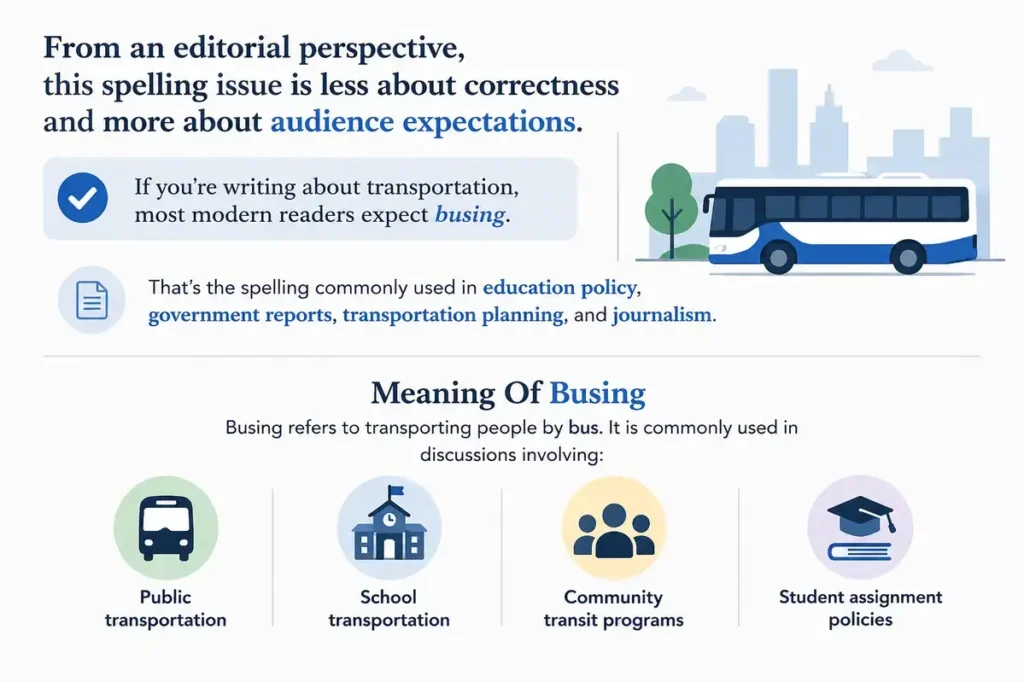
A senior editor doesn’t correct bussing automatically when it refers to transportation. The first step is to identify what the writer means. If the sentence concerns school transportation or moving passengers by bus, busing is a clean choice for American English. If the sentence concerns clearing restaurant tables, bussing is the natural form. Dictionary entries and established usage should guide the decision rather than a simplistic rule that says every doubled consonant is correct. Writing tools may flag one form because their dictionaries or regional settings favor another, so a software suggestion isn’t always the final editorial authority.
Expert Tip
If you’re writing for an American audience and the sentence concerns transporting people, choose busing unless your publication’s style guide says otherwise. If you’re describing restaurant table service, choose bussing. This simple meaning based approach prevents most errors.
Conclusion
Busing or bussing can both be correct, but context determines the better choice. For transporting people by bus, busing is especially common in American English, while bussing is also an established variant. For restaurant table service, bussing is the conventional form.
The spelling difference comes from the way English has developed different inflection patterns rather than from one universal doubling rule. That’s why assuming that every verb ending in a short consonant sound must double its final letter can lead you astray. Dictionary evidence and real usage provide a better guide.
If you’re writing for an American audience, use busing for transportation and bussing for clearing or serving tables. When in doubt, look at the meaning before looking at the spelling. That one habit will help you make the right editorial choice consistently.
FAQs
Is busing or bussing correct?
Both busing and bussing can be correct. For transporting people by bus, busing is especially common in American English, while bussing is also used as a variant. For restaurant work, bussing is the standard spelling for clearing or serving tables. The intended meaning and regional writing convention determine the best form.
What does busing mean?
Busing means transporting people by bus. It commonly appears in discussions about school transportation, public transit, organized travel, and emergency transportation. For example, “The school is busing students to another campus.” In American English, this spelling is particularly common when the word refers specifically to moving passengers by bus.
What does bussing mean?
Bussing can mean transporting people by bus, making it a variant of busing. It is also commonly used for the restaurant task of clearing used dishes, glasses, and utensils from tables. For example, “She is bussing tables after dinner.” The surrounding context usually makes the intended meaning clear.
Is busing more common than bussing?
For transportation, busing is generally the more familiar spelling in American English. However, bussing is also established and appears in published writing. In restaurant contexts, bussing is much more natural because it refers to clearing or serving tables. Regional preferences and individual style guides can also influence which form writers choose.
Why does bussing have two s’s?
Bussing follows the spelling pattern created by adding ing to the verb bus in some varieties and contexts. English has several rules involving final consonant doubling, but those rules don’t produce one universal result for every short verb. Established usage has allowed both busing and bussing to develop as accepted forms.
How do you pronounce busing and bussing?
When they refer to transportation by bus, busing and bussing are normally pronounced the same way: /ˈbʌsɪŋ/. They have two syllables, with the main stress on the first syllable. The spelling with two s’s doesn’t normally mean that the s sound is held longer.
Should I use busing or bussing in formal writing?
For American formal writing about transportation, busing is a clear and widely accepted choice. Use bussing when discussing restaurant table service. If you’re writing for a specific publication, follow its style guide. Consistency matters more than forcing one spelling into every context.
Is bussing tables the correct expression?
Yes. Bussing tables is the standard expression for clearing used dishes, glasses, utensils, and other items from restaurant tables. The related job title is commonly busser. In this context, bussing is the natural spelling. Writing “busing tables” can create confusion because readers may interpret it as transporting people by bus.
