
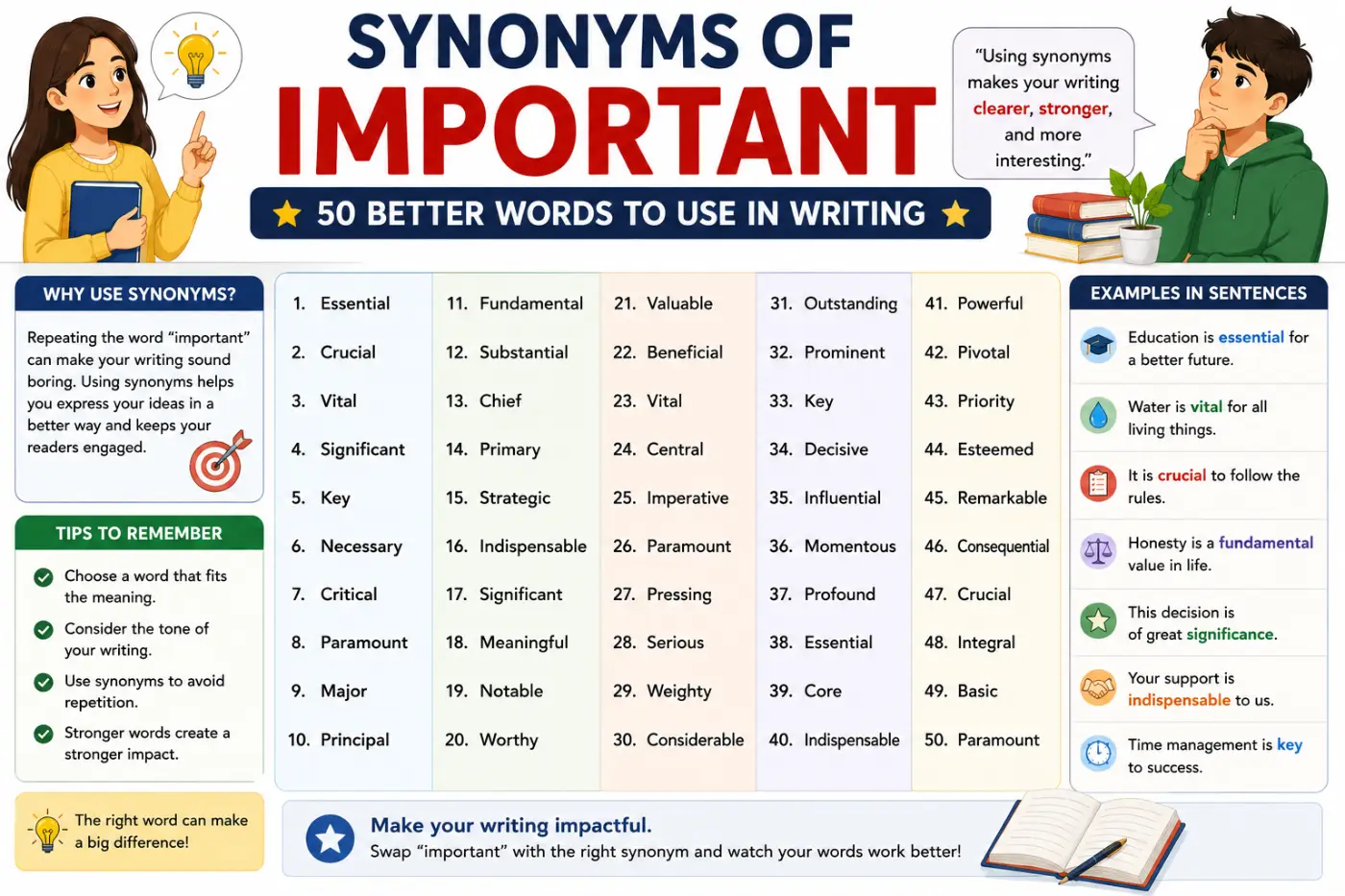
Have you ever written an email, school essay, resume, or even a text message and searched for synonyms of important because you kept using the word important over and over? It happens to almost everyone. Repeating the same word too often can make your writing feel repetitive, even when your ideas are strong.
Learning synonyms of important can make your writing more natural and engaging. The right alternative helps you express your ideas with greater clarity, match the tone of your message, and avoid unnecessary repetition.
Another way to say important depends on the context. Words like essential, significant, major, valuable, and critical can often replace it, but each has its own meaning and works best in different situations. Choosing the right one makes your writing more precise and effective.
What Does Important Mean?
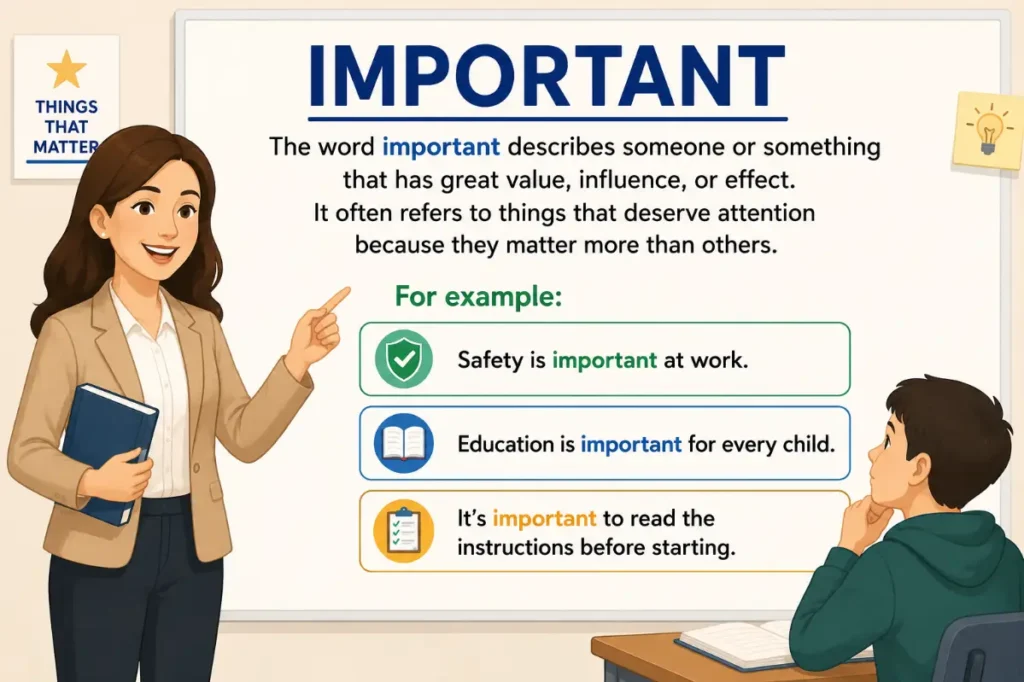
The word important describes someone or something that has great value, influence, or effect. It often refers to things that deserve attention because they matter more than others.
For example:
- Safety is important at work.
- Education is important for every child.
- It’s important to read the instructions before starting.
Although important is one of the most common English adjectives, using it repeatedly can make your writing sound repetitive. That’s why knowing several alternatives makes your vocabulary stronger.
Where Does the Word Important Come From?
The word important comes from the Latin word importare, which meant to bring in or carry into. Over time, the meaning changed from carrying something physically to carrying significance or value.
It later entered Middle French as important, meaning something that mattered greatly, before becoming part of the English language during the late sixteenth century.
Today, the word is used in almost every kind of writing, including:
- School assignments
- Business reports
- News articles
- Academic research
- Job applications
- Everyday conversations
- Social media posts
Its meaning has stayed surprisingly consistent for hundreds of years. When something is important, it deserves attention because it has value, influence, or lasting effects.
What Is Another Word for Important?
There isn’t one perfect replacement for important because every situation is different.
Sometimes you want to show necessity.
Sometimes you want to describe influence.
Other times you want to highlight value or urgency.
Here are a few of the most common choices.
| Word | Best Used For |
|---|---|
| Essential | Something absolutely necessary |
| Significant | Something meaningful or influential |
| Critical | Something extremely urgent or necessary |
| Major | Something large in importance or size |
| Valuable | Something worth appreciating |
| Meaningful | Something with emotional or personal value |
| Necessary | Something required |
| Influential | Someone or something that affects others |
| Key | A central idea or factor |
| Vital | Something needed for success or survival |
Each alternative has its own shade of meaning, which you’ll learn throughout this guide.
Master List of Synonyms of Important
The English language offers dozens of excellent alternatives to important. Some work best in everyday conversations, while others fit formal writing, professional emails, academic essays, or casual chats.
The table below introduces the first group of useful synonyms.
| Word | Meaning | Tone | Example |
|---|---|---|---|
| Essential | Absolutely necessary | Neutral | Water is essential for life. |
| Necessary | Required for a purpose | Neutral | A passport is necessary for international travel. |
| Significant | Having great meaning or effect | Formal | The study showed significant improvements. |
| Critical | Extremely important or urgent | Formal | Time is critical during emergencies. |
| Vital | Needed for success or survival | Formal | Communication is vital in every relationship. |
| Key | Main or central | Neutral | Trust is the key factor in teamwork. |
| Major | Large in importance | Neutral | The company announced a major update. |
| Crucial | Extremely important | Formal | Practice is crucial before the competition. |
| Valuable | Worth a lot | Neutral | Your feedback is valuable to us. |
| Meaningful | Having personal importance | Neutral | It was a meaningful conversation. |
| Influential | Able to affect others | Formal | She became an influential leader. |
| Prominent | Well known or noticeable | Formal | He is a prominent scientist. |
| Powerful | Having strong influence | Neutral | The speech delivered a powerful message. |
| Fundamental | Forming the basic foundation | Formal | Reading is a fundamental skill. |
| Primary | First in importance | Formal | Safety remains our primary concern. |
These words cover most professional and academic situations while giving your writing more variety than simply repeating important.
Simple Everyday Synonyms of Important
If you’re writing for friends, classmates, customers, or general readers, these alternatives usually sound the most natural.
| Word | Meaning | Example |
|---|---|---|
| Big | Having great importance | This is a big decision. |
| Key | Main or central | Teamwork plays a key role. |
| Major | Very important | We reached a major milestone. |
| Needed | Required | Your help is needed today. |
| Valuable | Worth having | Experience is valuable. |
| Useful | Helpful | That’s useful information. |
| Special | Different in a meaningful way | Today is a special day. |
| Meaningful | Full of value | They had a meaningful discussion. |
These words are common in everyday American English because they’re easy to understand without sounding too formal.
Formal Synonyms for Professional Writing
Business emails, resumes, reports, and academic papers often require stronger vocabulary. These words sound polished without becoming difficult to read.
| Word | Best Context | Example |
|---|---|---|
| Significant | Research, reports | The project achieved significant growth. |
| Critical | Business, healthcare | Critical thinking improves decisions. |
| Essential | Instructions, education | Training is essential for new employees. |
| Fundamental | Education, science | Respect is a fundamental value. |
| Integral | Professional writing | Communication is an integral part of leadership. |
| Instrumental | Achievements | She was instrumental in completing the project. |
| Paramount | Legal and formal writing | Customer safety is of paramount importance. |
| Pivotal | Turning points | The meeting played a pivotal role in the agreement. |
These words are excellent choices when you want your writing to sound more professional and precise.
Casual and Modern Alternatives
In relaxed conversations, text messages, and social media, people often choose shorter or more conversational words.
| Word | Meaning | Example |
|---|---|---|
| Huge | Extremely important | That’s a huge opportunity. |
| Big deal | Something important | Graduation is a big deal. |
| Serious | Deserving attention | This is a serious issue. |
| Must have | Absolutely needed | A map is a must have for hikers. |
| Top | Highest priority | That’s my top concern. |
| Worth it | Valuable enough | The extra practice is worth it. |
These expressions sound natural in conversations but usually aren’t suitable for academic or professional documents.
Which Synonym Should You Choose?
Not every synonym works in every sentence. The best choice depends on what you want your reader to understand.
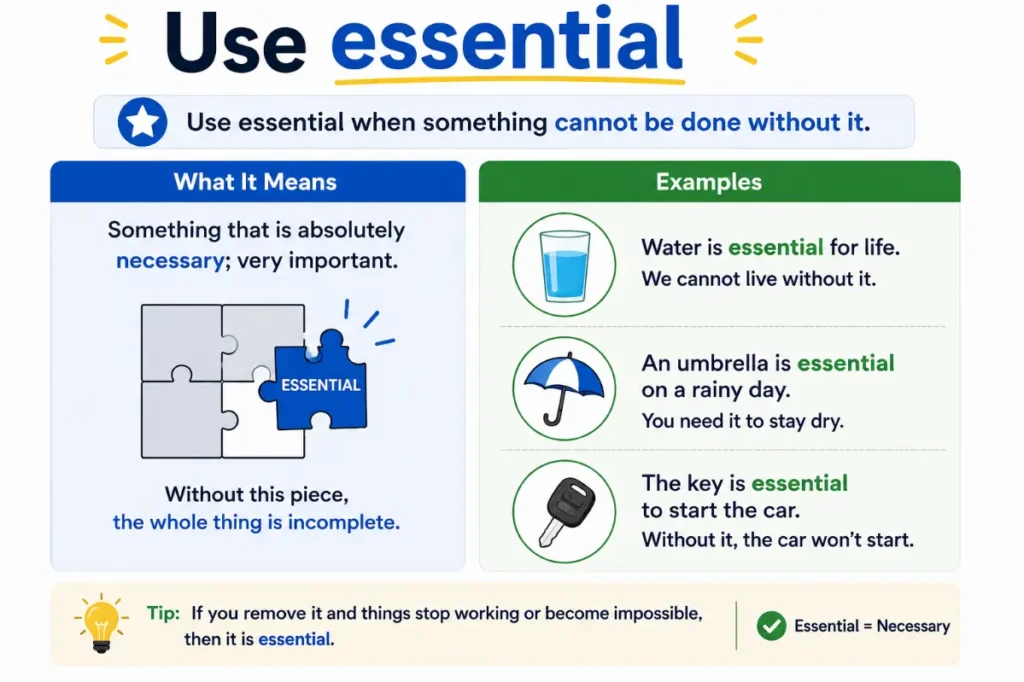
- Use essential when something cannot be done without it.
- Use critical when the situation is urgent or extremely serious.
- Use significant when discussing results, research, history, or statistics.
- Use valuable when talking about usefulness or worth.
- Use meaningful when describing emotions, memories, or personal experiences.
- Use major for large events, changes, or achievements.
- Use key when describing the main reason or central factor.
- Use vital when success, health, or survival depends on something.
Choosing the right word makes your writing more accurate instead of simply sounding more advanced.
Why Learning Synonyms Makes Your Writing Better
Expanding your vocabulary does much more than avoid repetition. It helps readers understand exactly what you mean. Some words express urgency. Others show emotional value. Some highlight influence, while others emphasize necessity.
For example, compare these two sentences.
- It is important to arrive early.
- It is essential to arrive early.
The second sentence feels stronger because essential tells readers that arriving early isn’t just helpful. It’s required.
Likewise, compare these examples.
- She made an important discovery.
- She made a significant discovery.
The second version sounds more natural because significant is commonly used for research, science, and major findings.
Learning synonyms of important helps you choose words that match your exact meaning instead of relying on one adjective for every situation. This small change can make essays, resumes, business emails, and everyday conversations sound clearer, more engaging, and more professional.
Synonyms of Important From Mild to Strong
Some words suggest a small amount of importance, while others show that something is absolutely necessary. Choosing the right level of intensity helps your writing sound more accurate.
| Intensity | Synonym | Meaning | Example |
|---|---|---|---|
| Mild | Useful | Helpful but not essential | This guide is useful for beginners. |
| Mild | Valuable | Worth having or appreciating | Your advice is valuable. |
| Mild | Meaningful | Emotionally significant | We had a meaningful conversation. |
| Moderate | Notable | Worth noticing | She made a notable improvement. |
| Moderate | Major | Bigger than average in importance | It was a major project. |
| Moderate | Key | Central to success | Communication is a key skill. |
| Moderate | Significant | Having a noticeable effect | The company saw significant growth. |
| Strong | Essential | Absolutely necessary | Water is essential for life. |
| Strong | Crucial | Extremely important | Teamwork is crucial for success. |
| Strong | Vital | Needed for survival or success | Sleep is vital for good health. |
| Very Strong | Critical | Extremely urgent or necessary | Time is critical during an emergency. |
| Very Strong | Paramount | More important than everything else | Safety is of paramount importance. |
As the intensity increases, the word carries more weight. Using critical when useful is enough can sound exaggerated, while using valuable instead of essential may weaken your message.
Synonyms of Important by Part of Speech
The word important is an adjective, but you can express the same idea with nouns, verbs, and adverbs. Doing this makes your writing more varied.
Adjectives
These directly replace important.
| Word | Example |
|---|---|
| Essential | Exercise is essential for good health. |
| Significant | This was a significant event. |
| Major | They announced a major change. |
| Vital | Water is vital for survival. |
| Critical | Critical thinking improves learning. |
| Valuable | Your opinion is valuable. |
| Fundamental | Reading is a fundamental skill. |
| Key | Communication is a key factor. |
Nouns
Sometimes changing the sentence structure sounds more natural.
| Noun | Example |
|---|---|
| Importance | The importance of sleep cannot be ignored. |
| Significance | Historians debated its significance. |
| Value | Education has great value. |
| Priority | Safety is our top priority. |
| Necessity | Clean water is a basic necessity. |
Verbs
Instead of describing something as important, you can show its value through action.
| Verb | Example |
|---|---|
| Matter | Every opinion matters. |
| Count | Every second counts. |
| Influence | Teachers influence young minds. |
| Affect | Weather affects travel plans. |
| Shape | Good habits shape your future. |
Adverbs
Adverbs explain how important something is.
| Adverb | Example |
|---|---|
| Significantly | Sales increased significantly. |
| Greatly | Your support greatly helped us. |
| Critically | Critically injured patients need immediate care. |
| Especially | This rule is especially important for beginners. |
Changing parts of speech helps your writing flow naturally instead of repeating the same adjective.
Are There Any US and UK Differences?
For the word important, American English and British English are almost identical. Both varieties use the same spelling and most of the same synonyms.
There are still a few small preferences.
| Situation | US English | UK English |
|---|---|---|
| Everyday writing | Important | Important |
| Business writing | Key, critical | Key, critical |
| Academic writing | Significant, essential | Significant, essential |
| Formal speech | Vital, crucial | Vital, crucial |
Some expressions are simply more common in one region.
Americans often say:
- That’s a big deal.
- That’s a major issue.
- That’s a key point.
British speakers may say:
- That’s quite important.
- That’s rather significant.
- That’s a key consideration.
The meanings stay the same, so readers from both countries will understand them easily.
What Is the Best Synonym for Important in a Resume?
Hiring managers like precise language. Instead of saying you played an important role, choose a word that sounds more professional.
Good choices include:
- Essential
- Key
- Instrumental
- Critical
- Significant
Examples:
- Played a key role in launching a new product.
- Was instrumental in improving customer satisfaction.
- Managed a critical business process.
- Made significant improvements to team productivity.
- Delivered essential support during company expansion.
These alternatives sound confident while staying accurate.
What Is the Best Synonym for Important in an Essay?
Academic writing usually benefits from words that sound objective rather than emotional.
Strong choices include:
- Significant
- Crucial
- Fundamental
- Essential
- Primary
Examples:
- Climate change is a significant global challenge.
- Education plays a fundamental role in society.
- Clean water is essential for public health.
- The discovery marked a crucial moment in medical history.
- Research remains the primary source of evidence.
These words fit essays because they sound formal without being difficult to understand.
What Is the Best Synonym for Important in an Email?
Professional emails should be polite, clear, and direct.
Good alternatives include:
- Key
- Essential
- Necessary
- Valuable
- Critical
Examples:
- Please review the key points before tomorrow’s meeting.
- Your approval is necessary before we continue.
- This information is essential for the project.
- Your feedback is valuable to our team.
- This update is critical for all employees.
These words communicate urgency without sounding dramatic.
What Is the Best Synonym for Important in Text Messages?
Text messages usually sound better with shorter and simpler words.
Natural choices include:
- Big
- Huge
- Key
- Serious
- Big deal
Examples:
- That’s a big decision.
- This is a huge opportunity.
- Don’t forget the key details.
- We need to talk about something serious.
- Graduation is a big deal.
These expressions feel conversational and friendly.
What Is the Best Synonym for Important When Speaking?
During presentations or everyday conversations, simple language is often the most effective.
Good choices include:
- Key
- Major
- Essential
- Valuable
- Vital
Examples:
- The key message is simple.
- This is a major challenge.
- Good communication is essential.
- Every customer’s opinion is valuable.
- Teamwork is vital for success.
These words sound natural when spoken aloud.
Original Example Sentences Using Synonyms of Important
Real examples make it easier to understand how each synonym works.
- Drinking enough water is essential for good health.
- The scientist made a significant discovery after years of research.
- Customer satisfaction remains our top priority.
- This document contains critical safety instructions.
- She played a key role in organizing the event.
- Reading every day is a valuable habit.
- The coach gave crucial advice before the final match.
- Trust is fundamental in every strong relationship.
- Learning computer skills has become vital in many careers.
- His speech had a powerful impact on the audience.
- Time management is necessary for meeting deadlines.
- Volunteers were instrumental in raising money for the charity.
- That meeting became a pivotal moment in the company’s history.
- Her experience proved beneficial to the entire team.
- Respect is a core value in our workplace.
These examples show how different words fit naturally into different situations without changing the overall message.
Significant vs Essential What’s the Difference?
Both words often replace important, but they are not interchangeable in every sentence.
| Significant | Essential |
|---|---|
| Means meaningful or influential. | Means absolutely necessary. |
| Often used for results, events, research, and history. | Often used for needs, requirements, and instructions. |
| Something can be significant without being required. | Something essential cannot be left out. |
Examples:
- The study produced significant results.
- A password is essential for accessing your account.
The research findings matter, but the password is required.
Critical vs Crucial What’s the Difference?
These two words are close in meaning, but they emphasize different ideas.
| Critical | Crucial |
|---|---|
| Often suggests urgency or danger. | Focuses on great importance for success. |
| Common in healthcare, business, and emergencies. | Common in education, sports, planning, and teamwork. |
| May involve immediate action. | May describe long term success. |
Examples:
- The patient is in critical condition.
- Practice is crucial before the championship.
In the first sentence, there is urgency. In the second, practice is extremely important for success but not an emergency.
These subtle differences help you choose words that sound natural and precise instead of simply replacing important with the first synonym you find.
Common Mistakes When Using Synonyms of Important
Learning new vocabulary is helpful, but using the wrong synonym can make your writing confusing. Here are some common mistakes and how to avoid them.
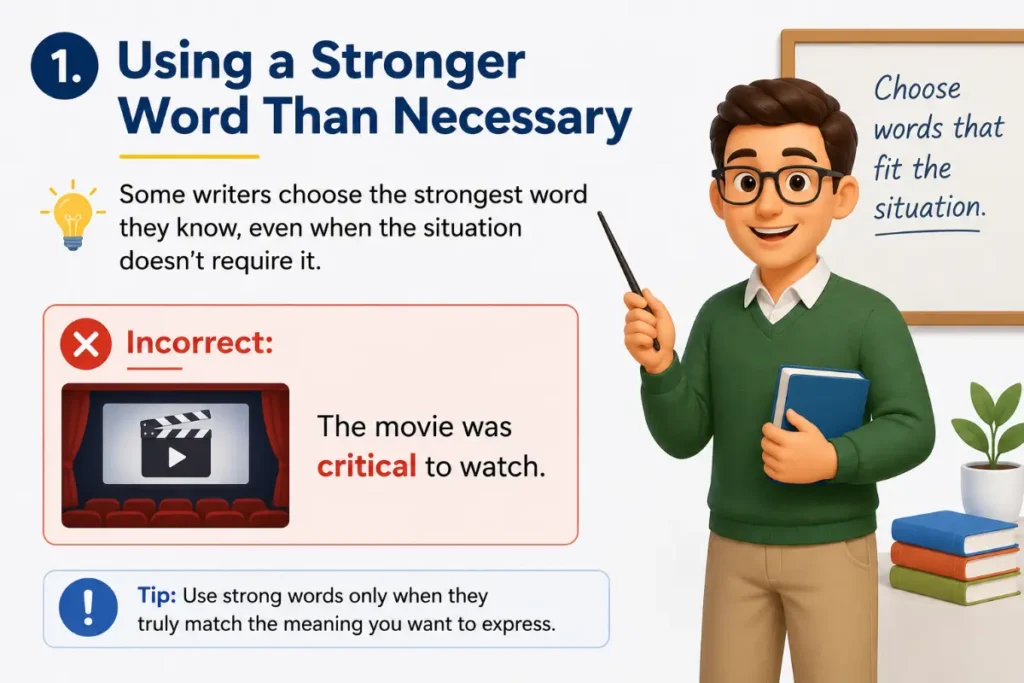
1. Using a Stronger Word Than Necessary
Some writers choose the strongest word they know, even when the situation doesn’t require it.
Incorrect:
- The movie was critical to watch.
Better:
- The movie was worth watching.
- The movie was important to understanding the story.
Critical usually suggests urgency or a serious situation.
2. Treating Every Synonym as Identical
Every synonym has its own meaning.
Incorrect:
- Water is significant for life.
Better:
- Water is essential for life.
- Water is vital for life.
3. Using Formal Words in Casual Conversations
Very formal words can sound unnatural in everyday speech.
Less natural:
- That’s a paramount concern.
More natural:
- That’s a big concern.
- That’s a major concern.
4. Repeating the Same Synonym
Replacing important with essential in every sentence creates the same problem.
Instead, vary your vocabulary.
Example:
- Communication is essential.
- Trust is key.
- Listening is valuable.
- Teamwork is crucial.
5. Ignoring the Context
Always think about what you really want to say.
If something is required, use necessary or essential.
If something has worth, use valuable.
Antonyms of Important
Sometimes the best way to understand a word is to learn its opposite.
| Antonym | Meaning | Example |
|---|---|---|
| Unimportant | Not meaningful or valuable | The mistake was unimportant. |
| Minor | Small in importance | It was a minor problem. |
| Trivial | Having very little value | They argued over a trivial issue. |
| Insignificant | Too small to matter | The difference was insignificant. |
| Meaningless | Without purpose or value | The comment felt meaningless. |
| Irrelevant | Not connected to the topic | That detail is irrelevant. |
| Worthless | Having no value | The damaged ticket became worthless. |
Knowing antonyms helps you describe both ends of a situation more accurately.
Quick Tips for Choosing the Right Synonym
When you’re unsure which word to use, these simple tips can help.
- Choose essential when something is absolutely required.
- Choose vital for health, safety, or success.
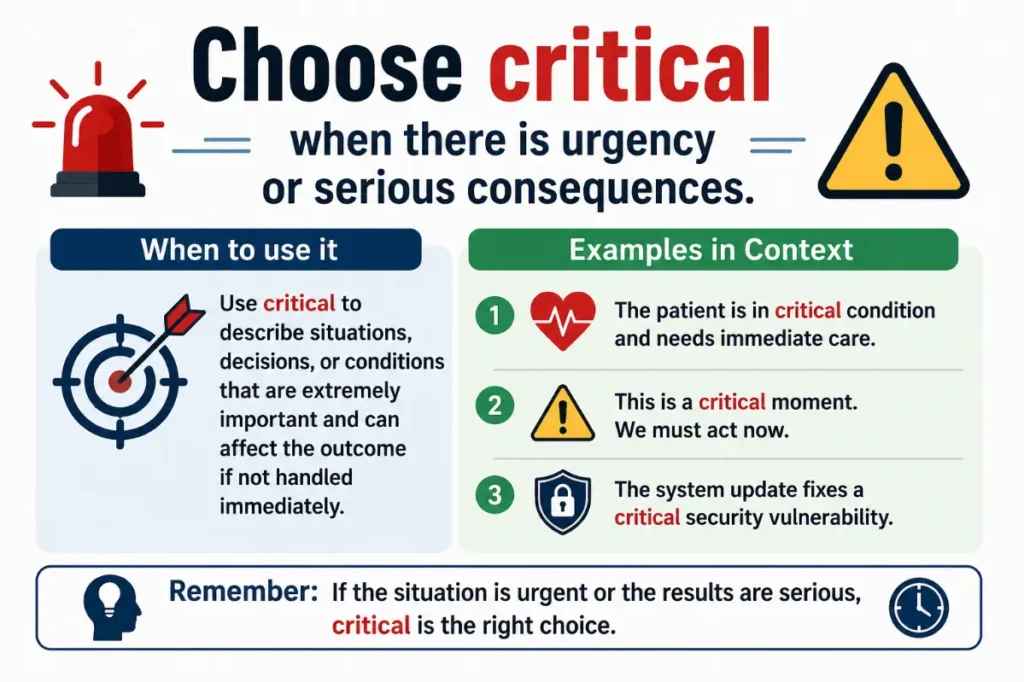
- Choose critical when there is urgency or serious consequences.
- Choose significant for research, history, statistics, or major results.
- Choose key for the main idea or central point.
- Choose major for large events or changes.
- Choose valuable when talking about usefulness or worth.
- Choose meaningful for emotions, memories, or relationships.
- Choose fundamental for basic principles or foundations.
- Choose instrumental when someone helped make something happen.
A simple rule is this:
Think about why something is important before choosing another word. The reason usually tells you which synonym fits best.
Conclusion
Expanding your vocabulary is one of the easiest ways to become a stronger writer and speaker. Instead of repeating the same word in every sentence, you can choose an alternative that matches your exact meaning and your audience.
Learning synonyms of important helps you write essays that sound more polished, emails that are more professional, resumes that highlight your achievements, and conversations that feel more natural. Words like essential, significant, critical, key, valuable, and vital each add their own subtle meaning, making your message clearer and more engaging.
The next time you reach for the word important, pause for a moment and think about what you really want to say. Choosing the right synonym won’t just improve your vocabulary—it will make every sentence stronger and more precise.
Frequently Asked Questions
What’s another way to say important?
There are many synonyms of important, including essential, significant, critical, vital, major, key, valuable, and crucial. The best choice depends on your sentence and the level of importance you want to express.
What is the strongest synonym for important?
Words like critical, paramount, vital, and essential are among the strongest alternatives. They suggest that something is necessary, urgent, or cannot be ignored.
Which synonym of important should I use in an essay?
For academic writing, significant, essential, fundamental, and crucial are excellent choices because they sound formal, clear, and precise.
Can I use key instead of important?
Yes. Key works well when describing the main idea, reason, or factor. For example, Communication is a key part of good leadership.
What’s another way to say important in a resume?
Professional resumes often use words like key, instrumental, critical, essential, or significant. These words describe achievements more specifically than simply saying something was important.
Are all synonyms of important interchangeable?
No. Synonyms of important share a general meaning, but each has a different shade of meaning. Essential means required, significant means meaningful, critical suggests urgency, and valuable emphasizes worth.
Which synonym sounds best in everyday conversation?
In casual speech, words like big, major, key, valuable, and huge usually sound the most natural. They are easy to understand and fit most conversations.
