
Have you ever stared at an email, school essay, blog post, or text message and realized you’ve used synonyms for when too many times? It happens to everyone. Repeating the same word can make your writing sound flat, even if your ideas are strong.
The good news is that English offers many ways to express time, conditions, situations, and moments without repeating the same word over and over. Choosing the right alternative can make your writing smoother, clearer, and more natural.
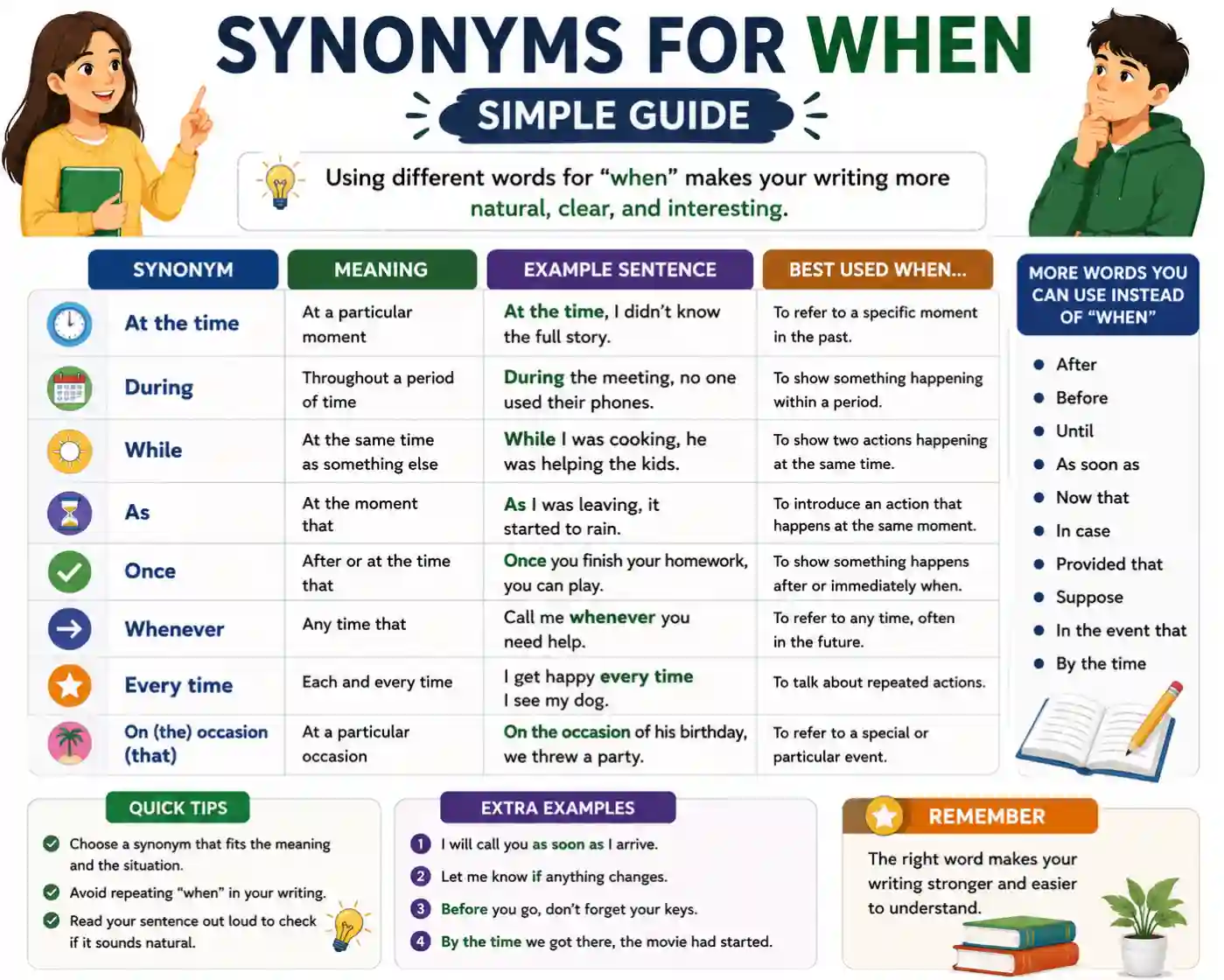
Quick Answer: There is no perfect replacement for synonyms for when because when has several meanings. The best alternative depends on the sentence. Common choices include once, whenever, while, after, before, as soon as, during, at the time, and on the occasion that.
What Does When Mean?
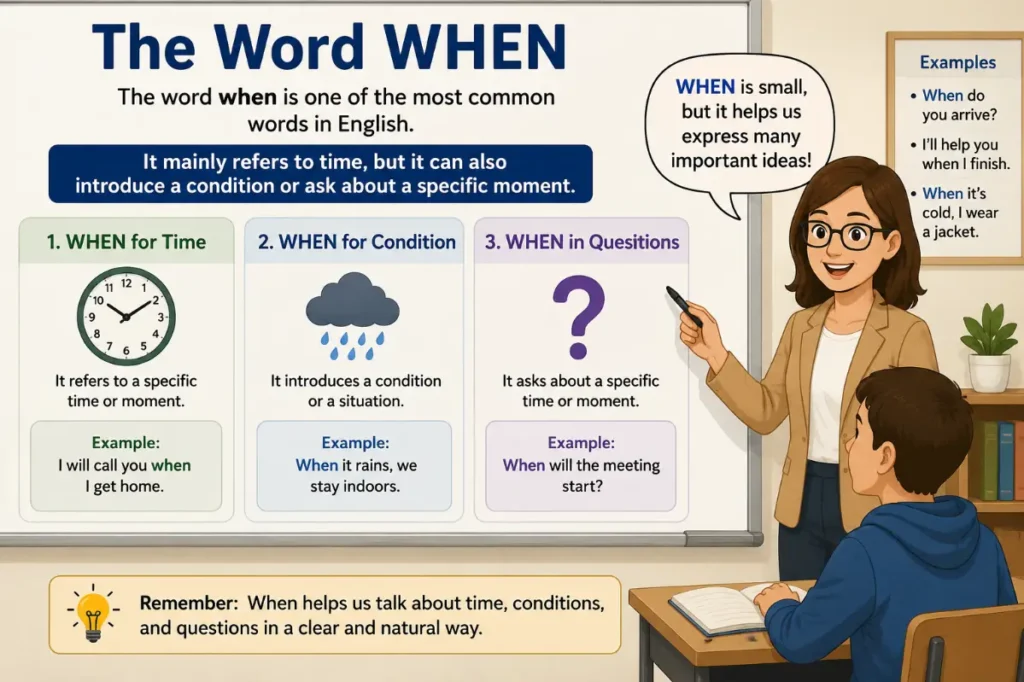
The word when is one of the most common words in English. It mainly refers to time, but it can also introduce a condition or ask about a specific moment.
For example:
- When did you arrive?
- Call me when you get home.
- I smiled when I saw the surprise.
In each sentence, when connects an action to a particular time.
Where Did The Word When Come From?
Many people search for better wording but never wonder where the word itself came from.
The English word when comes from the Old English word hwænne, which meant at what time. It shares roots with other Germanic languages and has been used in English for more than a thousand years.
Although the spelling has changed over time, its main purpose has stayed almost the same. It still helps people talk about time, events, and situations.
Why People Look For Synonyms For When
People usually search for alternatives because they want to:
- Avoid repeating when several times in one paragraph.
- Make essays sound more polished.
- Improve professional emails.
- Write smoother stories.
- Add variety to blog posts.
- Sound more natural in conversations.
- Match formal or casual writing styles.
The important thing to remember is that there isn’t one universal replacement. The best choice depends on what when means in your sentence.
Master List Of Synonyms For When
The table below groups useful alternatives by tone and usage.
| Word or Phrase | Meaning | Tone | Example |
|---|---|---|---|
| Once | After something happens | Everyday | Call me once you arrive. |
| Whenever | At any time | Everyday | Visit whenever you can. |
| While | During the time | Everyday | Read while waiting. |
| As | At the same time | Everyday | As I walked, it started raining. |
| After | Following an event | Everyday | Leave after dinner. |
| Before | Earlier than | Everyday | Finish before noon. |
| As soon as | Immediately after | Everyday | Text me as soon as you land. |
| During | Throughout a period | Formal | Stay quiet during class. |
| At the time | At that moment | Neutral | I was busy at the time. |
| The moment | Immediately when | Neutral | The moment I called, she answered. |
| The minute | Right after | Casual | The minute he arrived, we left. |
| The second | Instantly | Casual | The second it rang, she picked up. |
| Upon | Immediately after | Formal | Upon arrival, check in. |
| Following | After | Formal | Following graduation, he moved. |
| On the occasion that | If it happens | Formal | Contact us on the occasion that problems arise. |
| In the event that | If | Formal | In the event that flights change, we’ll notify you. |
| Anytime | Whenever | Casual | Stop by anytime. |
| At the point that | At that moment | Formal | The project ended at the point that funding stopped. |
| Meanwhile | During another event | Neutral | Meanwhile, dinner was cooking. |
| By the time | Before another moment | Neutral | By the time I arrived, everyone had left. |
| Since | From the time | Neutral | She’s been here since Monday. |
| Until | Up to a point | Neutral | Wait until tomorrow. |
| Then | Afterward | Casual | Finish your homework, then relax. |
| Thereafter | After that | Formal | Thereafter, the policy changed. |
| Subsequently | Later | Formal | Subsequently, the company expanded. |
| Immediately after | Right afterward | Neutral | Immediately after lunch, the meeting began. |
| At the instant | Exactly then | Formal | At the instant the bell rang, students left. |
| Every time | On each occasion | Everyday | Every time we meet, we laugh. |
| On arrival | Upon arriving | Formal | On arrival, report to reception. |
| At that moment | Exactly then | Neutral | At that moment, everything changed. |
Simple Everyday Alternatives
These are the easiest replacements for daily writing.
| Alternative | Best Use |
|---|---|
| Once | Something happens first |
| After | Later in time |
| Before | Earlier in time |
| While | Two actions happen together |
| Whenever | Any time something happens |
| Every time | Repeated events |
| As soon as | Immediate action |
| Then | Next action |
Examples
- Once dinner is ready, we’ll eat.
- After school, I’ll call you.
- Before leaving, lock the door.
- While cooking, she listened to music.
- Whenever you need help, ask.
- Every time he visits, he brings cookies.
- As soon as I finish, I’ll join you.
- Finish your work, then take a break.
Formal Alternatives
Professional writing often benefits from more precise wording.
| Alternative | Common Use |
|---|---|
| Upon | Business writing |
| Following | Reports |
| During | Academic writing |
| In the event that | Contracts |
| On the occasion that | Legal writing |
| Thereafter | Formal reports |
| Subsequently | Research papers |
| At the time | Professional communication |
Examples
- Upon completion, submit the form.
- Following the meeting, we’ll send notes.
- During the conference, phones should remain silent.
- In the event that your payment fails, contact support.
- Subsequently, sales increased.
- Thereafter, no additional changes were made.
Casual Alternatives
These sound more conversational.
- The moment
- The minute
- The second
- Anytime
- Then
- Every time
Examples:
- The moment I opened the gift, I smiled.
- The minute you arrive, text me.
- Come by anytime.
- Every time we talk, I learn something new.
Slang Or Informal Expressions
These should stay in casual conversations.
| Expression | Example |
|---|---|
| The second | The second I saw it, I laughed. |
| Soon as | Soon as you’re free, call me. |
| Anytime | Stop over anytime. |
| Right after | Right after class, let’s eat. |
| The instant | The instant it happened, everyone noticed. |
These expressions aren’t suitable for academic essays or formal reports.
Synonyms By Strength
Sometimes you want to show how immediate an action is.
| Intensity | Better Choice |
|---|---|
| General time | When |
| Mild | While |
| Moderate | After |
| Fairly immediate | Once |
| Immediate | As soon as |
| Very immediate | The moment |
| Instant | The second |
| Exact instant | Upon |
For example:
- I’ll leave after dinner.
- I’ll leave once dinner ends.
- I’ll leave as soon as dinner ends.
- I’ll leave the moment dinner ends.
Each version becomes slightly stronger.
Synonyms By Function
Because when performs different jobs, its replacement depends on the sentence.
| Function | Good Alternatives |
|---|---|
| Asking about time | At what time, what time |
| Showing sequence | After, once, then |
| Showing simultaneous actions | While, as, during |
| Showing repeated events | Whenever, every time |
| Showing immediate action | As soon as, the moment, upon |
| Showing condition | In the event that, if |
How To Choose The Best Alternative By Situation
Not every synonym works in every sentence. The best replacement depends on why you’re using when. Are you talking about time, giving instructions, writing professionally, or sending a quick text? This section will help you choose naturally.
What Is The Best Word To Use In An Essay?
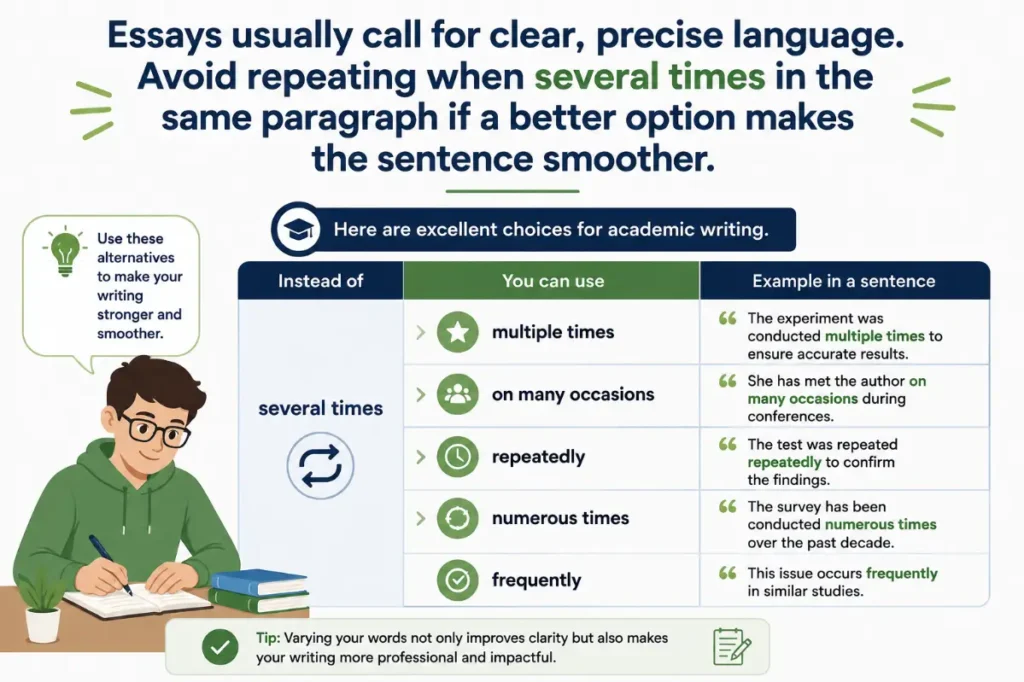
Essays usually call for clear, precise language. Avoid repeating when several times in the same paragraph if a better option makes the sentence smoother. Here are excellent choices for academic writing.
| Instead of When | Best Choice | Why It Works |
|---|---|---|
| When one event follows another | After | Clear and direct |
| When something happens immediately | Once | Concise |
| During the same time | While | Shows simultaneous actions |
| Formal transition | Following | Academic tone |
| Exact period | During | Precise wording |
Examples
- After the experiment ended, the students recorded their observations.
- While reading the novel, I noticed several recurring themes.
- Following the interview, the researcher analyzed the responses.
- During the discussion, everyone shared ideas.
- Once the evidence was collected, the report became easier to write.
What Is The Best Word To Use In A Resume?
Resumes should be short and action focused. In many cases, you can remove when completely.
Instead of writing:
Managed projects when deadlines became tight.
Try:
Managed projects during tight deadlines.
Or:
Managed projects throughout critical deadlines.
Other useful choices include:
- During
- Following
- After
- Upon
- Throughout
Resume Examples
- Promoted after exceeding sales targets.
- Led the team during system upgrades.
- Improved productivity following workflow changes.
- Upon joining the company, reduced processing time by 20 percent.
What Is The Best Word To Use In Emails?
Emails should sound natural and polite. Good replacements include:
- Once
- After
- As soon as
- Whenever
- At that time
Examples
Instead of:
I’ll reply when I receive your documents.
You can write:
I’ll reply once I receive your documents.
Instead of:
We’ll meet when everyone arrives.
You can write:
We’ll meet after everyone arrives.
Instead of:
Call me when you’re free.
You can write:
Call me whenever you’re free.
What Is The Best Word To Use In Text Messages?
Texts are usually short and casual.
Popular choices include:
- Once
- Then
- Anytime
- The minute
- The moment
Examples
- Text me once you’re home.
- The minute you finish, call me.
- Come over anytime.
- Eat first, then we’ll go.
- The moment you see him, let me know.
What Is The Best Word To Use In Everyday Speaking?
Conversation is flexible, so people naturally switch between several expressions.
Common choices include:
- After
- Before
- While
- Once
- Whenever
- Every time
- Then
Spoken Examples
- I’ll wash the dishes after dinner.
- Call me once you arrive.
- We talked while walking home.
- Every time I visit, the food is amazing.
- Then we’ll head to the movie theater.
More Than 10 Real Life Example Sentences
Learning from real situations makes new vocabulary much easier to remember.
School
- Once class ends, we’ll go to the library.
- During the lesson, students asked thoughtful questions.
- After the exam, everyone felt relieved.
Work
- Following the presentation, the manager answered questions.
- As soon as the report is finished, send it to me.
- Upon approval, the project will begin.
Family
- Every time Grandma visits, she bakes cookies.
- While my brother cooked dinner, I cleaned the kitchen.
Travel
- The moment we landed, it started raining.
- After checking into the hotel, we explored the city.
- During the flight, I watched two movies.
Friends
- Whenever you’re in town, let’s meet.
- The second she heard the news, she called me.
- Then we went out for dinner.
Shopping
- Once the store opens, we’ll buy the supplies.
- Before leaving, don’t forget your receipt.
Sports
- While practicing, the coach gave helpful advice.
- After the game, both teams shook hands.
Technology
- As soon as the download finishes, install the update.
- Following the software update, the computer ran faster.
Once Vs After
Both describe something happening later, but they are not identical.
Once
Once focuses on the completion of an action before another action begins.
Example:
- Once the movie ends, we’ll leave.
This suggests you’ll leave immediately after the movie finishes.
After
After simply places one event later than another. The time gap can be short or long.
Example:
- After the movie, we’ll get dinner.
Key Differences
| Once | After |
|---|---|
| Focuses on completion | Focuses on sequence |
| Often immediate | May include a delay |
| Common in instructions | Common in all types of writing |
While Vs During
These two words are among the most commonly confused alternatives.
While
Use while before a clause that contains a subject and a verb.
Correct:
- While I was cooking, the phone rang.
During
Use during before a noun or noun phrase.
Correct:
- During dinner, the phone rang.
Key Differences
| While | During |
|---|---|
| Followed by a clause | Followed by a noun |
| While I studied | During class |
| While she worked | During vacation |
Whenever Vs Every Time
Although they look similar, these expressions have different meanings.
Whenever
Use whenever to mean at any time.
Example:
- Visit whenever you want.
Every Time
Use every time to describe repeated occasions.
Example:
- Every time I visit, we drink coffee.
Key Differences
| Whenever | Every Time |
|---|---|
| Means any suitable time | Means each occurrence |
| Flexible timing | Repeated habit |
| Open invitation | Regular pattern |
As Soon As Vs The Moment
Both expressions describe immediate action.
As Soon As
This phrase is neutral and works well in almost every situation.
- As soon as you arrive, call me.
The Moment
This expression adds emotion and emphasis.
- The moment I saw the puppy, I smiled.
Writers often choose the moment when telling stories because it creates a stronger emotional effect.
Upon Vs Following
These formal alternatives often appear in business and academic writing.
Upon
Use upon to show that one event happens immediately after another.
- Upon arrival, please register.
Following
Use following simply to mean after.
- Following today’s meeting, the report will be published.
Upon usually sounds more formal than following.
Common Mistakes When Using Synonyms For When
Choosing the wrong alternative can make your sentence sound awkward or incorrect.
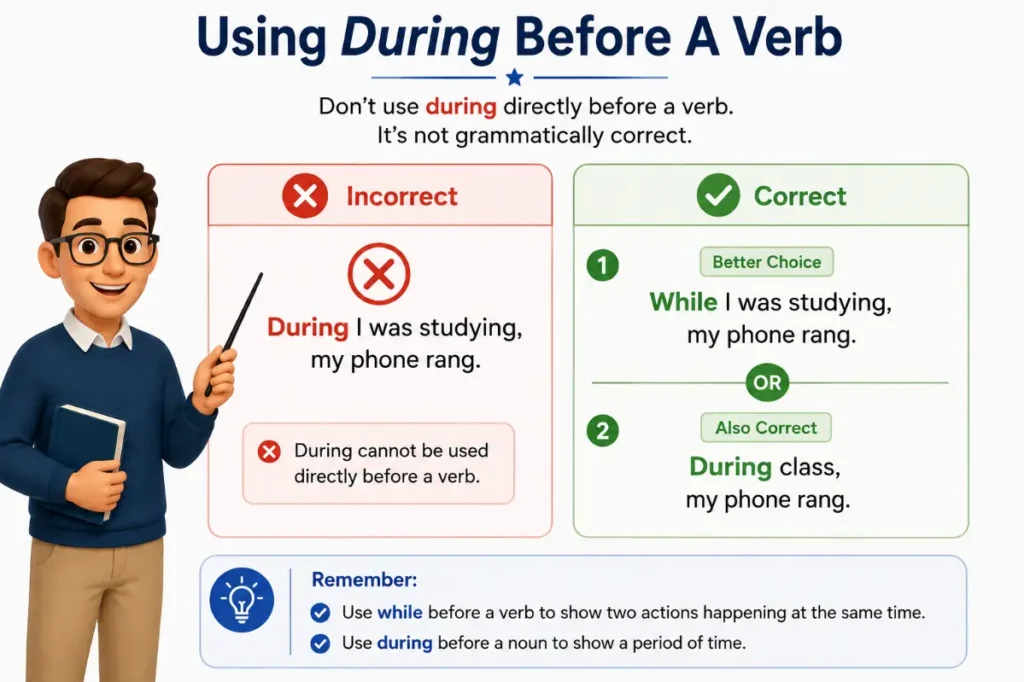
Using During Before A Verb
Incorrect:
- During I was studying, my phone rang.
Correct:
- While I was studying, my phone rang.
Or:
- During class, my phone rang.
Using While Before A Noun
Incorrect:
- While dinner, we talked.
Correct:
- During dinner, we talked.
Or:
- While we ate dinner, we talked.
Assuming Every Alternative Means The Same Thing
Not every synonym fits every sentence.
Compare:
- Once you arrive, call me.
- Whenever you arrive, call me.
The first sentence refers to one future event.
The second refers to any arrival time in general.
Overusing Formal Alternatives
Some writers replace every when with upon because it sounds more formal.
Incorrect:
- Upon you get home, call me.
Correct:
- Upon arriving home, call me.
Or:
- Once you get home, call me.
Making Sentences Sound Less Natural
Sometimes the simplest choice is still the best.
Natural:
- I’ll call you when I finish work.
Less natural:
- I’ll call you upon finishing work.
Simple wording is usually easier to read.
Ignoring Context
Before replacing when, ask yourself these questions.
- Is this formal or casual?
- Am I describing one event or repeated events?
- Does the action happen immediately?
- Will another word make the sentence clearer?
The answers will guide you toward the best choice.
When Should You Keep The Word When?
Sometimes the original word is already the best option. Replacing it can make the sentence harder to read.
Examples:
- When did you start learning English?
- Tell me when you’re ready.
- I smiled when I heard the news.
- Nobody knew when the train would arrive.
If another word doesn’t improve clarity or flow, keep when. Good writing values clarity over unnecessary variety.
Antonyms Of When Related Expressions
Unlike many words, when does not have one direct opposite because it asks about or refers to time. Still, some words and phrases express the opposite idea depending on the sentence.
| Word or Phrase | Meaning | Example |
|---|---|---|
| Never | At no time | He never arrived. |
| Nowhere near | Not close in time or situation | The deadline is nowhere near. |
| No longer | Not anymore | She no longer works here. |
| At no point | Never during a period | At no point did he complain. |
| Without | Lacking a condition or event | He left without saying goodbye. |
These words are not perfect antonyms, but they often express opposite ideas in context.
Quick Tips For Choosing The Right Alternative
Picking the best replacement is easier if you think about the meaning instead of simply looking for another word.
- Use once when one action happens immediately after another.
- Use after for a simple sequence of events.
- Use while for two actions happening at the same time.
- Use during before a noun, not a verb.
- Use whenever for something that can happen at any time.
- Use every time for repeated events.
- Use as soon as to show immediate action.
- Use upon only in formal writing.
- Keep when if it already sounds natural.
- Always read the sentence aloud to check if the replacement sounds smooth.
Cheat Sheet For Synonyms For When
| Situation | Best Choice |
|---|---|
| One event happens after another | Once |
| General sequence | After |
| Two actions happen together | While |
| Referring to a period | During |
| Immediate action | As soon as |
| Very immediate | The moment |
| Formal documents | Upon |
| Business writing | Following |
| Any time | Whenever |
| Repeated events | Every time |
| Casual conversation | Then |
| Everyday writing | When |
Which Alternative Sounds Most Natural?
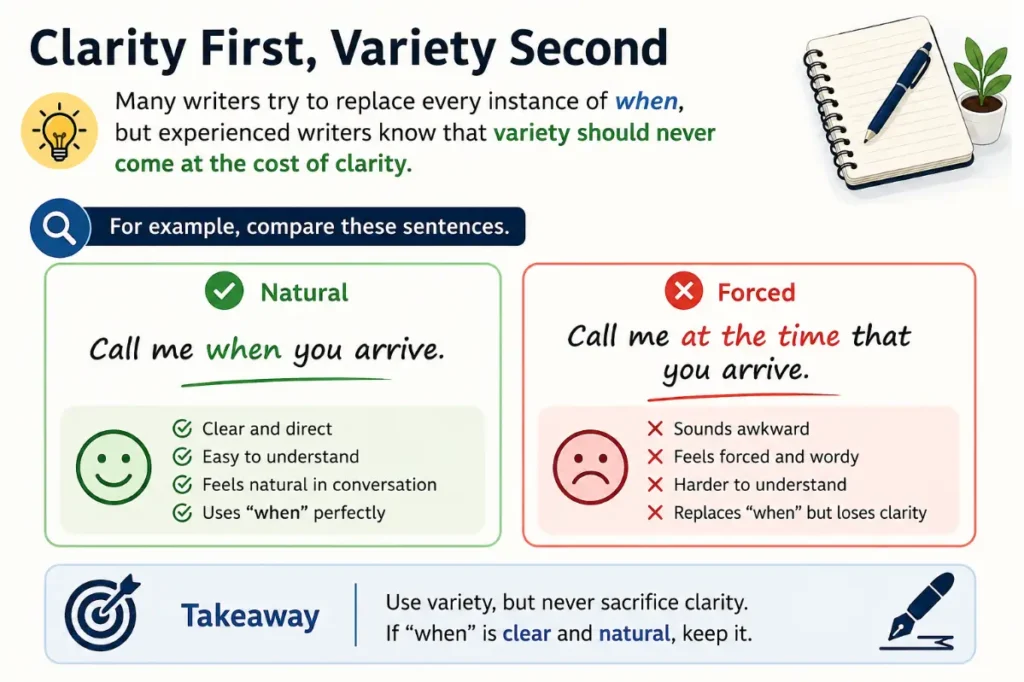
Many writers try to replace every instance of when, but experienced writers know that variety should never come at the cost of clarity.
For example, compare these sentences.
Natural:
- Call me when you arrive.
Also natural:
- Call me once you arrive.
Less natural:
- Call me upon arriving.
The third sentence is grammatically correct, but it sounds more formal than most everyday conversations.
As a general rule:
- For everyday writing, use when, once, after, and while.
- For professional writing, consider following, during, or upon.
- For storytelling, expressions like the moment and the second create stronger emotion.
- For text messages, keep it simple with once, then, or anytime.
Choosing words that match your audience will always improve your writing.
Conclusion
Finding the right synonyms for when isn’t about replacing every occurrence of the word. It’s about choosing the expression that best matches your meaning, tone, and audience. In some sentences, when remains the clearest choice. In others, words like once, after, while, during, whenever, or as soon as can make your writing more precise and engaging.
As you practice, you’ll naturally recognize which option fits each situation. Focus on clarity first, vary your wording when it improves the sentence, and your writing will sound smoother, more confident, and more professional.
Frequently Asked Questions
What’s another way to say when?
The best alternative depends on the sentence. Common choices include once, after, while, whenever, during, the moment, and as soon as.
What are the best synonyms for when in formal writing?
For formal documents, good synonyms for when include upon, following, during, thereafter, and in the event that. These work well in reports, business writing, and academic papers.
Can I replace when in every sentence?
No. Sometimes when is already the clearest and most natural choice. Replace it only if another word improves the sentence.
Is once the same as when?
Not exactly. Once usually means immediately after something happens, while when can refer to many different time relationships.
Should I use while or during?
Use while before a clause with a subject and verb.
- While I was studying…
Use during before a noun.
- During class…
What is the most common alternative to when?
In everyday English, once, after, while, and whenever are among the most common alternatives because they sound natural in most situations.
Which synonyms for when work best in essays?
For essays, choose words that improve clarity instead of simply adding variety. After, while, during, following, and once are usually the strongest options.
