
Have you ever written an email, school essay, resume, or text message and felt that the word value sounded too repetitive? It happens to everyone. Using the same word over and over can make your writing feel flat. That’s why learning synonyms for value can help you sound more natural, clear, and confident.
The word value has many meanings. It can describe importance, worth, usefulness, price, beliefs, or appreciation. Because it has several meanings, the best replacement depends on what you’re trying to say.
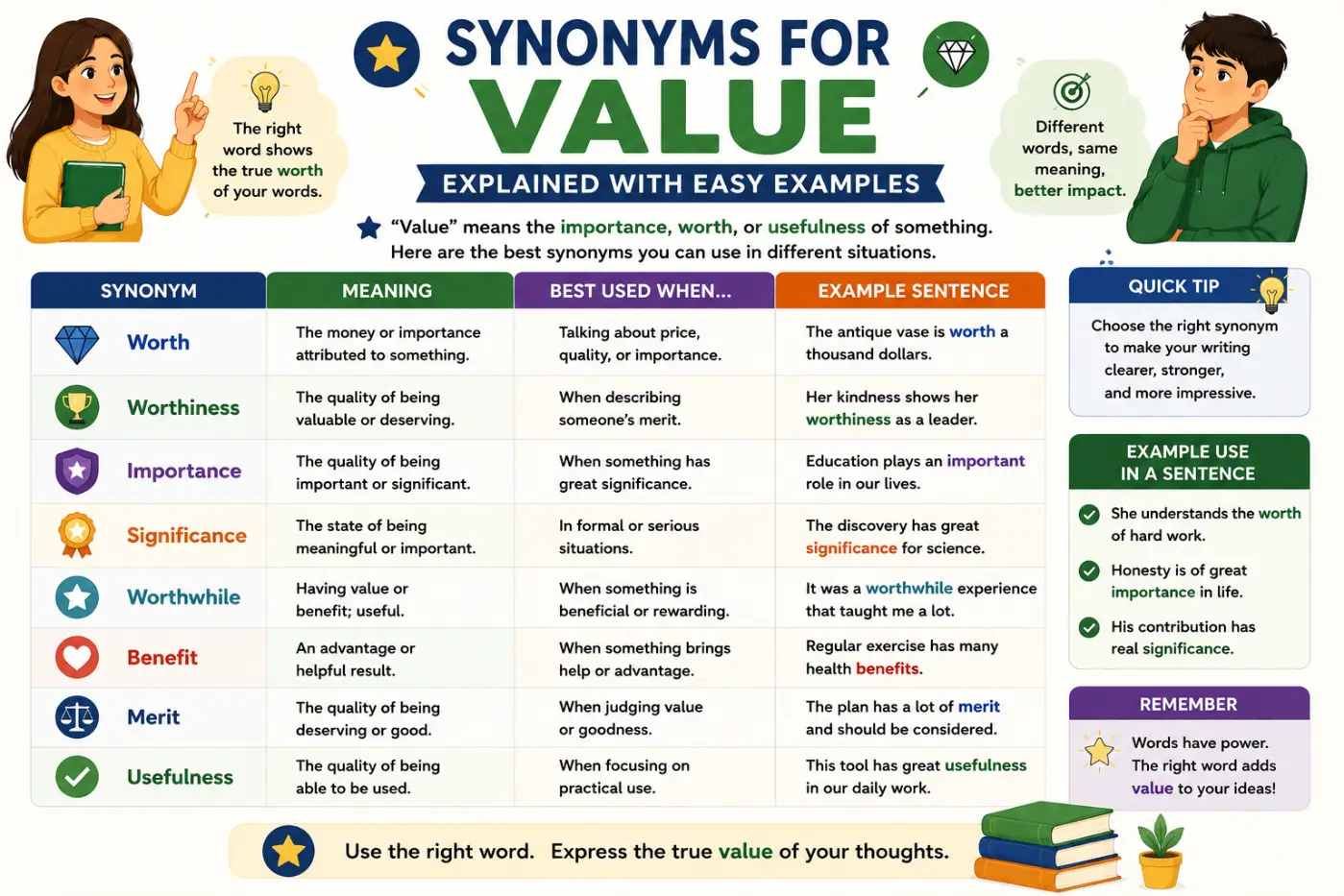
Synonyms for value are alternative words that express ideas like worth, importance, usefulness, price, or appreciation. The best choice depends on your sentence and the meaning you want to convey.
What Does Value Mean
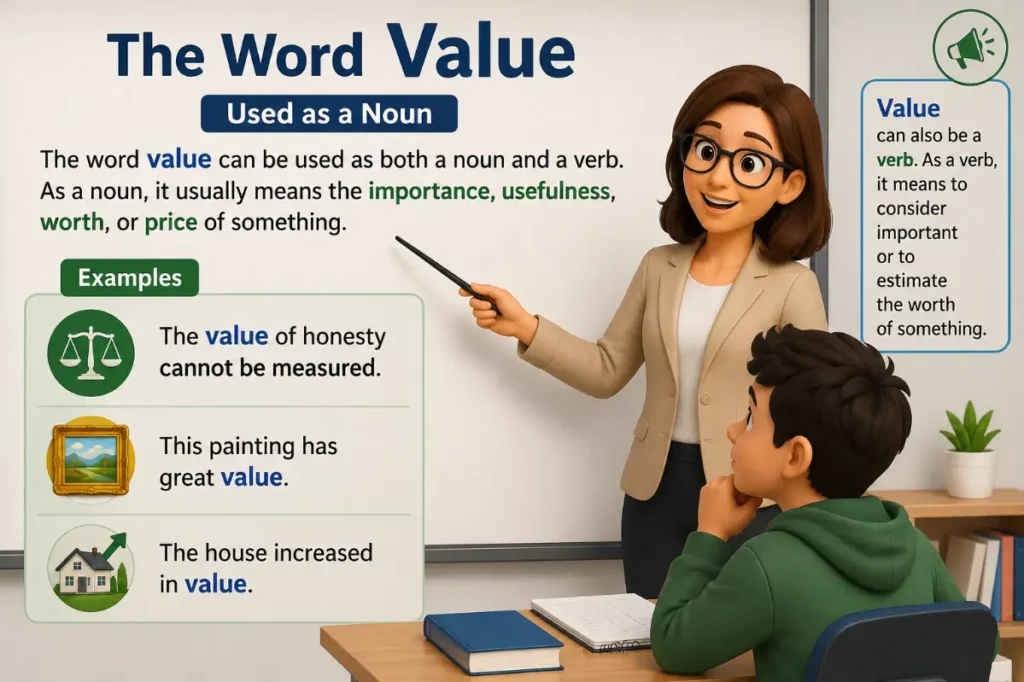
The word value can be used as both a noun and a verb. As a noun, it usually means the importance, usefulness, worth, or price of something.
Examples:
- The value of honesty cannot be measured.
- This painting has great value.
- The house increased in value.
As a verb, it means to appreciate, respect, or consider something important.
Examples:
- I value your opinion.
- Employers value teamwork.
Where Did the Word Value Come From
The English word value comes from the Old French word value and the Latin word valere, which means “to be strong” or “to be worth.” Over hundreds of years, its meaning expanded. Today, people use it when talking about money, quality, importance, personal beliefs, business, education, and relationships.
Many people only think of money when they hear the word value, but English speakers use it in many different ways every day.
Master List of Synonyms for Value
| Word | Meaning | Tone | Example |
|---|---|---|---|
| Worth | Importance or quality | Everyday | The experience was worth every minute. |
| Importance | Level of significance | Formal | Education has great importance. |
| Merit | Positive quality | Formal | The proposal has real merit. |
| Significance | Special meaning | Formal | The discovery has historical significance. |
| Usefulness | Practical benefit | Everyday | The tool proved its usefulness. |
| Benefit | Helpful result | Everyday | Exercise has many benefits. |
| Advantage | Favorable point | Everyday | Experience is a major advantage. |
| Quality | Standard of excellence | Everyday | The product offers excellent quality. |
| Excellence | Outstanding quality | Formal | They strive for excellence. |
| Price | Cost in money | Everyday | The price increased yesterday. |
| Cost | Amount paid | Everyday | The cost surprised everyone. |
| Worthiness | Deserving respect | Formal | Her kindness showed great worthiness. |
| Respect | High regard | Everyday | I have great respect for teachers. |
| Appreciation | Recognition of worth | Formal | She expressed appreciation for the help. |
| Esteem | Deep respect | Formal | He is held in high esteem. |
| Treasure | Something highly valued | Everyday | Family is my greatest treasure. |
| Asset | Valuable resource | Business | Communication is an important asset. |
| Strength | Positive feature | Everyday | Patience is her greatest strength. |
| Virtue | Good moral quality | Formal | Honesty is an important virtue. |
| Priority | Something important | Everyday | Safety is our top priority. |
| Relevance | Importance to a topic | Formal | The study has modern relevance. |
| Meaning | Personal significance | Everyday | The gift had special meaning. |
| Utility | Practical usefulness | Formal | The software offers great utility. |
| Gain | Positive benefit | Everyday | Everyone saw a gain from the change. |
| Reward | Valuable result | Everyday | Hard work is its own reward. |
| Gold | Extremely valuable thing | Informal | Her advice is pure gold. |
| Gem | Something outstanding | Informal | This book is a real gem. |
| Keeper | Something worth keeping | Slang | That recipe is a keeper. |
Simple Everyday Synonyms
These words work well in daily conversation.
- Worth
- Benefit
- Help
- Use
- Price
- Cost
- Quality
- Meaning
- Strength
- Treasure
Example
“This lesson has a lot of value.”
Better alternatives:
- This lesson has a lot of worth.
- This lesson has real importance.
- This lesson has great meaning.
Formal Synonyms
These fit essays, reports, and business writing.
- Significance
- Merit
- Importance
- Relevance
- Utility
- Esteem
- Appreciation
- Excellence
- Virtue
- Asset
Informal and Slang Alternatives
These sound more casual.
- Gold
- Gem
- Keeper
- Big deal
- Priceless
- Top notch
Example:
“His advice was pure gold.”
This sounds much more natural than saying “His advice had great value.”
Synonyms by Strength
| Mild | Moderate | Strong |
|---|---|---|
| Use | Benefit | Importance |
| Worth | Quality | Significance |
| Help | Merit | Excellence |
| Cost | Asset | Treasure |
| Price | Appreciation | Priceless |
Synonyms by Part of Speech
As a Noun
- Worth
- Importance
- Significance
- Merit
- Benefit
- Quality
- Price
- Cost
- Asset
- Utility
As a Verb
When value means appreciate or respect, use these alternatives.
- Appreciate
- Respect
- Treasure
- Prize
- Cherish
- Admire
- Honor
- Esteem
Examples:
- I value your honesty.
- I appreciate your honesty.
- I treasure your friendship.
Which Synonym Works Best in Different Situations
Choosing the right word depends on where you’re using it. A resume needs different language than a text message, and an essay usually calls for more formal words than casual conversation.
Best Synonyms for Value in a Resume
Hiring managers like clear, professional language. Instead of repeating value, choose words that show skills, contributions, or strengths.
| Instead of Value | Better Choice | Example |
|---|---|---|
| Value | Asset | I became an asset to the customer service team. |
| Value | Contribution | My contribution increased sales by 15 percent. |
| Value | Strength | Problem solving is one of my greatest strengths. |
| Value | Benefit | My improvements provided long term benefits. |
| Value | Importance | I understand the importance of teamwork. |
Example sentences:
- Time management is one of my greatest strengths.
- I understand the importance of excellent customer service.
- My experience became an asset to the company.
- I appreciate every opportunity to learn new skills.
Best Synonyms for Value in an Essay
School essays usually require formal vocabulary.
Good choices include:
- Importance
- Significance
- Merit
- Relevance
- Worth
- Utility
Examples:
Instead of:
“The value of reading is clear.”
Write:
- The importance of reading is clear.
- The significance of reading cannot be ignored.
- Reading has great educational merit.
- The relevance of reading continues throughout life.
Best Synonyms for Value in an Email
Professional emails should sound polite but natural.
Better alternatives include:
- Appreciate
- Respect
- Benefit
- Importance
- Worth
Examples:
Instead of:
“I value your feedback.”
You can write:
- I appreciate your feedback.
- I truly respect your opinion.
- Your feedback is important to us.
- Your suggestions are greatly appreciated.
Best Synonyms for Value in Text Messages
Friends usually prefer simple, everyday language.
Natural alternatives include:
- Appreciate
- Love
- Respect
- Treasure
- Mean a lot
Examples:
- I really appreciate your help.
- You mean a lot to me.
- I treasure our friendship.
- Thanks. I really value your support.
Best Synonyms for Value in Speaking
When speaking, simple words often sound the most natural.
Good options include:
- Worth
- Important
- Appreciate
- Respect
- Benefit
Examples:
- That’s really important.
- I appreciate everything you did.
- It’s worth the effort.
- We all benefit from teamwork.
Original Example Sentences Using Different Synonyms
Here are real-life examples that show how different words fit different situations.
- The teacher explained the importance of practicing every day.
- Good communication is a valuable asset in any workplace.
- Everyone appreciates honest feedback.
- The museum has great historical significance.
- Her kindness is one of her greatest strengths.
- This laptop offers excellent value for the money.
- The experience was worth every minute.
- We respect your decision completely.
- Exercise provides many health benefits.
- The old watch has sentimental meaning for our family.
- This software has limited practical utility.
- Hard work brings lasting rewards.
- His advice was pure gold.
- That cookbook is a real gem.
- Your friendship means more than money.
Synonym Comparison
Worth vs Value
Although these words are close in meaning, they are not always interchangeable.
| Worth | Value |
|---|---|
| Focuses on importance or deserving quality. | Has several meanings including price, usefulness, and importance. |
| Often describes people, experiences, or objects. | Can describe money, beliefs, quality, or appreciation. |
| Usually appears as a noun or adjective. | Works as both a noun and a verb. |
Examples:
- The trip was worth the cost.
- The painting has great value.
The first sentence talks about whether something deserved the effort. The second focuses on the object’s importance or monetary worth.
Importance vs Significance
Many learners confuse these two words.
| Importance | Significance |
|---|---|
| Means something matters. | Means something has deeper meaning or impact. |
| Common in everyday English. | More common in academic writing. |
| Usually easier to understand. | Sounds more formal. |
Examples:
- Sleep is important for your health.
- The discovery has scientific significance.
Appreciate vs Value
These verbs look similar but carry different shades of meaning.
| Appreciate | Value |
|---|---|
| Often expresses gratitude. | Shows deep respect or importance. |
| Common in conversations and emails. | Common in business and formal writing. |
| Usually refers to thanking someone. | Can refer to beliefs, people, or principles. |
Examples:
- I appreciate your help.
- I value your honesty.
The first thanks someone. The second shows lasting respect.
Common Mistakes When Using Value
Many English learners make the same mistakes. Avoid these common errors.
Using Value for Every Situation
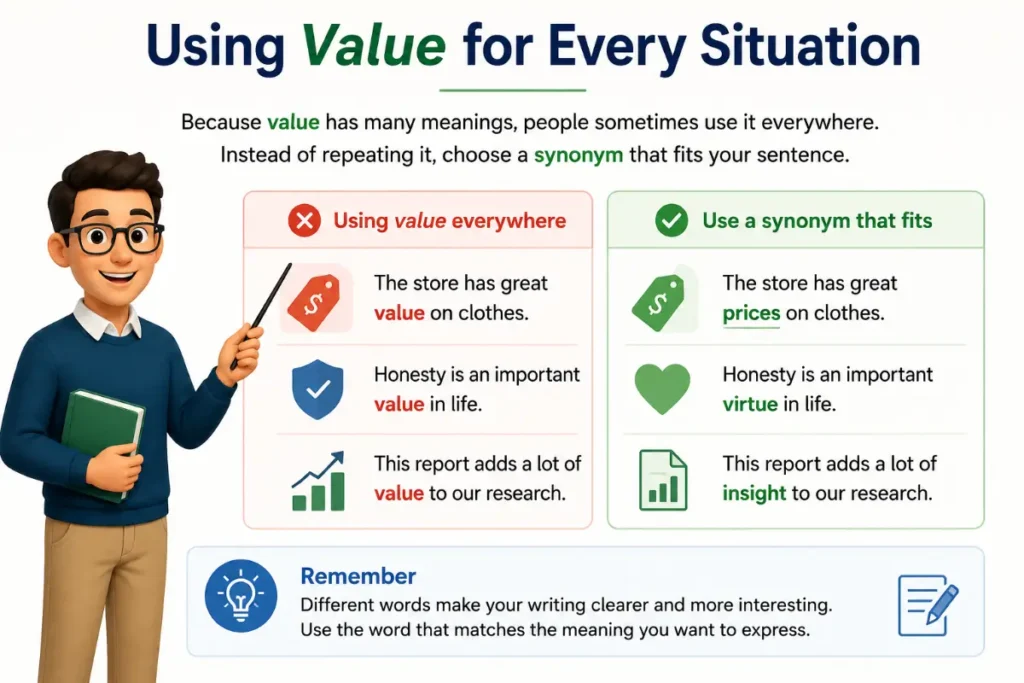
Because value has many meanings, people sometimes use it everywhere. Instead of repeating it, choose a synonym that fits your sentence.
Poor:
- This lesson has value.
- This advice has value.
- This person has value.
- This meeting has value.
Better:
- This lesson has importance.
- This advice is helpful.
- Every person has worth.
- This meeting will be beneficial.
Confusing Value with Price
Price and value are not the same. Price is the amount of money you pay. Value is what something is actually worth.
Example:
The phone costs one thousand dollars.
Its value depends on its quality, performance, and usefulness.
Using Formal Words in Casual Conversations
Words like utility, merit, and significance sound natural in essays but may sound too formal in everyday speech.
Instead of saying:
“This movie has great cinematic significance.”
Most people simply say:
“This movie is really important.”
Using Appreciate When You Mean Worth
These words have different meanings.
Incorrect:
“I appreciate one hundred dollars.”
Correct:
“This item is worth one hundred dollars.”
Correct:
“I appreciate your help.”
Antonyms for Value
Sometimes you need the opposite word.
| Antonym | Meaning |
|---|---|
| Worthlessness | Having no value |
| Uselessness | Not useful |
| Insignificance | Lack of importance |
| Inferiority | Lower quality |
| Disrespect | Lack of respect |
| Neglect | Failure to care |
| Waste | Poor use of something |
| Meaninglessness | Having no meaning |
Example sentences:
- The broken machine became useless.
- Ignoring safety shows disrespect.
- The damaged item had little worth.
Quick Tips for Choosing the Right Word
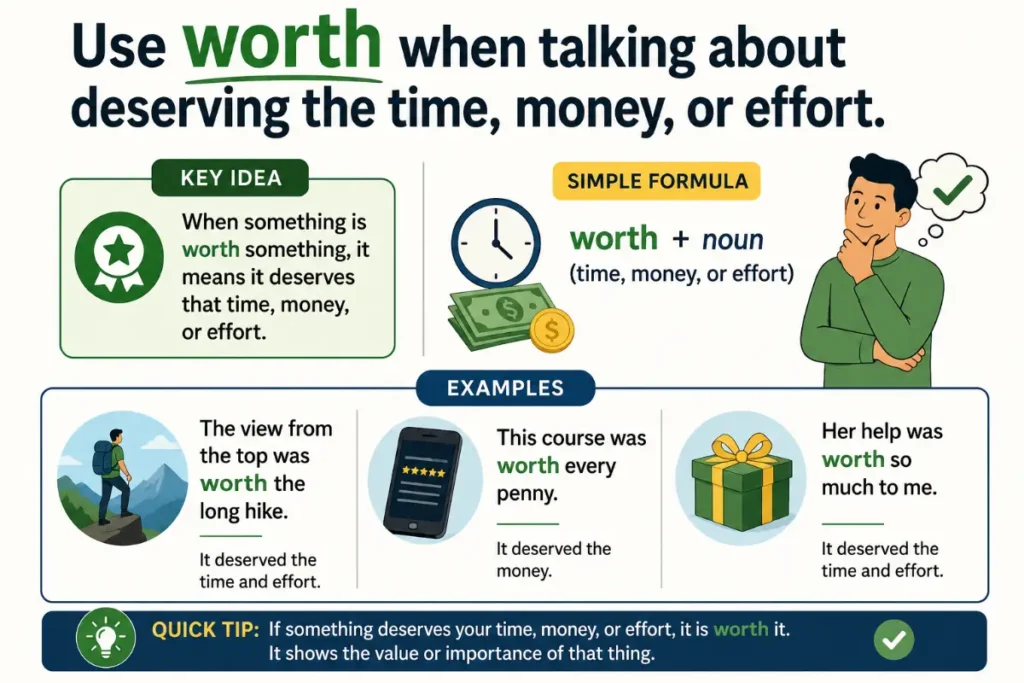
- Use worth when talking about deserving the time, money, or effort.
- Use importance in everyday writing and school assignments.
- Use significance for history, science, and academic topics.
- Use merit when discussing quality or strengths.
- Use appreciate when thanking someone.
- Use respect for people, opinions, and beliefs.
- Use asset in resumes and business writing.
- Use benefit when explaining positive results.
- Use price only when discussing money.
- Use treasure or cherish for emotional relationships.
Conclusion
Knowing the right synonyms for value can make your writing stronger, clearer, and more engaging. Instead of using the same word repeatedly, choose a synonym that matches your exact meaning. Use worth when talking about deserving something, importance for general significance, significance in formal or academic writing, benefit for positive results, and appreciate when expressing gratitude or respect.
The more you practice these words in real conversations, emails, essays, and professional writing, the more natural they’ll become. Keep this guide handy whenever you need a better word, and you’ll always have the confidence to choose the most accurate expression.
Frequently Asked Questions
What are the best synonyms for value?
Some of the best synonyms for value include worth, importance, significance, merit, benefit, quality, usefulness, appreciation, respect, and asset. The right choice depends on the meaning of your sentence.
What’s another way to say value?
You can say worth, importance, significance, merit, benefit, or quality. If you’re using value as a verb, words like appreciate, respect, cherish, or treasure may work better.
Can value and worth be used interchangeably?
Sometimes, yes. Both words refer to something important or deserving. However, value has a wider range of meanings, including price, usefulness, beliefs, and appreciation, while worth usually focuses on how deserving or important something is.
Which synonym for value sounds best in professional writing?
In business or academic writing, words such as importance, significance, merit, relevance, utility, and asset often sound more precise and professional than simply repeating value.
Is value a noun or a verb?
Both. As a noun, it means worth, importance, usefulness, or price. As a verb, it means to appreciate, respect, or consider something important.
What is the opposite of value?
Common antonyms include worthlessness, uselessness, insignificance, neglect, and disrespect. The correct opposite depends on the context.
How can I avoid repeating the word value in my writing?
Think about the exact idea you want to express. If you mean importance, use importance. Use price or cost when you’re discussing the amount of money something requires.
