
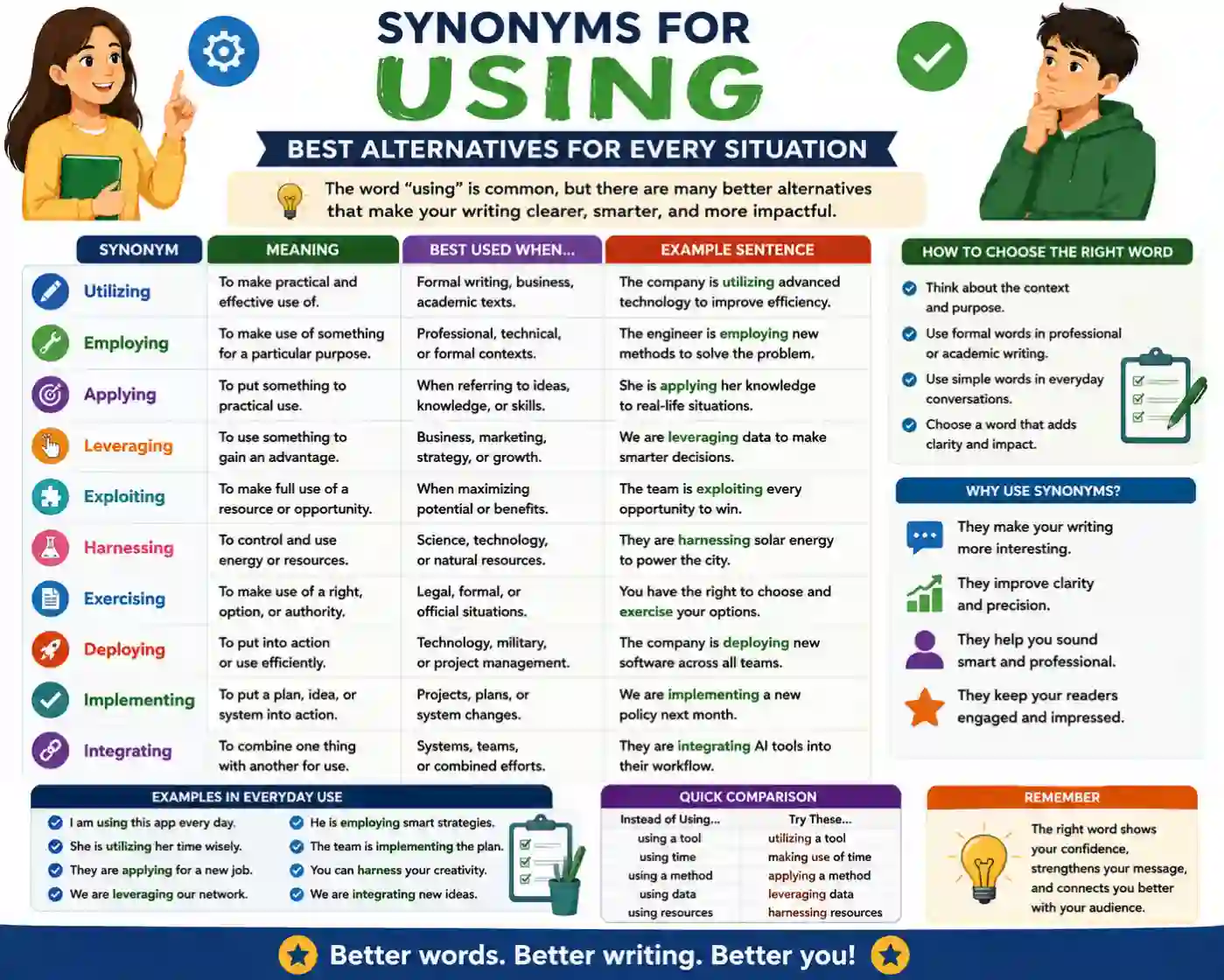
Writing the same word again and again can make your writing sound repetitive. It happens when you’re writing an email, a school essay, a resume, a blog post, or even a simple text message. If you’re searching for synonyms for using, you probably want better words that fit different situations and make your writing more interesting.
Synonyms for using are words and phrases that can replace using, depending on the meaning and context. Common alternatives include employ, apply, utilize, operate, handle, make use of, and take advantage of. The right choice depends on what you’re writing and who will read it.
Choosing the right synonym does more than improve your vocabulary. It helps your ideas sound clearer, more natural, and more professional. A resume needs different wording than a text message, while an academic paper calls for different language than a casual conversation. This guide explains the meaning and history of the word, provides a complete list of useful synonyms, shows when each one works best, and helps you choose the right alternative with practical examples.
What Does Using Mean
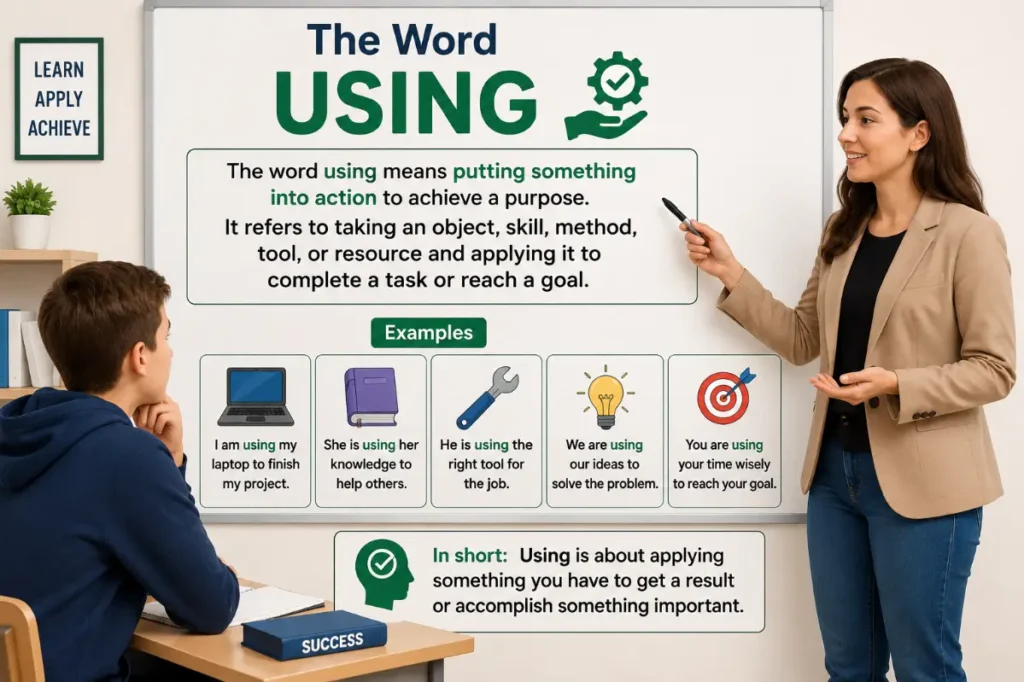
The word using means putting something into action to achieve a purpose. It refers to taking an object, skill, method, tool, or resource and applying it to complete a task or reach a goal.
Here are a few simple examples.
• She is using a laptop to finish her homework.
• He is using his experience to solve the problem.
Although the meaning seems simple, English has many different words that express this idea. Some are better for business writing, while others fit casual conversations or academic papers. Learning these alternatives helps you avoid repetition and makes your writing sound more natural.
Where Did the Word Using Come From
Many articles only list similar words without explaining where the word came from. Understanding its history makes it easier to see why English has so many alternatives. The verb use entered English from the Old French word user, which meant to employ, practice, or make use of something. That word came from the Latin verb uti, meaning to use, enjoy, benefit from, or take advantage of. As English developed, use became one of the language’s most common verbs. The form using is the present participle, describing an action that is happening now or continuing over time.
For example.
• I am using my phone.
• They are using modern software.
Because people use objects, ideas, skills, and methods in many different ways, English naturally developed dozens of related words that fit specific situations.
For example.
• A scientist may apply a theory.
• A student can make use of online resources.
Each word shares the basic idea of using but adds its own meaning and tone.
What Are the Best Synonyms for Using
| Word | Meaning | Tone | Example |
|---|
| Use | Put something into action | Neutral | Use a calculator for this problem. |
| Utilize | Use efficiently | Formal | The company utilized advanced softwar |
| Employ | Use for a purpose | Formal | She employed a new strategy. |
| Apply | Put into practice | Formal | Apply your knowledge carefully. |
| Make use of | Use something available | Neutral | Make use of free resources. |
| Take advantage of | Benefit from | Neutral | Take advantage of the discount. |
| Operate | Control equipment | Technical | He operates heavy machinery. |
| Handle | Manage or work with | Neutral | She handled the customer complaint well. |
| Work with | Use while performing a task | Everyday | I enjoy working with children. |
| Run | Operate software or machines | Everyday | Run the application again. |
This collection includes everyday alternatives, professional vocabulary, business terms, and formal expressions so you can choose the best word for almost any sentence.
Simple Everyday Synonyms for Using
Most daily conversations don’t need complicated vocabulary. These words sound natural and are easy to understand.
| Synonym | Best Used For | Example |
|---|---|---|
| Use | Almost every situation | I use my phone every day. |
| Work with | Collaboration and tools | She works with children. |
| Handle | Managing tasks | He handled the request quickly. |
| Run | Software and machines | Run the program again. |
| Spend | Time and money | We spent the afternoon studying. |
| Wear | Clothing | She wears a blue jacket every day. |
| Carry | Equipment | Firefighters carry important tools. |
| Rely on | Depending on something | We rely on clean water every day. |
These words are common in conversations, emails, and everyday writing.
Formal Synonyms for Using
Formal writing often needs more precise language. These alternatives work well in reports, business documents, resumes, academic papers, and professional emails.
| Synonym | Best Context | Example |
|---|---|---|
| Utilize | Business reports | The organization utilized digital tools. |
| Employ | Academic writing | Researchers employed several methods. |
| Apply | Essays | Apply these principles consistently. |
| Implement | Business writing | The company implemented new procedures. |
| Execute | Project management | Execute the plan successfully. |
| Leverage | Resume writing | Leverage technical expertise to improve results. |
| Exercise | Legal writing | Exercise your voting rights responsibly. |
| Put into practice | Education | Students put new skills into practice. |
Remember that formal words should only be used when they sound natural. Sometimes the simple word use is still the best choice.
Informal and Slang Alternatives for Using
Casual conversations and social media often use relaxed expressions instead of formal vocabulary.
| Expression | Meaning | Example |
|---|---|---|
| Tap into | Gain access to | Tap into your creativity. |
| Go with | Choose | I’ll go with the blue design. |
| Stick with | Continue using | I’ll stick with my old phone. |
| Mess with | Interact casually | Don’t mess with the settings. |
| Play around with | Experiment | I’m playing around with a new app. |
| Try out | Test something | Let’s try out the new feature. |
| Lean on | Depend on | I lean on my friends for advice. |
These expressions sound friendly but usually don’t belong in formal writing.
Which Synonym Is Stronger
Not every synonym has the same level of meaning. Some simply describe ordinary actions, while others suggest planning, expertise, or efficient use.
| Strength | Synonyms | Typical Situation |
|---|---|---|
| Very Mild | Use, work with, handle | Daily conversation |
| Mild | Apply, wear, spend, carry | School and workplace |
| Medium | Employ, operate, implement | Professional writing |
| Strong | Utilize, leverage, execute | Business writing and resumes |
| Very Strong | Exploit, maximize, capitalize on | Persuasive or advanced writing |
As the words become stronger, they usually sound more formal. The best synonym is not always the strongest one. It is the one that fits your audience and purpose.
Which Parts of Speech Are Related to Using
The word using is the present participle of the verb use. Many related words belong to different parts of speech and can help you write more naturally.
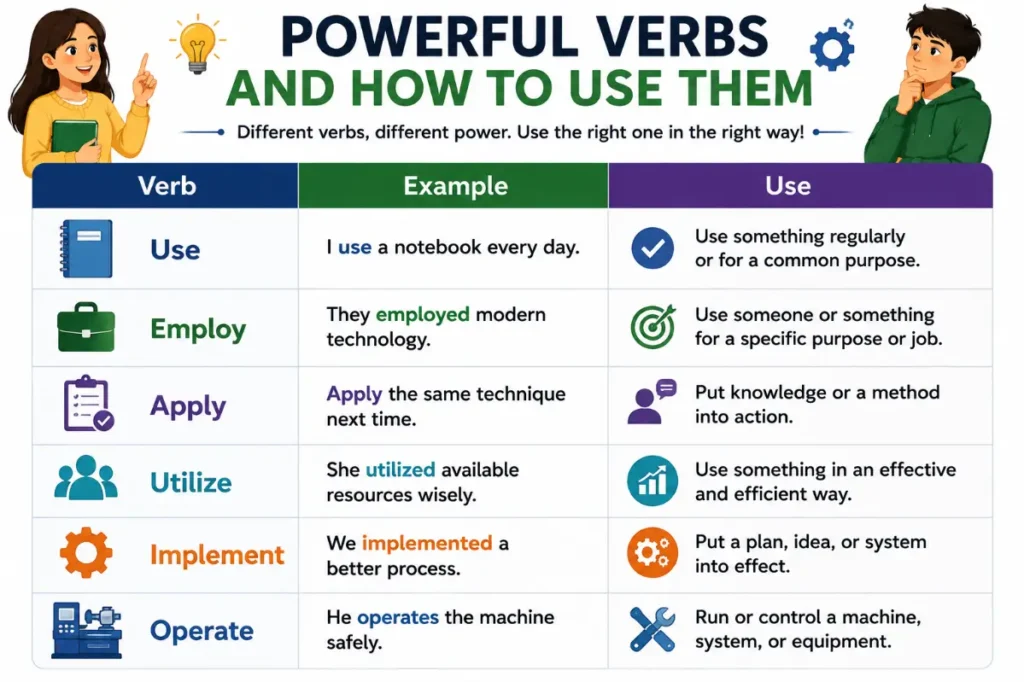
Verb Forms
| Verb | Example |
|---|---|
| Use | I use a notebook every day. |
| Employ | They employed modern technology. |
| Apply | Apply the same technique next time. |
| Utilize | She utilized available resources wisely. |
| Implement | We implemented a better process. |
| Operate | He operates the machine safely. |
Noun Forms
| Noun | Example |
|---|---|
| Use | The use of technology continues to grow. |
| Application | The application of science improves daily life. |
| Employment | Employment of renewable energy is increasing. |
| Utilization | Efficient utilization saves money. |
| Implementation | The implementation took several weeks. |
Adjective Forms
| Adjective | Example |
|---|---|
| Useful | This guide is useful for beginners. |
| Usable | The software is now usable. |
| Functional | The equipment remains functional. |
| Practical | That’s a practical solution. |
| Effective | This is an effective method for learning. |
Changing the sentence structure instead of repeating the same verb is an easy way to improve your writing.
Does American and British English Use Different Synonyms
For the word using, American English and British English are almost the same. Both varieties use the same core vocabulary.
There are still a few small preferences.
| Expression | American English | British English | Notes |
|---|---|---|---|
| Use | Very common | Very common | Standard in both countries. |
| Utilize | Common in business | Common in business | Sounds formal everywhere. |
| Employ | Common | Common | Frequently used in professional writing. |
| Operate | Common | Common | Used for machines and systems. |
| Make use of | Common | Slightly more common | Often heard in British English. |
| Leverage | Very common | Becoming more common | Especially popular in American business writing. |
| Tap into | Common | Common | Informal in both regions. |
The biggest difference is usually not between American and British English. Instead, it is the level of formality. Choosing the right tone is much more important than choosing a regional variation.
Best Synonyms for Using in Different Situations
The best replacement for using depends on where you’re writing. A word that sounds perfect in a resume may sound too formal in a text message. Likewise, a casual phrase might not fit a business report. The sections below explain which synonym works best in different situations and why.
What’s the Best Word to Use on a Resume
A resume should highlight your skills and achievements. Instead of repeating using, choose action verbs that sound confident and professional.
| Better Word | Why It Works | Example |
|---|---|---|
| Utilized | Shows efficient use of resources | Utilized data analysis tools to improve reporting accuracy. |
| Employed | Sounds professional and purposeful | Employed effective communication skills to resolve customer issues. |
| Implemented | Shows action and results | Implemented a new filing system that reduced errors. |
| Leveraged | Highlights making the most of a skill or resource | Leveraged leadership experience to manage a team of ten employees. |
| Applied | Shows practical use of knowledge | Applied project management techniques to complete tasks ahead of schedule. |
Good resume example:
Instead of:
I was using Microsoft Excel every day.
Write:
I utilized Microsoft Excel to analyze monthly sales reports.
Or:
I leveraged Microsoft Excel to improve data accuracy.
These alternatives sound stronger because they focus on accomplishments rather than simple actions.
What’s the Best Word to Use in an Essay
Academic writing should sound clear, precise, and natural. Avoid replacing every instance of using with a complicated word. Choose the word that best matches the sentence.
| Synonym | Best Use |
|---|---|
| Apply | Rules, theories, and knowledge |
| Employ | Research methods and techniques |
| Utilize | Resources and technology |
| Implement | Policies and strategies |
| Draw on | Experience or previous research |
Example:
The researchers employed several methods to collect accurate data.
The students applied the scientific method during the experiment.
The author drew on historical records to support the argument.
What’s the Best Word to Use in an Email
Professional emails should be polite and easy to understand. Simple language usually works best.
Good choices include:
• Use
• Refer to
Examples:
Please use the attached document during tomorrow’s meeting.
You can access the report through the company portal.
Please make use of the updated template for future requests.
Avoid words that sound overly formal unless your workplace expects that style.
What’s the Best Word to Use in Text Messages
Texting is casual. Short, familiar words sound the most natural.
Common choices include:
• Use
• Tap into
Examples:
Try out the new app.
I’ll stick with this one.
Go with the blue shirt.
Use Google Maps if you get lost.
These expressions sound friendly and conversational.
What’s the Best Word to Use When Speaking
Everyday conversations usually don’t require formal vocabulary.
Natural alternatives include:
• Use
• Go with
Examples:
I usually work with small businesses.
We rely on online banking now.
She handled the situation really well.
I’ll go with your suggestion.
Simple words often sound more confident than complicated ones.
What’s the Best Word for Business Writing
Business documents often require language that sounds professional without becoming difficult to read.
These words work well.
| Synonym | Best For |
|---|---|
| Utilize | Resources and technology |
| Implement | New systems and procedures |
| Leverage | Skills and opportunities |
| Employ | Methods and strategies |
| Execute | Plans and projects |
Example:
The company implemented new security measures.
Our team leveraged customer feedback to improve the product.
The organization employed several marketing strategies.
What’s the Best Word for Creative Writing
Creative writing focuses on vivid language instead of repetitive wording. Depending on the situation, you might replace using with words like:
• Wield
• Command
Examples:
The knight wielded a shining sword.
She drew upon years of experience.
The captain commanded every available resource.
These words create stronger mental images than simply saying using.
Real Life Example Sentences
Here are original examples that show how different synonyms fit different situations.
- The engineer utilized advanced software to design the bridge.
- Students applied the new grammar rule during the test.
- We employed several safety measures before beginning construction.
- She handled the customer complaint with patience and professionalism.
- Our team implemented a faster checkout process.
- I rely on my calendar to stay organized.
- The company leveraged social media to reach new customers.
- Please access the shared folder before the meeting.
- He drew on his teaching experience to solve the problem.
- We made use of every available resource during the emergency.
- The chef used fresh herbs to improve the flavor.
- They operated the machine according to the manufacturer’s instructions.
- I’ll stick with my current phone for another year.
- Let’s try out the new software this afternoon.
- Farmers depend on rainfall during the growing season.
These examples show that each synonym works best in a specific context.
Employ vs Utilize
These two words often confuse English learners because they both mean using, but they are not always interchangeable.
| Employ | Utilize |
|---|---|
| Means to use something for a purpose | Means to use something effectively or efficiently |
| Often refers to methods, people, or techniques | Often refers to tools, resources, or equipment |
| Common in academic writing | Common in business writing |
| Sounds slightly simpler | Sounds more formal |
Examples:
The researchers employed several testing methods.
The company utilized advanced software.
If you’re talking about making efficient use of a resource, utilize is usually the better choice.
If you’re referring to a method or technique, employ often sounds more natural.
Apply vs Implement
These words are similar but describe different actions.
| Apply | Implement |
|---|---|
| Put knowledge or rules into practice | Put a plan or system into operation |
| Often used for skills and ideas | Often used for policies and procedures |
| Usually affects an individual | Often affects an organization |
Examples:
Students applied the grammar rule correctly.
The school implemented a new attendance policy.
You apply knowledge.
You implement systems.
Use vs Utilize
Many writers think utilize always sounds better than use. That isn’t true.
| Use | Utilize |
|---|---|
| Simple and natural | More formal |
| Works in almost every situation | Best for professional writing |
| Easy to understand | Can sound unnecessary if overused |
Instead of writing:
We utilized a pencil.
Write:
We used a pencil.
However, this sentence sounds better with utilize.
The hospital utilized advanced medical technology to improve patient care.
A good rule is to choose use unless there’s a clear reason to sound more formal.
Draw On vs Rely On
These expressions both involve depending on something, but they are different.
| Draw On | Rely On |
|---|---|
| Use experience, knowledge, or skills | Depend on a person or thing |
| Often refers to internal strengths | Often refers to outside support |
Examples:
She drew on her years of experience.
We rely on electricity every day.
One refers to using something you already have.
The other refers to depending on something outside yourself.
Common Mistakes When Choosing a Synonym
Many people replace using with a more complicated word because they think it sounds smarter. This often makes writing less natural.
Here are common mistakes.
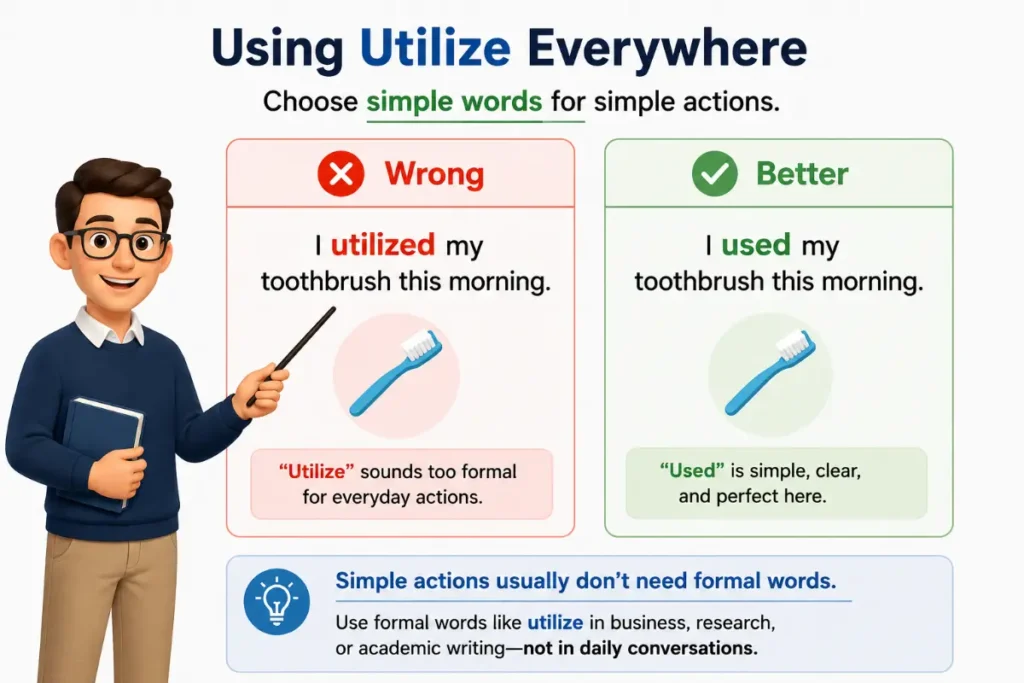
Using Utilize Everywhere
Wrong:
I utilized my toothbrush this morning.
Better:
I used my toothbrush this morning.
Simple actions usually don’t need formal words.
Mixing Up Apply and Implement
Wrong:
The company applied a new policy.
Better:
The company implemented a new policy.
Policies are implemented.
Knowledge and skills are applied.
Using Exploit as a Positive Word
Exploit often has a negative meaning because it suggests taking unfair advantage.
Wrong:
The charity exploited community volunteers.
Better:
The charity utilized community volunteers.
Choosing Words That Don’t Match the Audience
Business reports can include leverage and implement.
A text message usually shouldn’t.
Always think about who will read your writing.
When Should You Not Replace Using
Sometimes using is already the best word. Don’t replace it just to avoid repetition if the alternative sounds awkward.
For example.
Using sunscreen helps protect your skin.
This sentence is simple and clear.
Replacing it with utilizing sunscreen doesn’t improve the meaning.
Likewise, avoid formal words in conversations with friends.
Natural writing is usually better than complicated writing.
Antonyms of Using
Sometimes you need the opposite idea instead of another synonym.
| Antonym | Meaning |
|---|---|
| Ignore | Pay no attention to |
| Avoid | Stay away from |
| Neglect | Fail to use or care for |
| Waste | Fail to use properly |
| Abandon | Leave behind |
| Discard | Throw away |
| Reject | Refuse to accept |
| Stop | End an activity |
| Misuse | Use incorrectly |
| Underuse | Use less than needed |
Example:
Instead of using available resources, the company ignored them.
Quick Tips for Choosing the Right Synonym
Choosing the right synonym becomes much easier if you follow a few simple guidelines.
• Choose use for everyday writing.
Apply is the right choice for knowledge, rules, and skills.
• Choose rely on when talking about dependence.
Remember that the best synonym is the one that sounds natural in your sentence. Using complicated vocabulary doesn’t always make your writing better. Clear writing almost always wins.
Related Words You May Also Find Helpful
If you’re expanding your vocabulary, these related terms are worth learning alongside the word using.
- Use
- Usage
- Utilize
- Utilization
- Employ
- Employment
- Apply
- Application
- Implement
- Implementation
- Operate
- Operation
- Handle
- Manage
- Execute
- Leverage
- Access
- Work with
- Draw on
- Make use of
Learning these related words will help you write with greater variety while keeping your sentences clear and natural.
Quick Reference Table
| Situation | Best Alternative |
|---|---|
| Everyday conversation | Use |
| School essay | Apply, Employ |
| Resume | Utilized, Leveraged, Implemented |
| Business email | Use, Employ, Implement |
| Technical writing | Operate, Utilize |
| Research paper | Employ, Apply |
| Creative writing | Wield, Draw on, Handle |
| Social media | Use, Try out, Stick with |
Final Takeaway
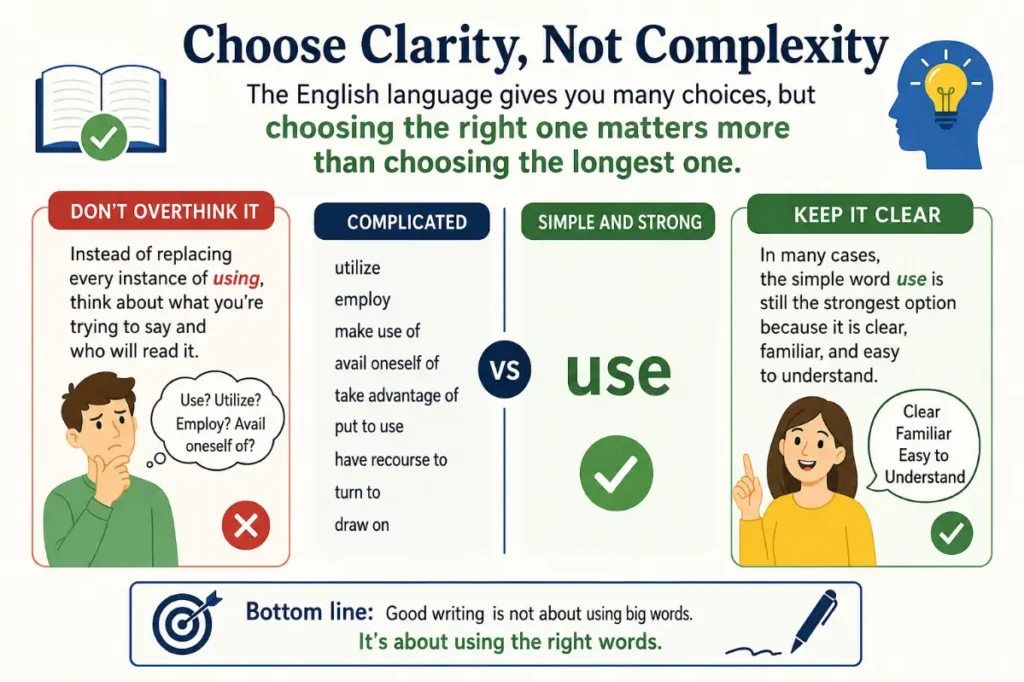
The English language gives you many choices, but choosing the right one matters more than choosing the longest one. Instead of replacing every instance of using, think about what you’re trying to say and who will read it. In many cases, the simple word use is still the strongest option because it is clear, familiar, and easy to understand.
When you need more variety, choose words like apply for knowledge, employ for methods, implement for systems, operate for machines, and utilize for efficient use of resources. By understanding these small differences, you’ll write with greater confidence and precision in every situation.
Conclusion
Finding the right synonyms for using can make your writing clearer, more engaging, and less repetitive. While the word using works perfectly in many situations, English offers plenty of alternatives that fit different audiences and purposes. Words like apply, employ, utilize, implement, operate, and handle each add a slightly different meaning, so choosing the right one helps your message sound more accurate and natural.
Before replacing using, think about your context. A resume benefits from strong action verbs, an academic paper needs precise language, and a text message usually sounds best with simple words. Focus on clarity instead of using complicated vocabulary just to sound impressive. The right synonym is always the one that communicates your idea in the easiest and most natural way.
Frequently Asked Questions
What’s another way to say using?
Some of the best synonyms for using include use, employ, apply, utilize, implement, operate, handle, make use of, draw on, and rely on. The best choice depends on the context and the tone of your writing.
Is utilize better than use?
Not usually. Use is shorter, clearer, and works in almost every situation. Utilize is more formal and is best when you want to emphasize making efficient use of a resource.
Can I use employ instead of using?
Yes, but only in the right context. Employ usually refers to methods, techniques, tools, or strategies and is common in professional and academic writing.
What are the best synonyms for using in a resume?
Good resume alternatives include utilized, leveraged, implemented, employed, applied, and operated. These action verbs help describe your achievements more effectively.
What’s the difference between apply and implement?
Apply means to put knowledge, skills, or rules into practice. Implement means to put a plan, policy, or system into operation. Example: You apply a technique. You implement a new process.
What’s another way to say using in an essay?
For academic writing, words like apply, employ, utilize, implement, and draw on often work well. Choose the word that best matches the meaning instead of replacing every instance of using.
What is the simplest replacement for using?
The simplest replacement is often use itself. If repetition becomes a problem, everyday alternatives like work with, handle, make use of, or rely on can also sound natural without making the sentence complicated.
