
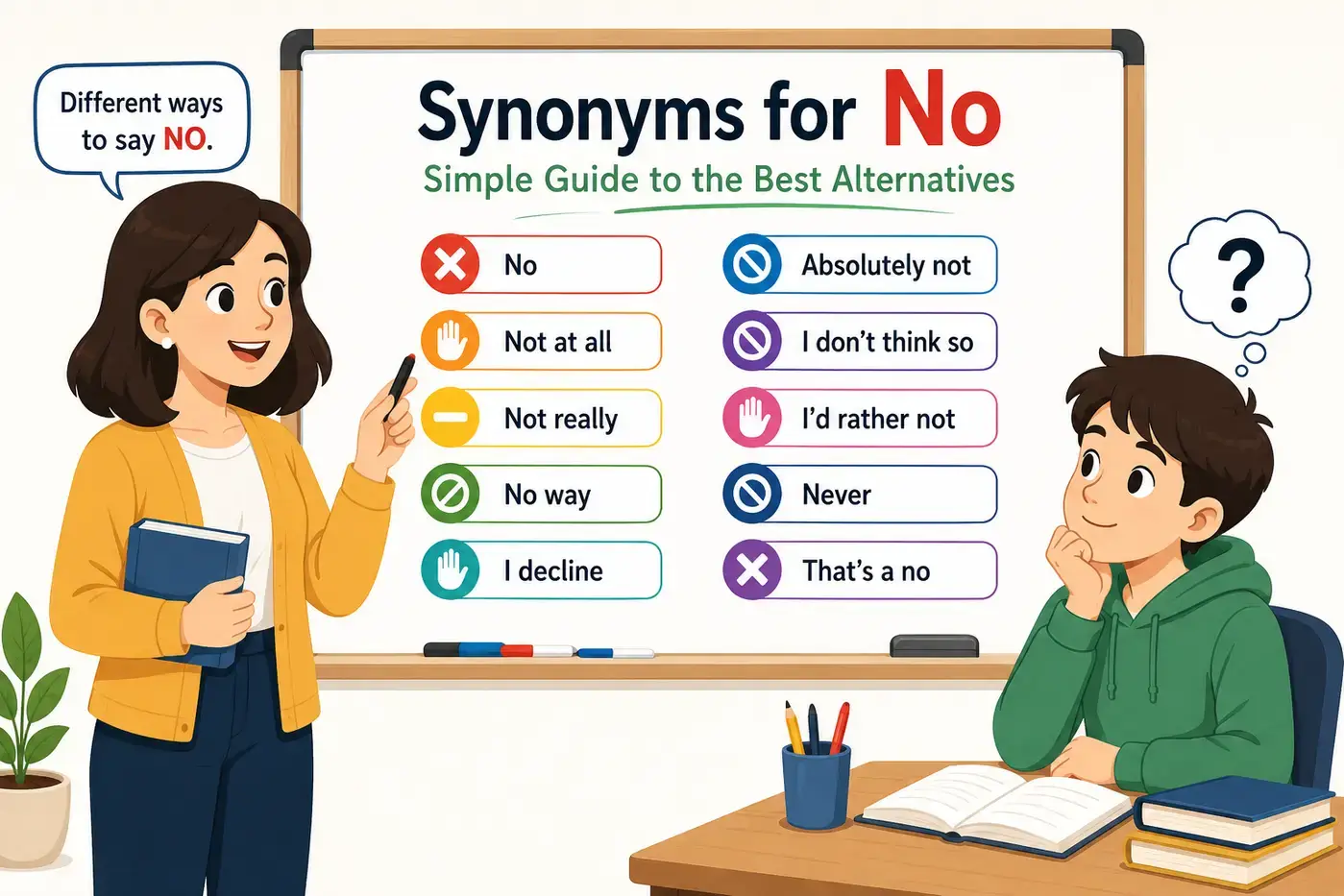
If you’re looking for synonyms for no, you’ve probably found yourself writing an email, school essay, work report, or even a quick text and realizing you’ve used the word no too many times. While it’s a simple and useful word, repeating it can make your writing sound dull and less engaging. Choosing a better alternative can make your message clearer and better suited to the situation.
The good news is that English offers many ways to express the same basic idea. You might need a polite way to decline an invitation, a formal word for a business email, a stronger term to reject an idea, or a casual expression for everyday conversation. Each option has its own meaning, tone, and best use.
This guide explains the meaning and origin of the word no, introduces more than 30 useful alternatives, compares similar words, and shows you how to choose the right one for emails, essays, text messages, conversations, and professional writing. By the end, you’ll know exactly which word fits your message and why.
Short Answer
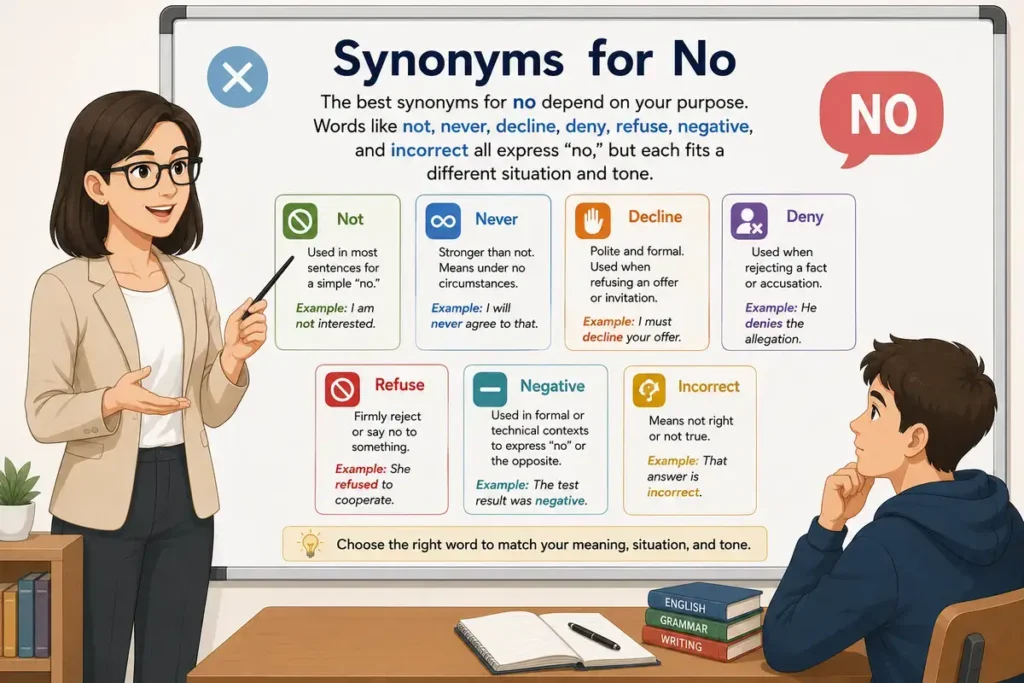
The best synonyms for no depend on your purpose. Words like not, never, decline, deny, refuse, negative, and incorrect all express “no,” but each fits a different situation and tone.
What Does the Word No Mean?
The word no is one of the most common words in English. It expresses refusal, denial, disagreement, absence, or a negative answer.
People use it every day in many situations.
- Answering a yes or no question.
- Refusing a request.
- Saying something is not true.
- Showing something does not exist.
- Setting a boundary.
- Rejecting an idea or suggestion.
Although it is short, no carries different meanings depending on the situation. A gentle “no” to a friend’s invitation feels very different from a firm “no” in a legal document or workplace policy.
Where Did the Word No Come From?
Many people use the word every day without thinking about its history. The English word no comes from Old English nā, which meant not ever or not at all. It developed from two even older words that meant not and always. Over hundreds of years, English speakers shortened and simplified the pronunciation until it became the modern word no. The idea behind the word has stayed almost the same for centuries. It still expresses a negative response, rejection, or the absence of something.
Because it has existed for such a long time, no appears in almost every type of English.
- Everyday conversation.
- Literature.
- Business writing.
- Academic papers.
- Legal documents.
- Government policies.
- News reports.
- Online messaging.
Its long history also explains why English has developed many different ways to express the same basic idea.
What Are the Best Synonyms for No?
| Word | Meaning | Tone | Example |
|---|
| Not | Something isn’t true | Neutral | That is not correct. |
| Never | At no time | Neutral | I never said that. |
| Nope | Informal no | Casual | Nope, I’m busy today. |
| Nah | Casual refusal | Casual | Nah, I’ll stay home. |
| Negative | Negative response | Formal | The result was negative. |
| Decline | Politely refuse | Formal | She declined the invitation. |
| Refuse | Say no directly | Neutral | They refused the request. |
| Deny | Say something isn’t true | Formal | He denied the accusation. |
| Reject | Not accept | Formal | The editor rejected the article. |
| Oppose | Be against | Formal | Many opposed the plan. |
Which Synonyms for No Sound Soft and Which Sound Strong?
Not every alternative carries the same level of force. Some sound friendly while others leave no room for discussion.
Mild Alternatives
These words keep the conversation polite.
- Not
- Maybe not
- I don’t think so
- Pass
- Decline
- Turn down
- Not really
Example
I don’t think that’s the best option.
Moderate Alternatives
These show disagreement without sounding harsh.
- Disagree
- Reject
- Oppose
- Incorrect
- False
- Without
Example
The committee rejected the proposal after reviewing the budget.
Strong Alternatives
These communicate a firm refusal or complete rejection.
- Refuse
- Deny
- Never
- Prohibit
- Ban
- Forbid
- Impossible
- Unacceptable
- Veto
Example
The company refused to release customer information.
Can No Be Different Parts of Speech?
Yes. One reason English has so many synonyms for no is that the idea of “no” appears in different grammatical forms.
As an Adverb
It modifies another word by making it negative.
Examples
- I am not ready.
- She has never visited New York.
As a Determiner
It comes before a noun.
Examples
- No mistakes were found.
- No students were absent.
As an Interjection
It stands alone as a response.
Examples
- No, thank you.
- No, that’s not correct.
As a Noun
Sometimes no refers to the answer itself.
Examples
- We received a clear no.
- Her answer was an immediate no.
As a Verb Alternative
English usually replaces no with verbs that express refusal or rejection.
Common examples include:
- Decline
- Refuse
- Reject
- Deny
- Oppose
- Veto
- Forbid
Example
The manager declined the request.
Instead of saying someone “said no,” English often uses one of these more specific verbs because they describe exactly how the refusal happened.
Do People Use Different Words Instead of No in American and British English?
For the most part, no means the same thing across all English-speaking countries. Americans, British speakers, Canadians, Australians, and New Zealanders all understand it instantly. The biggest differences appear in everyday conversation rather than grammar.
| Expression | American English | British English | Notes |
|---|---|---|---|
| Nope | Very common | Common | Casual and friendly. |
| Nah | Very common | Very common | Relaxed conversation. |
| Not really | Common | Common | Polite disagreement. |
| No way | Very common | Very common | Shows surprise or strong refusal. |
| Certainly not | Common | Common | Formal and emphatic. |
| By no means | Formal | Formal | Common in professional writing. |
| Nay | Rare | Slightly more common in formal voting | Mostly used in legal or parliamentary settings. |
Regional differences mostly affect style rather than meaning.
For example, an American friend might answer with Nope, while someone in the United Kingdom might simply say No or Not really. Both responses are natural, and neither is considered incorrect. Professional writing is almost identical in both countries. Words such as decline, refuse, deny, reject, and negative are accepted on both sides of the Atlantic. The important thing is to match the tone to the situation. Casual expressions work well in conversations and text messages, while formal alternatives fit business, academic, and legal writing much better.
Which Synonym for No Fits Your Situation Best?
The best choice depends on your audience and your goal. A word that sounds perfect in a text message may sound too casual in a business email. On the other hand, a formal word can feel cold in everyday conversation. The sections below show which alternatives work best in different situations.
What Should You Use on a Resume?
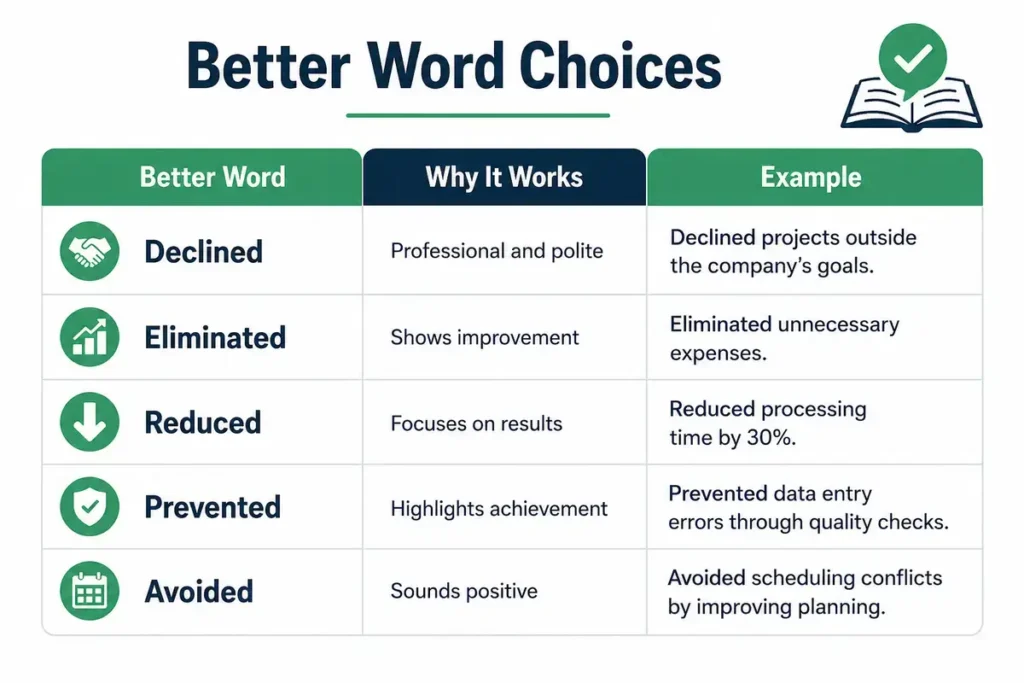
A resume should sound professional and positive. Instead of showing what you did not do, focus on actions and results. When you need to describe rejecting, reviewing, or limiting something, choose words that sound precise.
| Better Word | Why It Works | Example |
|---|---|---|
| Declined | Professional and polite | Declined projects outside the company’s goals. |
| Eliminated | Shows improvement | Eliminated unnecessary expenses. |
| Reduced | Focuses on results | Reduced processing time by 30%. |
| Prevented | Highlights achievement | Prevented data entry errors through quality checks. |
| Avoided | Sounds positive | Avoided scheduling conflicts by improving planning. |
Examples
- The team prevented costly mistakes by updating the review process.
- We eliminated duplicate records before the final audit.
- The department avoided unnecessary spending during the project.
Which Word Works Best in an Essay?
Essays usually require clear and formal language. Avoid slang unless you’re quoting someone or writing dialogue. Good choices include:
- Not
- Never
- Deny
- Reject
- Oppose
- Disagree
- Incorrect
- False
Examples
- Many historians disagree with that theory.
- Researchers rejected the earlier explanation after new evidence appeared.
- The statement is incorrect because it ignores recent findings.
- Several experts oppose the proposed policy.
What’s the Best Alternative in an Email?
Emails often need a balance between honesty and politeness. A direct no can sometimes sound too blunt, especially in professional settings. Instead, try these alternatives.
| Situation | Better Choice | Example |
|---|---|---|
| Declining an invitation | Decline | I appreciate the invitation, but I must decline. |
| Refusing a request | Unable to | I’m unable to approve this request today. |
| Saying something isn’t possible | Cannot | We cannot make changes after the deadline. |
| Rejecting an idea politely | Don’t recommend | I don’t recommend moving forward at this stage. |
| Turning down an offer | Turn down | After careful thought, I’ve decided to turn down the offer. |
Examples
- Thank you for reaching out. I’m unable to attend the meeting this week.
- We cannot extend the deadline because the project has already begun.
- I appreciate the opportunity, but I’ll have to decline.
What Should You Say in a Text Message?
Texting is informal, so shorter alternatives usually sound more natural.
Common choices include:
- Nope
- Nah
- Not really
- Maybe later
- I’m good
- I’ll pass
- No thanks
Examples
- Nope, I’m already home.
- Nah, maybe next weekend.
- I’ll pass this time.
- No thanks, but I appreciate it.
Remember that tone matters. A simple “No.” can sound cold in a text, while “No thanks!” feels much friendlier.
Which Alternative Sounds Best in Conversation?
In everyday speaking, people often soften a refusal to avoid sounding rude. Natural choices include:
- I don’t think so.
- Maybe not.
- I’d rather not.
- Not this time.
- I’ll pass.
- Sorry, I can’t.
- Not today.
Examples
- I’d rather not discuss that right now.
- Maybe not. Let’s try something else.
- Sorry, I can’t make it tonight.
- I’ll pass, but thanks for asking.
These expressions sound polite while still making your meaning clear.
Real Examples of Synonyms for No in Everyday Life
Seeing words in context makes them easier to remember. Here are original examples from real situations.
At Work
- The manager declined the proposal after reviewing the budget.
- Our legal team rejected the agreement because several terms were unclear.
- The supervisor refused to approve overtime without written permission.
At Home
- Dad said no to another pet.
- Mom forbade us from swimming during the storm.
- We had no milk left for breakfast.
With Friends
- I passed on dessert because I was full.
- My friend turned down the concert tickets.
- She replied, “Not really,” when I asked if she liked the movie.
Online
- The website returned a negative response.
- My payment was rejected by the bank.
- The app ruled out weak passwords during registration.
Travel
- The airline denied boarding because the passport had expired.
- The hotel could not accept late check-ins after midnight.
- The guide advised us not to enter the closed trail.
Reject vs Refuse What’s the Difference?
Both words mean someone says no, but they aren’t always interchangeable.
| Reject | Refuse |
|---|---|
| Focuses on not accepting something. | Focuses on choosing not to do something. |
| Often used for objects, ideas, or applications. | Often used for requests, offers, or actions. |
| Common in hiring, publishing, and admissions. | Common in everyday conversation. |
Reject
- The university rejected my application.
- The editor rejected the article.
Refuse
- She refused to answer the question.
- They refused our request.
Quick Rule
Use reject when something is evaluated and not accepted. Use refuse when a person decides not to do something.
Decline vs Turn Down Which Sounds Better?
These two expressions are very close in meaning, but their tone is different.
| Decline | Turn Down |
|---|---|
| More formal. | More conversational. |
| Common in business writing. | Common in everyday speech. |
| Sounds polite and professional. | Sounds friendly and relaxed. |
Examples
Decline
- I must decline your invitation.
- She declined the interview request.
Turn Down
- I turned down the job offer.
- He turned down another slice of pizza.
Quick Rule
Choose decline for professional communication. Choose turn down for casual conversations.
Deny vs Disagree What’s the Difference?
These words both express a negative idea, but they mean different things.
| Deny | Disagree |
|---|---|
| Says something is not true. | Says you have a different opinion. |
| Focuses on facts or accusations. | Focuses on viewpoints. |
Examples
Deny
- The athlete denied using banned substances.
- She denied making the phone call.
Disagree
- I disagree with your conclusion.
- The scientists disagree about the results.
A person can disagree without saying someone is lying. Denying something is much stronger because it rejects the claim itself.
Common Mistakes When Using Synonyms for No
Choosing the wrong alternative can change your message or make it sound awkward.
Using Slang in Professional Writing
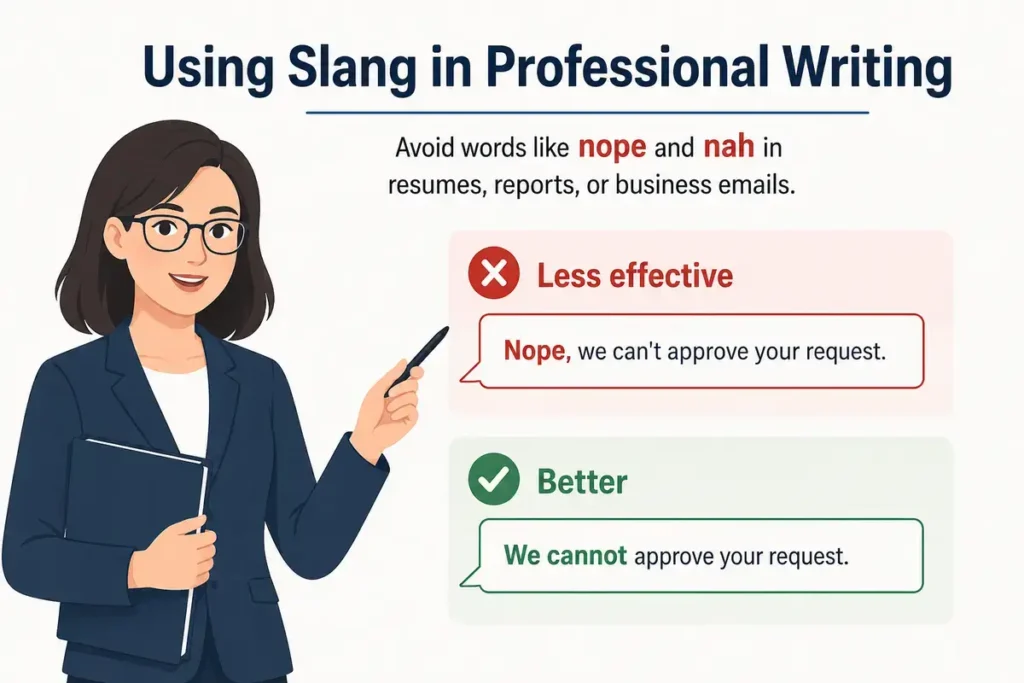
Avoid words like nope and nah in resumes, reports, or business emails.
Less effective
- Nope, we can’t approve your request.
Better We cannot approve your request.
Using Reject for People
People usually reject applications, ideas, products, or offers. They do not normally reject a person directly in everyday English.
Natural
The company rejected his application.
Less natural
- The company rejected him.
The second sentence is possible, but native speakers often prefer mentioning what was rejected.
Confusing Deny and Refuse
These words have different meanings. Deny means saying something isn’t true. Refuse means choosing not to do something.
Making Every Response Sound Too Strong
Not every situation needs a firm refusal.
Instead of:
- Absolutely not.
You could say:
- Not today.
- Maybe another time.
- I’d rather not.
- Thanks, but I’ll pass.
These sound friendlier in everyday conversation.
When Should You Avoid Certain Synonyms?
Some alternatives fit only specific situations.
| Word | Avoid It When | Better Choice |
|---|---|---|
| Nope | Writing professionally | No or Not |
| Nah | Academic writing | No or Not |
| Ban | Nothing is officially prohibited | Prevent or Stop |
| Veto | No official authority exists | Reject or Decline |
| Deny | Sharing an opinion | Disagree |
| Reject | Refusing an action | Refuse |
| Impossible | Something is only difficult | Unlikely or Difficult |
Choosing a word that matches the situation makes your writing sound more natural and more believable.
What Are the Opposite Words of No?
Sometimes the best way to understand a word is to compare it with its opposite. While no expresses refusal, disagreement, or absence, its antonyms express agreement, approval, or acceptance.
| Antonym | Meaning | Example |
|---|---|---|
| Yes | Positive response | Yes, I’d love to help. |
| Certainly | Strong agreement | Certainly, I’ll send the report today. |
| Absolutely | Complete agreement | Absolutely, that’s the right choice. |
| Indeed | Confirms something is true | Indeed, the results improved. |
| Agree | Share the same opinion | I agree with your suggestion. |
| Accept | Receive or approve | She accepted the invitation. |
| Approve | Give official permission | The manager approved the budget. |
| Allow | Give permission | The teacher allowed extra time. |
| Confirm | Say something is true | Please confirm your reservation. |
| Support | Be in favor of | Most employees supported the proposal. |
These words don’t replace no, but they help you understand the opposite meaning and choose the right response.
How Do You Choose the Right Synonym?
With so many alternatives available, picking the right one can feel difficult. A few simple questions make the choice much easier.
Think About Your Audience
Friends usually expect casual language. Teachers, employers, and clients usually expect more formal wording.
Example
- Casual: Nope, I’m busy.
- Professional: I’m unable to attend.
Match the Strength of Your Message
Don’t use a very strong word if a gentle response is enough.
Too Strong
- I absolutely refuse.
Softer
- I’d rather not.
- I’ll pass.
- Not this time.
Be Clear
The simplest word is often the best one. If no says exactly what you mean, there’s no need to replace it.
Choose Words That Match the Situation
Think about what you’re actually trying to say.
- Saying something isn’t true? Use deny or false.
- Declining an invitation? Use decline or turn down.
- Showing disagreement? Use disagree or oppose.
- Explaining that something isn’t allowed? Use prohibit, forbid, or ban.
- Giving a casual response? Use nope, nah, or not really.
A small change in wording can make your message sound friendlier, more professional, or more confident.
Quick Reference Chart
Use this chart when you need a fast recommendation.
| Situation | Best Choice |
|---|---|
| Business email | Decline |
| Resume | Prevent, Reduced, Eliminated |
| Academic essay | Reject, Deny, Oppose, Disagree |
| Text message | Nope, Nah, I’ll pass |
| Friendly conversation | Not really, Maybe not, I’d rather not |
| Formal report | Incorrect, False, Negative |
| Legal writing | Deny, Prohibit, Forbid, Veto |
| Official decision | Reject, Decline, Approve or Deny |
Conclusion
Finding the right synonyms for no isn’t about replacing every instance of the word. It’s about choosing language that matches your message, your audience, and your tone.
A casual conversation might call for nope or I’ll pass, while a business email sounds better with decline or unable to. Academic writing often benefits from words like reject, deny, or disagree because they communicate ideas more precisely.
When you’re unsure, choose the simplest word that clearly expresses your meaning. Clear writing is always more effective than complicated writing. The more you practice using different alternatives, the easier it becomes to sound natural in emails, essays, conversations, and professional documents.
Frequently Asked Questions
What’s another way to say no?
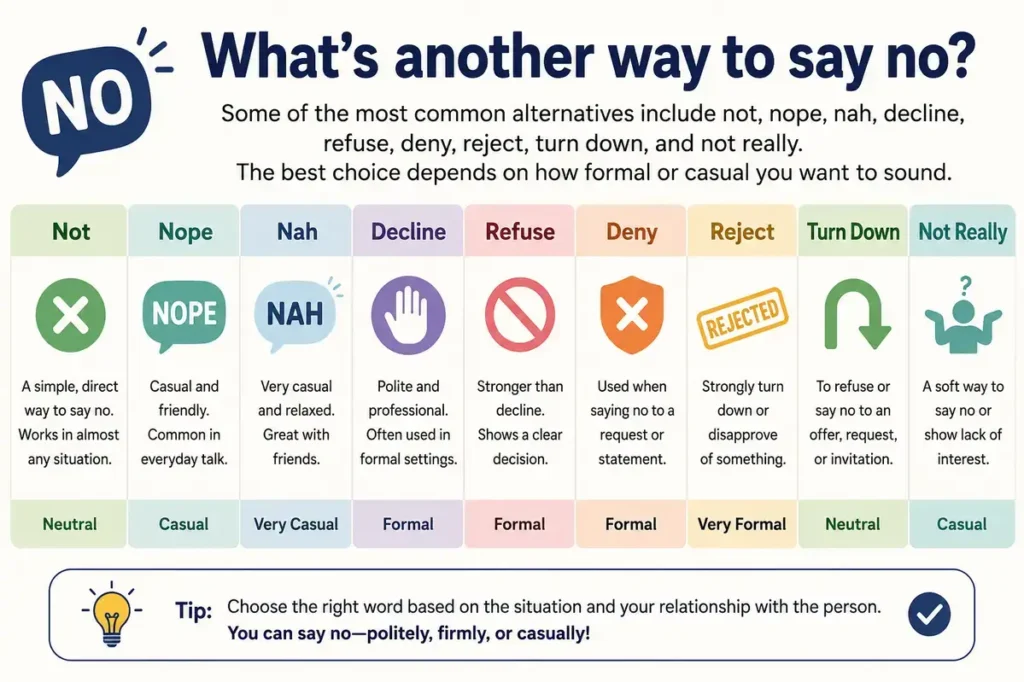
Some of the most common alternatives include not, nope, nah, decline, refuse, deny, reject, turn down, and not really. The best choice depends on how formal or casual you want to sound.
What are the best synonyms for no in professional writing?
The best synonyms for no in professional writing include decline, cannot, unable to, reject, deny, and negative. These words sound polite, clear, and appropriate for business communication.
Is nope a real English word?
Yes. Nope is an accepted informal English word. It is common in conversation and text messages but should usually be avoided in formal writing.
What’s the difference between reject and refuse?
Reject means something has been evaluated and not accepted, such as an application or proposal. Refuse means a person chooses not to do something or says no to a request.
Which synonym for no sounds the most polite?
Words and phrases like decline, I’d rather not, I’m unable to, not this time, and I’ll pass usually sound more polite than a direct no.
Can I use synonyms for no in an essay?
Yes. Using synonyms for no can make an essay more varied and precise. Just choose formal words that fit the context, such as reject, deny, oppose, disagree, or incorrect.
Is it always better to replace the word no?
No. Sometimes no is the clearest and most natural choice. Replace it only when another word communicates your meaning more accurately or matches the tone of your writing better.
