
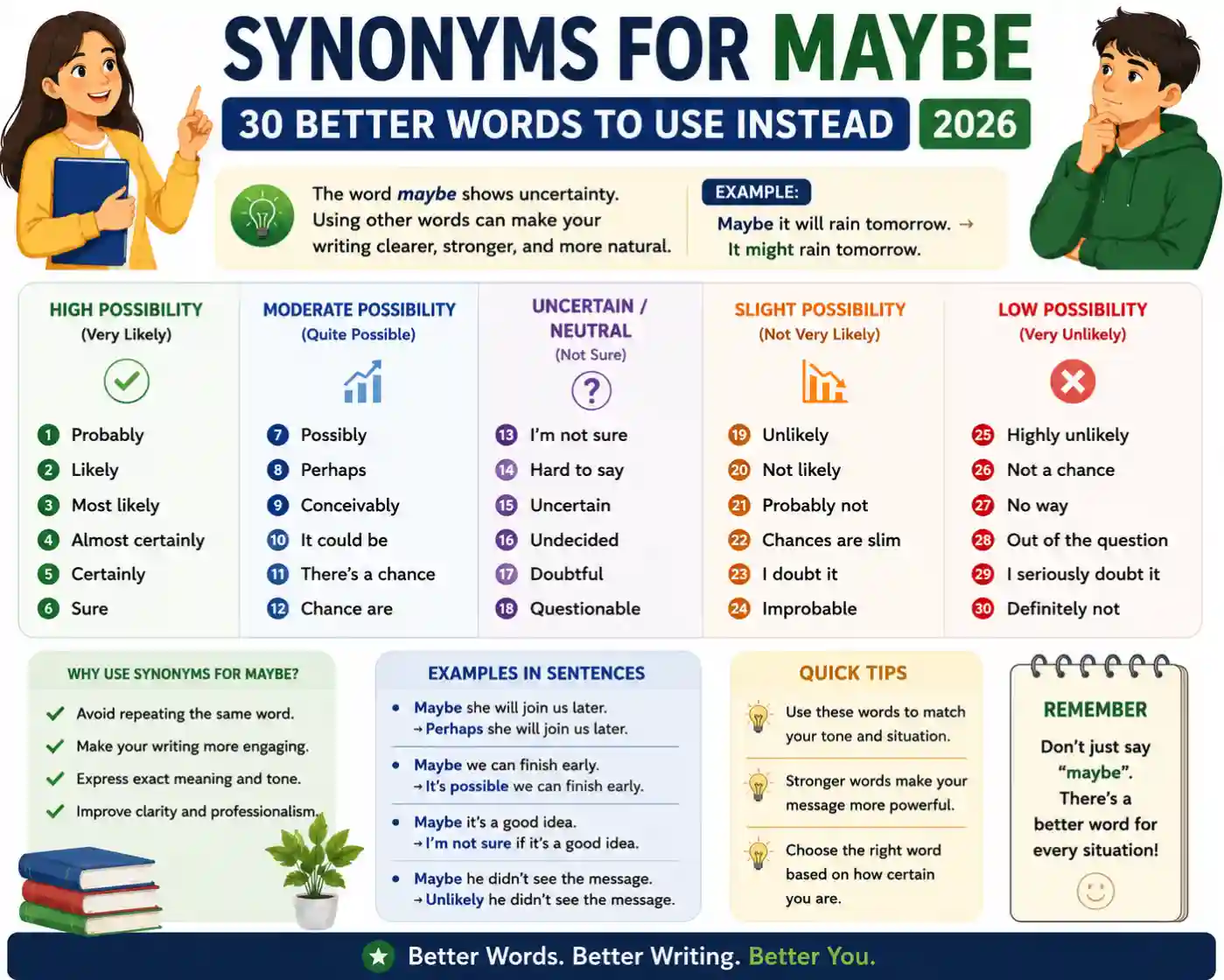
Have you ever started an email, school essay, social media post, or text message and paused at the word maybe? It works fine, but using the same word over and over can make your writing feel repetitive. Learning synonyms for maybe helps you sound clearer, more natural, and more confident.
People use maybe every day to show uncertainty, possibility, or polite hesitation. The problem is that one word cannot fit every situation. A casual text, a formal essay, and a work email all need a different tone.
This guide covers the history and meaning of the word, a complete list of alternatives, the best options by strength and tone, and regional usage notes. By the end, you will know exactly which word to use and when to use it.
Short Answer
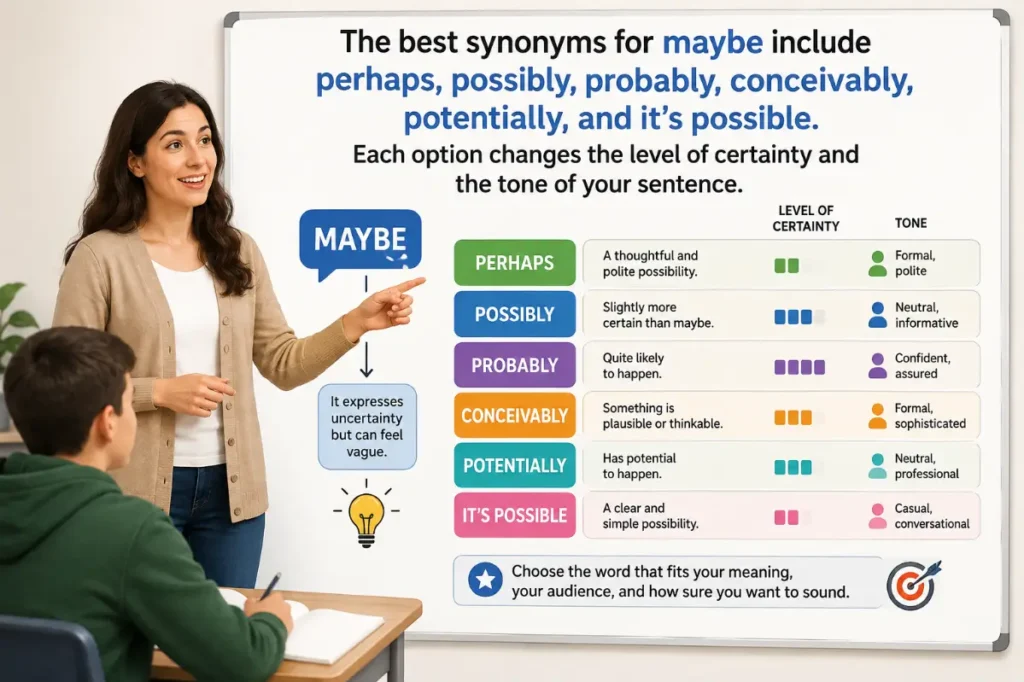
The best synonyms for maybe include perhaps, possibly, probably, conceivably, potentially, and it’s possible. Each option changes the level of certainty and the tone of your sentence.
What Does Maybe Mean in Plain English?
The word maybe means that something is possible but not certain. It shows doubt, chance, or an undecided opinion.
For example:
- Maybe I will go to the party.
- Maybe she forgot to send the email.
- Maybe we should wait for more information.
The speaker does not know the final answer. The event might happen, or it might not. People often search for synonyms for maybe because they want to:
- Make essays sound more formal.
- Improve emails at work.
- Add variety to creative writing.
- Sound more polite in conversations.
- Express different levels of certainty.
A small word can change the entire tone of a sentence. Compare these examples:
| Sentence | Tone |
|---|---|
| Maybe he will join us. | Casual and neutral |
| Perhaps he will join us. | Slightly formal and polished |
| Possibly he will join us. | Careful and objective |
| Probably he will join us. | More confident |
| Conceivably he will join us. | Formal and analytical |
The Origin of the Word Maybe
Many people use maybe every day but never think about where it came from. The word maybe comes from two older English words: may and be. In Middle English, speakers used the phrase it may be to express possibility. Over time, people shortened the phrase into the single word maybe. This change made the language quicker and easier to use in speech and writing.
The older phrase still exists today:
- It may be true.
- It may be necessary to leave early.
- It may be a good idea to call first.
Both forms express uncertainty, but they do not always sound the same. Understanding the history of the word makes it easier to choose better synonyms for maybe because you can see how English offers both casual and formal ways to express possibility.
Master List of Synonyms for Maybe
Below is a complete list of synonyms for maybe, grouped by tone and everyday use. Most articles stop at ten options, but real writing needs more variety.
Simple and Everyday Synonyms
Formal Synonyms for Maybe
Casual and Conversational Alternatives
Which Synonyms for Maybe Sound Stronger or Weaker?
Not all alternatives show the same level of confidence. Some suggest a small chance. Others suggest something is quite likely. This scale helps you pick the right word for the situation. For example:
- Perhaps I will attend the meeting sounds open and polite.
- I will probably attend the meeting sounds much more certain.
- The plan could conceivably succeed sounds formal and cautious.
Synonyms for Maybe by Part of Speech
The word maybe is an adverb, but English often uses phrases, modal verbs, and expressions to communicate the same idea.
Adverbs
Modal Verbs
Phrases and Expressions
Do Americans and British Speakers Use Different Alternatives to Maybe?
Most synonyms for maybe work in both American and British English, but some choices are more common in one region. For American English, perhaps, possibly, probably, and I guess are some of the most natural choices. For British English, perhaps, I suppose, and at a guess appear more often in everyday speech. Understanding these small differences helps you choose synonyms for maybe that match your audience and sound natural wherever your readers live.
Summary
The word maybe comes from the older phrase it may be, and it remains one of the most useful words for expressing uncertainty. However, different situations call for different choices.
In this first part, you learned:
- The plain meaning of maybe.
- The origin of the word.
- A complete master list of more than thirty alternatives.
- How different words express different levels of certainty.
- How these alternatives work as adverbs, verbs, and expressions.
- The main differences between American and British usage.
What Is the Best Word to Use Instead of Maybe?
There is no single best replacement for maybe. The right choice depends on who you’re talking to and what you’re writing. A text message usually sounds best with casual language. A college essay or business email often needs something more polished. The sections below explain the best choices for common situations.
What Should You Use Instead of Maybe in an Essay?
Essays usually benefit from clear and formal language. While maybe is not wrong, it can sound too conversational in academic writing. These alternatives usually work better:
| Word | Why It Works | Example |
|---|---|---|
| Perhaps | Formal but natural | Perhaps the results were influenced by weather conditions. |
| Possibly | Shows careful thinking | The data possibly reflects a seasonal trend. |
| Potentially | Common in academic writing | This change could potentially improve efficiency. |
| Conceivably | Analytical tone | The policy could conceivably affect future growth. |
| Theoretically | Discusses ideas or principles | Theoretically, both solutions are valid. |
Example Sentences
- Perhaps the author wanted readers to question the ending.
- The experiment could potentially produce different results.
- Conceivably, another explanation exists.
- Theoretically, the system should perform better after the update.
- Possibly, additional evidence will support this conclusion.
What Should You Use Instead of Maybe in a Resume?
A resume should sound confident. Words that express uncertainty can weaken your achievements. Instead of writing vague statements, focus on facts whenever possible.
Less effective:
- Maybe helped improve customer satisfaction.
- Maybe responsible for managing projects.
Better:
- Helped improve customer satisfaction by 18%.
- Managed projects from planning through completion.
If you truly need to describe future possibilities, these phrases work better than maybe:
| Better Choice | Example |
|---|---|
| Expected to | Expected to complete certification this year. |
| Anticipated | Anticipated graduation in May 2027. |
| Planned | Planned completion date is December 2026. |
| Seeking | Seeking opportunities in digital marketing. |
The goal is confidence, not uncertainty.
What Should You Use Instead of Maybe in an Email?
Professional emails should sound polite and clear. These alternatives usually fit better than maybe.
| Situation | Best Choice | Example |
|---|---|---|
| Making a suggestion | Perhaps | Perhaps we can meet on Thursday. |
| Discussing uncertainty | Possibly | We could possibly move the deadline. |
| Offering an option | It may be helpful | It may be helpful to schedule another meeting. |
| Being careful | It might | It might make sense to review the numbers again. |
Email Examples
- Perhaps we should discuss this during tomorrow’s meeting.
- It might be easier to schedule a video call.
- We could possibly finish the project by Friday.
- It may be helpful to gather more feedback first.
These options sound professional without sounding stiff.
What’s the Best Alternative in Text Messages?
Texting is informal, so simple language usually sounds the most natural.
Common choices include:
- Maybe
- I guess
- Probably
- Might
- Could be
- We’ll see
- Who knows
Examples
- I guess I’ll come after work.
- Probably around six.
- Might be a little late.
- Could be fun.
- We’ll see what happens.
- Who knows? It may surprise us.
Friends rarely expect formal vocabulary in casual conversations.
Which Word Sounds Best in Everyday Conversation?
When speaking, people usually choose short and familiar words. These are the most common:
| Word | Naturalness |
|---|---|
| Maybe | Very natural |
| Perhaps | Natural |
| Probably | Very natural |
| Might | Very natural |
| Could | Very natural |
| I guess | Very natural |
| I suppose | Natural |
| We’ll see | Very natural |
Long words like conceivably or ostensibly often sound too formal in everyday speech unless you’re discussing technical or academic topics.
Real Life Example Sentences Using Synonyms for Maybe
Seeing words in context makes them much easier to remember.
School
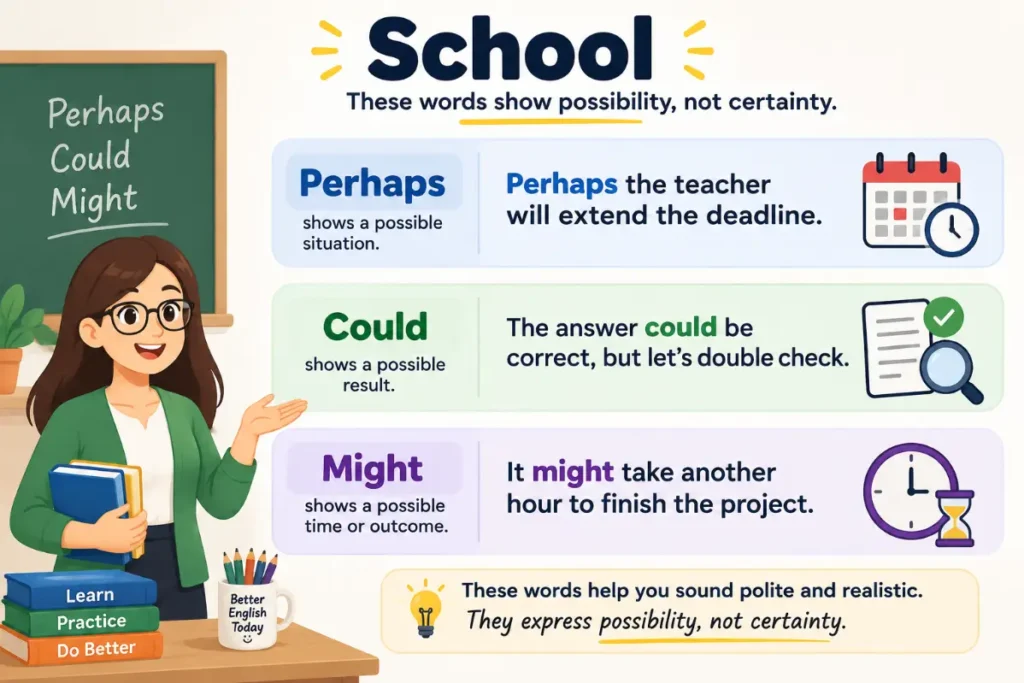
- Perhaps the teacher will extend the deadline.
- The answer could be correct, but let’s double check.
- It might take another hour to finish the project.
Workplace
- We could possibly launch the product next month.
- Presumably, the client has received our proposal.
- It may be helpful to review the contract again.
Family
- Maybe we’ll visit Grandma this weekend.
- There’s a chance Dad will get home early.
- I suppose we could order pizza tonight.
Friends
- Probably everyone is meeting at the park.
- Who knows? It could turn into a great trip.
- I guess I’ll text you later.
Travel
- The flight might be delayed because of the weather.
- Conceivably, another route would be faster.
- Perhaps we should leave earlier.
Shopping
- It may be cheaper to wait until next week.
- Possibly the store has another size.
- I suppose we can compare prices online.
Perhaps vs. Possibly: What’s the Difference?
These two words are close in meaning, but they create different impressions.
| Perhaps | Possibly |
|---|---|
| Sounds slightly warmer | Sounds more cautious |
| Common in conversation | More common in formal writing |
| Suggests an open idea | Emphasizes uncertainty |
| Often introduces suggestions | Often discusses probability |
Compare these sentences.
Perhaps we should take a different route.
This sounds friendly and collaborative.
Possibly we should take a different route.
This sounds more careful and analytical.
Probably vs. Maybe: What’s the Difference?
Many learners confuse these words because both talk about uncertainty. The difference is confidence.
| Maybe | Probably |
|---|---|
| Around a 50–50 chance | More likely than not |
| Neutral uncertainty | Strong expectation |
| Less commitment | More confidence |
Examples:
Maybe he’ll come to the party.
You genuinely don’t know.
He’ll probably come to the party.
You think there’s a good chance he will.
Using probably when you only mean maybe can accidentally make your statement sound more certain than you intended.
Might vs. Could: Which One Should You Choose?
These modal verbs often replace maybe, but they are not always identical.
| Might | Could |
|---|---|
| Focuses on possibility | Focuses on possibility or ability |
| Slightly more uncertain | Sometimes suggests capability |
| Very common in predictions | Common in suggestions |
Examples:
She might arrive after lunch.
The focus is uncertainty.
She could arrive after lunch.
This may suggest that arriving after lunch is one possible outcome.
Another example:
We could leave now.
This also suggests that leaving is an available choice.
Common Mistakes When Using Synonyms for Maybe
Even experienced writers sometimes choose the wrong alternative.
Using Probably When You Mean Maybe
Incorrect meaning:
He’ll probably forget.
Use this only if you believe forgetting is likely.If you simply aren’t sure, write: Maybe he’ll forget.
Using Formal Words in Casual Conversations
This sounds unnatural:
Conceivably, I’ll grab some coffee. Most native speakers would simply say: Maybe I’ll grab some coffee.
Using Maybe in Formal Research
Academic writing often benefits from more precise language.
Instead of:
Maybe the treatment improved patient outcomes.
Write:
Possibly the treatment improved patient outcomes.
Or:
The treatment may have improved patient outcomes.
Repeating the Same Word
Instead of writing:
Maybe we should leave. Maybe it’ll rain. You can vary your language: Perhaps we should leave. It might rain. We could come back later. The writing becomes smoother and more interesting.
What Are the Opposite Words of Maybe?
Sometimes you need certainty instead of possibility. Here are common antonyms.
| Word | Meaning |
|---|---|
| Definitely | Without doubt |
| Certainly | Clearly true |
| Absolutely | Complete certainty |
| Surely | Expected with confidence |
| Undoubtedly | No reasonable doubt |
| Obviously | Clearly apparent |
| Indeed | Confirms a statement |
Examples:
Maybe she’ll win.
Definitely she’ll win.
The difference in confidence is obvious.
Quick Tips for Choosing the Right Word
Choosing the best alternative becomes much easier if you match the word to the situation.
| Situation | Best Choice |
|---|---|
| School essay | Perhaps, possibly |
| Academic paper | Potentially, theoretically |
| Business email | Perhaps, it might, possibly |
| Friendly text | I guess, maybe, probably |
| Speech | Perhaps, maybe |
| Conversation | Might, could, maybe |
| Careful analysis | Conceivably, plausibly |
| Giving advice | Perhaps, it may be helpful |
Keep this simple rule in mind:
- Use perhaps when you want to sound polite.
- Use possibly when you want to sound careful.
- Use probably when you believe something is likely.
- Use might when discussing future possibilities.
- Use could when talking about possible actions or outcomes.
- Use maybe when casual, everyday language is the best fit.
These small choices make your writing sound more natural and help you communicate exactly what you mean.
How Can You Sound More Natural Without Saying Maybe?
One of the easiest ways to improve your writing is to vary your word choice. Instead of reaching for maybe every time, think about the level of certainty you want to express.
Ask yourself these simple questions:
- Am I making a suggestion?
- Am I guessing?
- Am I expressing a strong possibility?
- Am I writing formally or casually?
- How certain do I want to sound?
Your answers will usually point you toward the best alternative.
For example:
| Instead of | Try | Why It Works |
|---|---|---|
| Maybe we should leave now. | Perhaps we should leave now. | Sounds polite and thoughtful. |
| Maybe he’ll accept the offer. | He’ll probably accept the offer. | Shows stronger confidence. |
| Maybe the report is wrong. | It’s possible the report is wrong. | Sounds balanced and objective. |
| Maybe the software needs an update. | The software may need an update. | More natural in professional writing. |
| Maybe we’ll get lucky. | Who knows? We might get lucky. | Fits casual conversation. |
Small changes like these make your writing more engaging without making it harder to read.
Can You Replace Maybe Every Time?
No. Sometimes maybe is still the best choice. It is short, familiar, and easy to understand. Native speakers use it every day in conversations, emails, and text messages.
For example:
- Maybe I’ll call you later.
- Maybe we should order pizza.
- Maybe she’s already home.
Replacing maybe with a longer word every time can make your writing feel unnatural.
For example: Conceivably I’ll call you later.
This sounds far more formal than most conversations require. The goal is not to avoid maybe. The goal is to choose the word that fits the situation.
Cheat Sheet for Synonyms for Maybe
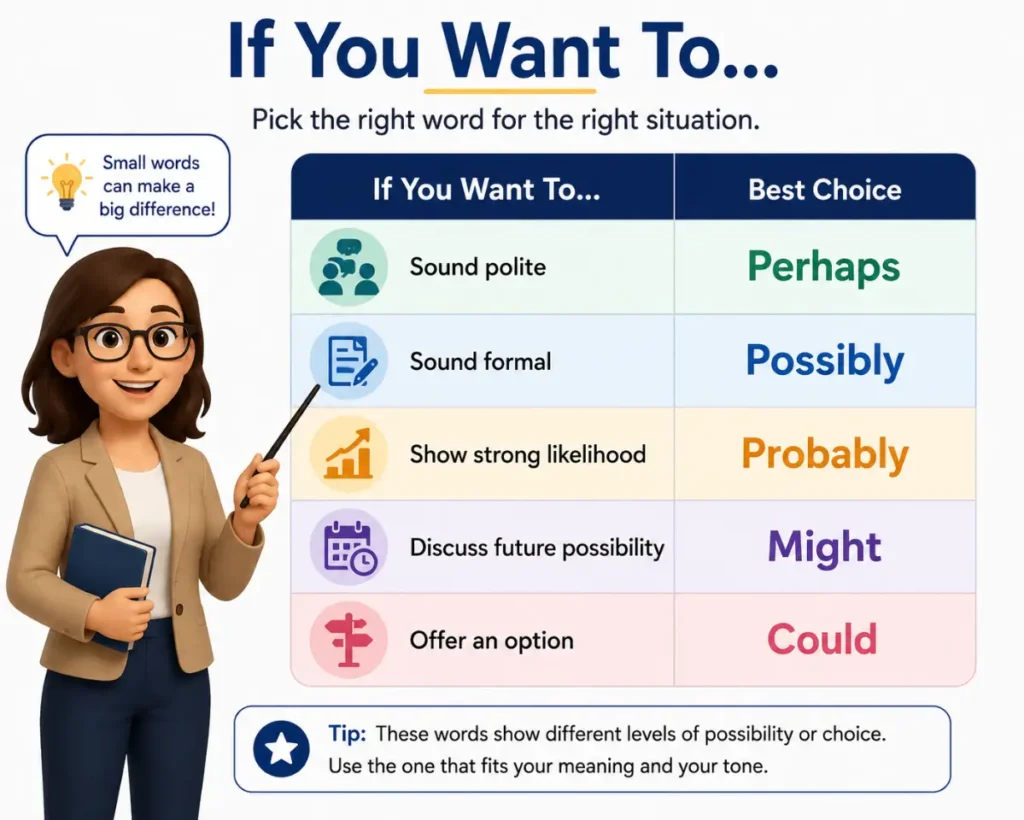
Use this quick reference whenever you’re unsure which word fits best.
| If You Want To… | Best Choice |
|---|---|
| Sound polite | Perhaps |
| Sound formal | Possibly |
| Show strong likelihood | Probably |
| Discuss future possibility | Might |
| Offer an option | Could |
| Sound academic | Potentially |
| Discuss theory | Theoretically |
| Show careful reasoning | Conceivably |
| Speak casually | Maybe |
| Talk with friends | I guess |
| Express uncertainty in conversation | I suppose |
| Ask politely | By any chance |
| Mention a small chance | There’s a chance |
| Sound optimistic | Hopefully* |
Note: Hopefully is not a true synonym for maybe. It expresses hope rather than uncertainty, so use it only when you want to show optimism.
Conclusion
Learning synonyms for maybe gives you more control over your writing. Instead of repeating the same word, you can choose an alternative that matches your message, your audience, and your level of certainty.
For casual conversations, maybe is still a great choice. In professional emails, perhaps or possibly often sound more polished. If you’re fairly confident, probably works better. When discussing ideas or theories, potentially or conceivably may be the better fit.
The more you read and write, the more natural these choices become. Start by replacing maybe only when another word expresses your meaning more accurately. Clear writing isn’t about using difficult vocabulary. It’s about choosing the right word at the right time.
Frequently Asked Questions
What’s another way to say maybe?
Some of the best synonyms for maybe are perhaps, possibly, probably, might, could, and it’s possible. The best choice depends on your tone and how certain you want to sound.
What is the most formal synonym for maybe?
Words like conceivably, potentially, possibly, and theoretically sound more formal than maybe. They are common in academic, technical, and business writing.
Is perhaps more polite than maybe?
Yes. Perhaps usually sounds a little more polite and refined. It works well in professional emails, essays, and respectful conversations.
Can I use probably instead of maybe?
Sometimes. Probably means something is more likely to happen, while maybe simply shows possibility. Don’t replace one with the other unless the meaning stays the same.
Which synonym should I use in an essay?
For most essays, perhaps, possibly, and potentially are excellent choices. They sound professional while keeping your writing easy to understand.
Are there any slang alternatives to maybe?
Yes. In casual conversations, people often say I guess, who knows, we’ll see, sort of, or kind of. These expressions are best for speaking or informal writing, not academic work.
What are the best synonyms for maybe in everyday English?
The most natural synonyms for maybe are perhaps, possibly, might, could, and probably. These words are common in American English and fit many everyday situations.
