
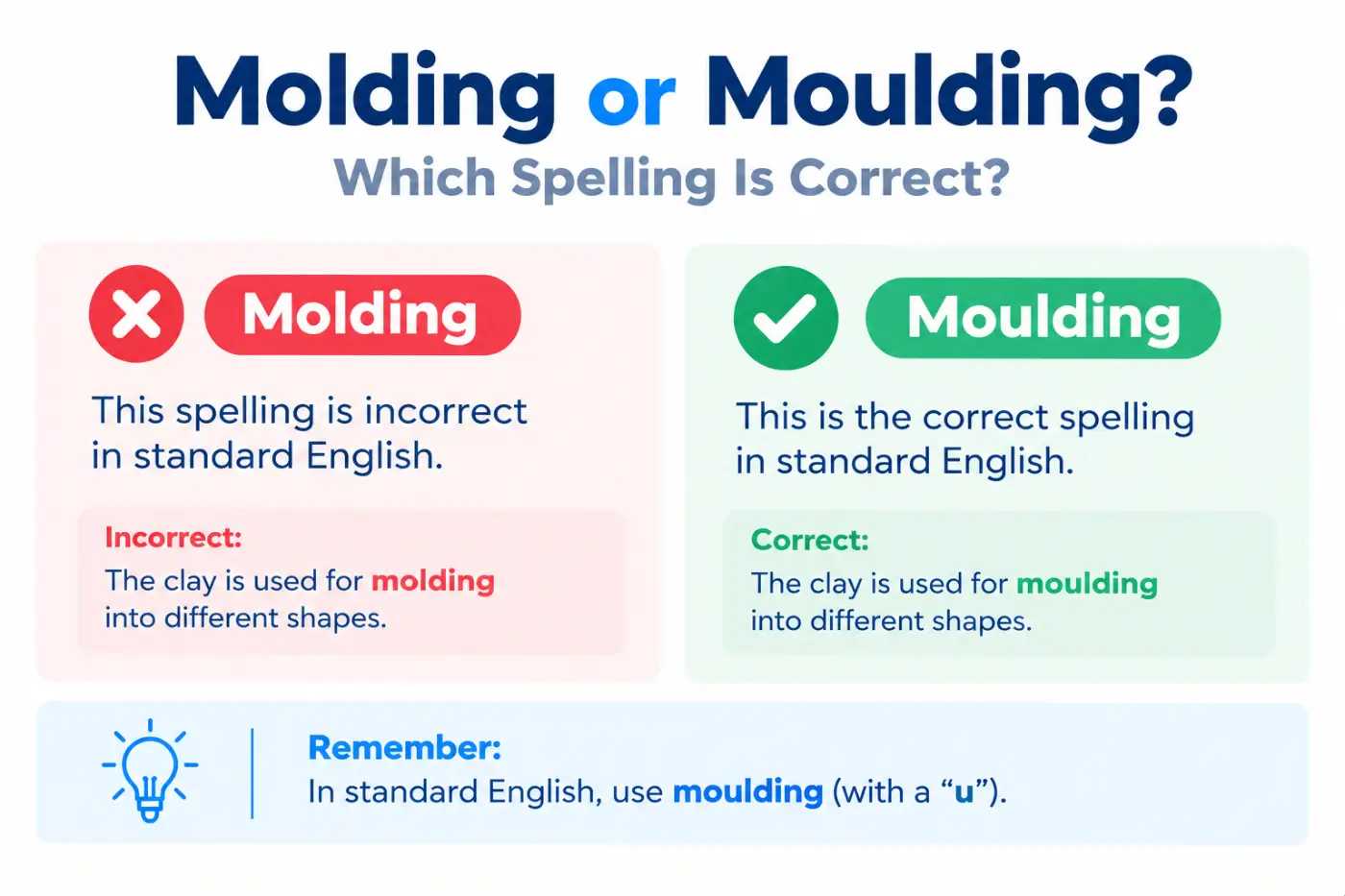
If you’ve seen two different spellings of the same word and wondered which one to use, the answer depends on your audience. Molding is the standard spelling in American English, while moulding is standard in British English and several other varieties of English. Both forms are correct. The difference comes down to regional spelling conventions rather than meaning.
This distinction matters in everyday writing, school assignments, business documents, product descriptions, and technical fields such as construction and manufacturing. Using the spelling that your readers expect helps your writing look polished and consistent.
The word itself has several meanings. It can describe the process of shaping a material, a decorative strip along a wall or ceiling, or a manufacturing technique used to make products from plastic, metal, and other materials. The intended meaning usually becomes clear from the surrounding words.
The easiest rule to remember is simple. Use the American spelling for readers in the United States, and use the British spelling for readers who follow British conventions. Both forms describe the same basic ideas, so you don’t need to learn two separate definitions.
Quick Answer
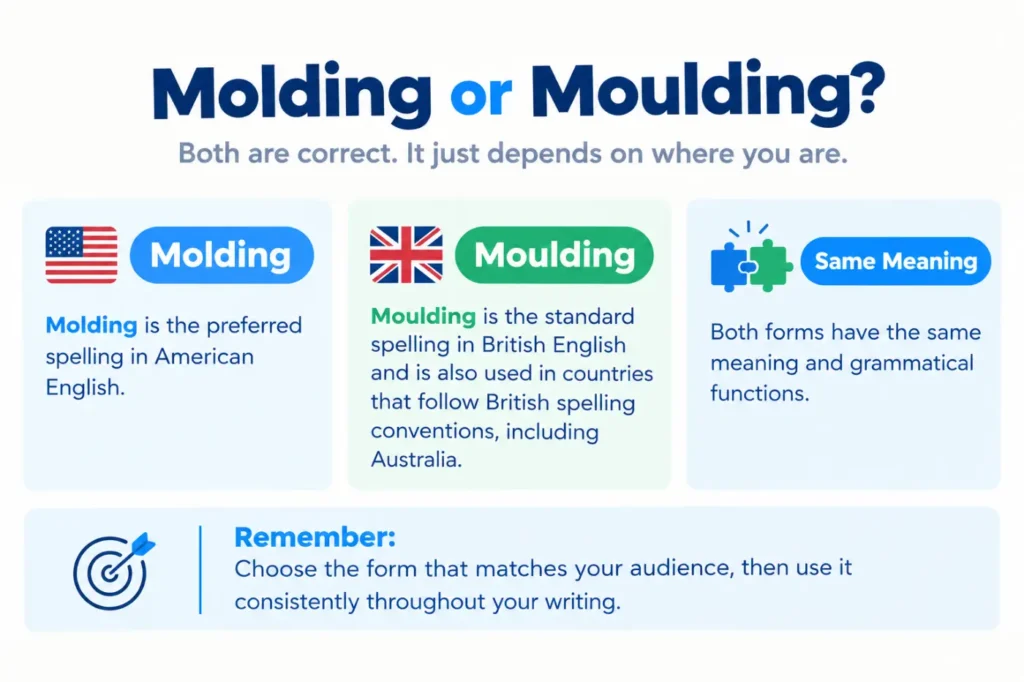
Molding is the preferred spelling in American English. Moulding is the standard spelling in British English and is also used in countries that follow British spelling conventions, including Australia. Both forms have the same meaning and grammatical functions. Choose the form that matches your audience, then use it consistently throughout your writing.
Featured Snippet Definition.
Molding is the American English spelling of a word that describes shaping a material into a specific form or a decorative strip used on walls, ceilings, doors, and furniture. Moulding is the British English spelling of the same word. Both forms are correct, and the choice depends mainly on regional spelling conventions.
Comparison Table for Both Spellings.
| Feature | Molding | Moulding |
|---|---|---|
| Standard spelling | American English | British English |
| Meaning | Shaping a material or decorative trim | Shaping a material or decorative trim |
| Part of speech | Noun and verb form | Noun and verb form |
| Pronunciation | Usually /ˈmoʊldɪŋ/ in the US | Usually /ˈməʊldɪŋ/ in British English |
| Origin | English spelling variant | English spelling variant |
| Formality | Standard and formal | Standard and formal |
| Common contexts | US construction, manufacturing, design | UK construction, manufacturing, design |
| Example | The molding frames the doorway. | The moulding frames the doorway. |
The main difference is the letter u. American English generally drops that letter in words such as color, favor, and mold. British English often keeps it in forms such as colour, favour, and mould.
Meaning and Definition.
The word describes several related ideas. Its meaning depends on the sentence and the subject being discussed.
What Molding Means.
Molding has three common uses in American English.
1. The process of shaping a material. This meaning describes forming a substance into a particular shape. Manufacturers use molding to produce plastic containers, rubber parts, toys, and many other products.
2. Decorative trim. In construction and interior design, the word refers to shaped strips attached to walls, ceilings, doors, windows, or furniture. These pieces can hide gaps, create visual detail, or give a room a finished appearance.
3. The act of influencing development. The word can also describe shaping someone’s character, habits, skills, or ideas. For example, a good teacher plays an important role in molding a student’s confidence.
In each case, the central idea is shaping something. The shape might be physical, as in a plastic part, or more abstract, as in a person’s character.
What Moulding Means.
Moulding carries the same meanings in British English. It can refer to a manufacturing process, decorative architectural trim, or the gradual development of a person’s character or behavior.
For example, a British builder might discuss fitting decorative moulding around a doorway. A manufacturer in the United Kingdom might describe moulding a plastic component. An educator might write about the role of family life in moulding a child’s values.
The spelling changes, but the definition does not. Readers can understand both forms in context, although a publication or company may prefer one spelling to maintain a consistent style.
Is Moulding an Incorrect Word.
No. Moulding is a legitimate English spelling, not a typo or an inherently incorrect form. It is standard in British English and appears in professional writing, technical documents, and everyday communication across regions that use British spelling conventions.
Likewise, molding is not an error in American English. The two forms reflect established regional differences. Calling one universally wrong would overlook how English spelling varies across countries.
Key Differences Explained.
The two forms differ mainly in spelling conventions. Their meaning, grammatical role, and basic pronunciation pattern remain closely related.
Spelling and Regional Preference.
American English generally uses mold and molding. British English generally uses mould and moulding. The same pattern appears in related words, including molded and moulded.
These differences developed as American English adopted spelling preferences that differed from British conventions. Both systems remain standard within their respective regions.
Meaning and Context.
Neither spelling carries a special meaning that the other lacks. A decorative strip called molding in the United States can be called moulding in the United Kingdom. Similarly, the process of shaping molten plastic or another material can use either spelling, depending on the document’s regional style.
The surrounding words provide the meaning. Terms such as wall, ceiling, plastic, injection, and manufacturing often point to a physical or industrial use. Words such as character, values, and education may signal a figurative meaning.
Grammar and Part of Speech.
Both forms can work as nouns and as verb forms.
1. As a noun, the word can describe a physical feature or a manufacturing process. For example, The molding needs a fresh coat of paint.
2. As a verb form, it can describe an action in progress. For example, The factory is molding the plastic into small parts.
3. As a modifier, it can describe a related process or feature. For example, The team uses a molding machine.
The grammatical rules remain the same. Only the regional spelling changes.
Formality and Professional Use.
Both forms suit formal writing when used according to the relevant regional standard. A US engineering report would normally use molding, while a British building specification would usually use moulding.
The same principle applies to academic papers, product catalogs, technical manuals, and business emails. Consistency matters more than treating one spelling as more sophisticated than the other.
Pronunciation.
The word usually has two syllables, with the stress on the first syllable. American speakers generally pronounce the first vowel with the sound heard in go. Many British speakers use a similar vowel sound, although regional accents can affect the exact pronunciation.
The extra letter in the British spelling does not create an extra syllable. Both forms have the same basic sound pattern within their respective accents.
Which Form Is Correct.
Use molding for American English and moulding for British English. Neither spelling is universally more correct. The right choice depends on the spelling standard your audience follows.
American dictionaries generally recognize molding as the standard US form. British dictionaries generally use moulding as the preferred British form. This follows a wider pattern of differences between American and British spelling.
Consider these examples.
1. American English: The contractor installed new molding around the windows.
2. British English: The contractor installed new moulding around the windows.
3. American English: The company specializes in plastic molding.
4. British English: The company specializes in plastic moulding.
Each sentence is correct for its intended variety of English. Problems arise when a document switches between regional standards without a clear reason. For instance, using molding in one section and moulding in another can make a report look inconsistent.
If you write for a US audience, choose the American form from the beginning. If you prepare a document for a British company or publication, follow its spelling conventions. When a client or style guide specifies a preferred form, follow that instruction.
Sentence Examples.
These examples show how the word appears in everyday conversation, professional writing, construction, manufacturing, and figurative language.
Ten Examples Using the American Spelling.
1. We chose white molding to match the new doors and window frames.
2. The carpenter replaced the damaged molding before painting the room.
3. The factory uses plastic molding to produce durable parts for household appliances.
4. My parents taught me values that played a major role in molding my character.
5. The architect added decorative molding to give the living room a more traditional look.
6. Our science teacher explained how molding can turn liquid plastic into useful objects.
7. The contractor included the cost of installing crown molding in the renovation estimate.
8. The company improved its molding process to reduce material waste and produce more consistent parts.
9. Her early experiences helped shape her judgment and were important in molding her approach to leadership.
10. The research paper examines how family, school, and community influence the molding of social attitudes.
Five Examples Using the British Spelling.
1. The homeowner selected wooden moulding for the hallway.
2. The builder repaired the moulding around the front door.
3. The manufacturer uses plastic moulding to make small electronic components.
4. The designer recommended decorative moulding to complement the original features of the house.
5. The teacher discussed the role of education in moulding young people’s attitudes.
These examples show that both spellings work in the same kinds of sentences. The intended audience determines the preferred form.
Common Mistakes and Misspellings.
Most errors happen when writers mix American and British spelling rules or confuse the word’s different meanings. These five mistakes are easy to avoid once you recognize the pattern.
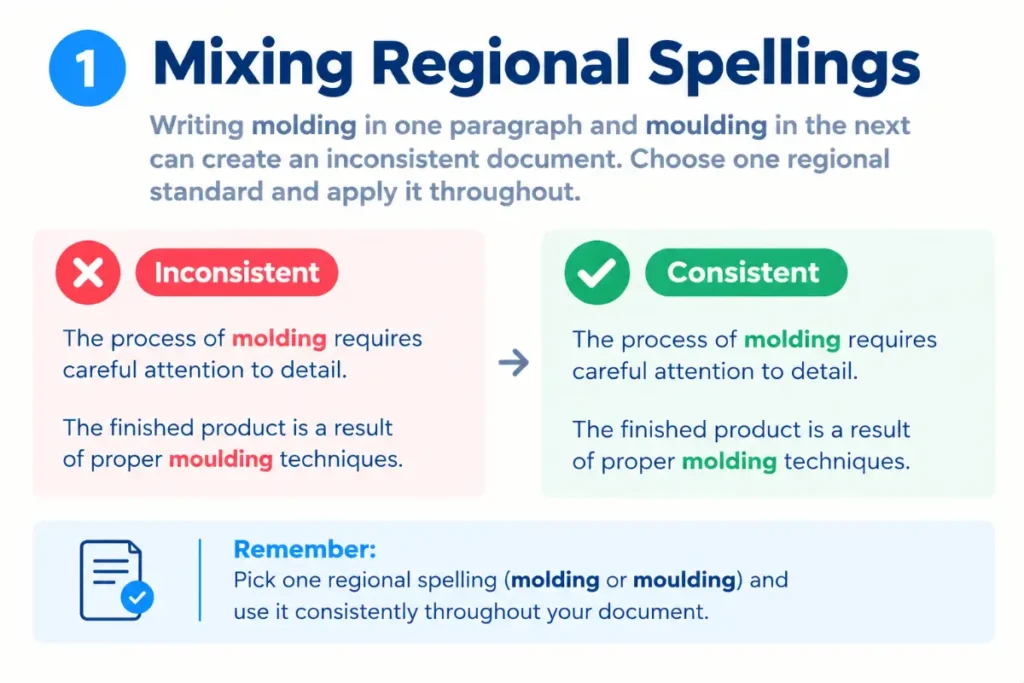
1. Mixing regional spellings. Writing molding in one paragraph and moulding in the next can create an inconsistent document. Choose one regional standard and apply it throughout.
2. Assuming the British form is misspelled. A US spellchecker may flag moulding because its dictionary follows American conventions. That does not make the word incorrect in British English.
3. Assuming the American form is missing a letter. Some writers add a u because they are familiar with British spelling. In US documents, molding is the usual form.
4. Confusing decorative trim with a manufacturing process. The same word can describe both. A sentence about installing trim refers to a building feature, while a sentence about shaping plastic refers to production.
5. Using the wrong related verb form. American English normally uses molded and molding. British English commonly uses moulded and moulding. Mixing these forms can make a technical report or article look poorly edited.
A useful editing habit is to check the whole document rather than correcting individual words in isolation. Consistency across headings, captions, tables, and body text matters just as much as spelling in the main paragraphs.
Pronunciation Guide.
Both spellings have two syllables and usually share the same basic pronunciation within each regional variety of English.
Molding
American English
/ˈmoʊldɪŋ/
Pronunciation guide: MOHL ding.
Moulding
British English
/ˈməʊldɪŋ/
Pronunciation guide: MOHL ding.
Syllables and Stress.
The word breaks into two syllables: mold and ing. Speakers place the main stress on the first syllable, while the ending sounds lighter.
The first vowel differs slightly in how linguists represent it in American and British pronunciation. The International Phonetic Alphabet uses /oʊ/ for the common American vowel and /əʊ/ for the common British vowel. Actual speech varies by accent, so these transcriptions represent typical pronunciations rather than every regional variation.
Common Pronunciation Errors.
1. Adding an extra syllable. The spelling does not require three syllables. Keep the word to two.
2. Stressing the ending. The first syllable carries the main stress. Avoid giving both syllables equal emphasis.
3. Pronouncing the extra letter in the British spelling. The u changes the written form, not the number of syllables. It does not create a separate vowel sound.
Etymology and Word Origin.
The word has a long history connected to shaping and forming materials. Its roots trace back through French to Latin, where modulus referred to a measure or small model. Related forms developed into words used for patterns, shapes, and objects formed from a particular design.
English adopted forms associated with the idea of a mold or model. Over time, the word came to describe both the object used to shape a material and the result of shaping it. It also developed architectural uses for decorative features made in shaped strips.
The spellings mold and mould became established regional variants. American English generally settled on the shorter form, while British English retained the u. The spelling difference became part of a broader pattern that includes color and colour as well as favorite and favourite.
Today, both spellings remain accepted in their respective varieties of English. Their shared history helps explain why they look different but carry the same meanings.
Regional Usage.
English spelling varies across countries, and this word follows a familiar regional pattern.
American English.
In the United States, molding is the standard form. It appears in building plans, home improvement articles, manufacturing documents, product descriptions, and everyday writing.
Common US expressions include crown molding, door molding, plastic molding, and injection molding. American writers generally use related forms such as molded and moldmaker as well.
British English.
In the United Kingdom, moulding is the usual spelling. Builders, designers, manufacturers, and writers use it in the same contexts as Americans use the shorter form.
British documents commonly use expressions such as crown moulding, plastic moulding, and injection moulding. The related forms moulded and mouldmaker follow the same spelling pattern.
Australian English.
Australian English generally follows British spelling conventions, so moulding is the expected form in ordinary writing. Their construction and manufacturing documents may use the term for decorative trim and material forming.
Canadian English.
Canadian English combines features of British and American spelling. In this case, moulding is a common Canadian form, particularly in construction and manufacturing contexts. However, individual companies and technical publications may follow their own style guides.
A Simple Regional Rule.
If you’re writing for readers in the United States, use molding. For readers in the United Kingdom or Australia, moulding is the usual choice. In Canada, check the relevant publication or organization’s preferred style when consistency matters.
Grammar Rules and Part of Speech.
The word follows ordinary English grammar. You don’t need a special rule to use it correctly. The main task is to identify its role in the sentence and follow the appropriate regional spelling.
Using the Word as a Noun.
As a noun, it can refer to decorative trim, a shaping process, or the act of influencing development.
Examples include:
1. The molding around the window needs repair.
2. The company invested in new molding equipment.
3. The molding of a child’s habits often begins at home.
The noun can be singular or plural. For example, one piece of molding refers to a single piece, while several pieces of molding refers to multiple pieces. In construction, the material term is often treated as a mass noun.
Using the Word as a Verb Form.
The word also functions as the present participle of mold or mould. It can appear in continuous verb forms or describe an ongoing process.
1. The factory is molding the parts today.
2. The sculptor is molding the clay by hand.
3. Her experiences are molding her views.
In each example, the word describes an action in progress or a process of change.
Using It Before Another Noun.
The word can also modify another noun. For example, molding machine, molding process, and molding material describe equipment, an operation, and a substance associated with forming shapes.
In British spelling, the corresponding expressions are moulding machine, moulding process, and moulding material. The grammatical relationship stays the same.
Capitalization and Punctuation.
The word is normally lowercase in the middle of a sentence. Capitalize it at the start of a sentence or when it appears in a title that follows a capitalization style requiring it.
The spelling itself does not need quotation marks or special punctuation. Use standard punctuation based on the sentence, not on the regional spelling.
Real Life Usage Examples.
The following examples show how the word fits into different settings. The American form appears first because this article focuses on US readers.
Daily Conversation.
1. Do you think white molding would look better with these cabinets.
2. We need to replace the molding before we finish painting the bedroom.
In casual conversation, people usually rely on context to make the intended meaning clear. A discussion about a renovation points to decorative trim, while a conversation about a factory may refer to production.
Email and Workplace Communication.
1. Please include the cost of the new molding in the revised renovation estimate.
2. Our production team will review the molding process before the next manufacturing run.
These examples show why precise wording matters at work. The same term can refer to a building material or an industrial operation, so nearby details should make the meaning clear.
Academic Writing.
1. The study examines how early experiences contribute to the molding of personal identity.
2. The engineering report compares the performance of two plastic molding techniques.
Academic writing benefits from consistent spelling and clear definitions. A paper prepared for an American institution should generally follow American spelling conventions unless its instructions specify another standard.
News and Journalism.
1. The renovation project includes new molding throughout the historic building.
2. The manufacturer introduced an updated molding process to improve product quality.
News writers should follow their publication’s style guide. Consistency helps readers focus on the story rather than notice small differences in spelling.
Literature and Storytelling.
1. Soft afternoon light caught the white molding above the fireplace.
2. Her years as a teacher played a lasting role in molding the young artist’s confidence.
In descriptive writing, the physical meaning can help readers picture a room, while the figurative meaning can express how experiences shape a person. The context gives the word its emotional or practical force.
Related and Confused Terms.
Several related words help explain how this term works in construction, design, and manufacturing. Understanding the differences makes it easier to choose precise language.
1. Mold. In American English, this can mean a form used to shape material. It can also refer to a type of fungus. The intended meaning depends on context.
2. Mould. This is the British spelling of the shaping form and the usual British spelling for the fungus. American English generally uses mold for both meanings.
3. Molding machine. This is equipment used to form material into a desired shape. Manufacturers may use heat, pressure, or other methods depending on the material and process.
4. Injection molding. This manufacturing method forces material into a mold to create a part. It is common in plastic production and appears frequently in US industrial writing.
5. Crown molding. This decorative trim usually sits where a wall meets a ceiling. It can give a room a traditional, formal, or finished appearance.
6. Trim. This is a broad term for finishing pieces around doors, windows, floors, and other building features. Molding is one type of trim, but not every trim piece has a molded profile.
7. Casting. This process involves pouring or otherwise introducing a liquid or flowable material into a mold and allowing it to solidify. The term is common in metalworking and other manufacturing fields.
8. Extrusion. This process pushes material through a shaped opening to produce a continuous profile. Unlike many molding processes, extrusion commonly creates products such as pipes, tubing, and long strips.
These terms overlap, but they are not interchangeable in every situation. For example, crown molding is a type of decorative trim, while injection molding describes a manufacturing process. Using the specific term helps readers understand exactly what you mean.
Expert Editor Insight.
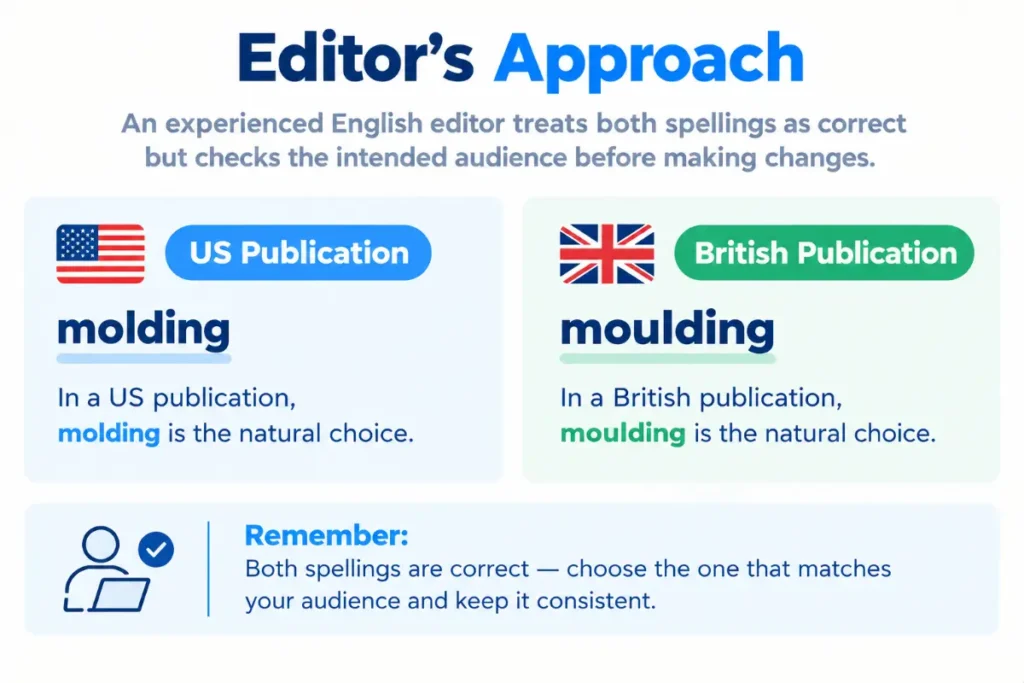
An experienced English editor treats both spellings as correct but checks the intended audience before making changes. In a US publication, molding is the natural choice, while a British publication normally uses moulding. Spellcheckers may flag the less familiar regional form, so editors should check the document’s language settings before accepting a suggested correction. They also look for consistency in related words, including molded and moulded. A quick search for both spellings can catch accidental mixing across the main text, headings, captions, and tables.
Conclusion.
The choice between molding or moulding comes down to regional spelling, not meaning. American English uses molding, while British English generally uses moulding. Both spellings describe shaping materials, decorative trim, and the process of influencing someone’s development. Neither form is universally wrong, and both work in formal and informal writing when they match the intended audience.
For US readers, use molding in school assignments, business documents, construction plans, and everyday communication. Remember this simple editing tip: if you write color rather than colour, you will usually want mold and molding as well. Consistent spelling makes your writing clearer and more professional.
FAQs
Is Moulding a Real Word?
Yes. Moulding is a standard British English spelling used for decorative trim, material shaping, and the process of influencing development. It is not a misspelling simply because American English usually drops the letter u. If you’re writing for a US audience, use molding. For British readers, moulding is generally the expected form.
What Does Molding Mean?
Molding can describe the process of shaping a material into a particular form, a decorative strip attached to walls or ceilings, or the act of influencing a person’s development. In construction, it often refers to trim around doors, windows, and ceilings. In manufacturing, it commonly describes forming plastic or other materials into specific shapes.
Which Is Correct in American English Molding or Moulding?
Molding is the standard spelling in American English. Moulding is the usual British spelling and is also common in Australian English. Both forms carry the same meanings, so the difference is regional rather than grammatical. For US schoolwork, business writing, construction estimates, and technical documents, choose molding and keep the spelling consistent.
How Do You Pronounce Molding and Moulding?
Both forms usually have two syllables, with the stress on the first. A common American pronunciation is represented by the IPA transcription /ˈmoʊldɪŋ/, while a common British pronunciation is /ˈməʊldɪŋ/. The extra u in the British spelling does not add a syllable. Accent differences may affect the exact vowel sound.
Can Molding Start a Sentence?
Yes. The word can begin a sentence when it serves as a noun or a verb form. For example, Molding around the doorway needs repair uses it as a noun. Molding the clay takes patience uses it to describe an action. Capitalize the first letter at the beginning of a sentence as you would with any other word.
What Is Another Word for Molding?
The best alternative depends on the meaning. For decorative features, trim or ornamental trim may work. For manufacturing, forming or shaping may fit, although each can describe a different process. Choose a synonym that preserves the specific meaning of your sentence.
Why Do People Confuse Molding and Moulding?
People confuse the spellings because American and British English follow different conventions for several familiar words. American English generally uses mold, while British English usually uses mould. Spellcheckers can add to the confusion when their language settings do not match the writer’s audience. Learning the regional pattern makes the choice easier.
Is Molding Appropriate for Formal Writing?
Yes. Molding is appropriate in formal American English, including academic papers, technical reports, construction documents, and professional emails. Moulding is equally appropriate in formal British English. The important point is to follow the spelling convention required by the audience or organization. A consistent regional style makes a document look carefully edited and professionally prepared.
